Chronicle: Company of the East Road, on one page

Back to the chronicle “Chronicle: Company of the East Road”

All the adventures of this chronicle, the oldest first. 64 in all

26. Where the Mograws Slept

Night fell upon Galtrev like a velvet shroud, and with it came the final flickers of torchlight along the crooked lanes. Deorla stood alone in the high corner of the old hill-fort, the wind teasing strands of her dark hair as she watched the lights blink out, one by one. The meeting had gone as expected.

Rauthan, ever the eager hound of older powers, had spoken boldly beneath the dark wood beams of the chieftain’s hall.

“The clans are ready. They remember the war—remember you. If you give the word, they will rally.”

But Deorla’s reply had been cold steel wrapped in quiet resolve.

“Not yet,” she told him. “When I have done what I must… when the fire is ready to be stoked—I will call. And you will gather them then.”

He had bowed—not entirely with disappointment, but with recognition. The time was not ripe. And Deorla walked her own path.

By midday she had crested a ridge and spotted what she needed—grazing across a wide and hidden pasture tucked between two low hills were dozens of broad, slow-moving beasts: mograws*1. Thick-coated, curled-horned cattle bred for endurance and meat, raised by Dunlending herdsfolk for generations. Their hooves thudded dully against the earth as they moved, placid and unaware.


Nightfall gave her the cover she needed. She crept into the field like smoke through tall grass. Two mograws fell without sound, her strikes precise and swift. She worked quickly under the moonlight, carving what she could carry, packing it in tight bundles wrapped in hide. The ground swallowed the blood before it could glisten.

By morning, the herd stirred uneasily, unaware they were diminished. Deorla was already gone, slipping into the nearby woods.

There, she spent hours combing brambles and undergrowth for what little the land still offered. Blackberries, blueberries, and even a patch of wild garlic near a dry creek bed found their way into her satchel. She set no fire, left no trail.


On her second day in Galtrev, she woke up rather late. Finally getting some rest she deserved. For half of the day she walked around Galtrev thinking about her past and future, as all people do when they have some time to spare. She also met few habitants and talked to them about little things that did not really matter to her that much, like weather and food.


It was late in the afternoon when she sensed it, a gaze upon her. But different one than usual, not hatred, but curiosity. It was an elf, standing near one of the houses - tall and silver-eyed, clad in soft grey and green, the sigil of a seven-pointed star upon his collar.


“Ascarnil, of the House of Lore,” he said with a slight bow. “I travel with the Dúnedain for a time. We follow the sons of Elrond. They are not far behind.”

Deorla’s gaze narrowed. She said nothing.

“I read it in your eyes,” he added gently. “You are not of them, nor of us. But you are remembered. The past clings to you.”

He glanced skyward, his tone shifting.

“My House gathers what knowledge remains—lost names, buried deeds, truths misremembered. We seek to know the old world before the new forgets it.”

His words were not threatening, but they hung with weight.

Before Deorla could press him further, a distant horn sounded from the west.

“Duty calls,” Ascarnil said with a nod. “Walk with care. These hills watch more than just travelers.”

He was gone in a blink—vanished into the brush, as silently as he’d come.

Yet his words stayed with her. If the sons of Elrond were near, the roads were no longer her own. She would need to move carefully, unseen.


The next morning, grey light poured down from behind a veil of high cloud. Deorla stayed hidden in her tent near few trees that Galtrev had inside the town. She was cleaning her knife and laying out her gathered food. The meat had been salted and wrapped tight, the berries sorted, and the garlic crushed into oil-dipped cloth. 

By nightfall, everything was ready.

The last of the daylight slipped behind the mountains as she strapped her pack, fastened her cloak, and stepped onto the road—silent as shadow and colder than the wind.

The Gap of Rohan waited.

And beyond it, the next piece of her purpose.

*1 - Mograws are the cows near Galtrev - the name for them is self created for story purposes.

27. "Ashes and Oak"

Author’s Note: This piece was shaped with a little help from AI. It provided assistance on things like the structuring, some names, shortening some verbose language/ideas as I'd written, and gave me the odd turn of phrase here and there. The heart and shape of the story are my own, but I realise it is important to be transparent about my use of AI support in producing it ultimately.


"Ashes and Oak"

It was just before dawn when Naridalis passed through the gates of the Company’s kin house in the Bree-homesteads, the hush of the world still unbroken. Mist clung low to the ground, softening the angles of stone and wood, and every step she took sounded too loud for such a quiet hour. The birds had not yet begun their morning chorus. In the pale light, the building stood still… shuttered, resting, untouched by the waking day. No smoke yet from the chimney. No stir from the stables or the various profession worktables...

She paused beside a stack of timber located just beyond the threshold. It was a long generously sized stack of fine, pale oak, neatly bound and sheltered beneath a waxed tarpaulin. Her heart gave a faint pull. She reached out, fingertips brushing the grain. Cool. Scented. Lothlórien oak, fine-grained and flawless. Nothing like it within leagues of Bree that would be sure.

There was an insignia on the bindings, the seal of her house, the emblem of Ceneshar, her father. She exhaled slowly, palm resting on the wood. So he sent it, after all.

But the lumber had sat idle, untouched since arrival. No planks moved, no sawdust scattered, no tools left near. Left waiting, as if the kin house no longer knew how to make use of gifts, or perhaps no longer cared to. That, more than anything, unsettled her.

Inside, the stillness deepened. Furniture had shifted slightly… someone had rearranged the common hall… but the hearth was cold, and there was no trace of laughter, no smell of smoke or cooking. No one stirred. Only a faint draught met her as she moved through. There was a cloak left hanging in the corner, but no boots below it. Someone had been by, but not lately.

She found the notice-board by instinct, half-turning as if drawn by something she couldn’t name. And there it was.

The letter.

Pinned crooked with a dull nail, the paper already curling at the edges. The script was unmistakable: jagged, confident, unforgiving. She read it in silence; her eyes unmoving as the weight of each word settled around her.

Deorla’s words were not written for comfort.

They were fire. A reckoning. Every line dragged the past into the light and left it charred. She said goodbye to no one. She cursed more than she named. She burned what she left. She had chosen her path.

Her eyes narrowed as the words turned from scorched earth to sheer contempt. Each line shed another tie. A deliberate unravelling. A funeral pyre of memory.

Naridalis felt… many things.

Surprise was not one of them.

Anger came first; hot, brief, and sputtering. Then a hollow ache beneath it, the kind left by an old bruise. She had known Deorla could vanish if she ever wanted to, certainly she was highly skilled in such ways…. but this? This felt deliberate. A public show of it… a carpet pulled… a page torn from a book... a tantrum almost.

But then, at the end, the knife twisted differently:

“Thank you Naridalis for making me think deeply…”

Naridalis blinked. Read it again.

The only line in the letter not seemingly sharpened to cause a wound. The only sentence where a name wasn't dragged through hot embers.

Her brow furrowed. ‘Why say that? Why leave that?’

‘What did it mean? A true thanks? A mockery? A slip?’

‘If Deorla had meant to sever everything…. Then why leave even a single thread uncut?’

She didn’t know. And that uncertainty pricked her more deeply than any insult in the letter. For all Deorla's rage and finality, she had left behind a single knot… something almost like recognition. Almost.

Naridalis folded her arms, studying the notice-board, her brow furrowing as other truths surfaced.

Alairif and Guriwen … gone now it seemed, a report of their own banner of kinship having been raised somewhere out in the world. She felt no bitterness in this, only the weight of time's slow turning; she did not like how things had been left… She felt she understood why they chose to leave…. And why they wouldn’t be the only ones to make that same choice either. He had claimed the Company "had failed", that the very enemy in the darkness had been at its core...

So much had changed in her absence.

She paused, and was about to turn away when one last slip of parchment caught her eye… it was the way it was standing out… it seemed a recent addition, firm-penned, and practical:

“Killed a giant, very hungry, spell-casting spider in the marshes. She has a nest in the Misty Mountains (at least we're pretty sure that's where it is). Going to try and find it and destroy it. Warrior or guide (preferably both) very welcome to come along. Leaving in a few days to meet at Forsaken Inn (unless preparations take longer).”

Signed simply: Tivlyn Locksley

Naridalis read it twice.

It was so plain, so earnest…. there was no poetry in it, no venom or vanity. Just danger, purpose, and a call to act. A far cry from Deorla's bitter farewell, scorched in loathing and ash.

Tivlyn’s words carried something else: a trace of what the Company had once been. Not politics. Not power. But protectors on the road…. quiet sentinels against the darkness.

Despite herself, Naridalis felt a flicker of something old and rooted: the call to serve. To keep the roads clear, to carry hope to those who travelled them. Even now, with bonds frayed and names faded… someone…. still remembered.

Perhaps more than one….

She touched the corner of the note, a small nod of silent approval, and turned away with the thought already fixed…. she would speak with Raspberrien. Today, if she could find her.

If Deorla was truly gone…. and gone with such fire, then someone had to be left standing in the ashes. Raspberrien had always seemed to mean well, but meaning well and leading were not the same thing. In truth, Naridalis did not know her all too well.

And Naridalis needed answers.

‘What had happened with the Company while she was away? Who was still left? What was to be done with the Company now… patched, rebuilt, or scattered to the wind? Who else knew about Deorla and did nothing… who else knew about Deorla… and did “something”?’… and what, if anything, was Raspberrien going to do about it all…

She turned from the notice-board, the quiet of the morning already beginning to shift as the light grew stronger.

Later, there would be talk. There would be plans.

But for now, she climbed the stairs with a shadow on her back and the scent of Lorien oak still clinging to her fingers.

28. (Live RP) “The Road We Rebuild”

Author’s Note: This piece was shaped with a little help from AI. It provided assistance on things like the structuring, some names, shortening some verbose language/ideas as I'd written, and gave me the odd turn of phrase here and there. The heart and shape of the story are my own, but I realise it is important to be transparent about my use of AI support in producing it ultimately.


(Live RP) “The Road We Rebuild”

A group of people in a park

AI-generated content may be incorrect.

Reflections after the Gathering
Penned by Naridalis

I arrived at the kin house in the quiet light of evening. It seemed others had returned then also, as there was a gathering of kin in the courtyard. I had scarcely settled Sylva in the stables before I was swept into the heart of a storm: a summons called by Mervedis, who I learned was our rarely seen Company Archivist.

The Archivist, an Elf who looked young comparably, but whose eyes held stories of the world, stood before us all to speak plainly of what many gathered had certainly thought privately:

“What happened while I was away?” she asked. “This place is in ruins.”

It was clear at once that she had returned not just to observe, but to rekindle what had nearly been lost. Her concern was not misplaced. The Company, for all its lingering strength, bore deep wounds: Deorla’s betrayal, the disbanding of trusted bonds, and the uncertainty of what leadership, if any, should follow.

Among the voices gathered were Raspberrien, burdened with exhaustion and lingering suspicion; Tarnon, seasoned and steady, who spoke with the weight of long membership; many others to whom Naridalis held no acquaintance…. and then there were some who took every opportunity to cast blame, stir division, or declare the Company broken beyond repair.

The Elf Celedon, ever the cold critic, spat his venom with poise: “Only Elves have the strength to resist the Shadow,” and “You are only deciding who will hold the Company in their hands when it crumbles to dust.” He laughed at the hope of mortals, yet lingered long enough to show, I think, that even he was not untouched by hope’s ember. As I said to him he was, “still watching, still talking… You haven’t quite let go of hope... or perhaps you still care, in your own way.”

I would be remiss not to speak further of the Dwarf named Narali too, whose presence during the gathering was quieter than most, but no less pointed in its delivery. Their words were not loud, yet they carried an edge sharpened by pain or conviction perhaps. When the talk turned to Deorla; her betrayal, her crimes, her final severing from us, Narali did not seek to soften the blow.

Their tone suggested something deeper than mere frustration. A belief, perhaps, that all in the Company, are culpable. That by silence, by trust, by even failing to see things, we allowed Deorla to rise, to lead, to murder innocents in our name. Though Narali didn’t seem express anything indicating her own responsibility for this in the same regard.. only others…

It is a heavy thought though… And not entirely untrue.

None of us who stood near Deorla can claim to have known nothing. Some knew too little; some knew too much. And most, like myself, stood in the grey between… sensing, questioning, but never quite daring to call it aloud. Hoping we were wrong, or didn’t see the full picture…

Narali’s judgement, whether fair or not, forces reflection. She offered little hope for repair, nor seemed to desire healing. But even their bitterness serves a purpose, if it holds a mirror to what we were too proud, or too afraid, to face.

If Narali sees the Company as permanently stained, I do not share their view. But I will not dismiss it. They remind us that moving forward must never mean forgetting what was done. Not just by Deorla, but by the silence that allowed her shadow to grow.

Let the words of such dissenters weigh, even if they wound.

But this gathering was not about Celedon or Narali. It was, I believe, about finding what remains.

Of the many others present, whose voices were not laced with anger, but of concern, they sought to offer something just as necessary…. hope, spoken plainly, or shown in their presence alone.

I think first of Velkhar, who, despite being unknown to most of us, spoke with honest clarity: “I've no quarrel trusting or working with any of you, so long as you all pull your weight.” It was not said with ceremony, but with expectation, one that binds us more tightly than oaths ever could. I found his directness refreshing, and I said as much: “Trust is earned by action, and now is the time for all of us to pull our weight, together we can rebuild what was lost.”

Meltharian, too, stood out, not by boldness, but by sincerity. She came as an outsider, hesitant, having heard that this was a Company that once tried to do good. Her question… whether she was welcome, whether she should return on another day…. struck me deeply. What could we offer her but honesty? I told her: “You’re welcome. We don’t hide from our problems, as you can see.” Mervedis remarking as well that, “We might need new blood now, especially”.

She stayed. That, to me, was a quiet act of courage.

There were others still…. Erthera, a cartographer as it happens, asked plainly after Deorla’s absence and listened without flinching to the answer. Recommitting her support to move forward. Or Bethrelfin, who stayed seated with her cat, initially queit but attentive, present when she could easily have walked away as others did. She would stand strongly against the division that Celedon would sow, hailing the doom of the Company, asking of him “… how is it doomed exactly? Will you sit back and do nothing and let everything fail?"

At one point, amid Celedon’s bitter claims and the weight of accusation in the air, it was Seleni who reminded us gently of why we had gathered. Not just to settle scores, but to rebuild. She said little more than what was needed, but in her tone was calm, and in her bearing, intent.

Others, Cirvalad, Beorek, Brumgar, Frebbear, all listened more than they spoke, but when they did, it was with the voice of someone who weighs their words carefully, perhaps more than most.

All of these folk, again…. just some I recollect who spoke, were unadorned by rank or legacy…. they stayed. They offered what they had, whether it was patience, questions, or the willingness to listen.

The Company will not be rebuilt by speeches alone. It will be by such people, those who do not need to be asked twice, nor told they matter. And perhaps more than any of us, they are the reason I believe the Company can find its footing again.

When I spoke, I tried to do so as plainly as I could. Not wanting to enter into endless debates on the past, or casting aspersions on those assembled without proof.

I tried to express how I did not believe in recreating the same structures that failed us… no throne, no council with crowns of ash. I offered that instead of a single commander or even a council, that we build something truer to our nature, a decentralised structure, where trusted folk play a role in watching over the stretches of great East Road that they know best. Each one, a Keeper of sorts, guiding action in those places and striving to uphold our shared honour by guiding others, without command.. I proposed we begin a ledger in the kin house, where names could be recorded voluntarily… no appointments, only service. So that none need be chosen in secret or by popularity alone.

Mervedis, to her credit, listened and adapted her own proposals to my prior suggestions… lending my words her support. Where once she, and others demanded new leadership be filled immediately…. by the end, she and others agreed: that we would each take responsibility for the region we travel or serve in. That we would restore our reputation, not through great leaders, but through the actions of each one of us individually along the road; as it always should have been.

I had meant to further propose three simple tenets that we might adopt, shared by all who bear the name of the Company going forward. But I was taken aback by where the discourse was drifting… toward racial lines, Elder rule over the mortal races…

It was this descent into superiority, division, and ego that derailed what I had hoped to offer plainly to all present… a foundational code. The We, the Company of the East Road would renew ourselves:

  1. To protect the Free Peoples from harm; openly or in secret.
  2. To deal fairly in combat or trade, with honour given to those we work to serve.
  3. To cast no shadow through hidden allegiance, betrayal, corruption or unjust deed.

Alas, they went unsaid… the moment passed, overtaken by pride and posturing. That even the suggestion of Elven superiority should even be entertained…. have we learned nothing of the larger history of the breaking of the world?

Still, despite the fraying edges, sense was found.

Tarnon received many votes as a trusted voice among Men (a big part of the Company's membership). Salandril too, though not present, was proposed (by Raspberrien and myself) to watch the Lone-lands, given his trading activity and work in curbing brigands there. These made him an ideal local figure as keeper potentially, should he wish to do so… Others too may rise in time, if given the chance in different places.

But the majority agreed that no final roles should be forced in the moment. A future meeting would seek to assign such things, and in the meantime, those willing can step forward.

Mervedis herself, who began with fierce challenge, saw the shape of what we could become. She said, “I think it will be wise to stick so far to Eriador... let’s regain the trust of people here first.” That was where the meeting resolved.

By my recollection, the majority agreed on this:

  1. The Company will focus first on Eriador, where our name is most frayed.
  2. Those who wish to watch over regions or sections of the East Road may step forward.
  3. A regular gathering time will be set, to share reports and guidance, and solidify roles and responsibilities.
  4. And trust, always trust, must be earned by deed, not title. In this case, re-earned by all to whom association with the Company is intended.

As for the dissenters, their bitterness was sharp, but not without cause. Yet we do not heal by walking backward. And we cannot afford to lose ourselves again to division and pride. They may choose to walk a different path ultimately, away from us, but hopefully we can bring them with us and show them that in hope there is salvation to be found for the Company.

I do not know what will become of this new shape. But I know this: The Company still breathes. It still draws folk in who wish to do good. And for now, that is enough to build upon.

— N
 

29. The Name is a Lie

The sun rose thin and pale above the hills of Dunland as Deorla moved swiftly across the grasslands. Each step brought her closer to the Gap of Rohan, and with it, a turning point in her quiet campaign.


She had declined the offer of Galtrev’s loyalty—for now. Her words to the chieftain had been firm, veiled in smoke and patience: "When the time comes, I will send for you. When I have accomplished what I must." That time had not yet arrived. Not while her blade still moved in the dark.


She walked with care. The land was too open now—too exposed. Though she had the dried mograw meat from her night hunt and berries stowed away, caution kept her alive. The highland air smelled of dry earth and distant rain. Somewhere, a hawk screamed overhead.


Two riders appeared ahead as the path curved by an old stone marker—tall, lean figures on one on an amored horse and the other on a pale grey stag.


Greetings, traveler,” the smiling one called. “You’re heading south?”


She nodded slowly. “Aye.”


They brought their mounts to a soft halt beside her. The one who spoke had the confident charm of someone used to being listened to.

“These roads are quiet,” he said, tone casual. “Safer in company, wouldn’t you say?”


Deorla eyed them warily. There was something familiar—too familiar—in the build of the silent one, the set of her jaw beneath her cowl. And the talkative one… he had a voice like turned silver.


They were too familiar.


But they did not seem to recognize her.


“Names?” she asked.


You can call me Alphthôl and He laughed at his own embellishment. “And my friend here is Fionin"


Curious, she thought. Why  use Sindarin names and pretend to be something you're not?
But she gave her own lie in return, smooth and practiced.“Firebryn,” she said. “I’m on my way to visit a mapmaker I know. Lives near the cliffs before the Gap. Owes me some work before I travel further.”

They accepted it without question. Travel together, then. Just for a while.


It was not until they reached a half-abandoned mining camp that things began to unravel.
As they were talking to one of the Dunlandings in front of a mining camp about where they can found the dwarf, as Deorla/Firebryn did not knew about his current location.

As they spoke the wind and rain stopped, it fact it was starting to get quite warm, a day was coming. The talkative rider pulled off his helm to wipe the sweat from his brow. 


That’s when she saw him.


Her breath caught, but only for an instant.


That face—Alairif
She recognized him now without a shred of doubt.


And the quiet one must be Guriwen.


But they still didn’t know her, or at least she hoped so, but if they did I bet they would react difrently, at this time she was so glad to ditch the old ranger outfit in the lake, and wear hew new traveling bird masked clothing.

But this gave her a reason to think more about the way she looks and the mount she was using, once she gets to her home maybe a haircut she thought.


She forced a calm smile and turned back to the miner. “Seems the dwarf has taken to hiding in a cave near the Gap,” Dunelanding said after Alairif offered him some silver coins. “Hounded by orcs, apparently." he added at the end.


Her companions offered no protest when she suggested helping the dwarf. She watched them closely. They were good—very good. But not careful enough, or perhaps she was the one being fooled. This was something she did not anticipated on her travels, at least not so soon!

Few thoughts had crossed her mind as they were traveling in a rush towards the cave.
"How did they find me?" "Did I left enough clues?" "Perhaps just a coincidence?" 


Rest journey to the cave has been rather quiet, it was a rush to get there, and more thoughts on Deorla’s mind.


"Perhaps the Company I've left behind decided to go after me afterall, but Guri and Ali aren't part of them anymore from what she remembered as she was leaving. So many questions so little answers. But one thing became clear to her, she will need to deal a swift blow for Company of the East Road, apparently leaving was just not good enough. "If they wanna war they will have it."


The cave mouth was half-hidden behind a boulder-slide and old brush. A faint reek drifted from inside—orc filth and rotting leather.


Two sentries loitered near the entrance, blades in hand, armor scratched and dented. Alairif—still wearing that cursed false name—dismounted and struck with practiced grace.


Steel sang.


Two orcs fell.


Inside, the cave stretched into gloom. Old mining shafts split into multiple tunnels, darkness pooling in their mouths like ink.


“We should split up,” Deorla said evenly. “If the dwarf’s alive, we’ll find him faster.”
Alairif agreed and took the left path.
Deorla turned toward the right without hesitation.
Guri remained behind to guard the entrance.
As the shadows closed in around her, her mind grew quiet, focused.
They had no idea who she truly was.
Not yet.


But the game had begun.

Here are the maps to use for any RP purposes of Deorla travels


30. [SATR] "A Light on the Water"

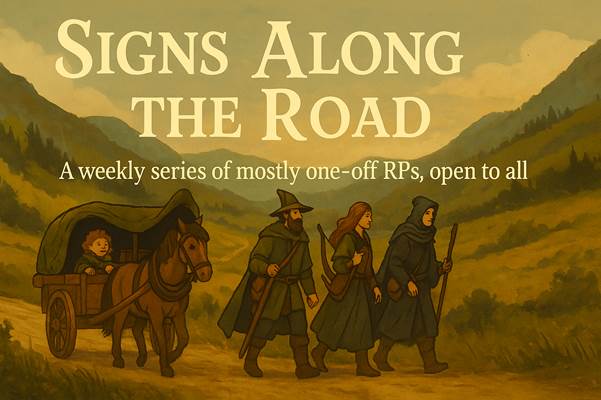
Banner for 'Signs Along the Road' showing a group of people walking with horses on the road.Image Created By AI

OOC - Author's Note:

This entry recounts a live RP session which revolved around the IC introduction of new player characters to the Company of the East Road - open to all. It is part of a chronicle aimed to be weekly called "Signs Along the Road". If you would like to join the Company and use this RP hook to do so, please reach out to Naridalis.

This session was held on 1st June 2025 | The next session was held on 8th June 2025. You can click this link to jump forward to that session's writeup: here.

Additionally: This piece was shaped with a little help from AI. It provided assistance on things like the structuring, some names, shortening some verbose language/ideas as I'd written, and gave me the odd turn of phrase here and there. The heart and shape of the story are my own, but I realise it is important to be transparent about my use of AI support in producing it ultimately.


A boat in front of a castle

AI-generated content may be incorrect.

“A Light on the Water”

Evening settled like a hush over the docks of Mithlond, the low sun casting long silver streaks upon the water. Naridalis stood at the edge of the pier, her cloak stirring in the breeze, watching a solitary vessel drift outward into the bay. The water, grey and solemn, heaved with the rhythm of departing vessels, slow and measured as the heartbeat of Arda itself. The rhythm of the harbour was unhurried, unbothered by time… ships came, ships went, and no one raised their voice. Even the gulls seemed subdued beneath the weight of the hour.

She leaned a hand against a weathered wooden post, the salt-stained grain familiar beneath her fingers. For a long moment, she stood in silence beside the dockmaster, Eglamír. He was always there, as much a part of the harbour as the stone steps or mooring ropes. She glanced to him, her voice low.

“You never tire of it, do you?” she murmured. “The sea. Always watching. Like you’re listening to something the rest of us can’t quite hear.”

He said nothing, but Naridalis imagined he heard her, in some quiet corner of his mind untouched by time. She shared a passing tale; of a hapless Bree-lander she’d helped to the right ship that morning. A small thing, perhaps, but it had mattered. And it reminded her why she’d returned. The East Road was stirring again.

And so was the Company.

From beside the sea, and this end of the road… she would begin anew. Not with ceremony, nor loud proclamation, but with walking, and watching, and offering help where it was needed. That was how reputations were truly rebuilt, not in speech, but in service.

As the sun sank behind the hills and shadow crept up from the water, others arrived.

Sulgalion was the first, an Elf with starlit eyes and a voice that carried memory like music. He spoke with quiet joy, a poet’s turn to his phrases, yet his gaze was far and measuring. He hailed from Ossiriand of old, and though the lands he knew were long vanished, the shore had not abandoned him.

Then came Tayschren, another Elf, though younger, and plainly troubled. His face bore the scars of more than battle, and his eyes the look of one who had watched too many ships vanish westward. One among them, he said, had borne away the last being he had loved. What lingered in him now was sorrow, and behind it, anger, dangerous and unresolved.

Arothas arrived last, quietly, his posture uncertain, his words halting. Wounded by the Enemy in the recent War of the Ring… and told to take ship to Valinor, and yet he hesitated. Middle-Earth, he confessed, called to him still. He did not know why… only that it did.

Naridalis greeted them without ceremony, but with respect. She listened to their words and offered her own, not commands, but invitations. The East Road, she explained, stretched from these grey havens to the wildlands and settlements beyond, and though weathered, it was watched, just as the Dúnedain had once watched it, with quiet conviction by the Company she had given kinship to.

She herself kept vigil, now as she had in days past, but she could not do it alone. The road east, she explained, still bore its ancient purpose. It connected not only places, but people: merchants, wanderers, and those who kept the peace.

As the stars emerged overhead, a strange peace settled among the group. They spoke of grief, of scars both seen and unseen. Tayschren, in particular, unburdened himself, revealing the fury that coiled beneath his sorrow, the rage that sometimes overtook him in battle, the fear that he was becoming the very beast he hunted.

Naridalis listened with quiet gravity, her voice calm but edged with memory.

“My father walks that path,” she said. “He was a good man. But grief turned him bitter, made him cruel. He hardened against the world… until nothing could reach him. Not even me.”

Her words struck softly, but surely. She offered Tayschren a place; not a safe haven, but a road where he might wrestle with those shadows openly, without shame. The East Road did not need perfect heroes. It needed willing hearts. For the Company had known its fair share of darkness of late. It had made mistakes, harboured secrets, lost its way – and terribly so. But this…. this was a new beginning. A chance to do better. To protect, to serve, and to fight back against the lingering shadow.

And through it all, the sea continued its murmurs. Naridalis returned once more to Eglamír’s side. His gaze captured by a Dwarven dockworker beyond…

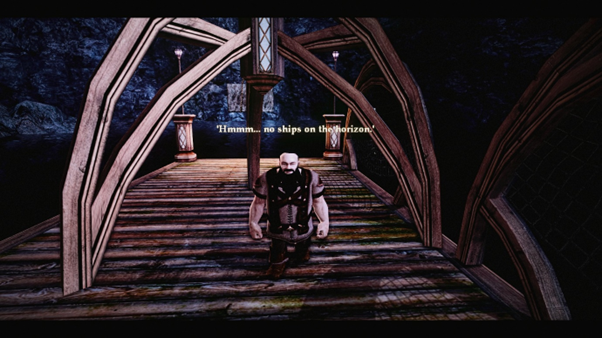
“He says there are no ships on the horizon,” he whispered to her, “but I see them Naridalis. Three sails catching the sun like wings….  He cannot see them anymore. He lost his sight in the war… and his mind is not what it once was. Still, he comes here, listens, watches. Perhaps he sees something deeper…. only memories.”

“Perhaps that is how he sees,” Naridalis said softly. “It is sorrowful to have memories of things you can no longer see.”

They stood in silence for a moment, the sea lapping gently at the pilings, the stars burning clear overhead.

When she turned back, it was with purpose.

“There was a time when the Company lost its way,” she told them all. “But we have returned. Not for glory. Not for gold. But for those who pass unnoticed. For the lost, the hunted, the quietly brave.”

One by one, she offered each a token, a small braid of green and silver cord, inscribed in fine script. They were the markers of the Company of the East Road. No sigils, no banners. Just a promise, worn in thread.

Naridalis had offered them no titles, no ranks, no promises of command. Only a braid of thread…. woven by her own hand, simple enough to pass unnoticed by the casual eye. And yet, it marked a turning she felt…

It was not a ceremony. The Company of the East Road needed no such ceremony.

It was purpose. And trust.

Each token that had passed from her hand to theirs was a quiet pledge, not just to her, or to the name of the Company, but to the road itself, and to the unseen folk who walked it. Travellers and traders, messengers and midwives, hobbits, wanderers, and those with no names left to them. The Free Peoples would not remember oaths made in halls, nor the old glories of forgotten deeds. But they would remember kindness. They would remember being helped. Being protected. Being seen.

That was what the tokens stood for. What SHE wanted them to stand for.

The Company had no command structure, not in the old sense anymore…. No captains, no lieutenants. The Company had tried such things before, ranks and hierarchies, names carved in stone, and those names had been misused….. twisted by ambition, hollowed by secrets, manipulated by shadow and flame.

No more.

Instead, Naridalis wanted the Company to become a network of souls bound by an oath; a shared code. Not bound by power, but by principles:

  1. To guard the Free Peoples, openly or in silence.
  2. To act with honour in word, in trade, and in battle.
  3. To cast no shadow, by deceit, by cruelty, or by betrayal.

She laid out the new oaths plainly. If they would walk with her, she said, they must walk in light… even if their past had been touched by darkness.

It would be a hard path. Not all would walk it well. Some might fail. But those who bore the token would do so by choice, not coercion. And that made all the difference.

Naridalis had chosen the braid deliberately: green for the lands they watched, silver for the stars under which they marched. No crest, no sigil. Just a thread. But a thread could bind things together…. a wound, a story, a fellowship.

It could be passed on. Hidden. Carried across borders and between tongues.

Perhaps in time there would be others like her in the Company…. keepers... of roads in the South or the East, in hills or highlands. Perhaps one day further strangers would be offered the same braid by someone they had never met, and yet still understand its meaning.

It was not a symbol of leadership.

It was a symbol of continuity.

Of shared burden. Shared promise.

The future of the Company would not be written in ledgers, nor mapped in territory. It would live in actions… in water fetched from a roadside well, in warnings passed quietly to a village elder, in blades drawn only when needed, and sheathed when honour allowed. Each bearer of the token would be a thread in a greater tapestry, subtle, interwoven, almost invisible until the light struck it just so.

That was how it had to be. How she would strive for it to be, even if others did not.

Naridalis understood that now. The Company did not need to rise again in the shape it once held. It needed to grow into something smaller… but truer. Something lasting.

Sulgalion did not take the oath, not yet. He would walk with them awhile, he said, and see what the road revealed. But his words carried respect. Tayschren accepted his token with reverence, clutching it like a man anchoring himself. Arothas pledged himself fully, his voice growing stronger for having spoken it aloud.

And in the stillness of that coastal evening, as the first stars glimmered and the road stretched dark and waiting toward the east, she felt the weight of that truth settle upon her… not as a burden, but as a mantle.

Not a captain’s cloak, nor a commander’s chain.

Just thread.

And thread, she knew, could hold fast even when stone crumbled.

Naridalis stepped back, letting her gaze follow the eastward curve of the road where lantern-light met the darkening wood. As the wind stirred her cloak and the scent of pine drifted down from the hills, she spoke quietly to those gathered:

“Ready yourselves. The road is long… and our work begins with the rising sun.”

A group of people in clothing

AI-generated content may be incorrect.


You can find more tales along the road here: "Signs Along the Road"

31. Whispers in the Smoke

The cave yawned wide before her like the mouth of some slumbering beast. Deorla stepped into its gullet with blade in hand and eyes sharp in the dark. The scent of old fire, unwashed bodies, and rotted meat clung thick to the air. This was no mapmaker’s den. It was a nest.

Orcs. And not few.

She moved quickly, soundless as a cat across stone. A narrow side passage gave her cover and from there she watched, waited. The interior was deeper than she'd guessed from outside—clearly once a mining site, now repurposed with crude iron pikes and cloth dividers hung from old support beams. It was half-camp, half-lair.

At the far end, beside a broken anvil, a hunched figure paced: an Agmarin and uruk  of significant size, armor cobbled together from Dunlending and Isengard remnants, a battered helm hanging from one shoulder. His voice barked sharp orders at a pair of lesser orcs, who scrambled to obey.

Deorla crouched, watching, calculating.

She could kill them. She had done it before, and with joy. But this time… there was a greater prize in patience.

She sheathed her dagger and stepped forward.

Not into light. Not into view. But into their path.

She dragged a length of broken chain behind her, letting it scrape just loud enough.

An orc turned, snarling. “Who's there?”

She shifted her tone—thick, Dunlending accent, rasped by smoke.

“A whisper from the East,” she hissed in Westron, low and mocking. “From the fires that fell. I've seen the weakness. Riders growing fat on their victory. The Gap is soft.”

The uruk turned his head, nostrils flaring. “You dare enter here, witch?”

Deorla smiled behind the shadows. She never let them see her face.

“I dare tell you this—ride west at moonrise. Strike the Rohirrim where their horses sleep. And you’ll find no swords ready. The Riders watch the north now… they’ve forgotten the teeth of Isengard.”

That name—Isengard—still held weight among these stragglers, orcs left behind when Saruman fell.

The uruk stepped forward. “And why help us?”

“Because men forget their debts,” she said. “And the fire still burns in me.”

She let a piece of broken white cloth fall from her cloak—it bore a faint sigil, one she’d taken from a slain scout, its origin untraceable. It looked real enough.

They bought the lie.

The uruk grunted, suspicious but eager. Victory was a promise no orc ever questioned too long. Orders were given. Steel scraped. The preparations began.

Deorla slipped back into the dark, unseen and silent.

By the time the first howl rang through the cave—some orc stirring his brethren to violence—she was already moving toward the surface.

Deorla emerged to moonlight and stillness. She expected voices, or perhaps the flicker of campfire embers where the two people had waited.

But there was nothing.

No sound.
No shapes.
No sign of the riders who had shared her path.

Not even hoofprints marked the earth in clear direction.

“They left…” she muttered. “And not in haste.”

She circled the clearing, checking for signs—any trace of their departure—but the ground was too rocky, too scattered with old prints. It was as if they had vanished.

Vanished… or chosen to disappear.

Her hand tensed on the edge of her belt. A subtle pressure built behind her eyes—not panic, but calculation.

Had they recognized her?

Had they followed her into the cave, watched from shadows?

Or had they simply vanished by design, puppets cut from their strings?

Whatever the truth, Deorla was alone again.

She turned south toward the Gap of Rohan, where the orcs would soon spill like a plague across the grass. They would die, of course. That was their purpose.

A distraction… a message.

She walked with a quiet satisfaction.

Let the Rohirrim believe it was an old grudge from Isengard.

Let them ride north in confusion.

Deorla’s blade moved far ahead of her now—and the path beneath her feet had already begun to burn.

32. [SATR] "Tell the Ones who Walk the Road"

Banner for 'Signs Along the Road' showing a group of people walking with horses on the road.Image Created By AI

OOC - Author's Note:

This entry recounts a live RP session which revolved around the IC introduction of new player characters to the Company of the East Road - open to all. It is part of a chronicle aimed to be weekly called "Signs Along the Road". If you would like to join the Company and use this RP hook to do so, please reach out to Naridalis.

This session was held on 8th June 2025 | The next session was held on 15th June 2025 and you can read that here. | A quicklink to the previous session can be found: here. 

Additionally: This piece was shaped with a little help from AI. It provided assistance on things like the structuring, some names, shortening some verbose language/ideas as I'd written, and gave me the odd turn of phrase here and there. The heart and shape of the story are my own, but I realise it is important to be transparent about my use of AI support in producing it ultimately.


A person standing in front of a fire

AI-generated content may be incorrect.

“Tell the Ones Who Walk the Road”

The hill above Nobottle was quiet when I lit the fire, low flames, smoke curling soft into the morning air. I did not expect company. Yet the road is never truly empty.

Caramach was the first to arrive… a hobbit with dust on his boots and a careful way of looking at the world, as though he'd seen too many things and learned to speak lightly of them. He smiled as he approached, called himself "Mac", and settled beside the fire like it was a place he’d known in another life. There is something in him…. a restlessness not born of youth, but of having stayed too long in the wrong places perhaps...

Garibald came next. A river-hobbit, as he made plain, and one with steady hands and a quiet voice. He spoke not to fill the air, but because he had something worth saying. I saw no fear in him, even when the talk turned grim. He reminded me of the water he came from; still on the surface, strong underneath.

Then Heligin arrived. That did surprise me. I had thought him well-anchored in Bree, wrapped in apron and laughter and the scent of warm spice – always cooking with purpose. Yet there he was, walking with us. And though he said little at first, I could feel the weight of his presence. A man who listens with care is often more valuable than one who acts without it.

I welcomed them all, as I would any traveller who comes with clear eyes and an open will. But I did not hide the truth: something was wrong in Nobottle. Livestock vanished. A peddler named ‘Welly’ had gone missing seemingly without a trace. A note, nailed to a chicken coop, speaking of red eyes and watching darkness had been found. The Bounders had dismissed it… gossip, they said. Nothing to trouble over - fae stories, fireside nonsense, the wanderings of a drunkard.

But I have walked through enough half-believed stories to know that truth often wears a cloak of foolishness, until the blood shows.

And there would indeed be blood.

---

We came down from the hill as the morning wore thin, the hush of Nobottle ahead of us like the pause before a word you do not wish to hear spoken. The village was still. Not silent, no place in the Yondershire is ever is truly silent, but still, in that uneasy way one feels before a storm breaks. The bounders moved about in small clusters, chatting idly and looking everywhere except the ground.

Then we saw the cart.

I crouched to study the ground. There was no sign of a struggle. No footprints suggesting a fight or flight. Just the faint indentations where something, or someone, had walked away from the wreck. Away from the village. Away from the cart.

Caramach spoke first, half-hopeful, suggesting Welly may have gone to fetch help. He looked at the scene with the eyes of someone who wants the world to be explainable. I don’t fault him for that. Garibald said little, but I saw his gaze tracking the same lines mine did. He was already thinking ahead.

Heligin noted the cart was intact and asked about the contents. I gave him the answer plainly: simple goods. Honest trade. The sort of wares that could fit a dozen village fairs, none of them remarkable. Enough to make a living, but not enough to be killed for.

Garibald made the point I’d hoped someone would. Bandits don’t leave coin behind. They don’t walk away from plunder, not when they’ve risked steel for it. That, at least, confirmed what I had begun to suspect. This was no theft gone wrong.

I pointed out the tracks then…. subtle, but clear once you knew to look. They led away from the cart, toward the river, into the reeds and beyond. That detail caught their attention. Hobbits are not born for tracking, but they understand the weight of a misplaced step when it leads out of bounds.

Heligin spoke of pubs, of drink, of foolish accidents. I entertained the thoughts, lightly. It is easy to dismiss what one fears with laughter and small comforts. But I had already seen the truth writ beneath the soil, faint as it was.

The cart was not a scene of confusion. It was a door. And Welly had passed through it. Alone.

So we followed. Most of us, Heligin would check the nearby tavern for any signs… though I thought I saw a flicker in his eyes as he mentioned it…

---

A group of people walking in a dark forest

AI-generated content may be incorrect.

The trail from the cart led us eastward, down a slope of tangled grass and soft earth. I walked ahead, slow-footed, eyes searching the places others forget to look. Caramach and Garibald followed close behind. Each were quiet in their own way, as only hobbits could be, though the silence felt heavier the further we went.

The river soon came into view. It ran broad and fast, swollen by spring rains, its voice never quite still; hissing through reeds, lapping at the roots of old trees. It is not the sort of river one crosses lightly, nor one that gives back what it takes.

Near the edge, beneath the bent branches of a leaning willow, we found the blood.

Just a smear at first, rusted red, half dried into the bark of an exposed root… but enough to mark the moment something terrible had passed this way. Not an accident. Not a scraped knee. Someone had bled here, and more than they could spare.

I knelt beside it and asked the others what they made of it. Garibald, ever thoughtful, wondered aloud if Welly had fallen in. Caramach looked grim, he had heard of a waterfall downstream and said, with a kind of practical dread, that if Welly had entered the river here, it might have been the end of him.

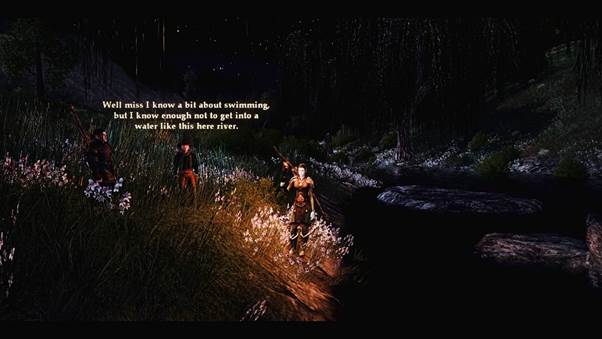
I asked if either of them could swim. Garibald nodded, his river-hobbit blood making that question a light one. Caramach wisely said no, and I thanked him for his caution. It was not said as jest. Wisdom is often knowing what not to do.

Then I told them of the mill.

I had passed through this region once before, years ago. There was an old watermill along the lower bend. I reasoned, if Welly had entered the water, alive or not, the current might have taken him there. And if he had not, we might still find what had followed him.

---


A video game screen of a video game

AI-generated content may be incorrect.


We made our way along the river’s edge, the daylight thinning with each step. I lit a torch as the first stars began to blink into view above the hills. Shadows stretched long across the ground. The wind shifted. None of us spoke much.

Then the mill came into sight. Slouched against the far bank, its great wheel still turning, slow and half-rotted in the current. The timbers leaned as though tired of holding their shape, and moss clung thick around its base.

There were no bridges. Just a line of wide, moss-slicked stones that crossed the river like a broken necklace.

I paused before stepping out. The stones were treacherous, and the river unforgiving. But the trail led on, and so must we.

One by one, we crossed.

Boots slick with river-mud, we reached the mill. I approached the side wall first, where the reeds grew thick and tangled. It was there I found the second trail of blood… darker than the first, and older, but no less troubling. This was not a fresh wound spilt. It was a body dragged.

Inside the mill, I could see through dusty windows, signs of disuse had settled like old breath. The floor did not look disturbed. A trail had been carved through the dirt outside though - a path where something large, or lifeless, had been pulled from one end to the other.

We followed it beyond the back door, where the hill behind seemed to rise into the night sky.

Garibald said he had a bad feeling. I did not disagree.

The grass was broken in places. The earth still soft from spring. We climbed the hill in silence, step by step, toward the end of the trail, and whatever waited at the top.

---

The air atop the hill was still, heavier than it had been by the water, as though the land itself was holding its breath.

We stepped into the tall grass one by one, and even the hobbits said little. Garibald’s gaze was sharp and uneasy. Caramach’s usual cheek was quieted, tucked away behind the furrow of his brow.

At the top, over by the trees in the even longer grass, we found Welly.

Or what was left of him…

He had been dragged through the muck and left there, torn and twisted in a way no natural creature should do. Half-buried in a thicket of broken branches, one arm still clutching the strap of his satchel, though the rest of him... was not whole. What remained of his body had been gnawed, his face turned toward the sky, as though he had died looking up, asking why.

I did not let the others linger on the sight.

I asked, gently, if one of them would check the satchel. My mind preoccupied with scanning the perimeter… where we safe here?

Caramach stepped back, and I did not blame him. It was Garibald who moved forward, kneeling with a kind of solemn care that made me understand why he had come on this road to begin with.

Inside the satchel were a few cracked trinkets, a bundle of cloth, some dried herbs and pipeweed… most of it intact. And at the bottom: a letter.

Water-stained. Curling at the edges. Penned in a shaking hand.

Garibald read it aloud.

It was addressed to Welly.

So we knew at least, that this was indeed him.

But there was something else… a second letter… written by Welly…

… he had... known?

He had seen the red eyes. He had felt the thing that watched him. He wrote of the hedgerows, of the silence, of the hunger that had no shape… only presence. He knew what followed him, and he knew he would not outrun it.

“Tell the ones who walk the road,” he had written.

And so we had come. But too late…

I folded the letters with care and placed it back into the satchel. There was nothing else to recover. Not truly.

We did not find a beast waiting in the grass. No warg leapt at us from the hilltop. But the signs were there. The blood. The trail. The torn flesh and silence. Something had fed here. Something wild, or worse.

But it was gone now, nearest my sense could tell at least…

Caramach was the first to speak, quiet but thoughtful. He had seen such things before, he said, on the road. He spoke not like one frightened, but one deciding. He said he might walk with us, to learn a few things… perhaps offer something in return.

Garibald followed. His words were fewer, but they held more weight. He said our purpose was his own: to help where help was needed. To go where others would not.

I welcomed them both.

There was no need for ceremony. Only the walking forward.

I looked out across the hill and the quiet village below. The bounders would return to their rounds. The folk would close their shutters, and the red eyes would become just another tale told over cider on stormy nights.

But we would remember.

And the Company would remember.

Because if we do not walk these roads… if we do not watch where others will not… then the next Welly will vanish without even a name left in the grass.

And still, the red eyes will watch.

A person standing in the woods

AI-generated content may be incorrect.


[The stories continue in future "Signs Along the Road"]

33. The Gathering of the East Road – Return of Old Pacts

It was on a dusky spring evening, just as the first stars began to blink into the twilight sky above the kin-house, that the Company of the East Road gathered once more. The trees around the hall rustled with a gentle wind, and lanterns flickered in warm tones of gold and amber. Word had gone out from Mervedis—not in haste, but with firm intent. It was time, she said, to speak of what was, and what could be again.

One by one, they arrived: travelers with dust on their boots, scribes clutching ledgers, and a few bright-eyed new faces drawn by tales of the East Road’s return to purpose. Among them was a familiar soul—Ivy, whose smile brought a ripple of warmth to the gathering. There were nods and greetings, hands shaken and memories exchanged, and then Mervedis stepped forward to speak.

She stood beneath the old carved arch of the Hall of Silenced Echoes, its stonework humming softly with lore. Clad in deep violet and sun-gold, with her lore-shield resting by her side, she raised a rolled parchment in hand.

"Much was thought lost in the fire that took the old records," she began, her voice calm but commanding. "But the past is stubborn, and so am I."

With a faint smile, she unrolled the scrolls—ancient contracts, miraculously spared by flame and time.

"These are bonds not just of ink, but of trust. Agreements once made by the Company—forgotten by some, but not undone."

She held up the first:

  • A pact with the Mayor of the Shire, calling upon the Company to assist in matters of safety and aid for hobbit folk, particularly in the outer bounds where Bounders grew thin and rumors thick. In return, the Shire would offer harvest supplies and letters of recommendation for the Company across its borders.

Then came the second:

  • An agreement with the Merchants’ Circle of Bree, proposing a tentative trade route through lesser-traveled paths—safer thanks to the Company’s vigilance. In exchange, coin and trade access would flow more freely, benefitting both the Company and Bree's frontier markets.

Mervedis looked out upon the gathered members, her silver-white hair catching starlight.

"I propose we renew these pacts. Let our purpose be more than memory—let it be movement. The work will not be easy. But there is reward."

And here she laid the final scroll down: a declaration, freshly inked.

"Starting this month, those who contribute to the kin's work—whether by hand, thought, or blade—shall receive a stipend of five gold coins. It is not for wealth’s sake, but for the health of the Company. We must reward effort if we are to endure."

A murmur of approval rippled through the room. There were no grand cheers—this was not a night of triumph, but of steady rekindling.

And so the night passed, not in revelry, but in resolve. The Company of the East Road had faced betrayal, loss, and long silence. But with the return of old pacts, new faces, and earned reward, it began again—step by step—upon the road it once walked.

34. The Silent Siege of the Gap

(This RP is done via DM friend of mine and lots of dices rolls)


Night fell like a wolf’s shadow upon the Gap of Rohan.

The stars were swallowed by storm clouds, and the wind ran cold through the hills. On that narrow pass between the White Mountains and Isengard’s ruined scars, a war born of whispers began.

Deorla stood on a ridge to the north, cloaked in shadow, arms folded. Below her, a tide of ruin marched—the orc force she had poisoned with rumors and fire, now driven mad by the scent of horse-blood and vengeance.

There were 93 orc foot troops, clad in scrap metal and stolen hides, and 51 archers with cruel, hooked arrows clutched in clawed hands. At their head: the war-leader Magzûrz, an uruk from Saruman’s fallen breeding pits, snarling orders with froth on his lips.

Before them: the Gap’s wooden defenses—three towers, a hastily patched wooden gate, and seven barricades, all manned by a brave few.

Only 23 Rohirrim foot soldiers stood ready.
Just 5 archers held the towers.
And between them paced 5 warhounds, tethered but snarling, sensing what was to come.

Deorla watched, silent. She expected more resistance, but afterall the war has ended. \

Phase One — The First Assault

A warhorn shattered the air, blown by a goblin with cracked lips. The orc archers loosed first — a black rain of arrows soaring toward the three towers and gate. They managed to kill 1 soldier and damage the tower little bit.

The Rohirrim replied—horns, arrows, and grit. The tower bows returned fire, dropping orcs in clusters.

But then came the charge, but just before the arrows managed to get 2 orcs.

Orc warriors surged forward with axes, cleavers, and blunt iron maces. They struck the barricades first, crashing against them like a wave.

3 Rohirrim fall defending the barricades.

The warhounds were unleashed. Fast and savage, they leapt over wood and steel, ripping through the first line of orcs.

7 orcs spilled the blood after the swift counterattack of the warhounds, most of the orcs did not have much armour equiped so it was perfect for the warhouds to tear them apart like some small toys.

Deorla turned her gaze south. The sky there began to tremble with hoofbeats.

Phase Two — Gamling the Old Arrives


The distant sound of a war-horn split the night anew—but this one blew from hope, not doom.

From the south rode Gamling the Old—his helm scarred by three wars, his spear still sharp. With him came 50 hardened foot troops and 46 horsemen, the banners of Rohan whipping in the wind.

They broke upon the orc flank like a hammer of thunder. 11 orcs felt swiftly to the horses and they started slowly to turn around, specially with still two barricades standing still.

Deorla was shocked, she did not expect any reiforcments, How? From where? But deep down she knew, she knew it was Alairif and Guriwen work, she cursed in black speech, she should seen this coming! She should know! The battle strated to look grim, as she glanced at the battlefield once again she saw Gamling striking down Magzûrz in single combat, turning the tide.

Phase Three – The Circle of Death

As the battle raged, with flames rising from a collapsed tower and cries echoing over the bloodied earth, Deorla moved.

She descended silently from her ridge. Her armor was already prepared: old Rohirric leather, scorched and dirt-stained, perfect for camouflage. She covered her face in soot. On her breast—a faded emblem of a forgotten rider company.

By the time she reached the scattered remnants of the orc host, only around 40 remained—broken, disoriented, but still armed.

She spoke in Black tongue, her voice low and cutting:

“Circle. Now. Shields tight. Arrows useless.”

The orcs recognized strength. They obeyed.

A brutal, compact formation formed quickly—blades outward, shoulders pressed together, like a living iron shell rolling toward the defenders. And hidden within that beast of violence was Deorla, crouched low, hood drawn.

The Rohirrim couldn’t see her. Couldn’t hear her. Exactly what she was hoping for.

The Final Collapse

As the orc circle rolled forward in desperate cohesion, the Rohirrim pressed harder from the sides. Gamling's infantry drove their spears into gaps. The riders circled behind to cut off retreat.

There was no command. No leadership among the orcs.

Deorla made sure of that.

She gave no orders. No cries of attack or defense. The orcs looked to her—but she gave them silence. She watched with cold purpose as one by one, they were slaughtered. Their last push was valiant, but blind. The circle shrank. Then broke.

Gamling has seen his share of battles and wars. he had won the battle without much of trouble, all orcs have been killed in the collapse. 

In the chaos, one soldier dragged Deorla to safety, mistaking her for a wounded comrade. He yelled something over the din—she nodded weakly, faking exhaustion. Blood from a fallen orc coated her armor convincingly.

As she was getting dragged, Deorla notices Gamling was searching for something, or rather someone. "Yea, they knew it was me who was coming, damm them two humans. She had last card left in her arsenal, altho a heavy toll was payed for it, she left her horse on a hill, with a body on a dead orc painted in black. She was hoping that he would provide enough if distraction to let her escape, and it worked. Gamling himself rode towards the hill.

Within five minutes, she was behind the Rohirrim shield wall.

She had crossed the Gap.

Not as fire. Not as enemy.
But as shadow, and as shadow she managed to sneak away from the battlefield as everyone was distracted and tending the wounds.

35. [SATR] "The Pipeweed Plot"

Banner for 'Signs Along the Road' showing a group of people walking with horses on the road.Image Created By AI

OOC - Author's Note:

This entry recounts a live RP session which revolved around the IC introduction of new player characters to the Company of the East Road - open to all. It is part of a chronicle aimed to be weekly called "Signs Along the Road". If you would like to join the Company and use this RP hook to do so, please reach out to Naridalis.

This session was held on 15th June 2025 | The next session was held on 22nd June 2025, and you can read about that here. | A quicklink to the previous session can be found here: here.

Additionally: This piece was shaped with a little help from AI. It provided assistance on things like the structuring, some names, shortening some verbose language/ideas as I'd written, and gave me the odd turn of phrase here and there. The heart and shape of the story are my own, but I realise it is important to be transparent about my use of AI support in producing it ultimately.


“The Pipeweed Plot”

A group of people standing in front of a building

AI-generated content may be incorrect.

In the warm stillness of a Shire morning, peace clung stubbornly to the cobbled lanes of Michel Delving, but those with keen eyes might have noted a rising tension beneath it. Something was amiss.

Naridalis arrived quietly, responding to a summons from Mayor Will Whitfoot. The message had been brief, hinting at a vanished item and unease ahead of the summer festival. She waited in the square, her expression unreadable, until familiar figures began to arrive.

Mervedis greeted her first, cheerful and warm, though slightly confused. She had come on other Company business, but upon learning of the trouble, she pledged to remain and help. "After all," she said with a smirk, "this will be payback for all the work the Company has been slacking on."

Next came an unfamiliar elf, who introduced himself as Oirano. Polite, poised, he had an ageless air about him. Naridalis regarded him curiously, offering a respectful bow. "You have the bearing of one who has walked long among the stars... elder of our kin, perhaps even from Valinor itself."

Their gathering grew with the arrival of Sulgalion, a familiar ally. He greeted Naridalis warmly and bowed to the others. “Stars have shone upon our meeting indeed!”

Together they approached Mayor Whitfoot, who welcomed them with a heavy sigh. “Welcome all, members and allies of the Company. A treasure’s gone missing,” he said. “A barrel of the finest pipeweed... vanished from Mr. Pindlewick’s cellar. The festival’s near, and folk will be crushed without it. We must find the pipeweek, or at least the culprit.”

Mr. Pindlewick stood nearby, fidgeting nervously. “Aye, there were odd noises that night,” he added, “shuffling, whispers... I dared not investigate. A few neighbours mentioned a cloaked figure lurking near the cellar door.”

The Company asked for details. Mervedis inquired about the type of pipeweed, it was Longbottom Leaf. Oirano pressed for specifics: the location of the cellar, who had access. Mr. Pindlewick explained that only he, his apprentice beside him, and a ‘Merriweather’ the delivery hobbit had keys. There was no sign of forced entry. “If I were to guess,” he said, “I’d start with the overgrown garden next door... it’s rarely tended and has a few old sheds.”

A hobbit passerby, Littleblades, stopped briefly to greet the Company. Though he hadn’t seen anything himself, he noted that he’d passed some pipeweed farms on the road to Hobbiton. He wished them luck and departed.

Oirano asked whether Mr. Pindlewick still had his key. The hobbit grew visibly uncomfortable. “That is rather a personal question, isn’t it? I assure you, my keys are safe and sound.”

Sulgalion suggested a dog might track the scent. Naridalis agreed that a keen nose might help, but no such hound was presently with them.

Naridalis concluded the interview. “Some of us shall begin with the overgrown garden and the sheds, and may speak with Old Merrow and the miller’s boys as you also said… perhaps even track down this Merriweather fellow wherever he may be.”

The party dispersed toward their chosen tasks, the Mayor’s concerns echoing behind them, along with a steady refrain from a passing hobbit about an upstart in Hobbiton gathering quiet support.

The party gathered briefly outside of Pindlewick’s shop, forming a quick plan. Naridalis and Oirano would take to the cellar, inspecting it firsthand, while Mervedis and Sulgalion crossed into the neighbouring garden plot to investigate the overgrown sheds.

Seeing that the shop appeared locked up, as Pindlewick had said, Naridalis and Oirano opted to examine the cellar where the theft had occurred. Around the side of the shop, a small, wooden, cellar hatch could be found, tucked beside a crooked barrel rack. Sulgalion was first to note a lock on it, but as it turned out, it was not closed. The hinges creaked as it opened and the two descended.

In the cellar’s gloom, the air smelled of damp wood and tobacco. Naridalis uncovered a scrap of dark cloth on a nail, and later, a faintly scented parchment hidden beneath the stairs, its words nearly lost to time. Oirano found little else, though both noted the disturbed dust and tracks where barrels had once stood.

Above, the garden yielded more. A shed, long forgotten, bore marks of recent passage. A helpful cat led Mervedis to a bundled stash, dried leaves and old parchment. Within it, Sulgalion pieced together a faded label reading “Longbottom Leaf.” The scent would match that of the cellar. The trail was clear now: the stolen goods had been hidden here. Drag marks in the soil where also spotted by the elves, leading away from the shed and towards the neighbour’s house.

Regrouping outside the garden’s edge, the party pieced their findings together. Naridalis held up the parchment she had retrieved. “This was hidden beneath the cellar stairs,” she explained. “Smudged... but clearly once marked as a label. The scent matches.” Mervedis presented the bundle from the shed, confirming that it too bore the same sharp, smoky aroma. “This is the same leaf,” she said. “The one taken.”

Naridalis nodded, her eyes narrowing. “Then it was moved here. Deliberately hidden, not merely lost.”

A group of people walking in a yard

AI-generated content may be incorrect.


They followed the path to the adjacent cottage, where the neighbour, a Mr. Merrimac Fairbairn, resided. Naridalis knocked firmly on the door, flanked by her companions. After a pause, a hobbit with wary eyes and weathered hands answered. “I’ve heard you lot talking,” he said cautiously. “What business have you with me?”

“We seek the truth of the matter,” said Naridalis calmly. “About the pipeweed, and the trail that leads to your shed.”

Mervedis offered a parcel of lembas with a friendly smile. “A gesture of peace,” she said. “We mean no harm.” Merrimac eyed the bread warily, then accepted. “Well… I suppose you may as well hear what I’ve got to say.”

At first, he was defensive. “Aye, the shed’s mine. But I haven’t touched it in years. Too overgrown to bother.”

But Naridalis pressed gently. “The cloth found in the cellar matches your sleeve. And the scent of pipeweed clings to you still.”

Cornered, Merrimac wavered. Then, with a sigh, he spoke. “I… I admit it. The pipeweed was taken. But it wasn’t for greed. It was Merriweather… he’s more than my cousin. He’s the upstart folk whisper of in Hobbiton. Said we could change things. Said the Mayor’s time was past.”

Oirano and Sulgalion questioned him further, but Merrimac faltered. “It was meant as a statement,” he said, lowering his voice. “To disrupt the festival, cast doubt on Mayor Whitfoot, stir the folk to ask questions. But now… I see what it’s done. The worry. The mistrust.”

Naridalis studied him carefully. “Change may be needed, Merrimac. But not through theft. Not through shadows and fear.”

He nodded slowly. “Aye. You’re right. Take what’s left. Return it. I’ll speak with the Mayor, face whatever comes.”

The Company stood together in the soft light of evening, the mystery unravelled, but its meaning less simple. The Shire, so long a haven of comfort, was no longer untouched by unrest. Beneath its green hills, new tensions stirred.

The pipeweed had been found. But the road ahead was less certain.

And so they turned from Michel Delving, the mystery laid to rest… but the journey not yet ended.


[The stories continue in future "Signs Along the Road"]

36. [SATR] "The Brandywine Blockade" [Part 1/3]

Banner for 'Signs Along the Road' showing a group of people walking with horses on the road.Image Created By AI

OOC - Author's Note:

This entry recounts a live RP session which revolved around the IC introduction of new player characters to the Company of the East Road - open to all. It is part of a chronicle aimed to be weekly called "Signs Along the Road". If you would like to join the Company and use this RP hook to do so, please reach out to Naridalis.

This session was held on 22nd June 2025 | The next session was held on the 29th June 2025, which you can find here. | A quicklink to the previous session is here.

Additionally: This piece was shaped with a little help from AI. It provided assistance on things like the structuring, some names, shortening some verbose language/ideas as I'd written, and gave me the odd turn of phrase here and there. The heart and shape of the story are my own, but I realise it is important to be transparent about my use of AI support in producing it ultimately.


A group of people in a park

AI-generated content may be incorrect.

A Letter to the Company of the East Road, Bree Homesteads

Subject: Request for Archival Entry — Incident at the Brandywine Bridge

Mervedis,

I hope this letter finds you well. I write so that what follows may be entered into the Company’s record. Please see it preserved under the affairs of the East Road, appended to the present season.

What occurred this morning may seem, at a glance, the work of common brigands. But the manner of it, and its ending, speak of deeper roots.

At dawn I arrived in Stock, in the Shire where word of a blockade at the Brandywine Bridge had spread swiftly. I was met by a capable party: Garibald, Oirano, Bethrelfin, and a newcomer hobbit, Bratikus, whose candid demeanour belied her bravery. The Company’s banner flew quietly with us as we marched north.

The blockade was no rumour. We found the bridge sealed by debris, crates, and felled timbers. Bounders held the western approach, weary and undermanned. Captain Eadric confirmed the bridge was taken by Rogan “Ironhand” Brand, a known outlaw, and his gang of cutthroats. They demanded coin from travellers under threat of steel.

Our first course was diplomacy. We approached under truce. Garibald spoke with strength and clarity. His words nearly won the day, Ironhand wavered, clearly unsettled, but the brigand’s courage failed him in the wrong direction, and he ordered the attack.

I gave warning. My arrows found their mark, and when Ironhand charged, I met him directly. He cut my bow arm, a shallow mark, but I turned him with steel to the thigh. Beside me, Oirano held the line with disciplined spearwork, and Bethrelfin’s bow struck true more than once. Bratikus, though flustered, rallied behind Garibald and showed no small courage.

It was Garibald, however, who shifted the battle’s rhythm. While the rest held position, he slipped through the chaos with purpose. He tripped two brigands cleanly off their feet, and sent one tumbling over the edge and into the river. Later, seeing Bethrelfin under pressure, he struck her attacker with a brutal blow to the back of the head, felling him outright. His actions were not only valiant, but precise.

And then came the unexpected: Dumpling, Bethrelfin’s calico cat, had infiltrated the enemy’s camp. At her mistress’s whistle, she burst from the crates and felled barrels, scattering the enemy further with hisses and claws. One brigand lost footing entirely, another dropped his sword. What chaos she sowed, we reaped. I would scant have believed it, had I not seen it myself, though Beth tells me it is not the first time such tactics have been successfully employed by her and Dumpling.

Captain Eadric’s Bounders charged atop their ponies soon after. Their lances broke the remaining line. Ironhand was taken alive. His men surrendered or fled.

In the quiet after battle, I questioned the brigand leader. His confession was soft and shaken: the blockade was a ruse. Its purpose was to hold attention here, while smugglers moved goods through Bucklebury Ferry to the south. He claimed the goods were harmless. I doubt that.

The Brandywine is clear now. The crossing is safe. But the ferry bears watching. I will see to it personally, though may be joined again by the companions I felt glad to have at my side this day.

Please ensure this account is set to parchment in the archive.

Further, I hope my letter finds you well.

— Naridalis

A red wax seal with a dragon design


A group of people standing on a stone surface

AI-generated content may be incorrect.


[Meanwhile in Michel Delving]

Diary of Mayor Will Whitfoot—

It ain’t every day a Mayor’s handed a letter from the Bridge-Watch with ink still damp and urgency written all over it. Seems there's been a bother on the Brandywine, though I suppose that’s putting it a bit lightly.

A band of ruffians, Men, no less, not the usual mischief-makers from around Frogmorton or Tookbank.... set up a blockade on the bridge itself they did. Bold as brass, they were, shaking down honest hobbits for coin and goods, or turning them away outright. And right at our eastern border, too. Such cheek. I’d wager not even Lotho would have had the gall, and that’s saying something.

But here’s the part that brought me to blinking. The report says the whole lot was scattered, the road made safe again, not by any muster of Shirriffs but by Outsiders... that same band calling themselves the Company of the East Road. Not just sword-swingers, mind, but scouts and wardens, elves and big folk, even one of those peculiar hobbit-lasses with more attitude than sense. Captain Eadric's called them “strange companions,” but his tone bore a respectful note. Said they moved fast, struck hard, and left no trail of wreckage save what the ruffians brought on themselves.

Now, I’ve heard mutters about the shire-inns... folk wondering if it’s right, trusting protection of our bounds to folk from Bree and beyond. But I’ll say this plainly: when trouble came knocking, they answered. And if the roads are safe today for market wagons and mushroom carts, it's on account of their blades and their daring.

Still, I’ll be keeping an eye on them. Help is help, but even well-meaning folk from outside don’t always understand how things are done in the Shire. Best to send a word of thanks... and a polite reminder that we mind our own, mostly. Though perhaps, in these times, the road don’t end at our fences anymore.

—WW


You can find more tales along the road here: "Signs Along the Road"

37. House of Shadow

The road stretched endlessly before her, beaten and dry beneath the early summer sun. Deorla walked—her boots scuffed, legs sore, cloak tight around her frame. She had no horse anymore.

But she was used to walking.

The land itself seemed at peace now. She saw no riders, no merchants, no enemy scouts. Even the wind was calm. Fields rolled on her left and right, broken only by distant fences or rotted wagon wheels half-swallowed by tall grass. For the first time in weeks, there was no urgency behind her steps.

When she finally came upon the ruins of Marton, she paused—not from weariness, but memory. Once a small settlement with stone paths and market wagons, now it was hollowed by flame and time. The war had gutted it. Roofs lay sunken; its well was choked with weeds. Black streaks trailed from shattered windows.

Deorla passed silently, as though unwilling to disturb the ghosts.

Later that afternoon, after climbing a long ridge, she looked out and saw it: Edoras, golden in the fading light, nestled on its hill like a crown on the land’s brow.

But she did not head toward it.

Instead, she turned eastward to a graveled trail, where earth rose in a sacred rhythm. Two lines of barrows flanked the ancient road—kings of Rohan, buried in honor, their mounds overgrown with flowers and grass. Great stones stood like silent sentries.

The first row held the founders: Eorl the Young, Brego, Helm Hammerhand—legends etched in moss-stained runes.

The second row was fresher, cleaner, with trimmed grass and offerings: Fréaláf, Thengel, Théoden—the king who rode to Gondor and never returned.

Deorla knelt briefly between the two lines.

She did not bow. She did not weep for them as they were her enemies. Still she respected them, they were few of the true heros of Middle-Earth she found worthy of being in her book of respects.

She looked to Théoden’s barrow - her left eye started to burn a bit, as it was Theoden who left the scar on her left eye that day on the fields of battle, but she did not hold a grudge , she stood a moment in silence and whispered,

“The world changes. Even for kings.”

Then she stood and walked on.

By nightfall, the white peaks of the Ered Nimrais loomed like sleeping beasts in the east. Nestled against their foot was near Aldburg in deep forest and well hidden her destination: a semi-large wooden house, with a small shed nearby, half-covered in ivy and shadowed by birch trees. She looked around and it seems all the decoration and things she managed to steal and gather during her service for Sauron was still being well mentained. 

As Deorla approached, the door creaked open—not by her hand.

“You took your time,” said a familiar voice, wry and warm.

There stood Firebryn, cloaked in a weathered shawl, red hair turned mostly gray but still wild. Once a smuggler from Dale who moved arms and food beneath the eyes of captains during the war, now she walked with a limp and leaned slightly on the doorframe.

“I thought you’d be bones in a ditch by now,” she added, stepping aside.

Deorla smirked faintly. “I almost was. Twice.”

Inside, the house was clean, though plain—just as Deorla remembered. The hearth was lit, and bundles of dried herbs hung from the ceiling. A travel pack lay folded on a wooden chair, right where she’d left it.

Deorla set her satchel down, eyes softening for a moment. “You kept it all...”

“Well,” Firebryn shrugged, “you pay me in gold and silence. That’s rare enough these days. Besides—some of us are too old to keep running. This is a fine place to age in peace.”

They sat together as night deepened, no need for more words.

Deorla was safe—for now.

But war never stayed far from her shadow.

38. [SATR] "The Ferry and the Fog" [Part 2/3]

Banner for 'Signs Along the Road' showing a group of people walking with horses on the road.Image created by AI

OOC - Author's Note:

This entry recounts a live RP session which revolved around the IC introduction of new player characters to the Company of the East Road - open to all. It is part of a chronicle aimed to be weekly called "Signs Along the Road". If you would like to join the Company and use this RP hook to do so, please reach out to Naridalis.

This session was held on 29th June 2025 | The next session was held on 6th July 2025, which can find here. | A quicklink to the previous session can be found: here.

Additionally: This piece was shaped with a little help from AI. It provided assistance on things like the structuring, some names, shortening some verbose language/ideas as I'd written, and gave me the odd turn of phrase here and there. The heart and shape of the story are my own, but I realise it is important to be transparent about my use of AI support in producing it ultimately.


“The Ferry and the Fog”

Night gathered over the Brandywine, the moon high and full. The mist rolled low across the banks, veiling the stones in silver and soft dew. Lantern-light clung to Naridalis’ side, casting a narrow halo as she stood at the bridge’s midpoint, still and watchful, her breath shallow from the ache that hadn’t yet left her ribs.

The battle here had passed quickly, but its echoes lingered. The makeshift barricade; planks lashed with rope, crates stacked high like theatre props, hadn’t been designed to hold. It had been built to scare, to ward off, to delay and to send a message.

‘It was theatre,’ she thought, eyes narrowing at the memory of Ironhand being dragged to his knees, blood in his mouth, eyes full of fire even in defeat. ‘And Ironhand played the lead.’

He hadn’t begged or bargained. He had confessed with a kind of twisted pride.

‘The bridge don’t matter. The ferry does. This? Just a distraction.’

A distraction! Meant to draw eyes and swords away from the true purpose. But if Ironhand’s crew weren’t robbers, and the bridge was never the goal, then what was?

What lay at the ferry that needed such a distraction to conceal it?

Was it simply smuggling? Then why the force, why the numbers, why the risk of bloodshed in peaceful lands? She had to admit, the barricade did draw the attention of the bounders on both sides of the river.

The fellowship gathered once more: Bethrelfin, Garibald, Bratikus, and the newly arrived Sulgalion joined them. Oirano had gone on to Bree to see if he might raise the Bree-Watch for their aid.

And so they turned south, toward Buckland, toward answers they didn’t yet know.

A group of people walking in a dark alley

AI-generated content may be incorrect.

As they neared Buckland a huge hedge rose before them under moonlight, much taller than a man’s reach and tangled with bramble and memory. It was known as the High Hay, an ancient thing, that had stood for generations, a living wall between hobbit peace and the wilds beyond. But tonight, the wild had seeped inward, quiet and slow.

A bounder stirred from slumber at the gate; Agloo was his name. He was sleepy-eyed and suspicious at first. It was Beth who stepped forward, her voice low and honest. She didn’t plead. She simply told the truth. A fight at the bridge. A lead pointing south. A duty to protect, not pry.

Agloo blinked and recognised her. The one from Haygate. The garden. The tall fellow.

‘Even here,’ Naridalis thought, ‘the Shire’s defence lies not in weapons, but in memory. In neighbours. In trust.’

The gate creaked open.

What greeted them inside was not warmth or laughter, but silence.

Newbury slept uneasily. Doors were latched. Windows shuttered. No lanterns danced in the windows. No music or idle talk between neighbours, as there usually was, even so late...

It felt as though the village itself was holding its breath.

She wondered if they had seen something, heard something… whether the smugglers had passed through here already? Or were the folk of Buckland wiser than they’re often given credit for… that they knew to steer clear of trouble.

No answer came of course. Only the hush of leaves as they walked along the lane way.

---

They moved like shadows through the narrowing lanes. Moonlight filtered between old beech limbs. The moss beneath their feet softened every step, as they took the lane that would lead them down toward the water.

And as they neared the bend that led toward the Bucklebury Ferry, Beth slowed to a halt. Her eyes narrowed, head tilting. “Wait…”

They all paused. Naridalis’ hand brushing the hilt at her side. Her balance still wasn’t right, not since Ironhand struck her at the bridge. She hadn’t said much. Pain was best ignored, until it couldn’t be.

But tonight, she knew better than to doubt her companions.

“What do you hear?”

Beth whispered of voices, faint and gruff. Sounds carried not by their volume, but by their rhythm…. like orders being barked in succession.

Sulgalion soon confirmed it. A murmur at first, then louder. Men at work. The smugglers, no doubt.

The party slid into the underbrush, veering off the path toward the river’s edge.

There, in the flicker of distant lamplight, they saw the ferry landing, quiet no longer.

Men moved crates atop one another. Others hauled at the ferry ropes; drawing it towards them from across the river. In the distance, they could just about make out the ferry itself. There seemed to be more shadows being carried by it.

‘So here it is,’ Naridalis thought. ‘The heart of it.’

‘But what are they moving? And why under cover of night?’

Ironhand had claimed the cargo was harmless, goods meant for those in need.

But men who help others do not set traps at bridges. They do not raise arms and leave villages silent behind them.

‘If this was charity,’ she thought grimly, ‘they would not need this much steel.’ She noted this after a quick count of the men; five armed with swords, three of whom had crossbows; ‘Likely the Brigands’ she thought. She counted another five who didn’t seem so armed, possibly the smugglers; but she couldn’t be certain. There could be more in wait just out of their sight.

They could not charge blind. Not with this fog. Not with the way the dock sat low by the water, flanked by crates and cover.

Beth glanced back, her tone quiet and measured. “Let me send Dumpling,” she said, tapping her satchel once. A small rustle answered. A shape darted from her shoulder and disappeared into the underbrush: a flash of fur and instinct, low to the ground and silent as moonlight on water.

A group of people in a field

AI-generated content may be incorrect.

Dumpling, her faithful cat, vanished into the reeds with remarkable speed.

They waited.

Moments passed. The voices below continued, unaware.

Then: a twitch in the undergrowth. Dumpling returned in a blur, bounding up Beth’s boot, leg and back into her carer’s satchel.

Beth frowned, murmuring, “Too many.”

Gari grimaced. Brat’s jaw tightened.

“So we are outnumbered,” Naridalis said. “But perhaps not outmatched.”

Naridalis pressed a hand to her side, where the ache still throbbed beneath the ribs. She had no strength for another pitched skirmish. But neither could they ignore what Dumpling had confirmed.

“We’ve no luxury for retreat. If they succeed in bringing across that ferry, we lose more than just answers.”

Between them they discussed possible ideas, options, tactics… “We lay snares. Ambush them on the slope. Let the first fall hard.”… came the deciding approach. It wasn’t clear from whom; they had all come to the view.

Without further word, they spread out along the incline taking up a formation. Only two in the party had the skill for such swift and skilled preparation as laying traps was. With a silent nod, Naridalis moved beside Beth, and the two disappeared into the underbrush.

They worked quickly. Naridalis found a narrow hollow near the path’s edge, dug shallow into the soft earth with the heel of her boot. She wedged broken stakes, discarded, perhaps, from some old mooring or fence, into the pit, then stretched a snare of thin cord across the trail just above it, low and near-invisible in the dark.

Beth moved with equal ease, setting a second tripline farther along, her own snare calibrated to pitch the target into an old iron stake buried upright beneath fallen leaves. A grim trick of leverage and instinct.

Their hands moved without sound, without waste. This was not their first night laying quiet death in the woods.

When all was set, they returned.

Naridalis gave a quiet gesture. “Trap here.”

Beth nodded. “And here.”

The air was thick with river mist and breathless anticipation. Naridalis’ thoughts turned bitter: ‘This should not be needed here. Not in the Shire. But peace, too, must be defended’.

Then Sulgalion and Garibald stepped forth, as planned. Brat taking to the tall reeds in stealth.

The pair emerged from the reeds slowly, openly, casting the appearance of wanderers with little threat. Sul stood tall, moonlight glinting off his coat. Gari’s shield was lifted, spear resting but ready.

“Good night to you, fine people. Are you perchance fishing in these parts?” Sul’s voice rang out like a bell, too calm, too mannered for a man who had wandered into danger. That was the point.

The dock fell to silence. Brigands turned.

One muttered, “He’s no Bounder, but that sword’s real enough.”

And then Sul drew it. Clean. Bright. Elven steel catching silver light.

The illusion broke.

The brigands surged.

---

The first brigand’s scream was the match to dry tinder.

He had barely hit the buried stakes before the rest had charged. His blade half-drawn and curses on his lips. He didn’t see the snare until his boot caught the cord. His momentum pitched him forward, and with a sickening crunch, he plunged chest-first into the pit Naridalis had hollowed.

The scream was bone chilling, followed by the wet sound of gargling, as the old wood driven now between the man’s ribs by his own weight sent air out of his lungs in one final, rattling gasp. He spasmed once and then stilled, his body draped awkwardly over the stakes, limbs twitching in the mud like a discarded puppet.

The second followed fast, too close to see what had happened. He shouted something crude and stumbled across Beth’s line. It yanked taut between his boots. He flailed, lost his balance, and crashed sideways, straight into the old iron mooring spike she had half-buried beneath the leaves.

The point took him under the arm and burst clean through his back with a sharp, wet pop. His breath caught on its own blood. He tried to scream but only gurgled. His hands clawed the air, then fell limp.

In a heartbeat, two were down… one impaled, the other skewered through lung and spine.

The rest did not have the time to hesitate, as they had been running too.

Steel flashed and the dock exploded in motion.

Sul met the next with a grace so sudden it seemed unearthly. His blade caught a charging brigand’s axe at the haft, turned it aside, and slipped beneath the man’s guard in one liquid motion. The brigand dropped like a felled tree.

Gari, sturdy as bedrock, locked his shield as another came at him with wild swings. The hobbit didn’t flinch. He absorbed the first blow, then rammed upward with his spear, sinking it into the man’s thigh and throwing him back into the reeds.

Beth loosed two arrows. One missed, the other struck a shoulder, sending a man stumbling. She shifted her position immediately, drawing again.

Naridalis fired as well, dropping one smuggler with a clean shot to the gut. But another had already broken through the confusion; using her former target as cover.

He rushed her, cudgel raised, eyes wild.

She loosed another arrow. It clipped his thigh but didn’t stop him. The cudgel swung down, catching her across the ribs. She crumpled, the world spinning, pain blooming bright behind her eyes.

As the man raised the cudgel for a finishing strike, a stone whistled through the air and cracked across his temple. He staggered, fell, unconscious or dead.

But Naridalis didn’t see who saved her. She was already scrabbling in the mud for her knife.

---

Elsewhere, in the tall reeds just east of the dock, Bratikus waited, crouched low.

She had not joined the others in the forward assault. Instead, she had crept in from the side, belly nearly to the ground, boots sunk in marshy earth, cloak muddied to blend into the grasses.

A brigand had even dashed past her, cursing, never seeing the hobbit beneath the stalks. Brat didn’t move.

She had eyes elsewhere… fixed on the three smugglers on the far dock, frantically hauling at a thick rope strung across the Brandywine. The ferry was sliding into motion, inch by inch, ever quicker now… drawn from the western shore. Lantern light swayed. Silhouettes aboard. Reinforcements.

Her heart kicked.

“Stop the rope,” Brat thought. She plucked a sharp riverstone from her pouch, tested the weight in her palm, then stood just high enough to clear the reeds.

But then… movement to her left. She caught sight of the brigand who had passed her moments before… rising now over Naridalis with cudgel raised.

“No.”

She twisted her hips, changed aim in a blink, and let the stone fly.

It cracked across the side of the brigand’s head with a flat whap. He reeled, stumbled, and dropped the cudgel. Naridalis scrambled out from under him, gasping.

Brat didn’t wait. She was already winding up her sling again, eyes back on the dock.

The smugglers still strained at the ferry rope, trying to pull it up to the bank. Brat’s second throw hit one of them square in the knuckles. He shouted, dropped the rope, and fell back with a string of curses, clutching his hand and critically knocking into the other two while doing so.

The rope slid loose of them. The ferry rocked wildly, its forward drift slowed.

The smugglers hesitated, no longer sure of their position, or even from where they were under attack.

Brat ducked low once more, already pulling her next stone from the pouch at her hip.

---

No one was now pulling the ferry rope. But it hadn’t stopped…

The raft continued its slow glide toward the Buckland bank, drifting, still coming. Whether its weight and the earlier pulls had given it just enough momentum to land, or whether the current would catch it and draw it off-course again... no one could yet say.

Naridalis forced herself upright from the reeds. Her ribs were aflame, breath shallow, vision ringing at the edges. The smuggler who had struck her still lay half in the mud behind her, unmoving. Her hands were slick with damp earth and blood, some of it hers.

She scanned the fight. It was going badly.

Sul and Gari were outnumbered again. The brigands who had survived the traps and arrows had regrouped, and now surged with desperation and fury. Three more smugglers had come up from the dock, abandoning the rope and joining the fray. Their blades were crude, but fast.

Naridalis wiped her mouth with the back of her hand and gripped her dagger tighter. She couldn’t see Beth, or Brat.

The fight was not yet won. Not even close.

And the ferry, heavier than it looked, was also still drawing in towards the dock. Its lanterns swayed softly with the current.

It might land.

Or the river might take it.

Either way, time was running out.

A group of people walking on a dock with lanterns and a boat in the water

AI-generated content may be incorrect.

Image created by AI


You can find more tales along the road here: "Signs Along the Road"

39. The Last Lieutenants

The sun was beginning to set behind the white peaks of the Starkhorn as Deorla stepped into the small fenced paddock behind her secluded home. Firebryn stood there already, brushing down one of the four horses that had belonged to Deorla—now well-groomed, well-fed, and visibly pleased to have their mistress home again.

“You kept them in fine shape,” Deorla murmured, trailing her hand over the flank of a dark bay mare.

Firebryn grinned, not looking up. “They've got better manners than most men I’ve smuggled goods for. Easier to feed, too.”

Deorla chuckled under her breath. Her gaze shifted from the horses to the mountains in the distance, their jagged shadows crawling slowly across the valley. For the first time in weeks—months, perhaps—she allowed her shoulders to relax.

The house was quiet and warm inside, lit by late golden rays and the scent of wood smoke. She stepped through the threshold and touched the frame, a small smile tugging at her lips. This house had been her refuge after the fall of the Dark Lord, when the world reshaped itself and many like her became ghosts.

“It’s good to be back,” she said aloud, as much to herself as to Firebryn.

They sat together later that night, a single candle between them and the world outside dark, brooding with cricketsong. Deorla had poured herself a cup of aged mead. Firebryn nursed hers slowly, eyes sharp and curious.

“You’ve that look again,” Firebryn said.

Deorla raised a brow. “What look?”

“The one you had before you went into the East and carved a path through ruin and fire.”

Deorla tilted her head, then said with a grim smile, “You’re not wrong. I've decided. I will go to Mordor.”

Firebryn choked on her mead. “Mordor?”

“It is broken, scattered… but not dead,” Deorla explained calmly. “With Sauron fallen, the only ones left in power are his lieutenants—men and women of shadow who once stood alongside me. I know them. I know how they think."

“You think you can rule them?”

“I know I can.” Her eyes gleamed, not with madness, but with cold certainty. “If I reach them first, before they tear each other apart or fall prey to Gondor’s slow crawl eastward, I can unify what remains. Mordor can be reshaped, and the rest that will be harder to deal with I will deal in other way. You probably met some already and some are just names you might have heard, but there are total of eights of lieutenants that I will have to deal with, and each will be tricky. There's:

Lhaereth the Stained

“The Poisoner Queen. The Architect of Plague.”
Lhaereth was once revered in the black halls of Nurn for her alchemy, but her ambition curdled her craft into corruption. She brewed diseases like wine, testing them on slaves and beasts until her concoctions could bring cities to their knees. Cold, clinical, and obsessed with control, she resides in Dol Guldur or other hidden sanctums, working in silence. I know Lhaereth will not be easily persuaded—only results and raw power will bend her loyalty. But in truth, I do not wish to bend her to my will, she's the only one I wish to see destroyed after what she did to my home of Nurn, it's because of her. I also think her citadel Seregost would be the best place to have as my base of operation.

Firebryn just nodded and continued to listen as Deorla was explaing next people


Borangos the Horror

“The Unmade One. Flesh-warped Terror.”
Once a man, if the tales are true. Now a grotesque mass of corrupted body and unshackled rage. Borangos was forged in the pits beneath Barad-dûr, a living weapon to break sieges and slaughter captains. He does not speak. He remembers only hate. His mind may be shattered, but his strength is unrelenting. If he still roams Mordor, he is likely bound to some ruin in Gorgoroth, waiting like a beast in its lair.

“Borangos cannot be reasoned with—but he can be pointed. If I can chain the beast, I can use him."

Urudanî

“Priestess of Ash. Flame that Worships Itself.”
A high priestess of the Cult of the Eye, Urudanî is not merely a zealot—she is zeal. She believes herself chosen by the Flame of Udûn and sees the fall of Sauron as a divine test. She preaches still to the broken in Mordor, rallying those too afraid to choose a new master. Her conviction is dangerous. She would sooner die than kneel, unless I present herself as the true successor to the Eye.

“She burns for Sauron still. I must convince her I am the ember that remains.”

Karazgar, the Weeping Warrior

“The Blade That Mourns. The Lie That Walks.”
Karazgar is a mystery cloaked in sorrow. Once a commander of men, now something far less tangible. He weeps not for his victims but for the world he believes must be destroyed. A nihilist with blades, he appears where chaos brews—feeding it, guiding it. Some call him ghost. Others, assassin. I know he walks with purpose, and his allegiance lies not with power, but with entropy.

Dolguzigir, the Dark Archivist

“The Keeper of Forbidden Words.”
Dolguzigir served as a scribe in the deep vaults of Barad-dûr. He remembers every pact, betrayal, and secret whispered in the shadow of the Dark Tower. A collector of lore, he survived the fall by making himself indispensable. Now, he holds truth like a dagger—wielding it against allies and enemies alike. I Deorla will need to barter knowledge for knowledge… or silence him before he speaks too much.

“He knows who I was before. That makes him powerful. That makes him dangerous.”

Dulgabêth, the Mouth of Sauron

“The Liar-Lord. The Tongue that Twists.”
Though slain by Aragorn before the Black Gate, whispers say Dulgabêth never truly died—or perhaps his name has become a mantle passed on. This new “Mouth” rules by fear, enforcing obedience among the remnants in Nurn and Lithlad, or perhaps he was not killed at all the gate, it's something I would need to find out. His voice alone bends the will of lesser men. I once stood beside him in court, matching word for word. I knows his pride is his leash.

“If he yet lives, he’ll want the throne for himself."

Rûkhor, the Pale Herald

“The Bone-Walker. The Whisperer of Tombs.”
A being neither living nor entirely wraith. Rûkhor lingers in the borderlands of the Dead Marshes, gathering the dead and whispering to the lost. Some say he was once a Haradrim prince, cursed by Sauron for betrayal. Now he serves no master, only death itself. I suspects he could be swayed… if offered something ancient enough to stir what little soul he has left.

“He listens only to ghosts. But I know the names of the ones he loved—and how they screamed.”

Gothmog, the Nameless Flame

“The Shadow That Refused to Die.”

Though some believe Gothmog perished in the Second Age at the fall of Angband, and others saw him die again as Mordirith in the wars of Minas Morgul, there are whispers that Gothmog was never truly one being—but a title, a vessel for wrath forged anew each age.

Now, he reigns once more in Minas Morgul, cloaked in sorcery and ruin, holding court over a city that bleeds shadow. His throne sits beneath the tower's broken spires, and his voice echoes through halls once walked by kings of Gondor, twisted now to his will. Of all the remaining lieutenants, Gothmog commands the strongest fortress and the darkest magic. He is a commander of wraiths, beasts, and memories long dead, and no banner flies in Mordor without his silent approval.

“He does not merely rule the city. He is the city. Morgul breathes with his lungs and dreams with his hate.”


In truth I might most likely not comeback from this journey at all, I know I said I know I can, but in reality I think that was just a lie to boost my ego... Anyway I will do this either way.

Firebryn stared at her in silence for a time, then leaned back with a sigh. “Well, it’s more exciting than sweeping your floors.”

Deorla smirked. “Then perhaps it’s time I gave you something else to do.”

“Oh?”

“Two things,” Deorla said, counting on her fingers. “First—find someone to take over the house. A caretaker, trustworthy, discreet. This place cannot be left untended.”

Firebryn nodded, already thinking. “And second?”

“You still want purpose before your bones turn to dust?” Deorla’s voice lowered. “Then go to Eriador. Find what’s left of the Company of the East Road. Root them out. End them. They’ve lingered too long, still whispering in the dark, working behind closed doors. I left them for good, and still they try to pull my strings.”

Firebryn’s eyes lit up. She set her cup down slowly and leaned forward. “A proper job, then. One more ride west... and one last fire.”

Deorla smiled, not kindly. “Burn them to the ground, Firebryn. Every last trace.”

The candle flickered between them, casting dancing shadows on the walls. In the silence that followed, plans began to take shape. Beyond the window, the moon climbed over the mountains—witness to oaths sworn in the twilight, in a house forgotten by the world.

And so the wheels turned once more. Toward Mordor. Toward vengeance. Toward the ashes of war.

40. [SATR] "Ferry's Wrath" [Part 3/3]

Banner for 'Signs Along the Road' showing a group of people walking with horses on the road.Image created by AI

OOC - Author's Note:

This entry recounts a live RP session which revolved around the IC introduction of new player characters to the Company of the East Road - open to all. It is part of a chronicle aimed to be weekly called "Signs Along the Road". If you would like to join the Company and use this RP hook to do so, please reach out to Naridalis.

This session was held on 6th July 2025 | A quicklink to the previous session can be found here. | Signs Along the Road will go on a summer hiatus for now. Returning in a week or two's time. Hope to see you along with us.

Additionally: This piece was shaped with a little help from AI. It provided assistance on things like the structuring, some names, shortening some verbose language/ideas as I'd written, and gave me the odd turn of phrase here and there. The heart and shape of the story are my own, but I realise it is important to be transparent about my use of AI support in producing it ultimately.


“Ferry’s Wrath”

There had been no time to call for help. No time to scramble for a blade.

But Naridalis had found that she didn’t need to.

For a sharp crack had rung out beside her, flat and sudden.

A stone, flung from Bratikus' sling, had whistled through the fog and had struck her assailant clean in the temple. The smuggler’s eyes widened in confusion, his body seizing as though frozen. Then he dropped, folding to the earth without another sound.

Nari coughed, pain flashing in her ribs. She turned her head slightly and saw Brat through the reeds, still low, still watching, her arm already winding back for another throw. The hobbit's face was pale but steady, breath puffing in the chill air. She did not wait for thanks. She had done what needed doing.

Nari rolled onto her side with a wince and pulled herself slowly to one knee. Mud clung to her gloves and sleeves. The smuggler’s body lay near her feet. She reached for her fallen bow and dagger and steadied herself.

The earlier fight at the bridge had left her shaken; the blow from Ironhand still throbbed with every motion; now made ever worse by the sting of the cudgel hit she’d only just received. But she was alive… and there’s no greater source of vigour to the senses than realising that you’re still alive…

The scene before her was chaos. Lantern-light spilled in flickers across shifting shapes.

At the nearby dock, crates were being hastily moved to make cover. Men shouted. More were coming on the approaching ferry.

Nari’ thoughts drifted, briefly, frantically: ‘Where’s Beth?’

She had not seen her since the earlier advance. Not among the reeds. Not at the dock’s edge. There’d been no whistle of her arrow, no glimpse of her shape in the mist. Nari turned her head, scanning quickly, but the shadows yielded nothing.

Had she fallen? Was she held back by wounds or worse?

The thought twisted in her chest, more bitter than the wound itself. She didn’t take Bethrelfin as one to vanish quietly. If she were able, she would be here already.

But she was not.

And so, Nari forced her focus forward once more. The dock could not be held alone.

Nearby, Bratikus crept through the tall grass, her club in hand, towards Nari. She was crouched but ready, her club now drawn.

“Nari, are you okay?,” she asked, not looking at her directly; it wasn’t yet safe to do so.

Naridalis pushed up, slow and ragged, the pain sharp behind every movement. But she stood. She stood because the fight wasn’t over.… there was no walking away from this. Not yet.

“We have to stop that ferry”, she said to Brat; the hobbit nodding in turn.

Together, the two of them moved from the reeds toward the dock, slipping from the shadows to try and forestall the next wave.

The Brandywine lapped at the posts below.

The ferry had almost made it to land.

And through the mists, Nari could begin to make out many more shapes aboard… it seemed the true battle had yet to even begin.


Not far from the dock, up the rise of the bank where the reeds thinned into rough grass, Sulgalion and Garibald were still in combat. Several brigands now stood between them and the dock. Armed with crude swords and with axes drawn, the brigands had charged haphazardly. They were far from dissuaded at the sight of their fallen fellows, making them dangerous.

Sul stood tall, his sword glinting in the moonlight. He watched as the first of the smuggler-brigands broke into a run, axe swinging in both hands, breath coming in grunts. The elf’s eyes narrowed. He made no sound, only adjusted his stance, pivoting his lead foot just slightly as the man bore down on him.

The brigand raised his weapon overhead. Sul’s sword moved like a flash of starlight.

He shifted his weight and twisted in an elegant manner, then drove forward the point of his sword with a cool precision; aimed directly at the man’s chest. The timing was perfect. The steel pierced cloth and flesh with a sharp crack, driving the breath from the man’s lungs. The brigand choked, eyes wide, stumbling as Sul stepped in and pulled the blade free. Another quick strike followed, an arcing slash across the side that dropped the man to his knees before he collapsed into the grass. The others didn’t wait.

A second smuggler charged from the side, this one leaner, faster, with a dagger in each hand and a sharp grin stretched across his face. Gari stepped in to meet him, shield raised, spear at the ready. But the smuggler was quicker than expected.

He darted low, slashing at Gari’s leg. The hobbit yelped, twisting his shield downward just in time to deflect the blow, but the force of it sent him reeling. He stumbled back, lost his footing, and fell hard on the muddy slope. His spear tumbled out of reach, rolling down into the grass.

The smuggler pressed in fast, sensing advantage. But Sul was already moving. He wasn’t about to let the man press his newfound advantage so easily.

He turned sharply from his fallen foe, his blade drawn back, and in a single fluid motion he slashed across the smuggler’s path. The brigand halted mid-step, retreating from the sudden silver arc of the sword in the moonlight.

Sul didn’t follow immediately. Instead, he placed himself between Gari and the threat, blade held high in silent warning.

Gari groaned, pushing himself upright, one hand clutching his side where the blow had landed. His shield was scratched, but intact. He found his spear, rolled to grab it, and rose again with a grunt.

“I’m still in this Sul,” he muttered, blood on his lip, eyes sharp beneath his brow. Sul glanced at Gari, nodding once. “Good,” was all he said, but there was a smile on his face.


At the water’s edge, the river whispered around the pilings. Naridalis crouched beside a stack of old crates, one hand pressed to her ribs, the other gripping her bow. Her breath still came in short, ragged pulls, but the sting of the cudgel blow was receding. She glanced to her side. Bratikus crouched nearby, clutching her club in one hand and a fresh stone in the other. Her arm was cut, but her expression said ‘ready’.

Nari turned her eyes toward the dock…. a burly smuggler now stood there. He must have seen them approach, but he didn’t call out. He stands ready; broad-shouldered, balding, arms like tree limbs. A cutlass hangs at his belt, but in his hands he wields a thick iron hook, notched and worn. His eyes lock on Nari first, then he sees Brat.
Image created by AI

The ferry was nearly there now. Drawn in by momentum, it coasted the final stretch toward the Buckland shore; those aboard were actually pulling the rope to arrive faster! Its lantern swung like a dying star, casting soft ripples of gold across the fog, not quite managing to illuminate those aboard.

Brat crept forward a pace and whispered under her breath, “There’s more of them. Can you see?” Nari nodded grimly. They’d have to act…. The two broke cover, boots striking the dock in tandem, weapons drawn. They ran straight for the hook-handed brute.

He saw them coming.

He met them halfway with surprising speed for a man of his bulk, swinging the hook in a wide arc. Nari ducked the first swipe, but Brat was forced back, her club nearly knocked from her hand. The man snarled and pressed his advantage, slamming the hook downward toward Nari with brutal force.

She twisted aside, but not fast enough. The blunt side of the iron caught her across the shoulder, sending her stumbling to the side with a sharp cry. Brat responded at once, darting low and slamming her club against the man's hip. He grunted, staggered, but didn’t fall.

He advanced again.

Too close. Too strong.

Nari reached for her other dagger, but her arm refused to lift properly. The bruising from the cudgel earlier left her chest tight and her limbs sluggish.

…. but it was too late. The ferry had now finally reached the dock. The water around it gave a slow, heavy slap against the pilings as five men stepped forward from its bow; all had crossbows in hand.

They moved in practiced rhythm, fanning out at the vessel’s lip, heels to the edge, bolts already loaded. Behind them, silhouettes loomed, others preparing to follow, too numerous to count against the still swirling mists.

They raised their weapons. A breath passed. A creak of wood. Then came the volley.

Five bolts screamed from the ferry, straight at the smuggler, Nari and Brat.


At the top of the slope, the clash of steel still rang against the dark. Sul stood over the last of the fallen brigands, his sword bloodied, breath heavy but measured. Gar reclaimed his fallen spear. His shield arm ached, and his lip was split, but the worst of the assault had been repelled, or so he thought.

The bodies of their attackers lay sprawled about them, some groaning, others still. But it was clear, none remained standing.

Sul wiped his blade on the edge of his coat, then sheathed it with a clean motion. “That’s the last of them,” he said, gaze dropping toward the dock.

Gar was already moving, half-running, half-limping as he descended through the grass.

From below came a sharp, rhythmic sound, boots striking boards, the creak of timber, and the unmistakable sound of crossbows being drawn.

Gar reached the bend in the slope where the treeline gave way to the dock, and he saw them.

Five of them, lined at the front of the ferry.

All armed. All aiming.

And below, directly in their path, stood Naridalis and Bratikus.


A volley of bolts was released with terrifying speed. One slammed into a crate just behind Nari, splinters flying past her cheek. Another punched through the dock’s planks between Brat’s boots. But not all miss.

A bolt catches Nari in the side, just below the shoulder. The impact sends her staggering, breath ripped from her lungs. The pain is white-hot, sudden and deep. She drops to one knee, blood seeping fast from her side. Brat cries out as a second bolt grazes her arm, tearing through cloth and leaving a sharp line of blood. She stumbles back behind a barrel, breathing hard, eyes wide.

The smuggler is amazed he’s not been hit himself! He sees his chance and steps forward again. By the ferry, the crossbowmen start to reload with practiced speed. More shadows stir behind them. The dock now belongs to them.


Garibald’s heart kicked into motion. “No!” he breathed, and without thinking, he grabbed the only thing he could.

A javelin.

With a sharp tug from his back brace, he freed it, raised it, and in as swift a motion as all that, he hurled it down the hill with all his strength.

The javelin cut the air with a whistling arc, passing the edge of the dock just as the crossbows fired. It struck the smuggler with the silver hook, who had stood between the ferry and the women, with brutal force.

The man didn’t cry out. He simply folded backwards as the impact took him clean off his feet. He crashed sideways into the edge of the dock, directly into the crossbowmen as they readied to fire again.

The second volley was broken. Bolts clattering loose. Cries ringing out as limbs tangle and weapons scatter. One even topples into the river. For one breathless moment, the dock belongs to the fellowship again.


Nari blinked rapidly, struggling to keep consciousness. Her whole arm throbbed and hung limp. Blood soaked the collar of her tunic. She could barely concentrate to look for Brat, when the sound of boots struck the dock behind them, fast and firm.

A shape dropped beside her, pulling her behind a crate. It was Garibald.

“You’re not dying here, Nari!” he snapped, already grabbing her good arm. She grunted in pain but nodded, too dazed to speak.

Another pair of feet landed at Brat’s side. Sul’s cloak swept as he dropped low, one hand seizing the hobbit’s shoulder, and pulling her behind cover also.

“Up,” he said, low but firm.

Brat wheezed, blinking against the pain. “my arm,” she grunted.

The group took a breath behind the shallow shelter of broken boards and stacked contraband. The air was thick with dust, blood, and fog. Brat slumped beside Nari, her teeth clenched, already seeking to administer a bandage to her wound.

Sul crouched beside them, face taut with urgency. “You still breathing?”

Nari coughed and gave a shaky nod, clutching her shoulder. “For now,” she managed.

Gari leaned out briefly, scanning the dock, as the sound of a new challenge rang out.

Something heavy stepped forward.

The ground beneath them trembled.

Nari’s eyes widened. “What now?”

The dock shuddered.

Hooves rang out, once, then twice, metal against wood.

A massive black horse stepped through the mist onto the ferry’s forward ramp. Its nostrils flared, steam rising from its mouth, and it gave a single high-pitched snort as if in answer to the hush that had fallen over the landing.

Upon its back sat a tall figure clad in dark leather and iron. His helm was ridged with steel. A crimson scarf wrapped his lower face. A long, curved blade was strapped to his side. One gauntlet rested loosely on the reins, the other on the pommel of the sword.

The real fight had arrived.
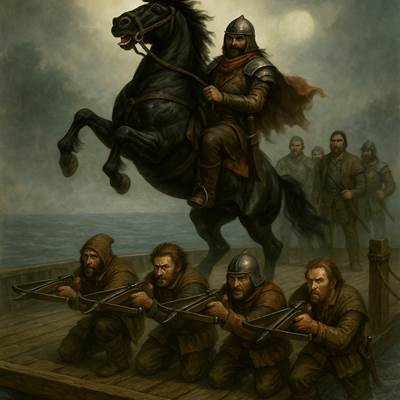
A child holding an object to a group of men

Image created by AI


Sulgalion's expression soured at the sight of the enemy. He took a deep breath and looked towards this Captain of bandits…. and cried out: "I see you are not fond of walking. Such a shame, it would've helped you with that ugly hanging gut of yours".

The horse stamped the dock, steam curling from its nostrils. The brigand-captain’s helm tilted slightly as Sul’s words rang out across the mist. A few crossbowmen still scrambling to their feet glanced at one another, stunned. The captain’s grip tightened on the reins, but he did not charge. Not yet.

The mist shifted. Behind the crossbowmen, five more brigands stepped forward. They were dressed in heavier armour, and their blades drawn. They moved with purpose, forming a new line at the ferry’s edge. The dock was now firmly back in their hands.

Brat looked to Gari and muttered "If we survive this, I will have an amazing story to tell."

The Captain hesitated no more. He gave a sharp pull on the reins, and the horse surged forward - straight toward the crates that the wounded fellowship huddled behind.

“Down!” Sul barked. The group barely had time to react.

The black beast slammed forward with terrifying speed, the captain’s sword gleaming at his side. The dock shuddered beneath the weight of the charge. Hooves struck splintering wood. Crates were smashed aside like kindling.

Sul rose too late to stop it. The horse barrelled into him with a sickening crunch, the captain’s shoulder crashing into the elf’s side. Sul was hurled backward with a shout, landing hard on the dock beside Nari, who was already too slow to move out of the way.

The horse clipped her too, its flank slamming into her already-injured side and sending her tumbling to the boards. The breath left her body in one burst, and she rolled until stopped by the base of a broken crate.

Brat tried to rise and dodge but was knocked aside as one of the crushed boxes split open beside her, showering her in broken wood and twisted scraps of metal. Her club flew from her hand.

Gari barely had time to react. For he was caught at the end of the charge and flung into the dock rail, his shoulder striking with a dull thud. He groaned and dropped to one knee, stunned. The horse reared over him, and hooves come slamming down upon his shield. It splinters into countless pieces, though taking much of the blow, his arm is severely hurt. A further glancing blow from the captain’s sword catches Gari across the brow. He falls back with a cry and his spear is thrown from his hand.

The charge had broken them all.

All four lay scattered, groaning or clutching wounds, breathless and dazed. For a heartbeat, all was still except the creak of the dock and the low snort of the horse.

Then the brigand-captain wheeled the beast around. His helm glinted, his cloak trailing behind him. He turned to face them again, preparing to strike once more.

He raised his sword.

His horse reared.

And then…


A streak of calico.

A flicker of fur and claws.

Dumpling appeared!

The cat flew through the air from the far side of the crates, having launched from some impossible leap, claws extended. She landed squarely on the captain’s chest with a hiss. Her claws found purchase along the man’s face and helm-straps. He shouted, staggered in the saddle, flailing wildly.

The horse bucked.

“Clever girl,” the captain muttered just before he managed to seize the cat and hurl her to the side. Dumpling hit the ground and tumbled, but she was already scrambling back into the shadows, unharmed.

In the struggle, the captain’s helm had come loose, ripped free by Dumpling’s claws. He sat exposed now, blood along one cheek, his eyes wide with fury.

That was the opening.

Bethrelfin’s arrow came like a whisper of wind.

She had risen from behind the far crates, bow raised, barely able to stand. Her hair was matted with blood, but her hand was steady.

The arrow struck him clean between the eyes.

The captain froze.

The sword dropped from his hand.

He slumped in the saddle and then fell, backward and heavy, onto the dock. The warhorse screamed and bolted, galloping up off down the bank of the river into the night.

A strange stillness followed, as if everyone had forgotten to breathe.

But danger had not passed.


From the right side, the armoured brigands stepped forward. The steel of their blades caught the torchlight. Sul arose, badly hurt but not willing to concede the fight. There was blood on his coat, it was impossible to tell whether it was his or earlier Brigands. His sword was still in his hand though and he turned his gaze to them and squared his shoulders for a charge. He gave no cry, no threat, just motion. Swift and smooth, like a drawn arrow loosed into wind.

Seeing this, the brigands fell back behind the crossbow line. Sul’s determined charge shaking them.


At the same time, Garibald had also stirred.

He leapt over the brigand-captain's body with renewed energy. The hobbit ran forward, and in fluid motion, unstuck the javelin he had earlier lodged in the chest of the iron-hooked smuggler. His face was scraped and smeared with blood. But his eyes were clear.

He ran toward the line of crossbowmen. The four of them, who had survived the earlier chaos, were now raising their bows again, their allies line up behind them. Shocked at the loss of their Captain, they were regaining formation, their weapons to be trained on the fellowship one… last… time.

“I won’t let them,” Gari cried as he raced and rolled between bodies and crates alike to get there as quickly as he could…. It was all he could do for his wounded friends, to place himself in the path of their demise.
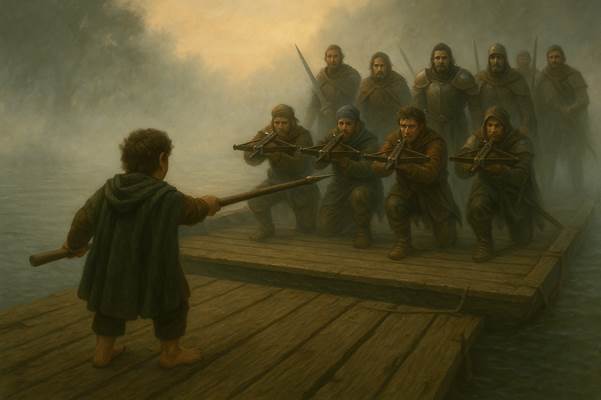
Gari makes a standImage created by AI

He raised his javelin like a barrier, a denial; his arm extended, his body tense. Blocking the sightline to the others, even for a moment. A moment is all it would need….

A futile effort, but perhaps the most heroic gesture Nari had ever witnessed a Hobbit perform.

She blinked, seeing him there…. past Brat, past Sul… just standing alone against four crossbows and five swordsman… and she tried to call his name, but she couldn’t… she wanted to close her eyes; not to look, not to witness…

But she wasn’t going to do that.

She watched as he stood between her and death.

Between all of them, and the ferry’s wrath.

Time seemed to stop.

Pain filled her chest… but so did something else.

Something fierce.

And that’s when they all heard it.

A sound, from behind them, growing.

Not of steel, but of music…

A strange and piercing note on the air…

The playing of Bagpipes.


The music came from the hilltop behind them, up toward the hedgerows where the path met with Buckland.

Then there were cries heard. They began as a single wail, lonely and sharp, and then this was joined by a second, a third, and the steady beat of many feet.

The brigands faltered.

The crossbowmen glanced to the hill. Their hands now trembling.

The light of dawn had broken, and the fog parted at the crest of the hill to show dozens of figures; hobbits.

They came in a ragged line, not warriors by trade, but every one of them armed: pitchforks, cudgels, torches, scythes. Some bore hunting bows, others only the tools of field and forge.

At their front was a stern-looking Bounder captain with a green sash across his shoulder, Captain Eadric. But he was not leading them. He was simply the one keeping up.

The hobbits of Buckland had come.

Not just the Bounders. Not just the Shirriffs. The people of Buckland.

Men and women, elders and youths, some with shields cobbled from barn doors, others with pans on their heads, all with something in hand and fire in their eyes.

A voice rose from the hill: “We stand with the Company!”

The cheer that followed could have shattered the river’s fog. It rolled down the slope like a great thunder.


Nari blinked back tears she hadn’t realised were there. She somehow managed to sit upright. Blood ran down her shoulder, and her remaining arm threatened to give way, but she stayed upright.

“We’re not alone,” she whispered.

The brigands knew it too. They all turned and ran, crashing back onto the ferry in a panic.

One shouted, “Cut the line! Get it off the dock!”

But they were too slow.

The last man on the rope slipped, and the ferry lurched away. Its mooring line tangled, snapped, and trailed in the current. The vessel spun sideways, knocking crates and men into the river. One brigand screamed as he leapt into the Brandywine rather than face the hobbit host.

In less than a minute, the ferry was adrift.

Then it was gone, carried away by the ever quickening current.

Silence took the dock again.

And then the hobbits began to cheer.
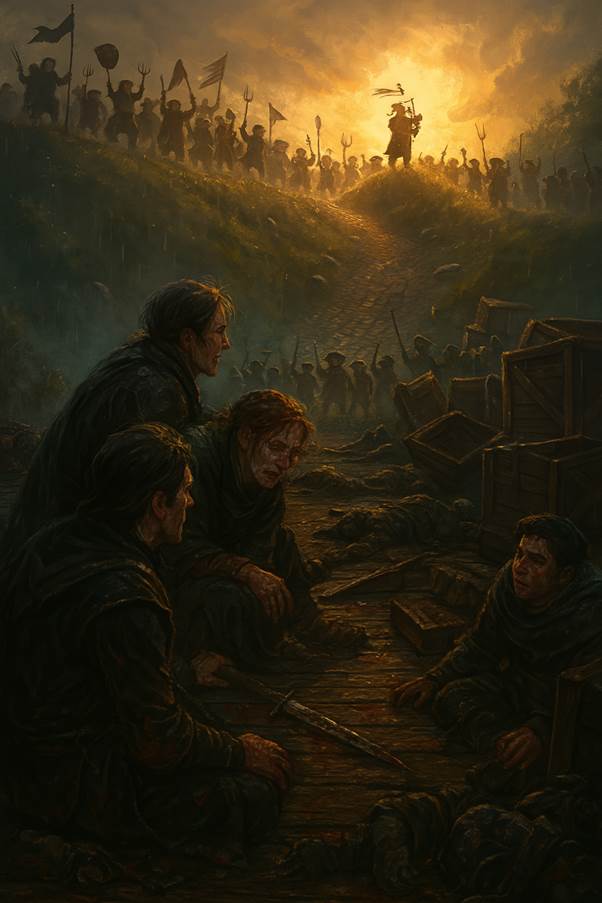
A group of people sitting on a wooden surface

AI-generated content may be incorrect.Image created by AI


The battle was done.

Not won with strategy. Not by blade or bolt, or even luck. But by resolve.

By a fellowship that would not yield, and a people who refused to remain silent any more.

The ferry vanished into the morning fog. No pursuit was given. None was needed.

On the dock, the fellowship remained, bloodied and broken but alive.

Nari leaned against a half-toppled crate, her shoulder bandaged loosely with cloth from Brat’s satchel. Her vision still swam. Her breath came light and quick. But the worst had passed. She let the ache sit without fighting it. There would be time for healing. Later.

Gari slumped beside her, wiping his brow with a grimy sleeve. His chest rose and fell heavily. A slow grin tugged at the corner of his mouth as he looked up at the hobbits now filtering down from the hill, some still gripping pitchforks and broken tools with white knuckles.

“Didn’t think I’d live to see Buckland charge a battlefield,” he muttered.

Beth approached at a slow, uneven pace, her hand pressed tightly to her ribs. Her tunic was torn, and her hair was streaked with both blood and mud. Yet there was no mistaking the steel in her eyes.

She said nothing at first, only gave a slow nod to Nari, then to Sul and Gari in turn. When she looked to Brat, the hobbit grinned wide and offered a half-salute.

Beth let out a short laugh, then crouched stiffly beside the others.

“I didn’t miss the end, I hope.”

“You ended it,” Nari said gently, her voice carrying more than gratitude. “Right when it counted.”

Beth nodded once, a flicker of something warmer in her expression. “Good.”

Then she leaned back against the crate, exhaling deeply. “Next time,” she muttered, “someone else gets to do the dramatic shot.”

Sul chuckled but hid a smile… He stood a short way off, his coat torn and spotted with blood. He seemed to mourn that fact deeply. He leaned on the railing, wiping his sword before sliding it home into the scabbard at his hip. He ran a hand through his hair, smoothing it into place with surprising care given the state of things. Then he turned, his expression unreadable as he looked back toward Nari.

“So,” he said. “This is what your Company is doing along the Great Eastern Road?”

Nari lifted her eyes to meet his, a faint smile just visible beneath the dirt and pain. “Yes,” she said. “This is what the Company does… when it does its best work. It has a lot to rebuild in that regard. But yes.”

He nodded, slow and thoughtful.

Brat, nearby, let out a delighted wheeze of laughter. “Are the Company taking on new members? If Sulgalion wants to join, I’d like to join too.” She cast a glance toward Gari and turned bright pink.

Nari let the smile reach her eyes. “You’re in, Brat. We’ll talk over the code of conduct another time, over a ‘pint’ as the hobbits like it. As for Sul…”

She looked back at him. “I think he prefers to walk alongside, when it suits him.”

Her voice softened. “.. and I’m glad it suited him this time.”

Sul raised a brow, and his lips curled into something like a genuine smile.

“Until the open waters call me forth,” he said, “I shall see what there is to see upon the Road. Might also make a journey to Rivendell. It has been too long.”

Nari inclined her head. “Then walk with us while the road is shared.”

Brat perked up. “I didn’t do much,” she said, sheepish now that the danger had passed. “But I can tell there’ll be stories in working with the Company. And that is what I’m after.”

Nari shook her head. “You saved my life, Brat. More than once tonight.”

The hobbit flushed red again and busied herself with folding another bandage.

Beth leaned wearily on her bow, stroking Dumpling who seemed happy.

Around them, the hobbits of Buckland had begun to work, checking the wounded, righting overturned crates, helping haul bodies from the dock. Not all were enemies. There was talk of who would write the letter to Michel Delving. Of whether the Bounders would be sending word to the Thain.

Sulgalion rubbed his chin and said aloud: "I do wonder if any of these fine hobbits will have us for breakfast..."

Voices rose all around them at the mention… bright and with cheer. Others joined in a rough song, clumsy and off-key, but heartfelt. A few simply laughed, the kind of laughter that comes only when fear has passed. A balm to all.


Naridalis remained seated for a long moment, her eyes fixed downriver.

The ferry was lost to the water now. Whatever the Brigands were trying to smuggle had gone along with it, or into the Brandywine… though perhaps there would be some clues about the dock. Still, she didn’t look for them just yet.

Instead, she turned her gaze upriver. Past the dock. Past the ruined barricades. Past the bloodstains and broken timber. Back towards the path, as it would wind through Buckland and beyond to eventually rejoin with the Great East Road.

She stood with effort, favouring her injured side, and rested her hand on Gari’s shoulder for support. Turning to them all she said softly, “Let’s go see what comes next”.

Sulgalion gave a half-smile, Garibald offered a nod, and Bethrelfin mimed a yes to Dumpling before catching sight of her husband who had just arrived. As the two embraced, Bratikus, wide-eyed, held up a hand already ready to scribble the first line of her next tale….

They would all walk again – together.

Bound not just by a shared sense of protecting free folk, but by fellowship.

By the fire shared, and stories told.

For those who can see…

Signs Along the Road.
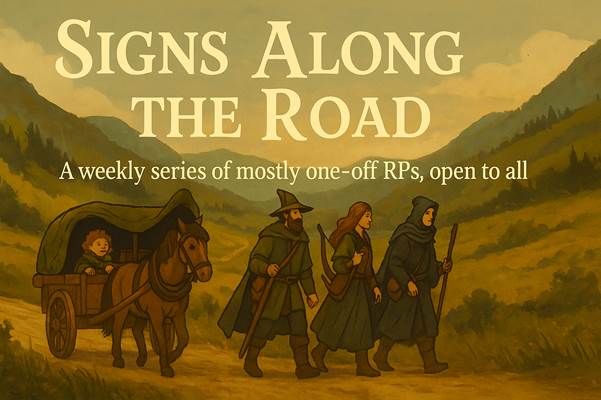
Banner for 'Signs Along the Road' showing a group of people walking with horses on the road.Image created by AI

41. Ashes and Farewell

The golden light of early morning filtered softly through the latticed shutters of Deorla’s hidden house. The air held a rare stillness — not the kind that comes before a storm, but the quiet pause before history begins to turn again. Outside, birds stirred in the brush, and smoke curled gently from the stone chimney. Inside, Deorla stood before a shape half-concealed beneath the floorboards — a white chest, pale and cold like ice, as if winter itself had been shaped into wood and steel.

The chest bore the carved likeness of a dragon’s head, its mouth twisted into a frozen snarl. Its surface was lacquered in a faint glimmer of frost-colored enamel, giving it the illusion of being perpetually chilled. The lock was ornate — a narrow slit disguised beneath the tongue of the dragon — and bound by an old rune-ward known only to Deorla.

She retrieved a narrow shard of obsidian from her satchel, etched with fine black script. Sliding it into the chest’s hidden slot, a low mechanical thrum followed by a click sounded — as if the dragon had sighed through its fangs. The lid opened.

Inside lay the reward of cunning, blood, and shadow: over ten thousand golden coins, each neatly stacked and sealed in silken pouches or stamped crates. The wealth of three years spent running the Company of the East Road — now hers alone.

She exhaled through her nose, smiling faintly. “Enough to raise an army,” she murmured. “Or to buy loyalty that costs more than steel.”

While Deorla counted and sorted what she would carry, Firebryn had already left at dawn, saddlebags heavy with trade tokens and coin. Her destination was Edoras, not just to gather supplies for the road ahead, but also to find someone dangerous enough to understand the weight of guarding Deorla’s hidden house.

She returned the next evening, cloaked in rain and silence, her boots muddy and her eyes sharp.

“I found them,” Firebryn said, hanging her travel-worn cloak. “A pair. Not the honest sort — but that’s the point, isn’t it?”

Deorla raised a brow.

“Name’s Erting, once a captain of Stangard,” Firebryn continued. “Got dismissed for brutality during the last days of the war — something about flaying Easterlings alive during patrols. He knows how to keep things guarded. He’s quiet, cold. Knows command.”

“And the other?”

“His wife — Maerhild . Former herbalist. She had a stall in Langhold once, but no one bought her mixtures except hunters and… well, folk who wanted to get rid of people. Let’s say her knowledge of poisons is extensive.”

Deorla sat back in her chair, fingers pressed beneath her chin.
“They’ll keep the house unbothered.”

“They’ll keep it unapproachable,” Firebryn replied. “I paid them enough to keep their mouths shut and their blades sharper. They’ll settle in by the end of the week. You won’t be missed.”

Deorla smirked faintly. “Good. I built this place to vanish into the world. Now let it sleep in their shadows. But in case I will leave enough gold for at least three years payment.

With Firebryn securing her replacement caretaker Deorla turned her focus to the journey itself.

Knowing the roads ahead would not be kind, she began gathering and preparing supplies. With Firebryn's return from Edoras, her arms were laden with essentials: dried meats, smoked eels from the river near Snowbourn, salted cheese wrapped in linen, and dozens of packs filled with dried berries, oats, and flatbread. Roots and rare herbs were packed separately, kept in small jars of dark glass to preserve their potency. Firebryn had also brought hard-to-come-by items—dried saltfish from Gondor’s coast, fire spices from Harad, and bark-brew tonic strong enough to awaken a half-dead soldier.

No mere traveler, Deorla prepared as a shapeshifter of nations—each steed and garment an identity, a veil behind which she could hide or command.

The Harbinger – A jet-black steed known in ancient whispers as a sign of shadow's return. Taken from the remnants of Mordor, its hooves seem to echo with distant thunder, and its piercing crimson eyes know no fear. This was her Harbinger Horse. With it, Deorla paired her iconic black armor—serrated, shadow-draped, and blood-touched.

The Dead City's Warden – A mount once stabled in the ghosted avenues of Minas Morgul. Its coat is dark steel and its gear heavy and silent. With this Dead City Horse, Deorla donned her ceremonial battle armor which she wore very rarely but sometimes large battles could not be avoided—dense and brutal, meant for commanding sieges and slaughter. Here, she was no longer a whisper, but a conqueror of ruin.

The Rider of the Mark – A sun-kissed Rohirric stallion, fast and loyal, with green-plumed tack and soft leather saddle. On this horse, she wore her Rohirrim disguise, bearing a fictitious crest, the garb tailored for open mead halls and windy plains. It was her key to move unseen in familiar lands.

The Stone-Runner – A Gondorian charger bred for nobility and endurance, slate-gray with white fetlocks and a silver bridle. Her Gondorian garb was minimal yet elegant, a black-and-silver ensemble fit for a traveling noble or errant knight. This face allowed her to walk in cities that once hunted her.

The Silent Hunter – A horse bred in the far deserts of Harad, clothed in shadow-dyed wrappings, silent as a ghost. This Silent Hunter Horse moved as if tracking prey. She wore desert robes, layered in red and bone, beaded with ivory and adorned with glass talismans. This guise was for the veiled markets and assassin-walks of the South.

The Gorgoroth Behemoth – The most fearsome of her mounts, pulled from the flames of the Black Land itself. Armored in spiked steel with molten-stone eyes, this Gorgoroth War-steed bore her into legend and her new bird shaped outfit just fit perfectly with it;


As dawn crept over the ridge and the mists of the Rohan hills began to pull back, the time of parting came. The six mounts were prepped and outfitted, saddlebags filled with dried meats, honey-bread, herbs, cured roots, and Firebryn’s carefully packed bundles of medicinal powder and venom antidotes. Every inch of Deorla's caravan shimmered with intent—this was not a wanderer’s flight, but a campaign in motion.

But before the gates of the house opened for what might be the last time, Deorla turned to the new stewards: Captain Erting, the grim-eyed man from Stangard, and his quiet, unsettling wife Maerhild, the former poisoner-herbalist now veiled in dignity. She stepped toward them, the white-ice chest gleaming faintly behind her like a forgotten relic of another age.

Her voice was cold and precise.

“This house is not merely timber and stone. It is memory. It is blood. And if anything happens to it—by your negligence, greed, or betrayal—I will return.
Even should my body be scattered to ash in Mordor’s wind,
I will crawl back from death, through shadow and storm,
and I will end you both.”

There was no fire in her tone—just certainty. Captain Erting bowed, his eyes narrowing. Maerhild offered a thin smile, part flattery, part unease.

They stood in silence for a time. The smuggler-turned-keeper held her cane tightly, her graying braid fluttering in the wind. Her eyes were red—not from sadness, but from knowing.

“I never thought I’d see this house rise from ruin,” Firebryn said. “And I never thought I’d be the one locking its doors.”

“You’re more than that,” Deorla replied.

Firebryn chuckled softly. “And you gave me purpose, Deorla. More than I ever had, smuggling crates up Anduin like a rat.”

Deorla reached into her cloak, drawing out a small leather-bound locket. Inside, a drawn symbol—a raven perched upon a sword embedded in a mountain.

They embraced tightly. No tears, but the weight in the air hung heavy. They both knew they would never meet again.

42. The Boar and the Black Rider

The night was ink-dark, and only the breath of stars shimmered faintly above the towering forests of the Aldburg Wood. Deorla rode in silence, the hooves of her mount—the Harbinger—striking the mossy floor like low drums of war. The creature was bone-armored and wreathed in withered leaves, a beast born of shadow and decay. 

The rustling came first. Then the grunt. Her black gaze snapped ahead, narrowing. There, through the underbrush, came the unmistakable form of a monstrous boar, larger than any she had seen. Flanking it were leaner beasts, tusked and wild-eyed—guardians of something older than memory.

A shimmer in the moonlight revealed more clearly Deorla had no doubt: Scion of the Great Boar.

“So the blood of Everholt still lingers,” Deorla muttered to herself, reining in her steed.

The tale of Folca, the 13th King of Rohan, and his tragic end while slaying the legendary boar of Everholt was known even in Nurn. That same blood now ran in these beasts—guardians of forest and vengeance. She did not engage them; not tonight. They were watchers of borderlands, not enemies. She gave a slow nod of respect and continued on her path, though their gleaming tusks followed her all the way.

Few hours later under a starry night sky, she reached a waterfall—a cascade so wide and thunderous it swallowed her thoughts in sound alone. She stood there for a time, cloaked in black, her Harbinger steed drinking from the pool below. The veil of water, glittering like gems in starlight, marked her entrance into Gondor.


She passed the waterfall and pressed on, the sky turning from starlit blue to the sickly grey of dawn. On the far side of the Beacon hills, where the land flattens before the White Mountains rise, Deorla was intercepted. A party of Variags—men of Khand—rode fast upon her trail. They bore the blood sigil of the eastern tribes, and at their head rode Vrakya, a Jarl of savage ambition and grim reputation.

Clad in plated bronze and crimson cloth, Vrakya dismounted with a smile full of broken teeth.

“You ride alone, Shadowflame. Too far from your desert roots. But the Rohirrim still bleed in the East— But I heard recently the price off your head is something everyone talks about now. What a weird chance I runned into you, all alone. Boys, get her!"

Before the final word left his lips, Deorla was in motion.

She struck first—not with some spell, but with the flat of her gauntlet, slamming it into his jaw with a crunch of bone. The Variag stumbled, cursing, and drew his blade in a wide arc meant to intimidate. Deorla ducked low, pivoted on her heel, and swept his legs from beneath him with a perfectly timed kick.

He crashed into the dirt, and she was already atop him. They wrestled in the dust, blades scraping armor. Vrakya was stronger, but she was faster. A feint—his blade caught her shoulder plate, but not skin. Her dagger found his ribs.

He gasped, but she twisted the blade deeper, breath hot against his ear.

“You should’ve ridden past.”

She pulled free and rose. Vrakya didn’t. His men watched, unmoving—awed or afraid.

Deorla didn’t bother with a speech. She simply turned to them, blood still dripping from her blade.

“You didn’t see me,” she said. “You saw a ghost on the wind.”

None challenged her. One by one, the riders turned their mounts and vanished into the wild.

She cleaned the blade on Vrakya’s crimson sash, then buried it beside his body beneath a cairn of stones, marking the site with a spearpoint stabbed into the earth.

By dusk, she arrived at the great ruined gate of Anórien, once a symbol of Gondorian pride. A statue of Isildur stood above her, sword raised against the twilight.

Deorla looked up and smirked.

“You died clinging to power,” she said, brushing past it. “Let’s see how long your house holds without it.”

The road stretched out before her now. To Osgiliath. To Gorgoroth. To Mordor.
And to her final ambition.

43. [SATR] "The Beggar on the Bridge"

Banner for 'Signs Along the Road' showing a group of people walking with horses on the road.Image created by AI

OOC – Author’s Note:

This story recounts a live RP session held as part a weekly series called "Signs Along the Road". Each week there is a new RP hook. If you would like to come along, please reach out to Naridalis (sessions held every Sunday, but not limited to that either). The series does refer to the Company of the East Road and can be used as a way to ICly introduce your character to the kinship (whether you wish to join it is entirely optional).

Additionally: This piece was shaped with a little help from AI. It provided assistance on things like the structuring, some names, shortening some verbose language/ideas as I'd written them, and it gave me the odd turn of phrase here and there. The heart and shape of the story are my own, but I realise it is important to be transparent about my use of AI assistance.

This week's hook:
The West-gate of Bree has seen a strange figure these past few days: a hunched traveller loitering on the small stone bridge where the East Road meets the Greenway. Those passing say he stops folk with a tale of an injured companion lying just off the road, urging them to follow him at once. At least a few have gone… but none have returned to town. Still, the figure returns to the bridge each time thereafter, still seeking aid.


"The Beggar on the Bridge"


A person standing on a stone path

AI-generated content may be incorrect.

The morning in Bree-land began clean and bright. Sunlight slid across the stone of the western wall and laid long strips of gold over the cobbles at the West-gate. Wagons rattled, merchants argued over prices, and farmers steered their carts toward the Greenway or the Shire. Just beyond the bustle, the small stone bridge west of the gate stood in plain view. A cloaked, stooped figure haunted its span, lifting a hand to each passer-by and begging with a hoarse, uneven voice. Most hurried past and called him a beggar with a strange tale.

Naridalis watched from the edge of the gate’s crowd, cloak tugged by the light breeze, eyes returning again and again to the bridge. A young man in fresh armour approached her. He gave his name as Redgrave and wore his unease along with his mail; telling of how his armour was new and he was walking it in. She invited him to walk with her. There had been talk of the beggar’s story, and things that unsettle folk so close to Bree should not go unlooked. Nari called a pale hawk to her wrist with a whistle, and then as if whispering to it, released it again into the air. Sadar climbed into the morning sky and circled high. He would offer his sight to them both.

They crossed to the bridge together. The beggar’s tale sounded simple on its surface. A companion lay fallen in a nearby dell, just past the hill beyond the stream. Most had passed him by, but a few had gone to help and had never returned. His eyes kept flicking to the hedgerow and his story never quite came out the same way twice. He claimed two men had gone, then three. He spoke of some things in detail and others with a lack of it. It was all together suspicious to them both.

Redgrave pressed him with short, sharp questions. The man flinched under a steady hand on his shoulder and shrank like someone who expected blows. Hunger and fear clung to him. It felt like a trap, yet the fear was not feigned. Nor the hunger.

Naridalis decided to see the truth for herself. Before they left, she pressed a wrapped square of lembas into the man’s hands and told him how to use it, a bite to a day, enough to keep him for a week. Then she and Redgrave crossed the bridge and walked out over the damp grass of the plains towards the hill, Sadar circling ahead.

The fields rose slightly and dipped again into a shallow hollow half-hidden by thorn and bramble. The air cooled as they drew near it. Insects fell silent. No birds sang. The dell felt wrong, as if the ground itself held its breath within.

From the edge, they could see that a body did indeed lay in the centre of the hollow. A man on his side in rough clothing. From what they could see of his face, it was drawn and colourless, his lips dry, one hand pressed to his ribs. A lantern lay toppled nearby, its glass cracked. Sadar banked and climbed, and even the hawk’s cry sounded thin here. Naridalis taking his cries as confirmation that across the fields there were at least no men waiting, no bows hiding in the grass for them to exit. If this was a trap, it was not a brigand’s.

A screenshot of a video game

AI-generated content may be incorrect.

She moved in carefully and felt for the man’s pulse. His skin was cold as river stone. The beat under her fingers was weak but present. The cold that clung to him was wrong for a late morning. The air lay heavy over him like a hand.

They tried to carry him out. At Nari’s word, Redgrave lifted the man across his shoulders. For a few steps it seemed easy. Then a numbness crept up his arms, and the weight on his spirit fell like wet earth. Redgrave faltered. The body slipped and thudded back into the grass.

As soon as it left his grip however, the weakness fled him. He knelt and sucked air as if he had been held under water. The fallen man’s lips moved and a dry whisper scraped the air. ‘Shadows walking. Waiting in the earth’.

Naridalis went to Redgrave, and seeing him steady himself decided to search the hollow somewhat. The soil felt too soft underfoot for a dry morning. In the thick grass they found a sleeve jutting from the ground, frayed and filthy, with stiff fingers half-swallowed by soil. A few steps on, a boot pressed up from another dark patch. Others had come here, yes, and not returned because the earth had taken them. The shape of it matched the old tales. This felt like the long arm of the Barrow-Downs reaching further north than most would like to admit.

They spoke of leaving and seeking a lore-keeper, anyone who might have more knowledge of such dark influences… for what good would they do, if they do joined those who had come before…

As they backed away, with intent to leave the dell, the prone figure twitched and then jerked upright with an ugly strength. The colour of his skin changed to a flat, grey cast. His lips peeled from teeth that clicked like bone. His gaze fixed on them with a sickly light. The smell of rot rose from his clothes. A wight of the Barrow-Downs after all!

Redgrave’s steps faltered as the creature stirred. Naridalis saw Red’s knuckles whiten around the hilt of his blades, his jaw tight with a fear he was trying, and failing, to disguise. For a heartbeat she thought he might turn and flee, and she would not have judged him if he had. Few mortals faced a wight without their courage failing.

But then his eyes flicked to hers. He saw no panic there, only steadiness. She gave a single nod, silent as steel, and something in him shifted. His fear was not gone, but it bent itself into a sharp edge rather than a chain.

With a cry that shook the dell, Redgrave hurled himself forward… and so Naridalis drew and shifted to her bow. She whistled Sadar down into a raking pass and loosed an arrow as the hawk broke clear of its attack on the wight. The arrow struck deep but the creature kept coming for them.

The creature clawed at Redgrave’s breastplate and scored the new steel. Redg shouted his courage into the dell anew and drove both blades hard into the creature’s sides. Filth spilled as he tore the swords free. The body collapsed and smeared him with old blood and black decay.

The wight shrieked, a sound that was not of lungs but of ancient, spiteful malice. It buckled under their assault. The stench was choking, and the young man staggered back, his face a mask of both horror and resolve.

The creature collapsed in a heap of foul remains, yet even in death it had one last cruelty. A grey shadow tore itself from the husk and rose into the air, wailing in a hollow tongue that promised ‘ruin to all who trespassed the Downs’. Then it scattered on the wind, leaving only silence behind.

As the echo faded, the dell seemed to breathe again. The ground firmed underfoot, sunlight spilled more warmly through the trees overhead, and the sound of crickets returned hesitantly to the air. A sparrow sang from a hedge. The ordinary sounds of Bree-land returned.

Redgrave stood panting, his blades dripping with rot, his face pale but his eyes alive. In that moment, he had faced something he had every right to fear and, against his own belief, he had endured where others would have not.

Naridalis praised him for steady hands and a sure strike; a rather detached comfort to give in the moment, as it would turn out, but her thoughts were more to the poor soul whose body had once been taken as a wight by this apparition… they could not save him… but they could at least give him final rest by releasing him. There was not much left to bury, but she did what she could.

The hold on the hollow was broken, but Redgrave’s breath still came in sharp pulls, the echo of that dreadful shriek clinging to him. His blades dripped black filth, his armour stank of the grave, and he trembled as if the creature’s claws still pressed against his chest.

They climbed the slope together. At the crest he stopped, dropping to his knees on the grass. The strength that had carried him through the charge seemed to have burned itself out the instant the wight fell. His hands shook as he tried to wipe the grime from his blades, and from his face.

He spoke haltingly, confessing what Naridalis had already seen in his eyes before the fight began: that fear had gripped him, hollowing his limbs, that the armour he wore was less a badge of duty than a shield for his own trembling heart. He called it selfish, a heavy mask of steel to hide his weakness.

Naridalis lowered herself beside him without hesitation, letting the silence sit between them for a time. She did not press him to meet her gaze; shame already bent his shoulders. Instead her words came even and steady, carrying no judgment. “Fear was no shame”, she told him. The armour he wore may have been meant only for himself, yet it had turned the wight’s claws aside all the same. Steel borne for self-preservation had still served another in the moment of need. For she too could rejoice in having escaped its clutches, and that this was in no small part thanks to Redgrave’s courage.

Her hand rested briefly on his shoulder. He had not fled. He had not let the horror of the Downs master him. When the choice came, he stood, and he struck true. That was what mattered.

Redgrave swallowed hard, eyes stinging with tears, but the tremor in his limbs eased. He had faced a shadow that most men would never look upon, and though he still shook, he was breathing… alive, present…. and he had endured.

Nari reached into the fold of her cloak and drew out a silk handkerchief, fine and pale, its stitching of subtle elven craft catching the light. She pressed it into Redgrave’s hand without a word. The young man blinked at it, unused to such finery, then slowly raised it to his face. The fabric caught his tears and the grime alike, leaving faint traces of dusted silver thread against his skin. It was a small kindness, but one that steadied him more than any counsel could.

A group of people walking in a field of white flowers

AI-generated content may be incorrect.

After a time, they returned to the bridge. The beggar saw them and almost could not believe they had come back. Naridalis told him the truth. A harsh truth, but one meant to give comfort ultimately and dispel doubt.

Naridalis spoke plainly, her voice even but not unkind. She told the beggar that the companion he had clung to in hope had been taken by a shadow from the Barrow-downs, perhaps many days ago, perhaps longer. Whatever he had been in life, he had not been himself for some time. His body now lay at rest, freed from its torment, though there was nothing left to return to.

The beggar swayed at her words as though struck. Redgrave drew a steadying breath, his voice gentler as he looked at the man. “What is your name, friend?” he asked.

The beggar’s eyes flickered with uncertainty, as though he had not been called to speak it in many years. At last he swallowed and said, “My name… is Harl. Harl, son of… no one, for I have no kin left. Only him… and now even he is lost.” The words seemed to pain him. The admission broke something in him; his shoulders sagged, and grief spilled raw in his voice. The ragged cloak that hung from his shoulders made him look like a scarecrow in the sunlight.

Redgrave stepped forward, his face still streaked slightly where his tears had run earlier. He unsheathed one of his blades with deliberate care. Its polished surface, untouched by the filth, gleamed in the morning light. He turned it in his hands and placed it crosswise against Harl’s chest, hilt downward. Then he guided the man’s trembling hand to close upon it, his own holding it fast.

“You need not be son of someone to stand for those you love,” Redgrave told him, his voice ragged with emotion. The words were heavy, dragged up from a place of old pain. He spoke of a mistake buried thirteen years in his past, of how he had let shame master him, and how living under its shadow served neither the living nor the dead. The words cost him dearly. Tears welled in his eyes again and slipped unheeded down his face, streaking the grime and sweat.

Harl’s shoulders shook, but he did not look away. For the first time, something lit in his expression that was not fear or hunger but a fragile spark of hope. He nodded once, a small, sharp motion, as though the sword’s weight steadied him.

A group of people in clothing

AI-generated content may be incorrect.

Naridalis watched the exchange in silence, recognising the moment for what it was: two men finding a bond not through blood but through shared pain. When she spoke, her voice was clear.

“The Company of the East Road”, she said, “was no narrow fellowship. It was not built on names or noble lines, but on the work of keeping the road safe and answering the needs of those who travelled it. Traders walked among them for profit, sellswords for hire, wanderers for their own purposes, and others simply because it was the right thing to do. All of them had their place so long as the watch was kept.”

Redgrave lifted his eyes to her then, still wet with tears. “Would the Company truly take in two who call themselves kinless?” he asked, doubt pressing hard on his voice.

“Yes,” Naridalis replied without hesitation. “If you would walk with us, then you will not be kinless. You will be counted among those who stand for the Free Folk.”

Harl answered first. His voice cracked, but it carried a trace of the man he had once been. He said he would walk with them. He had been a baker long ago, before he had lost everything, and his hands still remembered the work of kneading and shaping dough. Bread, Nari said, had a way of binding folk together around a table, of reminding them they were not alone. That could serve the Company as surely as steel.

For a long while they stood together in the brightening light. Bree’s bustle carried from the gate behind them; wheels on cobble, hawkers calling out deals, the simple thrum of everyday life that seemed suddenly more precious.

Harl gathered his torn cloak around his shoulders, but stood straighter now, his back no longer bowed by despair. Redgrave wiped his face with the fine handkerchief Narid had pressed into his palm and managed a tired, honest smile.

Above them, Sadar wheeled in the clear morning air, his shadow sliding across the stones of the bridge. The echo of the hollow felt far away now, more memory than threat. A broken man no longer waited alone by the stream, and two who had once deemed themselves lost… had begun, at last, to look like companions walking the same road. Together they all turned toward the gate and the day ahead, the first steps of a fellowship newly forged.


You can find more tales along the road here: "Signs Along the Road"


44. The White Company’s Snare

The lands of Anórien stretched before Deorla like a tapestry of shifting hues. Beyond the waterfalls and borders, the countryside was dotted with half-abandoned farms, their fields thin and tired from years of war. Gondor was healing, but the scars were deep, and such scars could be used.

She rode slowly at first, not eager to draw notice. Each village she passed held whispers of Gondor’s resilience—but also their fear. When her black-armored figure appeared on the horizon, shutters closed, children were pulled indoors, and the brave few who lingered only stared, clutching tools as makeshift weapons.

Deorla did not stop. Her eyes were fixed eastward. Mordor awaited.

By the third night, she discovered ruins along a ridge, the remnants of an old Gondorian watchtower. The walls were toppled, ivy climbing over grey stone, and a shattered bell lay half-buried in the earth. It was here she made her camp, letting the fire crackle low while the wind sang through the broken tower.

As she ate from her provisions, she unrolled her maps—drawn by her own hand in the years of traveling as "Deorla, merchant and leader of the Company of the East Road." Now she traced with ink-darkened fingers the route toward Osgiliath, then farther east into Ithilien. Mordor was not far.

She thought of the names of the remaining lieutenants—Borangos, Lhaereth, Karazgar, and more. Old rivals. Old equals. Soon to be either allies… or obstacles to be removed.

“One throne,” she muttered softly to herself. “And only one voice to command it.”

The night was long, haunted by the cries of owls and the rustling of wild creatures in the underbrush.

By the time she reached Osgiliath, the White City’s soldiers were a more open presence. Though the city had been reclaimed after the fall of Sauron, it was still in ruin—a patchwork of rubble, scaffolding, and tents where men labored to restore what had been lost.

Crossing the broken bridge, Deorla kept her hood drawn. She passed through the markets, where Gondorian craftsmen hammered armor and women traded food from makeshift stalls. The people were rebuilding—but their eyes were weary, suspicious.

She bought no food, asked no questions, and offered no name. Only the gleam of gold coins—pulled from her white dragon-headed chest—secured her passage without trouble.

Deorla knew from the moment she decided to travel to Mordor, that her biggest challenge will be crossing Ithilien, there was no more dangerous place for her than this. Pesky rangers, her sworn enemies since forever. But she took the risk, she could always try enter Mordor via one might say a main gate, the black gate. But that was not her plan. She knew in order to take control of Mordor, or at least to learn something about it after fall of Sauron and the remaining lieutenants was to speak none other to one of them. Dolguzigir, the Dark Archivist was only lieutenant that she knew will at least be neutral to her. His job under rule of Sauron was to archive and repository of dark knowledge in Minas Morgul, and she suspected he still does that. So she would have to get to Minas Morgul, and best way and faster would be through Ithilien. 
 

By the next evening, Deorla had crossed into the forests of Ithilien. They were fair to look upon—sunlight dappled through thick green leaves, wildflowers spread across glades—but beneath their beauty, danger stirred. The woods had become more than wilderness: they were now a guarded realm. Crossing the borderlands of Ithilien was treacherous. The forests, though beautiful in parts, were alive with shadows—not of Sauron’s servants, but of Gondor’s rangers. Though diminished in number since the War, their presence was still sharp.

For Faramir, Prince of Ithilien, ruled these lands. In his role as march-warden, he had sworn to clear the woods of outlaws, wandering orcs, and the remnants of Sauron’s broken host. To aid him, the White Company patrolled the hidden roads, Gondor’s finest rangers, veterans of the War of the Ring. And not only men lived here—an Elven colony from Mirkwood had taken root among the ruins, their fair voices and watchful eyes now interwoven with the defense of the land.

Deorla knew this, and yet she pressed on. The shadow of Mordor lay beyond, and no Ranger nor Elf would turn her from her path.

The first arrow struck the trunk of a tree beside her, quivering in the bark. She did not flinch. A second and third followed, hemming her in.

“Come no farther, stranger!” a voice rang out from the shadows—firm, commanding, and all too practiced.

Shapes emerged from the brush—half a dozen Rangers, bows drawn, cloaks blending with the wood. Their insignia, the White Tree upon their sleeves, marked them as the White Company itself.

Their captain, a weathered man with a scar along his jaw, stepped forward. His eyes narrowed at the sight of her black-clad form.

“You do not belong in Ithilien,” he said. “State your name and purpose—or you will not leave these woods alive.”

Deorla gave no answer. Her lips curved in the faintest of smiles, her hand resting on the hilt of her blade. Her horse stamped restlessly, sensing her mood, steam curling from its nostrils in the cool night air.

Above, the whisper of Elvish voices carried faintly through the leaves. She knew the Elves of Ithilien watched as well, unseen, bows in hand.

The Rangers shifted, tightening their grip on their weapons. The captain raised his hand in silent signal.


45. [SATR] "Staddle Your Debts"

Banner for 'Signs Along the Road' showing a group of people walking with horses on the road.Image created by AI

OOC – Author’s Note:

This story recounts a live RP session held as part a weekly series called "Signs Along the Road". Each week there is a new RP hook. If you would like to come along, please reach out to Naridalis. The series does refer to the Company of the East Road and can be used as a way to ICly introduce your character to the kinship (whether you wish to join is entirely optional).

Additionally: This piece was shaped with a little help from AI. It provided assistance on things like the structuring, some names, shortening some verbose language/ideas as I'd written them, and it gave me the odd turn of phrase here and there. The heart and shape of the story are my own, but I realise it is important to be transparent about my use of AI assistance.

This Week's Hook:
Word has reached the Company that a merchant of Bree has begged for aid. A farmer in Staddle owes him a heavy debt for seed and tools, yet refuses payment. The Bree-watch won’t stir themselves over "farmer’s squabbles," but the Merchant’s Guild is whispering about it, and so the Company is approached to mediate and, if need be, collect.

Ordinarily Naridalis would not choose such a task herself: it smacks of coin over cause, and her patience for petty disputes is thin. Yet she reasons that if the Company does not step in, then rougher folk might... brigands or debt-collectors of a harsher hand; and that would bode far worse for farmer and merchant alike. So, she will set out towards Staddle, with any who would assist.


"Staddle Your Debts"
A person standing on a cobblestone street

AI-generated content may be incorrect.

Morning rain still clung to the cobbles at the Staddle Gate when Naridalis and her companions gathered. She said little of the work before them, yet her tone carried sharp distaste. To be sent as collectors of coin sat poorly with her. Such tasks were too close to brigandry in her eyes, but she would rather it be settled with calm words and kinder hands, than left for true villains to seize upon – as would often be the case with disgruntled merchants seeking repayments.

A man she did not recognise, called Theodrid, joined her. He muttered that a job was a job though seemed to carry equal disdain for such affairs, while Garibald the hobbit, whose assistance on prior occasions had proved invaluable, simply hoped they’d be home before supper (perhaps a joke made to improve all their moods). All three knew this was no errand of honour, and it weighed upon them as they set out.

A group of people walking on a dirt path

AI-generated content may be incorrect.

The bustle of Staddle’s faire met them soon enough, with bright stalls and hobbit laughter at odds with the purpose of their visit. They found themselves in the centre of the Farmer’s Faire; truly a hobbit festival but one which had crept in to be celebrated in Bree-land in recent decades.

Naridalis forced a smile at the colours and music, though inwardly she felt the shame of walking such roads for merchants who pressed debts upon small folk. Still, she told herself, better that the Company stand between debtor and creditor, than a cudgel raised in anger. Through the throngs of hobbits and men they pressed, ears open for whispers, until the faire gave way to a quieter lane and the first hint of trouble.

A Bree-guard named Holik was leaning against a tree along the way. His bow was ready, his eyes sharper still, and he warned them that the farm ahead was not as it should be. Carts overturned, livestock gone, and no smoke from the chimney. No farmer had been seen since last eve. Naridalis urged him to join them, for if harm had come, they would not stand idle. His orders bound him to the road, yet with some persuasion he accompanied them, uneasy at the situation.

A video game screen capture

AI-generated content may be incorrect.

The sight that met them was bleak. The farm yard lay torn as though by storm: chickens slain, a cart wheel splintered, the barn doors stained with blood. No sound stirred within the house upon their investigations.

Naridalis crouched, her fingers brushing the dark streak across the timber, tracing its path into the grass beyond. Garibald’s searching by the damaged cart uncovered a locket, worn and marked with a woman’s name… Milla. Recognition struck Naridalis; the farmer’s wife bore that very name she recalled from the contract. If such a thing lay discarded in the mud, it spoke of violence. Her heart sank.

A group of people standing on a path

AI-generated content may be incorrect.

The trail of blood led them uphill through tall grass, winding toward old ruins left by long-forgotten folk. Each step grew heavier, for the three feared they would find the farmer slain.

A stone wall with a stone structure in the middle

AI-generated content may be incorrect.

At last the ruins opened, and dread gave way to shock.

For there sat the farmer, wounded but alive, bound and bloodied, yet surrounded by the corpses of three brigands he himself had slain. A pitchfork and a stone had served him better than despair. Both relief and horror gripped Nari especially, and Garibald rushed to bind his wounds.

The hobbit farmer, named Fendi, told through broken breath how the merchant had lost patience with him owing his debt and had sent thugs to take his goods. They had thought him easy prey, but he had proven otherwise. For he had once been a bounder in his youth, and knew well how to defend himself.

The Company listened, shamed that such work had been placed upon them at all. Holik, the Bree-watchman, bent over the brigands, recognising them as known malcontents, and Garibald returned the locket into Fendi’s grateful hands. The farmer’s voice cracked with joy at its sight, for his wife and children were safe away in Bree, and the sight of the locket seemed to buoy his spirits, if not salve his wounds.

A video game of a child sitting on the ground

AI-generated content may be incorrect.

Image created using Google's Gemini AI to superimpose characters on in-game screenshot

Yet fear lingered in Fendi’s words. The merchant, he said, would not stop. He would send more, harsher men, until the debt was claimed. Theodrid met his eyes, resolve to help the man burning strongly and Naridalis promised that this debt was ended. A debt that should never have been paid in blood, was now soaked through.

The brigands lay dead, and Theodrid and Garibald found a letter among them bearing the merchant’s own seal, proof enough of his unlawful actions in hiring these brigands. The law would not side with him now. Holik would see to it. Instead, bounty coin from the slain men would cover Fendi’s losses and free him from shame.

So the day closed with a bitter lesson. The party’s disdain had not been misplaced… this was ill work for the Company, unworthy of their purpose. Yet had they turned away, the farmer would have bled out among the ruins, his courage unseen, his victory hollow, his family without a husband and father.

Good had come, though it was born of cruelty and deceit. One merchant unmasked, three brigands slain, and a farmer’s life preserved. The road was safer, but Naridalis carried with her the weight of knowing that such tasks stain even the best intentions along the road.


You can find more tales along the road here: "Signs Along the Road"


46. The Last Gallop of the Harbinger

The woods of Ithilien were alive with the hunt.

The first arrow whistled past Deorla’s face, snapping through a birch trunk. The second struck her horse’s flank — a warning shot, not yet meant to kill. The cries of men followed soon after, echoing between the trees:

“In the name of the Prince of Ithilien! Drop your weapon!”

Deorla spurred her mount, the Harbinger, into a sharp turn. Branches lashed her arms as she darted through narrow paths veiled in moonlight. Behind her, the White Company gave chase — twenty Rangers of Faramir’s command, elite soldiers sworn to cleanse the woods of all who walked under the shadow.

Bolts hissed from the darkness. One struck the saddle; another grazed her thigh, a shallow cut that burned. She veered toward a ridge where the trees thickened, hoping to lose pursuit.

Then she saw it — a cliff face ahead, dropping into the black rush of a waterfall. Her horse skidded to a halt, hooves scraping the edge. Water roared below, a cold thunder.

She turned to face the oncoming Rangers. They fanned out, torches glimmering like fiery eyes among the trees.

“Last warning!” a voice rang out — firm, authoritative.
The Captain of the White Company, a veteran of Osgiliath, stood at their front. “Drop your steel, woman, and speak your name!”

Deorla’s eyes glowed faintly beneath her hood. “You are out of your depth, Captain,” she said, voice cold as the river’s spray. “The wind carries darker names than mine.”

The Rangers tightened their circle.

“Then we shall see if you bleed darker blood.”

He raised his hand — and the volley came.

Deorla kicked her heels. The Harbinger leapt forward — straight into the waterfall.
The icy plunge swallowed them both.

The impact was like a hammer blow. The current dragged horse and rider down into a whirl of churning water and black stone. Deorla clung to the reins, lungs burning, as they were thrown beneath jagged rocks.

When she finally broke the surface, the night was silent again — no torches, no shouting, only the river’s ceaseless voice. The Rangers would think her dead.

She guided her wounded horse to shore, gasping for air, her cloak clinging heavy to her armor. Water streamed from her hair as she stumbled onto the mossy bank.

She laughed once — a low, bitter sound.

“You’ll have to do better than that, Ithilien.”

Then after drying herself out, she noticed her mount will not survive the upcoming travel. It was her only friend with the other 4 mounts she left behind, which probably had been already captured by Rangers. Harbinger was with her like forever, he was old, but Mordor and Rohhiric blood served him well for his age, but it seemed it time was at it's end. Deorla did not wept, she had no time for that, and the mount knew that. They said farewell to each other like a goold old friends, knowing they will not see each other again anymore. 

By dawn, she found herself amid the broken remnants of an old Gondorian border outpost — a small fortress choked in ivy, its banners long faded.

Inside, she lit a fire, stripping the soaked layers from her armor. The stone hall was silent save for the hiss of flame. She used her dagger to cut away the ruined bandage on her thigh — the Ranger’s arrow had left a shallow wound, but nothing fatal.

As she rested, she noticed old carvings on the wall — the White Tree flanked by two stars. This had once been a watchtower when Ithilien was green and alive, before the shadow had crept north.

Now only ghosts remained.

She ate sparingly from her travel pack — dried meat and roots — then set her map before her. Mordor was still days away.

The fire in the ruined outpost burned low, hissing softly against the damp stones. Deorla sat by it, armor loosened, cloak steaming faintly from the river’s chill. Her reflection wavered in the blade she cleaned — a ghostly image of a woman she barely recognized anymore.

The water had washed away the blood, but not the memory.

For hours, she sat in silence. Then the silence broke — not by sound, but by thought.

One by one, she whispered the names of those who had driven her to this point.

“The White Company... Faramir’s hounds. May their arrows splinter, their courage rot.”

Her voice trembled with low, steady venom.

“The Dunedain — self-proclaimed wardens of the free world. May their watch fail and darkness take their roads.”

She cast another log into the fire, watching the sparks leap like fleeing stars.

“The Company of the East Road...”

The words came slower, heavier. She once led them — traded with them, bled beside them, built them into something formidable. But when she had turned from their cause to her own, they branded her traitor.

“...they were mine once,” she murmured. “They had their chance to stand beside me. Instead, they bit the hand that fed them. So let them wither with the others.”

Her fingers tightened around the dagger. The metal creaked faintly beneath her grip.

It wasn’t merely hatred she felt — it was purpose. Every betrayal, every chase, every hunt that sought her blood had sharpened her resolve into something harder than steel.

“If this world will not let me live in peace,” she whispered, “then it shall remember me in ruin.”

The fire’s glow flickered across her face, painting her features in alternating hues of gold and shadow — half woman, half phantom.

Outside, the rain began to fall again, steady and relentless, like the drumbeat of a coming storm.

Later, when the day had dimmed into green twilight, she found herself beneath ancient trees where pale ruins rose from the moss. Carved Elven columns stood like watchful sentinels, their surfaces etched with ivy and the faint runes of Mirkwood’s old settlers.

Here, the air still carried traces of song — faint, like distant memory. The Elves of Ithilien had made this place bloom once, but only silence ruled it now.

Then from the shadow of a fallen arch stepped a tall figure — fair, stern, and cold as moonlight.

“Few mortals walk this way unbidden,” he said, his voice calm but wary.

Deorla straightened. “Few mortals still know where to walk.”

“You are no wanderer. The shadow clings to you like frost. Why are you here?”

“To end what should have ended long ago,” she replied.

The Elf’s eyes narrowed. “You bring the scent of the East. The Prince’s rangers have hunted your kind through these woods for months.”

Deorla smirked faintly. “Then tell your Prince he’ll need sharper hunters.”

He studied her, silent, as if weighing her worth — or her damnation. Finally, he lowered his gaze.

“Go, then. But the land remembers. And the land judges.”

“Then let it judge,” she said “It’s not the first to curse me, and it won’t be the last.”

As she vanished into the mists of the forest, the Elf lingered, staring after her.

“Shadowflame,” he murmured under his breath — the name whispered still among the ruined watchtowers of the East.


47. [SATR] "The Nen Harn Pact"

Banner for 'Signs Along the Road' showing a group of people walking with horses on the road.Image created by AI

OOC – Author’s Note:

This story recounts a live RP session held as part a weekly series called "Signs Along the Road". Each week there is a new RP hook. If you would like to come along, please reach out to Naridalis. The series does refer to the Company of the East Road and can be used as a way to ICly introduce your character to the kinship (whether you wish to join is entirely optional).

Additionally: This piece was shaped with a little help from AI. It provided assistance on things like the structuring, some names, shortening some verbose language/ideas as I'd written them, and it gave me the odd turn of phrase here and there. The heart and shape of the story are my own, but I realise it is important to be transparent about my use of AI assistance.

This Week's Hook:
"Folk passing the northern Bree-fields whisper that something stirs by the waters of Nen Harn. The Bree Watchers laugh it off as drunken talk, they don't venture that far north anyhow... If any care for the safety of Bree’s northern bounds, let them see with their own eyes what waits by that lake, before worse comes creeping inland."


"The Nen Harn Pact"
 

A group of people riding horses in a field

AI-generated content may be incorrect.

The wind moved softly through the grasslands north of Bree, carrying with it the scent of late summer’s final bloom of wild flowers. Word had travelled ahead of Naridalis: the lake called Nen Harn was troubled. Fishermen came home pale and shaken, their nets torn as if by claws; shepherds in the area spoke of voices by the water’s edge, of dogs that whimpered and would not cross the fields. The stories were half-believed and half-dreaded, the sort that grow stronger when the fire burns low. But as ever, even in fireside fables there lingered a thread of truth, and Naridalis had long since learned to heed such whispers, for the truth can be most strange indeed.

At Hengstacer Farm, Naridalis found Emma Rosethorn sweeping crumbs from her apron, her eyes dark with worry. As the elf listened, her gaze turned east, toward the great unseen lake of Nen Harn that seemed to brood at them beyond the hills.

It was there that Piorra arrived; a woman clad for the wilds and carrying the bearing of one who knew how to handle herself in a fight. The two met as travellers often do; one seeking truth, the other purpose, and together they resolved to ride before the light faded to put to rest this disquiet and concern among the Free Peoples of these lands.

A screenshot of a video game

AI-generated content may be incorrect.

The journey led them north-eastward and carried them across rolling fields where the shadows of clouds brushed the earth. Naridalis rode her elk, Sylva, a creature tall and sure-footed, and the sight of them together was still an unusual one in these lands, as Piorra had remarked.

The woman had kept good pace beside Nari, though she was silent for much of the way. Her eyes drawn always to the horizon where silver light marked the fall of waters.

At last the land fell away, and Nen Harn lay before them… a lake wide and still beneath the still rising sun. The air was already heavy with mist when they neared and Naridalis dismounted and knelt by the shore upon their arrival, grazing her fingers along the damp stones and clay.

A person standing next to a horse

AI-generated content may be incorrect.

After a time, they walked along the shore and would come across their first sign… for beneath the reeds, they found a torn fishing net. The cords of the net had been shredded and curled as though seared by talons.

A group of people standing in a pond

AI-generated content may be incorrect.

As the day worn on, they would happen across their second sign… for within some mud by the shore foot-prints were found. These prints were broad in step and had a webbed toe… they seemed heavy enough to crush the rushes flat, indicating a large creature at any rate. The prints led from the lake toward the south, where broken ruins could just about be spotted, standing against the sinking sun, for dusk had come upon them in their search.

The two followed the prints in silence at first. Yet as they walked, Nari’s thoughts lingered upon the strange impressions they had found by the reeds. No creature known in these lands left such marks. At least as seen by her in her time here…. and how long now had that been, she wondered.

Still… not bear, nor wolf, nor even the lumbering giant tortoises that sometimes crept from the lake could account for those broad, webbed prints; distinctly bi-pedal in form. The two women eventually spoke of possibilities as they tracked the prints and day turned to night, but neither could say for sure what made such marks.  

At the ruins’ edge, firelight flickered between toppled stones. They crept closer, breath shallow as the air cooled around the stones. In the flicker of the fire they saw more clearly the pair who kept vigil there: an old man wrapped in a travel-worn cloak, his back bent though his hands still moved with quiet purpose, and beside him a woman perhaps half his age, her movements measured, wary of every sound beyond the ruin’s edge.

A screenshot of a video game

AI-generated content may be incorrect.

Their faces were drawn and pale, yet Nari thought that their eyes held a steadiness that spoke of… habit. She felt that this was not their first night beside these waters.

Between them lay crates stacked with care, their lids sealed by wax and bound with rope, a sign of important goods for sure. The mark upon the wood caught the firelight, and surprised both… for they bore the sigil of Imladris; that of Elrond Half-elven’s own house. The sight of this sent a ripple of unease through Piorra and Nari both, for what business had Rivendell’s stores so far west of their hidden vale? To find such craft here, in this lonely place, guarded by two common wanderers, was as strange as the prints that had led them here…

A screenshot of a video game

AI-generated content may be incorrect.

Naridalis and Piorra exchanged a glance as the realization struck them both: whatever rite or plot these two strangers kept, it would soon play out beneath the moon. There was no wisdom in rushing in blind. Together they slipped from stone to shadow and chose a vantage by the tree line - a place from which they could see and hear without being seen. The night grew colder as they settled in to wait, their mounts tethered further off where even Sylva’s breath would not betray them. Hidden behind an ancient tree, they crouched low in the shadows. The great tree’s bark was rough and cold to touch, but from against it they pressed themselves and watched.

The glow of the fire within the ruins wavered, throwing the faces of the two strangers into half-light. The old man’s voice came first, cracked and worn, his words shaped by long ritual. He spoke of the moon’s nearing fullness, of an offering overdue, of something ancient that waited in the depths… The younger woman answered softly, fear trembling beneath her calm. Her tone was that of one bound by duty rather than faith, repeating vows she did not choose. Bits of their speech drifted to the listeners… fragments of dates, of tides, of a creature that must be fed lest the waters rise in wrath.

Piorra and Nari shifted slightly to catch more of the words, every sense straining. The talk was half chant, half confession, and it chilled them more than any clear threat might have. Piorra’s breath misted beside her; the human’s hand never left her spear. Time seemed to slow around them, the sounds of the night fading to silence save for the crackle of the fire and the low murmur of those two voices within the ruins. Then, from beyond, a ripple passed over the lake…

A tree in a grass field at night

AI-generated content may be incorrect.

It began faint as a breath… but then it spread across the still face of the lake with great speed. Nari thought it only wind or wave at first, but the motion deepened, circling in slow rhythm until the waters bulged and broke.

From the black depths rose a form vast and glistening, scales shining like hammered obsidian, its eyes pale as moonstone. Bony ridges crowned its head, and from its maw came a sound like a furnace drawing breath. The two watchers at the fire dropped to their knees at once, laying bowls upon the ground as though before a king. The smell of fine roasted grain and fruit (both elven in origin) mingled with the scent of lake-spray as they pushed the offerings forward.

For a time the creature only fed. Nari and Piorra looked on in frozen silence as the old man reached forward, perhaps too eager to shift a bowl closer or steady a falling crate. It was a simple motion, one born of habit and care, yet it proved his undoing. Even the most seasoned hand may falter in the presence of such power. The disturbance drew the beast’s gaze, and in that instant hunger turned to fury. With a violent sweep of its neck, it struck, and in a heartbeat the old man vanished beneath teeth and a swallowing sound. It had happened so fast. The accomplice’s cry tore through the air, echoing off the ruins; grief and terror were entwined in that instant.

Naridalis moved before thought could form, instincts honed by long years on the wild road. Even as she darted forward across the slick stones, her hand found her bow and an arrow was nocked. Her bowstring thrummed as a streaking silver arrow tore through the dark to bury itself in the creature’s flank before she had even drawn a full breath.

She did not slow; she scaled a fallen column of stone, her cloak sweeping behind her as she scaled it, and from that higher perch she loosed again… one arrow after another, each strike glinting like a shard of moonlight into the beast.

A stone blocks in a dark forest

AI-generated content may be incorrect.

Below, Piorra charged. Her heart was pounding so hard it filled her ears. Terror clawed at her chest, but seeing Nari stand tall above the chaos, even though the two had only just met that day… it gave her solace and helped calm her motion and strengthen her resolve to press the attack.

Piorra lowered her spear and rushed to meet the beast, a cry breaking from her lips. The weapon struck true, sparks flashing as iron met scale. The creature reared, blotting out the stars, and crashed forward at her. Piorra’s shield caught the blow with a splintering crack that drove her to one knee against the stone column. Nari’s arrows struck again, raining from above like the wrath of some forgotten storm. The ruin flared with fire and moonlight.

The creature lunged again, jaws wide, but Piorra’s counterstroke found its mark at the shoulder, opening a dark wound from which blood steamed upon the stones. Still it came at them both… until a voice rose above the din.

The young woman, her hair wild and her face streaked with tears, ran between them and the beast. Her hands outstretched she cried “No! Stay your hands! You know not what you do!”

Her words carried a terror that seemed to halt the beast, for it lowered its head with a hiss… its eyes fixed on her as though remembering some ancient bond.

In ragged gasps she spoke, her voice trembling but sure in itself… She said how long ago, the elves had sought to destroy such creatures, thinking to cleanse the waters. But for each they slew, two more were born. Only when the lords of Imladris made a binding pact… an offering of food, not flesh… was their hunger stilled. She explained how she was one of a small number… who upheld an ancient ‘Pact’. One that had guarded this charge ever since those eldar days.

As she spoke, the creature stirred restlessly, its tail sweeping as it turned back to the scattering of crates from Rivendell’s stores. The scent of fruit and bread filled the air again as it ripped them open and with a low, rumbling growl it began to feed.

A person standing next to a stone wall

AI-generated content may be incorrect.

The three watched in silence as it ate. When it was sated, it drew back toward the lake of its own accord – though the woman seemed to utter a chant all the same. With a final shuddering roar it slipped beneath the surface, and the night fell still once more.

Silence lingered… heavy, stunned, and filled with the stench of blood and fruit. Piorra leaned upon her spear, trembling from exhaustion and disbelief. “It devoured him,” she muttered. “And we let it live.” Naridalis’ face was grave, pale in the moonlight. “Perhaps mercy is no less dreadful than death,” she said quietly. “Yet I have heard tales of bindings such as this. To break them is to invite ruin.” The woman nodded weakly, clutching the silver clasp at her throat – an emblem of their Pact. “It will not rise again until the moon turns full another year. That is the bargain. We pay its price so others need not.”

The elf’s gaze drifted to the dark waters, to the slow widening rings that marked where the monster had gone down. “Then let the lake keep its peace,” she murmured, though Nari’s voice held no comfort.

Naridalis and Piorra spoke softly of what must come next. They would ride to Bree and tell the Watch of what they had witnessed, though both knew the tale would sound like madness to any who had not stood upon that shore. Piorra gave a weary laugh, saying few in Bree believed in spirits unless they stole their sheep. Naridalis only smiled faintly, knowing the truth was too strange for easy telling, yet still they agreed the warning must be given.

Yet even as she spoke, Naridalis felt the pull of duty stir within her. These lands were now known to her, and she could not in good conscience leave their fate to chance. Quietly she resolved that when the moon turned full again one year hence, that she would return to stand watch beside the lake, to lend what aid she could to those who bore the burden of this ancient pact. If it must be renewed year by year, then she would answer its call for as long as her road allowed.

A couple of people in a field

AI-generated content may be incorrect.

When dawn came, the mist lay thick and still upon Nen Harn. The woman of the Pact bowed low before them, grief etched deep upon her brow. Nari and Piorra turned from the shore in silence, their hearts weighed by the knowledge that peace had been bought with blood. The pact of Nen Harn endured another year… but in Naridalis’ mind, unease took root like a shadowed seed, and she knew that somewhere beneath that placid surface, hunger yet waited.


You can find more tales along the road here: "Signs Along the Road"


48. Tales by the Hearth

Knackered Neekerbreeker

The tavern of Knackered Neekerbreeker buzzed with the hum of conversation, but none spoke louder than the old man by the hearth. His voice, raspy and sharp like dry grass, carried above the clatter of mugs and laughter.

“Ah, you young ones don’t know nothin’,” he said, pointing a crooked finger at a curious stablehand. “You think all the dark ones died with that eye atop the tower? Ha! There’s one still walkin’—and some say she ain’t even alive.”

“Who, old Bram?” asked a guard, half-smiling.

“Them call her Deorla,” Bram said, lowering his voice, drawing the crowd in. “Used to run with merchants once, the Company of the East Road, honest folk, or so we thought. But she weren’t no merchant—she was the Herald of the Unseen War! A servant o’ the Shadow himself!”

Someone gasped, another laughed nervously.

“Aye, laugh if you must,” Bram hissed, “but I’ve heard from a rider out of the Gap that she fought Gamling the Old himself—nearly took him down! They say her armor was black as midnight, her horse red-eyed and smoke-breathed, come from the pits o’ Mordor itself.”

He took a sip of ale, slamming the mug down for effect.

“And when she fled, the ground near the river burned for three days. The White Company tried to catch her, but not even Faramir’s rangers could find her trail. Some say she crossed into Gondor, some say Dunland. But me—” he leaned closer, eyes glittering— “me, I say she’s out there still. Waiting. Gathering her strength.”

A silence fell. Then, a woman at the back, her voice trembling, spoke:

“They say she wears a bird’s mask... to hide the fire burnin’ where her face used to be.”

Bram nodded slowly. “Aye. The Shadowflame never dies easy.”

The fire crackled. A mug dropped somewhere.

And outside, thunder rolled over the Bree-Lands.

Hands of Helm

The night was cold in the tavern of The Hands of Helm where the ale was warm and the talk ran wild. Near the fire, an old rider named Harlfynn leaned forward, his scarred hand gripping a mug of mead. His voice carried through the chatter like the low growl of a storm.

“Listen close, lads,” he began, eyes glittering, “for there’s a name the Mark don’t speak no more. Deorla.”

He paused, letting the name sink in like a curse.

“They say she rode with us once—trained among the horse-archers of the Eastfold, proud and fierce. But after the War, when Sauron fell, she vanished. Some said she died. Others whispered she turned traitor.”

One of the younger riders scoffed. “A woman can’t outlive Mordor itself.”

Harlfynn snorted. “You ever seen a woman who rides a beast wreathed in ash and thorns? Aye, I didn’t think so. She’s still ridin’. Saw her myself once, by the old Gap road. Cloak black as crow’s feathers, eyes like coals hid beneath that bird mask she wears.”

The tavern grew quiet.

“She fought Gamling the Old once, or so the tale goes,” said Harlfynn, his voice lowering. “Would’ve taken him down too, if not for his guard. After that, she disappeared. The White Company searched the valleys for her scent, but they found only scorched earth and dead hounds.”

A gust of wind shook the door. The candles flickered.

“They say she cursed us all,” Harlfynn murmured. “Cursed the Company o’ the East Road that betrayed her. Cursed the Rangers who hunted her. Said she’d return when the world forgets her name—and then, the Unseen War begins anew.”

He raised his mug in mock toast. “To Deorla, the Shadowflame. May she never ride this way again.”

But no one joined his drink.

Outside, the wind howled like a horse in pain.

Extract from the Annals of the White Company

Recorded by Minas Darnen, Scribe of the White Tower, in the Third Year of the Fourth Age.

"There are rumors that persist, despite the cleansing of the East and the fall of the Dark Lord. Whispers of a woman once bound to the Shadow—Deorla, called the Herald of the Unseen War."

"Prince Faramir ordered her pursuit, believing her to be a remnant of Mordor’s hierarchy—one who might rally the broken remnants of the Eye. The White Company rode hard, crossing waterfalls and ruins along the Rohan border. Yet she eluded all pursuit, vanishing into the wild lands beyond Anórien."

"Some among the rangers claim she commands the loyalty of creatures twisted by the Dark Years—boars, wolves, and worse. Others swear she was seen kneeling beside the tombs of Rohan’s kings, whispering curses upon their lineage."

"No confirmation of her death exists. Some say she fled to Mordor to claim the ashes for her own. Others… that she waits for the Shadow to stir again."

"The Eldar of Ithilien name her 'Mor-nossë'—the Dark Flame that walks in daylight."

End of record.

49. [SATR] "Oath in the Chetwood"

Banner for 'Signs Along the Road' showing a group of people walking with horses on the road.Image created by AI

OOC – Author’s Note:

This story recounts a live RP session held as part a weekly series called "Signs Along the Road". Each week there is a new RP hook. If you would like to come along, please reach out to Naridalis. The series does refer to the Company of the East Road and can be used as a way to ICly introduce your character to the kinship (whether you wish to join is entirely optional).

Additionally: This piece was shaped with a little help from AI. It provided assistance on things like the structuring, some names, shortening some verbose language/ideas as I'd written them, and it gave me the odd turn of phrase here and there. The heart and shape of the story are my own, but I realise it is important to be transparent about my use of AI assistance.

This Week's Hook:
"A caravan bound for Bree has gone missing upon a trail that weaves through the Chetwood. Some whisper of brigands, though no sign of raiders has been seen in these parts of late. The paths lie quiet, yet the wagons have not come through, and folk grow uneasy as goods go undelivered. With the Company’s own caravans soon to depart along this route, there is cause to ensure the way is safe, and so a scouting party will be sent ahead. The Chetwood keeps its own secrets, and it is not always kind to those looking to uncover them."


"Oath in the Chetwood"
Grandfolk in Bree will tell you that there are places in the Chetwood where the air smells wrong, and where voices carry in a way that is not right. They say a caravan went missing there near the turn of the season, when the last warm rains slipped down from the downs and the nights began to smell of leaf-mould. Most in the town shrugged and said brigands, or wolves if they wished to be kinder. Then they took their ale and minded their own business. But the Company of the East Road had a mind to send their own wagons west before winter, so they put their heads together and decided to learn what had become of the lost. No one wished to ride a path that swallowed friends and gave no word back.

They say the hunt began in the lumber camp past Combe. That the foreman, had told them what little he knew. That there had been a storm, he said, sharp and short, with wind enough to make the upper boughs of the Chetwood's largest trees tremble and creak. The caravan must have taken shelter somewhere along the lesser trails by the lake, as no one saw them on the main road. He said he hoped for the best, which is what men say when they fear the worst. He wished them luck and pointed at the track that leads deeper, where the road softens to mud and the trees crowd close.

So the Company went under the leaves. They say an elf of Lórien walked with them, quiet as a shadow and armed with a bow (Naridalis). Hobbits padded at her heels, quick-eyed and quicker with their hands when branches needed shifting or knots needed loosening (Tihovic and Garibald). Others came too. More elves if you can believe it... there was a swordmaiden (Rasberiel) and lastly another, though this one was a lot older by the looks of the light in her eyes... (Daewen) but I know little of such things myself.

The way I've heard it, the forest had that slow, listening hush that keeps tongues still. So, they marched through much of it in silence. The ground gave with a wet sound beneath their boots, and the last threads of the morning’s mist clung low over pools and wagon ruts by the time the trail bent toward the water of the lake.

The shore curved gently, green with moss and reeds that bent in the wind and traced soft lines across the water. A huge oak had fallen nearby, its roots lifted high and tangled with stones and wet soil. If you touched the trunk, you could feel a chill beneath the bark, as I hear it, and it made everyone uneasy.

Now here the tale splits a little, as it will when it is told five winters in a row beside five different fires. Some say a man stood near the roots when they arrived, with heavy shoulders and a glance that could weigh a stranger in a heartbeat. Others say he stepped out later, when the Company had gone to their knees and begun to peer among the torn roots and bush for sign of the caravan. Either way they call him a Beorning, though others scoff and say no such folk come so near to Bree Frodefast. They say he told them the birds had seen what men could not.

A group of people on a hill

AI-generated content may be incorrect.

There was some scoffing at that point, let me tell you, though mostly from the littlefolk. For it is also told that one of the elves could speak to the birds as if to friends met on the road. T'was the older of them I think, and she had the patience for the quick chatter of the birds! Well, a small flock did she attract, and they settled along a fallen tree and listened, in their own feathered way. When the elf had finished, they say her face had grown grave, for the birds had watched the caravan huddle in a nearby hollowed great tree when the storm had come upon them. Aye, as the birds told it... the caravan had pushed their wagons into the hollow itself of the great oak by the lake. But by night another tree had come down, trapping them within. The birds did not understand where the people had gone thereafter, for they took shelter themselves.

So the Company thanked the birds and followed the lake to find the hollowed old oak; which was less a cave and more a tunnel running the length of the old oak’s heart. The Beorning was said to have followed them also.

One of the hobbits went in, as only the littlefolks have a knack for tight spots. He trusted his hands more than his eyes and moved by feel, slow as a badger in a hedge. When he came out, they say he reported that, the wagons were found within. So too were signs of bedding and cooking. The little things of life were all in place. Yet there were no people.

But when making his same way out, he happened to look up into the hollowed oak above... and they say his mouth was set open in fright! For he saw a terrible sight. He spoke low, as if the trees would hear otherwise... 

He said that the bodies of the caravaneers were part of the oak. Aye... you've heard me right. PART of the old oak. Not placed there. Not laid. But bound by root and branch and taken in. Limbs and faces swallowed by living wood. He saw fingers with bark running over them. He saw a cheek pressed flat against grain as if the tree was part of it. I tell you this not to frighten you, for the telling of it made the much older folk than me afraid.

Anyway, out came the halfling then, pale as milk and shaking. He told them everything he had seen inside that hollow. The wagons, the bedding, the pots and all... but of the people he reported that they were not gone; for they were a part of the oak itself. The others listened in silence, the air heavy around them. It was clear enough then what had happened to the caravan.

A group of people walking on a dirt path

AI-generated content may be incorrect.

They all exchanged uneasy glances, and then, as they began to spread out around the hollow to take stock of what they had found, something caught the eye of one of the elves. The swordmaiden, who had sharp eyes and a sharper patience for picking about in mire, lifted a length of chain the colour of old moonlight. Burried beneath the roots of the fallen tree that had blocked the way to the hollow it had been... and not alone was it, for a goblet lay nearby, very thin at the lip and scored with marks of old. There were other things, all with that same oldness to them. The storm had ripped them up out of the ground with the tree, but the land did not want them seen.

This is the point in the tale where the Chetwood shows its true face. For as they turned the finds over in their hands and wondered at them, the lake stirred as if a great fish had moved. Mist gathered out over the reeds and pushed inward toward the shore. It took a shape. The shape took a voice. They say it was a woman if you stood far enough back, but if you came close there was no edge to her, only the thin run of light within water, and that light kept changing. Her words carried without sound, like the way a whisper becomes clear in a church.

She said the caravaneers had taken what the roots had kept safe for longer than many of them had been alive. She said an oath had once held her to this water, and that oath had frayed the way rope does when it rubs and rubs on wood. The storm had broken the last fibers. Her binding had slipped. When the caravaneers took the trinkets, the snare for thieves sprang shut. Those who touched the relics were caught under the same law that bound her. The tree took them. The tree swallowed them. Until the taking was undone, nothing could be coaxed free.

It is hard to say what is a threat and what is a sorrow when such voices speak. They say the elf of Lórien answered with respect, for she knew not to bait old powers. Others nodded and set aside their fear. The hobbits squared their small shoulders and did what hobbits do, which is to eat to settle their nerves, and then to work. Aye, the Company began to gather what the storm had thrown loose. No one argued about sharing the silver. No one joked to ease the mood. They worked as if a child slept nearby and might wake if they clattered. Back into the hollow went the hobbit once more to collect the trinkets taken by the caravan too.

They set each piece back into the soft earth of the mound by the roots. They smoothed the soil with their palms. The elves sang under their breath a little, not to command, but the way a person hums to help a knot loosen. When the last trinket went down and the soil was pressed over, the light on the lake grew thin and washed away the mists. The shape that was a woman grew less than a person and more than a thought. She lifted a hand, if it was a hand, and the reeds bowed without any wind to return her to the water.

They say the Company heard then a sound from within the hollow that was not bark rubbing, and not the groan of wood settling, but something like breath. When the brave hobbit went in again and shouted for rope, the others came helping. Vines that were all about like iron began to slacken. The Company did not need to cut with knives.

A man slipped free, like a fish drawn from a net. Then a boy. Then two more men, one so tangled that they had to lift him, slow and careful. One of the elves bound scrapes and wrapped hands that shook so hard the cups rattled when they tried to drink some tea.

A group of people standing in the woods

AI-generated content may be incorrect.


No one died that day, or so the best tellers say. It took time to bring them all out. When the last of the caravaners sat on the damp earth and looked at the sky as if they had forgotten it, the spirit at the lake had grown thin as dawn fog. She spoke a last time. Many in Bree remember the words as told differently. Some say she thanked them. Some say she gave a warning. Some say she asked for quiet to be kept. All agree that what she meant was this: her watch had ended. The mound would be left in the care of time. The living should leave the dead their secrets.

The combe logging camp foreman would later swear that the birds followed the Company for half a mile, flitting ahead to wait at the next turn as if they wished to escort them back to what men call safe.

There was little talk on the walk out. They kept to the main track and did not test any short way they did not know.

Somewhere along that walk, they say, the elf of Lórien paused and looked back at the dark mass of trees in the Chetwood. If any words were spoken, they were not put into the tale. Some things are left on the path, so they do not come into town.

In the days that followed the story climbed the lanes of Combe like a cat and settled itself in the eaves, and from there to Bree. A farmer swore that his uncle’s best mare had balked at the lake track even before the storm, and this proved that animals know what men do not. A tanner's wife told her sister that her mother had warned her never to pick up old silver found in roots, for it belongs to the ground, not to hands.

Since then, young folk aee known to to go out into the Chetwood in twos and threes to see if the reeds of the lake indeed whispered when no wind moved them. The wiser of the lumbermen though keep their saws away from that place. If a tree comes down there, it is left where it rests. Tale of the Beorning too was spoken of softly at first, and then less often, and then not at all.

As for the Company, they did not boast. They checked the roads that week with care. They spoke to a sergeant of the Watch and told him the truth of it, mostly, though they kept the shape of the lake’s voice to themselves. The survivors were seen about the Prancing Pony for a time, walking with that slow step that comes when the body has been a prison and then is not. After a fortnight they hired places on various southbound carts and went away.

If you go to the water and take the turning the birds are said to favour, you will find no sign of the hollow now, but the mound sits somewhere there and keeps its secrets. If you look too long, your eyes will begin to make faces in the wood grain of the trees, and you will be wise to blink and look away as quickly as you can.

They say the Company of the East Road turned their wagons toward autumn after that, with a new caution in the way they planned their stops through the Chetwood and some of 'em even gained the habit too of asking trees for leave before camping under them.

You may believe as much of this as you like. Ask the lumbaryard foreman in Combe and he will give you an account that would match my own. But if you wish to walk in the Chetwood near the water, do it with quiet feet. Keep your hands out of the roots. And if mist gathers and takes a shape on the lake, lower your eyes and speak with respect. Some watches have ended, and some have not.


You can find more tales along the road here: "Signs Along the Road"


50. A Blood-Spattered Contract

It was a simple contract. An investigation into missing pies. A way for the Company to gain the Shire’s good graces, another potential alliance.

Why then, did it end in so much bloodshed?

The mayor was worried – pies were going missing and the Harvestmath Festival was nearing ever closer. He had contacted the Company, and on behalf of the kin, Mervedis accepted the task and asked for aid. Bethrelfin, along with her cat Dumpling, and Lonoric gladly offered their help, along with others of their kin.

The small group travelled around Hobbiton, asking about anything that was deemed strange to the hobbits. Apart from the missing pies, everything seemed to be fine, except for a white-haired woman who had offered her help to the mayor in ensuring the festival was a success. Bethrelfin had spoken to the others. “This is not right. Why would anyone offer to help with something many would deem so mundane?”

They later found who the mysterious woman was – a lady called Firebryn. She was arguing with some dwarven merchants when the party happened upon her. She had scoffed at their intrusion, though her interest peaked the moment she laid eyes on Mervedis. Her tone had softened, her serpent tongue stating she had nothing to hide and would gladly show them that she meant no harm.

Deception and betrayal are uncommon in a land full of simplicity, love and gentility. So, they chose to believe her and followed her closely. At the edge of Waymeet, Firebryn had turned and smiled at them, a predator realising she had her prey exactly where she wanted them. She entrapped Mervedis in rope, entangling her like a spider would to its dinner. She then threw a fire bomb towards the other two. Bethrelfin took the brunt of it, fire licking and singeing her arms, causing her to step back and fall over. She had screamed in pain, managing to throw Dumpling out of the fire. Lonoric had just about dodge the flames, his eyes wide in panic and fright as he clutched onto his lantern.

“You have a choice. Leave me with who I was tasked in killing, or be killed alongside her.” Bethrelfin had struggled to stand up, the wind slowly extinguishing the flames around her. Wincing, she had grabbed her bow and knocked an arrow before aiming it right at Firebryn. Calm, steady, she murmured, “We do not leave our kin behind.” A short whistle sent Dumpling barrelling into Firebryn, who dropped her dagger in shock. Quickly, Dumpling took the dagger in her mouth and rushed away with it. One less weapon to worry about.

Firebryn had hesitated for a mere moment before uttering, “Very well.” She unsheathed her sword, cutting the ropes which entangled Mervedis before plunging the sword deep into her stomach. Far too quick, she slid her sword out and pointed it back at Bethrelfin and Lonoric, who were frozen in place.

Mervedis fell to the ground, crimson staining her dress, blood soaking the soil around her. Bethrelfin quickly composed herself before letting her arrow fly. It whistled in the wind, lodging itself into Firebryn’s sword arm. A scream tore out of her throat as she dropped her sword, cussing and cursing the two. Before she could do anything, Lonoric let out a yell and threw his lantern with all of his might, shattering it at her feet. Oil and flame danced at her legs as she tried to turn the tide once more. But a low whistle was her downfall. Dumpling charged at her once more, the scruffy feline treading on fire as if it were nothing before clawing her way up Firebryn’s body. Her claws quickly found easy purchase on her leathers as she clambered up to her face. Her claws went deep, swiping at her face and gouging deep cuts, leaving blood in her wake. She pounced back off, the damage she left now clear as day – she had been blinded by the attack. Wounded, bloodied, now blind, she fell to the ground. Though as she let out her last breath, she continued to smile, demented, wicked, hateful.

Lonoric and Bethrelfin rushed to Mervedis’ side, but any efforts to heal her were useless. Firebryn had known exactly where to strike, the wound too deep. She had mumbled to Lonoric to continue her legacy, to tell the mayor that they were successful in finding the pie thief, to make sure the contract is signed and the alliance is cemented.

Bethrelfin burned Firebryn’s body. Whoever had sent her would not find any trace of her here. She had kneeled before Lonoric, wrapping an arm around his shoulder as Dumpling had limped towards him and rested her head on his knees. “We’ll find whoever did this,” murmured Bethrelfin. “Yes, we will,” Lonoric whispered. “And they will pay.”

They stayed a moment longer in each other’s arms, the cold breeze kissing their burns and cleaning their lungs as they took deep breaths, trying to clear the smoke out of their mouth. They buried Mervedis’ body under the tree where she would be surrounded by flowers come spring. Lonoric shakily agreed that he would inform the mayor that the contract was complete. Bethrelfin gathered Dumpling in her arms and the parted ways with heavy hearts and blood on their hands.

Pages