Chronicle: Company of the East Road, on one page

Back to the chronicle “Chronicle: Company of the East Road”

All the adventures of this chronicle, the oldest first. 64 in all

51. Stained Hands

Bethrelfin was glad that Malethion had not questioned when she entered the house stained in blood. He had taken Dumpling from her arms and quietly went to run her a hot bath. She stood in the doorway, completely frozen. Everything in her had gone quiet, except the burning wounds on her arms. She could not speak. She could not move. She could barely breathe.

She let Malethion guide her to the washroom, let him strip her clothes and gently lay her in the bath. The warm water burnt her already burning arms, but she did not care. He had just finished washing her hair before giving her a kiss and leaving the room. He had told her why he was leaving, but all she could hear was roaring in her ears.

Ash. Blood. Soot. Iron. Dirt. Fire.

She watched a glimmering sword plunge into an elven body, coming back out glittering in crimson and gore. She watched the elf plummet to the ground, slow and graceful. Her blood watered the soil beneath her, nourishing the roots.

An arrow flew from her bow. More blood, the shocked face of a woman staring back at her. The shock turned to a grimace, which then turned into a grin. The woman began laughing, louder and louder.

A flash of fur. Even more blood. Even more screaming. She was breathing smoke and ash and iron crimson. A hobbit fell to the ground next to the elf, wailing and trying to push against her wound. A wound deep enough to cleave Middle Earth in two. 

She watched as the woman fell to the ground, still smiling, her eyes a mixture of white and red. Her fair white hair was matted with dirt and blood against her face. Yet she kept smiling, kept taunting her. "You have won no victories here," the corpse whispered.

She held the elf in her arms, kingsfoil dangling helplessly between her fingers. A breath. Another. Then silence. Her healing had no use. She could do nothing.

Ash. Blood. Soot. Iron. Dirt. Fire.

Bethrelfin looked down at her hands, still stained a deep red. She scrubbed them in the water, but the stains refused to come out. Undeterred, she continued to scrub. It must come out, it will come out. 

Wide-eyed she looked up to see Malethion at the door, holding clean clothes. He had rushed towards her before she even had a chance to speak, holding her hands and shushing her. Was she saying anything? She could not hear.

The roaring noise filled the air around her. Iron and ash was all she could smell. 

Why did she feel so hoarse? Why did her throat hurt her so much?

Ash. Blood. Soot. Iron. Dirt. Fire.

Silence.

52. When the Dead Whisper Her Name

The night air was thick and damp as Deorla reached the lowlands where Ithilien’s greenery withered into pale reeds and stagnant pools. A ghostly mist rolled over the earth, swallowing the moonlight until only her breath and the faint drip of water could be heard.

She had traveled for hours without rest—north, then east, always keeping the stars of Eärendil behind her. Her cloak clung wet against her armor, and the scent of rot grew stronger with every mile. At last she found a rise of broken stone above the marsh and made her camp there, too weary even to eat.

The stillness was wrong. Even the insects did not sing here. Beyond the thin fog, faint glimmers danced in the black water—lights like pale candles, wavering and whispering, as though they mourned beneath the surface.

Deorla knew the tales.
She knew where she stood.

The Dead Marshes—the place where the ghosts of old wars lay dreaming, where the fallen of men and orc and elf alike lingered beneath the mire. She had passed many cursed grounds before, but this one watched her.

She leaned against her pack, the smell of damp earth heavy in her lungs, her eyes tracing the distant shimmer of ghostly fire. Sleep, she told herself, would not come easy here… and yet it did. Slowly, heavily, she sank into the weight of exhaustion.

The whispers of the dead seemed to follow her down into the dark.
And as her eyes closed, the pale lights flickered closer—
Until they filled her dream.

At first, it was light.
Not the pale, cold gleam of the marshes — but the red, roaring glow of conquest.
Deorla stood upon a field of ruin, armor shining black as obsidian beneath a blood-stained sky. Banners of the Eye rose high and proud, and legions of orcs, men, and beasts alike chanted her name — Herald, Herald of the Unseen War!

She saw the cities she had helped burn, the keeps she had conquered, the rivers turned to smoke. Every victory, every cry of the fallen was her triumph.
In her dream, she smiled.

Then came the shadows.

From the flames stepped faces she had forgotten — or tried to.
Furley was among them, eyes hollow and voice thin as the wind.
Others followed — merchants, soldiers, comrades from the Company of the East Road. They whispered her name with accusation, their forms flickering like smoke.

“Go back to your graves,” she hissed. “You were weak. You chose your fate.”

They did not move.
They watched.
And when their whispers grew to screams, Deorla’s wrath cut through them like steel. With a sweep of her arm — the same gesture that had commanded armies — the dream-wraiths shattered and fell away like dust caught in wind.

Silence returned.
The field was gone.

Now she stood in a great gray plain of ash and fog, the ground cracked beneath her boots. Faint lights glimmered in the distance — the same dead candles that floated above the marshes outside her real body.

And then… she felt warmth.
A flicker of orange light behind her.

When she turned, she saw Firebryn.

Not as she had last seen her — older, weary, half bent by the years — but young, sharp-eyed, and burning with that quiet cunning that had always made her dangerous.

Firebryn smiled faintly.
“Dreaming of glory again, are we?” she said.

But Deorla knew, or rather felt. This was no longer a ghost or a dream. She just felt it.
"And you finally found your peace?"

Firebryn smirked
"I told ya I could do it... The... I mean .. they were kinda tough. But in the end. I won."
There massive silence for what it seems etternity.
Firebryn then just asks
"What you think?"
Deorla trys to hold her emotions in check, but a single tear lets loose and goes down her cheek like a rain drop.
"You're an idiot... You're such an idiot...If you traveled with me..You should refused and come with me!"
Another silence brakes
"If I would've traveled with you, I would be the same person you're now, I would had the same pitiful look on my face. Ya. HELL NO!"
Deorla looses control and just shouts and crys at the same time
"SO YOU'D RATHER ROT? YOU"D RATHER THIS BE IT?! - WHAT'S WRONG WITH YOU?!"
...
Firebryn just replys
"Will you move out of the way? You're blocking it. The sun. It's just so pretty."
 

53. [SATR] "Flowers for Kings"

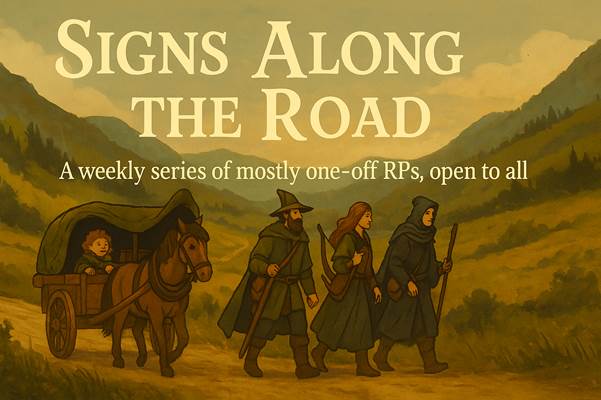
Banner for 'Signs Along the Road' showing a group of people walking with horses on the road.Image created using generative AI

OOC – Author’s Note:

This story recounts a live RP session held as part a weekly series called "Signs Along the Road". Each week there is a new RP hook. If you would like to come along, please reach out to Naridalis. The series does refer to the Company of the East Road and can be used as a way to ICly introduce your character to the kinship (whether you wish to join is entirely optional).

Additionally: This piece was shaped with a little help from AI. It helped on things like the structuring, some names, shortening some verbose language/ideas as I'd written them, and it gave me the odd turn of phrase here and there. The heart and shape of the story are my own, but I realise it is important to be transparent about my use of AI assistance.

This Week's Hook:

" Along the quiet east road from Bree, an old woman sits on a crumbled wall with a bundle of wildflowers in her lap. To those passing, she speaks of a promise upheld by her forebears... to lay an offering of flowers upon the tomb of a long-forgotten Arnorian king deep in the Midgewater Marshes. Age and distance have made the journey impossible for her these days, and her son who would usually lead her there has gone south to trade... but she is adamant to go herself. Would helping her be a quiet errand... or could it lead to a larger duty to fulfil. Anything is possible within the Marshes...”


"Flowers for Kings"

A group of people in clothing

AI-generated content may be incorrect.

The morning was peaceful upon the East Road, the mist still clinging to the hollows and the air rich with the scent of autumn leaves. The road was fairly busy, filled with merchants and traders from Herne and beyond, even wagons out of Gondor rumbling northward through the green hills.

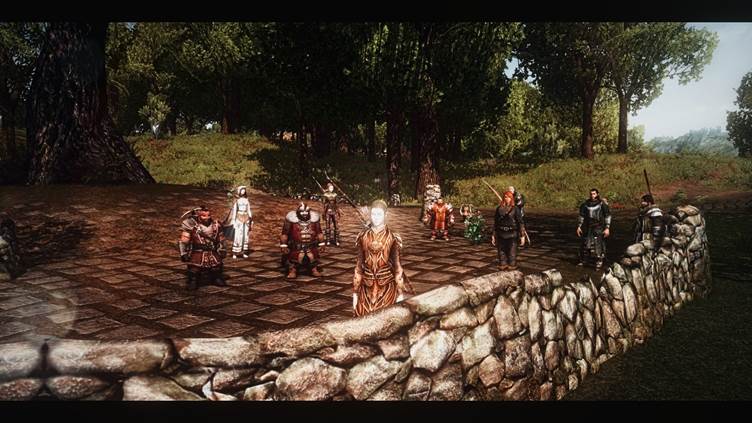
Near the great Yellow Tree, just outside of Bree, Naridalis waited in quiet contemplation for her friend Daewen to arrive. Quiet that is, until a rider passed through and stopped suddenly. Fymrin was her name, and she was clad in fine leather armour. A hunter Naridalis suspected, perhaps returned from the Chetwood. But before she could consider it further, from behind them both came the further trampling of boots: Nelm of Rohan, some say a ‘Thane’, if such can be believed; Melannen, a fiery red-haired woman dressed darkly; and soon others Benjenn, one of Beorn’s line Naridalis suspected, Rothlung, clearly a hardy warrior possibly hailing from beyond the misties, and then a curious collection of dwarves: Vatnarr, Wittkun and Rompli, though they did not seem to be travelling together… together they all were bound by chance to meet along the same stretch of road.

Greetings turned to conversation between a few of them as they passed, and Nari thought the discussion might have begun with Fymrin speaking of a great white bear that she had ‘glimpsed’ in the woods. But soon their talk turned lighter… tales of roads travelled, mishaps, and cheerful boasting of adventures on their way to or from Bree. There was laughter between them, for such gatherings on the road seldom came without mirth.

Yet among the bustle sat an old woman by the far wall, from Nari’s position at least. She was wrapped in a shawl of faded green cloth and in her lap, she sorted a handful of wildflowers within a basket; her fingers trembling as she looked up at the passers-by. Her voice, when it came, was thin but steady.

Nari and others of Elven hearing caught her frail words first, though they were still half lost in the road’s bustle. To most, the woman was only another weary traveller until Daewen arrived, her unique presence drawing eyes and ears alike. With her coming, attention gradually turned fully to the old woman who had persisted in speaking aloud, and people stopped to hear what she had to say.

She spoke slowly, gathering her breath as she went. First she told of Bree and its folk, of the marsh road she had walked since youth, and only after their interest grew did she reveal what truly weighed on her heart. There was a tomb in the Midgewater Marshes, she said, where a king of Arnor lay sleeping. Each spring she walked there to lay flowers upon his rest, as her mother had done, and her mother before her. But age had made the road cruel, and her son had gone south with a caravan. She asked would any of them spare their time, to help her reach that lonely place?

The strangers glanced among themselves. Naridalis was among the first to incline her head in acceptance of this request for help. “You shall have help in this,” she said. One by one, others gave their assent. Benjenn swore it by Beorn of old; Fymrin offered her blade; Nelm bowed as a Thane of Hytbold; even Rompli, an ever-boastful dwarf, roared that ‘no hero worth his beard would refuse’. Wittkun grumbled but came along, muttering of fools and flowers.

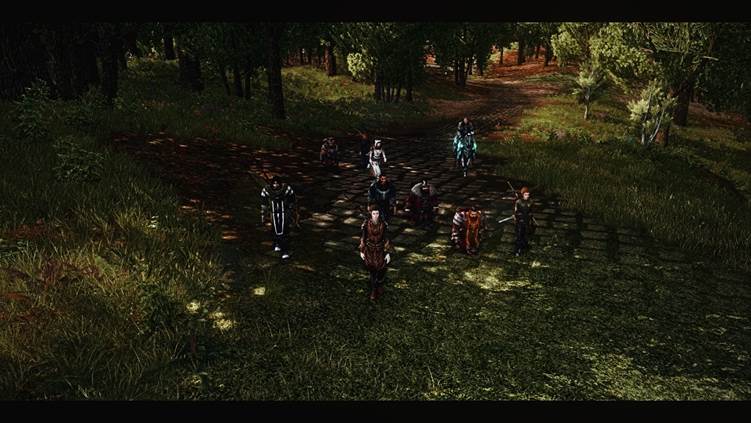
So they set out eastward, the old woman walking ahead with her stick, her pace slow yet certain. The Yellow Tree faded behind them as the land dipped toward the marsh. The air thickened, heavy with the smell of peat and stagnant water, and a chorus of frogs and neekers soon filled the peace of the road. They crossed by stones slick with moss until the path became little more than a chain of half-sunken steps.

Their journey was not without mishap. The Midgewater Marshes were treacherous, filled with unseen pits and sudden sinkholes that could swallow a man or an elf to the knee, and easily submerge a halfling. The air buzzed thick with midges, biting and relentless, and the fog muffled both sight and sound until even their own voices seemed swallowed by the mire.

Fymrin nearly lost her footing in the mud, saved only by clutching a half-buried log. Melannen relied on Rothlung’s counsel to cross a particularly deep section. Rompli plunged in headlong, spluttering about “heroic miscalculations.” Naridalis herself slipped once, and when she rose, she held not mud but a severed goblin arm, fresh and pale. Such a putrid place was this, that she imagined the goblin felt the better of losing the arm, to hasten its journey out of this place…

The fellowship grew wary in their travels, for the marsh was known to hide more than beasts… there were whispers of wights and ghosts from the wars of old. Rothlung spoke low to Benjenn of strange tracks he had seen, neither man nor orc, and Wittkun lit his pipe to keep the midges away – clearly not his first venture into such a place. Yet the old woman pressed on, following the willows and the faint shimmer of higher ground ahead, as if unbothered by it all. For she had tread this route many times throughout her years, and where she could she helped others find the way still.

A group of people in a field

AI-generated content may be incorrect.

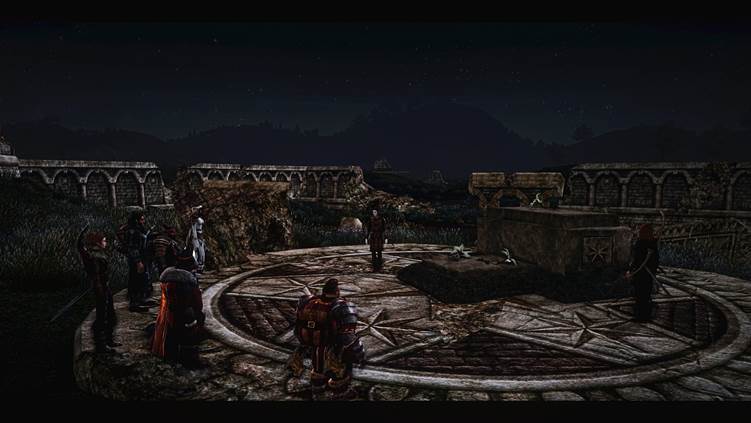
At last the mists thinned and the land rose beneath their feet, though it was not ‘dry’. The reeds gave way to stretches of bare earth that offered a reprieve. In the soft light, shapes began to emerge before them…. Of a ruin half-swallowed by mud, its pillars leaning like weary sentinels, walls carved with broken crowns and fading stars.

The fellowship slowed their steps, hushed by the weight of the place. Naridalis felt the air change, colder now, as if memory itself lingered there. The old woman’s eyes shone as she lifted her hand, awe and reverence shaping her voice. “Here he lies,” she whispered at last, “the king whose name is lost. When peace failed, he chose no side but to protect the people, and so he swore to be buried where all three realms met.”

They climbed through the ruins until they arrived at a stone dais, where a marble tomb lay beneath moss and vine alike. The air here was sweeter in scent.

Recognising the engravings along the tomb, Daewen sang softly of the Seven Stars and the White Tree. The melody wound through the ruins like a chant, drawing the mist lower around them. Each member of the fellowship followed in turn; in their own way of course... Nelm of the Mark bowed deeply, offering the respect of Rohan; Benjenn knelt and murmured a blessing in the tongue of Beornings; Fymrin folded her hands, quiet and thoughtful. Even Rompli bent the knee, though his words were clumsy: “Honourable king! You were good, and honourable, and rich too!” Wittkun too bowed his head, muttering a gruff verse from the deep halls of his kin. Naridalis lingered apart, her gaze fixed upon the carvings, hearing in Daewen’s voice an echo of ages past and feeling that time itself paused in reverence.

The old woman smiled through tears and laid her flowers last, whispering something too soft to catch. As she did, Daewen’s hand brushed aside the moss on the tomb’s edge, uncovering a line of worn script. Her eyes widened as she read it aloud… the name of the king, long forgotten by all save the stones. ‘Arvaldir, son of Eärmon, remembered for his mercy and his gift of bread to the poor’. The sound of that name seemed to travel through the ruin like a breath of wind. The old woman’s face lit with wonder; she laughed and wept further all at once, rejoicing that her devotion had not been in vain. For a moment, peace seemed to rest upon them, as if the land itself remembered. The reeds stirred, the air eased, and even the marsh’s scent seemed gentler

Yet the stillness was fragile. Nelm, wandering along the ruined wall, called quietly to Rothlung at his side. “Look here,” he murmured. “These prints… I’ve hunted beasts all my life, but I know not their kind.. they almost seem like….” Rothlung crouched beside him, brow furrowed. “Orcs, perhaps… and many,” he said grimly. “We may not be alone,” he had time to say aloud within earshot of a few of them.

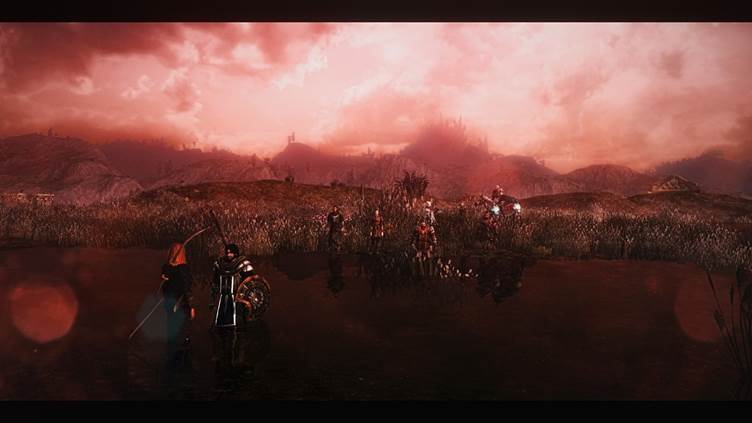
As he spoke, Nari glimpsed a pale light coming from her side… from her blades… for their edges shimmered blue. “Orcs,” Daewen cried, seeing Nari’s blades herself. But it was too late, for a great host of shadows poured over the ruin’s edges at them… with guttural cries breaking from above them too. Goblins poured down the shattered walls, accompanied by larger Orcs in their ambush. Dozens, then scores, swarmed the courtyard. Nelm shouted for cover, but Rompli only roared, “Dwarf heroes never hide!” as he charged headlong into the fray.

The marsh erupted into chaos. Arrows hissed through the air, thudding into stone and flesh alike. The horse of Nelm reared and screamed as goblins dragged at its reins, the rider slashing down with his blade. Rothlung’s spear struck true, felling a monstrous Orc, only for a goblin to leap upon his shoulder. Vatnarr's swings felled goblin and orc alike. Fymrin’s twin swords shone pale in the gloom, cutting through two goblins in a blur of motion. Wittkun’s mace swung wide, crushing armour and bone with a sound like thunder, while Benjenn, transformed in his bear-form, waded through the melee, scattering foes with roaring fury, focussing on the larger Orcs.

Naridalis fought near the tomb, her daggers flashing bright blue where goblin blood met their edge. One of the creatures raked her arm with a jagged blade, the wound searing as the filth burned her skin, but she pressed on, driving her knee into its chest and casting it into the mud. “Hold the line!” she cried, though her voice was half drowned by the clash and shrieks around them.

A video game of a video game

AI-generated content may be incorrect.

Lightning burst suddenly above, Daewen standing upon the tomb, her hands raised high in the air. A bolt struck a nearby wall with blinding force, splitting it open in a shower of molten stone – casting off a group of goblin archers and raining down on others still. For a heartbeat the goblins faltered, their howls drowned by the rolling thunder. Yet more came, climbing over the broken rampart, their numbers unending. The company drew closer to the tomb, their circle tightening.

Then came the cry. The old woman staggered beside the tomb, an arrow buried deep in her chest. Her flowers spilled from her grasp, scattering across the marble like drops of colour in water. “No!” Fymrin dropped beside her, pressing cloth to the wound, but the blood poured freely between her fingers. “Stay with me!” she pleaded, her face stricken with grief and fury.

The light was already fading from the woman’s eyes. Her lips moved as if to speak the king’s name, yet no sound came… only a sigh that drifted into silence.

Fymrin bent low, shaking her head, whispering, “I swore I would keep you safe.” Naridalis turned at the words, struck by the same helpless ache that gripped them all.

Then the ground began to tremble. The old woman’s blood seeped through the cracks of the tomb, tracing the ancient letters Daewen had uncovered. The air thickened with a low hum that deepened until it filled their bones. “Back!” Naridalis cried, drawing Daewen away as the marble split apart. A column of light burst from the fissure, and from within rose a figure wreathed in pale fire: a man clad in mail dark as the earth, a broken crown upon his brow.

The goblins shrieked, hurling spears and stones, but the wraith raised his hand, and the sky answered. A storm of lightning fell upon the ruin. Daewen’s earlier casting was but a spark beside it as the heavens themselves seemed to break open.

Bolts leapt between the pillars and struck the marsh, fountains of black water bursting skyward as the ground cracked and hissed. Goblins and Orcs burned where they stood, or were drowned or worse, dragged beneath the marshes… their screams faded as quickly beneath the roar of thunder.

The fellowship could only shield their eyes. Though Nari tried to look. Of what she saw… it was as if the brilliance filled every shadow, and when at last it faded, for she could not watch it to its full ending… the ruin were again silent.

Smoke rose from sundered stones; the tomb was gone. Where the old woman had fallen, only her flowers remained, darkened by blood but untouched by storm.

Nari stepped forward, her arm bleeding, and gathered the flowers carefully into her hands. “She gave her life for memory,” she said quietly. “And memory answered when she needed help… when we all did.” Fymrin stood pale beside her, tears streaking the grime on her face. Rothlung leaned upon his spear, exhausted, while Benjenn slowly resumed his human form. Rompli, soot-blackened and panting, murmured something about “honourable kings indeed.”

Around them the air cleared, the thunder long gone. None looked back as they left the marsh that day, though each felt the weight of what they had seen: a once nameless king awakened, a pilgrim’s blood sanctifying the earth, and a fellowship who came to lay flowers and instead beheld the light of a people’s legend reborn.


You can find more tales along the road here: "Signs Along the Road"

54. What Remains Beyond the Black Gate

The Herald Returns to the Ashlands

The Dead Marshes died behind her like a bad dream that had crawled into reality.
Ahead, heat rippled through the air, and the world turned iron-grey beneath a sun that seemed ashamed to shine.

The Black Gate — the Morannon — once the impenetrable maw of Mordor, now sagged like the corpse of a giant.
Its beams lay broken, scattered like the bones of some ancient beast. Rust ate through its iron ribs. The towers flanking it were half-collapsed, their watch-fires long extinguished.

What had once been glorious in dread was now a ruin, humiliated, defiled by the daylight.

She ran her fingers across a torn plate of iron, feeling the warped dents left by the siege.
A memory surfaced — her last time through these gates, armored in black and silver, the Eye burning above Barad-dûr, her purpose sharp as a blade.

Now, only silence greeted her.

She stepped through.

And Mordor… welcomed her.

The ash smell hit her first.

Then the heat.

Then the sound — distant hammering, echoing screams, and the groans of beasts bred for war long abandoned by masters who would never return.

Udûn had changed… but it had not died.

Mountains loomed like black teeth around the valley of slag and fire. Steam huffed from cracks in the earth. Smoke rolled across the ground in choking waves. Towers that once flashed with crimson signal-fires now stood crooked, manned by whoever had survived the fall — fragments, scavengers, tribes desperate to carve territory out of ruins.

Deorla felt something like nostalgia.

The Hierarchy

It was not orcs who first noticed her return.

To the west of the gate’s shattered remains, tucked behind a ridge of basalt and ash, a small Gondorian outpost clung stubbornly to duty. Tattered banners bearing the White Tree fluttered weakly in the sour wind. There were only six soldiers, all gaunt, all exhausted, their armor patched, their faces hardened by fear rather than pride.

They spotted her silhouette rising from the ash like a memory of horror.

Hands went to spears.
A bowstring tightened.

“Identify yourself!” one shouted.

She lifted her hood only halfway. Enough to show she was no orc. Not enough to reveal anything else.

“I seek passage,” she said flatly.

The soldiers exchanged looks. Their sergeant, a young man whose helmet had clearly belonged to someone much older, stepped forward.

“You’re heading into Udûn? No one goes there willingly.”

“Then you have your miracle of the day.”

Her tone made them uneasy.
Good.

But they needed someone to speak to.

The sergeant gestured her into their ruined tent.
There was no hostility — only desperation.

Inside, the truth spilled quickly.

Their captain had vanished.

Gone into Udûn to map the new orc movements.
He never returned.

Orc attacks continued with unnatural organization.

Structured. Coordinated.
Not random raids… but controlled hunts.

The men were terrified.

“It’s like nothing changed,” one muttered.
“Like the war never ended. They attack in waves… same whistles, same war drums… same banners—”

Another soldier whispered,
“And sometimes… sometimes we hear voices. Like… like someone’s commandin’ them.”

Deorla hid her smirk.

Someone was commanding them.

She leaned forward.

“What name have you heard whispered?”

They hesitated.

One answered.

“…Ugrukhôr.”

The name slid into the tent like a blade.

Deorla’s pulse thrilled.

Ugrukhôr.
The Captain of the Pit.
The Iron Torturer.
Sauron’s executioner and master of the breeding pits.

She remembered him well — and he would remember her.

To the Gondorians, she simply nodded and stood.

“Your captain is dead,” she said coldly.
“Your outpost will fall within the week. Leave by dawn.”

They stared at her in fearful fascination.

She walked away without another word.

Behind her, one soldier whispered:

“Who was she?”

No one answered.

She descended into Udûn proper as night fell, the air shifting from hot to blistering.
Plumes of steam burst from the scorched earth. Old war forges glowed faintly, their fires somehow not yet extinguished.

And then came the tracks.

Fresh.
Orcish.
A patrol.
Sloppy… but numerous.

They found her first.

Six of them — underfed, scarred, twitchy. They circled her with dull knives and rusted swords.

The biggest reached for her shoulder.

She sliced his throat open with a motion so swift they barely saw the blade.

The others froze.

Something ancient stirred in their blood — submission.
Recognition.
Fear.

They knelt without knowing why.

“Good,” she said softly.
“Now you may be useful.”

Interrogation in the Tower of Smoke

She dragged three of them to a ruined watchtower — a place where screams once echoed nightly.
It would serve again.

The first orc hung upside-down until he babbled nonsense and died.

The second broke only after she carved the Eye symbol across his chest.

He spoke of tribe hierarchies, petty rivalries, scattered allegiances…

But the third gave her what she wanted.

“Ugrukhôr!” he shrieked.
“He still rules the pit!”
“He still commands the forges!”
“He—he’s rebuildin’ the ranks! The Howlers serve him! The Pale Brethren too! They all answer to him!”

Deorla felt cold delight bloom in her chest.

The Captain of the Pit had survived the fall of Sauron, and it seems he is working close with The Pale Herald, another of the key figures in Mordor

He had claimed Udûn.

And Mordor was not broken — merely waiting.

Still... before making a move I better scout all the regions of the Mordor and see how other are doing and if they are even alive. This will give me a good overview how to reclaim Mordor and who to use and who will be my enemy. Knowing Pale Herald and Captain of the Pit will go againts me, but perhaps others could prove more usefull.

55. Where the Strong Still Rule

The march-cry of orcs echoed far behind her as Deorla slipped deeper into Udûn, moving not along the obvious roads, but through slag-filled ravines and forgotten service tunnels known only to those who had once ruled this land rather than merely survived it.

She did not approach Anglach by the main causeway.

She never did.

The Foundry That Remembered

Anglach rose from the ash like a half-buried titan.

Once, its furnaces had burned so hot that the air shimmered red even beneath clouded skies. War-engines had rolled from its gates — iron beasts meant to crush cities and souls alike. Here, the echo of Grond had first been tested. Here, dwarf-smiths taken during the Last Alliance had been forced to labor until their hands failed and their spirits broke.

Even now, the foundry breathed.

Not alive — but not dead.

The name still fit: Iron-Flame.

Its outer towers were scarred by siege and time, but the core held. Massive chimneys belched weak smoke. Forges glowed low, guarded by Ugrukhôr’s sentries — brutal orcs with pit-brand scars, their armor thicker than anything she had seen elsewhere in Udûn.

Deorla waited until night deepened, then slipped inside through an exhaust shaft cracked open during the war.

The stone recognized her weight.

Days Beneath the Hammer

She claimed an abandoned forge chamber deep within Anglach — a place where the fire still answered to those who knew the old words. The light there was dim, fed by half-starved furnaces and veins of molten iron that pulsed beneath the floor like veins in a dying beast.

For three days, she did not leave.

She stripped her armor piece by piece.

The black plates bore scars from Rohan, Gondor, Ithilien — dents where blades had struck, cracks where she had nearly fallen. She reforged them with care, heating the metal slowly, folding it back into itself, whispering old Black Speech not as spells, but as discipline.

Her blades followed.

One was reforged for speed.
The other for cruelty.

Each night, she listened.

Anglach spoke through vibration — the rhythm of hammers elsewhere in the foundry, the groan of chains hauling iron, the screams of things being tested and discarded.

And what she learned pleased her.

Ugrukhôr had claimed Anglach well.

From its depths, war machines crawled back into existence — crude, brutal constructs meant to guard his citadel in Udûn’s deepest basin. Spiked rams. Chain-flails mounted on rolling frames. Iron-plated beasts dragged by enslaved trolls.

He was not rebuilding Mordor.

He was fortifying himself against it.

He fears rivals more than enemies, she realized.

That fear made him predictable.

Whispers in the Iron Dark

Deorla did not reveal herself.

She moved above them instead — along broken gantries and half-collapsed walkways, where shadow clung thick as oil and even orc-eyes failed to pierce the dark. Below, near one of Anglach’s lesser furnaces, a pair of orcs argued in low snarls while feeding slag into the fire.

She listened.

They spoke of raids interrupted.
Of supplies vanishing before reaching Ugrukhôr’s stores.
Of humans — Easterlings — moving through the ash-wastes with discipline rather than fear.

And then a name surfaced.

Sereg.

The sound of it tightened something in her chest.

One of the three commanders she herself had appointed in the final years of the Unseen War. A man of Rhûn — patient, disciplined, dangerously ambitious. She had trusted him with men, with supply routes, with independent command. When Sauron fell, she had assumed him dead or scattered like the rest.

But the orcs spat his name with unease.

“Sereg still breathes,” one growled.
“He does not bow to the Pit-Captain.”
“He camps near the border of Udûn — gathers men — waits.”

The other hissed back, glancing nervously into the darkness.

“They say he still serves the Dark One.”
“They say he serves no one.”
“They say he wants Udûn for himself.”

Deorla smiled in the shadows.

Alive.
Unbroken.
Unbowed.

Whether Sereg clung to the memory of Sauron, or merely sought to carve a kingdom from the carcass of Mordor, did not yet matter. What mattered was that he had not submitted to Ugrukhôr — and that made him either a rival… or a blade waiting to be taken up.

She slipped away from the forge without a sound.

Her armor newly reforged.
Her blades hungry.
Her path decided.

“If you still remember who placed the crown upon your brow,” she thought, “you will kneel.”
“And if you do not…”

She turned toward the ash plains leading to the border of Udûn, where fires flickered faintly — a camp hidden just beyond the Pit-Captain’s grasp.

Deorla would go to Sereg.

Not as a ghost.
Not as a memory.

But as the Herald returned to claim what remained.

56. 'A strange letter'

Naridalis returned to the kin house late in the night. The dust of the road was matted into her cloak, and as she entered, she finds a letter on the ground by the door, where it should not be.   
  
The writing was poor, cramped and very uneven, as if scratched in haste or by an unsteady hand, most of it near unreadable, even by the standards of Men, as it was clearly not by any Elf hand  
  
Still, with care, one line could be made out, 'meet me at midnight, bring everything', and beneath it, after a blot of ink and a torn edge, a place was named with some effort, 'by the kin house stables'.  
  
She stood a long while with the paper in hand, listening to the quiet of the kin house, nobody was around, and with midnight approaching she wondered whether to go or not... the words sat ill with her. After so long away, she had hoped to take some rest, and yet this note clawed at her mind.  
  
The kin house felt altered to her, as though it had drawn a quiet breath in her absence and now held it. Where was Mervedis? Often would she be found walking the halls at night time, when others slept. Nari had asked her once what for, and she had replied "To think Nari, to think"...   
  
Mervedis did not seem to sleep much; far too much thinking to be done, and especially of late, since she had taken up so many responsibilities after Deorla's departure. Mervedis had been central in efforts to hold the Company together. Nari worried about her, but knew she had others in the Company to watch over her while Nari travelled abroad.
  
Sleep also did not come easily to Nari, ever since her time beneath the Black Pool. And now, the thought of sleep really did not appeal to her. Not with the words from the letter pressing closer at her thoughts.

The hour was approaching... the place close by.... and the sense that whatever was being gathered, it had not been meant for her eyes to see...


This story has a connection with this one: 'Turning Point'

57. 'Turning Point'

OOC - Author's Note:
This entry follows on from a series of live events which culminated in the death of a character, who is/was quite important to Lonoric. With events having moved so quickly, I’ve not yet written much about the two character’s first meeting as of yet, so stayed tuned for that as I work with the character’s author in due course.

The relevant summary of the key event is excellently provided by Bethrelfin, here.


Additionally: This piece was shaped with a little help from AI. It helped on things like the structuring, some names, shortening some verbose language/ideas as I'd written them in the first instance, and it also gave me the odd turn of phrase here and there while editing. The heart and shape of the story are my own, but I realise it is important to be transparent about my use of AI assistance in its production.


‘Turning Point’

Image Credit: StockCake.com

From the journals of Lonoric, Archivist Third-Class

-Company of the East Road kin house, Bree-

I write tonight with steady hands, though my heart keeps missing its step, as if it has forgotten the tune it once knew. It has taken several months to recuperate after what happened, though my injuries were not so grave as others… The Shire looks the same as ever, green and flowery and oh so certain of its ‘peace’; but I have learned that such things can indeed deceive, and deceive fatally.

Mervedis taught me that, long ago, in Bree, back at the Company’s kin house where we had first met. I did not understand the life lesson then, and I hate that I have come to understand it better now…

To see her fall, struck down by a plot wrapped in trickery and stolen pies, is a hurt I do not yet know how to express. I was never an innocent hobbit, not truly, not like others I knew living quiet lives… but I was a hopeful one. That part of me feels smaller now with her passing.. her murder.

Feeling better for travel, I ventured all the way past Michel Delving to Bethrelfin’s cottage and arrived only this morning, thinking the sound of her voice or the purr of Dumpling might steady me.

Instead, I found stillness.

The place which had been so carefully mended and tended to after its long years of ruin, stood neglected again. Silent. Cold.

The garden lay untended, the planters empty, the very beds where Malethion once perfected his craft left bare to the Yule time weather.

They are gone, then.

I think he has taken her eastward, perhaps back toward Mirkwood, away from this sorrow. I cannot fault him for it. I only hope it is but for a time, and not a leaving altogether. For I know how they both found joy being in the Shire… at least… they had once found joy here.

If ever I should wander so far myself, I wonder if our paths might cross again, and whether we would know each other as we were, or what we have become…

What troubles me most is not only grief, though it sits heavy enough in me to make me feel as if I carry a sack of potatoes on my back at all times, but a certain strange ‘heat’ boiling beneath my skin.

Firebryn is dead, she has slain Mervedis, completed her mission, and so there can be no simple settling of accounts. No justice for Mervedis… not even vengeance…

… And yet the order came from Deorla, the one known as the Shadowflame, once of ‘us’, the former leader of the Company! That thought does not rest well with me. Though before my time, the events I had only started to learn from Mervedis point to a betrayal of the Company, for what it stood for, and for what it ought to be.

But this… this was worse. If Deorla could seek vengeance against us, then why can’t I seek it of her?

Tonight I will write to the Company’s housekeeper, asking him to meet me at midnight by the stables, for I have timed my arrival accordingly to avoid the notice of others.

I shall ask of him to bring all of Mervedis’ recent notes. I know she was tracking rumours, threads, half-seen signs of where Deorla had fled.

I will keep this to myself. No more lives need be put at risk for what I intend. What I will do with such knowledge, I cannot yet say, only that Deorla must answer. Whether by justice or by my own hand, I do not know.

But I will see it done.

I will see it done for Mervedis.


This story has a connection with this one: 'A Strange Letter'

58. Steel Knows the Truth

Deorla did not have to search long.

Sereg had chosen his ground with the instinct of a born commander — and she recognized it immediately. His base lay cradled in a bowl of blackened stone near Anglach, the mountains rising steeply on all sides like clenched fists. Only a single road led inward, narrow and steep, choked with sharpened wooden stakes and iron-spiked barricades. Watchtowers rose at measured intervals, each manned and alert. Fires burned low and disciplined, never flaring high enough to betray their numbers.

Deorla paused at its edge, studying the layout with an approving eye.

Perfectly chosen, she admitted silently.
Paranoid. Isolated. Patient.

She did not skulk this time.

She walked openly down the road, cloak drawn back just enough to show steel beneath. Crossbows snapped into readiness. Spears leveled. Voices barked orders in the tongue of Rhûn.

“Stop there!”

She stopped.

Several men stared harder than the rest. One lowered his weapon slowly.

“…By the East,” he murmured.
“That armour… I’ve seen it before.”

Deorla raised her chin.

“I seek Sereg,” she said. “Tell him I have returned.”

Steel shifted uneasily.

After a tense pause, a runner was sent inward

Sereg did not arrive with ceremony.

He came like a storm.

The moment he emerged between the towers, he lunged — His golden halberd flashing, heavy and brutal, forged for war rather than show. No words. No warning. No hesitation.

Deorla barely twisted aside in time.

Steel rang against steel, the sound echoing harshly against the mountains. The first blow drove her backward. The second split the air where her throat had been. Sereg fought like a man who had spent years expecting betrayal — relentless, precise, merciless.

She countered with speed and experience, but he was stronger than she remembered.

They circled.
Clashed.
Bled.

Her blade nicked his shoulder; his pommel cracked against her ribs. The watchers did not interfere — they understood.

This was not an execution.

It was judgment.

Sereg drove her to one knee with a sweeping strike, kicked her sword from her hand, and placed his halberd blade at her throat. Her breath came hard. Her vision narrowed.

Then—
The pressure vanished.

Sereg stepped back.

Slowly, deliberately, he lowered himself to one knee before her.

The camp froze.

“I was testing,” he said, voice low and steady.
“Too many tricks lately. Too much sorcery. Too many ghosts wearing familiar faces.”

He looked up at her, eyes sharp and searching.

“Now I know it is you. Flesh and bone.”
“The Herald.”

Deorla exhaled once, bitter and breathless.

“You always did enjoy theatrics,” she rasped.

A corner of his mouth twitched — not a smile, but something close.

“You taught me not to trust appearances.”

He helped her to her feet without ceremony.

Around them, the camp slowly relaxed, though no weapons were lowered. Sereg gestured for her to follow him inward, toward a command tent reinforced with scavenged iron and stone.

Inside, maps of Udûn lay spread across a heavy table. Routes were marked. Supply lines noted. Anglach circled in red.

Sereg spoke without looking at her.

“Ugrukhôr grows bold. His machines crawl closer every season.”
“He calls himself lord of the Pit, but he knows I will not kneel.”

“And yet you remain,” Deorla said quietly.

He turned to her then.

“I remain because this land is unfinished.”
“Because Mordor does not belong to orcs alone.”
“And because you named me commander — and I do not abandon what I am given.”

Silence settled between them, thick with memory and unspoken history.

Outside, the forges of Anglach throbbed faintly, like a distant heart.

Deorla straightened, pain set aside.

“Then listen carefully,” she said.
“Because Udûn is about to choose a ruler.”

Sereg inclined his head.

“I am listening.”


59. The Shape of What Comes Next

The fire between them burned low, settling into a bed of coals that glowed like watchful eyes. Deorla stood over the map Shereg had spread across a scarred table—Mordor, broken into jagged regions by ash, iron, and old rivalries. Once, she had walked these lands as a servant. Now she looked upon them as something to be taken.

“I am done surviving,” she said at last, her voice calm in a way that made it dangerous. “I will take all of Mordor. Every pit, every tower, every broken banner still clinging to the idea of power. And I will unite it.”

Shereg did not interrupt. He only listened, arms folded, the faintest curve of a smile tugging at the corner of his mouth.

“I cannot rule it alone,” Deorla continued. “Mordor does not bow to a single blade—not anymore. It bows to commanders who know its filth, its hunger, its way of breaking the weak.” She lifted her gaze to him. “Udûn will be the first. You will rule it in my name.”

That earned a sharp breath from him—not surprise, but recognition. He went to one knee without ceremony, fist pressed to the stone floor.

“Udûn will answer to you,” Shereg said. “By iron and fire.”

She inclined her head once. It was enough.

The fire dipped lower as Deorla’s gaze lingered on the map, her voice softening—not with regret, but with certainty.

Then, quieter—almost an afterthought, though it was anything but—she added,
“Firebryn is dead.”

“Firebryn did not want to fade away,” she continued. “She did not want her ending to be watching over a quiet house in Rohan, counting seasons until death found her gently.”

Shereg looked at her, listening closely.

“She wanted meaning,” Deorla continued. “So I gave it to her. I sent her to meddle where it would hurt. To strike at the Company of the East Road. To remind them that what they broke was not finished with them.”

Her jaw tightened.

“She chose her end. And she died as she lived—moving pieces on the board, not waiting to be removed.”

Shereg bowed his head once. “Then she died as a player,” he said quietly. “Not a caretaker.”

“Yes,” Deorla replied. “And that matters.”

Shereg straightened and gestured to the map. “If you are serious about taking Mordor—and I believe you are—then you should know the board as it stands.”

He pointed first to the south-east.
“Dulgabêth now calls himself Sauron’s Heir. He gathers remnants, warbands, anything that still bows to old titles. He plans to seal his claim by wedding Lhaereth the Stained—blood, lineage, terror. A neat little lie dressed as destiny.”

Deorla’s lips curled faintly. “And Lhaereth?”

“She plays her own game,” Shereg said. “Whatever she tells Dulgabêth, her eyes are always elsewhere. But make no mistake—both of them want Ugrukhôr broken.”

He tapped Udûn. “Ugrukhôr still squats in Durthang, fat on iron and arrogance. His only real ally is the Pale Herald, but the Herald is busy in Lhingris, tangled in the Shelob mess. For now, Ugrukhôr’s borders are quiet—but only because he believes Anglach will always feed him.”

That made Deorla smile. A thin, cruel thing.

Shereg continued.
“Uradani and Rogmul have sealed themselves away. No messengers in or out. No one knows what they’re building—or who they’re preparing to strike.”
“Karazgar is dead. Fell somewhere in Rhovanion. No body, but no power either.”
“And Dolguzigir, the Dark Archivist…” He shrugged. “Still buried in scrolls and spells. He works from Minas Morgul, as always. Only now, Morgul has a new master—Gothmog, the Nameless Flame. The two seem… aligned.”

Deorla absorbed it all in silence.

“At present,” Shereg concluded, “the smartest move is to choke Ugrukhôr slowly. Anglach is his lifeline.”

“Then Anglach becomes mine,” Deorla said. “I will take full control of the foundry. No iron leaves Udûn without my word. Let him starve behind his walls and call it strategy.”

“And me?” Shereg asked.

“You will go west,” she replied. “To Dunland. Raise reinforcements. Old loyalties. New grudges. Udûn must look strong before the first blow ever falls.”

“Find Frestang. Speak with him. Use his words, his kin, his grudges. Dunland has always remembered who listens to them—and who uses them. Make sure they choose the right path again.”

She placed the letter into Shereg’s hand.

“One more thing,” she said. “Take this to the Company of the East Road. Let them know I remember them. Let them wonder whether they still remember me.”

Her eyes hardened. “If there are any left who would choose me willingly—good. If not… Firebryn was only the beginning.”

Shereg studied the seal, then laughed softly. “A warning wrapped as an invitation.”

“Exactly,” Deorla said.

As they parted ways—him toward the west, her back toward Anglach and the choking heart of Udûn—Deorla felt it settle at last. The wandering was over. The mourning was done.
 

60. Message from Mordor

(( This is happening about four months after this story here: https://laurelinarchives.org/node/66594 ))

In a small tavern in Cardolan in Herne to be exact, a weird figure appears, wearing all gold and black outfit with a golden scythe, you can clearly tell he's searching for someone, or something.

But finally his luck reached him, the elf of whom Deorla spoke and described was here. He approached her, trying not to scare her away, as many for some reason do cowar in fear when he approaches them, maybe it's due to his massive height, who knows. He greets her with his name and just tosses a letter towards the table she was sitting at
- Letter from Deorla 

That's all he says, and just leaves. He does not want to cause any scenes, and unnecessary bloodshed, and now after his task is completed, he can go back to his homeland.

Message is sealed with a wax with a logo of Company of the East Road

Dear Naridalis
I wonder is it better to be born good, or to overcome one's evils, through great effort. Would they see you any different? There are sayings that conflict their own meaning; such as everyone is born good. Then why are there monsters? Why we shaped by the destinies laid upon us? Are you telling me no monster can be born, only gods tainted by that which is laid before them? If that is to be true, do we let monsters atone? Is it right to, or should they be forced to. Should they be forced to live their lives atoning for the actions they had. What if they wish not to, what if they wish to be monsters? Should we, should we purge them? There are the questions I asked  myself, it led me to belief that I could not be what I was. For I had done wrong I too had been a monster, but Company saw good in me, they took me in, they let me partake in their adventures and thought that I saw the good in people, and the bad too. But I dictated my own rights, my own beliefs. I know you may not look down on me still, even after all this time and chaos. But if you still do, know that you're right. No human is born good, no human is born evil, we are blank canvas, and what is written upon us is written by what we choose. What we see.  Sometimes our canvas can be written but with little ink, or blood. But it is still us who writes it. Thank you. Now I think it's time I start living. If you still wish to, you and Company may still serve me, before I claim what is mine. 

61. Only the Strong Remain

Ashes That Answered

Udûn had grown quieter.

Not weaker — never that — but quieter.

The forges of Anglach no longer roared without pause. Deorla had ordered the fires controlled, rationed, disciplined. She had no intention of burning through strength too early. Ugrukhôr’s supply lines had been bled carefully rather than shattered. She did not want chaos.

She wanted ownership.

But Anglach was not yet fully hers.

For weeks she had haunted it.

She struck patrols in the outer slag tunnels — never the central guard.
She collapsed a minor storehouse — never the primary vault.
She sabotaged a gear assembly in the eastern crane towers — but left the heart of the forge untouched.

Enough to unsettle.

Never enough to provoke a full siege.

The orcs stationed there grew restless. They blamed ghosts. They blamed Shereg. They blamed each other. Watches doubled. Sleep thinned. Blades were drawn at shadows.

And sometimes they were right.

From the high ridge above Anglach, Deorla watched patrol routes shift below like veins under skin. The Easterlings Shereg had left behind — loyal, disciplined, hardened — were not enough to seize the foundry outright. Not yet.

She needed more than fifty swords.

She needed weight.

So she pressed lightly. Carefully.

A missing scout here.
A supply wagon vanished into ash there.
A captain found dead with no sign of struggle.

The message was clear without ever being spoken:

You are not safe.

But she never struck hard enough to trigger Ugrukhôr’s full retaliation. Not yet. Not until she could close her fist and not merely brush with her fingers.

Patience was a sharper weapon than steel.

And on the second moon of the third watch, Shereg returned.

The Return from Dunland

He did not arrive with banners.

He arrived with dust.

A column of hard-eyed Dunlendings rode behind him — not many, perhaps sixty — but they were the right kind. Scarred. Bitter. Loyal to coin or creed, and in this case, creed had been spoken.

Frestang had kept his word.

They entered through the eastern approach of Anglach, where the mountains choke the wind and force all riders into a narrow throat of black stone. Deorla stood waiting, armored once more — her repaired plates darkened with oil and soot, edges sharpened, no longer bearing the wounds of Ithilien.

Shereg dismounted slowly.

For a long moment they only studied one another.

“You breathe,” he said at last.

“You obeyed,” she replied.

That was enough.

What Dunland Promised

They spoke that night within their camp, still perfectly defended. 

Frestang had gathered more than fighters.

He had gathered belief.

“The Dunlendings remember the Eye,” Shereg said. “Not as a god. As a force. As an order in the world. They are tired of bowing to Rohan and being forgotten by Gondor.”

Deorla said nothing.

He continued.

“Frestang spreads your name carefully. Not as Dark Lord. Not yet. As the one who survived the fall. As the one who understands the new age.”

A faint smile touched her mouth.

Smart man.

“And the Company?” she asked.

Shereg’s expression shifted.

“They received the letter."

Silence stretched.

"And?"

Shereg just shrug "They ignored it" 

What Changed in Mordor

Two months was enough time for rot to surface.

Ugrukhôr had noticed the strain on his supplies. Durthang’s forges burned less frequently. Patrols grew harsher along the border. Scouts vanished near Anglach — taken quietly, questioned, discarded.

But he had not yet struck openly.

Because something else held his attention.

“The Pale Herald has withdrawn further into Lhingris,” Shereg reported. “Shelob’s brood grows restless. Rumors say he seeks relics beneath Cirith Ungol.”

Deorla nodded once.

“Let him chase spiders, at least we do not have to deal with Shelob now, that's one enemy I do not wish to face at all.”

“And Dulgabêth?” Shereg asked.

Now that name lingered heavier.

“He courts Lhaereth openly,” Shereg said. “The wedding has not happened. Some say she delays him. Others say she studies him.”

“And which do you believe?”

“I believe,” Shereg answered carefully, “that she waits to see who bleeds first between you and Ugrukhôr.”

That made Deorla laugh softly.

“Then we shall not bleed.”

The Land That Remembers

That night, long after Shereg’s men had welcomed him back and had a toast with him and the Dunlendings that settled in, Deorla walked alone along the upper ruins of the Narchost, one of the two towers that formed the Black Gate. For what purpose? One say to calm her mind and think about the past. 

Udûn stretched beyond the iron balconies like a scar that never healed.

The ash wind moved softly across the valley, carrying distant echoes of Shereg’s war preparations.

She rested her hands on the blackened railing and looked outward.

“You always hated this place,” she said quietly.

There was no one beside her.

Not truly.

But in her mind, Firebryn leaned there as she once had — arms folded, eyes bright with defiance, hair catching forge-light like living flame.

“You said Udûn felt wrong,” Deorla continued softly. “Too quiet. Like it was holding its breath.”

In memory, Firebryn had laughed at the darkness rather than feared it.

Deorla’s gaze swept the valley.

“This land was not born to Sauron,” she murmured. “Before him, it was Morgoth’s wound. Before that, it was simply broken earth from a war that reshaped the world.”

Her voice was steady — almost instructive, as it had once been when teaching.

“Sauron did not create Udûn. He disciplined it. He forged order from chaos. That is why it endured him.”

The furnaces below throbbed, red light flickering across her armor.

“Ugrukhôr thinks he commands a fortress,” she said. “He does not understand what he stands on. Udûn belongs to whoever commands its memory. Whoever shapes its fear.”

Silence answered her.

For a fleeting moment, the wind shifted — and she almost imagined Firebryn’s reply:

Then command it.

Deorla closed her eyes briefly.

“You wanted a meaningful death,” she said at last. “Not a quiet ending in Rohan. I gave you fire.”

The valley offered no judgment.

Only ash.

When she opened her eyes again, the softness was gone.

“Watch, then,” she whispered into the dark.
“Watch what I build.”

The Citadel in Shadow

While the valley burned, Deorla moved.

Not with an army.

Alone.

She circled eastward through the broken ravines carved by old lava flows — paths she remembered from years past. She avoided the main war road entirely, climbing instead along a jagged escarpment that overlooked Durthang’s rear elevation.

The fortress rose like a blade from stone.

Durthang had changed.

Reinforced outer palisades. Additional ballista towers. Ore caravans funneled directly into a newly fortified lower gate. Smoke rose thicker from its inner forge shafts — Anglach’s reduced output had forced Ugrukhôr to compensate internally.

Good.

Strain bred mistakes.

She observed guard rotations. Counted banners. Noted which towers signaled fastest. Which commanders responded with discipline — and which with panic.

One detail pleased her most:

The eastern supply conduit — a narrow ravine passage feeding water and ore carts — was under-manned during full mobilization.

Because Ugrukhôr did not expect threat from that direction.

Because he believed the mountains protection enough.

He was wrong.

As twilight swallowed the battlefield noise below, Deorla crouched upon a blackened ridge overlooking Durthang’s highest tower.

The banners of Ugrukhôr snapped in the ash wind.

“For now,” she murmured to herself.

Below, Shereg’s forces disengaged exactly as planned. Ugrukhôr’s troops pursued briefly — then withdrew, thinking they had repelled an ambitious assault.

They celebrated too soon.

By the time Deorla returned to their camp under cover of night, she carried something far more valuable than bloodshed.

She carried understanding.

Shereg awaited her in the forge chamber, armor dented, cloak torn, but alive.

“Well?” he asked.

She removed her gloves slowly.

“He defends the front like a beast,” she said.

A pause.

“But he leaves his spine exposed.”

The firelight reflected in her eyes.

“We are not ready to take Durthang,” Shereg said carefully.

“No,” she agreed. "At least with not brutal force alone"

Then her voice sharpened.

“But now, I found other way around all that I just need more time to work on the details”

62. The Iron Warlord and the Shadow Queen

Echoes in Udûn

Two months had passed, and Udûn had begun to whisper again.

Not with the crackle of forges or the grind of war machines—
but with the rumor of her.

Deorla the Herald.
Deorla the Returning Flame.

Some orcs swore they saw a pale silhouette stalking the borders.
Others claimed their patrols were cursed—missing men, silent blades in the dark, fires snuffed while their backs were turned.

Nothing decisive.
Nothing final.

But enough to unsettle.

Enough to uproot the stability Ugrukhôr demanded for his empire.

Udûn remained a wound carved into Mordor’s flesh.
Black slag mounds rose like burial hills.
Broken catapults rusted half-swallowed by ash.
The wind carried the faint ring of metal—echoes of the age when thousands labored to forge engines of war.

Deorla walked through it as if returning to an old battlefield she herself created.

A broken warg snarled at her from behind a collapsed siege tower.
She raised her hand, and the beast froze—
not because of magic,
but because it remembered a shape older than fear.

She let it live.
Let it carry the rumor further.

Her sabotage continued:

  • She slashed the support beams of watchtowers.
  • Poisoned one of the forge-water basins so blades came out brittle.
  • Toppled a supply cart into a ravine.
  • Killed only the orcs wandering alone, never groups.
  • Left tracks that misled patrols into old mine shafts.

Each act small—
but together, they wove doubt into every heartbeat of Anglach’s workforce.

By the third week, the overseers screamed at empty air.

By the fifth, Ugrukhôr doubled the perimeter guard.

By the seventh, panic had spread like fever.

But still, she did not strike.

She wanted them tired.
Paranoid.
Sleepless.

She wanted the forges of Anglach to tremble at the thought of footsteps in the dark.

Then she would take them.Or at least pretend to do so, as she takes the fortress. 

The Creature at the Iron Maw

One night, as Deorla traversed the ancient mining tunnel beneath Udûn—the one built during the Last Alliance—
she felt a weight in the air.

A presence.

Something was waiting at the tunnel’s exit.

Not guarding.
Not hunting.

Warning.

It crouched on all fours like a starving dog, but its limbs were too long, its face too human. The pale, leathery skin clung to sharp bones, almost glowing in the dark. Something like wings drooped from its back—thin and tattered, more membrane than flesh.

A wretched chimera of orc, ghost, and sorcerous residue.

“The Pale Herald made you,” Deorla muttered.

The creature hissed—a sound like wet iron cooling.

“No master… only hunger… only webs… only eight eyes watching…”

“The Pale Herald,” she repeated. “He’s stirring Lhingris?”

It shook violently.

“She stirs… SHE returns… and he obeys. Pale flames in the tunnels… silk in the cracks… Udûn will be last to fall when the great hunger wakes once more—”

“What do you mean she?”

The creature began to melt—skin slipping from bone.
Its voice gurgled into a strangled whisper:

“She spins again… SHE… SPINS…”

And then it collapsed into dust.

Not slain.
Dismissed.

A message delivered.

Silence followed.
But not peace.

Someone was watching Udûn from the direction of Lhingris.

Someone ancient.
Someone hungry.

Deorla wiped the dust from her boots and continued toward the cliffs overlooking Anglach.

Let her spin, she thought.
Mordor had room for more monsters.

The False Siege of Anglach

Shereg’s army arrived like a dark tide.

Easterlings in scale armor that shimmered like fresh blood.
Dunlendings wearing hides and crude metal plates, their war-cries echoing across the slag valley.

They assembled in full view of Anglach.

But Deorla had commanded restraint.

“Threaten them hard. Don’t break them however. Not yet. Let him believe this is the real siege, let him come out of his fortress finally.”

So Shereg staged a siege without delivering one:

  •  Day One — The Drums Begin

The first morning of Shereg’s siege dawned under a sky the color of burned bone.
Ash drifted from high chimneys like slow-falling snow, coating every helmet, every shield, every strand of horsehair in soot. The Dunlendings muttered curses about ill omens; the Easterlings only lowered their visors and marched onward, their faces unreadable behind lacquered masks.

Shereg rode at the head of the formation, dark braids snapping in the wind, his armor a patchwork of Nurnese steel and Rhûn craftsmanship. He looked utterly in his element—like the dusty plains of Udûn had been shaped for him personally.

When the first war horns sounded, the sound rolled across the valley like a wave of thunder.

The orcs of Anglach scrambled along their battlements, shouting contradictory orders, fumbling to ready their machines. Torches flared along the battlements. Standards were raised. Siege sirens wailed.

But Shereg did not advance.

He marched his men into formation, let the shadows of their numbers fill the valley, and simply stared at the foundry fortress until the overseers began to sweat.

He did not move a single siege tower.

He refused every eager suggestion from his lieutenants to send scouts or archers forward.

He merely let dread do the work.

The orcs stayed awake the entire night, expecting a strike that did not come.

  • Day Two — The Harassment Begins

On the second day, the drums returned—but this time the trebuchets were hauled forward.
Massive wooden arms creaked, groaned, and heaved stones the size of oxen into the air.

The projectiles crashed in front of Anglach’s walls in great plumes of dust, always falling just short.
The orcs roared in victory at first, thinking the invaders incompetent.

But Shereg’s trebuchets hit every miss exactly the same.

Exactly the same distance.

Exactly the same timing.

The precision unsettled even the overseers.

Then Shereg sent Dunlending skirmishers screaming toward the walls—only to have them stop, turn abruptly, and vanish behind smoke screens before the defenders could even string their bows.

A dance of provocation.

  • Day Three — The Spy from other Enemies

During the third day, as the army feigned another advance, an Easterling spy disguised as a laborer slipped into Shereg’s command tent with a tarp of oil-soaked rags and a hooked dagger.

He whispered Dulgabêth’s new mantra:

“The Heir rises. Udûn is his.”

Shereg did not hesitate.

He slammed the spy onto his back, drove a boot into his ribs, and cut his throat in a single practiced motion.

But the spy’s dying words echoed:

“He will wed Lhaereth, fool. And Mordor will kneel.”

Shereg burned the body.
Then mounted its blackened skull atop a spear.

A message to both armies:

The Ash Queen commands Udûn now.

  • Day Four — The Furnace Revenant Awakens

The dawn of the fourth day split the sky with a sound like a mountain cracking.

The gates of Durthang—miles north but unmistakable—shuddered, then opened with a scream of tortured metal. A flood of heat burst forth, warping the air. Shereg looked up from sharpening his spear as the tremor rolled beneath his feet.

At first, there was only firelight.

Then he saw the figure.

Ugrukhôr.

The Captain of the Pit.

He emerged from Durthang not as a blazing furnace titan, but as a silent, armored executioner, colder and deadlier than the forges that birthed him.
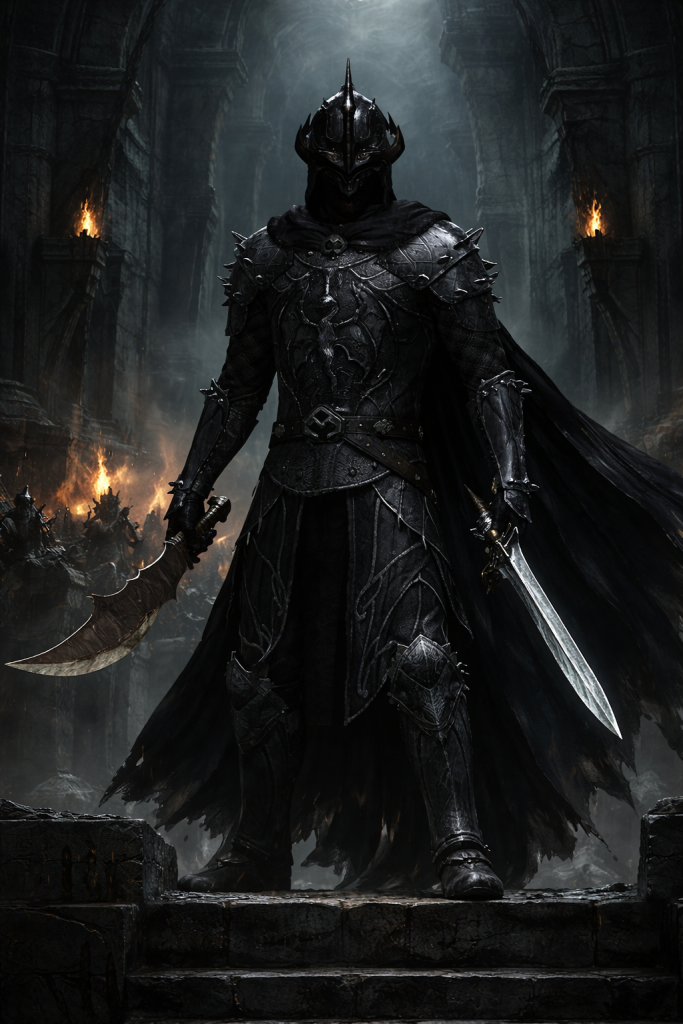
Ugrukhôr stepped through the gate encased in dark, rune-etched plate, his armor crafted with brutal precision—sharp edges, jagged spikes, and black metal that swallowed the light around him. His helm was crowned with a cruel, hooked crest, the face concealed by a visor shaped like the snarl of some iron predator.

No steam.
No roaring flames.

Just a terrible stillness, like a blade drawn in a tomb.

His pauldrons were carved in the likeness of fanged beasts, and the breastplate bore the emblem of the Eye—cracked but not erased—etched deep into the metal as though burned there centuries ago. A black cloak hung from his shoulders, frayed by years of battle, fluttering behind him like a shadow that refused to detach.

In his hands he carried his infamous paired weapons:

  • a curved, serrated butcher’s blade, designed to rip through armor with savage ease
  • and a long, pale knife, forged from some ancient alloy that gleamed like a shard of moonlit bone

No two weapons matched, and yet together they formed a rhythm of death known to every orc that had ever served beneath him.

His steps made no fiery tremor—only the cold, ringing thud of iron greaves on stone, echoing across Udûn like the pacing of an executioner approaching a prisoner’s cell.

And behind him surged his war-band:

Not molten monsters, but elite Uruks, clad in similar dark plate, their helms faceless, their armor decorated with spikes, ridges, and scraps of trophy bones. They marched with cruel discipline, shields lifted, blades drawn, unleashing guttural war-cries that rolled like thunder.

When Ugrukhôr raised his serrated blade, he did not roar fire.

He simply pointed, and the army charged.

A wave of steel.
Precise.
Merciless.
Unstoppable.

A true Captain of the Pit.

Shereg held the line, roaring orders in the tongue of Rhûn, dragging wounded men back into formation. Spears met steel-flesh hybrids, shields split under furnace hammers, and Dunlending war cries filled the valley with defiance.

But it was clear:

Ugrukhôr was not trying to defend Anglach.

He was trying to annihilate everything in front of it.

Every blow he struck was meant to crush, not repel.
Every breath he took exhaled steam that curled from cracks in his armor.

The Captain of the Pit had gone to war personally.

And for the first time since the fall of the Dark Lord, Udûn trembled beneath a true battle.

But this—
all of this—
was exactly what Deorla had been waiting for.

Deorla Finally Strikes

The moment Ugrukhôr’s forces emptied from Durthang, leaving only skeleton crews at the fortress, Deorla slipped into the same forgotten mining tunnel she had discovered weeks earlier.

The walls breathed heat from the forges above.
Ash drifted like fine mist.
Chains rattled in unseen chambers.

She moved through the tunnel like a memory.
A ghost returning to its grave.

When she emerged inside the lower levels of Durthang, her eyes gleamed.

Empty barracks.
Nearly silent forges.
Patrol routes cut in half.

Exactly as she predicted.

She began her work immediately.

She had spent the last two months gathering materials—blasting powders from abandoned storerooms, scrap metal from ruined smithies, unstable alchemical mixtures left forgotten. She combined them with her own knowledge, mixing volatile substances, shaping deadly traps, forging bombs designed not to destroy walls but to collapse entire corridors.

She planted tripwires on staircases.
Buried charges beneath main walkways.
Hung explosive vials above choke points.
Smeared killer toxins along weapon racks.
Tampered with the furnace controls and pressure valves.
Rigged the main gate locks to jam at the exact moment Ugrukhôr tried to retreat.

Durthang was turning into her weapon.

Her snare.

Her masterpiece.

When Ugrukhôr returned from slaughtering Shereg’s army—and he would return—
he would step into a fortress primed to drown him in fire.

In the heart of the citadel, Deorla paused and inhaled deeply.

The smell of iron.
The hum of forges.
The faint echo of war outside.

She smiled.

“Let the Captain of the Pit rage,” she whispered.

“When he comes home… his home will devour him.”

And with that, she vanished into the smoke to lay the final trap, which was herself.

63. Death Hung Above the Throne

Time for Action

Durthang burned quietly.

Not with open flame.
Not yet.

But beneath the fortress, hidden in forgotten maintenance shafts and abandoned furnace tunnels, death had already been planted by Deorla’s own hands.

The battle outside still raged.

The thunder of shields and iron drifted through the stone like distant storms. Every so often the entire fortress trembled from the impact of siege engines or the heavy march of Uruks rushing from gate to gate. Dust filtered from the ceiling in thin streams while alarm bells screamed somewhere above.

And through it all, Deorla moved unseen.

She stalked the lower halls of Durthang with a lantern shuttered low, memorizing every corridor, every choke point, every weak support beam. The old fortress had changed since the days of Sauron, but not enough. The foundations remained the same. Orcs rebuilt quickly, but rarely cleverly.

Ugrukhôr had reinforced the walls.
He had strengthened the gates.
He had forged deadlier weapons.

But he had not understood the deeper truth of Mordor:

Every fortress in the Black Land eventually became its own tomb.

Above the Walls

Outside, Shereg’s false siege had transformed into slaughter.

The moment Ugrukhôr entered the battlefield, the balance shifted violently.

Outside, Shereg’s false siege had transformed into slaughter.

The moment Ugrukhôr entered the battlefield, the balance shifted violently.

Shereg watched from horseback as the Captain of the Pit carved through his front lines with terrifying precision. Ugrukhôr did not fight like an enraged berserker. He fought like an executioner.

Every strike deliberate.
Every kill efficient.

His curved butcher blade hooked shields aside while the pale dagger slipped through armor gaps with surgical cruelty. Dunlendings fell in heaps around him. Easterling spear walls collapsed under the charge of his armored Uruks.

And worst of all—

Ugrukhôr’s war machines had emerged.

Not great siege towers or monstrous engines.

Smaller. Faster. Deadlier.

Iron carts mounted with rotating blade mechanisms rolled downhill into Shereg’s infantry, tearing men apart before exploding in sprays of burning oil. Heavy crossbows fixed onto armored frames launched thick black bolts that punched clean through shield lines.

Old weapons.

Prepared before Deorla’s arrival in Udûn.

Weapons built for conquest.

Shereg barely managed to reorganize his forces before another assault crashed into them.

He spat blood into the ash and growled:

“Good… come further.”

Because despite the losses, despite the chaos, this was exactly what Deorla wanted.

Every moment Ugrukhôr remained outside Durthang was another moment Deorla owned the fortress from within.

The Throne Room

Deep within the upper levels, Deorla finally reached Ugrukhôr’s personal chamber.

The doors were enormous slabs of black iron engraved with crude depictions of conquest—orc armies trampling Gondorian soldiers beneath spiked boots.

Inside, the chamber was colder than expected.

No lavish treasures.
No decadence.

Only war.

Maps covered the walls. Weapon racks lined the pillars. Crates of supplies stood ready for rapid deployment. The room belonged to a commander obsessed with readiness.

Then Deorla noticed something strange.

One map had markings different from the others.

Not Anglach.
Not Durthang.

Lhingris.

Dozens of symbols circled the region in red ink.

The Pale Herald.

And beside them, another marking written in rough Black Speech:

“The Web Opens.”

Deorla narrowed her eyes.

So Ugrukhôr feared it too.

Interesting.

The Trap for the Captain of the Pit

Deorla never left Ugrukhôr’s throne room.

Once she discovered the maps, the markings over Lhingris, and the crude warnings scrawled beside the Pale Herald’s territory, she understood immediately what this chamber truly was.

Not a place of vanity.

A nerve center.

A war room.

Every campaign in Udûn began here. Every patrol route, every forge shipment, every troop movement passed through this chamber first. Ugrukhôr trusted these walls more than he trusted his own captains.

Which meant this was where he would return.

Not the forge.
Not the barracks.
Not the gates.

Here.

The room itself was built like a bunker carved into the mountain heart of Durthang. Thick black pillars supported the ceiling. Iron braziers burned with low red flame along the walls, filling the chamber with a dim, blood-colored glow. Maps, reports, and weapon racks surrounded a massive iron table scarred by knife marks and old burns.

Deorla stood silently in the center of it all.

Then she began dismantling the room piece by piece.

She removed the iron bolts from beneath the western support pillar and replaced them loosely enough that the structure would hold for a few more hours—perhaps less if shaken violently. She poured furnace oil beneath the stone tiles around the central table, allowing it to seep into hidden cracks where it could not easily be seen.

Then she climbed into the ceiling beams.

Durthang’s throne room had once been constructed to intimidate visitors with enormous hanging furnace lanterns suspended by heavy chains overhead. Ugrukhôr had kept them despite their age.

A mistake.

Deorla weakened the chains with slow, deliberate cuts.

Not enough to snap immediately.

Only enough that a violent tremor—or explosion—would bring the entire burning structure crashing downward.

But Deorla did not intend to rely on chance.

From a leather pouch at her belt, she withdrew several small packets of compact blasting powder—carefully wrapped in oilcloth and mixed with fine iron filings stolen from Anglach’s forge stores. Crude by Gondorian standards perhaps, but in the enclosed weight of Durthang’s throne room, they would be more than enough.

One by one, she pressed the charges directly into the weakened anchor points of the chains and support braces overhead, smearing them into cracks and fastening them beneath iron joints where they could not easily be seen from below.

The moment the charges ignited, the already-damaged chains would snap apart in succession. The heavy lantern cages, burning braziers, and massive iron beams suspended above the throne would collapse inward all at once, dragging sections of stone ceiling down with them.

A controlled burial.

Violent enough to crush everyone beneath it.

And because Deorla had already sabotaged the great entrance mechanisms, the throne room doors would seal shut under the impact, trapping Ugrukhôr and his captains inside with the collapsing wreckage.

No glorious duel.

No heroic final stand.

Only iron, stone, and darkness falling from above.

Exactly the kind of death Deorla believed a warlord deserved.


64. Three Brothers

Author's Note: This story is borne of the mention of three 'random' names of the dead at a recent kin event (news of three fellows killed while guarding a caravan bound for Imladris on Company business). It offers some background for a future kin RP about the items taken.


The brothers Elias, Brenner, and John were forged in the bitter flames of Archet’s fall. Growing up in the shadow of its end, they had survived the chaotic years which had followed for all those who had been told they were ‘fortunate enough’ to have lived through the brigand assault.

Like many orphaned as a result, they had managed to cling to the edges of the law to survive. Unwelcome in Combe, Staddle or Bree, they learned early that the world had many hard edges to it, and in that harsh upbringing, they found strength only in one another.

When they first crossed paths with the Company of the East Road, it was an elf called Naridalis who had seen beyond the raw, unrefined tenacity in them, and had offered them a path toward something better. She extended the invitation of kinship not merely to fill up the ranks, but to give three broken lives a purpose worth fighting for… little knowing she was binding them to a fate she would come to later, and most bitterly, regret.

Yet, in the beginning, that unbreakable bond of the brothers was a source of some curiosity for Naridalis; curiosity and concern. At times she even felt uneasy with it. For whenever the brothers were assigned to patrols, she felt a subtle prickle of apprehension, as the brothers were virtually inseparable. They moved as a single entity; their senses and strikes overlapped. While they were undeniably capable fighters... more than capable of turning away common cutthroats or beasts... their reliance on one another was a hidden vulnerability she felt.

They would often lose focus on the wider situation, while protecting each other with a ferocity that bordered on the reckless at times. More than once she had had to get them out of a jam… many in the Company had in fact. The brothers were apologetic, at least, on the surface. They had grown to trust their new found family. Grown to trust that when they ever did get into trouble, that the Company would have their backs.

It was a beautiful, tragic devotion that made them excellent armsmen each, but hindered them from ever truly standing as individuals in the wider world. Such was the business of the Company, especially when ranging far from Breeland and the support of allies. And for this, they were often held back, kept away from the more dangerous of contracts the Company found itself handling.

For a long time, Elias, Brenner and John had been filled with a wide-eyed wonder when around Elves… other Elves… Elves they didn’t know, Elves not in the Company. Elves in the far off lands to the east. Their fascination had been truly ignited by the whispered legends and tales of Rivendell often traded over drinks in the Knackered Neekerbreeker tavern and when out on patrols with other members of the Company.

When the opportunity finally presented itself, to escort some artefacts of note to Rivendell, they were quick to volunteer. With other resources stretched thinly, and the road there better travelled of late, finally, they were given leave to go. They spoke of the journey to be as if it were a pilgrimage.... a final shedding of their haunted past, as if walking to the light of Lord Elrond’s sanctuary itself would... heal them.

But the long east road is cruel thing.

It is as cruel as the lives they had escaped when growing up, and it demanded a price of them that they could not pay, for all three had been slain en route; the artefacts stolen away.

They will not now witness the golden light of the hidden valley or the peace they so desperately sought. Instead, they lie upon the cold earth near the Last Bridge.

In the hours which passed since news of what happened reached the Company, Naridalis had taken some small solace in the realisation that the brothers at least had had each other at their ends. They were inseparable in life, and now, so too in death would they walk together. They were beyond the reach of a world that had never been their ally, and because they could no longer seek justice for themselves, she would ensure that the ones who had ended the brothers would soon find their own lives cut short.

The Company would ride at dawn to the Last Bridge, for answers... for justice.. and maybe for some small amount of vengeance as well.

Pages