By my reckoning I have lingered in fair Celondim for nine-score days and three. 'Fair' I name it, for although I am yet unused to cities and houses of stone, the green hills of Falathlorn are indeed fair and in my heart I have grown to love this elven-land (but not nearly as much as the elm-woods of Harlindon!)
Today is First Day1and already spring is stirring: the sap is flowing again in herb and leaf, and merry birds are singing in the budding branches; the air is soft and cool and carries the sweet fragrance of woodland flowers. As I write, the red Sun is slowly sinking2 beyond the mountain peaks and the growing Moon is but a slender silver sickle riding above her in the pale western sky; when next he grows to fullness, it will be his sixth since I began my labours with Maegamel and Thavroniel, and I have not been idle.
From Maegamel I have learned much of the healing of body3 and soul,4 for while we of elvenkind by the strength of our indwelling spirit suffer no sickness, our incarnate bodies are made from the stuff of Ardhon5 and therefore are less enduring than our everlasting souls. Thus the evils of the world can bring to us grievous bodily harm and our spirits may suffer anguish;6 but by the art of the healer such hurts, both Seen and Unseen, can oft be mended.
The art of healing, says Maegamel, consists of four chief aspects: knowledge and skill in the craft, inborn power of spirit, the mindful art of using this power, and the lore of all things that live. Also she told me that dealing in death, whether in hunting or in war, abates its virtue,7 and thus my peaceful Linda15 upbringing serves me well!
Meanwhile, Thavroniel has shared with me the lore of herb and tree from far afield and thus unknown to my kin in Harlindon. In my mind I thought I had great knowledge of living things, yet to my wonder she has shown me the virtues of blossom, leaf and root that grow not in the wooded eaves of Ered Lindon, and she has taught me much of the making of essences and extracts, draughts and potions, and salves and ointments thereof. Thavroniel in turn has learned from me the glad songs of blessing that my people sing while we gather and prepare our herbs of healing, which are akin to the chants she knows but she deems them more potent (much to her astonishment and to my delight!)

Besides herb-lore, Thavroniel set my hand to practice writing scripts, for in her mind she hoped I might yet pass as a scribe; but alas, she says my penmanship is hopeless! For all her labours I have failed to improve my letters, nor will she allow me to write only with the runes8 of my kin, though with them my hand is tidy; for, she says, in these latter days they are forgotten by all in the Westlands save for loremasters9 (anyway, she deems that naught that I may write would please their lofty minds!) And she yet holds to her argument that they were first made by the Elves of Doriath10, while it is the lore of my folk that they were devised by our forebears in the greenwood of Ossiriand in the Elder Days.11
This debate brings to my mind the memory of Dimaethor, father of Fethurin, who first taught me the elvish runes and letters; for he was an elf of Doriath, but he dwelt apart in the hollin forest of Region where he was wont to hunt, and he gainsaid his kin from Menegroth and trusted the tale of the Nandor.
Nevertheless, my written Sindarin has somewhat improved, says Thavroniel, yet I deem my words are awkward and ungainly, and in my secret thought I am glad that no other eyes save mine shall ever read my humble Parf-na-Innath!
She has had me practice also writing in the Common Tongue, and in speech with her she bade me to speak only Westron (for so it is called), but it is chiefly by the transfer of thought from her mind to mine that I have begun at last to best it.
It was also her hope that I might at least glean something of the scholar's craft, and therefore Thavroniel has shown me the Reckoning of Years; thus have I learned that this new year is in the elven reckoning the 137th löa of the 49th yén, but it is commonly called the 3018th year of the Third Age of the Sun.
Now the kindred of Men, she says, mostly mark their new year's beginning at the winter solstice, which I deem is folly, for surely it must begin when life is rising anew within the earth in Spring? But she tells me that it is the course of the Sun that the After-born follow, and that is the day its strength begins again to wax; and while my kin, and all of elvenkind I guess, feast and make merry at midwinter too, it yet seems strange to me. (Although the thought comes to my mind that I was born on the day of the autumn equinox, and therefore each year that day marks the start of a new year of my life.)
I also cannot grasp the need to number each day, nor the rending of the seasons into 'weeks' and 'months' when the Sun and Moon and stars all signal the ever-changing seasons, without either effort or reckoning. To my mind neither growing things with roots in the earth nor living things that move12 have a need for such a contrivance, so why should a wild elf? (But Thavroniel says it is the desire of her heart to tame my wildness!) She tells me the purpose of this reckoning is to tally the Tale of Years for masters of lore, and I say that if this toil is the delight of loremasters then that is their free choice, but it is mine is to disregard this unnatural ordering of time. (After all, they will not be bending their "lofty minds" to my simple scribbles!)
And by the counsel of Thavroniel I have forgone my woodland garb, which she deems ragged and unsuited to a student of her arts, and she has clad me in a comfortable robe with fine stitching and a padded shirt; and while I am unused to such raiment, it brings joy to my heart when I feel the bracing breeze waft about my nethers! But she has also made dark and dreadful hints about my unshod feet, and in my heart I fear that I am forsaking my cherished Lindē nature!
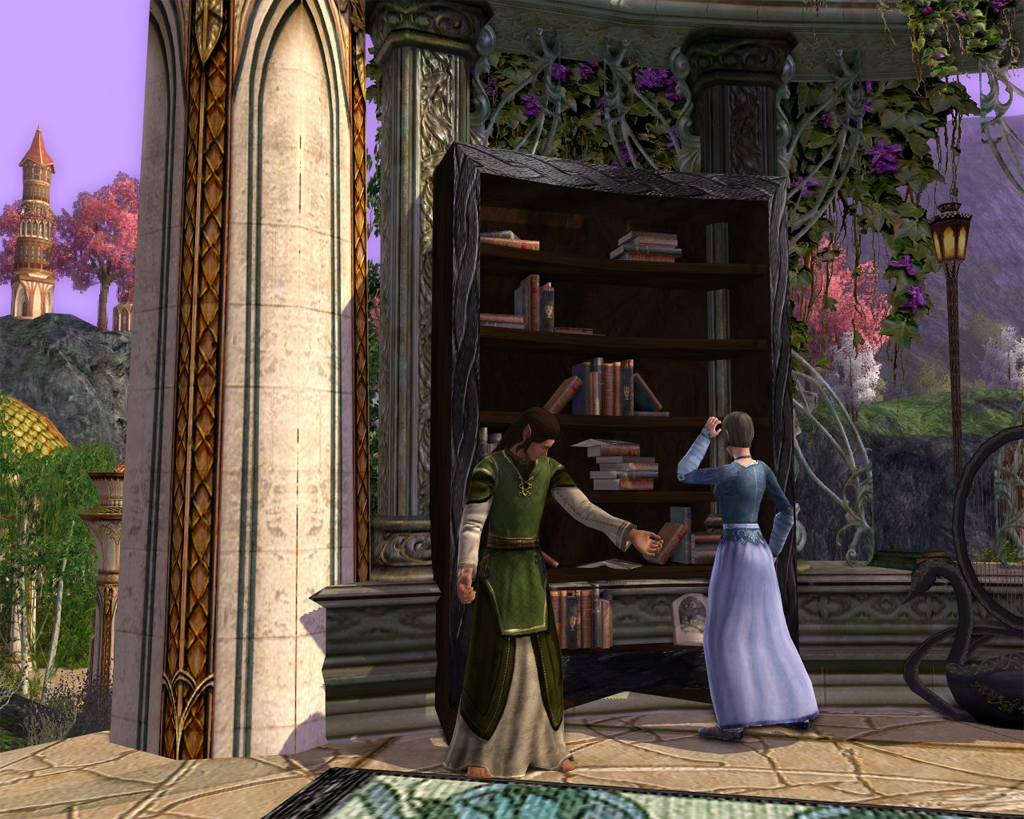
Besides the teaching of the healers, I have also learned something of the art of the elven jewel-wright from Haldan, and to my great delight I have found that I have some small skill in the crafting of silver; for it seems to me, who loves water and starlight and the silver Moon, that of all the metals of the earth silver is the most pure.13 Thus have I proudly added to my array of bracelets two fashioned by my own hand, though they be but essays in the craft; but into them I put the thought of all that I love14 and I therefore cherish them. And although my skill does not measure against the craft of elven-smiths, Halden tells me I yet might find some reward from assisting those I chance upon in my wandering.
I have also sometimes given aid to the glade-wardens of Celondim, for I earned their friendship when first I came and their homely camp nigh Nen Hilith has since been my abode. My adventures with them have taken me to the elven-ruins of Tham Gelair, and as far afield as Limael's Vineyard northwards of the elven-city, where I befriended the the merry vintner Brethilwen; for when at first I met her she told me in jest, 'All Elves delight in wine and song, and I do not have the gift of melody', but in my veins flows the blood of the Lindi15 and so we are well suited! And Limael's Vintage is indeed a delight to my tongue, and she deems it the 'last child of the storied wines of Ossiriand,' which fills me with mirth, for it is wellnigh six and fifty hundred years (by Thavroniel's Tale of Years) since the fair land of Ossiriand was rent asunder by the Great Sea!
And there I met with goblins for the first time in my life! They made a foray into the fields of growing vines, but the affray was short and sharp for the wardens assailed them unlooked-for and they were dismayed by the fierceness of our assault. But of these foul creatures I shall tell no more, for it is loathsome enough that they are now forever fixed within my memory!
* * *
But now my heart tells me that the time is nigh for me to bid farewell to my new-found friends, and return to the long road that follows the course of the Lhûn. Athal the Dwarf tells me that at its end lies Thorin's Hall, the great dwarf-mansion of Durin's Folk whereof Thorin Oakenshield, son of Thráin son of Thrór, was king ere he was slain in battle wellnigh eighty years ago. Dwalin son of Fundin is now the Steward there, for King Dáin Ironfoot rules the Longbeards from the dwarf-realm of Erebor in Wilderland, far away; and Athal says that this is nigh the Woodland Realm of the Silvan Elves in the great forest of Mirkwood, so it may be that I shall see the Lonely Mountain for myself, for it is on my way.
But he says also that Mirkwood is again these days an evil place, for ill tidings have come by way of his kin thereof that at times bring trade to the Blue Mountains, and their tale is grim: dark things swell in number within that gloomy wood and his people travel no longer along the Great Dwarf Road of old. So I gave thought to what path I might then take, and to Athal I showed the map drawn by the hand of Camaen Teithor in Mithlond, and he marvelled to behold it and called it a great gift; for such things are uncommon in the Westlands, he said, especially in the hands of a backwoods elf of so few years!
And he deems that in Rivendell I may find counsel or a guide to lead me through the High Pass over the Mountains of Mist, thence northwards below the feet of the Grey Mountains. Yet he warns that it is a perilous path that I wish to follow, and his heart forbodes that I should forsake my quest and remain safely in Celondim, or instead return to the refuge of my forest-home in Harlindon! But my mind is set and I will go on, though Athal says I am as stiff-necked as any dwarf; but he knows not that in my heart I do this for the memory of Faethurin, my departed friend.
Laenin the Glade Watcher is of the same mind, and he says it is unwise to walk heedless and unarmed into the wilds of Eriador, for he deems my elm-wood staff is not equal to a blade; yet it served me in good stead when I was assailed by goblins in the vineyards, though to my mind he is ill-pleased that I slayed none and but drove them off, battered and broken, or left them lying senseless for the wardens to dispose.
Nevertheless, he bade me to at least bring a fitting weapon upon my road, and he gifted me a short elven-sword of cold hard steel; it is old and well-used but its edge is yet keen (though notched from some affray aforetime), and it is his hope that with it I will seem less harmless to any who may bear me ill. I gave him my thanks and girt it at my side, but its weight and length are a burden to me, for never have I borne a blade; my people are lightly-armed with bows and staves and spears, and the Elves of Doriath of old favoured the axe and so too do their latter-day kin. And so I sheathed it down the inside of my leather pack with the hilt protruding upwards, so my hand can yet withdraw it from my back. But in my heart I hope this will need not happen.
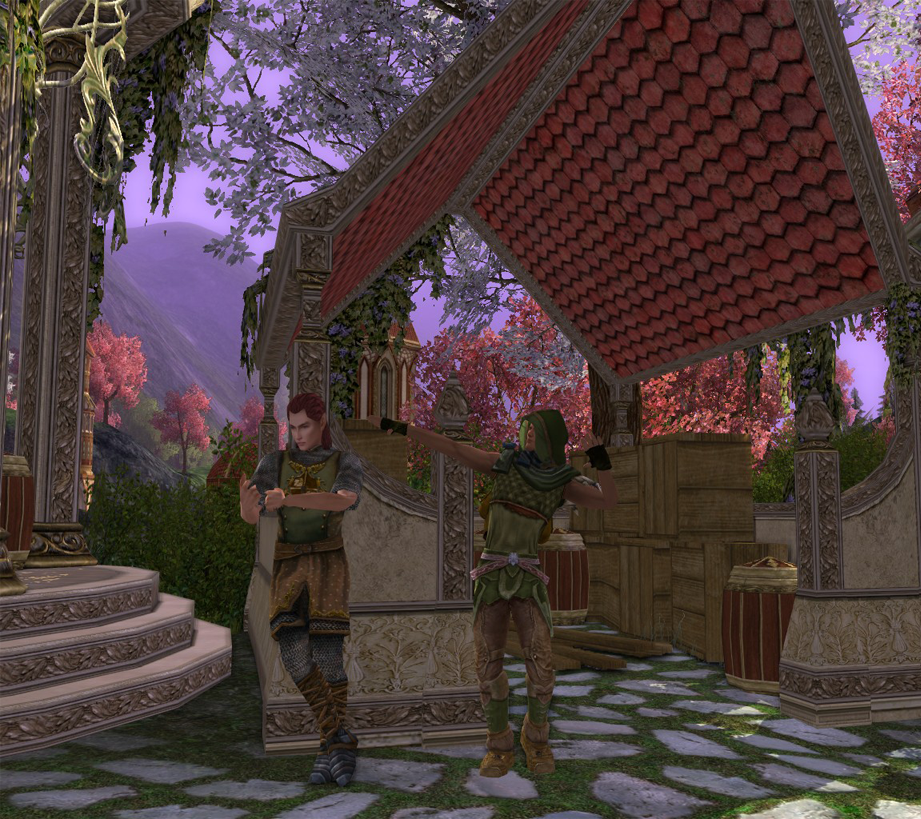
My purpose is well known amongst the Elves of Celondim, and although the new green of Spring is shimmering in the fields of Falathlorn I have been forewarned that the northern highlands of the Blue Mountains are far colder than those I am used to in the south. To this end Cannasgam, who fashions fine raiment of woven cloth and leather armour, has furnished me with a hood and mantle of forest green that are lined with warm fur, and soft but stout shoes, for he says that even my hardy Green-elven feet will not endure the frozen North unshod! It is my hope to depart for warmer climes ere cold winter comes to Evendim, yet it is best to be prepared, for the wilds are uncertain and no one can foretell what may come to pass unlooked-for on the road. (Though to my mind these shoes feel harsh and choking, for through my soles I cannot feel the silent breath of the living earth; but it is my guess that this discomfort is better than my toes being bitten by the icy teeth of bitter frost!)
And Faengamil, who tends the great stone-wrought oven whence rich aromas float upon the breeze -- which delight my nostrils and set my mouth to watering whenever I toil at the writing-desk of Thavroniel -- baked for me waybread that she names lembas in jest, for I gave to her the byname 'Maiden of Ivann' (for she knows I eat not the flesh of beasts, and she oft feeds me rich buns and pies and tarts made from wholesome fruits of the earth) and she says it is for the comfort of one who has need to go upon a long journey in the wild!17
Mibrethil gave to me yet another boon: a small pouch of coin to aid me along my way, and a blessing of good fortune and safe travel he laid upon me. For such kinship and kindness I shall be ever grateful, and my heart is  filled with love but also with sorrow at our parting.
Alas, none know more of the elven host of Lord Celeborn -- High Elves and Grey-elves and Green-elves, my kin -- who, after the ruin of Beleriand, dwelt together in Harlindon and thence removed to settle nigh Lake Evendim18 at the dawn of the Second Age of the World; save that the realm of Arthedain was overrun by the Witch-king of Angmar well-nigh a thousand years ago. Nor is it told whereabout Nenuial they made their abode, only that they removed to Eregion long ago, and naught remains there now but the shattered remnants of the ancient cities of Men.
Yet my heart desires still to follow in the footsteps of my kin of old, and thus I am told to seek the counsel of Dorongúr Whitethorn, Master of Duillond, for he has dwelt in the West for years uncounted and is deemed the wisest of the Elves of Falathlorn in the lore of Eriador. Now Duillond lies less than three leagues distant from the gates of Celondim, but thither I have not yet come for need has not driven my feet northwards beyond the branch of the Lhûn that waters the sweet vines of Limael's Vineyard, and I would not spoil the wonder of the road with haste.
But my tale is overlong and the night is growing old; the slim crescent of the Moon is sinking behind the shadowed mountains, and I have a mind to march under the white light of the glittering stars.
* * *

1. (Sindarin) Iestor, (Quenya) Yestarë
2. "The Eldarin 'day' or arë was reckoned not from midnight, but from the moment of the disappearance of the sun below the horizon as observed from the shores of the sea."
- The Peoples of Middle-earth, 1. The Prologue and Appendices [...], IV. The Calendars
3. (Quenya) hröa, pl. hröar; (Sindarin) rhaw
4. (Quenya) fëa, pl. fëar; (Sindarin) fae
6. "The fear of the Elves were destined to dwell in Arda for all the life of Arda, and the death of the flesh did not abrogate that destiny. Their fear were tenacious therefore of life 'in the raiment of Arda', and far excelled the spirits of Men in power over that 'raiment', even from the first days protecting their bodies from many ills and assaults (such as disease), and healing them swiftly of injuries, so that they recovered from wounds that would have proved fatal to Men."
- Morgoth's Ring, "Laws and Customs among the Elda"
7. "... the arts of healing, and all that touches on the care of the body, are among all the Eldar most practiced by the nissi [elven-women]; whereas it was the elven-men who bore arms at need. And the Eldar deemed that the dealing in death, even when lawful or under necessity, diminished the power of healing, and that the virtue of the nissi in this matter was due rather to their abstaining from hunting or war than to any special power that went with their womanhood."
- ibid
8. "The alphabets were of two main, and in origin independent, kinds: the Tengwar or Tîw, here translated as ‘letters’; and the Certar or Cirth, translated as ‘runes’. The Tengwar were devised for writing with brush or pen [...] The Certar were devised and mostly used only for scratched or incised inscriptions."
- The Lord of the Rings, "Appendix E: Writing"
9. "The Longbeard Dwarves therefore adopted the Runes [...] and they adhered to them even far into the Third Age, when they were forgotten by others except the loremasters of Elves and Men."
- The Peoples of Middle-earth, "Of Dwarves and Men"
10. "The Cirth were devised first in Beleriand by the Sindar, and were long used only for inscribing names and brief memorials upon wood or stone."
- The Lord of the Rings, Appendix E: 'Writing and Spelling.'
11. "...the Runes, or Cirth as they were called, were first devised by the Danians... in the woods of Beleriand, and were in the beginning used mainly for incising names and brief memorials upon wood, stone, or metal."
- The Peoples of Middle-earth, "The Appendix on Languages'"
12. Olvar and kelvar
- The Silmarillion, "Index of Names"
13. "It is quite possible, of course, that certain ‘elements’ or conditions of matter had attracted Morgoth’s special attention (mainly, unless in the remote past, for reasons of his own plans). For example, all gold (in Middle-earth) seems to have had a specially 'evil’ trend - but not silver. Water is represented as being almost entirely free of Morgoth. (This, of course, does not mean that any particular sea, stream, river, well, or even vessel of water could not be poisoned or defiled - as all things could.)"
- Morgoth's Ring, “Myths Transformed”
14. "Leaf and branch, water and stone: they have the hue and beauty of all these things under the twilight of Lórien that we love; for we put the thought of all that we love into all that we make."
- The Lord of the Rings, "Farewell to Lórien"
15. (Quenya) Lindar (sg. Linda); (Sindarin) Lindil (sg. Lindel) : "Singers" , the name the Teleri gave themselves.
"The Sindarin loremasters remembered the Nandor as Danwaith [...] This name they at first applied to the Nandor that came into Eastern Beleriand [Ossiriand]; but this people still called themselves by the old clan-name *Lindai, which had at that time taken the form Lindi in their tongue."
- The War of the Jewels, "Part Four. Quendi and Eldar: C. The Clan-names [...]"
16. "Other names in song and tale are given to these peoples [...] The Nandor are the Host of Dan, the Wood-elves, the Wanderers, the Axe-elves, the Green Elves and the Brown, the Hidden People; and those that came at last to Ossiriand are the Elves of the Seven Rivers, the Singers Unseen, the Kingless, the Weaponless, and the Lost Folk, for they are now no more. The Sindar are the Lemberi, the Lingerers; they are the Friends of Osse, the Elves of the Twilight, the Silvern, the Enchanters, the Wards of Melian, the Kindred of Luthien, the people of Elwë...
"[Commentary] Later changes [...] altered 'Axe-elves' to 'Staff-elves' as a name of the Nandor, and introduced 'Axe-elves' as a name of the Sindar..."
- Morgoth's Ring, "Of the Coming of the Elves"
17. The Peoples of Middle-earth, "XV. Of Lembas"
18. When they entered that region there were many Noldor in their following, together with Grey-elves and Green-elves; and for a while they dwelt in the country about Lake Nenuial (Evendim, north of the Shire).
- Unfinished Tales, "The History of Galadriel and Celeborn"
 |
xi |
 |