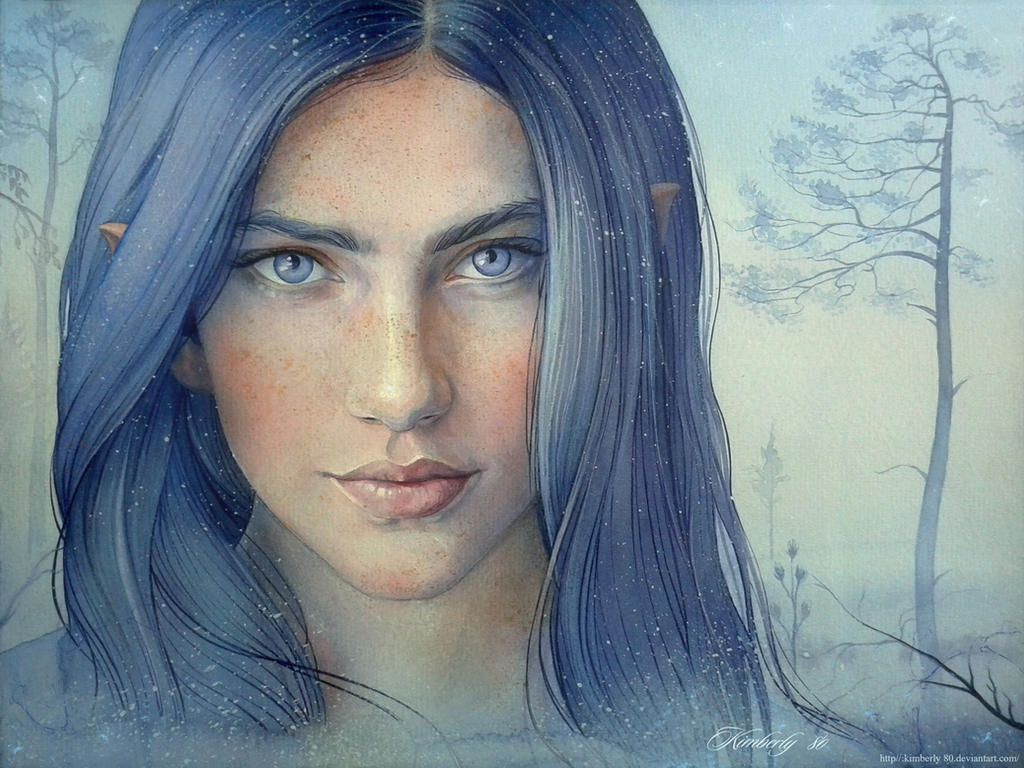
Feveren chose not to linger for the night on Foxden Heath, and from his stopping place under a lonely juniper his feet had led him three leagues south and eastwards through the sweet-smelling heather that clad the rolling hills. Slowly the dawn grew to a pale light, and climbing a steep hill, the young elf saw suddenly the dim shapes of treetops rising above its brow. Joy rose in his heart.
Sensing his delight, Gwedal came to a halt and Feveren leapt lithely to the ground. He gave his friend's bristled flank a grateful pat and looked up to see Glavror flying in merry circles above his head, a small dark shape amidst the fading stars and wisps of pink cloud borne on the stiffening breeze from the North. The sparrow gave a gleeful chirrup and with one last loop he swooped down to perch on the elf-lad's shoulder.
Together the three travellers hastened downhill towards a tree-clad hollow that lay in the lee of the long rocky ridge bordering the Far Downs. The wind was sighing in the branches, and the rising sun shimmered through the quivering leaves as they descended. It was only a small stand of trees, but to Feveren's delight he saw they were trees he knew well: tall yews and slender birches, among which a few wide-armed oaks were putting out their yellow catkins.
'Ever my heart rises as we draw near the greenwood,' he said to his companions. Gwedal grunted his agreement, and Glavror trilled in Feveren's ear. The elf-lad nodded, and a wide grin spread across his face.
'Aye, my friends,' he said. '‘Glad I am to hear the wind in the trees, and to breathe again the woodland air!'
As he set foot beneath the roof of rustling branches, Feveren felt his heart lighten; his mind felt as if a drear fog had been swept clear by the fresh spring breeze. Both were free at last of the dark cloud that had gathered as he travelled across the barren heath of the Yondershire, where once the rolling hills were clad with wild forests, and he sang a merry greeting to the glad trees of the small wood.
The high escarpment of the Far Downs ran eastwards, and there amidst the trees it met the road that led from the Yondershire that followed along its sheer and rugged face. It was devoid of traffic, and the wood was silent save for the rustle of leaves overhead and the dawn-song of birds. The three companions followed the road as it bent around the tail of the Downs, and suddenly between the tree-trunks Feveren descried low rooftops poking up from a hidden vale beyond. This he guessed to be Little Delving, a halfling village that was unmarked on his map, but which Hildifons the marchwarden had described.
It nestled in a small valley fenced by the high rock wall of the scarp along its southern and western sides, and a steep chalk ridge that ran eastwards on its the northern edge just below the trees in which Feveren hid. He could see there was no passing along the lee of the Downs, and he hoped there might instead be passage around its eastern flank. Leaving Gwedal to forage between the sprawling roots, he stowed his pack and staff at the foot of a great oak and clambered noiselessly into its branches to better look out over the village. It was still early morning, too early for the unhurried hobbit inhabitants to be out and about, but smoke already drifted lazily from a number of chimneys before being wafted away by the breeze. A small figure moved along the road, dousing the line of hanging lanterns that lit the path at night.
Settling onto a wide bough, Feveren leant back against the knotted trunk and set his feet upon the thick twisting limb that curved up before him. His bent knees were pressed almost to his breast, and his toes gripped the rugged bark; his arms hung loosely, and with his slender fingers he stroked the tree's rough oaken skin. He could feel the living joy within its wood, and its gladness as the morning sunlight warmed its leaves; he listened to its song as its branches stirred gently in the wind. Turning his head he looked out through the young leaves and catkin curtains at the sleepy settlement, and wondered at the strange round doors and windows of the hobbit-dwellings, most of which seemed to be delved right into the hillside.
All was quiet save for the whispering leaves and the endless music of foaming water, for a wide stream plunged down the western cliff-face and hurried under a low wooden bridge, its rippling surface glittering in the early light. Thin strands of river-mist still clung to the grassy banks. Feveren looked longingly at the stream, for two days had passed since he had bathed in the clean waters of the Lhûn; his glance fell upon his travel-stained feet, and remembering his strange meeting with Hildifons Took the Second, he chuckled and waggled his begrimed toes.
Feveren's eyes followed along the stream's swift course and he saw that it flowed along a deep gully that it had through the long years cloven into the chalk. Alas, there would be no nearby eastern crossing after all, for its white walls were too steep for Gwedal to scale. Feveren chewed his lip in thought. In the Yondershire the three friends had been fortunate when they came to the high dry-stone wall that marked the border of the Westfarthing, for though it did not hinder Glavror's wings or the agile young elf, Gwedal could neither fly nor clamber over it. But they had chanced upon a gaping breach in the carefully set stones, rent by forces unknown, through which the great boar had readily passed. Confronted now by the cluster of hobbit-dwellings, Feveren doubted that fortune would smile upon them again so soon.
Yet he did not wish to chance the road that wound through the village, for there was little hope that they would pass unseen while the sun was shining; nor did he have a mind to wait until nightfall when they could move under cover of darkness. He grinned wryly to himself. It was far less troublesome to pass unseen within the shadowed greenwoods of his home, where for miles a nimble Green-elf could clamber from tree to tree through their woven boughs at need. Glavror fluttered down from the upper branches to perch upon his bended knee, and cocked a bright eye at the young elf.
'To journey secretly through strange lands might prove less easy than I deemed,' Feveren told the sparrow, 'and we have not yet come to the abodes of Men! How shall we fare then?' With a flap of his wings Glavror shook his small head. 'By our art and woodcraft my folk can fade into the trees, but this will not avail us amidst yonder hobbit-houses! Alas, if I could but work a charm of invisibility, then we would pass unseen,' he laughed, 'but if such a mighty charm does indeed exist, I do not know.' He chewed his lip. 'The Elders of my clan could summon a cloaking mist, but such enchantment is beyond my skill. Nor do I know a spell of slumber that would aid us like Lúthien of old!' Softly he sang:
With arms upraised and drooping head
then softly she began to sing
a theme of sleep and slumbering,
wandering, woven with deeper spell
than songs wherewith in ancient dell
Melian did once the twilight fill,
profound, and fathomless, and still. 1
* * *
As Feveren gazed idly through the gently swaying branches, the soft murmur of the wind and the sunlight twinkling through the rippling leaves slowly mesmerised him. A sparkling haze fell over his sight and his spellbound mind began wander, until his meandering thought returned to the evening that he spent with Dorongúr Whitethorn, the Master of Duillond, ere he departed Falathlorn. Of many things they had spoken, until Valacirca was sinking in the northern sky; but it was Dorongúr's words concerning the race of Men that came now to his mind.
He had only just learnt from the elf-lord of the wanton ruin of green Arassien at their hands, and his heart was afire at their reckless deeds. Dorongúr was trying to quench the flames with soft words and cool wine, he guessed, but at that moment he had no love at all for the Usurpers.2 Bitterly he had reproached the Heavy-handed who dwelt upon the living Earth but loved it not, for to his woodland mind the despoiling of forests was profane! Even the hearts of dwarves, he railed, in their joy of making harboured a deep love for the world in which they delved; and Hildifons had told him of the hobbits' close friendship with the earth.
But his angry outburst had been cut short by the calm clear voice of the High-elf lord.
'The Secondborn are more akin to the Elves than you may deem,3 young Feveren!' Dorongúr had smiled as he raised a shining silver goblet to his lips. It was finely graven with a winding vine that glittered in the lamplight.
'But are they not mortal, Master?' Feveren asked, his brow still creased in a frown. 'It is told that it is their doom to perish, and that seems to me most unlike Elven-kind!'
'Indeed,' Dorongúr answered, 'it is the gift of Men that they dwell only a short space in the world alive, and are not bound to it, and depart soon whither we Elves know not.'4
'Gift?' the elf-lad had snorted scornfully. He took a mouthful of wine and licked his lips; it was rich and heady, vinted in Dorwinion from sweet red grapes and a delight to Feveren's tongue, but still his fair face wore a scowl. 'And mayhap they seem somewhat like us in looks, but that counts for naught!' he said.
'That was not my meaning, Feveren son of Gladlin,' said Dorongúr. 'But now you have raised the matter, let us consider it. You are of the Green-elves, young one, therefore you surely know the tale of Beren Erchamion and Lúthien Tinúviel?'
'Aye, it is told that Beren was of old a friend to my kin of Ossiriand in the Elder Days.5 Many songs we sing of his great love for Lúthien and their bold recovery of the Silmaril from the Iron Crown; and alas! it was my thought that the kindred of Men shared Beren's qualities. But what of them?'
'How then do you think Dior Eluchíl their son was begotten by a Man and an Elf, if their bodies were unalike?'6
Glowering, Feveren had conceded the point with a shrug.
'However,' the elf-lord returned to his earlier theme, 'think on this: your forebears, the Danwaith whom we name the Nandor, had the greater knowledge of living things;7 but the Noldor, my kin, are accounted greatest in matters of lore and craft.'
Feveren gave Dorongúr a questioning look, so the High-elf continued.
'The Elves of the Twilight, the Sindar, are the fairest, most wise, and most skillful of the Úmanyar; the Falathrim of Círdan, were masters of the waves and skilled in the craft of shipbuilding.'
'I know not the name Úmanyar,' said Feveren. 'What does it mean?'
'The elves of Middle-earth who came not to Valinor,' Dorongúr replied.
'O! We name them Moripendi in the woodland tongue,' said Feveren. 'But I do not understand. What of it?'
Dorongúr paused in thought for a moment.
'Forgive me, Feveren. Though we speak Grey-elvish, I sometimes speak names in the tongue of my high kindred. Úmanyar is such a one, for the word Moriquendi has through the long years changed in its meaning. Arda is another I oft use, which in Sindarin is Ardhon; but in Lindárin, the woodland tongue of your people, it is Ambar. For the divers Elven clans have each their own tongue.'[/i]
The young Green-elf arched his brow. 'Truly,' he said. 'But fear not that I may misunderstand you, Master Dorongúr, for from my childhood teachings in the greenwood of the Danas,' his lips twitched with a small smirk, 'I know many names in the High-elven speech: the eight High Ones, greatest of the Valar; Anar the Sun, and Isil the Moon, and the chief clusters of stars... er... some olvar and kelvar ...' His boasting faded and he paused sheepishly. 'Well, perhaps not many,' he admitted, 'but a fair few! For Selcheneb is proud of her knowledge of Noldorin and shared it with us gladly. Alas, I do not remember all of it now.'
The High-elf bowed his head in acknowledgement.
'But although I mostly understand your Quenyan words,' the young elf complained, 'your meaning yet escapes me!'
Dorongúr laughed. 'I thought it was plain: that despite our different tongues, we all are Ellálië.' Dorongúr used the tongue of Feveren's Lindar kin, and gave him a knowing wink. 'Likewise, Men have many different tongues, hence the need for Annúnaid, the common mannish tongue that came from Westernesse.'
'Master Dorongúr,' the elf-lad said sullenly, 'I mean no disrepect, but your counsel is like an entwining vine that weaves its way through many spreading branches! It is no simple task to follow its winding course!'
The elf-lord pursed his lips thoughtfully and replenished their wine. Feveren took a grateful swig, cupping the stemmed goblet with both hands.
'Even the manner of our peoples differ,' Dorongúr observed. He leaned back in his chair and raised his wine in salute. 'Indeed, you yourself remarked that it was strange to your woodland mind that we High-elves drink from goblets of crystal or silver, unlike the wine-bowls of your folk!'
'Aye,' Feveren had nodded warily, 'it is true I am unused to the ways of your kin.'
'And do you deem that the ways of all the Wild Elves -- the Tawarwaith of Mirkwood or the Galadhrim of Lothlórien, who are both your Nandorin kin -- are yet alike to your Laegrim tribe? You may share their woodland heart, but your thought through the long years of your sundering has grown apart.'
Sitting cross-legged upon a low couch, the elf-lad tugged idly on his toe as was his wont when thinking deeply. The elf-lord watched him carefully, genteelly sipping his wine.
'Even then,' Dorongúr went on, 'you have told me of your melotorno -- your love-brother -- Faethurin, who is now departed to the Blessed Realm; was your thought and his always alike? Ósanwe you shared, but you yet each had your own heart and mind.'
Feveren had sighed and taken a gulp from his goblet. 'Now I see you mean that the race of Men is as varied as the Elves,' he said, wiping his lips with the back of his hand. 'But the thought and hearts of Men are unalike to ours! It seems to my mind that their purpose is but to dominate the world, and bend it to their will!'
'Truly, their fëar have not the mastery over their bodies as do our own,' Dorongúr agreed, 'and this misleads their thought and therefore their deeds; and indeed they hold less love for Arda than we Elves,8 for a shadow lies upon them.9 Yet I deem their hearts and minds are indeed akin to ours; certainly they feel joy and sorrow, or love and pity, although less strongly than Elven-kind. Yet you cling to the misbelief that all men are equal in thought and deed!' He gave Feveren a long look. 'I told you before that there are also those elves of the High Kindred who fell into pride and self-will, for nothing can wholly escape from the shadow that lies upon Arda.'10 The High-elf's bright eyes looked deeply into Feveren's; grey as the sea under an overcast sky, they bored into the hazel-green depths of the woodland elf's. 'But you have not thought to ask of this Shadow!'
Abashed, the elf-lad glanced away and plucked harder on his toe. Twice now the elf-lord had spoken of a Shadow, and in his heart Feveren felt a deep forboding. But he did not give voice to his thought, and instead swallowed back his wine.
'As to their purpose,' continued the elf-lord, 'it is alike that of all living beings: to endure in Arda Hastaina ... that is, "Arda Marred". Men tend to the welfare of their kindred, just as we Elves.'
'Arda Marred'? the young elf had asked in amazement, his curiosity overcoming his bitterness. 'Isferon spoke also those words to me. The ancient taint of Morgoth and its stain upon the earth that sustains us, he said. But never have I heard tell of such a thing, Master Dorongúr! Is this the Shadow whereof you spoke? Whence does it come?'
Once more Dorongúr looked deep into the elf-lad's eyes, and Feveren had felt the soft touch of the elf-lord's thought brush across his mind. Dorongúr gave a satisfied nod.
'In your distress I feared to bring yet more dismay to your young heart,' the High-elf said kindly, 'but you are an elf-child no longer, and I deem you are much hardier than first I thought.'
At these soothing words, the last of Feveren's displeasure faded. His furrowed brow smoothed and at last a smile tugged at the corners of his mouth; but he wondered at the meaning of elf-lord's words.
'I perceive you know little of the Ainulindalë, the Music of the Ainur, and the Valaquenta, the tale of the Valar and Maiar,' said Dorongúr. 'I deem these tales may bring better understanding to your thought.'
The young Green-elf had laughed. 'I had forgotten their names in the high-elven speech, yet I do know them. They are but children's tales that Selcheneb our Lore-keeper told us when we were elflings in the greenwood, so that we might learn the names of the Powers of the World and of their mighty works. But we deem these tales fanciful and do not esteem them, for the chief regard of my folk is for here and now; today, not the yesteryears of long ages past!' He gazed wistfully into his empty goblet. 'Though I know now the Blessed Realm is indeed real, for hither my friend removed and there my heart now dwells,' he murmured.
'Indeed, thus I said "you know little",' Dorongúr replied, pouring more wine. 'For your Lore-keeper doubtless learnt these tales from the Iathrim of Beleriand, who in their turn heard them from the Exiles. Indeed, maybe it was her purpose to protect your bliss, and thus she withheld the truth she well knew. But do not despise the lore that has come down from distant years, young one; for oft it may chance that old lore-keepers keep in memory word of things that once were needful for the wise to know.'11
'Then the tales are true?' asked Feveren in astonishment.
'In part,' the High-elf answered. 'For through the long ages they became mingled with the fancies of the Dark Elves who dwelt ever in Middle-earth, and such is the fate of the Great Tales of Valinor and Arda.12 However, Selcheneb is not a Light-elf of Aman, and knows only the tales of the Wild Elves; but I remember this ancient lore as it was told by the Valar themselves.'
Feveren gazed at the old elf in wonder. Selcheneb was eldest of his folk, and wise in the lore of Ossiriand and Beleriand of old. But the thought had never entered his mind that within her fanciful tales of the Days before days lay the seeds of truth and greater wisdom.
'And what of Two Trees of Ivann?' he exclaimed. 'And the making of the Moon and the Sun? For it seemed to our minds -- to Fethurin and me -- that if the Sun that brings light and warmth to the whole wide world was wrought from but one of the fruits of Laurelin, then the Tree of Gold must have been sufferingly bright and hot!'13
The young elf lifted his clear voice in song.
'Comes never there but one lone star
That fled before the moon;
And there the Two Trees naked are
That bore Night’s silver bloom,
That bore the globéd fruit of Noon
In Valinor.' 14
'Nor could woods and flowers grow from the earth without the Sun's life-giving rays, yet it is said that Telperion and Laurelin lit only Valinor!' he went on. 'But it is also told that the First Elves slept beneath the green sward, and the Nelyar, my forebears, awakened in a grove of birches under the stars15... thus we wondered, how could this be?'
'Verily, the Trees were real, but not so the tale of the fruit of Noon,'16 Dorongúr smiled. 'But let your wayward mind be not waylaid by other tales!' Then a shadow came over his face, and he closed his eyes. 'Nor let your heart be dismayed by the tale of Melkor, "He who arises in Might", whom you perhaps name Belegûr in common Elvish.' He opened his eyes and in them gleamed a cold light. 'But that name he long ago forfeited,' Dorongúr told the elf-lad, 'and the Noldor, who among the Elves suffered most from his malice, will not utter it, and we name him Morgoth, "the Dark Enemy of the World"!'17
'Belegurth, "Great Death", my kinsfolk named him of old in jest,' said Feveren wryly. 'Yet perhaps we made too light of a dark Shadow!'
'The Darkest of all Shadows!' cried the High-elf. 'For he was not merely a Vala of Arda that fell into evil. He was the chief spirit of Pride and Revolt in all Eä,18 ere his power diminished, the very Spirit of Evil! Hearken now to the Tale of the Curse of Morgoth,19 young one, and heed my words.'
And so it came to pass that Feveren heard the full tale of Morgoth's fall from grace, and the grievous consequence of his deceits. Not all of Dorongúr's tidings were new to the young Green-elf: of the Dark Lord's discord within the Great Music, and his contrivance against the works of the Lords of Valinor in the shaping of the world, Feveren knew somewhat from Selcheneb. But Morgoth's corruption of the very stuff whereof the Earth is made was altogether unknown to him.
He was thus grieved to learn that the world was therefore forever tainted with Morgoth's malice: for in his lust to dominate the world the Dark Lord had put his fell being into its very substance, and thenceforth all things that were born on Earth -- or indeed fashioned from it -- were therefore stained with his ill will.20
And the elf-lad had discovered that from this marring had come the woes of Elven-kind, for although their hröar were made to endure their longeval fëar, this taint led to their waning over the long ages; Dorongúr said that death was unnatural, and the sundering of spirit and body was one of the griefs of Arda Marred. Indeed, he learnt that even the summons of the Valar, which began the Great March, was made to safeguard the Elves from the designs of Morgoth; thus the Sundering of the Quendi was brought about, first between the Eldar and the Avari, and the Vanyar, Noldor and Teleri thereafter. Thus divided, never again was Elven-kind wholly reunited.
And in these latter days Sauron had risen like a shadow of Morgoth and a ghost of his malice;21 his dreadful sorcerous power, his necromancy and mastery of shadows and phantoms, had at its root this taint that imbued the world.
All hope had died in Feveren's young heart and it was filled with great sorrow. For it seemed to him that if all beasts or plants or incarnate spirits, or indeed the very flesh and bones of Ardhon -- from its deepest stones to its highest peaks -- were thus tainted, then there was no escape from evil!
To the Green-elves, who delighted at wandering freely in the wide and wild lands of Harlindon, the notion of prison was strange and dreadful, but not unknown, for the old tales told of the fell strongholds of Udûn and Angband, far to the North long ago. But for an elf to have that freedom taken from them, and to be confined in deep dark dungeons, they deemed the utmost cruelty and it filled them with profound horror. Yet now it seemed to Feveren that all the world was a vast prison for the embodied souls of the Incarnates, forever thralls to the malice of Belegurth even though he was long gone! He hung his head in sorrow.
But the elf-lord had put comforting hands on Feveren's slumped shoulders and smiled.
'Yet,' he said, 'still we love Arda though it is marred, and we can heal some of its hurts. And from it we still make much that is fair and good, for the world is not made from the mind of the Dark Lord alone and thus altogether evil: it is mingled with the work and thought of other Powers that are pure and true!'22
Feveren had warily returned Dorongúr's smile, though his eyes were wet and a tear glistened on his cheek.
'And our spirits, too?' he asked. 'Is the virtue of the Elves unstained also?'
'Alas,' Dorongúr replied, 'all fëar arise from the Flame Imperishable, and are thus beyond the reach of Morgoth; yet they can still be grieved, burdened, or driven to evil deeds by their own free will. But our bodies, being made from the substance of Arda and also thereby sustained, are thus not free of the Dark Lord; and our bodies effect our indwelling spirits. Only the Blessed Realm is wholly free of his taint.'23
'And therefore our hearts yearn to cross the Sundering Sea?' Feveren reasoned. Then a thought had come to him. 'But Men cannot! Alas for their ill doom!'
'Their fate is unalike,' said Dorongúr, 'but not evil. For it is a gift from Eru, and it is my belief that of all His designs the outcome must be for His Children's joy; from this belief, hope springs ever in my heart.' He smiled. 'And, young Feveren, estel is not defeated by the ways of the world!'24
'Do Men then share this hope?' asked the elf-lad. 'Though they are not forever bound to the world?'
'Alas,' the elf-lord said sadly, 'Therein lies the chief difference between our kindreds.25 The fëar of the Firstborn are doomed to dwell in Arda until its end, and are therefore steadfast and have greater power over our bodies. But in mortal Men the effect of Morgoth's taint is therefore stronger, and their spirits bend more easily toward him. So it was that they were easily seduced by the deceits of Morgoth, and believing the Dark Lord's lies they abjured Eru and deem His gift of death is a curse upon them. I do not think they bear much hope, save to see tomorrow's dawn.'
* * *
Aloft amongst the oaken branches, Feveren stirred and looked about. His mind had not wandered long, it seemed, for the sun still lay low in the eastern sky and the river-mist yet lingered. But the rosy wisps of dawn-clouds now gleamed white in the high blue sky, and the small figures of hobbits were emerging from their round doors and greeting one another. From his vantage-point above the village their calls sounded like the piping of birds, muffled by the cascading music of the waterfall. Glavror was still perched upon his knee, and the little sparrow gave a soft chirrup. The young elf smiled grimly at him.
Why, he wondered, had Selcheneb kept this tale secret from him and Faethurin? Maybe it was indeed her purpose to protect the elf-boys' bliss, for this lore would surely have brought despair to their young hearts. And growing up in a land blessed by elven virtue and seemingly free from evil, would he have believed the Lore-keeper if she said the world he loved so dearly was thus tainted?
Ever had the Lore-keeper urged her young charges to learn of their own accord, giving them only enough knowledge to kindle their curious minds. Perhaps she knew that he would need to see the consequences with his own eyes ere he would believe such a tale was true. And perhaps this was why the Council of Elders had therefore given him leave to depart on his journey of discovery, despite his callow youth? Was it a rite of passage, he wondered?
These thoughts filled Feveren's mind, but suddenly he realised with a shock that he had hitherto forgotten the words of Dorongúr; words which the elf-lord had spoken to him little more than a day before! It was as if some dark enchantment had lain upon his memory as he crossed the treeless heath, and only now that he was once more beneath the leaf-clad branches had his mind again begin to think clearly. Was this somehow the effect of the taint of Belegurth? He shook his head fiercely, his hands clenched. 'Nay,' he thought to himself, 'I cannot let fear arise in my heart from this new-found wisdom, nor blame it for my own failing!' For he thought that his mind must have been so overwrought by his sorrow that his will had been overcome.
But, he reminded himself, he was a Green-elf of Lindon! His people had endured the downfall of Beleriand and flourished still in their beloved greenwood, despite the Dark Lord's evil designs. So, too, would he endure by strengthening his will and mindfulness, for no longer was he a fanciful elf-child; no longer would he be ruled by his wayward mind! 'Though this is easier said than done,' he thought grimly, and he hardened his resolve.
Nor would he let sorrow overwhelm him. Feveren his mother named him, "Joyous Soul", and this name he had proudly kept; in two-score years not even his parents had used his chosen-name, Methlegel. He was but 'Feveren' to all who knew and loved him, and therefore with his inherent joy he would overcome any sorrow or misgiving that cast a shadow on his heart! Yet now he wondered if Gledhril had gifted him his mother-name from insight or from foresight?26
Despite his resolve, the thought of young elf was troubled. Since he had departed Eryn Milbar, purpose had ever been his guiding star; but even his purpose had changed from that which he and Faethurin had first devised, when they were but elf-children in the glad greenwood. Their hope had been to discover the elven-realms of their kin who had of old forsaken Harlindon to dwell in the lands east of Ered Lindon; but now his purpose had become a journey of remembrance to honour his departed friend.
Yet for the two elf-boys dozens of years ago, it was to be a journey of mirth and wonder in the lands beyond the mountains of their home. Feveren heaved a sigh. This was not the merry journey whereof they had dreamed. He certainly had not foreseen the shadow of fear and doubt that had haunted his footsteps since he had departed fair Harlindon.
Feveren wished fervently that his friend was with him. Ever had Faethurin's steady presence been his mainstay, a proof against his wayward thought and fears. And the one with whom he shared his heart when his thought was clouded; the one who truly knew Feveren's mind. 'What would be Fethurin's counsel?' he wondered. And in his mind he heard suddenly the young voice of his friend, the hunter. 'To go with the flow is well and good upon the running stream, but when crossing dry land we needs must go carefully step by step!'
Feveren laughed aloud. Aye, each step of his journey thus far had been set by a lesser purpose, and one by one he had followed them to their end. And so he would go on, he decided; he would bend his mind to his latest lesser purpose: to find a map of the Shire to ease to his journey. 'And may fate guide my wandering feet!' he thought.
Ever had he trusted to fate, as he called it. But Dorongúr had said that the world was not altogether evil, for the virtue of the venerable Powers lay also in its making, and now Feveren wondered if it was by this grace that he had always been guided from peril and misfortune. It was a cheering thought.
The young elf dropped lightly to the turf, landing in a crouch. He arched his back and stretched his slender limbs like a wild woodcat, causing his long tousled hair to fall across his face. Standing, he tucked it back behind his ears and his feathered friend fluttered down onto his shoulder to nuzzle against his bared earlobe. Feveren gently stroked the bird's small head with a grubby finger, which he then held up before his eyes and examined critically. Dorongúr had said that water alone in Middle-earth was free of the taint of Morgoth,27 for in it there lived yet the echo of the Music of the Ainur,28 and the young elf yearned to plunge into its pure embrace and cleanse himself of the stains of travel and dismay.
'Come Glavror,' Feveren said. 'Let us summon Gwedal from his breakfast, and seek a ford downstream.' His belly grumbled, and he smiled as he thought happily of the wrapped honey-cakes within his pack, kept fresh by the art of the elven baker of Duillond, and the sweet mead that yet remained in his wineskin. 'Then at last we will break our fast beside the singing waters of this babbling brook, in which we shall bathe and be refreshed, and have our hope renewed!'29
* * *

1. The Lays of Beleriand, "The Lay of Leithian, canto XIII"
2. "The Atani they were named by the Eldar, the Second People; but they called them also Hildor, the Followers, and many other names: Apanónar, the After-born, Engwar, the Sickly, and Fírimar, the Mortals; and they named them the Usurpers, the Strangers, and the Inscrutable, the Self-cursed, the Heavy-handed, the Night-fearers, the Children of the Sun."
- The Silmarillion, "Quenta Silmarillion: Of Men"
3. "Elves and Men are represented as biologically akin in this 'history', because Elves are certain aspects of Men and their talents and desires, incarnated in my little world. They have certain freedoms and powers we should like to have, and the beauty and peril and sorrow of the possession of these things is exhibited in them."
- The Letters of J.R.R. Tolkien, #153
4. The Silmarillion, "Quenta Silmarillion: Of the Beginning of Days"
5. Now word went swiftly among the Elves of Ossiriand that a great host of Dwarves bearing gear of war had come down out of the mountains and passed over Gelion at the Ford of Stones. These tidings came soon to Beren and Lúthien; and in that time also a messenger came to them out of Doriath telling of what had befallen there. Then Beren arose and left Tol Galen, and summoning to him Dior his son they went north to the River Ascar; and with them went many of the Green-elves of Ossiriand.
[...]
There came a night of autumn, and when it grew late, one came and smote upon the doors of Menegroth, demanding admittance to the King. He was a lord of the Green-elves hastening from Ossiriand, and the doorwards brought him to where Dior sat alone in his chamber; and there in silence he gave to the King a coffer, and took his leave. But in that coffer lay the Necklace of the Dwarves, wherein was set the Silmaril; and Dior looking upon it knew it for a sign that Beren Erchamion and Lúthien Tinúviel had died.
- The Silmarillion, "Quenta Silmarillion: Of the Ruin of Doriath
6. "Elves and Men are evidently in biological terms one race, or they could not breed and produce fertile offspring – even as a rare event : there are 2 cases only in my legends of such unions, and they are merged in the descendants of Eärendil."
- The Letters of J.R.R. Tolkien, #153
7. "Those were the Nandor; and they became a people apart, unlike their kin, save that they loved water, and dwelt most beside falls and running streams. Greater knowledge they had of living things, tree and herb, bird and beast, than all other Elves."
- The Silmarillion, "Quenta Silmarillion, Of the Coming of the Elves and the Captivity of Melkor"
8. "The Elves find their supersession by Men a mystery, and a cause of grief; for they say that Men, at least so largely governed as they are by the evil of Melkor, have less and less love for Arda in itself, and are largely busy in destroying it in the attempt to dominate it."
- Morgoth's Ring, Athrabeth Finrod ah Andreth, Note 7
9. "Men came forth in the East of the world; but they fell under the shadow of the Enemy"
- The Lost Road and other stories, "The Lost Road, Chapter IV"
10. "Many [Eldar], as the histories reveal, could become estranged from good, for nothing can wholly escape from the evil shadow that lies upon Arda. Some fell into pride, and self-will, and could be guilty of deeds of malice, enmity, greed and jealousy."
- Morgoth's Ring, "The Laws and Customs Among the Eldar", note 5
11. Paraphrased from the words of Celeborn in The Fellowship of the Rings, "Farewell to Lórien"
12. "Arda, or 'The Kingdom of Arda' (as being directly under the kingship of Eru's vice-regent Manwë) is not easy to translate, since neither 'earth' nor 'world' are entirely suitable. Physically Arda was what we should call the Solar System. Presumably the Eldar could have had as much and as accurate information concerning this, its structure, origin, and its relation to the rest of Ea (the Universe) as they could comprehend. Probably those who were interested did acquire this knowledge. Not all the Eldar were interested in everything; most of them concentrated their attention on (or as they said 'were in love with') the Earth.
[...]
"The traditions here referred to have come down from the Eldar of the First Age, through Elves who never were directly acquainted with the Valar..."
- Morgoth's Ring, "Athrabeth Finrod ah Andreth", note 2
13. "... if the Sun that brilliantly illumines the whole Earth was but one fruit of Laurelin then Valinor must have been painfully bright and hot in the days of the Trees."
- Morgoth's Ring, "Myths Transformed"
14. The Shores of Faëry, J.R.R. Tolkien (1915)
15. The War of the Jewels, "Quendi and Eldar, The legend of the Awakening of the Quendi (Cuivienyarna)"
16. "The making of the Sun after the Death of the Trees is not only impossible 'mythology' now [in the Round World version of the legendarium] - especially since the Valar must be supposed to know the truth about the structure of Ea (and not make mythical guesses like Men) and to have communicated this to the Eldar (and so to Numenoreans!) - it is also impossible chronologically in the Narrative."
- Morgoth's Ring, "Myths Transformed"
17. "Melkor they called Morgoth 'the Black Enemy', refusing to use the Sindarin form of Melkor: Belegûr 'he that arises in might', save (but rarely) in a deliberately altered form Belegurth 'Great Death'."
- The Peoples of Middle-earth, "The Shibboleth of Fëanor" (note 21)
18. "Melkor is the supreme spirit of Pride and Revolt, not just the chief Vala of the Earth, who has turned to evil."
- Morgoth's Ring, "Myths Transformed"
19. Narn e·’Rach Morgoth Tale of the Curse of Morgoth
- - Morgoth's Ring, "Myths Transformed"
20. "To gain domination over Arda, Morgoth had let most of his being pass into the physical constituents of the Earth - hence all things that were born on Earth and lived on and by it, beasts or plants or incarnate spirits, were liable to be 'stained'. Morgoth at the time of the War of the Jewels had become permanently 'incarnate': for this reason he was afraid, and waged the war almost entirely by means of devices, or of subordinates and dominated creatures."
- Morgoth's Ring, "Myths Transformed"
21. The Silmarillion, "Valaquenta"
22. "Melkor's final impotence and despair lay in this: that whereas the Valar (and in their degree Elves and Men) could still love 'Arda Marred', that is Arda with a Melkor-ingredient, and could still heal this or that hurt, or produce from its very marring, from its state as it was, things beautiful and lovely, Melkor could do nothing with Arda, which was not from his own mind and was interwoven with the work and thoughts of others: even left alone he could only have gone raging on till all was levelled again into a formless chaos."
- Morgoth's Ring, "Myths Transformed"
23. "Thus, outside the Blessed Realm, all 'matter' was likely to have a 'Melkor ingredient', and those who had bodies, nourished by the hröa of Arda, had as it were a tendency, small or great, towards Melkor: they were none of them wholly free of him in their incarnate form, and their bodies had an effect upon their spirits."
- Morgoth's Ring, "Myths Transformed"
24. "Estel we call it, that is "trust". It is not defeated by the ways of the world, for it does not come from experience, but from our nature and first being. If we are indeed the Eruhin, the Children of the One, then He will not suffer Himself to be deprived of His own, not by any Enemy, not even by ourselves. This is the last foundation of Estel, which we keep even when we contemplate the End: of all His designs the issue must be for His Children's joy."
- Morgoth's Ring, "Athrabeth Finrod ah Andreth"
25. "From their beginnings the chief difference between Elves and Men lay in the fate and nature of their spirits. The fëar of the Elves were destined to dwell in Arda for all the life of Arda, and the death of the flesh did not abrogate that destiny. Their fëar were tenacious therefore of life 'in the raiment of Arda', and far excelled the spirits of Men in power over that 'raiment', even from the first days protecting their bodies from many ills and assaults (such as disease), and healing them swiftly of injuries, so that they recovered from wounds that would have proved fatal to Men."
- Morgoth's Ring, "Laws and Customs Among the Elder"
26. "The mother-name was given later, often some years later, by the mother; but sometimes it was given soon after birth. For the mothers of the Eldar were gifted with deep insight into their children's characters and abilities, and many had also the gift of prophetic foresight."
- The Peoples of Middle-earth, "The Shibboleth of Fëanor: Note on Mother-names"
27. "It is quite possible, of course, that certain 'elements' or conditions of matter had attracted Morgoth's special attention [...] Water is represented as being almost entirely free of Morgoth. (This, of course, does not mean that any particular sea, stream, river, well, or even vessel of water could not be poisoned or defiled - as all things could.)"
- Morgoth's Ring, "Myths Transformed, Notes on motives in the Silmarillion"
28. "And it is said by the Eldar that in water there lives yet the echo of the Music of the Ainur, and many of the Children of Iluvatar hearken still unsated to the voices of the sea, and yet know not for what they listen."
- Morgoth's Ring, "Ainulindalë"
29. The Shape of Water in J.R.R. Tolkien’s The Lord of the Rings, Norbert Schürer, Mythlore (Mythopoeic Society)
 |
xxx |
 |