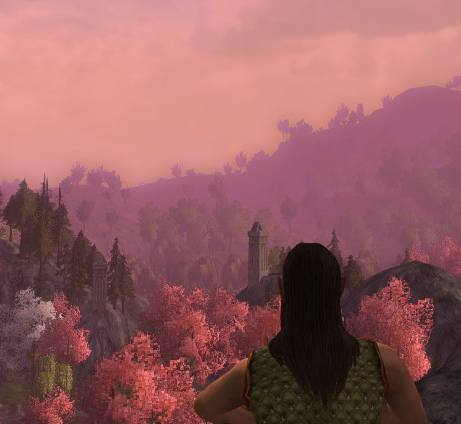
The day was growing old when Dorongúr Whitethorn, Master of Duillond, climbed up the curved stairway to the elf-haven's highest terrace, and there came upon the young Green-elf he had first met some weeks before. The elf-lad was perched upon its very edge, his unshod feet swinging idly to and fro high above the winding road as his gaze followed its path over the long stone bridge that spanned the Lhûn. Feveren saw that it disappeared into a tree-clad cleft in the hills beyond the river, and in the fading light of the setting sun his keen elven-eyes could descry two tall stone towers gleaming above the treetops on either slope. All his mind was given to peering at them, and thus he did not notice the soft brush of the elf-lord's thought upon his own; but Dorongúr sensed disquiet in the youngster's heart: something had but lately happened that unsettled the elf-boy, and the old elf wondered at it.
'Hail, young Feveren!' he called as he strode up from behind, and the elf-lad gave a start before leaping to his feet.
'Well met, Master Dorongúr!' he replied and bowed his head respectfully, but on his face he wore a gleeful grin for he had grown fond of the elf-lord when he tarried before in Duillond.
'Welcome! It has been but six days since you set forth to meet the Longbeards in the north,' smiled the High-elf. 'I did not look for your return so soon, yet it brings me joy to see you again. How did you fare?'
Feveren laughed. 'The dwarrow-realm is much colder than I imagined in my mind, for it is snow-covered even in the springtime. The trees stand bare of leaves and there is no merry birdsong amongst their barren boughs, and the frozen streams sing no joyful song beneath their icy coatings. Yet though the land is bleak and cheerless, the dwarven-folk have stout hearts it seems to me. But it is hard to earn their trust.'
Dorongúr nodded sagely. 'They do not easily open their hearts to Elven-kind, it is true. Oft has strife risen between our kindreds, even since the Elder Days of old, but I have made a friendship with the Master of Thorin's Gate.'
Feveren grinned. 'Indeed, Lord Dwalin has a kindly heart!' he said. Then his smile faded. 'But never will I love the deep-dolven halls of his people, for they daunt my mind and fill my heart with dismay!'
'Yet this is not the cause of the boy's disquiet,' the elf-lord thought, but he smiled and said, 'Of course, a wild elf of the greenwood -- who delights to feel the free wind blowing through the trees, and the sun's warm rays shining down from the open sky -- would find no comfort underground! But what of his folk? Could you love the Dwarves?'
The young elf's brow creased in thought. 'I cannot deny I am glad to once more hear fair elven voices and to speak again in Elvish, though it was good to practise my skill in the Common Tongue ere my feet lead me beyond the Lhûn. But I do not dislike them. Yet there are two things about Durin's Folk that will ever be strange to my mind.'
'Oh? What then?' Dorongúr asked.
'Though my clan elders deemed me full-grown ere I departed my homewood, I well know that I am not yet fully grown in stature and ever have I been the least tall in any Elven company. But the Dwarven folk all stand nigh the height I was when I was but a score of years!'1
The High-elf chuckled. 'And secondly?'
'Hairy beards!' Feveren exclaimed, and together they laughed aloud, drawing bemused glances from the elves that stood speaking in hushed voices nearby. Dorongúr took Feveren then by the arm and drew him across the terrace to an open alcove that extended above a frothing waterfall and looked out over the river valley. 'Oft I come to stand upon this viewpoint to ponder,' the elf-lord explained. 'Here shall we be undisturbed.'
To the mind of Feveren it was alike the high tree-flets of his homewood, but roofed and fashioned from pale stone, and he gazed out once more into the gathering twilight. The waters of the river far below gleamed silver in the the dying sunlight as it wended its slow course towards Mithlond, and again he saw the twin towers along the road. He pointed to them with his hand.
'Those towers that stand yonder, are they of Emyn Beraid?' he asked. Dorongúr looked out and shook his head.
'Nay, those guard the Eastway, the great dwarf-wrought gateway between lands of Ered Luin and the Shire of the Hobbit-folk. The Tower Hills lie to the south and east, wellnigh twenty leagues from Duillond, as the golden eagles of the mountains make it,' he replied, and he looked askance at the young elf. 'But it is not of the view that I wished to speak.'
Feveren looked at him in wonderment, for suddenly the elf-lord's face and voice were grave.
'I sense within you there is aught amiss. Did something else upon your journey cause you dismay?' he asked.
'Nay, Master,' Feveren replied with a sigh, and he told Dorongúr of his speech earlier with Isferon within the Scholar's Enclave. The High-elf nodded sadly.
'Alas,' he said, 'there are indeed those of my kin who have fallen into pride and self-will, for nothing can wholly escape from the evil shadow that lies upon Arda.'2
'Verily,' agreed the elf-lad, 'and I have now grown somewhat used to their haughtiness. But it is his words of our fading that trouble my heart.'
Dorongúr stayed silent and looked out across the darkening hills. The sky was clear and the stars were growing bright; the bells of sundown rang in the still air.3
'He tells of lore that your kindred brought from beyond the Sundering Seas,' Feveren went on, 'but our tales tell that the High-elves dwelt only in Thargelion ere the Battle of Sudden Flame,4 and never did they share their wisdom with my woodland forebears of Ossiriand. Yet my people long ago learnt somewhat from the Elves of Doriath who indeed hearkened to teachings from the Uttermost West.'
Still Dorongúr said nothing, but he gently laid his hand on the young elf's shoulder.
'To our minds "fading" means but withdrawing one day into secrecy and memory,' Feveren continued, 'unless we complete the Journey to the Blessed Realm. But he says that we shall instead become as shades, naught but spirits unhoused and unseen!'
'Alas,' said the elf-lord at last, 'he speaks truly. And this is grievous to your heart?'
'Nay, Master Dorongúr, though I am fond of my body!' Feveren answered with a grin. Then he frowned and chewed his lip as he sought the words to describe his misgiving.
'The lore of healing teaches of the union of body and spirit,' he said, 'and that for the Firstborn disunion in death is unnatural, thus should we perish our spirit removes to the Halls of Mandos to be reborn in the Blessed Realm. For, it is told, our spirits are ever bound to the confines of the World until its ending,5 whether we live or fade or are reborn. Yet one day the World will end... and what then? Do our spirits endure the long ages only to be destroyed utterly at the end? Is the fair World naught but a cage -- a prison -- for our kind?'
Dorongúr looked at the elf-lad with amazement. 'These are deep thoughts for a young elf, and indeed a mystery whereof even the Wise have no answer!' he exclaimed.6
Feveren turned to the elf-lord, and Dorongúr perceived a hint of anguish in the young elf's eyes. 'Seldom does the thought of my folk dwell upon the Powers of the World,' he said, 'nor do we ponder the Other Power.7 Yet we know we are Eruchîn, and deep in our hearts we deem our maker loves his Children, and thus to my mind its seems a cruel doom for his beloved.'
Dorongúr reached out and clasped Feveren's slender shoulders with both hands. 'Even the Valar know not the mind of Eru Ilúvatar, nor his last purpose for his Children,' he said in earnest. 'We can but trust to hope!'8
* * *

1. "Dwarves were about 4 ft. high at least."
- The Nature of Middle-earth, "Body, Mind and Spirit"
"Children of Men might reach their full height while Eldar of the same age were still in body like to mortals of no more than seven years."
- Morgoth's Ring, "The Laws and Customs Among the Eldar"
2. 'Many [Eldar], as the histories reveal, could become estranged from good, for nothing can wholly escape from the evil shadow that lies upon Arda. Some fell into pride, and self-will, and could be guilty of deeds of malice, enmity, greed and jealousy.'
- Morgoth's Ring, "The Laws and Customs Among the Eldar", note #5
3. “Bells and Bell-Ringing in Middle-Earth”. Mallorn: The Journal of the Tolkien Society, no. 31, Dec. 1994, pp. 15-19
4. "... but Caranthir fled and joined the remnant of his people to the scattered folk of the hunters, Amrod and Amras, and they retreated and passed Ramdal in the south. Upon Amon Ereb they maintained a watch and some strength of war, and they had aid of the Green-elves; and the Orcs came not into Ossiriand, nor
to Taur-im-Duinath and the wilds of the south."
- The Silmarillion, "Quenta Silmarillion: Of the Ruin of Beleriand and the Fall of Fingolfin"
5. "But what the end of the world portended for it or for themselves they did not know (though they no doubt had theories)."
- The Letters of J.R.R. Tolkien # 325)
6. "The real theme for me is about something much more permanent and difficult: Death and Immortality: the mystery of the love of the world in the hearts of a race 'doomed' to leave and seemingly lose it; the anguish in the hearts of a race 'doomed' not to leave it, until its whole evil-aroused story is complete."
- The Letters of J.R.R. Tolkien # 246
7. "The Other Power then took over: the Writer of the Story (by which I do not mean myself), 'that one ever-present Person who is never absent and never named'."
- The Letters of J.R.R. Tolkien # 2192
8. Dorongúr is refering to estel, rather than amdir:
" 'What is hope?' [Andreth] said. 'An expectation of good, which though uncertain has some foundation in what is known? Then we have none.'
'That is one thing that Men call "hope",' said Finrod. 'Amdir we call it, "looking up". But there is another which is founded deeper. Estel we call it, that is "trust". It is not defeated by the ways of the world, for it does not come from experience, but from our nature and first being. If we are indeed the Eruhin, the Children of the One, then He will not suffer Himself to be deprived of His own, not by any Enemy, not even by ourselves. This is the last foundation of Estel, which we keep even when we contemplate the End: of all His designs the issue must be for His Children's joy."
- Morgoth's Ring, "Athrabeth Finrod ah Andreth"
 |
xxv |
 |