Chronicle: Herald of the Unseen War, on one page

Back to the chronicle “Chronicle: Herald of the Unseen War”

All the adventures of this chronicle, the oldest first. 26 in all

1. Moving on

Deorla left the kin house before dawn, cloaked in her ranger garb—muddy greens and deep browns, worn soft with years. It blended well with the trees, the moss, and more importantly, with anonymity. She carried no banners, spoke to no one. The fewer eyes on her back, the better. 

Egde of Bree-land greeted her like a familiar breath: lazy mists clinging to the roadsides, the bray of a distant donkey, the sleepy shuffle of traders. Her passage stirred no alarm. A nod here, a glance away there. That was how she liked it. Just another shadow moving through hedge and hill.

It wasn’t until she reached Lone-lands that the air started to shift. The sky stretched wider out here, and the land had a way of holding silence like it meant something. Near the Forsaken Inn, she paused—instinct, maybe. A flicker of movement. Her eyes narrowed.

Alfarahil One of the now ex-kin members.

He stood off the path, talking to someone she didn’t recognize, the inn’s crumbling silhouette at their backs. He looked older, maybe wearier, but unmistakable. She ducked low, watching from behind a squat line of scrub. He didn’t look her way. Didn’t.

Still, a cold twist tightened under her ribs. He hadn’t seen her. Or, if he had, he hadn’t let it show. Either way, it was better to stay shadows. If Alfarahil saw her, others might hear. And if the others knew where she was heading... no. They couldn't.

She kept east, the wind roughening as she passed into Cardolan. The land here was barer, the sky open like a blade, but she moved with the practiced ease of someone who'd lived off it before. By mid-afternoon, she spotted a farm tucked near the bend of a hill—fences, livestock, smoke curling from a chimney. Her boots slowed.

The thought had crossed her mind before. Stealing from folk like that. They had food. They had coin. Maybe even a clean bed for a night—if they didn’t mind blood on the sheets.

But Deorla never walked blind.

She circled wide, slipping through tree and brush, quiet as dusk. That’s when she saw him. A ranger, sitting at the edge of the field, sharpening his blade like it was a ritual. She didn’t know his name, but she knew his kind.

Her teeth clenched. Too risky.

Without another glance, she turned heel and vanished into the treeline.

By the time the sun kissed the hills, she was near Sedgemead, camp set beneath the crooked shelter of old willows. Her fire was small, smokeless. Her thoughts, louder than the crackle of twigs.


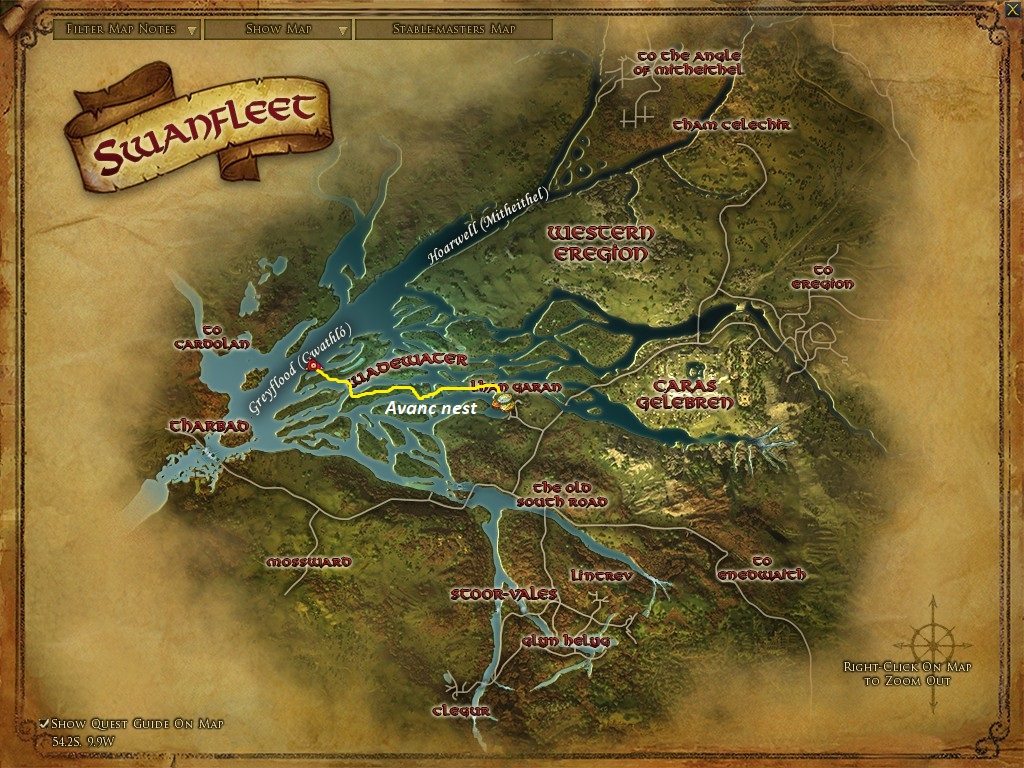
(Here below are the route taken by Deorla in the story if anyone interested in any RP hook/following her/etc)


2. The Black Swan of Greyflood

The waters of the Greyflood lapped gently against the banks, whispering secrets of the wild lands beyond. Deorla trudged along its side, the soft squelch of mud underfoot a steady reminder that she was far from any well-trod path. Her new outfit, crafted in the quiet weeks before all the turmoil on the East Road began, fit her like a second skin.

Gone was the tattered ranger's garb of faded greens and browns. Now she wore sleek, black leather armor, fitted for ease of movement and stitched tightly to mute the sound of her steps. The armor was of medium weight — heavy enough to turn aside a blade if it came to that, but light enough for her to move swiftly, melt into shadow when need called.

Completing the ensemble was a black bird-shaped mask, its beak short and curved, its surface polished to a dull sheen. She had carved and shaped it herself from treated wood, reinforced with strips of iron beneath, and painted it in the deepest black she could find. When worn, the mask turned her into a creature of nightmare: part woman, part omen. Only her keen grey eyes peered out from behind the narrow slits.

She missed the old gear in some ways—the worn leather, the scent of smoke and rain soaked into it over countless years—but it had been time to let it go. The past was too dangerous a burden now.


Not that the wilds of the Greyflood were any safer. Deorla's heart still pounded with the memory of the attack—those cursed river avancs. She had stumbled too close to a nest hidden among the reeds, thinking at first it was no more than an otter’s den. The creatures had come at her with thrashing tails and gnashing teeth, more reptile than bird. Swift, brutal blows with her knife had felled two of them, but she bore a deep gash along her forearm as a reminder of the fight. Blood still seeped through the makeshift binding she'd tied with a strip torn from her undershirt.

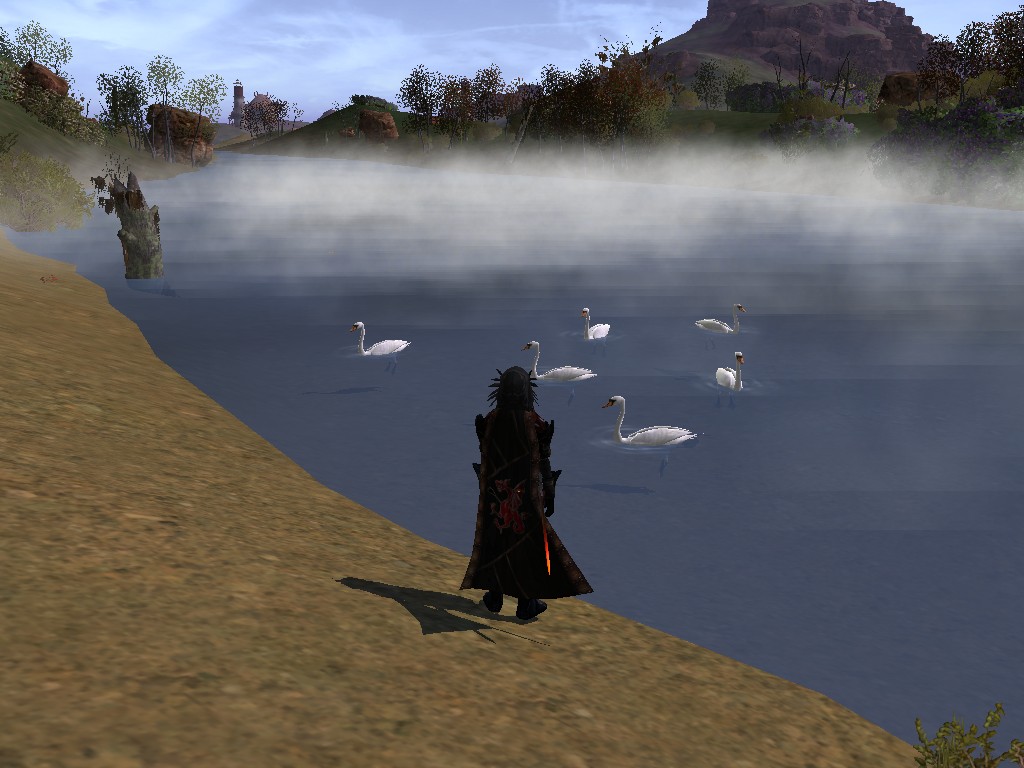
Later, as she followed the curve of the river, a softer sight greeted her bruised senses. A flock of wild swans floated serenely on a broad stretch of still water, their white feathers dazzling against the dark current. They moved without fear or hurry, weaving among each other with the kind of grace Deorla had only ever seen in dreams. For a moment, she simply stood and watched them, her breathing slowing, the adrenaline ebbing from her veins.

One of the swans lifted its long neck and regarded her solemnly, as if recognizing a fellow traveler of lonely, dangerous paths. Deorla offered it a half-smile beneath her cloak’s hood before she pressed on, the memory of the swans glimmering in her mind like a rare, unsullied thing.

Later that day, just as the sun crested above the green hills and the river’s mists began to lift, Deorla spotted the outline of a settlement ahead. Stone walls, squat and worn by wind, ringed a scattering of houses. The place was no fortress, but it looked defensible enough for a village this far from the heart of the kingdoms. A battered sign swinging in the breeze named it: Lhan Garan.


All wet from travels in the water, first thing she decided to do is give her horse a rest in a small stable in the village, after that she set a small tent near campfire, and ate what was left of her provisions, she mumbled to her self "Will need to stock upon some food while I am here, or steal it." and with that thinking she felt quietly a sleep, it was a hard day.

Here below are maps of Deorla travels and the route she has taken in this story if someone will want to travel same way or follow her in RP or for anything else.

3. The Knife Speaks Softly

The warmth of the sun clung to the air as Deorla spent her first day in the modest riverside village. It was a peaceful settlement tucked between hills and waters, unassuming in its rhythm of life—exactly the kind of place she rarely lingered in, but for once, she allowed herself a sliver of calm.

She rose with the dawn, drawn by the soft sounds of water and the chatter of two unlikely companions—an aging Dunlending with a sun-leathered face and a plump, cheerful hobbit who introduced himself as Teilo. They stood on a rickety wooden platform jutting out over the riverbank, casting lines with the ease of men who'd done little else for years.

She took it. The morning passed slowly, the sun climbing higher as dragonflies skimmed the water and the river lapped lazily beneath their feet. Deorla listened more than she spoke, content in the rhythm of casting, waiting, pulling. Her hands smelled of fish and riverweed by noon, and she didn’t mind at all. It was a nice break at least for one day.


Later, with the last of the gold she carried tucked into her belt pouch, she made her way to the village market—a crooked line of stalls set beneath faded canvas awnings. The scents of dried herbs, baked bread, and old leather mingled in the warm air. She moved through it with quiet purpose.

From an old woman hunched beside baskets of produce, she bought a bundle of smoked river fish, tightly wrapped in linen and tied with twine. Another stall sold flatbread, still warm from the stone oven, and she took two rounds of it along with a small pouch of dried berries. A boy no older than ten sold filled waterskins for a copper apiece, fetched fresh from the spring behind the hill. She bought two.

Bartering wasn’t needed—her coin was accepted with eager hands, though her presence drew wary glances. A lone traveler with a sword always did.


Behind the stables, a straw-stuffed training dummy stood neglected beside a rusted shield nailed to a post. She spent the hour before dusk there, letting muscle memory carry her through the forms—sweeping slashes, precise thrusts, brutal overhead strikes. It had been too long since her arms had felt the steady rhythm of discipline.


Deorla took the old South Road, the weather warm and gentle, the air scented with budding heather and damp stone. The road was quiet, save for the soft whisper of wind in the grass. Travelers were few. Peaceful. For now.


But all calm things fray at the edges, and by the second day she reached the borderland of Enedwaith—a land growing harsher, the hills more jagged, the land more untamed. There, at the narrowing of the path between two crumbling ridgelines, she encountered a ragged barricade.

Five men held it. Dunland deserters, by the look—grime-cloaked, sallow-eyed, wearing pieces of old tribal garb alongside looted scraps of armor. Their leader, a squat man with a slashed lip and bloodstained furs, stepped forward demanding coin for passage. Deorla offered him only a stare.

“We guard this road now,” he said, voice thick with arrogance. “You want through, you pay.”

She tilted her head, eyes unreadable beneath her hood. “No.”

The air grew tense. Words followed, sharp and fruitless. They reached no accord.

So she waited.


At nightfall, hidden beyond sight, she circled back. The deserters had made a crude camp near the road’s edge—poorly lit, no proper watch set, confidence bred from small victories and greater stupidity.

They didn’t see her coming.

The first died without a sound, a blade driven through the throat from behind. The second managed a cry before she split his windpipe with a sideways slash, the gurgling wet and ugly. The third she dragged into the dark, her hand muffling his scream as her dagger found the soft place beneath his jaw.

The last two fought.

One swung wildly, torch in hand, the firelight dancing off her blade as she twisted past him and plunged steel through his ribs. He fell cursing, then choking. The leader came last, bleeding already from a shallow cut across his face. He lunged. She let him. The blade barely missed as she stepped inside his swing, grabbed the haft of his axe, and buried her knife in his eye.

When silence returned, it clung to the road like fog.

She took nothing from their bodies.


By morning, the sun rose over Enedwaith and she passed through the bloodstained stones, alone.

The road stretched on through barren hills and dry grass, the terrain rough and lacking shelter. For half the day she followed the main path, pausing only to drink or to scan the open land. Near dusk, she veered westward and spent nearly an hour seeking a defensible place to rest. Trees were scarce, but she found a low dip behind a scatter of broken rocks, just deep enough to hide her fireless camp.

There she sat, cloaked in silence, blade across her knees.

Sleep would come lightly tonight.

(BELOW ARE THE MAPS AND ROUTE SHE TAKEN IF ANYONE WANNA FOLLOW HER OR DO ANYTHING IN FUTURE)

4. The Fire That Raised Her

The wind blew sharp and dry across the plains of Enedwaith, raking the tall grass like a thousand whispering hands. Deorla made camp in the shallow basin of a rocky hollow, flanked by scraggly bushes and windswept dirt. Night fell without ceremony, the stars cold and clear overhead. She kept no fire—there was no need. She had slept in worse places, and in far darker lands.

But the dreams came quickly that night.

She stood again beneath the black sky of Gorgoroth, the ash-stained winds of Mordor curling around her like an old cloak. The ground burned beneath her bare feet, as it had when she was a child—a wretched, nameless thing born of shackles and shadow. The air reeked of blood and iron. She could hear the marching drums, the shrieks of the whip, the thunder of forges that never slept.

She was eight the first time she killed. A boy no older than she had tried to steal a crust of bread from the overseer’s table. They handed her the blade and ordered her to do it. And she did. The knife barely fit her hand, but it found his throat all the same. The blood had been hot. The cheers colder.

Now she was in the Black Tower, kneeling before a throne that was never empty yet never held a body. Sauron’s voice spoke from all corners, immense and burning, and she bowed deeper than bone allowed. He had watched her for years. The girl who didn’t flinch, didn’t question, didn’t break. And when the War grew near, he raised her—not as a servant, but a blade.

He named her.

Herald of the Unseen War—not for glory, but for silence. For all the work done in the shadows: the assassination of rival captains, the manipulation of men too prideful to notice who guided their hand, the whispers in enemy camps that shattered morale before battle ever began. She didn’t fight in the front lines; she set the stage. Sauron had many weapons—but she was the whisper that turned into a scream. The war before the war.

And when the whisper became fire, another name was given:

Shadowflame.

Not merely for the way she fought—blades swift and silent, flames kindled only in aftermath—but for what she became: the will of the Dark Lord, cloaked in mystery, igniting fear in places where even the Nazgûl cast no gaze. She wore no mask, but no soldier dared describe her. Those who survived her presence often spoke only of smoke and blood. Of burning eyes in the dark. Of death that walked like a shadow but struck like fire.

She remembered the kneeling. The ritual. The words spoken in the Black Speech, as the Dark Lord’s voice filled the obsidian hall:

You're my flame unseen. My herald in the silence. My shadow at the gate. Let none stand before you.

She had believed him.

She had believed in the Eye, even when it did not see her.

Then the Eye fell.

The dream twisted—her past bleeding into the now. The Dunland deserters she’d slain days ago stood upright again, their forms flickering like flame-shadow around a campfire. Their wounds still bled, but their mouths moved.

“You carry no banner now, Herald,” one hissed.

“No Eye watches you, Shadowflame,” said another. “But still you burn. Who do you burn for now?”

Their laughter rose, distant and hollow. The stones split beneath her feet, and she fell into blackness.

The pit returned. The one beneath the Tower—where the unwanted were forged, and only one in ten survived the proving. She remembered every test. Every body. Every lesson in cruelty. The hands that taught her to kill also taught her to smile as she did it.

Deorla awoke gasping, fingers clutching her dagger before her eyes were even open. The hollow was still. Stars lingered overhead like quiet judges.

She sat there for a long while, not wiping the sweat from her face.

She still burned, the flame had never left her. Not entirely.

And in the dark places of the world, the name Shadowflame and Herald of the Unseen war still stirred old fears.

5. Ash Beneath the Stone

The road through Enedwaith had grown too visible.

Deorla kept to the edges where she could—skirting ridgelines, walking dry creekbeds, ducking beneath the tall grass when riders passed—but there were too many travelers for her liking. Traders from the north, messengers on lean horses, even scattered Rohirrim scouts flying no banner. Every hour brought hoofbeats or voices. Every face was another set of eyes she didn’t trust.

The land, too, gave little shelter. Sparse trees, shallow hills, and grasslands too open to hide a shadow.


She waited at a rise one afternoon and watched a caravan pass, guarded by four riders and a sullen merchant with a drawn sword. A boy glanced up toward the bluff where she stood. Their eyes met.

That was enough.

She turned east—toward the Bonevales.

They called it a cursed valley, but she preferred the curses of the dead to the questions of the living. No one followed that road unless they were desperate, damned, or mad.

The Bonevales were hushed with the breath of old death. The trees grew crooked here, blackbarked and leaning as if straining to flee. Stones jutted from the ground in unnatural patterns, and crude totems hung with faded feathers and animal skulls lined the paths.

But it was not the land that unsettled her—it was the presence. Not a watching, but a waiting.

On the second night, as Deorla made her fireless camp beneath the ribs of a shattered ruin, she found the first sign: a burnt symbol scrawled in coal across a stone slab. The rune was familiar—she had seen it on scrolls in Barad-dûr, worn around the neck of a Black Númenórean who once reported to her. A sigil of binding and hunger.

The next day, a mist rose around midday and refused to leave. Her path narrowed, then widened into a clearing surrounded by old standing stones—each taller than a man and carved with runes both Dunlending and older, fouler script beneath.

She stepped carefully. Her eyes scanned the stones.

That’s when she heard the voice.

Low. Measured. Heavy with memory.

“You carry his scent still… fire and ruin.”

From behind the central stone emerged a figure—not ghost, not quite man. He wore tattered robes of black and moss, his skin pale and stretched tight over bone. His eyes were sunken, rimmed in grey ash, yet burning faintly red beneath the shadow of his hood.

He bowed his head in mock respect.

“The Herald returns.”

Deorla did not draw her blade.

Not yet.

“Name yourself,” she said.
“I was once called Vathrûk,” the thing said. “In the Dark Tower, I served the Mouth.You, Shadowflame, stood closer to the Will than any of us. You gave orders. You spilled blood. You shaped the war before the war was named.”

His voice grew softer.

“And when the Eye fell… I remained here, and I fell here, as did others. Our Lord’s vision was not just conquest—it was transcendence.”

Deorla’s jaw tightened. “You’re a remnant.”

“We are the echo,” Vathrûk replied. “And in places such as this—where stone remembers and blood never dries—we linger. Bound by oath and death, and by the promise that the fire will rise again.”

He stepped forward, hand outstretched—not in threat, but offering.

“Come below. Let us speak as we once did. You need not walk alone.”

“No,” she said. “The fire doesn’t rise again. It just burns what’s left.”

Her blade was out before he moved.

What followed was not a duel, but an execution. The remnants of power Vathrûk had hoarded failed him. Her blade pierced him through the chest, then throat, then skull, each strike accompanied by a whispered curse in the Black Tongue—words she had learned before she had ever spoken her own name aloud.

When he fell, he did not bleed. He crumbled.

Ash on the wind.

She left the clearing without looking back.

In the morning, the mist had lifted, and the Bonevales fell behind her like a bad memory.

Galtrev brooded in twilight, its crooked streets humming with suspicion and half-whispered legends. The name Shadowflame had moved through the town like smoke on a dry wind, curling into every hall, every campfire, every wary stare.

Deorla knew it the moment she stepped inside the derelict tannery that someone was watching her.

But she let them wait. Let them measure their courage.

The one who finally came stepped with the discipline of a soldier—but not one of the Free Peoples that she saw training nearby by the fire-place, they seemed like Gondorians, so she stayed out of their sight. 

His frame was lean, wrapped in worn black leather stamped with old runes. His eyes were cold, not afraid, and his presence brought with it the heavy silence of memory.

He knelt.

“I am Frestang. I served Vathrûk, who served the Mouth, who served the Eye.”

Deorla did not speak. She merely watched.

“Word came two days past. A raven, marked in ash. The Bonevales are silent. Vathrûk is dust.”

He looked up—not with grief, but awe.

“You killed him. You ended what none of us dared to challenge.”

Deorla stepped forward. “He was a relic. Obsessed with echoing power that no longer serves.”

Frestang nodded. “And that is why the flame must lead again.”

She said nothing at first. A long silence stretched between them, broken only by the wind moaning across the high roofs of Galtrev.

Then he continued, voice low and certain.

“There are still those of us—veterans of the Eastern legions, survivors of Lithlad, commanders from the broken east-forts—who did not kneel to Gondor. We hide. We wait. But we are many. And in Galtrev, we are strong. The clans have grown restless. They need direction. Not sermons. Not kings. There are three clans currently in power here, Ox clan which supports still the old rullings of the eye, the falcon clan that is leading people seperate way, way of free people, and dragon clan who's like the medium between two.”

He lowered his head again, this time with something more solemn than obedience.

“We knew the Eye could not last forever. But you… you were flesh. Fire. Command. You still burn. Let that fire be ours.”

Deorla stared at him.

So it had come to this....

MAPS IF ANYONE IS INTERESTED TO JOIN/FOLLOW THIS STORY FOR ANY RP PURPOSES 

6. Where the Mograws Slept

Night fell upon Galtrev like a velvet shroud, and with it came the final flickers of torchlight along the crooked lanes. Deorla stood alone in the high corner of the old hill-fort, the wind teasing strands of her dark hair as she watched the lights blink out, one by one. The meeting had gone as expected.

Rauthan, ever the eager hound of older powers, had spoken boldly beneath the dark wood beams of the chieftain’s hall.

“The clans are ready. They remember the war—remember you. If you give the word, they will rally.”

But Deorla’s reply had been cold steel wrapped in quiet resolve.

“Not yet,” she told him. “When I have done what I must… when the fire is ready to be stoked—I will call. And you will gather them then.”

He had bowed—not entirely with disappointment, but with recognition. The time was not ripe. And Deorla walked her own path.

By midday she had crested a ridge and spotted what she needed—grazing across a wide and hidden pasture tucked between two low hills were dozens of broad, slow-moving beasts: mograws*1. Thick-coated, curled-horned cattle bred for endurance and meat, raised by Dunlending herdsfolk for generations. Their hooves thudded dully against the earth as they moved, placid and unaware.


Nightfall gave her the cover she needed. She crept into the field like smoke through tall grass. Two mograws fell without sound, her strikes precise and swift. She worked quickly under the moonlight, carving what she could carry, packing it in tight bundles wrapped in hide. The ground swallowed the blood before it could glisten.

By morning, the herd stirred uneasily, unaware they were diminished. Deorla was already gone, slipping into the nearby woods.

There, she spent hours combing brambles and undergrowth for what little the land still offered. Blackberries, blueberries, and even a patch of wild garlic near a dry creek bed found their way into her satchel. She set no fire, left no trail.


On her second day in Galtrev, she woke up rather late. Finally getting some rest she deserved. For half of the day she walked around Galtrev thinking about her past and future, as all people do when they have some time to spare. She also met few habitants and talked to them about little things that did not really matter to her that much, like weather and food.


It was late in the afternoon when she sensed it, a gaze upon her. But different one than usual, not hatred, but curiosity. It was an elf, standing near one of the houses - tall and silver-eyed, clad in soft grey and green, the sigil of a seven-pointed star upon his collar.


“Ascarnil, of the House of Lore,” he said with a slight bow. “I travel with the Dúnedain for a time. We follow the sons of Elrond. They are not far behind.”

Deorla’s gaze narrowed. She said nothing.

“I read it in your eyes,” he added gently. “You are not of them, nor of us. But you are remembered. The past clings to you.”

He glanced skyward, his tone shifting.

“My House gathers what knowledge remains—lost names, buried deeds, truths misremembered. We seek to know the old world before the new forgets it.”

His words were not threatening, but they hung with weight.

Before Deorla could press him further, a distant horn sounded from the west.

“Duty calls,” Ascarnil said with a nod. “Walk with care. These hills watch more than just travelers.”

He was gone in a blink—vanished into the brush, as silently as he’d come.

Yet his words stayed with her. If the sons of Elrond were near, the roads were no longer her own. She would need to move carefully, unseen.


The next morning, grey light poured down from behind a veil of high cloud. Deorla stayed hidden in her tent near few trees that Galtrev had inside the town. She was cleaning her knife and laying out her gathered food. The meat had been salted and wrapped tight, the berries sorted, and the garlic crushed into oil-dipped cloth. 

By nightfall, everything was ready.

The last of the daylight slipped behind the mountains as she strapped her pack, fastened her cloak, and stepped onto the road—silent as shadow and colder than the wind.

The Gap of Rohan waited.

And beyond it, the next piece of her purpose.

*1 - Mograws are the cows near Galtrev - the name for them is self created for story purposes.

7. The Name is a Lie

The sun rose thin and pale above the hills of Dunland as Deorla moved swiftly across the grasslands. Each step brought her closer to the Gap of Rohan, and with it, a turning point in her quiet campaign.


She had declined the offer of Galtrev’s loyalty—for now. Her words to the chieftain had been firm, veiled in smoke and patience: "When the time comes, I will send for you. When I have accomplished what I must." That time had not yet arrived. Not while her blade still moved in the dark.


She walked with care. The land was too open now—too exposed. Though she had the dried mograw meat from her night hunt and berries stowed away, caution kept her alive. The highland air smelled of dry earth and distant rain. Somewhere, a hawk screamed overhead.


Two riders appeared ahead as the path curved by an old stone marker—tall, lean figures on one on an amored horse and the other on a pale grey stag.


Greetings, traveler,” the smiling one called. “You’re heading south?”


She nodded slowly. “Aye.”


They brought their mounts to a soft halt beside her. The one who spoke had the confident charm of someone used to being listened to.

“These roads are quiet,” he said, tone casual. “Safer in company, wouldn’t you say?”


Deorla eyed them warily. There was something familiar—too familiar—in the build of the silent one, the set of her jaw beneath her cowl. And the talkative one… he had a voice like turned silver.


They were too familiar.


But they did not seem to recognize her.


“Names?” she asked.


You can call me Alphthôl and He laughed at his own embellishment. “And my friend here is Fionin"


Curious, she thought. Why  use Sindarin names and pretend to be something you're not?
But she gave her own lie in return, smooth and practiced.“Firebryn,” she said. “I’m on my way to visit a mapmaker I know. Lives near the cliffs before the Gap. Owes me some work before I travel further.”

They accepted it without question. Travel together, then. Just for a while.


It was not until they reached a half-abandoned mining camp that things began to unravel.
As they were talking to one of the Dunlandings in front of a mining camp about where they can found the dwarf, as Deorla/Firebryn did not knew about his current location.

As they spoke the wind and rain stopped, it fact it was starting to get quite warm, a day was coming. The talkative rider pulled off his helm to wipe the sweat from his brow. 


That’s when she saw him.


Her breath caught, but only for an instant.


That face—Alairif
She recognized him now without a shred of doubt.


And the quiet one must be Guriwen.


But they still didn’t know her, or at least she hoped so, but if they did I bet they would react difrently, at this time she was so glad to ditch the old ranger outfit in the lake, and wear hew new traveling bird masked clothing.

But this gave her a reason to think more about the way she looks and the mount she was using, once she gets to her home maybe a haircut she thought.


She forced a calm smile and turned back to the miner. “Seems the dwarf has taken to hiding in a cave near the Gap,” Dunelanding said after Alairif offered him some silver coins. “Hounded by orcs, apparently." he added at the end.


Her companions offered no protest when she suggested helping the dwarf. She watched them closely. They were good—very good. But not careful enough, or perhaps she was the one being fooled. This was something she did not anticipated on her travels, at least not so soon!

Few thoughts had crossed her mind as they were traveling in a rush towards the cave.
"How did they find me?" "Did I left enough clues?" "Perhaps just a coincidence?" 


Rest journey to the cave has been rather quiet, it was a rush to get there, and more thoughts on Deorla’s mind.


"Perhaps the Company I've left behind decided to go after me afterall, but Guri and Ali aren't part of them anymore from what she remembered as she was leaving. So many questions so little answers. But one thing became clear to her, she will need to deal a swift blow for Company of the East Road, apparently leaving was just not good enough. "If they wanna war they will have it."


The cave mouth was half-hidden behind a boulder-slide and old brush. A faint reek drifted from inside—orc filth and rotting leather.


Two sentries loitered near the entrance, blades in hand, armor scratched and dented. Alairif—still wearing that cursed false name—dismounted and struck with practiced grace.


Steel sang.


Two orcs fell.


Inside, the cave stretched into gloom. Old mining shafts split into multiple tunnels, darkness pooling in their mouths like ink.


“We should split up,” Deorla said evenly. “If the dwarf’s alive, we’ll find him faster.”
Alairif agreed and took the left path.
Deorla turned toward the right without hesitation.
Guri remained behind to guard the entrance.
As the shadows closed in around her, her mind grew quiet, focused.
They had no idea who she truly was.
Not yet.


But the game had begun.

Here are the maps to use for any RP purposes of Deorla travels


8. Whispers in the Smoke

The cave yawned wide before her like the mouth of some slumbering beast. Deorla stepped into its gullet with blade in hand and eyes sharp in the dark. The scent of old fire, unwashed bodies, and rotted meat clung thick to the air. This was no mapmaker’s den. It was a nest.

Orcs. And not few.

She moved quickly, soundless as a cat across stone. A narrow side passage gave her cover and from there she watched, waited. The interior was deeper than she'd guessed from outside—clearly once a mining site, now repurposed with crude iron pikes and cloth dividers hung from old support beams. It was half-camp, half-lair.

At the far end, beside a broken anvil, a hunched figure paced: an Agmarin and uruk  of significant size, armor cobbled together from Dunlending and Isengard remnants, a battered helm hanging from one shoulder. His voice barked sharp orders at a pair of lesser orcs, who scrambled to obey.

Deorla crouched, watching, calculating.

She could kill them. She had done it before, and with joy. But this time… there was a greater prize in patience.

She sheathed her dagger and stepped forward.

Not into light. Not into view. But into their path.

She dragged a length of broken chain behind her, letting it scrape just loud enough.

An orc turned, snarling. “Who's there?”

She shifted her tone—thick, Dunlending accent, rasped by smoke.

“A whisper from the East,” she hissed in Westron, low and mocking. “From the fires that fell. I've seen the weakness. Riders growing fat on their victory. The Gap is soft.”

The uruk turned his head, nostrils flaring. “You dare enter here, witch?”

Deorla smiled behind the shadows. She never let them see her face.

“I dare tell you this—ride west at moonrise. Strike the Rohirrim where their horses sleep. And you’ll find no swords ready. The Riders watch the north now… they’ve forgotten the teeth of Isengard.”

That name—Isengard—still held weight among these stragglers, orcs left behind when Saruman fell.

The uruk stepped forward. “And why help us?”

“Because men forget their debts,” she said. “And the fire still burns in me.”

She let a piece of broken white cloth fall from her cloak—it bore a faint sigil, one she’d taken from a slain scout, its origin untraceable. It looked real enough.

They bought the lie.

The uruk grunted, suspicious but eager. Victory was a promise no orc ever questioned too long. Orders were given. Steel scraped. The preparations began.

Deorla slipped back into the dark, unseen and silent.

By the time the first howl rang through the cave—some orc stirring his brethren to violence—she was already moving toward the surface.

Deorla emerged to moonlight and stillness. She expected voices, or perhaps the flicker of campfire embers where the two people had waited.

But there was nothing.

No sound.
No shapes.
No sign of the riders who had shared her path.

Not even hoofprints marked the earth in clear direction.

“They left…” she muttered. “And not in haste.”

She circled the clearing, checking for signs—any trace of their departure—but the ground was too rocky, too scattered with old prints. It was as if they had vanished.

Vanished… or chosen to disappear.

Her hand tensed on the edge of her belt. A subtle pressure built behind her eyes—not panic, but calculation.

Had they recognized her?

Had they followed her into the cave, watched from shadows?

Or had they simply vanished by design, puppets cut from their strings?

Whatever the truth, Deorla was alone again.

She turned south toward the Gap of Rohan, where the orcs would soon spill like a plague across the grass. They would die, of course. That was their purpose.

A distraction… a message.

She walked with a quiet satisfaction.

Let the Rohirrim believe it was an old grudge from Isengard.

Let them ride north in confusion.

Deorla’s blade moved far ahead of her now—and the path beneath her feet had already begun to burn.

9. The Silent Siege of the Gap

(This RP is done via DM friend of mine and lots of dices rolls)


Night fell like a wolf’s shadow upon the Gap of Rohan.

The stars were swallowed by storm clouds, and the wind ran cold through the hills. On that narrow pass between the White Mountains and Isengard’s ruined scars, a war born of whispers began.

Deorla stood on a ridge to the north, cloaked in shadow, arms folded. Below her, a tide of ruin marched—the orc force she had poisoned with rumors and fire, now driven mad by the scent of horse-blood and vengeance.

There were 93 orc foot troops, clad in scrap metal and stolen hides, and 51 archers with cruel, hooked arrows clutched in clawed hands. At their head: the war-leader Magzûrz, an uruk from Saruman’s fallen breeding pits, snarling orders with froth on his lips.

Before them: the Gap’s wooden defenses—three towers, a hastily patched wooden gate, and seven barricades, all manned by a brave few.

Only 23 Rohirrim foot soldiers stood ready.
Just 5 archers held the towers.
And between them paced 5 warhounds, tethered but snarling, sensing what was to come.

Deorla watched, silent. She expected more resistance, but afterall the war has ended. \

Phase One — The First Assault

A warhorn shattered the air, blown by a goblin with cracked lips. The orc archers loosed first — a black rain of arrows soaring toward the three towers and gate. They managed to kill 1 soldier and damage the tower little bit.

The Rohirrim replied—horns, arrows, and grit. The tower bows returned fire, dropping orcs in clusters.

But then came the charge, but just before the arrows managed to get 2 orcs.

Orc warriors surged forward with axes, cleavers, and blunt iron maces. They struck the barricades first, crashing against them like a wave.

3 Rohirrim fall defending the barricades.

The warhounds were unleashed. Fast and savage, they leapt over wood and steel, ripping through the first line of orcs.

7 orcs spilled the blood after the swift counterattack of the warhounds, most of the orcs did not have much armour equiped so it was perfect for the warhouds to tear them apart like some small toys.

Deorla turned her gaze south. The sky there began to tremble with hoofbeats.

Phase Two — Gamling the Old Arrives


The distant sound of a war-horn split the night anew—but this one blew from hope, not doom.

From the south rode Gamling the Old—his helm scarred by three wars, his spear still sharp. With him came 50 hardened foot troops and 46 horsemen, the banners of Rohan whipping in the wind.

They broke upon the orc flank like a hammer of thunder. 11 orcs felt swiftly to the horses and they started slowly to turn around, specially with still two barricades standing still.

Deorla was shocked, she did not expect any reiforcments, How? From where? But deep down she knew, she knew it was Alairif and Guriwen work, she cursed in black speech, she should seen this coming! She should know! The battle strated to look grim, as she glanced at the battlefield once again she saw Gamling striking down Magzûrz in single combat, turning the tide.

Phase Three – The Circle of Death

As the battle raged, with flames rising from a collapsed tower and cries echoing over the bloodied earth, Deorla moved.

She descended silently from her ridge. Her armor was already prepared: old Rohirric leather, scorched and dirt-stained, perfect for camouflage. She covered her face in soot. On her breast—a faded emblem of a forgotten rider company.

By the time she reached the scattered remnants of the orc host, only around 40 remained—broken, disoriented, but still armed.

She spoke in Black tongue, her voice low and cutting:

“Circle. Now. Shields tight. Arrows useless.”

The orcs recognized strength. They obeyed.

A brutal, compact formation formed quickly—blades outward, shoulders pressed together, like a living iron shell rolling toward the defenders. And hidden within that beast of violence was Deorla, crouched low, hood drawn.

The Rohirrim couldn’t see her. Couldn’t hear her. Exactly what she was hoping for.

The Final Collapse

As the orc circle rolled forward in desperate cohesion, the Rohirrim pressed harder from the sides. Gamling's infantry drove their spears into gaps. The riders circled behind to cut off retreat.

There was no command. No leadership among the orcs.

Deorla made sure of that.

She gave no orders. No cries of attack or defense. The orcs looked to her—but she gave them silence. She watched with cold purpose as one by one, they were slaughtered. Their last push was valiant, but blind. The circle shrank. Then broke.

Gamling has seen his share of battles and wars. he had won the battle without much of trouble, all orcs have been killed in the collapse. 

In the chaos, one soldier dragged Deorla to safety, mistaking her for a wounded comrade. He yelled something over the din—she nodded weakly, faking exhaustion. Blood from a fallen orc coated her armor convincingly.

As she was getting dragged, Deorla notices Gamling was searching for something, or rather someone. "Yea, they knew it was me who was coming, damm them two humans. She had last card left in her arsenal, altho a heavy toll was payed for it, she left her horse on a hill, with a body on a dead orc painted in black. She was hoping that he would provide enough if distraction to let her escape, and it worked. Gamling himself rode towards the hill.

Within five minutes, she was behind the Rohirrim shield wall.

She had crossed the Gap.

Not as fire. Not as enemy.
But as shadow, and as shadow she managed to sneak away from the battlefield as everyone was distracted and tending the wounds.

10. House of Shadow

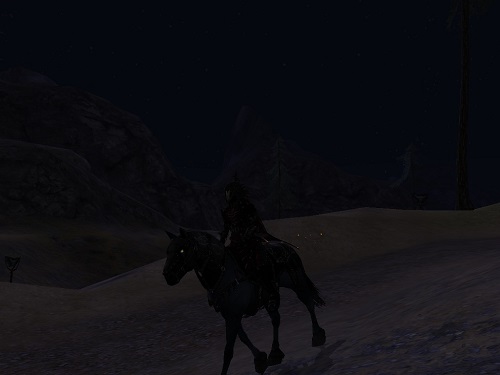
The road stretched endlessly before her, beaten and dry beneath the early summer sun. Deorla walked—her boots scuffed, legs sore, cloak tight around her frame. She had no horse anymore.

But she was used to walking.

The land itself seemed at peace now. She saw no riders, no merchants, no enemy scouts. Even the wind was calm. Fields rolled on her left and right, broken only by distant fences or rotted wagon wheels half-swallowed by tall grass. For the first time in weeks, there was no urgency behind her steps.

When she finally came upon the ruins of Marton, she paused—not from weariness, but memory. Once a small settlement with stone paths and market wagons, now it was hollowed by flame and time. The war had gutted it. Roofs lay sunken; its well was choked with weeds. Black streaks trailed from shattered windows.

Deorla passed silently, as though unwilling to disturb the ghosts.

Later that afternoon, after climbing a long ridge, she looked out and saw it: Edoras, golden in the fading light, nestled on its hill like a crown on the land’s brow.

But she did not head toward it.

Instead, she turned eastward to a graveled trail, where earth rose in a sacred rhythm. Two lines of barrows flanked the ancient road—kings of Rohan, buried in honor, their mounds overgrown with flowers and grass. Great stones stood like silent sentries.

The first row held the founders: Eorl the Young, Brego, Helm Hammerhand—legends etched in moss-stained runes.

The second row was fresher, cleaner, with trimmed grass and offerings: Fréaláf, Thengel, Théoden—the king who rode to Gondor and never returned.

Deorla knelt briefly between the two lines.

She did not bow. She did not weep for them as they were her enemies. Still she respected them, they were few of the true heros of Middle-Earth she found worthy of being in her book of respects.

She looked to Théoden’s barrow - her left eye started to burn a bit, as it was Theoden who left the scar on her left eye that day on the fields of battle, but she did not hold a grudge , she stood a moment in silence and whispered,

“The world changes. Even for kings.”

Then she stood and walked on.

By nightfall, the white peaks of the Ered Nimrais loomed like sleeping beasts in the east. Nestled against their foot was near Aldburg in deep forest and well hidden her destination: a semi-large wooden house, with a small shed nearby, half-covered in ivy and shadowed by birch trees. She looked around and it seems all the decoration and things she managed to steal and gather during her service for Sauron was still being well mentained. 

As Deorla approached, the door creaked open—not by her hand.

“You took your time,” said a familiar voice, wry and warm.

There stood Firebryn, cloaked in a weathered shawl, red hair turned mostly gray but still wild. Once a smuggler from Dale who moved arms and food beneath the eyes of captains during the war, now she walked with a limp and leaned slightly on the doorframe.

“I thought you’d be bones in a ditch by now,” she added, stepping aside.

Deorla smirked faintly. “I almost was. Twice.”

Inside, the house was clean, though plain—just as Deorla remembered. The hearth was lit, and bundles of dried herbs hung from the ceiling. A travel pack lay folded on a wooden chair, right where she’d left it.

Deorla set her satchel down, eyes softening for a moment. “You kept it all...”

“Well,” Firebryn shrugged, “you pay me in gold and silence. That’s rare enough these days. Besides—some of us are too old to keep running. This is a fine place to age in peace.”

They sat together as night deepened, no need for more words.

Deorla was safe—for now.

But war never stayed far from her shadow.

11. The Last Lieutenants

The sun was beginning to set behind the white peaks of the Starkhorn as Deorla stepped into the small fenced paddock behind her secluded home. Firebryn stood there already, brushing down one of the four horses that had belonged to Deorla—now well-groomed, well-fed, and visibly pleased to have their mistress home again.

“You kept them in fine shape,” Deorla murmured, trailing her hand over the flank of a dark bay mare.

Firebryn grinned, not looking up. “They've got better manners than most men I’ve smuggled goods for. Easier to feed, too.”

Deorla chuckled under her breath. Her gaze shifted from the horses to the mountains in the distance, their jagged shadows crawling slowly across the valley. For the first time in weeks—months, perhaps—she allowed her shoulders to relax.

The house was quiet and warm inside, lit by late golden rays and the scent of wood smoke. She stepped through the threshold and touched the frame, a small smile tugging at her lips. This house had been her refuge after the fall of the Dark Lord, when the world reshaped itself and many like her became ghosts.

“It’s good to be back,” she said aloud, as much to herself as to Firebryn.

They sat together later that night, a single candle between them and the world outside dark, brooding with cricketsong. Deorla had poured herself a cup of aged mead. Firebryn nursed hers slowly, eyes sharp and curious.

“You’ve that look again,” Firebryn said.

Deorla raised a brow. “What look?”

“The one you had before you went into the East and carved a path through ruin and fire.”

Deorla tilted her head, then said with a grim smile, “You’re not wrong. I've decided. I will go to Mordor.”

Firebryn choked on her mead. “Mordor?”

“It is broken, scattered… but not dead,” Deorla explained calmly. “With Sauron fallen, the only ones left in power are his lieutenants—men and women of shadow who once stood alongside me. I know them. I know how they think."

“You think you can rule them?”

“I know I can.” Her eyes gleamed, not with madness, but with cold certainty. “If I reach them first, before they tear each other apart or fall prey to Gondor’s slow crawl eastward, I can unify what remains. Mordor can be reshaped, and the rest that will be harder to deal with I will deal in other way. You probably met some already and some are just names you might have heard, but there are total of eights of lieutenants that I will have to deal with, and each will be tricky. There's:

Lhaereth the Stained

“The Poisoner Queen. The Architect of Plague.”
Lhaereth was once revered in the black halls of Nurn for her alchemy, but her ambition curdled her craft into corruption. She brewed diseases like wine, testing them on slaves and beasts until her concoctions could bring cities to their knees. Cold, clinical, and obsessed with control, she resides in Dol Guldur or other hidden sanctums, working in silence. I know Lhaereth will not be easily persuaded—only results and raw power will bend her loyalty. But in truth, I do not wish to bend her to my will, she's the only one I wish to see destroyed after what she did to my home of Nurn, it's because of her. I also think her citadel Seregost would be the best place to have as my base of operation.

Firebryn just nodded and continued to listen as Deorla was explaing next people


Borangos the Horror

“The Unmade One. Flesh-warped Terror.”
Once a man, if the tales are true. Now a grotesque mass of corrupted body and unshackled rage. Borangos was forged in the pits beneath Barad-dûr, a living weapon to break sieges and slaughter captains. He does not speak. He remembers only hate. His mind may be shattered, but his strength is unrelenting. If he still roams Mordor, he is likely bound to some ruin in Gorgoroth, waiting like a beast in its lair.

“Borangos cannot be reasoned with—but he can be pointed. If I can chain the beast, I can use him."

Urudanî

“Priestess of Ash. Flame that Worships Itself.”
A high priestess of the Cult of the Eye, Urudanî is not merely a zealot—she is zeal. She believes herself chosen by the Flame of Udûn and sees the fall of Sauron as a divine test. She preaches still to the broken in Mordor, rallying those too afraid to choose a new master. Her conviction is dangerous. She would sooner die than kneel, unless I present herself as the true successor to the Eye.

“She burns for Sauron still. I must convince her I am the ember that remains.”

Karazgar, the Weeping Warrior

“The Blade That Mourns. The Lie That Walks.”
Karazgar is a mystery cloaked in sorrow. Once a commander of men, now something far less tangible. He weeps not for his victims but for the world he believes must be destroyed. A nihilist with blades, he appears where chaos brews—feeding it, guiding it. Some call him ghost. Others, assassin. I know he walks with purpose, and his allegiance lies not with power, but with entropy.

Dolguzigir, the Dark Archivist

“The Keeper of Forbidden Words.”
Dolguzigir served as a scribe in the deep vaults of Barad-dûr. He remembers every pact, betrayal, and secret whispered in the shadow of the Dark Tower. A collector of lore, he survived the fall by making himself indispensable. Now, he holds truth like a dagger—wielding it against allies and enemies alike. I Deorla will need to barter knowledge for knowledge… or silence him before he speaks too much.

“He knows who I was before. That makes him powerful. That makes him dangerous.”

Dulgabêth, the Mouth of Sauron

“The Liar-Lord. The Tongue that Twists.”
Though slain by Aragorn before the Black Gate, whispers say Dulgabêth never truly died—or perhaps his name has become a mantle passed on. This new “Mouth” rules by fear, enforcing obedience among the remnants in Nurn and Lithlad, or perhaps he was not killed at all the gate, it's something I would need to find out. His voice alone bends the will of lesser men. I once stood beside him in court, matching word for word. I knows his pride is his leash.

“If he yet lives, he’ll want the throne for himself."

Rûkhor, the Pale Herald

“The Bone-Walker. The Whisperer of Tombs.”
A being neither living nor entirely wraith. Rûkhor lingers in the borderlands of the Dead Marshes, gathering the dead and whispering to the lost. Some say he was once a Haradrim prince, cursed by Sauron for betrayal. Now he serves no master, only death itself. I suspects he could be swayed… if offered something ancient enough to stir what little soul he has left.

“He listens only to ghosts. But I know the names of the ones he loved—and how they screamed.”

Gothmog, the Nameless Flame

“The Shadow That Refused to Die.”

Though some believe Gothmog perished in the Second Age at the fall of Angband, and others saw him die again as Mordirith in the wars of Minas Morgul, there are whispers that Gothmog was never truly one being—but a title, a vessel for wrath forged anew each age.

Now, he reigns once more in Minas Morgul, cloaked in sorcery and ruin, holding court over a city that bleeds shadow. His throne sits beneath the tower's broken spires, and his voice echoes through halls once walked by kings of Gondor, twisted now to his will. Of all the remaining lieutenants, Gothmog commands the strongest fortress and the darkest magic. He is a commander of wraiths, beasts, and memories long dead, and no banner flies in Mordor without his silent approval.

“He does not merely rule the city. He is the city. Morgul breathes with his lungs and dreams with his hate.”


In truth I might most likely not comeback from this journey at all, I know I said I know I can, but in reality I think that was just a lie to boost my ego... Anyway I will do this either way.

Firebryn stared at her in silence for a time, then leaned back with a sigh. “Well, it’s more exciting than sweeping your floors.”

Deorla smirked. “Then perhaps it’s time I gave you something else to do.”

“Oh?”

“Two things,” Deorla said, counting on her fingers. “First—find someone to take over the house. A caretaker, trustworthy, discreet. This place cannot be left untended.”

Firebryn nodded, already thinking. “And second?”

“You still want purpose before your bones turn to dust?” Deorla’s voice lowered. “Then go to Eriador. Find what’s left of the Company of the East Road. Root them out. End them. They’ve lingered too long, still whispering in the dark, working behind closed doors. I left them for good, and still they try to pull my strings.”

Firebryn’s eyes lit up. She set her cup down slowly and leaned forward. “A proper job, then. One more ride west... and one last fire.”

Deorla smiled, not kindly. “Burn them to the ground, Firebryn. Every last trace.”

The candle flickered between them, casting dancing shadows on the walls. In the silence that followed, plans began to take shape. Beyond the window, the moon climbed over the mountains—witness to oaths sworn in the twilight, in a house forgotten by the world.

And so the wheels turned once more. Toward Mordor. Toward vengeance. Toward the ashes of war.

12. Ashes and Farewell

The golden light of early morning filtered softly through the latticed shutters of Deorla’s hidden house. The air held a rare stillness — not the kind that comes before a storm, but the quiet pause before history begins to turn again. Outside, birds stirred in the brush, and smoke curled gently from the stone chimney. Inside, Deorla stood before a shape half-concealed beneath the floorboards — a white chest, pale and cold like ice, as if winter itself had been shaped into wood and steel.

The chest bore the carved likeness of a dragon’s head, its mouth twisted into a frozen snarl. Its surface was lacquered in a faint glimmer of frost-colored enamel, giving it the illusion of being perpetually chilled. The lock was ornate — a narrow slit disguised beneath the tongue of the dragon — and bound by an old rune-ward known only to Deorla.

She retrieved a narrow shard of obsidian from her satchel, etched with fine black script. Sliding it into the chest’s hidden slot, a low mechanical thrum followed by a click sounded — as if the dragon had sighed through its fangs. The lid opened.

Inside lay the reward of cunning, blood, and shadow: over ten thousand golden coins, each neatly stacked and sealed in silken pouches or stamped crates. The wealth of three years spent running the Company of the East Road — now hers alone.

She exhaled through her nose, smiling faintly. “Enough to raise an army,” she murmured. “Or to buy loyalty that costs more than steel.”

While Deorla counted and sorted what she would carry, Firebryn had already left at dawn, saddlebags heavy with trade tokens and coin. Her destination was Edoras, not just to gather supplies for the road ahead, but also to find someone dangerous enough to understand the weight of guarding Deorla’s hidden house.

She returned the next evening, cloaked in rain and silence, her boots muddy and her eyes sharp.

“I found them,” Firebryn said, hanging her travel-worn cloak. “A pair. Not the honest sort — but that’s the point, isn’t it?”

Deorla raised a brow.

“Name’s Erting, once a captain of Stangard,” Firebryn continued. “Got dismissed for brutality during the last days of the war — something about flaying Easterlings alive during patrols. He knows how to keep things guarded. He’s quiet, cold. Knows command.”

“And the other?”

“His wife — Maerhild . Former herbalist. She had a stall in Langhold once, but no one bought her mixtures except hunters and… well, folk who wanted to get rid of people. Let’s say her knowledge of poisons is extensive.”

Deorla sat back in her chair, fingers pressed beneath her chin.
“They’ll keep the house unbothered.”

“They’ll keep it unapproachable,” Firebryn replied. “I paid them enough to keep their mouths shut and their blades sharper. They’ll settle in by the end of the week. You won’t be missed.”

Deorla smirked faintly. “Good. I built this place to vanish into the world. Now let it sleep in their shadows. But in case I will leave enough gold for at least three years payment.

With Firebryn securing her replacement caretaker Deorla turned her focus to the journey itself.

Knowing the roads ahead would not be kind, she began gathering and preparing supplies. With Firebryn's return from Edoras, her arms were laden with essentials: dried meats, smoked eels from the river near Snowbourn, salted cheese wrapped in linen, and dozens of packs filled with dried berries, oats, and flatbread. Roots and rare herbs were packed separately, kept in small jars of dark glass to preserve their potency. Firebryn had also brought hard-to-come-by items—dried saltfish from Gondor’s coast, fire spices from Harad, and bark-brew tonic strong enough to awaken a half-dead soldier.

No mere traveler, Deorla prepared as a shapeshifter of nations—each steed and garment an identity, a veil behind which she could hide or command.

The Harbinger – A jet-black steed known in ancient whispers as a sign of shadow's return. Taken from the remnants of Mordor, its hooves seem to echo with distant thunder, and its piercing crimson eyes know no fear. This was her Harbinger Horse. With it, Deorla paired her iconic black armor—serrated, shadow-draped, and blood-touched.

The Dead City's Warden – A mount once stabled in the ghosted avenues of Minas Morgul. Its coat is dark steel and its gear heavy and silent. With this Dead City Horse, Deorla donned her ceremonial battle armor which she wore very rarely but sometimes large battles could not be avoided—dense and brutal, meant for commanding sieges and slaughter. Here, she was no longer a whisper, but a conqueror of ruin.

The Rider of the Mark – A sun-kissed Rohirric stallion, fast and loyal, with green-plumed tack and soft leather saddle. On this horse, she wore her Rohirrim disguise, bearing a fictitious crest, the garb tailored for open mead halls and windy plains. It was her key to move unseen in familiar lands.

The Stone-Runner – A Gondorian charger bred for nobility and endurance, slate-gray with white fetlocks and a silver bridle. Her Gondorian garb was minimal yet elegant, a black-and-silver ensemble fit for a traveling noble or errant knight. This face allowed her to walk in cities that once hunted her.

The Silent Hunter – A horse bred in the far deserts of Harad, clothed in shadow-dyed wrappings, silent as a ghost. This Silent Hunter Horse moved as if tracking prey. She wore desert robes, layered in red and bone, beaded with ivory and adorned with glass talismans. This guise was for the veiled markets and assassin-walks of the South.

The Gorgoroth Behemoth – The most fearsome of her mounts, pulled from the flames of the Black Land itself. Armored in spiked steel with molten-stone eyes, this Gorgoroth War-steed bore her into legend and her new bird shaped outfit just fit perfectly with it;


As dawn crept over the ridge and the mists of the Rohan hills began to pull back, the time of parting came. The six mounts were prepped and outfitted, saddlebags filled with dried meats, honey-bread, herbs, cured roots, and Firebryn’s carefully packed bundles of medicinal powder and venom antidotes. Every inch of Deorla's caravan shimmered with intent—this was not a wanderer’s flight, but a campaign in motion.

But before the gates of the house opened for what might be the last time, Deorla turned to the new stewards: Captain Erting, the grim-eyed man from Stangard, and his quiet, unsettling wife Maerhild, the former poisoner-herbalist now veiled in dignity. She stepped toward them, the white-ice chest gleaming faintly behind her like a forgotten relic of another age.

Her voice was cold and precise.

“This house is not merely timber and stone. It is memory. It is blood. And if anything happens to it—by your negligence, greed, or betrayal—I will return.
Even should my body be scattered to ash in Mordor’s wind,
I will crawl back from death, through shadow and storm,
and I will end you both.”

There was no fire in her tone—just certainty. Captain Erting bowed, his eyes narrowing. Maerhild offered a thin smile, part flattery, part unease.

They stood in silence for a time. The smuggler-turned-keeper held her cane tightly, her graying braid fluttering in the wind. Her eyes were red—not from sadness, but from knowing.

“I never thought I’d see this house rise from ruin,” Firebryn said. “And I never thought I’d be the one locking its doors.”

“You’re more than that,” Deorla replied.

Firebryn chuckled softly. “And you gave me purpose, Deorla. More than I ever had, smuggling crates up Anduin like a rat.”

Deorla reached into her cloak, drawing out a small leather-bound locket. Inside, a drawn symbol—a raven perched upon a sword embedded in a mountain.

They embraced tightly. No tears, but the weight in the air hung heavy. They both knew they would never meet again.

13. The Boar and the Black Rider

The night was ink-dark, and only the breath of stars shimmered faintly above the towering forests of the Aldburg Wood. Deorla rode in silence, the hooves of her mount—the Harbinger—striking the mossy floor like low drums of war. The creature was bone-armored and wreathed in withered leaves, a beast born of shadow and decay. 

The rustling came first. Then the grunt. Her black gaze snapped ahead, narrowing. There, through the underbrush, came the unmistakable form of a monstrous boar, larger than any she had seen. Flanking it were leaner beasts, tusked and wild-eyed—guardians of something older than memory.

A shimmer in the moonlight revealed more clearly Deorla had no doubt: Scion of the Great Boar.

“So the blood of Everholt still lingers,” Deorla muttered to herself, reining in her steed.

The tale of Folca, the 13th King of Rohan, and his tragic end while slaying the legendary boar of Everholt was known even in Nurn. That same blood now ran in these beasts—guardians of forest and vengeance. She did not engage them; not tonight. They were watchers of borderlands, not enemies. She gave a slow nod of respect and continued on her path, though their gleaming tusks followed her all the way.

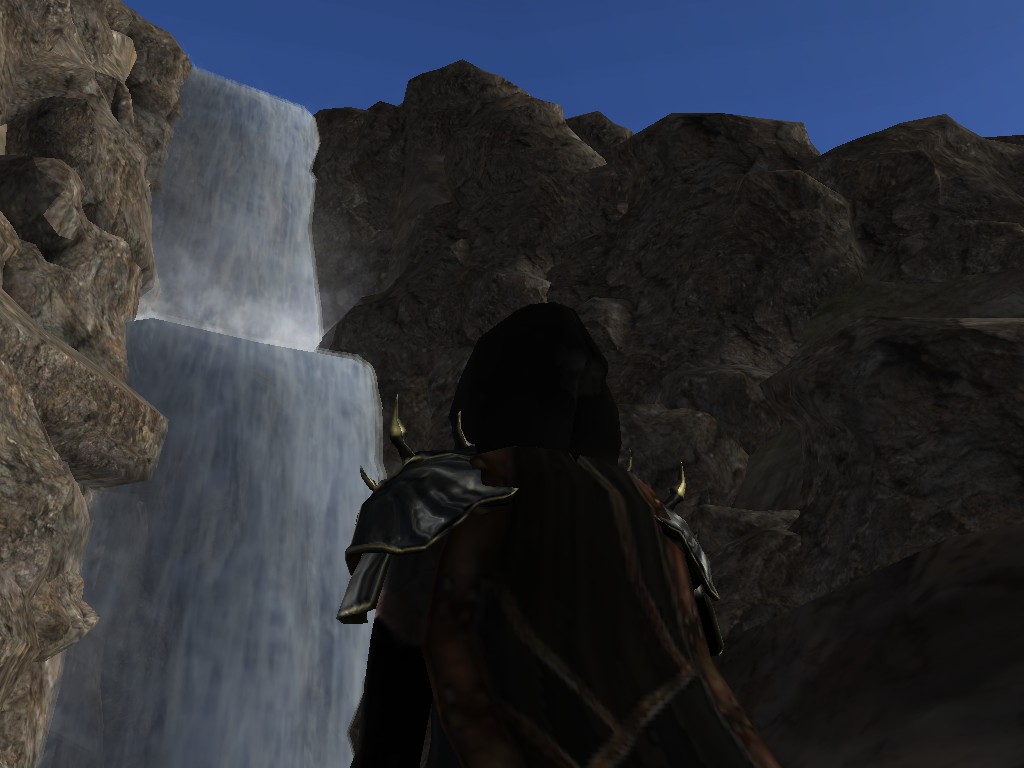
Few hours later under a starry night sky, she reached a waterfall—a cascade so wide and thunderous it swallowed her thoughts in sound alone. She stood there for a time, cloaked in black, her Harbinger steed drinking from the pool below. The veil of water, glittering like gems in starlight, marked her entrance into Gondor.


She passed the waterfall and pressed on, the sky turning from starlit blue to the sickly grey of dawn. On the far side of the Beacon hills, where the land flattens before the White Mountains rise, Deorla was intercepted. A party of Variags—men of Khand—rode fast upon her trail. They bore the blood sigil of the eastern tribes, and at their head rode Vrakya, a Jarl of savage ambition and grim reputation.

Clad in plated bronze and crimson cloth, Vrakya dismounted with a smile full of broken teeth.

“You ride alone, Shadowflame. Too far from your desert roots. But the Rohirrim still bleed in the East— But I heard recently the price off your head is something everyone talks about now. What a weird chance I runned into you, all alone. Boys, get her!"

Before the final word left his lips, Deorla was in motion.

She struck first—not with some spell, but with the flat of her gauntlet, slamming it into his jaw with a crunch of bone. The Variag stumbled, cursing, and drew his blade in a wide arc meant to intimidate. Deorla ducked low, pivoted on her heel, and swept his legs from beneath him with a perfectly timed kick.

He crashed into the dirt, and she was already atop him. They wrestled in the dust, blades scraping armor. Vrakya was stronger, but she was faster. A feint—his blade caught her shoulder plate, but not skin. Her dagger found his ribs.

He gasped, but she twisted the blade deeper, breath hot against his ear.

“You should’ve ridden past.”

She pulled free and rose. Vrakya didn’t. His men watched, unmoving—awed or afraid.

Deorla didn’t bother with a speech. She simply turned to them, blood still dripping from her blade.

“You didn’t see me,” she said. “You saw a ghost on the wind.”

None challenged her. One by one, the riders turned their mounts and vanished into the wild.

She cleaned the blade on Vrakya’s crimson sash, then buried it beside his body beneath a cairn of stones, marking the site with a spearpoint stabbed into the earth.

By dusk, she arrived at the great ruined gate of Anórien, once a symbol of Gondorian pride. A statue of Isildur stood above her, sword raised against the twilight.

Deorla looked up and smirked.

“You died clinging to power,” she said, brushing past it. “Let’s see how long your house holds without it.”

The road stretched out before her now. To Osgiliath. To Gorgoroth. To Mordor.
And to her final ambition.

14. The White Company’s Snare

The lands of Anórien stretched before Deorla like a tapestry of shifting hues. Beyond the waterfalls and borders, the countryside was dotted with half-abandoned farms, their fields thin and tired from years of war. Gondor was healing, but the scars were deep, and such scars could be used.

She rode slowly at first, not eager to draw notice. Each village she passed held whispers of Gondor’s resilience—but also their fear. When her black-armored figure appeared on the horizon, shutters closed, children were pulled indoors, and the brave few who lingered only stared, clutching tools as makeshift weapons.

Deorla did not stop. Her eyes were fixed eastward. Mordor awaited.

By the third night, she discovered ruins along a ridge, the remnants of an old Gondorian watchtower. The walls were toppled, ivy climbing over grey stone, and a shattered bell lay half-buried in the earth. It was here she made her camp, letting the fire crackle low while the wind sang through the broken tower.

As she ate from her provisions, she unrolled her maps—drawn by her own hand in the years of traveling as "Deorla, merchant and leader of the Company of the East Road." Now she traced with ink-darkened fingers the route toward Osgiliath, then farther east into Ithilien. Mordor was not far.

She thought of the names of the remaining lieutenants—Borangos, Lhaereth, Karazgar, and more. Old rivals. Old equals. Soon to be either allies… or obstacles to be removed.

“One throne,” she muttered softly to herself. “And only one voice to command it.”

The night was long, haunted by the cries of owls and the rustling of wild creatures in the underbrush.

By the time she reached Osgiliath, the White City’s soldiers were a more open presence. Though the city had been reclaimed after the fall of Sauron, it was still in ruin—a patchwork of rubble, scaffolding, and tents where men labored to restore what had been lost.

Crossing the broken bridge, Deorla kept her hood drawn. She passed through the markets, where Gondorian craftsmen hammered armor and women traded food from makeshift stalls. The people were rebuilding—but their eyes were weary, suspicious.

She bought no food, asked no questions, and offered no name. Only the gleam of gold coins—pulled from her white dragon-headed chest—secured her passage without trouble.

Deorla knew from the moment she decided to travel to Mordor, that her biggest challenge will be crossing Ithilien, there was no more dangerous place for her than this. Pesky rangers, her sworn enemies since forever. But she took the risk, she could always try enter Mordor via one might say a main gate, the black gate. But that was not her plan. She knew in order to take control of Mordor, or at least to learn something about it after fall of Sauron and the remaining lieutenants was to speak none other to one of them. Dolguzigir, the Dark Archivist was only lieutenant that she knew will at least be neutral to her. His job under rule of Sauron was to archive and repository of dark knowledge in Minas Morgul, and she suspected he still does that. So she would have to get to Minas Morgul, and best way and faster would be through Ithilien. 
 

By the next evening, Deorla had crossed into the forests of Ithilien. They were fair to look upon—sunlight dappled through thick green leaves, wildflowers spread across glades—but beneath their beauty, danger stirred. The woods had become more than wilderness: they were now a guarded realm. Crossing the borderlands of Ithilien was treacherous. The forests, though beautiful in parts, were alive with shadows—not of Sauron’s servants, but of Gondor’s rangers. Though diminished in number since the War, their presence was still sharp.

For Faramir, Prince of Ithilien, ruled these lands. In his role as march-warden, he had sworn to clear the woods of outlaws, wandering orcs, and the remnants of Sauron’s broken host. To aid him, the White Company patrolled the hidden roads, Gondor’s finest rangers, veterans of the War of the Ring. And not only men lived here—an Elven colony from Mirkwood had taken root among the ruins, their fair voices and watchful eyes now interwoven with the defense of the land.

Deorla knew this, and yet she pressed on. The shadow of Mordor lay beyond, and no Ranger nor Elf would turn her from her path.

The first arrow struck the trunk of a tree beside her, quivering in the bark. She did not flinch. A second and third followed, hemming her in.

“Come no farther, stranger!” a voice rang out from the shadows—firm, commanding, and all too practiced.

Shapes emerged from the brush—half a dozen Rangers, bows drawn, cloaks blending with the wood. Their insignia, the White Tree upon their sleeves, marked them as the White Company itself.

Their captain, a weathered man with a scar along his jaw, stepped forward. His eyes narrowed at the sight of her black-clad form.

“You do not belong in Ithilien,” he said. “State your name and purpose—or you will not leave these woods alive.”

Deorla gave no answer. Her lips curved in the faintest of smiles, her hand resting on the hilt of her blade. Her horse stamped restlessly, sensing her mood, steam curling from its nostrils in the cool night air.

Above, the whisper of Elvish voices carried faintly through the leaves. She knew the Elves of Ithilien watched as well, unseen, bows in hand.

The Rangers shifted, tightening their grip on their weapons. The captain raised his hand in silent signal.


15. The Last Gallop of the Harbinger

The woods of Ithilien were alive with the hunt.

The first arrow whistled past Deorla’s face, snapping through a birch trunk. The second struck her horse’s flank — a warning shot, not yet meant to kill. The cries of men followed soon after, echoing between the trees:

“In the name of the Prince of Ithilien! Drop your weapon!”

Deorla spurred her mount, the Harbinger, into a sharp turn. Branches lashed her arms as she darted through narrow paths veiled in moonlight. Behind her, the White Company gave chase — twenty Rangers of Faramir’s command, elite soldiers sworn to cleanse the woods of all who walked under the shadow.

Bolts hissed from the darkness. One struck the saddle; another grazed her thigh, a shallow cut that burned. She veered toward a ridge where the trees thickened, hoping to lose pursuit.

Then she saw it — a cliff face ahead, dropping into the black rush of a waterfall. Her horse skidded to a halt, hooves scraping the edge. Water roared below, a cold thunder.

She turned to face the oncoming Rangers. They fanned out, torches glimmering like fiery eyes among the trees.

“Last warning!” a voice rang out — firm, authoritative.
The Captain of the White Company, a veteran of Osgiliath, stood at their front. “Drop your steel, woman, and speak your name!”

Deorla’s eyes glowed faintly beneath her hood. “You are out of your depth, Captain,” she said, voice cold as the river’s spray. “The wind carries darker names than mine.”

The Rangers tightened their circle.

“Then we shall see if you bleed darker blood.”

He raised his hand — and the volley came.

Deorla kicked her heels. The Harbinger leapt forward — straight into the waterfall.
The icy plunge swallowed them both.

The impact was like a hammer blow. The current dragged horse and rider down into a whirl of churning water and black stone. Deorla clung to the reins, lungs burning, as they were thrown beneath jagged rocks.

When she finally broke the surface, the night was silent again — no torches, no shouting, only the river’s ceaseless voice. The Rangers would think her dead.

She guided her wounded horse to shore, gasping for air, her cloak clinging heavy to her armor. Water streamed from her hair as she stumbled onto the mossy bank.

She laughed once — a low, bitter sound.

“You’ll have to do better than that, Ithilien.”

Then after drying herself out, she noticed her mount will not survive the upcoming travel. It was her only friend with the other 4 mounts she left behind, which probably had been already captured by Rangers. Harbinger was with her like forever, he was old, but Mordor and Rohhiric blood served him well for his age, but it seemed it time was at it's end. Deorla did not wept, she had no time for that, and the mount knew that. They said farewell to each other like a goold old friends, knowing they will not see each other again anymore. 

By dawn, she found herself amid the broken remnants of an old Gondorian border outpost — a small fortress choked in ivy, its banners long faded.

Inside, she lit a fire, stripping the soaked layers from her armor. The stone hall was silent save for the hiss of flame. She used her dagger to cut away the ruined bandage on her thigh — the Ranger’s arrow had left a shallow wound, but nothing fatal.

As she rested, she noticed old carvings on the wall — the White Tree flanked by two stars. This had once been a watchtower when Ithilien was green and alive, before the shadow had crept north.

Now only ghosts remained.

She ate sparingly from her travel pack — dried meat and roots — then set her map before her. Mordor was still days away.

The fire in the ruined outpost burned low, hissing softly against the damp stones. Deorla sat by it, armor loosened, cloak steaming faintly from the river’s chill. Her reflection wavered in the blade she cleaned — a ghostly image of a woman she barely recognized anymore.

The water had washed away the blood, but not the memory.

For hours, she sat in silence. Then the silence broke — not by sound, but by thought.

One by one, she whispered the names of those who had driven her to this point.

“The White Company... Faramir’s hounds. May their arrows splinter, their courage rot.”

Her voice trembled with low, steady venom.

“The Dunedain — self-proclaimed wardens of the free world. May their watch fail and darkness take their roads.”

She cast another log into the fire, watching the sparks leap like fleeing stars.

“The Company of the East Road...”

The words came slower, heavier. She once led them — traded with them, bled beside them, built them into something formidable. But when she had turned from their cause to her own, they branded her traitor.

“...they were mine once,” she murmured. “They had their chance to stand beside me. Instead, they bit the hand that fed them. So let them wither with the others.”

Her fingers tightened around the dagger. The metal creaked faintly beneath her grip.

It wasn’t merely hatred she felt — it was purpose. Every betrayal, every chase, every hunt that sought her blood had sharpened her resolve into something harder than steel.

“If this world will not let me live in peace,” she whispered, “then it shall remember me in ruin.”

The fire’s glow flickered across her face, painting her features in alternating hues of gold and shadow — half woman, half phantom.

Outside, the rain began to fall again, steady and relentless, like the drumbeat of a coming storm.

Later, when the day had dimmed into green twilight, she found herself beneath ancient trees where pale ruins rose from the moss. Carved Elven columns stood like watchful sentinels, their surfaces etched with ivy and the faint runes of Mirkwood’s old settlers.

Here, the air still carried traces of song — faint, like distant memory. The Elves of Ithilien had made this place bloom once, but only silence ruled it now.

Then from the shadow of a fallen arch stepped a tall figure — fair, stern, and cold as moonlight.

“Few mortals walk this way unbidden,” he said, his voice calm but wary.

Deorla straightened. “Few mortals still know where to walk.”

“You are no wanderer. The shadow clings to you like frost. Why are you here?”

“To end what should have ended long ago,” she replied.

The Elf’s eyes narrowed. “You bring the scent of the East. The Prince’s rangers have hunted your kind through these woods for months.”

Deorla smirked faintly. “Then tell your Prince he’ll need sharper hunters.”

He studied her, silent, as if weighing her worth — or her damnation. Finally, he lowered his gaze.

“Go, then. But the land remembers. And the land judges.”

“Then let it judge,” she said “It’s not the first to curse me, and it won’t be the last.”

As she vanished into the mists of the forest, the Elf lingered, staring after her.

“Shadowflame,” he murmured under his breath — the name whispered still among the ruined watchtowers of the East.


16. Tales by the Hearth

Knackered Neekerbreeker

The tavern of Knackered Neekerbreeker buzzed with the hum of conversation, but none spoke louder than the old man by the hearth. His voice, raspy and sharp like dry grass, carried above the clatter of mugs and laughter.

“Ah, you young ones don’t know nothin’,” he said, pointing a crooked finger at a curious stablehand. “You think all the dark ones died with that eye atop the tower? Ha! There’s one still walkin’—and some say she ain’t even alive.”

“Who, old Bram?” asked a guard, half-smiling.

“Them call her Deorla,” Bram said, lowering his voice, drawing the crowd in. “Used to run with merchants once, the Company of the East Road, honest folk, or so we thought. But she weren’t no merchant—she was the Herald of the Unseen War! A servant o’ the Shadow himself!”

Someone gasped, another laughed nervously.

“Aye, laugh if you must,” Bram hissed, “but I’ve heard from a rider out of the Gap that she fought Gamling the Old himself—nearly took him down! They say her armor was black as midnight, her horse red-eyed and smoke-breathed, come from the pits o’ Mordor itself.”

He took a sip of ale, slamming the mug down for effect.

“And when she fled, the ground near the river burned for three days. The White Company tried to catch her, but not even Faramir’s rangers could find her trail. Some say she crossed into Gondor, some say Dunland. But me—” he leaned closer, eyes glittering— “me, I say she’s out there still. Waiting. Gathering her strength.”

A silence fell. Then, a woman at the back, her voice trembling, spoke:

“They say she wears a bird’s mask... to hide the fire burnin’ where her face used to be.”

Bram nodded slowly. “Aye. The Shadowflame never dies easy.”

The fire crackled. A mug dropped somewhere.

And outside, thunder rolled over the Bree-Lands.

Hands of Helm

The night was cold in the tavern of The Hands of Helm where the ale was warm and the talk ran wild. Near the fire, an old rider named Harlfynn leaned forward, his scarred hand gripping a mug of mead. His voice carried through the chatter like the low growl of a storm.

“Listen close, lads,” he began, eyes glittering, “for there’s a name the Mark don’t speak no more. Deorla.”

He paused, letting the name sink in like a curse.

“They say she rode with us once—trained among the horse-archers of the Eastfold, proud and fierce. But after the War, when Sauron fell, she vanished. Some said she died. Others whispered she turned traitor.”

One of the younger riders scoffed. “A woman can’t outlive Mordor itself.”

Harlfynn snorted. “You ever seen a woman who rides a beast wreathed in ash and thorns? Aye, I didn’t think so. She’s still ridin’. Saw her myself once, by the old Gap road. Cloak black as crow’s feathers, eyes like coals hid beneath that bird mask she wears.”

The tavern grew quiet.

“She fought Gamling the Old once, or so the tale goes,” said Harlfynn, his voice lowering. “Would’ve taken him down too, if not for his guard. After that, she disappeared. The White Company searched the valleys for her scent, but they found only scorched earth and dead hounds.”

A gust of wind shook the door. The candles flickered.

“They say she cursed us all,” Harlfynn murmured. “Cursed the Company o’ the East Road that betrayed her. Cursed the Rangers who hunted her. Said she’d return when the world forgets her name—and then, the Unseen War begins anew.”

He raised his mug in mock toast. “To Deorla, the Shadowflame. May she never ride this way again.”

But no one joined his drink.

Outside, the wind howled like a horse in pain.

Extract from the Annals of the White Company

Recorded by Minas Darnen, Scribe of the White Tower, in the Third Year of the Fourth Age.

"There are rumors that persist, despite the cleansing of the East and the fall of the Dark Lord. Whispers of a woman once bound to the Shadow—Deorla, called the Herald of the Unseen War."

"Prince Faramir ordered her pursuit, believing her to be a remnant of Mordor’s hierarchy—one who might rally the broken remnants of the Eye. The White Company rode hard, crossing waterfalls and ruins along the Rohan border. Yet she eluded all pursuit, vanishing into the wild lands beyond Anórien."

"Some among the rangers claim she commands the loyalty of creatures twisted by the Dark Years—boars, wolves, and worse. Others swear she was seen kneeling beside the tombs of Rohan’s kings, whispering curses upon their lineage."

"No confirmation of her death exists. Some say she fled to Mordor to claim the ashes for her own. Others… that she waits for the Shadow to stir again."

"The Eldar of Ithilien name her 'Mor-nossë'—the Dark Flame that walks in daylight."

End of record.

17. When the Dead Whisper Her Name

The night air was thick and damp as Deorla reached the lowlands where Ithilien’s greenery withered into pale reeds and stagnant pools. A ghostly mist rolled over the earth, swallowing the moonlight until only her breath and the faint drip of water could be heard.

She had traveled for hours without rest—north, then east, always keeping the stars of Eärendil behind her. Her cloak clung wet against her armor, and the scent of rot grew stronger with every mile. At last she found a rise of broken stone above the marsh and made her camp there, too weary even to eat.

The stillness was wrong. Even the insects did not sing here. Beyond the thin fog, faint glimmers danced in the black water—lights like pale candles, wavering and whispering, as though they mourned beneath the surface.

Deorla knew the tales.
She knew where she stood.

The Dead Marshes—the place where the ghosts of old wars lay dreaming, where the fallen of men and orc and elf alike lingered beneath the mire. She had passed many cursed grounds before, but this one watched her.

She leaned against her pack, the smell of damp earth heavy in her lungs, her eyes tracing the distant shimmer of ghostly fire. Sleep, she told herself, would not come easy here… and yet it did. Slowly, heavily, she sank into the weight of exhaustion.

The whispers of the dead seemed to follow her down into the dark.
And as her eyes closed, the pale lights flickered closer—
Until they filled her dream.

At first, it was light.
Not the pale, cold gleam of the marshes — but the red, roaring glow of conquest.
Deorla stood upon a field of ruin, armor shining black as obsidian beneath a blood-stained sky. Banners of the Eye rose high and proud, and legions of orcs, men, and beasts alike chanted her name — Herald, Herald of the Unseen War!

She saw the cities she had helped burn, the keeps she had conquered, the rivers turned to smoke. Every victory, every cry of the fallen was her triumph.
In her dream, she smiled.

Then came the shadows.

From the flames stepped faces she had forgotten — or tried to.
Furley was among them, eyes hollow and voice thin as the wind.
Others followed — merchants, soldiers, comrades from the Company of the East Road. They whispered her name with accusation, their forms flickering like smoke.

“Go back to your graves,” she hissed. “You were weak. You chose your fate.”

They did not move.
They watched.
And when their whispers grew to screams, Deorla’s wrath cut through them like steel. With a sweep of her arm — the same gesture that had commanded armies — the dream-wraiths shattered and fell away like dust caught in wind.

Silence returned.
The field was gone.

Now she stood in a great gray plain of ash and fog, the ground cracked beneath her boots. Faint lights glimmered in the distance — the same dead candles that floated above the marshes outside her real body.

And then… she felt warmth.
A flicker of orange light behind her.

When she turned, she saw Firebryn.

Not as she had last seen her — older, weary, half bent by the years — but young, sharp-eyed, and burning with that quiet cunning that had always made her dangerous.

Firebryn smiled faintly.
“Dreaming of glory again, are we?” she said.

But Deorla knew, or rather felt. This was no longer a ghost or a dream. She just felt it.
"And you finally found your peace?"

Firebryn smirked
"I told ya I could do it... The... I mean .. they were kinda tough. But in the end. I won."
There massive silence for what it seems etternity.
Firebryn then just asks
"What you think?"
Deorla trys to hold her emotions in check, but a single tear lets loose and goes down her cheek like a rain drop.
"You're an idiot... You're such an idiot...If you traveled with me..You should refused and come with me!"
Another silence brakes
"If I would've traveled with you, I would be the same person you're now, I would had the same pitiful look on my face. Ya. HELL NO!"
Deorla looses control and just shouts and crys at the same time
"SO YOU'D RATHER ROT? YOU"D RATHER THIS BE IT?! - WHAT'S WRONG WITH YOU?!"
...
Firebryn just replys
"Will you move out of the way? You're blocking it. The sun. It's just so pretty."
 

18. What Remains Beyond the Black Gate

The Herald Returns to the Ashlands

The Dead Marshes died behind her like a bad dream that had crawled into reality.
Ahead, heat rippled through the air, and the world turned iron-grey beneath a sun that seemed ashamed to shine.

The Black Gate — the Morannon — once the impenetrable maw of Mordor, now sagged like the corpse of a giant.
Its beams lay broken, scattered like the bones of some ancient beast. Rust ate through its iron ribs. The towers flanking it were half-collapsed, their watch-fires long extinguished.

What had once been glorious in dread was now a ruin, humiliated, defiled by the daylight.

She ran her fingers across a torn plate of iron, feeling the warped dents left by the siege.
A memory surfaced — her last time through these gates, armored in black and silver, the Eye burning above Barad-dûr, her purpose sharp as a blade.

Now, only silence greeted her.

She stepped through.

And Mordor… welcomed her.

The ash smell hit her first.

Then the heat.

Then the sound — distant hammering, echoing screams, and the groans of beasts bred for war long abandoned by masters who would never return.

Udûn had changed… but it had not died.

Mountains loomed like black teeth around the valley of slag and fire. Steam huffed from cracks in the earth. Smoke rolled across the ground in choking waves. Towers that once flashed with crimson signal-fires now stood crooked, manned by whoever had survived the fall — fragments, scavengers, tribes desperate to carve territory out of ruins.

Deorla felt something like nostalgia.

The Hierarchy

It was not orcs who first noticed her return.

To the west of the gate’s shattered remains, tucked behind a ridge of basalt and ash, a small Gondorian outpost clung stubbornly to duty. Tattered banners bearing the White Tree fluttered weakly in the sour wind. There were only six soldiers, all gaunt, all exhausted, their armor patched, their faces hardened by fear rather than pride.

They spotted her silhouette rising from the ash like a memory of horror.

Hands went to spears.
A bowstring tightened.

“Identify yourself!” one shouted.

She lifted her hood only halfway. Enough to show she was no orc. Not enough to reveal anything else.

“I seek passage,” she said flatly.

The soldiers exchanged looks. Their sergeant, a young man whose helmet had clearly belonged to someone much older, stepped forward.

“You’re heading into Udûn? No one goes there willingly.”

“Then you have your miracle of the day.”

Her tone made them uneasy.
Good.

But they needed someone to speak to.

The sergeant gestured her into their ruined tent.
There was no hostility — only desperation.

Inside, the truth spilled quickly.

Their captain had vanished.

Gone into Udûn to map the new orc movements.
He never returned.

Orc attacks continued with unnatural organization.

Structured. Coordinated.
Not random raids… but controlled hunts.

The men were terrified.

“It’s like nothing changed,” one muttered.
“Like the war never ended. They attack in waves… same whistles, same war drums… same banners—”

Another soldier whispered,
“And sometimes… sometimes we hear voices. Like… like someone’s commandin’ them.”

Deorla hid her smirk.

Someone was commanding them.

She leaned forward.

“What name have you heard whispered?”

They hesitated.

One answered.

“…Ugrukhôr.”

The name slid into the tent like a blade.

Deorla’s pulse thrilled.

Ugrukhôr.
The Captain of the Pit.
The Iron Torturer.
Sauron’s executioner and master of the breeding pits.

She remembered him well — and he would remember her.

To the Gondorians, she simply nodded and stood.

“Your captain is dead,” she said coldly.
“Your outpost will fall within the week. Leave by dawn.”

They stared at her in fearful fascination.

She walked away without another word.

Behind her, one soldier whispered:

“Who was she?”

No one answered.

She descended into Udûn proper as night fell, the air shifting from hot to blistering.
Plumes of steam burst from the scorched earth. Old war forges glowed faintly, their fires somehow not yet extinguished.

And then came the tracks.

Fresh.
Orcish.
A patrol.
Sloppy… but numerous.

They found her first.

Six of them — underfed, scarred, twitchy. They circled her with dull knives and rusted swords.

The biggest reached for her shoulder.

She sliced his throat open with a motion so swift they barely saw the blade.

The others froze.

Something ancient stirred in their blood — submission.
Recognition.
Fear.

They knelt without knowing why.

“Good,” she said softly.
“Now you may be useful.”

Interrogation in the Tower of Smoke

She dragged three of them to a ruined watchtower — a place where screams once echoed nightly.
It would serve again.

The first orc hung upside-down until he babbled nonsense and died.

The second broke only after she carved the Eye symbol across his chest.

He spoke of tribe hierarchies, petty rivalries, scattered allegiances…

But the third gave her what she wanted.

“Ugrukhôr!” he shrieked.
“He still rules the pit!”
“He still commands the forges!”
“He—he’s rebuildin’ the ranks! The Howlers serve him! The Pale Brethren too! They all answer to him!”

Deorla felt cold delight bloom in her chest.

The Captain of the Pit had survived the fall of Sauron, and it seems he is working close with The Pale Herald, another of the key figures in Mordor

He had claimed Udûn.

And Mordor was not broken — merely waiting.

Still... before making a move I better scout all the regions of the Mordor and see how other are doing and if they are even alive. This will give me a good overview how to reclaim Mordor and who to use and who will be my enemy. Knowing Pale Herald and Captain of the Pit will go againts me, but perhaps others could prove more usefull.

19. Where the Strong Still Rule

The march-cry of orcs echoed far behind her as Deorla slipped deeper into Udûn, moving not along the obvious roads, but through slag-filled ravines and forgotten service tunnels known only to those who had once ruled this land rather than merely survived it.

She did not approach Anglach by the main causeway.

She never did.

The Foundry That Remembered

Anglach rose from the ash like a half-buried titan.

Once, its furnaces had burned so hot that the air shimmered red even beneath clouded skies. War-engines had rolled from its gates — iron beasts meant to crush cities and souls alike. Here, the echo of Grond had first been tested. Here, dwarf-smiths taken during the Last Alliance had been forced to labor until their hands failed and their spirits broke.

Even now, the foundry breathed.

Not alive — but not dead.

The name still fit: Iron-Flame.

Its outer towers were scarred by siege and time, but the core held. Massive chimneys belched weak smoke. Forges glowed low, guarded by Ugrukhôr’s sentries — brutal orcs with pit-brand scars, their armor thicker than anything she had seen elsewhere in Udûn.

Deorla waited until night deepened, then slipped inside through an exhaust shaft cracked open during the war.

The stone recognized her weight.

Days Beneath the Hammer

She claimed an abandoned forge chamber deep within Anglach — a place where the fire still answered to those who knew the old words. The light there was dim, fed by half-starved furnaces and veins of molten iron that pulsed beneath the floor like veins in a dying beast.

For three days, she did not leave.

She stripped her armor piece by piece.

The black plates bore scars from Rohan, Gondor, Ithilien — dents where blades had struck, cracks where she had nearly fallen. She reforged them with care, heating the metal slowly, folding it back into itself, whispering old Black Speech not as spells, but as discipline.

Her blades followed.

One was reforged for speed.
The other for cruelty.

Each night, she listened.

Anglach spoke through vibration — the rhythm of hammers elsewhere in the foundry, the groan of chains hauling iron, the screams of things being tested and discarded.

And what she learned pleased her.

Ugrukhôr had claimed Anglach well.

From its depths, war machines crawled back into existence — crude, brutal constructs meant to guard his citadel in Udûn’s deepest basin. Spiked rams. Chain-flails mounted on rolling frames. Iron-plated beasts dragged by enslaved trolls.

He was not rebuilding Mordor.

He was fortifying himself against it.

He fears rivals more than enemies, she realized.

That fear made him predictable.

Whispers in the Iron Dark

Deorla did not reveal herself.

She moved above them instead — along broken gantries and half-collapsed walkways, where shadow clung thick as oil and even orc-eyes failed to pierce the dark. Below, near one of Anglach’s lesser furnaces, a pair of orcs argued in low snarls while feeding slag into the fire.

She listened.

They spoke of raids interrupted.
Of supplies vanishing before reaching Ugrukhôr’s stores.
Of humans — Easterlings — moving through the ash-wastes with discipline rather than fear.

And then a name surfaced.

Sereg.

The sound of it tightened something in her chest.

One of the three commanders she herself had appointed in the final years of the Unseen War. A man of Rhûn — patient, disciplined, dangerously ambitious. She had trusted him with men, with supply routes, with independent command. When Sauron fell, she had assumed him dead or scattered like the rest.

But the orcs spat his name with unease.

“Sereg still breathes,” one growled.
“He does not bow to the Pit-Captain.”
“He camps near the border of Udûn — gathers men — waits.”

The other hissed back, glancing nervously into the darkness.

“They say he still serves the Dark One.”
“They say he serves no one.”
“They say he wants Udûn for himself.”

Deorla smiled in the shadows.

Alive.
Unbroken.
Unbowed.

Whether Sereg clung to the memory of Sauron, or merely sought to carve a kingdom from the carcass of Mordor, did not yet matter. What mattered was that he had not submitted to Ugrukhôr — and that made him either a rival… or a blade waiting to be taken up.

She slipped away from the forge without a sound.

Her armor newly reforged.
Her blades hungry.
Her path decided.

“If you still remember who placed the crown upon your brow,” she thought, “you will kneel.”
“And if you do not…”

She turned toward the ash plains leading to the border of Udûn, where fires flickered faintly — a camp hidden just beyond the Pit-Captain’s grasp.

Deorla would go to Sereg.

Not as a ghost.
Not as a memory.

But as the Herald returned to claim what remained.

20. Steel Knows the Truth

Deorla did not have to search long.

Sereg had chosen his ground with the instinct of a born commander — and she recognized it immediately. His base lay cradled in a bowl of blackened stone near Anglach, the mountains rising steeply on all sides like clenched fists. Only a single road led inward, narrow and steep, choked with sharpened wooden stakes and iron-spiked barricades. Watchtowers rose at measured intervals, each manned and alert. Fires burned low and disciplined, never flaring high enough to betray their numbers.

Deorla paused at its edge, studying the layout with an approving eye.

Perfectly chosen, she admitted silently.
Paranoid. Isolated. Patient.

She did not skulk this time.

She walked openly down the road, cloak drawn back just enough to show steel beneath. Crossbows snapped into readiness. Spears leveled. Voices barked orders in the tongue of Rhûn.

“Stop there!”

She stopped.

Several men stared harder than the rest. One lowered his weapon slowly.

“…By the East,” he murmured.
“That armour… I’ve seen it before.”

Deorla raised her chin.

“I seek Sereg,” she said. “Tell him I have returned.”

Steel shifted uneasily.

After a tense pause, a runner was sent inward

Sereg did not arrive with ceremony.

He came like a storm.

The moment he emerged between the towers, he lunged — His golden halberd flashing, heavy and brutal, forged for war rather than show. No words. No warning. No hesitation.

Deorla barely twisted aside in time.

Steel rang against steel, the sound echoing harshly against the mountains. The first blow drove her backward. The second split the air where her throat had been. Sereg fought like a man who had spent years expecting betrayal — relentless, precise, merciless.

She countered with speed and experience, but he was stronger than she remembered.

They circled.
Clashed.
Bled.

Her blade nicked his shoulder; his pommel cracked against her ribs. The watchers did not interfere — they understood.

This was not an execution.

It was judgment.

Sereg drove her to one knee with a sweeping strike, kicked her sword from her hand, and placed his halberd blade at her throat. Her breath came hard. Her vision narrowed.

Then—
The pressure vanished.

Sereg stepped back.

Slowly, deliberately, he lowered himself to one knee before her.

The camp froze.

“I was testing,” he said, voice low and steady.
“Too many tricks lately. Too much sorcery. Too many ghosts wearing familiar faces.”

He looked up at her, eyes sharp and searching.

“Now I know it is you. Flesh and bone.”
“The Herald.”

Deorla exhaled once, bitter and breathless.

“You always did enjoy theatrics,” she rasped.

A corner of his mouth twitched — not a smile, but something close.

“You taught me not to trust appearances.”

He helped her to her feet without ceremony.

Around them, the camp slowly relaxed, though no weapons were lowered. Sereg gestured for her to follow him inward, toward a command tent reinforced with scavenged iron and stone.

Inside, maps of Udûn lay spread across a heavy table. Routes were marked. Supply lines noted. Anglach circled in red.

Sereg spoke without looking at her.

“Ugrukhôr grows bold. His machines crawl closer every season.”
“He calls himself lord of the Pit, but he knows I will not kneel.”

“And yet you remain,” Deorla said quietly.

He turned to her then.

“I remain because this land is unfinished.”
“Because Mordor does not belong to orcs alone.”
“And because you named me commander — and I do not abandon what I am given.”

Silence settled between them, thick with memory and unspoken history.

Outside, the forges of Anglach throbbed faintly, like a distant heart.

Deorla straightened, pain set aside.

“Then listen carefully,” she said.
“Because Udûn is about to choose a ruler.”

Sereg inclined his head.

“I am listening.”


21. The Shape of What Comes Next

The fire between them burned low, settling into a bed of coals that glowed like watchful eyes. Deorla stood over the map Shereg had spread across a scarred table—Mordor, broken into jagged regions by ash, iron, and old rivalries. Once, she had walked these lands as a servant. Now she looked upon them as something to be taken.

“I am done surviving,” she said at last, her voice calm in a way that made it dangerous. “I will take all of Mordor. Every pit, every tower, every broken banner still clinging to the idea of power. And I will unite it.”

Shereg did not interrupt. He only listened, arms folded, the faintest curve of a smile tugging at the corner of his mouth.

“I cannot rule it alone,” Deorla continued. “Mordor does not bow to a single blade—not anymore. It bows to commanders who know its filth, its hunger, its way of breaking the weak.” She lifted her gaze to him. “Udûn will be the first. You will rule it in my name.”

That earned a sharp breath from him—not surprise, but recognition. He went to one knee without ceremony, fist pressed to the stone floor.

“Udûn will answer to you,” Shereg said. “By iron and fire.”

She inclined her head once. It was enough.

The fire dipped lower as Deorla’s gaze lingered on the map, her voice softening—not with regret, but with certainty.

Then, quieter—almost an afterthought, though it was anything but—she added,
“Firebryn is dead.”

“Firebryn did not want to fade away,” she continued. “She did not want her ending to be watching over a quiet house in Rohan, counting seasons until death found her gently.”

Shereg looked at her, listening closely.

“She wanted meaning,” Deorla continued. “So I gave it to her. I sent her to meddle where it would hurt. To strike at the Company of the East Road. To remind them that what they broke was not finished with them.”

Her jaw tightened.

“She chose her end. And she died as she lived—moving pieces on the board, not waiting to be removed.”

Shereg bowed his head once. “Then she died as a player,” he said quietly. “Not a caretaker.”

“Yes,” Deorla replied. “And that matters.”

Shereg straightened and gestured to the map. “If you are serious about taking Mordor—and I believe you are—then you should know the board as it stands.”

He pointed first to the south-east.
“Dulgabêth now calls himself Sauron’s Heir. He gathers remnants, warbands, anything that still bows to old titles. He plans to seal his claim by wedding Lhaereth the Stained—blood, lineage, terror. A neat little lie dressed as destiny.”

Deorla’s lips curled faintly. “And Lhaereth?”

“She plays her own game,” Shereg said. “Whatever she tells Dulgabêth, her eyes are always elsewhere. But make no mistake—both of them want Ugrukhôr broken.”

He tapped Udûn. “Ugrukhôr still squats in Durthang, fat on iron and arrogance. His only real ally is the Pale Herald, but the Herald is busy in Lhingris, tangled in the Shelob mess. For now, Ugrukhôr’s borders are quiet—but only because he believes Anglach will always feed him.”

That made Deorla smile. A thin, cruel thing.

Shereg continued.
“Uradani and Rogmul have sealed themselves away. No messengers in or out. No one knows what they’re building—or who they’re preparing to strike.”
“Karazgar is dead. Fell somewhere in Rhovanion. No body, but no power either.”
“And Dolguzigir, the Dark Archivist…” He shrugged. “Still buried in scrolls and spells. He works from Minas Morgul, as always. Only now, Morgul has a new master—Gothmog, the Nameless Flame. The two seem… aligned.”

Deorla absorbed it all in silence.

“At present,” Shereg concluded, “the smartest move is to choke Ugrukhôr slowly. Anglach is his lifeline.”

“Then Anglach becomes mine,” Deorla said. “I will take full control of the foundry. No iron leaves Udûn without my word. Let him starve behind his walls and call it strategy.”

“And me?” Shereg asked.

“You will go west,” she replied. “To Dunland. Raise reinforcements. Old loyalties. New grudges. Udûn must look strong before the first blow ever falls.”

“Find Frestang. Speak with him. Use his words, his kin, his grudges. Dunland has always remembered who listens to them—and who uses them. Make sure they choose the right path again.”

She placed the letter into Shereg’s hand.

“One more thing,” she said. “Take this to the Company of the East Road. Let them know I remember them. Let them wonder whether they still remember me.”

Her eyes hardened. “If there are any left who would choose me willingly—good. If not… Firebryn was only the beginning.”

Shereg studied the seal, then laughed softly. “A warning wrapped as an invitation.”

“Exactly,” Deorla said.

As they parted ways—him toward the west, her back toward Anglach and the choking heart of Udûn—Deorla felt it settle at last. The wandering was over. The mourning was done.
 

22. Message from Mordor

(( This is happening about four months after this story here: https://laurelinarchives.org/node/66594 ))

In a small tavern in Cardolan in Herne to be exact, a weird figure appears, wearing all gold and black outfit with a golden scythe, you can clearly tell he's searching for someone, or something.

But finally his luck reached him, the elf of whom Deorla spoke and described was here. He approached her, trying not to scare her away, as many for some reason do cowar in fear when he approaches them, maybe it's due to his massive height, who knows. He greets her with his name and just tosses a letter towards the table she was sitting at
- Letter from Deorla 

That's all he says, and just leaves. He does not want to cause any scenes, and unnecessary bloodshed, and now after his task is completed, he can go back to his homeland.

Message is sealed with a wax with a logo of Company of the East Road

Dear Naridalis
I wonder is it better to be born good, or to overcome one's evils, through great effort. Would they see you any different? There are sayings that conflict their own meaning; such as everyone is born good. Then why are there monsters? Why we shaped by the destinies laid upon us? Are you telling me no monster can be born, only gods tainted by that which is laid before them? If that is to be true, do we let monsters atone? Is it right to, or should they be forced to. Should they be forced to live their lives atoning for the actions they had. What if they wish not to, what if they wish to be monsters? Should we, should we purge them? There are the questions I asked  myself, it led me to belief that I could not be what I was. For I had done wrong I too had been a monster, but Company saw good in me, they took me in, they let me partake in their adventures and thought that I saw the good in people, and the bad too. But I dictated my own rights, my own beliefs. I know you may not look down on me still, even after all this time and chaos. But if you still do, know that you're right. No human is born good, no human is born evil, we are blank canvas, and what is written upon us is written by what we choose. What we see.  Sometimes our canvas can be written but with little ink, or blood. But it is still us who writes it. Thank you. Now I think it's time I start living. If you still wish to, you and Company may still serve me, before I claim what is mine. 

23. Only the Strong Remain

Ashes That Answered

Udûn had grown quieter.

Not weaker — never that — but quieter.

The forges of Anglach no longer roared without pause. Deorla had ordered the fires controlled, rationed, disciplined. She had no intention of burning through strength too early. Ugrukhôr’s supply lines had been bled carefully rather than shattered. She did not want chaos.

She wanted ownership.

But Anglach was not yet fully hers.

For weeks she had haunted it.

She struck patrols in the outer slag tunnels — never the central guard.
She collapsed a minor storehouse — never the primary vault.
She sabotaged a gear assembly in the eastern crane towers — but left the heart of the forge untouched.

Enough to unsettle.

Never enough to provoke a full siege.

The orcs stationed there grew restless. They blamed ghosts. They blamed Shereg. They blamed each other. Watches doubled. Sleep thinned. Blades were drawn at shadows.

And sometimes they were right.

From the high ridge above Anglach, Deorla watched patrol routes shift below like veins under skin. The Easterlings Shereg had left behind — loyal, disciplined, hardened — were not enough to seize the foundry outright. Not yet.

She needed more than fifty swords.

She needed weight.

So she pressed lightly. Carefully.

A missing scout here.
A supply wagon vanished into ash there.
A captain found dead with no sign of struggle.

The message was clear without ever being spoken:

You are not safe.

But she never struck hard enough to trigger Ugrukhôr’s full retaliation. Not yet. Not until she could close her fist and not merely brush with her fingers.

Patience was a sharper weapon than steel.

And on the second moon of the third watch, Shereg returned.

The Return from Dunland

He did not arrive with banners.

He arrived with dust.

A column of hard-eyed Dunlendings rode behind him — not many, perhaps sixty — but they were the right kind. Scarred. Bitter. Loyal to coin or creed, and in this case, creed had been spoken.

Frestang had kept his word.

They entered through the eastern approach of Anglach, where the mountains choke the wind and force all riders into a narrow throat of black stone. Deorla stood waiting, armored once more — her repaired plates darkened with oil and soot, edges sharpened, no longer bearing the wounds of Ithilien.

Shereg dismounted slowly.

For a long moment they only studied one another.

“You breathe,” he said at last.

“You obeyed,” she replied.

That was enough.

What Dunland Promised

They spoke that night within their camp, still perfectly defended. 

Frestang had gathered more than fighters.

He had gathered belief.

“The Dunlendings remember the Eye,” Shereg said. “Not as a god. As a force. As an order in the world. They are tired of bowing to Rohan and being forgotten by Gondor.”

Deorla said nothing.

He continued.

“Frestang spreads your name carefully. Not as Dark Lord. Not yet. As the one who survived the fall. As the one who understands the new age.”

A faint smile touched her mouth.

Smart man.

“And the Company?” she asked.

Shereg’s expression shifted.

“They received the letter."

Silence stretched.

"And?"

Shereg just shrug "They ignored it" 

What Changed in Mordor

Two months was enough time for rot to surface.

Ugrukhôr had noticed the strain on his supplies. Durthang’s forges burned less frequently. Patrols grew harsher along the border. Scouts vanished near Anglach — taken quietly, questioned, discarded.

But he had not yet struck openly.

Because something else held his attention.

“The Pale Herald has withdrawn further into Lhingris,” Shereg reported. “Shelob’s brood grows restless. Rumors say he seeks relics beneath Cirith Ungol.”

Deorla nodded once.

“Let him chase spiders, at least we do not have to deal with Shelob now, that's one enemy I do not wish to face at all.”

“And Dulgabêth?” Shereg asked.

Now that name lingered heavier.

“He courts Lhaereth openly,” Shereg said. “The wedding has not happened. Some say she delays him. Others say she studies him.”

“And which do you believe?”

“I believe,” Shereg answered carefully, “that she waits to see who bleeds first between you and Ugrukhôr.”

That made Deorla laugh softly.

“Then we shall not bleed.”

The Land That Remembers

That night, long after Shereg’s men had welcomed him back and had a toast with him and the Dunlendings that settled in, Deorla walked alone along the upper ruins of the Narchost, one of the two towers that formed the Black Gate. For what purpose? One say to calm her mind and think about the past. 

Udûn stretched beyond the iron balconies like a scar that never healed.

The ash wind moved softly across the valley, carrying distant echoes of Shereg’s war preparations.

She rested her hands on the blackened railing and looked outward.

“You always hated this place,” she said quietly.

There was no one beside her.

Not truly.

But in her mind, Firebryn leaned there as she once had — arms folded, eyes bright with defiance, hair catching forge-light like living flame.

“You said Udûn felt wrong,” Deorla continued softly. “Too quiet. Like it was holding its breath.”

In memory, Firebryn had laughed at the darkness rather than feared it.

Deorla’s gaze swept the valley.

“This land was not born to Sauron,” she murmured. “Before him, it was Morgoth’s wound. Before that, it was simply broken earth from a war that reshaped the world.”

Her voice was steady — almost instructive, as it had once been when teaching.

“Sauron did not create Udûn. He disciplined it. He forged order from chaos. That is why it endured him.”

The furnaces below throbbed, red light flickering across her armor.

“Ugrukhôr thinks he commands a fortress,” she said. “He does not understand what he stands on. Udûn belongs to whoever commands its memory. Whoever shapes its fear.”

Silence answered her.

For a fleeting moment, the wind shifted — and she almost imagined Firebryn’s reply:

Then command it.

Deorla closed her eyes briefly.

“You wanted a meaningful death,” she said at last. “Not a quiet ending in Rohan. I gave you fire.”

The valley offered no judgment.

Only ash.

When she opened her eyes again, the softness was gone.

“Watch, then,” she whispered into the dark.
“Watch what I build.”

The Citadel in Shadow

While the valley burned, Deorla moved.

Not with an army.

Alone.

She circled eastward through the broken ravines carved by old lava flows — paths she remembered from years past. She avoided the main war road entirely, climbing instead along a jagged escarpment that overlooked Durthang’s rear elevation.

The fortress rose like a blade from stone.

Durthang had changed.

Reinforced outer palisades. Additional ballista towers. Ore caravans funneled directly into a newly fortified lower gate. Smoke rose thicker from its inner forge shafts — Anglach’s reduced output had forced Ugrukhôr to compensate internally.

Good.

Strain bred mistakes.

She observed guard rotations. Counted banners. Noted which towers signaled fastest. Which commanders responded with discipline — and which with panic.

One detail pleased her most:

The eastern supply conduit — a narrow ravine passage feeding water and ore carts — was under-manned during full mobilization.

Because Ugrukhôr did not expect threat from that direction.

Because he believed the mountains protection enough.

He was wrong.

As twilight swallowed the battlefield noise below, Deorla crouched upon a blackened ridge overlooking Durthang’s highest tower.

The banners of Ugrukhôr snapped in the ash wind.

“For now,” she murmured to herself.

Below, Shereg’s forces disengaged exactly as planned. Ugrukhôr’s troops pursued briefly — then withdrew, thinking they had repelled an ambitious assault.

They celebrated too soon.

By the time Deorla returned to their camp under cover of night, she carried something far more valuable than bloodshed.

She carried understanding.

Shereg awaited her in the forge chamber, armor dented, cloak torn, but alive.

“Well?” he asked.

She removed her gloves slowly.

“He defends the front like a beast,” she said.

A pause.

“But he leaves his spine exposed.”

The firelight reflected in her eyes.

“We are not ready to take Durthang,” Shereg said carefully.

“No,” she agreed. "At least with not brutal force alone"

Then her voice sharpened.

“But now, I found other way around all that I just need more time to work on the details”

24. The Iron Warlord and the Shadow Queen

Echoes in Udûn

Two months had passed, and Udûn had begun to whisper again.

Not with the crackle of forges or the grind of war machines—
but with the rumor of her.

Deorla the Herald.
Deorla the Returning Flame.

Some orcs swore they saw a pale silhouette stalking the borders.
Others claimed their patrols were cursed—missing men, silent blades in the dark, fires snuffed while their backs were turned.

Nothing decisive.
Nothing final.

But enough to unsettle.

Enough to uproot the stability Ugrukhôr demanded for his empire.

Udûn remained a wound carved into Mordor’s flesh.
Black slag mounds rose like burial hills.
Broken catapults rusted half-swallowed by ash.
The wind carried the faint ring of metal—echoes of the age when thousands labored to forge engines of war.

Deorla walked through it as if returning to an old battlefield she herself created.

A broken warg snarled at her from behind a collapsed siege tower.
She raised her hand, and the beast froze—
not because of magic,
but because it remembered a shape older than fear.

She let it live.
Let it carry the rumor further.

Her sabotage continued:

  • She slashed the support beams of watchtowers.
  • Poisoned one of the forge-water basins so blades came out brittle.
  • Toppled a supply cart into a ravine.
  • Killed only the orcs wandering alone, never groups.
  • Left tracks that misled patrols into old mine shafts.

Each act small—
but together, they wove doubt into every heartbeat of Anglach’s workforce.

By the third week, the overseers screamed at empty air.

By the fifth, Ugrukhôr doubled the perimeter guard.

By the seventh, panic had spread like fever.

But still, she did not strike.

She wanted them tired.
Paranoid.
Sleepless.

She wanted the forges of Anglach to tremble at the thought of footsteps in the dark.

Then she would take them.Or at least pretend to do so, as she takes the fortress. 

The Creature at the Iron Maw

One night, as Deorla traversed the ancient mining tunnel beneath Udûn—the one built during the Last Alliance—
she felt a weight in the air.

A presence.

Something was waiting at the tunnel’s exit.

Not guarding.
Not hunting.

Warning.

It crouched on all fours like a starving dog, but its limbs were too long, its face too human. The pale, leathery skin clung to sharp bones, almost glowing in the dark. Something like wings drooped from its back—thin and tattered, more membrane than flesh.

A wretched chimera of orc, ghost, and sorcerous residue.

“The Pale Herald made you,” Deorla muttered.

The creature hissed—a sound like wet iron cooling.

“No master… only hunger… only webs… only eight eyes watching…”

“The Pale Herald,” she repeated. “He’s stirring Lhingris?”

It shook violently.

“She stirs… SHE returns… and he obeys. Pale flames in the tunnels… silk in the cracks… Udûn will be last to fall when the great hunger wakes once more—”

“What do you mean she?”

The creature began to melt—skin slipping from bone.
Its voice gurgled into a strangled whisper:

“She spins again… SHE… SPINS…”

And then it collapsed into dust.

Not slain.
Dismissed.

A message delivered.

Silence followed.
But not peace.

Someone was watching Udûn from the direction of Lhingris.

Someone ancient.
Someone hungry.

Deorla wiped the dust from her boots and continued toward the cliffs overlooking Anglach.

Let her spin, she thought.
Mordor had room for more monsters.

The False Siege of Anglach

Shereg’s army arrived like a dark tide.

Easterlings in scale armor that shimmered like fresh blood.
Dunlendings wearing hides and crude metal plates, their war-cries echoing across the slag valley.

They assembled in full view of Anglach.

But Deorla had commanded restraint.

“Threaten them hard. Don’t break them however. Not yet. Let him believe this is the real siege, let him come out of his fortress finally.”

So Shereg staged a siege without delivering one:

  •  Day One — The Drums Begin

The first morning of Shereg’s siege dawned under a sky the color of burned bone.
Ash drifted from high chimneys like slow-falling snow, coating every helmet, every shield, every strand of horsehair in soot. The Dunlendings muttered curses about ill omens; the Easterlings only lowered their visors and marched onward, their faces unreadable behind lacquered masks.

Shereg rode at the head of the formation, dark braids snapping in the wind, his armor a patchwork of Nurnese steel and Rhûn craftsmanship. He looked utterly in his element—like the dusty plains of Udûn had been shaped for him personally.

When the first war horns sounded, the sound rolled across the valley like a wave of thunder.

The orcs of Anglach scrambled along their battlements, shouting contradictory orders, fumbling to ready their machines. Torches flared along the battlements. Standards were raised. Siege sirens wailed.

But Shereg did not advance.

He marched his men into formation, let the shadows of their numbers fill the valley, and simply stared at the foundry fortress until the overseers began to sweat.

He did not move a single siege tower.

He refused every eager suggestion from his lieutenants to send scouts or archers forward.

He merely let dread do the work.

The orcs stayed awake the entire night, expecting a strike that did not come.

  • Day Two — The Harassment Begins

On the second day, the drums returned—but this time the trebuchets were hauled forward.
Massive wooden arms creaked, groaned, and heaved stones the size of oxen into the air.

The projectiles crashed in front of Anglach’s walls in great plumes of dust, always falling just short.
The orcs roared in victory at first, thinking the invaders incompetent.

But Shereg’s trebuchets hit every miss exactly the same.

Exactly the same distance.

Exactly the same timing.

The precision unsettled even the overseers.

Then Shereg sent Dunlending skirmishers screaming toward the walls—only to have them stop, turn abruptly, and vanish behind smoke screens before the defenders could even string their bows.

A dance of provocation.

  • Day Three — The Spy from other Enemies

During the third day, as the army feigned another advance, an Easterling spy disguised as a laborer slipped into Shereg’s command tent with a tarp of oil-soaked rags and a hooked dagger.

He whispered Dulgabêth’s new mantra:

“The Heir rises. Udûn is his.”

Shereg did not hesitate.

He slammed the spy onto his back, drove a boot into his ribs, and cut his throat in a single practiced motion.

But the spy’s dying words echoed:

“He will wed Lhaereth, fool. And Mordor will kneel.”

Shereg burned the body.
Then mounted its blackened skull atop a spear.

A message to both armies:

The Ash Queen commands Udûn now.

  • Day Four — The Furnace Revenant Awakens

The dawn of the fourth day split the sky with a sound like a mountain cracking.

The gates of Durthang—miles north but unmistakable—shuddered, then opened with a scream of tortured metal. A flood of heat burst forth, warping the air. Shereg looked up from sharpening his spear as the tremor rolled beneath his feet.

At first, there was only firelight.

Then he saw the figure.

Ugrukhôr.

The Captain of the Pit.

He emerged from Durthang not as a blazing furnace titan, but as a silent, armored executioner, colder and deadlier than the forges that birthed him.
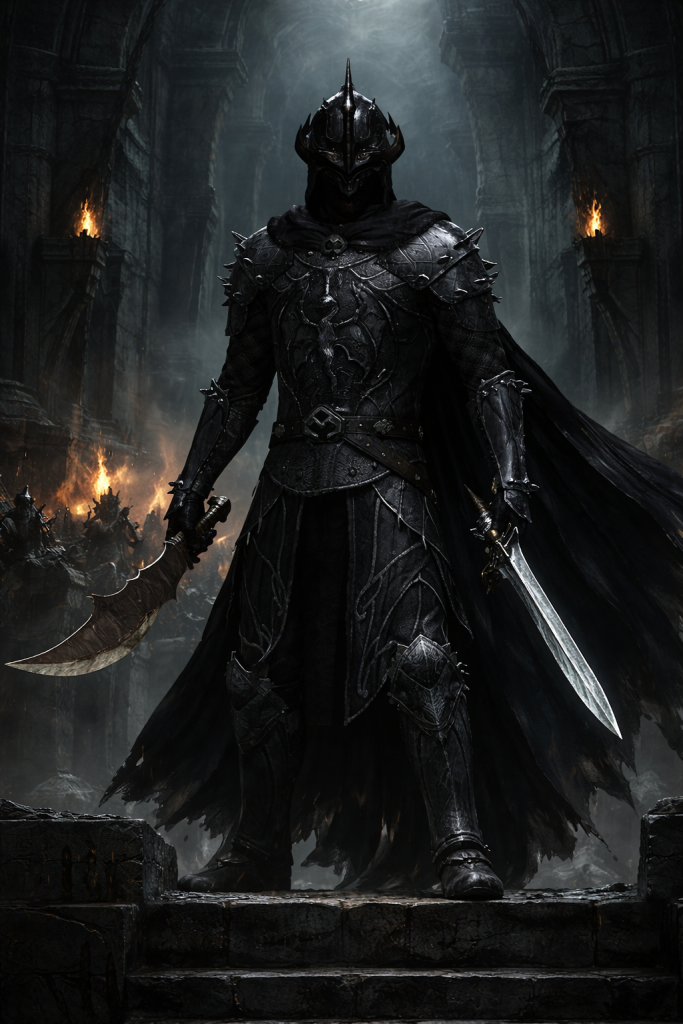
Ugrukhôr stepped through the gate encased in dark, rune-etched plate, his armor crafted with brutal precision—sharp edges, jagged spikes, and black metal that swallowed the light around him. His helm was crowned with a cruel, hooked crest, the face concealed by a visor shaped like the snarl of some iron predator.

No steam.
No roaring flames.

Just a terrible stillness, like a blade drawn in a tomb.

His pauldrons were carved in the likeness of fanged beasts, and the breastplate bore the emblem of the Eye—cracked but not erased—etched deep into the metal as though burned there centuries ago. A black cloak hung from his shoulders, frayed by years of battle, fluttering behind him like a shadow that refused to detach.

In his hands he carried his infamous paired weapons:

  • a curved, serrated butcher’s blade, designed to rip through armor with savage ease
  • and a long, pale knife, forged from some ancient alloy that gleamed like a shard of moonlit bone

No two weapons matched, and yet together they formed a rhythm of death known to every orc that had ever served beneath him.

His steps made no fiery tremor—only the cold, ringing thud of iron greaves on stone, echoing across Udûn like the pacing of an executioner approaching a prisoner’s cell.

And behind him surged his war-band:

Not molten monsters, but elite Uruks, clad in similar dark plate, their helms faceless, their armor decorated with spikes, ridges, and scraps of trophy bones. They marched with cruel discipline, shields lifted, blades drawn, unleashing guttural war-cries that rolled like thunder.

When Ugrukhôr raised his serrated blade, he did not roar fire.

He simply pointed, and the army charged.

A wave of steel.
Precise.
Merciless.
Unstoppable.

A true Captain of the Pit.

Shereg held the line, roaring orders in the tongue of Rhûn, dragging wounded men back into formation. Spears met steel-flesh hybrids, shields split under furnace hammers, and Dunlending war cries filled the valley with defiance.

But it was clear:

Ugrukhôr was not trying to defend Anglach.

He was trying to annihilate everything in front of it.

Every blow he struck was meant to crush, not repel.
Every breath he took exhaled steam that curled from cracks in his armor.

The Captain of the Pit had gone to war personally.

And for the first time since the fall of the Dark Lord, Udûn trembled beneath a true battle.

But this—
all of this—
was exactly what Deorla had been waiting for.

Deorla Finally Strikes

The moment Ugrukhôr’s forces emptied from Durthang, leaving only skeleton crews at the fortress, Deorla slipped into the same forgotten mining tunnel she had discovered weeks earlier.

The walls breathed heat from the forges above.
Ash drifted like fine mist.
Chains rattled in unseen chambers.

She moved through the tunnel like a memory.
A ghost returning to its grave.

When she emerged inside the lower levels of Durthang, her eyes gleamed.

Empty barracks.
Nearly silent forges.
Patrol routes cut in half.

Exactly as she predicted.

She began her work immediately.

She had spent the last two months gathering materials—blasting powders from abandoned storerooms, scrap metal from ruined smithies, unstable alchemical mixtures left forgotten. She combined them with her own knowledge, mixing volatile substances, shaping deadly traps, forging bombs designed not to destroy walls but to collapse entire corridors.

She planted tripwires on staircases.
Buried charges beneath main walkways.
Hung explosive vials above choke points.
Smeared killer toxins along weapon racks.
Tampered with the furnace controls and pressure valves.
Rigged the main gate locks to jam at the exact moment Ugrukhôr tried to retreat.

Durthang was turning into her weapon.

Her snare.

Her masterpiece.

When Ugrukhôr returned from slaughtering Shereg’s army—and he would return—
he would step into a fortress primed to drown him in fire.

In the heart of the citadel, Deorla paused and inhaled deeply.

The smell of iron.
The hum of forges.
The faint echo of war outside.

She smiled.

“Let the Captain of the Pit rage,” she whispered.

“When he comes home… his home will devour him.”

And with that, she vanished into the smoke to lay the final trap, which was herself.

25. Death Hung Above the Throne

Time for Action

Durthang burned quietly.

Not with open flame.
Not yet.

But beneath the fortress, hidden in forgotten maintenance shafts and abandoned furnace tunnels, death had already been planted by Deorla’s own hands.

The battle outside still raged.

The thunder of shields and iron drifted through the stone like distant storms. Every so often the entire fortress trembled from the impact of siege engines or the heavy march of Uruks rushing from gate to gate. Dust filtered from the ceiling in thin streams while alarm bells screamed somewhere above.

And through it all, Deorla moved unseen.

She stalked the lower halls of Durthang with a lantern shuttered low, memorizing every corridor, every choke point, every weak support beam. The old fortress had changed since the days of Sauron, but not enough. The foundations remained the same. Orcs rebuilt quickly, but rarely cleverly.

Ugrukhôr had reinforced the walls.
He had strengthened the gates.
He had forged deadlier weapons.

But he had not understood the deeper truth of Mordor:

Every fortress in the Black Land eventually became its own tomb.

Above the Walls

Outside, Shereg’s false siege had transformed into slaughter.

The moment Ugrukhôr entered the battlefield, the balance shifted violently.

Outside, Shereg’s false siege had transformed into slaughter.

The moment Ugrukhôr entered the battlefield, the balance shifted violently.

Shereg watched from horseback as the Captain of the Pit carved through his front lines with terrifying precision. Ugrukhôr did not fight like an enraged berserker. He fought like an executioner.

Every strike deliberate.
Every kill efficient.

His curved butcher blade hooked shields aside while the pale dagger slipped through armor gaps with surgical cruelty. Dunlendings fell in heaps around him. Easterling spear walls collapsed under the charge of his armored Uruks.

And worst of all—

Ugrukhôr’s war machines had emerged.

Not great siege towers or monstrous engines.

Smaller. Faster. Deadlier.

Iron carts mounted with rotating blade mechanisms rolled downhill into Shereg’s infantry, tearing men apart before exploding in sprays of burning oil. Heavy crossbows fixed onto armored frames launched thick black bolts that punched clean through shield lines.

Old weapons.

Prepared before Deorla’s arrival in Udûn.

Weapons built for conquest.

Shereg barely managed to reorganize his forces before another assault crashed into them.

He spat blood into the ash and growled:

“Good… come further.”

Because despite the losses, despite the chaos, this was exactly what Deorla wanted.

Every moment Ugrukhôr remained outside Durthang was another moment Deorla owned the fortress from within.

The Throne Room

Deep within the upper levels, Deorla finally reached Ugrukhôr’s personal chamber.

The doors were enormous slabs of black iron engraved with crude depictions of conquest—orc armies trampling Gondorian soldiers beneath spiked boots.

Inside, the chamber was colder than expected.

No lavish treasures.
No decadence.

Only war.

Maps covered the walls. Weapon racks lined the pillars. Crates of supplies stood ready for rapid deployment. The room belonged to a commander obsessed with readiness.

Then Deorla noticed something strange.

One map had markings different from the others.

Not Anglach.
Not Durthang.

Lhingris.

Dozens of symbols circled the region in red ink.

The Pale Herald.

And beside them, another marking written in rough Black Speech:

“The Web Opens.”

Deorla narrowed her eyes.

So Ugrukhôr feared it too.

Interesting.

The Trap for the Captain of the Pit

Deorla never left Ugrukhôr’s throne room.

Once she discovered the maps, the markings over Lhingris, and the crude warnings scrawled beside the Pale Herald’s territory, she understood immediately what this chamber truly was.

Not a place of vanity.

A nerve center.

A war room.

Every campaign in Udûn began here. Every patrol route, every forge shipment, every troop movement passed through this chamber first. Ugrukhôr trusted these walls more than he trusted his own captains.

Which meant this was where he would return.

Not the forge.
Not the barracks.
Not the gates.

Here.

The room itself was built like a bunker carved into the mountain heart of Durthang. Thick black pillars supported the ceiling. Iron braziers burned with low red flame along the walls, filling the chamber with a dim, blood-colored glow. Maps, reports, and weapon racks surrounded a massive iron table scarred by knife marks and old burns.

Deorla stood silently in the center of it all.

Then she began dismantling the room piece by piece.

She removed the iron bolts from beneath the western support pillar and replaced them loosely enough that the structure would hold for a few more hours—perhaps less if shaken violently. She poured furnace oil beneath the stone tiles around the central table, allowing it to seep into hidden cracks where it could not easily be seen.

Then she climbed into the ceiling beams.

Durthang’s throne room had once been constructed to intimidate visitors with enormous hanging furnace lanterns suspended by heavy chains overhead. Ugrukhôr had kept them despite their age.

A mistake.

Deorla weakened the chains with slow, deliberate cuts.

Not enough to snap immediately.

Only enough that a violent tremor—or explosion—would bring the entire burning structure crashing downward.

But Deorla did not intend to rely on chance.

From a leather pouch at her belt, she withdrew several small packets of compact blasting powder—carefully wrapped in oilcloth and mixed with fine iron filings stolen from Anglach’s forge stores. Crude by Gondorian standards perhaps, but in the enclosed weight of Durthang’s throne room, they would be more than enough.

One by one, she pressed the charges directly into the weakened anchor points of the chains and support braces overhead, smearing them into cracks and fastening them beneath iron joints where they could not easily be seen from below.

The moment the charges ignited, the already-damaged chains would snap apart in succession. The heavy lantern cages, burning braziers, and massive iron beams suspended above the throne would collapse inward all at once, dragging sections of stone ceiling down with them.

A controlled burial.

Violent enough to crush everyone beneath it.

And because Deorla had already sabotaged the great entrance mechanisms, the throne room doors would seal shut under the impact, trapping Ugrukhôr and his captains inside with the collapsing wreckage.

No glorious duel.

No heroic final stand.

Only iron, stone, and darkness falling from above.

Exactly the kind of death Deorla believed a warlord deserved.


Pages