'Echeleb?'
The Laegel looked up from the arrow he was carefully fletching. 'What is it, Legelion?'
The boy was sitting cross-legged upon the grass beneath the boughs of their home-tree, plucking idly at his big toe. This, to Echeleb Túbeng, was a certain sign that the thoughts of his son's son were troubled. Too much of his time did he spend lingering in the Halls of the Elvenking, his keen young mind always burdened with questions upon his return home.
'Thranduil said...' he began, but Echeleb held up his long hand to halt the question forming on the child's lips.
'Have I not told you that the words of the Elvenking are not to be trusted?' he asked.
'You have,' the boy answered, lowering his eyes, 'But this is important... it is about the Nandor in Ossiriand of old.'
The old Elf's brow furrowed. 'Well enough,' he said, 'Ask your question.'
'Well, Thranduil said that our kin who left to dwell in Arthórien were unfriends to the Iathrim; and that they were "darkhearted"... why says he this?'
Echeleb sighed. 'You speak of those the Sindar named "Guest Elves"?' he asked needlessly, holding the arrow up to the sunlight and inspecting it closely; in his memory he hearkened back to the unceasing twilight ere the Moon and Sun had risen, when the greenwoods of Lindon lay under the starlit heavens.
Legelion looked up, his eyes wide and bright with curiosity. 'Aye,' he answered.
'Alas,' said his father's father, 'I know not what befell that folk, but I can guess. For there were always some few Grey-elves who deemed our people rustic and unseemly when held against their worldliness. It is my guess that they affronted our kin, who in their distress perhaps wished ill-will upon their hosts; perhaps in wrath they did indeed do evil deeds.'
'Only some few? So not all the Sindar thought this way?' the boy asked hesitantly. This was surely why the King of the Woodland Realm treated him with disdain; the Laegil were unworldly in his eyes and thus unworthy in his mind. 'Do they still?'
Echeleb laughed. 'Nay, not those with long memories! They yet esteem the Laegrim of Lindon.'
'What do you mean?'
He slid the finished arrow into the quiver that lay beside him and beckoned to Legelion. 'Come hither,' he said. Using his heels, the boy shuffled closer on his behind, eager at the prospect of a tale in the offing. Echeleb reached over for the wineskin and poured out two cups, then passed one to Legelion who sipped it appreciatively. Though it was not of the quality that Teithoron served in his chamber, it was cool and ripe and tasted of blueberries; he licked his lips and waited while Echeleb quenched his own thirst with a long draught.
'This tale, like so many of the Elder Days, is a tale of a Silmaril and the Doom of the Noldor,' he began, and Legelion's eyes gleamed. 'It is a tale of a king slain in lust, and kin slain by kin, and it is a tale in which the Green-elves of Ossiriand played their part.'
'You are in this tale?' the boy gasped in awe.
'Listen and you will know,' said his father's father. 'In Menegroth dwelt Elu Thingol, King of Doriath and husband to Melian the Maia; and in the vaults of his city was kept the Silmaril that was cut from the Iron Crown of Morgoth Bauglir by Beren Erchamion and Lúthien Tinúviel his daughter, but that was lost to the maw of Carcharoth the Wolf. Huan the Hound of Valinor slew the Wolf but perished in the mighty battle alongside Beren...'
'I know something of Beren son of Barahir!' exclaimed Legelion, 'Teithoron Tegilbor has but lately been singing to me the Lay of Leithian, and he told me that Beren "became the friend of birds and beasts, and they aided him, and did not betray him, and from that time forth he ate no flesh nor slew any living thing that was not in the service of Morgoth."[1] Thus was he alike to the Laegrim!' he concluded, beaming proudly.
'Indeed?' laughed Echeleb, for in his heart he was glad to hear the child's pride in his kin. 'Then the scribe of the Elvenking may have some worth after all!'
'Please continue,' said the boy eagerly. Echeleb poured them each another cup of wine and then did as the child had bid.
'Thingol retrieved the jewel and thus was the bride-price for his daughter Lúthien's hand paid, but she in her grief had passed into the Halls of Mandos; there she moved the Doomsman of the Valar to pity, and he granted to Lúthien and Beren both a second mortal life. Thus did they return from death and dwelt on Tol Galen in Ossiriand.'
'Dwelt they nigh the Laegrim?' Legelion asked in wonderment.
'Nay,' answered Echeleb, 'for Dor Firn-i-Guinar was amidst the river Adurant, that bordered Ossiriand in the South; but our folk dwelt northwards in the forests around the river Legolin nigh Amon Ereb.'
'Where King Dân of old was slain?'
'Indeed. For after Dagor Bragollach Caranthir son of Fëanor and the remnant of his people joined with the scattered folk of Amrod and Amras, his brothers, and there they kept watch over the eastern passage. The Laegil lent them our aid.'
'And that's why the Iathrim esteem our kin?' he asked dubiously.
'Nay,' Echeleb laughed again. 'Though it would serve them well to be grateful, nonetheless.'
Legelion joined in his laughter and sipped more wine. He liked it when his father's father was merry, not stern and grim, weighted down by the burdens of the clan under his care. Not that he deemed himself to be their leader, but it was a mantle that fit him and thus he wore it grudgingly.
'Nay,' he repeated, 'it is to the Silmaril that we must heed. For Thingol treasured it and he was not fain to give it to the Sons of Fëanor despite their Oath, and then there came into his possession another great treasure. For Húrin Thalion gave to him the Nauglamír that he had recovered from the hoard of Glaurung, the Great Worm of Angband.'
'The "Nauglamír"? Was that another jewel?' asked the boy.
'Not any jewel: it was the Necklace of the Dwarves of Ered Luin, most renowned of their works in the Elder Days; wrought in gold for Finrod Felagund, King of Nargothrond, and set therein were gems he had brought with him from Valinor, and it had a virtue within it that gave it's wearer great grace and beauty. But it came into the mind of Thingol that it should be remade, and in it should be set the Silmaril; the greatest of the works of Elves and Dwarves brought together and made one!'
'Its beauty must have been very great,' said Legelion, and his eyes glittered as though the jewel he envisioned in his mind shone forth through them. He lay back upon the grass with his hands clasped behind his head, and gazing up through the leafy canopy at the cloudless sky, he gave a blissful sigh.
But then a small frown creased his brow, and he sat up again. 'But what of the king- and kin-slaying?'
'Ah,' said Echeleb, 'but the Nauglamír earned for itself another name, Sigil Elu-naeth! For the Dwarves of Nogrod who laboured to fulfill his desire lusted for the Nauglamír, and their lust turned to wrath and they slayed Thingol and fled eastwards through Region. But they in turn were slain in the greenwoods by the Elves of Doriath, save two who returned to Nogrod in Ered Luin and told a false tale of treachery against Elu Thingol.'
Legelion sat with his knees drawn up to his chin and his arms wrapped around his legs, his eyes wide in alarm. To his dismay, Echeleb got to his feet and shook out the empty wineskin.
'Tale-telling is thirsty work,' said he, and the boy leapt up like a startled deer and with a cry sprang forth towards the carven stair that wound up around the silver trunk of their home-tree. Within the count of a score of heartbeats he returned with a filled skin, and breathing hard, he poured a cup for his father's father. 'So too is listening,' he grinned, and poured for himself a cup also. Then he settled back upon the grass, waiting impatiently for Echeleb to drink.
'Great was the wrath of the Dwarves of Nogrod for the death of their kin and they wailed and tore their beards...' and at this Legelion chortled '...and ere long a great host came forth from Nogrod, and marched westward through Beleriand. But Melian had in her grief withdrawn her power from the Girdle that protected Doriath and had thereafter departed Middle-earth, and thus it was that the host of the Naugrim passed unhindered through the gates of Menegroth. And a grievous battle was joined in the Thousand Caves and a great many were slain, Elf and Dwarf alike, and Menegroth was plundered. And it has never been forgotten.'
'O!' exclaimed the boy, 'that is the reason why Thranduil treated the company of Thorin Oakenshield with such ill-will! For he must have been among the Elves that yet lived, and thenceforth he has had no love for the Naugrim... when did this take place?'
'At the dawning of the sixth century of the First Age of the Sun,' answered Echeleb. He watched Legelion try to tally the years, but he ran out of fingers and toes. Echeleb smiled to himself; the boy could read and write like a scribe, but he never in his brief life had he grasped numbers.
'That is nigh five thousand years ago,' he said to Legelion's obvious relief, for the boy was now trying to count on leaves spread around his feet with an irked look upon his young face. He looked up and smiled widely, showing his small wine-stained teeth.
'Thank you, Echeleb,' he said. The old Elf nodded back and they drained their cups together. Legelion swiftly refilled them and returned his attention to his father's father.
'But ere her leaving, Melian had bade Mablung, a great captain of the Sindar to send word to Beren and Lúthien...'
'Who dwelt on Tol Galen in Lindon,' interrupted Legelion.
'Indeed,' Echeleb agreed. 'Alas, Mablung perished defending the doors of Thingol's treasury wherein lay the Nauglamír...'
'With the Silmaril!'
'Aye, and they were both taken...'
'By the Naugrim!'
'Legelion?'
'Ay-' The boy gave a loud hiccup, and burst into tipsy giggles.
Echelen sighed. In the telling of his tale he'd forgotten to keep watch on the child, who had a boundless fondness for wine but a body too small to hold it. He sprang swiftly to his feet and seized the boy under one strong arm, and carried him writhing and squealing with laughter to the bank of the Forest River. There he dropped him into its icy waters. Legelion shrieked, sank once and came up spluttering in the shallows, before wading quickly to the shore; there he dragged himself dripping to where his elder stood laughing merrily. Standing, he too burst into wild laughter and shook himself like a hound.
'Better?' asked Echeleb, nimbly avoiding the spray.
Legelion gave a sneeze and water sprayed from his nose. 'Aye, thank you!' he grinned, and stripping off his soaking garb he laid it out upon the grass to dry in the warm late summer sunshine, while Echeleb emptied the contents of the boy's cup into his own.
'Take heed, for this is the part you have been awaiting!' Head now clear, the boy waited with bated breath.
'Now word went swiftly among the Elves of Ossiriand that a great host of Dwarves armed for war had come down out of the mountains and passed over Gelion, and these tidings came soon to Beren and Lúthien, for a messenger came to them out of Doriath telling of what had befallen there. Then Beren summoned to him Dior his son, and they went north to the River Ascar, and with them went many of the Green-elves of Ossiriand.'
'Were you among their number?' asked Legelion.
'I was. We caught them at Sarn Athrad, and unseen we assailed them. And as they climbed up Gelion’s banks burdened with their spoils, suddenly all the greenwood was filled with the sound of our elven-horns, and our shafts sped upon them from every side. There very many of the Dwarves were slain, but some escaped the ambush and fled eastwards towards the mountains. And as they climbed the long slopes beneath Mount Dolmed there came forth the Onodrim, and they drove the Dwarves into the shadowy woods of Ered Lindon, whence none ever returned.'
'Onodrim!' the boy cried in delight, jumping to his feet.
Echeleb could see in his eyes that his mind was afire with a hundred questions. 'Hush,' he said, 'when the tale is ended then may you ask of the Enyd to your heart's delight!'
Legelion sank down on his haunches to listen, but a different question rose to his lips. 'This then is why the Sindar esteem the Laegil?'
'Partly, but there is more yet to come,' answered Echeleb with a shrewd smile.
'Beren himself slew the Lord of Nogrod and wrested from him the Necklace of the Dwarves, but dying, he laid a curse upon the plundered riches. Thus the treasure of Doriath was drowned in the River Ascar, and thenceforth the river was named anew, Rathlóriel it became. Thereafter Beren took the Nauglamír and returned to Tol Galen, and there he clasped it round the fair neck of Lúthien and henceforth the Land of the Dead that Live became like a vision of the land of the Valar, filled with light.'
'You have been there and seen it?' asked the boy.
'Once only,' his father's father replied, "and no place have I seen that was so fair and fruitful... words alone are not enough to describe it, for its memory dwells not in my mind, but in my heart alone.'
'How came you there?'
'All shall be revealed,' smiled Echelb. 'Know first that Dior Eluchíl, son of Lúthien departed from Ossiriand with Nimloth his wife and he came to Menegroth, and there he set himself to raise anew the glory of the kingdom of Doriath. Then there on a night of autumn one came hastening from Ossiriand and smote upon the doors of Menegroth, demanding admittance to the King; and there in silence he gave to the King a coffer, and took his leave. And in that coffer lay the Necklace of the Dwarves, wherein was set the Silmaril; and Dior looking upon it knew it for a sign that Beren Erchamion and Lúthien Tinúviel had died indeed, and gone where go the race of Men to a fate beyond the world.
'Now I have heard the tale of a travelling bard that told that this one was a "lord of the Green-elves", but I know he was not.'
'It was you!' gasped Legelion.
'Your insight serves you well,' said Echeleb with a wry smile. 'Aye, it was I.'
Legelion gazed upon his father's father in awe; that his own kin should have a place in such a great tale in the lore of Middle-earth...
'So this was why you said that the Sindar yet held the Laegil in high regard; it was not only the rescue of their greatest jewel, but also its return?'
'Alas, for the all the good it did them,' said Echeleb bitterly and great sorrow was in his eyes.
'How so?' asked his son's son.
'I said that this tale was also of the Doom of the Noldor. For Dior Eluchíl clasped the Nauglamír about his neck, and rumour ran among the scattered Elves of Beleriand that Dior now wore it with pride, and thus the sons of Fëanor sent to him their claim upon it. But Dior answered them not, and thus they came at unawares in the middle of winter, and fought with Dior in the Thousand Caves; and so befell the second slaying of Elf by Elf. Therein Dior was slain and Nimloth his wife, and their two young sons seized and left to starve in the forest. Thus Doriath was destroyed, and never rose again.'
Legelion's heart was filled with dismay, for how could Elves -- his kin -- commit such cruel and evil deeds against their own? Against children such as he! And these were yet High Elves of the Blessed Realm? Tears of pity rose unbidden to his eyes...
'But,' Echelb's voice broke his sad reverie, 'it was with the Onodrim that your mind was filled but a short while ago.'
'Yes, but...' the boy saw then that Echeleb wished to speak no more of his part in the tale of the Nauglamír nor its sad history. He wiped his eyes with the back of his small hand. 'Aye, tell me then of the Shepherds of the Trees,' he said.
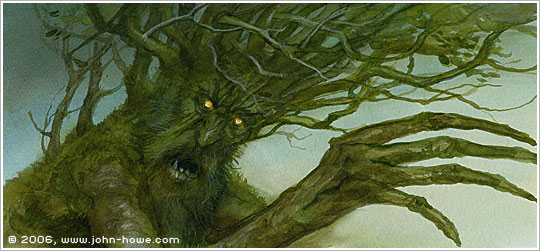
'Tall they were,' he said, 'Twice the height of an Elf, at the least. Like trees they seemed, and I deem that they are indeed akin, but trees that walk and think and speak.'
'How do they speak?' asked Legelion.
'With their mouths, of course!' laughed Echeleb.
'I meant what is the manner of their speech,' chortled the boy, his tears now forgotten.
Echeleb thought for a moment. 'Their tongue is slow and thoughtful,' he replied, 'rich and full; rumbling and booming. I learned but part of a single word from an Onod called Fimbrethil, and still can I recall it: "A-lalla-lalla-rumba-kamanda-lindor-burúme" which more or less means "hill'. But they love best the ancient High-elven tongue, yet ours they spoke uncommonly well.'
'A-lallalalla-room... nay, I cannot say it,' chuckled Legelion.
'When displeased he would say, "burárum"... or when in thought, "hrum, hoom."
'Burárum,' the boy repeated, 'hrum, hoom!'
'Well enough,' Echeleb smiled, 'but your voice is yet too shrill.'
'HRUM... HOOM!'
'And fearsome is their battle cry, "ra-hoom-rah!" which makes trees quiver and bend as if struck by the wind. But the Enyd themselves bend little; thus do they walk...' Standing, he demonstrated their great stride, his knees hardly bending, and Legelion imitated him.
'Nay, plant your toe first before your foot... that is good,' he said as the boy stalked to and fro. 'But now our leisure is ended, for there are duties I needs must attend ere the Sun sets. Fare well, son of my son.'
Legelion tugged his dried tunic on over his head, but tied his breeches round his head as to be a leafy crown. In his mind he became tall and sturdy, a great walking tree, and stretching out his wiry arms and uttering 'hrum, hoom... RA-HOOM-RAH!', the littlest Ent in all Middle-earth strode carefully and solemnly through the glade of the Laegrim and forth into the green-shadowed wood to hunt for errant Naugrim.
* * *
 It should be noted that this tale is set in the 2977th year of the Third Age, when Legelion was but twelve years of age; also that these anecdotes are not in strict chronological order.
 |
iv |
 |