Narn Hên i-Laegrim, on one page

Back to the chronicle “Narn Hên i-Laegrim”

All the adventures of this chronicle, the oldest first. 22 in all

1. The Green Annals

Herewith is the long history of my kin as told to me by my father's father (and my own brief part in this tale of years):

Now it came to pass that in the 1105th year of the Trees in the First Age of Arda, when the Eldar heeded the summons of the Valar and set forth on the Great Journey westwards from Nen Echui to Belegaer, they passed through Eryn Galen and came to the Hithaeglir. There were those among the Teleri who feared to cross those high mountains and, led by Lenwë (whom they called Dân), they repaired southwards into the vales of the River Anduin; thus they came to be called the Nandor.

But long thereafter orcs and other foul creatures of Morgoth began to harry them, whereat Denethor son of Lenwë -- hearing of the power and protection of King Thingol in Doriath -- led a host of the Nandor westwards over the Hithaeglir and the Ered Luin; there, ere the dawning of the First Age and the rising of the Moon and Sun, they came to Ossiriand and were welcomed as kin by the Lord of Beleriand and given his leave to dwell in those green unsullied lands. Long they dwelt there in the protection of the waters of Gelion, beloved river of Ulmo; but the peace was broken when, after the casting down of the Two Trees of Valinor and the theft of the Silmarils, Morgoth Bauglir returned to his stronghold in the North and thought to gain mastery of Beleriand.

And when Thingol's realm was beset by an orc horde from Angband, Denethor's people came to his aid in the First Battle of Beleriand, but their losses were great for they were but lightly-armed against their iron-clad enemy. Denethor himself was slain upon Amon Ereb, and his people -- who had great love for him -- henceforth took no other king; they never came forth again in open war, but became wise in woodcraft and lived in secrecy within their green forests. They clad themselves in raiment the colour of leaves to better be hidden, and thus were they named Laegrim thereafter. Their country they named Lindon which means "Land of the Singers" in their tongue, for the sound of their fair voices could be heard across the land.

The War of Wrath brought an end to the First Age of the Sun, and an end to Beleriand, which was rent asunder and drowned beneath the waters of Belegaer; yet the land of Lindon survived the deluge, and there Ereinion Gil-galad, High King of the Noldor, founded his kingdom. Eönwë, the herald of Manwë, bade the Elves of Beleriand to withdraw to Valinor, and many were there that heeded his summons; but of those who chose to remain in Middle-earth there were many who did not wish to live alongside the Noldor nor under their lordship, for the Iathrim had no love for the Exiles that had done them great evil during the Kinslayings of the First Age. They removed eastwards to join with the Tawarwaith of Lindórinand (which is now called Lothlórien) or Eryn Galen, saying that they desired to return to the simple life that was natural to the elves ere the invitation of the Valar had disturbed it. And many was the number of the Laegrim who wished also to rejoin their kin, for they had bowed to no king since Denethor fell nigh five hundred years before and they cherished their freedom. These Laegil were my forebears.
Thus did Echeleb Túbeng, my father's father, come to Eryn Galen at the dawning of the Second Age, and in those merry days of peace he wed his beloved, Delloril, to whom he had pledged his troth during their long years in Lindon; they begat two sons: Gladhron and Gellin, my father. Aforetime they kept the customs of the Laegrim, and after nigh six and a half thousand years we yet keep some of that lore, foreswearing the eating of flesh and dwelling within the branches of the forest not upon its floor. But in years now past they yielded to the Silvan wont of hewing wood for building and crafting, and many are the boons of fire.

The Nandor that dwelt in Greenwood the Great had aforetime welcomed many Avari among them, and great in those days was the number of Tawarwaith that dwelt or wandered carefree in the great forest, ungoverned by any lord and speaking in their own tongue; and into the woods they imparted a great store of the strength and virtue of their spirit, and thus by their art was it kept free of fell creatures and other ills. But it came to pass that amongst those Iathrim who joined with the Tawarwaith of Eryn Galen were Oropher and his son Thranduil, and they and their people embraced the Silvan tongue and customs. But he brought with him also the grudges of Doriath, and when Oropher assumed the mantle of kingship he removed our folk ever northwards from Amon Lanc, for he bore no love for the Noldo Galadriel, who had come to dwell among the Galadhrim in the realm of Lindórinand, nor the Nogothrim of Moria.

Yet in the 3434th year of the Second Age he put aside his ill will and gathered a large host to aid the Last Alliance of Elves and Men (and Dwarves of Moria!), for he had the wisdom to foresee that peace would not return to Middle-earth unless Sauron was overcome. They marched together with the Galadhrim of Amdír, but in the Battle of Dagorlad, the first assault upon Mordor, the Silvan armies suffered greatly for the quality of their arms and armour was poor compared to that of the Noldor and Sindar host of Gil-Galad and the Dúnedain of Isildur. Also, Oropher was unwilling to submit to the command of Gil-galad, a Noldo, and in haste he pressed forward ere Gil-galad had given the signal for the advance. Alas, he and Amdír were slain and the bulk of their warriors perished also. Thus while the Alliance had the victory, it was a dark day for the Tawarwaith; although good fortune brought both my father and his father home from the war.

Thranduil took his father's throne, and in the long peace that followed the diminished numbers of the Silvan Elves grew again; indeed, during this time my mother, Amdirren, and my father were wed and begat their firstborn son, Amdiran. Yet the Tawarwaith were unquiet, for they felt the change of the world that the new Age would bring, and there was in Thranduil's heart a deeper shadow for he had himself beheld in Mordor the malice of Sauron and the horror of war, and he forebode that the Dark Lord would arise again. And so he removed our people from the vales of Emyn Duir over the Forest River to the Woodland Realm where we yet dwell. Mindful of Thingol's fortress of Menegroth in Doriath during the First Age, here he delved his Halls in the living stone, and they serve as his palace and treasure vault and also a fortress our people in times of peril. (Though unlike Thingol he had not the aid of the Dwarves of Belegost in its building!)

And this was well done, for in the year 1050 of the Third Age there came to the forsaken capital at Amon Lanc a dark power called the Necromancer, and he built there the fortress of Dol Guldur; the Shadow grew deep in Eryn Galen and it became known thenceforth as Taur-nu-Fuin, or Mirkwood in the Annúnaid tongue, and the Emyn Duir are called now the Emyn-nu-Fuin. Fell creatures came to live in our forest and there are rumours of orcs and worse besides around the hill of Dol Guldur; while the Men-i-Naugrim of old lies unused and in disrepair for there are few who pass through Rhovanion now.

Little known is the elf-made path that winds for wellnigh seventy perilous leagues from the Forest Gate on the western eaves of Mirkwood to the Elvenking's Halls, though it was discovered more than seventy years ago by a company of Dwarves wending their way to Erebor in the east. Alas, Thranduil bore also his father's ill will towards Naugrim, for though he counted the Men of the Long Lake as friends, he gave no friendship to Thorin son of Thráin of the House of Durin (for it was he) or his companions; they would not say what cause they had to trespass in his realm, and in his wrath he made them prisoners in the caverns beneath his halls. Their tale is now well known, for they made good their escape from the Woodland Realm, whereafter Esgaroth in Wilderland was brought to ruin by the fire-drake Smaug the Golden, who in turn was slain by Bard the Bowman (now the king of Dale refounded), and the King under the Mountain returned to his seat in Erebor. And in the Battle of Five Armies Elves, Men and Dwarves stood united against the dark might of the orcs and wargs of Ered Mithrin and Hithaeglir; the first field of battle our folk had seen in nigh three thousand years!

Alas that my brother perished on that field ere I ever knew him; though in truth, had he not died I would not have been born! For my mother grieved the loss of her firstborn that left in her heart an emptiness that she could not quell, and that she yearned to fill again with love for a child; and though she carries the weight of many years, her will and desire gave her the strength of being needed for my begetting. But my father's heart misgave him, for the time of the Eldar on Arda is ending and soon will the last set sail from Mithlond and take the Straight Road into the Uttermost West; thus he reasoned it would be unkind to bring a new soul into the Hither Lands, a child whose time herein would be brief by the reckoning of elves... brief and perilous, for the Enemy's Shadow was ever growing across the lands of Middle-earth.

But he hearkened not to his heart's misgiving nor did he gainsay her wish; only to the ear of Echeleb did he voice his doubt, and his father counselled, "Oft hope is born when all is forlorn!" Or so my father tells me, and I wonder often at the meaning of these words. What hope could my birth bring, and for whom? But the renown of Echeleb is for his skill with a bow, not foretelling... perhaps I am troubling my heart overmuch with such thoughts!


1

2. Mereth Nuin Giliath (“Feast Under Stars”)

It is the 54th day of Iavas
In the 3015th year of the Sun
Of the Third Age of Middle-earth


It might well have been a night of the Elder Days ere the rising of the Moon, for naught but starlight lit the oak-encircled glade and glimmered on the swift waters of the Forest River flowing beyond the trees. A bright fire and torches of gold and silver light were kindled to push back the darkness of the forest, harps were strung, our hair twined with leaves and flowers, and food and wine aplenty brought forth, for it was a night of feasting and song.

The hearts and spirits of the gathered Laegil and Tawarwaith rose high, and our voices rang out in mirth and laughter amidst the beech and oak and elm. This merry feast was held in my honour, for it is now one and fifty years of the Sun since my begetting[1], and my days of childhood are behind me[2]; and though aforetime such celebrations were commonly held in Ethuil, the trees that looked on bore the red and gold leaves of Iavas, and the soft wind that blew down from the far-off Ered Mithrin was crisp and cool.

Fair songs were sung that recalled the merry, carefree days that delighted woodland elf-children in bygone days, mingled with songs praising the merry, carefree days that full-grown forest-elves yet live despite the 'burden' of their duties. Autumn songs of falling leaves and the waning Sun filled the night, and songs of homecoming for the Enderi rose up into the starry sky.    

Come home, come home, ye merry folk!
The sun is sinking, and the oak
In gloom has wrapped his feet.
Come home! The shades of evening loom
Beneath the hills, and palely bloom
Night-flowers white and sweet.

Come home! The birds have fled the dark,
And in the sky with silver spark
The early stars now spring.
Come home! The bats begin to flit,
And by the hearth 'tis time to sit.
Come home, come home and sing!

Sing merrily, sing merrily, sing all together!
Let the song go! Let the sound ring!
[3]

But there is one song that yet lingers in my mind: Amdirvilui sang a mirthful verse of a like autumn feast seven and seventy years before, which was interrupted over and again by a party of lost Dwaves. Now I well know the tale of the company of Thorin son of Thráin of the House of Durin, but this song told that one of the party was a perian, a halfling, who afterwards allayed the wrath the Lake-men held for the Longbeards of Erebor ere the Battle of Five Armies. "Bilbo Baggins" he was named, and about this perian and his folk I have become very curious indeed. Whence came the Periannath? Whither did they go? Are they akin to Men or Dwarves, or are they a people apart?

Many questions have I asked my kin about the periain, but I have gleaned little save a rumour that they dwell in a green country beyond the high Hithaeglir in the North-West lands of Middle-earth, east of the Sea. The erstwhile Sindar of King Thranduil's court were better versed in Periannath lore, but not by much: I learned that they name themselves "Hobbits" and are said to be a merry folk, fond of food and drink, and they possess the art of disappearing swiftly and silently, much like we of the Silvan folk -- could they be akin to Elves? For it is also said that their ears are slightly pointed and elvish![4] Nay, that cannot be so...

The Halls of the Elvenking holds little lore, and oft have I read the store of scrolls and tomes that King Oropher's people brought from Doriath -- indeed, it was within these very Halls that I learned to read and write! -- but I have seen naught therein concerning Hobbits. In truth, what I chiefly learned was that the poetry of the High Elves longs ever for the past glory of Valinor, but the songs of the Wood-elves abide in the here and now; they cherish their past and care little for the present days of Middle-earth, and their songs are aloof, solemn and lofty. Calaquendi, "Elves of the Light", they name themselves in their Quenya tongue, and us they call Moriquendi, "Elves of the Darkness" -- but our songs are the lighter! Theirs are songs of grandeur and melancholy, but ours are carefree and merry. But my thoughts wander...

Tidings of my quest reached the ear of Teithoron, scribe of the king, and he showed to me a report that he had scrivened some years after the Battle of Five Armies, for the king had also desired to know more about Bilbo Baggins and had sent forth scouts to gather what knowledge they could. This manuscript written in his fair hand bore many answers to my questions:

It told that aforetime periain dwelt in the upper vales of Anduin, between the eastern eaves of Eryn Galen and the Hithaeglir, but they departed during the time the Tawarwaith were fleeing northwards from the perilous Shadow of Dol Guldur. Now they dwell apart from the world of Elves and Men in a land in Eriador they call "the Shire", which in Sindarin is 'Trann', that was once a region of the Northern Kingdom of Arnor. There the king had many farms, cornlands, vineyards, and woods; and the periain yet till that fertile soil and grow fields of grain, orchards of fruit and nuts, and gardens of vegetable and berries, and there are yet many wide woods. But the scouts told also of a strange herb with pale fragrant flowers that they named galanes, which the periain grow on warm sheltered hillsides; and it is their custom to imbibe, through pipes of clay or wood, the smoke of its burning leaves! What folly is this? Wherefore would they do this, and whence could such a custom come?

The Periannath themselves are a little people, smaller than Naugrim and beardless; and they are a merry folk who laugh, eat and drink often and heartily. They are peaceful and delight in things that grow, and enjoy a close friendship with the earth. They are quick of hearing and sharp-eyed, and have long and skilful fingers; their feet are clad in a thick curling hair and thus is it common for them to walk unshod. And there is another strange custom that many yet keep: dwelling in burrows beneath the earth. This much have I learned and more besides, and in my heart I feel a fondness for these folk I have never seen, and a desire to meet them grows within it. But their green land lies two hundred leagues to the West as the eagle flies, and I, who has never left the confines of Mirkwood, deem a journey thither a daunting thought!

At the Feast Under Stars I was given a gift by Teithoron that greatly gladdened my heart: this book! It is bound in soft leather the colour of red leaves in autumn, and many are its pages of smooth clean parchment, upon which I shall henceforth record what lore and wisdom I yet may learn, and my musings and my chronicle.

Three days have passed since the feast, and thus far I've transcribed within its pages a history of the Laegrim of the Woodland Realm (which I've ventured to write in the manner of the loremasters of old!) and this page which marks the beginning of my tale.


[1] "As for the begetting and bearing of children: a year passes between the begetting and the birth of an elf-child, so that the days of both are the same or nearly so, and it is the day of begetting that is remembered year by year. For the most part these days come in the Spring."
- Morgoth's Ring, 'The Laws and Customs Among the Eldar'

[2] "Not until the fiftieth year did the Eldar attain the stature and shape in which their lives would afterwards endure, and for some a hundred years would pass before they were full-grown."
- ibid

[3] Annotated Hobbit by Douglas Anderson - J.R.R. Tolkien's draft of a verse entitled 'Elvish Song in Rivendell' not published in The Hobbit)

[4] "A round, jovial face; ears only slightly pointed and 'elvish'; hair short and curling (brown)."
- The Letters of J.R.R. Tolkien, #27
(The argument regarding elve's ears is never-ending!)


2

3. The Green in the Wood

It is the 1st day of Firith
In the 3015th year of the Sun
Of the Third Age of Middle-earth


The Enderi have ended, and now begins the season of Narbeleth that is also called Firith in the speech of the Sindar, and thoughts of the fading days of Laer brings to my mind the likewise fading of the days of the Elves.

Many a long year has passed since the Laegil of Lindon first came among the Tawarwaith of Eryn Galen and they welcomed us as kinsmen, for we were aforetime all of the Lindar on the Great Journey from Nen Echui. And thereafter were we both of the Nandor who lingered in the Vales of Anduin, before Denethor led our folk into Beleriand.

Likewise had they befriended the wandering Avari, for we had all of us been of the Nelyar kindred when Oromë first bade the Unbegotten to follow him into the West. And when Oropher led his household of Iathrim eastwards from Lindon to Rhovanion, they too were greeted as kin, for the Sindar are also of Telerin descent. Thus there was in Eryn Galen a merry mingling of Grey-elves, Green-elves and Wood-elves; but though we are akin, we are yet unalike.

For the Sindar desired to live the simple life of the Silvan Elves and adopted their speech and took names of Silvan form, yet they brought with them the wisdom, arts and skills of Doriath ere its ruin (and I count the written word to be the foremost of these!), and they united the scattered Tawarwaith into the Woodland Realm and became its lords. The Laegrim who came before them yet hold some customs of old: foreswearing the eating of flesh and dwelling only in the safety of the high branches of beech and oak; but otherwise the lore of the Laegrim is much alike to that of the Tawarwaith.

But that which sets us apart is our unlost hope to complete the Great Journey and take the Straight Road into the Uttermost West, whilst the Avari are content to remain in Middle-earth. We also hold great love for the beauty of the world, but greater still is our fear of fading into twilight unless we depart unto the Blessed Realm; for it is our doom to be bound to the circles of the world until its ending, and for those who remain to grow weary of the world as the fire of our spirits consume us, and we thus become unbodied 'Lingerers', unseen by mortal eyes and uncalled to the House of Mandos.

But this is no cause for estrangement between our kin, for while in our hearts we are Laegel and honour the lore of our forebears, we yet deem ourselves foremost to be Tawarwaith; a Green-elf clan in the Wood-elf kindred.

3

4. The Spiders of Mirkwood

It is the 32nd day of Rhîw
In the 3015th year of the Sun
Of the Third Age of Middle-earth


The wind was on the withered heath,
but in the forest stirred no leaf:
there shadows lay by night and day,
and dark things silent crept beneath.
[1]


Cold winter has fallen on Mirkwood, and in the frozen forest hunger has emboldened the giant spiders to hunt ever nearer to the borders of the Woodland Realm; and great indeed must be their desire for meat for them to overcome both the elven virtue of our land and the fear of our deadly arrows.

And thus were gathered two bands of our folk, one to search north and west of the Forest River, the other southwards along the Elf-path until the Enchanted River; hooded and cloaked against the sleet and armed with blades and bows, we set forth to hunt the hunters. Now this is a common task for the Tawarwaith, but this was my first scouring for I am now deemed old enough to play my part! My heart was astir with mingled joy and dread as I followed closely behind Angeleg, our leader, as she silently wove between the frosted trees. But in my mind there was also a call of duty, and though aforetime my Laegrim forebears forswore the hunting of wild creatures of the woods and fields -- the birds and beasts that are our friends -- these fell creatures are perilous, cunning and evil, and we needs must protect our fair realm.

The bow I carry was fashioned for me when I was but a child with barely the strength of arm to bend it[2], by Echeleb Túbeng my father's father, who is renowned among our kin for his skill as an archer. Cúlalf it is named, for it is made from a bough of elm which to his mind recalls the elm-woods of Ossiriand wherein he was born many long years ere the War of Wrath. It is a stout bow, its wood rich and warm, and its arrow shafts are of birch, fletched with goose feathers; but I had yet to slay aught with it. But now it has found its purpose... beware, creatures of shadow, beware!

Following the swift-flowing Forest River westwards in the dim grey light of the forest-dawn, we soon met with the first of these foul creatures in a drear hollow, drawn by the sound of their loathsome hissing voices. They were feasting on the fresh remains of a luckless hart, for such was their hunger that they had not even hung their prey within their strangling webs as is their wont. Swift and sure were our bowshots, our hearts pitiless, and their black blood stained the snow. More we found a scant hour later stalking some white deer, a hind and fawns that glimmered in the shadows; once more our bowstrings sang and the spiders perished.

For four days and nights we skirted the icy fringes of the Woodland Realm where the beeches give way to ivy-clad trees with gnarled trunks and twisted barren boughs, and the murk and gloom are a hindrance to even our elven eyes. By noon on the fifth day our waterskins were spent, and so we returned home; our tally was fourscore and seven of the vile creatures which will prey no more upon the beasts and birds of the forest, nor again defile our home. The carcasses we left to rot into the soil and so feed the earth, the only good these horrors had ever done in the course of their miserable lives!

The elders of our kindred say that aforetime, when Taur-nu-Fuin was yet Eryn Galen and wholesome, the spiders and other fell creatures of their ilk dwelt not beneath the forest-roof. Whence then had they come in the after-days, I wondered? And were they always evil, or had they once been but blameless beasts, tainted by Darkness? As is oft my custom when my thoughts are burdened with questions, I wended my way to the abode of Teithoron, scribe of King Thranduil, whose friendship to me has been a great boon these short years of my life; he it was who first taught to me the art of reading and the runes of writing. For though he says he is no loremaster, his memory is long and there is much wisdom that he learned in the halls of Menegroth ere the ruin of Doriath.

Thus over a cup of Dorwinion wine he told to me the tale of Ungoliant in the Elder Days, who is also named Delduthling in Sindarin. She was an evil thing; not a spider, but a fell spirit that took spider-form and wove vast webs of Unlight to cover her lair in Avathar. Whence she came no one can say, but it was she that aided Melkor the fallen Ainu in the Darkening of Valinor: the ruin of silver Galathilion and golden Melthinorn, the Two Trees that Yavanna sang into being upon the Green Mound. Thereafter Ungoliant fled to the Ered Gorgoroth in Beleriand, and the vale in which she dwelt was called Nan Dungortheb by the Iathrim.

Among her spawn was the great spider Shelob who fled the ruin of Beleriand and removed to the Ephel Dúath, west-wall of Mordor, and it was from her foul broods that the spiders of Mirkwood had come skittering hither across the empty Berennyr, and for nigh two thousand years have they spread ever northwards through the benighted forest. But were they summoned by the Shadow of the Forest, or simply drawn to its evil, I wondered? For I deem that they are neither allies nor servants of the Dark Lord, but merely fell creatures, ill-natured and cruel, living out their dreadful days in our once-fair wood. Teithoron knows not.


[1] The Hobbit, 'Queer Lodgings' - The Wind Was On The Withered Heath

[2] "[... a man who watched elf-children at play] might indeed have wondered at the small limbs and stature of these children, judging their age by their skill in words and grace in motion. For at the end of the third year mortal children began to outstrip the Elves, hastening on to a full stature while the Elves lingered in the first spring of childhood. Children of Men might reach their full height while Eldar of the same age were still in body like to mortals of no more than seven years."

- Morgoth's Ring, 'The Laws and Customs Among the Eldar'

4

5. Iestor

It is Iestor
Of the 3016th year of the Sun
In the Third Age of Middle-earth


The Sun has set, and as the sky fades the stars have kindled, marking the start of the first day of another year.[1] For the Tawarwaith this will be a night of feasting and merry-making beneath the glittering sky, but ere the feast begins I have a brief Laegren rite to perform. For this is my first Iestor since I have come of age, and as is our custom I shall plant a ripe acorn in the dell beyond the green-shadowed grove in which we dwell.

This oak tree and I shall henceforth grow together, for we are both of the stuff of Earth; but while its doom is to reach ever for the sky and spread its branches wide, it shall for me be a token of remembrance that while its body grows until it ages unto death, my own shall not (though I am myself yet a sapling and my earth-stuff has some growing yet to do!) For lest I one day depart unto the Blessed Isle, my doom is for the fire of my spirit to grow until it consumes my weary body, whereafter it shall fade into naught but a memory. But though this seems a sadness it is indeed cause for mirth, for what else is there now but to delight in the world? The lives of Elves may be years upon years, but each day is yet a precious gift for never again shall it return; to waste even a single one would be folly!

Now this rite is but one of many customs of the Laegrim of yore that the Laegil brought with them from Lindon in the after-days of the ruin of Beleriand: for still do we forswear the hunting of birds and beasts that are our friends, and the eating of their flesh; and as of old, we dwell within the high branches of beech, elm and oak, and walk their boughs -- and the world -- unshod (for bare feet make no sound and give far firmer footholds) and the raiment in which we are clad is indeed the colour of leaves! In the changing of the seasons we rejoice, and the passing of the brief years of the Sun; and many are the songs that we sing in praise of the Rodyn, but above all we honour Ivann, Queen of Earth and Giver of Fruits, for she it was who brought forth the trees and plants with roots in the earth, and the beasts that move on four legs, and the singing birds.

But yet much has changed for our kindred since we came to live among the Tawarwaith. Aforetime in Lindon the Laegrim dwelt warily and were seldom seen, but now we live openly. And we foreswore going to open war after King Dân and a great many of our folk were slain in the First Battle of the war of Morgoth against the Elves of Beleriand, and they lived thereafter in peace and secrecy within their woods; but we have in the count of days thereafter joined with the Silvan Elves in the War of the Last Alliance and in the Battle of Five Armies, and there is, alas, rumour of more war to come in these later days from which we will not shirk should these rumours become truth. And in these conflicts we fared better, for the Sindar brought with them cunning-handed skills to fashion arms and armour of higher quality than that with which we had aforetimes clad ourselves (though not bows, for ours are still the finer!)

And no longer do we wander the greenwoods, lingering wheresoever the passing seasons might bring us, but now we dwell rather in a fixed abode: a green-shadowed glade beside the Forest River nigh the Halls of the Elvenking, where the folk of our clan have dwelt now for many long years. Our number is not great -- fewer than a hundred -- thus our needs are easily met, by our own hands or by sharing and trading with the Tawarwaith. In each home-tree are built tiered houses, joined by ladders of soft rope, or steps of carven wood, or the very boughs themselves; some with one wall, or two or three or four, oft curtained against wind, snow and rain, and yet others that are but a talan; some are roofed and others open to the sky. Woven mats lie upon the floors and as of old we hang hammocks in which to sleep -- under the stars in fair weather. We craft low tables but no chairs, and graven racks and shelves and burnished chests and coffers to safely hold our things.

 The Laegil of old also made no fire to betray their hiding places[2], nor did they hew the wood of living trees; but now we value the gift of fire for comfort and for cooking and much else besides; and many are the things we craft and build from deadwood. But it would be a grievous deed for a Laegel to hew a tree for timber, for like birds and beasts, all trees are our friends and it is our will to protect and cherish them!

Thranduil son of Oropher is our king, and he is like his father and yet unlike. Like, for he is wise and benevolent and the protector of his people; and unlike, for while King Oropher sought to become as a Silvan Elf and return to the simple life natural to the elves in the quiet of the world, his son seems more proud of his Sindar blood (and his golden hair!) I was but a child of twelve autumns when first I met the King of the Woodland Realm, and he was proud and aloof and had little fondness for me! Nor did he much esteem the Nandor of Ossiriand, for he recalled the "Guest-elves" who fled Ossiriand for Arthórien after the First Battle with no goodwill, saying that they did not mingle happily with the Teleri of Doriath; the Laegrim who remained in the forests of Lindon he called craven! And we Laegil who dwell in Mirkwood, he deems naught but wild and ungentle barefoot tree-dwellers who have but lately welcomed fire. Once he told me that he abode me wandering his Halls only because of my desire to learn to read and write, while gleaning some little lore from Teithoron; thus did I earn his affection -- he said -- for he deemed it was my wish to be a Sinda! O! tra-la-la-lally, I do not think that shall be! Unless... the mighty Elvenking would not jest with a mere elf-child, would he?

Truth be told, it is now eight and thirty years since our meeting, and yet I still cannot read the king's heart. Perhaps it is true that we are more rude and rustic than his Sindar subjects, but oft I deem he speaks thus simply to affront me for his words seem to me to miss the mark. For when Oropher came among us, he and his Iathrim took names of Silvan form and style; indeed Thranduil Elvenking named his own son Legolas, which like my own is founded on the bygone Nandorin word laeg but in the Silvan form; to my mind he would instead have used the Sindarin word calen if he is so proud? But yet his own name is Sindarin, for tharan is not a Silvan word. Something is amiss with the Elvenking, I am sure of it!

Nevertheless, though I asked him once about the "Guest Elves", no word of the king's goading have I ever told to Echeleb, my father's father, for always did he think my pastimes strange and I feared he might forbid them! For he is proud of our Laegrim line, and he is as firm in his ways as a sturdy and ancient oak is rooted in the earth. Thus would he not deign to wed Delloril, my father's mother -- even though they had given the silver rings of betrothal one to another in Lindon -- lest the wars of Beleriand overtake the peaceful Laegil and sunder him from her; only upon their coming to Eryn Galen did he appoint the day of their wedding feast. (But Tawardil and Reneth, parents of my mother, were wed on the banks of the Legolin ere the War of Wrath ended, despite the peril of Morgoth!) Likewise was it the custom of the Laegrim for a father's father to gift the firstborn child of his child with their first bow, and so he gave to Amdiran my departed brother (may his spirit linger but briefly in the Halls of Awaiting!) Cúlalf, alike in name to the bow he fashioned for me -- though I am but second born -- which Amdiran bore to his doom in the Battle of Five Armies. And he cares not for Thranduil, for aforetime the Laegrim had no king to rule over them and were free, and so he thought to be when they removed hither ere the Sindar came to Eryn Galen.

But Legolas son of Thranduil is unlike his father. For all Thranduil's disdain of the Laegil of his Woodland Realm (feigned or no!) Legolas is truly fond of us and delights in learning our woodcraft. Indeed when it is his duty to captain the guards of the Halls of the Elvenking, oft does he choose folk from our kin for his company. He is merry and gay (but stern when needs must, as befits the son of a king) and his skill with a bow is outmatched only by that of Echeleb. His mind is keen and he too can read and write, even the Tengwar! Indeed, when I was younger he oft, while visiting Echelb on matters of safeguarding the Wood-elves of Mirkwood, lent me his aid while I toiled over the Angerthas Daeron, sitting with me on the matted floor of my home like my elf-child friend, not the prince of our people!  And he prefers the forest over the halls of his father graven from stone, wherein the Sindar nobles are commonly found. For though he is of Sindar blood, in his heart he is Silvan; an Elf who would be loved by all if he were king!

But the stars are now bright and I have tarried overlong; the time has come for me to meet my merry acorn. Wine and song await!


[1] "A ‘day’ of the sun [the Eldar] called ré and reckoned from sunset to sunset."

- The Lord of the Rings, 'Appendix D'

[2] "In a valley among the foothills of the mountains, below the springs of Thalos, [Finrod Felagund] saw lights in the evening, and far off he heard the sound of song. At this he wondered much, for the Green-elves of that land lit no fires, nor did they sing by night."

- The Silmarillion, 'Of the Coming of Men into the West'

5

6. Family Tree

It is the 1st day of Laer
in the 3016th year of the Sun
of the Third Age of Middle-earth


Too long has it been since I last put ink to parchment, but of what shall I write when I have naught to record? Perhaps that my acorn fares well and has sprouted into a small and hale green sapling, though I myself have not gained even a little height through all the days of Ethuil!

And needless is it to spend precious parchment to report on the joys and toil of each day, or of the passing seasons by which our labours are ordered: planting in Ethuil and harvesting in Iavas; foraging for nuts and berries in Iavas and Firith; or gathering herbs of healing for drying in the warm days of Laer. Yet our woodland life is never dull and every day is a delight!

But I must write something down, if but to vex Echeleb! For he scorns my keeping of this tale of my days, and when he sees me toiling over its pages he scoffs that no one shall ever read my words -- save perhaps Teithoron Tegilbor -- for few among the Tawarwaith have need of this "Sindar art"; thus, he says, is there little reason for to keep it. Swarn Dân! (It is my good fortune that he has not the skill to read my words, although perhaps there is some small part of him that would be pleased to see I have learned something of the Nandor tongue of old!)

If we Elves have a fault, I deem it is that in the course of our long, long lives, our bodies change not at all and therefore our minds change little too; hence there is a deep desire to preserve the world unchanged for all of our immortal lives. To my mind the higher crafts that grew in Beleriand, and which were brought to us by the Sindar, are gifts that should be received gladly and be availed of; if Echeleb had his way we would not even enjoy the boons of fire! (Nay, I jest... he is not so deep-rooted in the past.) Mayhap it is my lesser years that gives to me the will to seek new paths through the forests of my life; to climb a different tree than my forebears? But I know not...

Yet I would write something here that might gladden the heart of my father's father (if he could but read it!), and so I shall record the line of my kin...

The family line of any Elf reaches back to the Awakening at Nen Echui in the the Years of the Trees, and any Teleri would hope to claim descendancy from Enel the Elf-father himself, rather than of the other two and seventy Unbegotten Nelyar. But I think it matters not. In truth, not even Echeleb can reckon back through the years upon years ere the Host of Dân came to dwell in the forests of Ossiriand; and it is far beyond my skill to even try, for numbers are not my strength. Indeed, Teithoron taught me the counting-lore of the Cuivienyarna when I was yet a boy, but reckoning has never given me joy.

Our line spans so far before, through years uncounted, that the Telerin forms of the names of my forebears have long been forgotten and only their Sindarin rendering is remembered now: Norgalad and Thúlher who begat Echeleb; Gilorn and Ellother who begat Delloril; Nengel and Silivreneth who begat Tawardil; and Eithruin and Rodon who begat Reneth. And I cannot question these esteemed ancients, for Norgalad perished in the First Battle of Beleriand, and after that land sank ruined into the sea and their homeland of Lindon was sundered, the three who remained wearied of the world and heeded the summons of Eönwë to complete the Great Journey unto the Blessed Realm.

Echeleb wed Delloril in the after-days of the Laegrim coming to Eryn Galen at the dawn of the Second Age of the Sun; and they begat two sons, Gladhron and Gellin, my father. But Tawardil, father of my mother, wed Reneth ere the ruin of Beleriand and Amdirren, my mother, was born in the green-shadowed woodlands of Lindon; but brief were her days of dwelling there, for her birth was but soon ere the War of Wrath consumed the lands.

My mother and father begat their firstborn son, Amdiran my brother, in the days of peace that lay upon our folk whilst they yet dwelt in the western glens of the Emyn Duir. Alas, he fell to the foul blades of our foes in the Battle of Five Armies, fighting fearlessly against the orcs and wargs of Ered Mithrin and Hithaeglir. Hence was I born from my mother's grief and her deep desire for another child to whom she could give her boundless love.

And thus is the lineage of my kin ordered:

((The Angerthas Daeron is transcribed using Glǽmscribe.))

Echeleb says the line of our kin is like the branches of a mighty tree, but now that I have drawn it here it seems to my eyes more akin to the strangling ivy that hangs down from the oak boughs in the deepwood, and trails thence along the ground seeking for a new tree to climb!


6

7. Revering the Rodyn

It is the 20th day of Laer
In the 3016th year of the Sun
Of the Third Age of Middle-earth


"A Elbereth Gilthoniel
silivren penna míriel
o menel aglar elenath!
Na-chaered palan-díriel
o galadhremmin ennorath,
Fanuilos, le linnathon
nef aear, sí nef aearon!"

(Translation by Eldamo)

Each new day begins with the rising of the stars [1], and we welcome them by uplifting the name of Elbereth Gilthoniel in song. For she it was who kindled the bright stars for the comfort of the Firstborn Eruchîn; and when the Unbegotten Elves awoke, their eyes beheld first of all things the stars of heaven, and thus has my kindred ever held a great love for the starlight and revere Elbereth above all the Rodyn. But now my mind is puzzled... Elbereth is esteemed by all the Tawarwaith, and it matters not if our lineage be of the Nandor, Sindar, Morbin or Laegil; yet we do not all honour the other Holy Ones likewise. Though oft have I heard hunters invoke the name of Araw, and Ivann is beloved by all who dwell in the greenwood, but seldom are heard the names of the Exalted. The scattered folk of the Woodland Realm number many thousands and our forebears are diverse, thus is our kinship with the Rodyn also.

The tale of Elvenkind begins with the Awakening at Nen Echui in the noontide of Dor-Rodyn, ere the War of the Powers. After three hundred and thirty-five years the Unbegottten and their kin were found by Araw, but he was unwelcomed for the emissaries of Melkor had aforetimes spread false rumours of fear among the Penedh. And those first Elves, witnesses of the wrath of the Rodyn and the devastation of the war, were afeared and unwilling to heed the words of ones who had wrought such violence and death.

Thus did Araw bring to the Blessed Realm three elven lords as ambassadors, and these were Ingwë of the Minyar, Finwë of the Tatyar, and Elwë of the Nelyar. And they beheld the Light of the Two Trees and the glory of Dor-Rodyn and therefore they counselled their kin to embark upon the Great Journey to the Uttermost West, and Araw led them thither. But not all followed, for there were many who refused the summons, preferring the starlight and the wide spaces of Middle-earth to the rumour of the Trees; and there were those who heard not the invitation, for they had wandered far and wide betweentimes. And thus were the Morbin sundered from the Rodyn from the beginning; and likewise the Host of Dân[2], who foresook the Journey and dwelt thereafter in Eryn Galen and Lindórinand, knew not of the Rodyn save in tales of myth and legend.

Now Teithoron Tegilbor told me that in the days of peace ere the Wars of Beleriand, Araw still at times rode across that land and his mighty hunting-horn echoed in the hills; and when the Eledhrim heard it sound all knew that the Huntsman was pursuing the fell servants of Morgoth. And he said also that the name of Beleriand means "the Country of Balar" (who is Gaerys) and was beheld by the Lindar with awe and fear.) Whilst Echeleb, my father's father, said that aforetime in Ossiriand the Laegil dwelt in the protection of the seven rivers; for after Sirion Ulmo, Dweller of the Deep, loved Gelion above all the waters of the western world and his voice was heard in its music, for the spirit of Ulmo runs in all the veins of the world. And when my forebears fled to Eryn Galen after the ruin of Beleriand, my Laegrim clan brought with them such rites and customs with which we show reverence to the Rodyn.

Thus have our lives been ever entwined with the Exalted, and so too the folk of the Sindar... what is it that holds common for both kins? Perhaps it is that we dwelt in Beleriand for a long count of years ere the return of the Golodhrim? Ah... the Gelydh! For they had aforetime dwelt in Dor-Rodyn under the Light of the Trees and were called the Lachend, and the Rodyn had taught them much wisdom and many cunning-handed skills; thus they brought with them to Beleriand such knowledge and reverence as they had learned directly from the Holy Ones. And after the Nirnaeth Arnoediad there were Gelydh who removed to Doriath and others who mingled with the Laegil in Ossiriand[3], thus both the Grey-elves and Green-elves learned much lore from the Exiles thereafter. This, I deem, is whence our reverence arose, but now something occurs to me...

When I was but an elf-boy I hearkened to the rumour of a white stag that dwelt in Mirkwood westwards of the Elvenking's Halls, and thus I set out to find it. However, it found me... and I deem it was no bodily creature but the spirit of the forest that was, Eryn Galen (for we yet honour the spirits of Ardhon.) Long have I pondered if my adventure was perhaps a rare glimpse into the Unseen? For it is said that the High Elves dwell in both the Seen and the Unseen, the world of form and the world of spirit; and this set me to wonder if my bloodline is purely Green, or if there flows within my veins a trace of a Golodh from days of yore? Although such a thing has never happened to me again, so I know not... (but I hear still the voices of tree, stone and singing water, like all my kin.)

Truth be told, I am unsure how I would feel if it were so, for many of the deeds of the Golodhrim were evil, or so the tales tell. But it seems to me that not all Gelydh bear the guilt; nor have I have ever met a Golodh, not even in the Halls of the Elvenking where dwell the Sindar nobles of our kindred. But I have heard tell that their number in Imladris is great. Alas that it is more than a hundred and thirty leagues hence by path, road and pass; yet one day I shall journey thither.

But it matters not, for the bright Summer Sun is now high over the green-shadowed woodlands and a merry breeze is in the West. This is a day for swimming and mirth, not overthinking!


[1] "A ‘day’ of the sun [the Eldar] called ré and reckoned from sunset to sunset."

- The Lord of the Rings, 'Appendix D'

 [2] "They became a people apart, unlike their kin, save that they loved water, and dwelt most beside falls and running streams. Greater knowledge they had of living things, tree and herb, bird and beast, than all other Elves."

 - The Silmarillion, Quenta Silmarillion: 'Of the Coming of the Elves and the Captivity of Melkor'

[3] "The realm of Fingon was no more; and the sons of Fëanor wandered as leaves before the wind. Their arms were scattered, and their league broken; and they took to a wild and woodland life beneath the feet of Ered Lindon, mingling with the Green-elves of Ossiriand, bereft of their power and glory of old."

- The Silmarillion, Quenta Silmarillion: 'Of the Fifth Battle: Nirnaeth Arnoediad'

7

8. A 'Golodh' in the Greenwood

It is the 51st day of Iavas
In the 3016th year of the Sun
Of the Third Age of Middle-earth


Today marks the passing of two and fifty years since the day of my begetting, and in the hours before the setting of the Sun there came hither to the glade of the Laegrim a glad gift unlooked-for (that is, for a young unworldly Elf of inquisitive mind!): a strange visitor; an Elf unlike any I have met in the Woodland Realm. On his back he bore a great steel blade of marvellous workmanship, its full length but a foot shorter than I stand in my bare feet, and the saddle of his stallion -- for unlike the horses of the Tawarwaith, his mount was both saddled and bridled -- was girt with an unblazoned shield together with a scabbarded long sword; his longbow was of yew, and painted with gilded vines and leaves. And he was clad in armour, but not in leather as we garb ourselves, but with a hauberk of steel mail such as I have never seen.

In stature, he stood well-nigh a whole head taller than either my father or Echeleb; he was fair of face, his hair dark -- darker than that of we Laegil -- and his grey eyes were keen and proud. Of my kindred gathered there about the glade I espied him first of all, and from the tales of old that Teithoron Tegilbor had told to me I knew forthwith his ilk, and in eagerness cried out, "A Golodh! A Golodh has come!" Whereat he cast his piercing glance upon me, and in it burned such displeasure that my heart quailed within my breast; however his look was but fleeting, for marking Echeleb standing amidst the throng, he strode swiftly to him and they each embraced the other as long-lost friends!

My father's father presented this tall stranger to us as Aranyo, who had aforetime dwelt among the Laegim of Lindon ere the ruin of Beleriand, then they withdrew alone into Echeleb's abode and spoke long together until the rising of Gil-Estel, the evening star; and coming forth at last while we sang our glad greeting to the new day, Aranyo looked up to the heavens and called out, "Aiya Eärendil elenion ancalima!" And he had laid aside his gear of war and was garbed in a robe the warm colours of autumn leaves, and shod with boots of stitched soft leather. Then Echeleb summoned our folk to assemble 'round about the communal fire, for Aranyo had brought tidings of the Western lands for all to hear. Still abashed from his glowering ill-look before, I hid unquiet and unheeded behind my kinfolk and hearkened to all that was said beneath the rising stars.

Now for a long count of years, Aranyo told us, has he dwelt in Imladris under the aegis of Master Elrond, but lately he undertook to accompany a score of Elrond's folk to bring home Arwen Undómiel, that Elf-lord's beloved daughter; for these past years she has been a guest in the land of Lothlórien, the Golden Wood, but her father deems the mountains and all lands eastward are becoming dangerous. And passing nigh the abode of Echeleb, his friend of old in Ossiriand, he took his leave of the company for to briefly visit my father's father, so to bring both fond greetings and grim tidings.

For in the five and seventy years since Sauron, in his guise as the Necomancer, was driven from his stronghold of Dol Guldur in the South, he has returned to his rebuilt fortress of Barad-dûr in Mordor and declared himself openly; Orodruin, long dormant, has burst again in smoke and red flame. Now the Shadow that lies upon Mirkwood and issues forth from the dungeons of the Necromancer is of three of his fell servants, the Úlairi (though we know not this name nor the creatures which it marks.)

Yrch from the Hithaeglir oft issue forth to raid the eastern regions and slay or steal the horses of Rochand, and among their number march a new breed: great 'Uruk-hai', a kind stronger and more fell than all other Orchoth... and not all bear the badge of the Red Eye, but whom they serve is yet unknown. Therefore are the ways East over the Hithaeglir perilous, though Grimbeorn son of Beorn yet holds open Cirith Forn en Andrath, the narrow Pass of Caradhras is deemed treacherous for there it was that Celebrían, daughter of Galadriel and Celeborn of Lórien and wife to Elrond, was waylaid and seized by a sudden assault of Orcs, and at their hands suffered torment until she was rescued by the pursuit of Elrond and his sons, Elladan and Elrohir.

The Shadow of Mordor creeps over the lands, Aranyo warned, and all the hearts of the folks in Westlands are darkened; and there was much shaking of heads and murmurings among my kin at all his words.

O, alas for these drear days of my youth!

And after sharing his sad and ominous news, he bade farewell to all who had gathered to hear his words; but seeing me still lurking in the shadows he called to me and I obeyed with a trembling heart, for I knew well the tales of the hot and wayward wrath of the Exiles. But needless was my dread, for he had read the dismay in my face at his fierce glance before, and thereupon he sat with me beside the dwindling embers of our fire and asked my pardon!

And then he took my hand in his, and not unkindly he explained to me that the name 'Golodh' was not used by the friends of the Gelydh Ñoldor of Beleriand, but only by those who deemed that their abode aforetime in Avon gave them a haughty disdain for the "Elves of Darkness" who yet lingered in Middle-earth. Chief among them were the Iathrim, for King Elu Thingol had no love of the Ñoldorin chieftains by reason of their onset upon the Teleri in Aman, the people of Olwë his brother.[1]

Thus had he thought when he heard me call him 'Golodh' that I was an unfriend to his kin, but Echeleb had told him of my schooling with the Sindar of Thranduil's court, and thus he understood that it was their thought that swayed my words and was no affront on my part. Verily, Teithoron Tegilbor had oft described the Exiles as over-proud and their mood fey and perilous, but there was no wanton pride in the Elf with whom I sat beneath the bright stars and rising silver Moon. And though he had given me comfort with his soft words, so as to redress his misstep -- or so I guess -- he told to me his full tale beside the rekindled fire:

Though he himself has never seen the light of the Two Trees in Valinor with his own eyes, Aranyo is yet deemed -- in the tongue of old -- a Calaquendë, for he and his twin brother were born in Mithrim to Ñoldor of Fingolfin's host who endured the cruel crossing of the Helcaraxë.

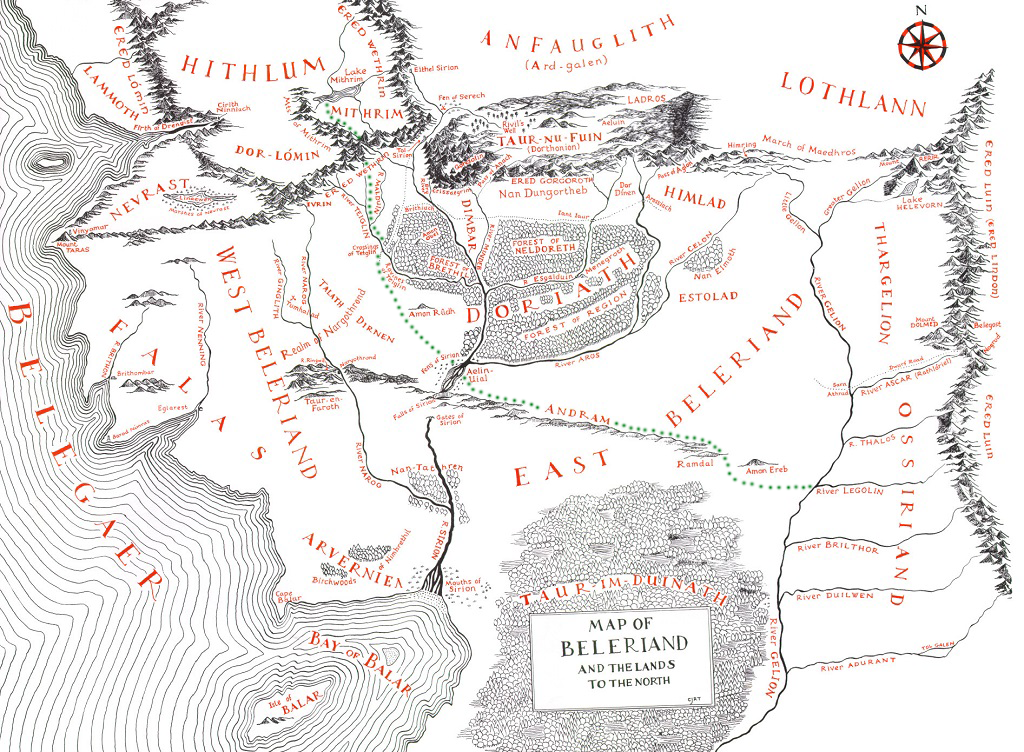
They were but children when Hithlum was brought to ruin by the hordes of Morgoth in the Nirnaeth Arnoediad wherein their parents both perished in its defence, and fleeing together south over the Ered Wethrin into Beleriand, they passed secretly across Talath Dirnen in the realm of Nargothrond. Then following the long wall of Andram, the brothers made their way steadily eastwards to the low hills of Ramdan and then travelled south to skirt Amon Ereb (where Denethor our king of old had met his end), for there the sons of Fëanor kept watch over the eastern passage and the twins had no love for the kinslayers who had forsaken Fingolfin's folk upon the shores of Aman.

Thus it came to pass that after much travail they wandered at last over the River Gelion and into Ossiriand, the Laegrim that dwelt therein took pity on the young Ñoldorin waifs and welcomed them into their clan, and there they harboured them until the lands of Beleriand were swallowed up by the deep waters of Belegaer in the War of Wrath and the greenwood of Ossiriand was torn asunder. Alas, in the turmoil the twins were parted, and bitter was Aranyo's grief for his lost brother for it was deemed that he perished in the deluge.

Thereafter he refused the summons of Eönwë for he would not forsake Middle-earth, but chose instead to remain and play his part in the healing of the world's hurts, and thus he long dwelt in the fair forests of Forlindon; but in the after-days of the Third Age many of the Eldar had since departed into the West, and the realm of Lindon had grown empty. But a chance meeting with a wandering company of Calaquendi kindled within his heart a yearning to see Middle-earth beyond the Ered Lindon ere he too passes over the Sundering Seas.

And lest I forget in this long, long retelling of his tale and tidings, he told me also that he is named in Sindarin Renion, but he chooses instead its Quenya form which is 'Aranyo'. Thus, he says, does he honour his Calaquendi mother and father, and still spites the ancient ban of Elu Thingol who forbade the speaking thereof in his realm. (And hence he deigned not to bring his tidings to the ear of Thranduil Elvenking, aforetime a Sinda of Doriath!) Never have I heard speech so lovely as the Quenya that he shared with me this night, though I understood nary a word; nor shall I forget the name he called me: Nesso.

Alas, to my mind the time he spent with me was all too brief, for his journey awaited and thus he could not tarry overlong; but for an hour more he abided my eager questions with gentle patience while the stars wheeled slowly overhead. But naught would he say of the kin-slayings of which Teithoron Tegilbor had schooled me, nor would he speak of Fëanor and his sons, for he loved them not for their misdeeds. Indeed, I deem his long abode with the Laegrim (whom he names Laiquendi) in the forests of Lindon, made him more akin to we Laegil than to his own high kindred!

However, he said much of his lost brother for his heart is still troubled with sorrow though many years have passed. Twins they were and thus alike in face, but their moods were unalike: even as children, Aranyo was bold and a bright flame was in him, and he yearned to ride one day with the cavalry of Eithel Sirion upon the plains of Ard-galen; but his brother's spirit was timid yet gay, and he loved the trees that grew nigh the shores of Lake Mithrim. Thus was he named Aldanil, which in the Sindar tongue is Galadher; it is in remembrance of him that Aranyo took the after-name, Taurosso which means "Forest-warden" and chose for his labour in Middle-earth to safeguard the greenwoods from hurt.

And so it was that while they dwelt together with the Green-elves in Lindon, Aranyo befriended Echeleb whose mood was akin to his, but Aldanil most loved Tawardil my mother's father, friend of the forest. And when I counseled him to not let his hope dwindle, that perchance his brother had prevailed and still lives even now in this latter day and they might yet meet again under the Sun, Aranyo told me that I reminded him much of Aldanil which gladdened his heart.

Little more did we speak but together watched the dying flames, and erelong he deemed the night was old and the hour late, and kissing me upon my brow, he bade me farewell and departed into the dark night.


[1] "Ódhil [sg. Ódhel] thus became specially the name of the Exiled Noldor [...] But the form Golodh seems to have been phonetically unpleasing to the Noldor. The name was, moreover, chiefly used by those who wished to mark the difference between the Noldor and the Sindar, and to ignore the dwelling of the Noldor in Aman which might give them a claim to superiority. This was especially the case in Doriath, where King Thingol was hostile to the Noldorin chieftains, Feanor and his sons, and Fingolfin, because of their assault upon the Teleri in Aman, the people of his brother Olwe. The Noldor, therefore, when using Sindarin, never applied this name (Golodh) to themselves, and it fell out of use among those friendly to them."

- The War of the Jewels, 'Quendi and Eldar'

8

9. Thoughts

It is the 2nd day of the Enedhor
In the 3016th year of the Sun
Of the Third Age of Middle-earth


These past days the unlooked-for coming of the Ñoldo, Aranyo Taurosso, and the words he spoke thereafter with my kin, have been much in my thoughts. His tale of the long journey made together with his lost brother, without help or guidance across the realm of Beleriand, has brought to my mind the vastness of that ancient land, now long drowned beneath the cold dark waters of deep Belegaer; and how all that is made in glory can so swiftly be unmade in wrath. What if the lands of Middle-earth were likewise brought to ruin? Lands that are to me yet unknown and unseen by my young eyes, and are yet untrod by my bare feet!

In the grim tidings that he brought, Aranyo spoke of Rochand of the horse-lords, a name known to us of the Woodland Realm only in rumour; and of the shadowed land of Mordor, of which we do not speak for it fills our hearts with fearful dread. Echeleb Túbeng tells me tales chiefly of his days in Lindon, and Teithoron Tegilbor those of Menegroth in Doriath, aforetime his abode; Legolas has in passing told of the vale of Imladris, last refuge of the Elves in Eriador; and my mother oft speaks of Mithlond whence the Eldar ever and anon set sail and follow the Straight Road to Dor-Rodyn, for my brother yet dwells there within the Halls of Mandos. And as a young child I learned of Trann, "the Shire", verdant home of the Periannath, that lies east of the Sea. Alas, this is all I ken of i Mbair Annui!

To the East in Rhûn beyond Dowinion (O! their heady wine!) and the Carnen lies naught but the lands of wild and evil Men, so it is told, and in the North the Naugrim once dwelt under the Ered Mithrin ere they were assailed by Yrch, but in Erebor there is a new King under the Mountain and his folk are counted among our friends; if there still dwell any of his kin in his realm of old in the Iron Hills, we know not. But in our forest fastness the woes of the Westlands beyond the high Hithaeglir matter not, nor are we troubled by the affairs of Men (save for the Dale-folk of Esgaroth with whom we trade); or so we deemed till now...

Yet how wide the lands of Middle-earth seem to one confined; how diverse the many folk that dwell therein. O, Lórien, Master of Desire and giver of visions and dreams, do you also fulfil the dreams of the Eruchîn and bring them into being? If this is so, I beseech you now to please grant my own desire: that I may one day wander in the world and delight in all its wonder!

I have learned also that it is a grave mistake to judge anyone by the deeds of their kin, for though Aranyo bore the label 'Ñoldo' he was unlike that which in my mind I deemed a Ñoldo thus to be. But it is also my thought that although not all folk are the same, they are yet all equal in worth; and that they are much alike in their woes and sorrow, and in their joys and mirth.

But in my heart I hold Teithoron blameless for his tales to me of Beleriand in bygone days, for he told them as they were seen with the eyes of the Sindar of Doriath. For many are the ways a deed may be seen through different eyes, and a single tale may be told in many ways by different tongues; to each tale there is more than one side to hear, and oft may it differ in its telling by another. This I told to Amdirren my mother, and she smiled and said I was growing wise! ‘In nothing is the power of the Dark Lord more clearly shown than in the estrangement that divides all those who oppose him,' [1] she told me, and I marked well her words.

My thought dwells also on the words that Aranyo spoke alone to me of his abode, together with his brother, within the green-shadowed woodlands of Lindon before the world was forever changed. For it was strange to speak thereof with one not of my Laegrim kin, but who yet dwelt aforetime in their greenwoods. The twins were, he said, first espied by the keen eyes of the Laegren marchwardens as they came nigh the place where the River Gelion was joined by the Legolin which flows swiftly down from the Ered Lindon, and thus he wondered if my name was therefore contrived by a mingling of the two river-names. Great was his mirth when I told him of its true making![2]

And what of his love for Echeleb, my father's father; and that of his brother for Tawardil, my mother's father? There is much, it seems, that I have yet to learn of the lore of my own kin, for never have I heard tell of these High Elves who aforetime dwelt amongst them. Alas that my forebears heeded the summons of Eönwë and thence departed Middle-earth for Dor-Rodyn, for thus is Echeleb alone my only source of lore of those last years of the Second Age of the Sun.

I think also of the fate of Aranyo's brother, and of the great tumult that they and my kin must have endured when Beleriand was beset by the mighty hosts of the Powers of Arda and Morgoth Bauglir, and thereafter brought to ruin. How was it in the greenwoods when Lindon was torn asunder and the solid earth beneath their feet was shaken and rent? Or had they long since fled, for it is said in the lorebooks of Teithoron only that the War of Wrath endured for two and forty years, and the long years over which the lands where overwhelmed by the Western Sea are uncounted. The Elves made no songs thereof, for their sorrow was too deep; but Echeleb speaks never of that time, and I had not the heart to question Aranyo in his grief. Therefore, I wonder, what indeed befell Aldanil... did he truly perish, or was his doom other than that which his brother holds true?

For my heart is troubled by the sorrow of my friend; for indeed I deem Aranyo a friend, though our meeting was but bittersweet and brief.


[1] Fellowship of the Ring, 'Lothlórien'
[2] 'Laegelion' (i.e. "son of Green-elf") is a somewhat demeaning byname given to him as a child by the former Iathrim of the court of Thranduil Elvenking. However, he deemed it a merry jest, and therefore took it in its Silvan form as his chosen name, preferring it over Methlegel, which serves a sad reminder that he is the last of his kin.

9

10. Eternal Twilight

It is the 12th day of Firith
In the 3016th year of the Sun
Of the Third Age of Middle-earth


Though the season of Firith is now upon us, there are still days that are bright and warm; and basking in the midday sunshine upon the grass-grown riverbank, I wondered how it was ere the rising of the Sun at the dawn of the First Age. Thus I tried to bring to mind a life without day or night, but ever in eternal twilight beneath the wheeling stars of Elbereth. When the Sun is set and the Moon is darkened I can know the abiding twilight that our forebears ever endured, but I cannot guess their mood; for in my mind I know the Sun will yet rise on the morrow and I cannot gainsay it to imagine otherwise! To behold the heavens in the glory of starlight alone is indeed a wondrous thing, but all my short life I have known the lights of the Moon and Sun.

Now Echeleb Túbeng, my father's father, was begat ere the Moon and Sun first arose in the West[1] (but this the Rodyn changed and we watch ever for their rising in the East), and Teithoron Tegilbor in his tale of years told that he was wed in Doriath under the light of the new-risen Sun; and they both tell that her first dawn was like a great fire upon the lands of Beleriand, and the clouds of Ennor were kindled, and there was heard the sound of many waterfalls.[2] But the Moon rose ere the Sun, and his light burnished the lands in shimmering silver and many things stirred and woke that had waited long in the sleep of Yavanna.[3] How wondrous it would be to have seen this with my own eyes! (And by the reckoning of Teithoron it is now seven thousand and forty-eight years of the Sun since her first rising... how very, very young I am!)

Teithoron told also the ancient tale that in the High Speech of the West is named Narsilion, the Song of the Sun and Moon; and in that tongue they are each named Isil, "the Sheen", and Anar, "the Fire-golden". This tale tells that after the ruin of the Two Trees by Morgoth Bauglir and Ungoliant Delduthling, the Moon was wrought by the Rodyn from the last Flower of Silver that bloomed upon Galathilion the White Tree; and after he had traversed the heaven seven times, the Sun arose, and she was fashioned from the last fruit borne by Melthinorn the Gold. From the Maiar two were chosen to guide these lamps of heaven: Tirion, a hunter of Araw, for the Moon; and Arien, who tended the gardens of Vána sister of Ivon, for the Sun. And Teithoron says that the Sun was set as a sign for the awakening of Men and the waning of the Elves, but it is the Moon that shall preserve our memory. And indeed, though I cherish the bright sunlight, it is the silver light of Tilion that most delights my heart.

And now the stars have risen on the new day, and as I lay upon the greensward of my forest home and gazed upwards at the sparkling sky, I wondered at the marvel of our being: that we each by Eru's grace embody a divine spark of the Flame Imperishable, our fae. And I pondered if to Tilion or Arien looking down upon Ardhon from the heavens above and seeing through the Unseen the countless luminous souls scattered across the lands, it would look alike to them as the scattered stars across the firmament look to us.


[1] "Varda [...] set them to voyage upon appointed courses above the girdle of the Earth from the West unto the East and to return."
    - The Silmarillion, "Quenta Silmarillion: Of the Sun and Moon and the Hiding of Valinor"
[2] The Silmarillion, Quenta Silmarillion, "Of the Sun and Moon and the Hiding of Valinor"
[3] Ibid

10

11. Lake-town Revisited

Please read A Day Out as a prequel to this entry.

It is the 1st day of Echuir
In the 3016th year of the Sun
Of the Third Age of Middle-earth


There are still four and fifty days ere Methor[1], but already the heart of the greenwood -- and of the Tawarwaith -- is stirring, eagerly awaiting the coming of Ethuil; and in the misty twilight hours, flashes of copper fur can oft be glimpsed amidst the bare boughs, for the winter hoards of the woodland squirrels are spent, and now they come forth from the warmth of their nests to resume their foraging and to seek out mates.

I also went forth at the rising of the sun to "forage" (though not to seek a mate!) for I was again given leave to join the yearly trading party to Lake-town, the vast settlement of Men that lies upon the western shore of the Long Lake. I am no stranger to this town, for I visited there once when I was but fifteen years of age, and I was eager to again explore beyond the confines of my forest home. Teithoron even had new raiment fashioned for me especially, for he said it would be unseemly to appear in my common woodland garb as I had when I was a child, and he deemed even my finest tunic and breeches -- my festive feast finery --  would not suffice! But naught would part me from my cherished woodland cloak and hood, for these Amdirren my mother had woven with her own hands.

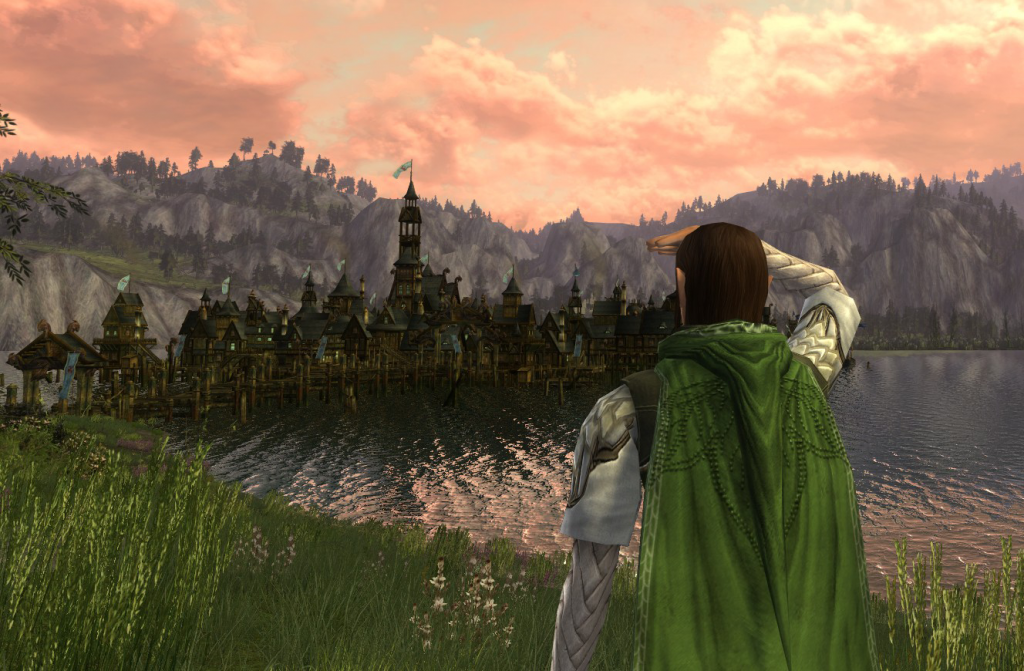
Maeriel remains the Elvenking's Ambassador to the town, and through her efforts, there is now a bridged road that wends from the eastern marches of the Woodland Realm, through the straggling pools and reed-beds of the Long Marshes, unto the western shores of the Long Lake. Thus it was that we had no need for passage by boat down the Forest River as before, and could ride mounted on horseback between the thickets of reed and rush, and then along the shore to the gates of Lake-town. (Alas, Rochereth forbade me from riding Gwedalion, son of Gwedal, for she distrusts the Lake-town hostlers and deemed also that it would be unfitting for men to learn that our folk ride upon woodland beasts.) Again I lingered on the road, and hearkening back to the day I had first laid eyes upon it, I marked that the vast wooden township was unaltered; it still stood above the cold waters upon its great stilts, and dark smoke still rose up into the rosy clouds.

Again we were met by Dagrun, the Captain of Market, though now her face was lined with age, cares and toil, and she clapped her hands and laughed merrily when she learned that I was indeed the small elf-child she had met six and thirty years before. But this time I followed behind her with our group of elf-traders to the Council of Ware where old agreements were renewed and new agreements forged, and I learned the meaning of boredom! Then we removed to the Trading Hall, a vast room bustling with busy merchants and piled high with their many wares. I watched curiously as they bartered and argued, and more than once men drew their fists and came to blows and guards came to take them away. And there were Dwarves, too!

The sight of these folk was wondrous to my eyes. Short and broad in stature they were; deep-breasted, strong in the arm, and stout in the leg, and their beards were long.[2] They chiefly huddled in small groups, speaking softly together in a strange and cumbrous tongue. Maeriel told me this is called Khuzdul, the secret speech of the Naugrim, a secret which -- unlike our kindred -- they do not willingly unlock, even to their friends, but tend and guard it as a treasure of their past.[3] Yet in their trade with men they spoke the Common Tongue with deep and throaty voices, but when I eagerly moved to speak with them, the Ambassador held me fast with a firm hand upon my shoulder.
   'These are Dwarves of Erebor,' she said, 'and though they are our close friends in trade they harbour little love for the Elves of Mirkwood since the Sack of Erebor by the Great Worm, for our folk came not to their aid in their hour of need and they have long memory for injuries! It would be better for you to first meet them in the own mansions where they feel secure and lofty....that is, more grand and noble,' she amended when I laughed aloud! Indeed, a Naug looked askance at me when he espied me watching (or mayhap he heard my cry of mirth?), and I wondered if I might one day visit their "lofty" halls under the Lonely Mountain!

As before, the group of elf-traders retired to the Dragonbone Inn when their labours were done, and from the doorway I marked that the mood within was more muted than my first visit. But the hush was disturbed by a loud commotion, for a large man thumped his fist upon the table where a small group of men sat nursing their tankards.
   'You have coin for ale, eh?' he berated a cringing drinker, 'but none to ease your debt to me?' Looking up at the sound of the closing door and seeing our elven-group, he lumbered toward us. I was dismayed to recognise him; it was none other than Saevarr, the boy who had been my guide and tormentor aforetime! But the boy had become a man, yet he was no less uncouth.
   'And so we meet again, eh Squirrel?' He looked me up and down as he had when we first met. 'You've grown,' he laughed, 'but you're still scrawnier than your fellows, and I'm still half a foot taller than you!'
Indeed, he now stood at six feet I guessed, but his girth was thrice the size it had been as a boy, and he was wearing finer raiment than even the most prosperous merchants I had seen within the Trading Hall.
   'Well met, Saevarr,' I replied merrily, though my heart was wary.
   'And still you wear no shoes!' he exclaimed. 'Come, you can buy me an ale... or are you still too poor to pay?'
With a wink, Maeriel slipped a small purse into my hand and led our group away.

I followed Saevar to a table in a darkened corner of the common room, "my private throne" he called it; and in the gloom, he could sit unseen yet watch all who came and went beneath the dim light of the torches, like a fat spider awaiting its prey! And he told me he was now a banker, and I asked him therefore what a "banker" does. At this he laughed, but not kindly, and told me that he owned the bank.[4] Still I did not understand his words, and therefore he explained, at great length, that he was now an important man in Lake-town, for he safeguarded in his vaults the treasures of others for which service they paid him in return. And he told me that he also oft loaned coin to those in need, and they repaid him in their turn and more besides!
   'But if you have much and they have little, why not share yours and give to them what coin they need to simply sustain themselves?' I asked. Now he laughed uproariously, and I deemed that this spider was more alike to a covetous dragon sitting upon its ill-gotten hoard!
   'You still haven't learned anything at all, have you, Squirrel?' he said. 'How much of my wealth would be left if I gave it away to the needy? What about my profits? Is it not enough that they have a moneylender who's not a greedy Dwarf
[5] to ease their suffering? Bah!'
I was weary of his talk and lust for gold, and so I sought to turn his thought to other matters.

   'How fares your father, Várthrek?' I asked. He had not spoken of his mother at our first meeting, and I heeded the warning in my heart and made no mention of her either.
   'He is still a guard, choosing honour and duty above wealth and status' he frowned, 'but now he is in his autumn years and no doubt expects me to provide for him in his dotage when age forces him to hang up his sword.'
   'And what of Fjolnir?'
   'Eh? Who's that?'
   'The toymaker at the market who gifted me my dwarf-made flute.'
   'That old man? Why, he's dead of course!'
These tidings saddened my heart. 'Alas, I had hoped to meet with him again for he was kind and friendly,' I said. 'And I thought to buy one of his fine kites today.'
   'With the long life of your people, you've forgotten that we mere mortals are doomed to die of age. Besides, his stall is no more... his daughter took it over when he died, but she owed me coin and so I claimed her goods in recompense. I have her kites somewhere in my stores if you wish to buy one from me!'
   'That was an unkind deed!' I exclaimed.
   'Wellnigh forty years have passed, and still you have not grown up... you're still a soft squirrel!'
   'And age has not softened your mood, I see!' I remarked with a laugh. 'You are still a base boor!'
   'Laugh all you want,' he said, 'but beware... many of the men with whom you had business today are indebted to me. With a word I could ruin all your trade!'
   'That would indeed be folly, for our goods go hence to Dale and Erebor, and I doubt you wish to risk the ire of King Brand or of Durin's Folk, nor the displeasure of the Master of Lake-town, over a petty quarrel with a soft Elf!'
   'Bah!' he spat. 'Your pretty smile hides the poisoned tongue of a viper... I'm glad I do no business with your kind!'
   'O! Did you not know that squirrels will not bite unless provoked?' I retorted and he glowered at me. 'Perhaps your ale has warmed overmuch and thus is your cold heart now so hot,' I said, and emptied my flagon into his. Then I bade him farewell and left him fuming in the shadows, while I went to fetch a fresh ale for myself, cool and untainted by Saevarr's ill mood, to drink beside the bright and cheerful hearth; and in a moment of impish impulse I plucked my wooden flute from beneath my tunic, and I tootled the selfsame tune with which I once teased the stout boy beside Fjolnir the toymaker's stall. And the folk sitting thereabouts caught my merry music, and smiled one to another and danced together heedless of the dour glances that Saevarr cast upon them from his gloomy corner.

Now the gathering of treasures is not unknown to the Elves. Indeed Tharanduil Elvenking has a rich hoard, and Teithoron says he is ever eager for more, for he has not yet as great a treasure as other elf-lords of old[6]; but with his treasury, he provides for the wants and needs of all his people. And I have learned that coin is indeed necessary for trade between Men, Elves and Dwarves, although in truth the labour I saw within the Council of Ware bewildered me! But to see men who spend their short mortal lives in earnest toil, fettered by it to one such as Saevarr son of Várthrek, fills my heart with dismay, for it seems they toil in vain.

Nor can I fathom the hearts of those who are driven by greed. For if all a person's needs are met, why desire more? And whence comes this desire, for surely it is unnatural to the fae of the Eruchîn? Is it therefore a token of the taint of Morgoth Bauglir, the Marrer of Middle-earth, I wonder?

But enough deep questions for now! Menelvagor climbs in the sky and a new day begins... Now is the time for song and merriment, not for pondering the mystery and misery of misers! Though I deem I shall not go to Lake-town henceforth while Saevarr yet dwells there, for he cast a shadow of gloom upon both of my visits; but he spoke the truth when he said mortal men were doomed to die of age, and I am enduring!


[1] "Tolkien did not give the Sindarin words for these holidays in Appendix D. These translations from the Quenya were provided by Sindarin expert /u/Elaran in the /r/sindarin subreddit."
- Shire Reckoning: A visualization of the calendars described in J.R.R. Tolkien's The Lord of the Rings Appendix D
[2]  The War of the Jewels, "The Later Quenta Silmarillion: Concerning the Dwarves"
[3] The Lord of the Rings, Appendix F, "The Languages and Peoples of the Third Age"
[4] I can find no evidence that banks existed in Middle-earth, but we have vault-keepers and "Visiting Bankers" in LotRO. (A little artistic license on my part!)
[5] Nor can I find any JRRT references to moneylenders apart from Thorin's ambiguous comment in The Hobbit: "Altogether those were good days for us, and the poorest of us had money to spend and to lend..."  but I wanted to give my antagonist a despicable profession. (Artistic license again!)
[6] The Hobbit, Chap. 8: "Flies and Spiders"


11

12. A Stranger in the Silvan Wood

It is the 41st day of Echuir
In the 3017th year of the Sun
[1]
Of the Third Age of Middle-earth


No stranger has come hither since our unlooked-for Golodh guest, Aranyo Taurosso, late in Iavas. In the days that have since passed, the golden winter leaves of the beech trees have fallen, and their silver boughs are clothed in tapered buds waiting to unfurl in the first warmth of Spring. But today there came yet another strange visitor to the Woodland Realm... or perhaps I should indeed say two visitors, for he was not alone, but brought with him an even stranger prisoner who is now confined within the nethermost dungeons of the Elvenking's Halls.

This visitor was a Man, but unlike the only other man I have beheld before in our forest realm, for he was no escaped thrall seeking aid and refuge from orcish raiders, nor was he like the Men of the Long Lake whom I have met. Tall and lean he was, his grey eyes cold and stern; he was girt with longsword and dagger and he bore a hunting bow upon his back.  And though his garb was travel-stained and his face grey with weariness, he was no wayward traveller lost within our deep wood, for he strode forth with purpose, undaunted, and knew well the path upon which he trod; indeed, this was a man who had travelled aforetime through our greenwood, though I knew him not.

I was not the first to mark his coming, but I hearkened to the warning whistles of the marchwardens who watch over the borders of our realm; for though I am not of their number, I oft perch amidst the branches of the warding trees that overlook the misty paths leading to our abode. Thus unseen, I watched him stride heedless through the leaves that lay thick upon the forest-floor, and although he was clad in high leather boots his feet made little sound; and he paused and listened to the marchwardens' signals with a grim smile, as if he knew that the calls came forth not from the throats of birds but the lips of Elves. And although I could see he was skilled in wood-craft he moved without stealth, for he was hindered by his burden: a wriggling hempen sack upon his back, so noisome that even high above the path I wrinkled my nose at its unwholesome reek. And all the while his prisoner within hissed and spat foul curses at his captor.

As I watched he halted under the twisted branches of a gnarled oak and lowered the sack to the ground. From beneath his dark green cloak he withdrew a thick stick of dried meat and untied the rope that held closed the sack's neck. At once a thin pale arm lunged through the opening, and long grasping fingers reached for the man's throat... but with a dour laugh, he swept the hand aside and thrust the arm back into the confines of the sack, then dropped in the meat. Its rasping voice cried, 'Misery misery! Wicked, nassty Man. We hates it forever!' Tightly retying the knot, the man shouldered his cumbrous bundle and walked onwards, and I followed through the treetops. The sounds of it devouring its meagre meal filled me with revulsion.

I know not the nature of this wretched creature, but it spoke the Common Tongue so it is no beast, and coming nigh the Halls of the Elvenking it cried out piteously when it felt the elven wards that shield our home.
   ‘It hurts us, it hurts us,’ it whimpered, 'Nasty cruel Elves live here, fierce Elves with bright eyes! Aghh! It burns! It burns us... it freezes... '
My kin say that it is tainted by an ancient evil, and none can tell wherefore it has been brought hither; but it is not unknown to the Woodland folk, for I am told it was tracked through our forest some sixty years ago, yet it was not caught. The wood was full of the rumour of him, dreadful tales even among beasts and birds, but at the western edge of Mirkwood the trail turned away and wandered southwards, and then was lost.

The man, it is said, is a "Ranger" and a foe of the Shadow that dwelt upon a time within Dol Guldur. I knew naught of these Rangers nor whence they come, but I have learned that they are the last remnant of a diminished people, strange folk who wander secretly in the northern wilds of Eriador, the wide lands west of the Hithaeglir; but if their purpose is to oppose the Defiler of our forest then I will fain call them friend!


[1] While the published "The Tale of Years" in Appendix B of The Lord of the Rings places the capture in the year T.A. 3017, in the Unfinished Tales: "The Hunt for the Ring" this event is said to take place in T.A. 3018. It seems that JRRT changed the date to allow Gandalf more time to arrive in Hobbiton. However, this would mean that it took the Elves of Mirkwood 17 months to report Gollum's escape at the Council of Elrond, which seems to me unlikely. I've therefore used the ToY date for his capture and the UT date for his escape.

12

13. Another Visitor to the Silvan Wood

It is the 43rd day of Echuir
In the 3017th year of the Sun
[1]
Of the Third Age of Middle-earth


Two days have passed since the coming of the unnamed Ranger to the Halls of the Elvenking. Of his strange captive I have learned little, for no one may enter the dungeons without the leave of King Thranduil himself... leave that I have not been given! Alas, my curious mind burns hot with questions, but there are no answers to be had; for while many Green-elves are among the marchwardens who watch over our forest realm, they guard not beneath the Halls, for the confines of the caverns under the earth brings them great discomfort. Better for them the fresh forest breeze in the treetops!

I tried sneaking into the dungeons, of course, but my skill in woodcraft did not avail me, for I found that there are other wards therein besides the sharp eyes and keen ears of the guards. Indeed, when I was caught I besought Glinnoron, a door-warden, to give me entrance, but instead he offered to provide me with a cell of my very own if I wished so strongly to behold what was within... though one far away from that of "Gollum".

Gollum! So now I know the creature's name, but what manner of name it is I cannot tell. It is neither Silvan nor Sindarin, and not akin to any words I know in the Westron tongue. And both Teithoron and Legolas are nowhere to be found so that I might ply them with my questions, for it seems that they are in secret conclave with the Ranger and the King (or so it is said in the feast-halls.) Thus I have no tidings of this matter save what rumour blows through the Wood-elven folk like an ill wind through the trees of the forest; chief of which is that once upon a time an evil creature haunted Mirkwood, climbing trees to find nests and creeping into holes to find the young; and among the Woodmen who dwell nigh the Narrows of the Forest, it was said to be a ghost that drank blood, which slipped through windows to find cradles![2] Can it truly be that one so pitifully lean and withered is a creature of such wickedness?

But today there came new tidings and the name Mithrandir, the Grey Wanderer, is upon the lips of the Wood-elves, for it seems his wandering has brought him hither. Now this name I know, for ever it appears in the tales and songs of the Battle of Five Armies in the valley of Dale, for he it was who slew the Great Goblin of the Misty Mountains and rekindled the hatred of the Orcs for the Dwarves to fury; and who stood alone, with arms uplifted, between the hosts of the Dwarves and the alliance of Men and Elves, and heralded the coming of the army of Bolg.[3] And it is told that it was he who drove forth the Necromancer of Dol Guldur wellnigh a thousand years ago and brought about the Watchful Peace, the long quiet which endured four hundred years ere the Shadow returned and gathered all evil things under its rule.

He came swiftly on horseback, riding in haste across the bridge all the way to the king's doors, and I watched as he hurried into the Halls. And I beheld why he is called "Grey", for he was clad in grey robes and a long cloak of elven silver-grey, tarnished by wear and dusty from his long road. White was his hair and his beard, which hung down below his belt; he was strongly built and with broad shoulders, but bent with years, and I was amazed that this great man of the tales stood but the same height as I![4] Yet even from where I watched, I felt the hidden power of his mighty spirit that his aged aspect belied.

Never before had he come to Thranduil's Halls, however, though I am told that in recent years both he and the Ranger have at times enlisted the aid the of Silvan folk in a search of Mirkwood, wherefore I know not, for this hunt was kept secret. A secret that was kept from me? Why this is so, I know not, but I deem their quarry was indeed this creature Gollum.

O! I need more knowledge!


[1] While the published "The Tale of Years" in Appendix B of The Lord of the Rings places the capture in the year T.A. 3017, in the Unfinished Tales: "The Hunt for the Ring" this event is said to take place in T.A. 3018. It seems that JRRT changed the date to allow Gandalf more time to arrive in Hobbiton. However, this would mean that it took the Elves of Mirkwood 17 months to report Gollum's escape at the Council of Elrond, which seems to me unlikely. I've therefore used the ToY date for his capture and the UT date for his escape.
[2] The Fellowship of the Ring, "The Shadow of the Past"
[3] The Hobbit, "The Clouds Burst"
[4] The History of The Hobbit, by John D. Rateliff (ed.)


13

14. Our Visitors Withdraw

It is the 49th day of Echuir
In the 3017th year of the Sun
Of the Third Age of Middle-earth


Both Mithrandir and the Ranger departed the Elvenking's Halls today in haste, and at last I have spoken with Teithoron Tegilbor! Alas, he was not privy to the secret conclaves between the visitors and our king, nor to the counsels of Mithrandir, but he heard some part of their tidings which he has imparted to me. Of the Ranger he will not speak and says only that the man's secrets are his own to tell; nor can he say wherefore the creature Gollum is imprisoned, for he knows not; only that though he is small, he is great in mischief, and thus needs must be held fast. Whence he was brought hither, however, he told me much...

For sixteen long years the Ranger had searched down the length of Rhovanion, even to the Ephel Dúath and the fences of Mordor; and at last he found his quarry on the skirts of the Dead Marshes, those reeking wetlands that lie before Morannon, where Oropher our king of old and many of his Wood-elven host perished in the Battle of Dagorlad long ago. Thence he drove his captive towards Mirkwood over river and vale for nigh three hundred perilous leagues! It was his desire to be lost to all who might hunt him, and thus his hidden route followed a winding path. For fifty days he marched, and upon a map Teithoron traced the Ranger's course with wine-red ink as he recounted the tale of his passage:

But I wondered why this Gollum was brought hither to the Woodland Realm, for the map showed plainly that the Ranger had passed by the golden eaves of Lothlórien. Indeed, rather than the long and perilous path through Mirkwood, he could instead have taken Cirith Forn en Andrath through the Hithaeglir and so to Imladris. And why is this creature in our keeping? And what of Gondor and Rochand, the realms of Men nearest the Dead Marshes? And why is he called "Gollum"?

And my teacher laughed at my many eager questions, and he poured two large bowls of wine (though not the heady Dorwinion vintage!) saying that he was in need of fortifying ere my inquiry! The name, he said, is not of any of the tongues of Elves, Men or Dwarves; nor is it even a name in the Black Speech, though it seems thus suited. Nay, the truth is a simple thing: his kin gave it to him wellnigh five hundred years ago for the gurgling in his throat he makes whilst muttering to himself[1]; Sméagol was his true name before, which means "burrowing" in the Common Speech, for his folk were akin to the Periannath and Weston was their tongue. (Five hundred years he has endured! Is this common for his kind?)

Then he told that ever had it been Mithrandir's purpose to join the Ranger in Thranduil's Halls should fortune favour their quest and Gollum taken, for it was their desire to withhold such tidings -- for a time, at least -- from the world of Men and to remove the creature far away from Mordor and its spies; though wherefore he would not say. (But it seems that the creature has some unspoken connexion to the Black Land! What could it be?)

As for the elven realms, Teithoron said that the Golden Wood holds many secrets and it would be unwise therefore for one such as Gollum to enter there, with his sharp eyes and keen ears and his guileful heart filled with malice; besides there is no prison amidst the mallorn-trees. And the long road to Imladris passes over the Towers of Mist which are perilous, for many Orcs dwell in secret strongholds in those Mountains. The enchantments on the Forest Path are sound and our vaults deep under the earth, and thus was Thranduil's hold chosen, and so it has come to pass that the creature shall dwell ever in the dungeons of our home. But I deem this bodes ill!

Thus did Teithoron sate my curiosity, and much has he given to me to ponder. Alas, he durst not give me leave to visit Gollum Sméagol in his prison and he bade me to keep secret all that I had heard, and to this I foreswore unwillingly for I had hoped to share the tale with my kin around the fire this night. (I deem Sméagol to be a far more pleasant name than Gollum, and I wonder if anything of the perian he was aforetime still dwells deep within his heart?) But there was yet one other question burning in my mind...

And so I asked my teacher if Mithrandir and his friend had indeed hunted Sméagol aforetime through Mirkwood, and he said that this was so. Why then, I asked, was this kept hidden from me? I could have lent my aid, for though I yet lingered in the spring of childhood when the search was begun, I knew the forest well and my young eyes were keen. And he smiled and gently laid his long hand upon my shoulder, and he said, 'Forests have ears, and some elves have over merry tongues!'[2] His words smote my pride at first, but I could not gainsay them for verily he spoke true! There was naught I could do but join in his mirth!


[1] The Lord of the Rings, "The Shadow of the Past"
[2] The Hobbit, "A Short Rest"

14

15. Poison Ivy

It is the 3rd day of Ethuil
In the 3018th year of the Sun
Of the Third Age of Middle-earth


The merrymaking of Iestor[1] is now over, and the fair season of Ethuil has begun. The sap is flowing again in herb and leaf, the air is cool and soft and filled with the fragrance of blossoming woodland flowers. The young leaves upon the beeches of our Green-elven glade shimmer golden-green in the Spring sunshine, and in their midst birds of bright song lift up their voices; between the roots tight-curled fronds of fern are thrusting through the sweet-scented earth, and small flowers are opening in the greensward. Ah, the green smell brings joy to my heart!

But when our small company set forth for the southern marches of the Woodland Realm at the rising of Gil-Estel ere the dawn, our thought was not bent on renewal, but restoration. We were again led by Angeleg, but today we were not hunting the great spiders of Mirkwood; our quest took us far afield to a grove of ancient oak-trees that aforetime was a place of feasting and mirth ere the Shadow deepened over Taur-nu-Fuin, and although unused in this wise for wellnigh a thousand years, it is still dear to the hearts of the Tawarwaith, and word had come of something amiss.

There the wide-armed oaks were overridden by a vast tangle of strangling ivy, their gnarled girths girdled with thick woody stems that climbed high into the canopy, where the dark mass of creeping vines overshadowed the great trees, denying them the life-giving Sun. The sweet perfume of the flowering wood was overwhelmed by the strong sour smell of the ivy, and the age-old voices of the benighted trees whispered sadly in despair; thus was it our task to tear down the overgrowing vines and free the grey oaken boughs. And though I am loath to slay any living green, I well knew that this must needs be done.

The songs of blessing that we sang while we assailed the tenacious tendrils were unlike those we sing for the gathering of plants and herbs, for the words were of healing and regrowth (though muttered elvish curse-words could at times be heard among the highest branches!) It was arduous toil, and while my hands laboured my thoughts wandered free...

This ruinous ivy is not evil in itself, but is a mark of evil's corruption of our once fair and wholesome forest. Indeed, ever since I was an elf-child I have oft gathered its leaves for my mother to make teas and syrups that comfort tightness of breath (for while we have no need for such remedies[2], we trade many healing herbs and medicants with the Northmen; though not with the Naugrim, for they are likewise unaffected by mortal illness.[3])

But alas, the power of the Necromancer defiled our once beautiful forest, for when he took Amon Lanc for his abode and built there his fastness of Dol Guldur, a darkness crept slowly through the wood from the southward, and fear walked there in shadowy glades; fell beasts came hunting, and cruel and evil creatures laid there their snares.[4] The galassath strive one against another and the lavanath became black and foul.

Teithoron told me once of Udûn, first and greatest citadel of Melkor aforetime, delved under the Ered Engrin in the north of the world during the Years of the Lamps. Well do I remember his grim words for they filled my young heart with horror:

"The evil of Melkor and the blight of his hatred flowed out thence, and the Spring of Arda was marred. Green things fell sick and rotted, and rivers were choked with weeds and slime, and fens were made, rank and poisonous, the breeding place of flies; and forests grew dark and perilous, the haunts of fear; and beasts became monsters of horn and ivory and dyed the earth with blood."[5]

We know now that the Sorcerer of Dol Guldur was none other that Sauron himself, but my teacher says that the servant is unalike his master of old, for the desire of Morgoth was to unmake the world and bring all to ruin, but it is the wish of Sauron to rule it and bend it to his will. But, alas, his dark malice yet corrupts any lands under his sway, and his taint befouls all that is fair. Yet there is hope, for ever is the power of Sauron contested by the will of Thranduil Elvenking, and the beauty of the Woodland Realm endures.

For, I deem, the Wood-elves are the stewards of Mirkwood, as the Rodyn are stewards of all Ardhon. And among them, Ivon is whom we most revere, for she it is that cares for living things. She is called the “Giver of Fruits”, and Teithoron says she is “the lover of all things that grow in the earth, and all their countless forms she holds in her mind, from the trees like towers in forests long ago to the moss upon stones or the small and secret things in the mould.”[6] She nourishes the gelais by which the living bodies of levain and Incarnates are sustained.

And I deem that rocks and trees, birds and beasts are to be cherished simply because Eru fashioned them in the making of the world; that His purpose for all creation is for delight and beauty, to be enjoyed by we who are born into its magical wonder. Thus it is our part to rejoice in its glory and give homage to its Creator, to esteem and protect all things that grow and are fair. I have been mocked more than once for wearing no shoes, which is the custom of the Green-elves, and while this is well suited for stealth and nimbleness, in truth, walking barefoot keeps my kin in closer connexion with the hallowed earth.

The frenzied razing of the green vines brought to my mind a more wholesome pastime: the unhurried gathering of flower, leaf, seed and root of the woodland herbs; for this would commonly be my labour on a glorious day of early Spring such as this.

For six and thirty years Reneth, my mother, has shared with me her knowledge of the healing art, and while my leechcraft is not nearly as skilled as hers, she has imparted much herblore to me. Thus as the brown-green buds upon the the stooping oaken boughs were slowly unfettered from the tangled vines, my thoughts turned to Iavas when their green acorns will ripen to brown. At home we gather and grind the brown oakfruit for meal and flour, or eat them roasted or make spicy coffee for our lips' delight; the leaves also we use for medicants, and the bark too, but this is cherished chiefly by the leather-tanners for treating skins and hides. Indeed, the very ink with which I write is formed from oak gall and manifold are the uses of oaken hardwood... what a true marvel is the oak! (Yet I favour its cousin, the high-branched beech!)

The sun was long past its midday mark when, at last, our labour was done and the great heaps of stricken vines were set ablaze; for each cut tendril may yet take root and grow again. Their majesty restored, the ancient oaks joined their silent voices in our joyful song as they looked down upon the bonfire wherein their bonds burned in red flames. But dusk was coming on and soft light gleamed upon the grove, gilding the freed trees; the thin crescent of the Moon had fallen early into the pale sunset and the sky was clear above, revealing the first stars of night. Thence we hastened homewards ere the rising of Menelvagor and the new day.


[1] "Tolkien did not give the Sindarin words for these holidays in Appendix D. These translations from the Quenya were provided by Sindarin expert /u/Elaran in the /r/sindarin subreddit."
- Shire Reckoning: A visualization of the calendars described in J.R.R. Tolkien's The Lord of the Rings Appendix D
[2] "The fear of the Elves were destined to dwell in Arda for all the life of Arda, and the death of the flesh did not abrogate that destiny. Their fear were tenacious therefore of life 'in the raiment of Arda', and far excelled the spirits of Men in power over that 'raiment', even from the first days protecting their bodies from many ills and assaults (such as disease), and healing them swiftly of injuries, so that they recovered from wounds that would have proved fatal to Men."
- Morgoth's Ring, "Laws and Customs Among the Eldar"
[3] "[Dwarves] were singularly immune from diseases such as affected Men, and Halflings..."
- The Peoples of Middle-earth, "The Making of Appendix A: Durin's Folk"
[4] The Silmarillion, "Of the Rings of Power and the Third Age"
[5] The Silmarillion: Quenta Silmarillion, "Of the Beginning of Days"
[6] The Silmarillion:  "Ainulindalë, The Music of the Ainur"

*      *      *

While not directly referenced, I must also acknowledge the following works for both information and inspiration:

  • Ents, Elves, and Eriador: The Environmental Vision of J. R. R. Tolkien by Matthew Dickerson and Jonathan Evans (© The University Press of Kentucky, 2006)
  • Flora of Middle-earth: Plants of J. R. R. Tolkien’s Legendarium by Walter S. Judd and Graham A. Judd (© Oxford University Press, 2017)


15

16. Sméagol

It is the 16th day of Ethuil
In the 3018th year of the Sun
Of the Third Age of Middle-earth


Five slow weeks[1] have passed since Gollum Sméagol was brought to dwell within the deep dungeons of the Elvenking, and still I had not seen him! Oft have I lingered in the torchlit passages nigh their doors in the hope that one or another door-warden might relent their ceaseless vigilance, but alas! to no avail. Not even my gifts of honey-cakes and wine could soften their resolve, and my mother forbade me from slipping them a sleeping draught! And though my heart still burned hot with curiosity, my hope at last began to cool.

But Legolas came in the hours after noon to our Laegren glade and called for Echeleb and my father, for he was gathering an escort to lead the creature into the greenwood! This, he said, was by the command of his father, Thranduil Elvenking, for it was the counsel of the king that to keep him ever in dungeons under the earth would bring him to fall back into his old black thoughts. Thus he deemed that in days of fair weather his people might lead Sméagol through the woods whither a high tree stands alone far from the others, and in which he has been given leave to climb aloft to feel the free wind.[2]

The prince marked me standing eagerly behind my father, and he laughed merrily!
   'And if I do not invite you also, you will no doubt follow in the shadows even without leave... come then! And though you are not part of the guard, bring with you your bow and be wary!' he said.
Delighted, I shouldered Cúlalf and followed after them to the great gates of Thranduil's stronghold. Together with my kin there were assembled six other Wood-elves armed with bows and spears, and when the wretched prisoner was brought forth from within the Halls with a halter round his skinny neck, they wondered at the heavy safeguards made for so small a creature.
   'Small he may be, but great in mischief,' Legolas explained. 'And beware, his malice is great and gives him a strength hardly to be believed in one so lean and withered!'
[3]

And I wondered at his words too, when at last I saw this Sméagol: for he is a pallid gangrel creature, pitiful and thin. He hissed and spluttered and rocked himself backwards and forwards, and slapped his large flat feet on the ground.
   `Loose us! Loose us! ' he cried. `Gollum, gollum. The cord hurts us, yes it does, it hurts us, and we've done nothing.'
   'Are all periain like him?' I asked Legolas in dismay, for by all accounts they seem a merry folk.
   'Nay,' he said. 'I once met the Hobbit, Bilbo Baggins, after the Battle of the Five Armies was fought and won, and he had a wholesome look and a fair manner, and his deeds bespoke a goodness of heart.'
   'Thief, thief, thief! Baggins! We hates it, we hates it, we hates it for ever!' muttered Sméagol. 'We ought to have squeezed it, yes precious. And we will, precious!'
   'I deem your days of squeezing are forever over!' laughed Mechenebon, one of the Wood-elf wardens, stepping forward to loom over the wretch.
   `Don't hurt us! Don't let them hurt us, precious! They won't hurt us will they, nice Elves?'

   'But what evil befell him to make him thus?' I wondered.
   'Alas, I cannot say,' replied Legolas. 'What tidings Aragorn brought to the ear of the king, I know not. My father keeps his own counsel!'
   'Aragorn?' I exclaimed. 'This then is the name of the Ranger? It is a mighty name!'
   'Truly!' he replied. 'He is an Elf-friend of noble spirit and that is the name by which he is known to the folk of Rivendell.'
   'He is known to the Elves of Imladris?' Great was my wonder at the deeds of this mortal Man! 'How so?'
   'His tale is his own to tell, and I will not speak of it so openly,' he said glancing askance at Sméagol.
   'Gollum, gollum,' he whimpered with his face to the ground, sobbing in his throat.
   'All I am told,' Legolas said softly, 'is that this creature has suffered much torment, and Gandalf deems there is a chance he may yet be healed.'
   'And who now is Gandalf?' I asked.
   'He whom we name Mithrandir in the woodland tongue is known in the North as Gandalf the Grey.'
`Ach! sss! ' said Sméagol, covering his ears with his hands, as if the speaking of the name hurt him. 'He is cruel! He is harsh, precious! He is fire!' Then he spoke again, but not to us. 'Leave me alone, gollum! We can't find it, gollum, gollum, no, nowhere! O my poor hands, gollum! Ach!'
I looked to Legolas for answers, but he shrugged and shook his head in bewilderment.
   'Come,' he said, 'the Sun is walking in her blue fields and the day grows old; we have a goodly walk of our own yet to do: a league along the woodland path lies before us.'

But when we roused Sméagol to set forth into the greenwood he had yet another grievance!
   'Misery misery! The big light hurts our eyes, it does,' he whined. 'Sss, sss, my preciouss. Not very nice for the nassty Elves to brings us out from the dark, here to where the Yellow Face burns us. No. Not very nice at all, my love.'
   'Soon she will sink and there will be only moonlight to endure.'
   `Ach! sss! The White Face! We hate it,' he hissed. `Nassty, nassty shivery light it is -- sss -- it spies on us, precious. Where are you taking uss?'
   'Not far yonder stands a tree which the king, in his mercy, has given leave for you to climb and feel the fresh air.'
He looked up at us, and a faint light of cunning and eagerness flickered in his pale blinking eyes. 'Trees, you says? Very very good, eh, my precious?'
   'Do not think to flee!' said Legolas sternly. 'We have pity, but do not repay our kindness with falseness.'
   'Yess, yess. No, I means!' said Sméagol sitting up. 'Nice Elves! We'll be nice to them, very nice, if they'll be nice to us, won't we, yes, yess. We will come with them.'
   'I do not trust this sudden change, for I doubt it runs deep,' said Echeleb with a shake of his head.
   'Indeed,' agreed Legolas with a smile, 'but we must hope that through our pity and by kindliness we may reach his wretched heart.'
   'Yess, wretched we are, precious,' Sméagol whined. 'Elves won't kill us, nice Elves.'
   'But wherefore would we slay you?' I asked him.
   'Gah! Elves have hunted us before in elf-country -- sss --- fierce Elves with bright eyes!' He looked at me with his own pale blinking eyes. 'But these are nice Elves, my precious. Kind Elves, yes, yess.'

At last we set forth into the greenwood, and Sméagol's head on its long neck was ever turning this way and that. Legolas led us towards the eastern eaves of the forest where the elf-path came to a little used end; there the trees thinned ere the straggling pools and reed-beds of the Long Marshes begin. Sméagol often paused, sniffing the air, and at the moist smell of the wetlands he moved quickly, with his head and neck thrust forward, oft using his hands as well as his feet like a beast.

Soon we came to a gaunt but towering pine that stood alone upon a low grassy knoll, and Sméagol was set loose. He went up aloft as swift as a squirrel, his soft clinging hands and toes finding holds on the rough bark which even my unshod Green-elven feet could not! The guard set themselves about the foot of the great tree, and sitting upon a thick gnarled root I looked up and saw the shape of Sméagol's large head and ears against the evening sky; now and again he lifted his head slowly, turning it right back on his long skinny neck, as if seeking something our elf-eyes could not descry. Perhaps he was but enjoying the air, but now I wonder...

Night had fallen, but the moon was yet to rise into the dark sky and we waited under the scattered stars. Sméagol still sat aloft the tree, and he paid no heed to our calls to return to the forest floor.
   'I can bring him hither!' said my father's father with a grim smile, lifting up Egros.
   'Stay your bow, Echeleb!' commanded Legolas. 'Mithrandir would not have him hurt nor slain, and we shall not betray his trust.'
   'I shoot not to kill, but to frighten. My shaft shall fly true.'
But Legolas shook his golden head.
   'But see,' said Gellin my father, pointing to a place above where the wretched creature clung.
Ergos sang and found its mark, and with a dismal croak and a flurry of black feathers a dark form fell from the high branches to land with a dull thud upon the earth.
   'Creban!' spat Echeleb, prodding it with his bow. 'Whence it came and whatever its purpose, it cannot bode well.'
   'I do not trust this black crow,' agreed Legolas.
But the sure shot of Echeleb served well its purpose, for Sméagol swiftly foresook the high branches and moved down the tree trunk, head-first like a large foul squirrel, then dropped from the lowest branches of the tree onto all fours beside the dead bird. Then he sent out a long hiss through his teeth and stood up for a moment, tense and menacing; the guard swiftly encircled him, and he collapsed, snivelling. Echeleb asked, 'Grieve you for your feathered friend? Was it spy or messenger?'
Sméagol gave him a swift venomous look, but then fell to whining piteously.
   'No, no friend. Gollum! Sméagol has no friends, poor Sméagol, and we're so lonely, preciouss.'
   'Then you know naught?' said my father.
He stared sadly at the slain creban, then pressed his long finger to it and licked his teeth.
   'We only knows that they are nice to eats,' replied the loathsome creature. 'And it's still fresh, my love!' he added hopefully.
   'Are you not well-fed enough within our Halls that you would eat carrion?' I laughed, though I shuddered at the thought of devouring such a thing. But to my bewilderment he riddled:

'Alive without breath;
As cold as death;
Never thirsting, ever drinking;
Clad in mail, never clinking.'
[4]

It was Legolas who answered. 'Fresh fish from the Forest River thrice each day, though he will only eat them uncooked.'
   'Fissh, nice fissh,' Sméagol cackled. 'Yess, nice fisshes. So juicy-sweet!' A greenish light was kindled in his pale eyes, and they seemed to protrude further than ever from his wizened face.
   ‘Come now!’ Legolas said. ‘Time wears on, and the fair Moon is rising.'
   `You are not wise to be glad of the White Face,' said Sméagol. `It shows you up.'
And casting a last look at the dead creban, he hissed and whispered to himself; it appeared that he was pleased, but wherefore I cannot tell. His halter was afixed anew and, with many a gollum in his throat, he was led back to his dark abode beneath the earth.

Now as I sit within our home amidst the beechen boughs, writing by silver moonlight and the warm golden glow of a Dale-made candle, I ponder the day's errand and all that passed...

Crebain are uncommon even in the deepest gloom of Mirkwood, for the southern Hithaeglir is their home, but perhaps the Shadow of the Forest ere he fled Dol Guldur, or the evil power that now dwells therein, drew these fell birds to our benighted woods. And ever they fly in great flocks and therefore I wonder at the coming of a single creban alone and unlooked-for, for it casts a shadow upon my heart and makes my mind unquiet. I deem it is perhaps a boding of ill, but whereof it portends I cannot guess.

And my thoughts dwell also on the creature Sméagol (though I know now why he is called Gollum by some, and it seems fitting!) Yet I feel pity for the wretch, but what ill course his life had taken to make him thus I do not know, nor can I think to ever understand his twisted mind. But was it mischance or his own deeds that defiled his heart, for he seems to me too guileful to be wholly innocent of this doom. Though I deem he is not wholly ruined, and the counsel of the king is on the mark: with pity and kindliness perhaps he might yet be redeemed.

Perhaps it is well that he was given into our care.


[1] "For [ritual rather than] practical purposes the Eldar observed a week or enquië of six days." (*ahem*)
- The Lord of the Rings, Appendix D, 'The Calendars'
[2] The Fellowship of the Ring, 'The Council of Elrond'
[3] ibid
[4]The Hobbit, 'Riddles in the Dark'

Obviously much of Sméagol's dialogue etc. is taken from The Lord of the Rings.

16

17. The Turning of the Year

It is the 16th day of Laer
In the 3018th year of the Sun
Of the Third Age of Middle-earth


As I write these words, bright Anor is riding radiant in her blue fields, glorious but fierce. For the day is uncommonly hot, even in the green-shadowed woodlands, and many of the Wood-elves are therefore seeking solace in the fresh cold waters of the Forest River; they have forsaken their woodland garb and are frolicking clad in naught but their glistening skin... it is a merry day for swimming! Overhead broad beechen boughs gently sway, and through their green leaves golden sunlight glimmers; my back rests against smooth cool bark and the breeze brings sounds of mirthful song and splashing Elves to my ears, and delights my wet skin with its breath.
   (Ai! And I am dripping inky river-water on my prized journal!)

In sixteen days hence it will be the Day of Midsummer and there shall be much mirth and merrymaking throughout the Woodland Realm! Laer has wellnigh reached its height and on that day of all days the unshadowed Sun shines strongest and longest upon the face of Ennor. At dawn we shall greet her rising with song and joy, for though we love the glittering stars of Elbereth, the bright Day-star[1] gives life to all that is green and grows and is glad. Ivann it was that planted the seeds of the galassath, and whose song of sorrow brought forth the single fruit of gold upon the leafless bough of stricken Glewellin from which the Sun was made; thus it is her name that we shall sing in highest praise.

And Teithoron (who deigns not to to join us in our frolic!) told me of the Gondolindrim who, in the First Age of the world, long ago, likewise honoured this day with a great feast they named Tarnin Austa, whereupon they stood in silent solemn vigil and no voice was uttered in the city from midnight till the break of day; but the dawn they hailed, standing upon their gleaming eastern wall, with ancient songs and with the music of many elven-choirs.[2] Now we have no such walls about the Woodland Realm, nor would any Wood-elf abide a night of silence ere a great feast! And though I deem our hearts are akin to those Elves of old, our mirth begins at the rising of the stars and we make merry till the first pale light of dawn, and thereafter we sing our joyful reverence as the sun breaches the horizon.

But midsummer marks also the day that the strength of the sun begins to wane; the coming days will grow shorter and the nights longer. And it seems to me that this natural rhythm, this ebb and flow, is akin to the long slow breath of the world. Golden Summer gives way to the red leaves of Autumn, which in their turn herald the cold winds of Winter, and then green Spring comes again; the wheel of the year is ever turning and the years roll past, and the long lives of my elven-kindred go ever on and on.

The passing of the seasons of Ardhon brings to my thoughts the passage of years of my own short life. For by my reckoning (though I am likely wrong, for never have numbers been my friends!) it is wellnigh fourteen weeks until the Enedhoer and I will by then have danced and sung upon the living earth for three and fifty years! And though I have not yet attained the full stature and shape in which I will endure,[3] I linger in the first spring of childhood no longer and have changed much in the swift years of Middle-earth. Amdirren my mother said that she, too, was slow in growing and likened us to the steadfast oak or apple tree, but others are akin to the beech-tree or the silver birch which are swift in reaching for the sky. But, she says, 'Trees that are slow to grow, bear the best fruit!'[4]

Merry my life has been in the green-shadowed woodlands which I love, and though Taur-nu-Fuin is perilous and I oft yearn to behold the Wide World beyond the confines of the forest, my heart is ever filled with gladness and with joy!


[1] The Silmarillion, Quenta Silmarillion, "Of the Sun and Moon and the Hiding of Valinor"
[2] The Book of Lost Tales Part Two, "The Fall of Gondolin"
[3] Morgoth's Ring, "The Laws and Customs Among the Eldar"
[4] Molière

17

18. Reckoning of Years

The following is written in an unpracticed, childish hand upon a well-worn sheet of parchment, which is carefully folded and tucked within the back cover of Legelion's Narn Hên i-Laegrim. It is obviously an early exercise in writing Sindarin in the Angerthas Daeron, but it appears to have been referred to very often since.


Thus is the reckoning of a sun-round year as told to me -- Methlegel Feveren son of Gellin Dringor, son of Echeleb Túbeng, who is called Legelion -- by Teithoron Tegilbor, scribe to Thranduil Elvenking of the Woodland Realm in Rhovanion.

It was brought hither to Mirkwood in the fift sev 750th year of the Sun of the Second Age of Middle-earth by King Oropher of Doriath, for the wisdom of the Silvan Elves, his loyal subjects. (Save for Echeleb... haha!)

  • - Now is the Third Age of Middle-earth since the rising of the Sun.
  • - The First Age lasted for 590 years until the War of Wrath and the downfall of Morgoth Bauglir, the Dark Tyrant.
  • - The Second Age lasted for 3441 years until the War of the Last Alliance and the downfall of Sauron Gorthaur, the Enemy.


*      *      *

There are six seasons in a year.
They are:

Iestor[1] which is the first day of the year

Ethuil which has four and fifty days

Laer which has two and seventy days

Iavas which has four and fifty days

Enedhoer[1] which are three days amidmost, but become six days every twelve years (Alas! This is a riddle beyond my skill, but Teithoron says the reasoning thereof is uncommonly complex!)

Firith which has four and fifty days, and is also called Narbeleth

Rhîw which has two and seventy days

Echuir which has four and fifty days

Methor[1] which is the last day of the year


- Thus today is the 35th day of Firith in the 2977th year of the Sun of the Third Age of Middle-earth
- I was begotten on the 51st day of Iavas in the 2964th year of the Sun of the Third Age of Middle-earth
- And I was born on the 53rd day of Iavas in the 2965th year of the Sun of the Third Age of Middle-earth and I have but lately turned twelve years of age.
[2]

Teithoron says practice makes perfect! (And he says this often!)


*      *      *


There are six days in a week.[3]
They are:

Orgilion is the first day and it is dedicated to the Stars of Elbereth

Oranor is the second day and it is dedicated to the Sun

Orithil is the third day and it is dedicated to the Moon

Orgaladhad is the fourth day and it is dedicated to the Two Trees of Valinor

Ormenel is the fifth day and it is dedicated to the Heavens wherein dwell the stars

Orbelain is the sixth day and it is dedicated to the Valar, the Powers of Arda (it is also sometimes named Rodyn)

But wherefore the swift days are named, I know not!


*      *      *


A 'year' can be written as a coranor or a lóran. (O! I like this one!)
And there are 144 years of the Sun in a Long Year (which is named a yén in Quenya.)
Therefore this is Yén 49, Loa 96 or the 7008th sun-year in the reckoning of the Elves
[4]... yet Teithiron deems it best that I reckon in the Years of Men!
But the elven-year begins in Spring and the mannish year in mid-winter, so how does this tally? I do not follow!

Rhaich! Reckoning is highly bewildering... I deem numbers are my unfriends!


*      *      *

Elo! Teithoron says my pen-form[5] is improving! But alas! he says also that the skilled scribe records what is spoken only, and I must therefore refrain from affixing my own thought. (Although I deem it fair writing practise!)


[1] "Tolkien did not give the Sindarin words for these holidays in Appendix D. These translations from the Quenya were provided by Sindarin expert /u/Elaran in the /r/sindarin subreddit."
- Shire Reckoning: A visualization of the calendars described in J.R.R. Tolkien's The Lord of the Rings Appendix D

[2] "... a year passes between the begetting and the birth of an elf-child, so that the days of both are the same or nearly so, and it is the day of begetting that is remembered year by year."
- Morgoth's Ring, 'The Laws and Customs Among the Eldar'

[3] "For ritual rather than practical purposes the Eldar observed a week or enquië of six days."
- The Lord of the Rings, Appendix D, 'The Calendars'

[4] Calculated (probably wrongly!) using Shire Reckoning Calendar Simulations.

[5] "The Certar were devised and mostly used only for scratched or incised inscriptions. [...] Dwarves made use of such scripts as were current and many wrote the Fëanorian letters skilfully; but for their own tongue they adhered to the Cirth, and developed written pen-forms* from them."
- The Lord of the Rings, 'Appendix E: Writing'

* It is my guess that the Iathrim would have too.

It is assumed that the Silvan Elves of Mirkwood had no need for a formal calendar, but the Sindar brought with them from Doriath the same elven calendar that was later used in Imladris.

19. Amarth faeg! ("Evil fate")

It is the 20th day of Laer
In the 3018th year of the Sun
Of the Third Age of Middle-earth
[1]


Alas! I have no desire to write these words, for to set them down in inken runes would make this evil doom all too real; but write them I must, though it grieves my heart to do so...

My father is dead!

Gellin, my father, is dead and Echeleb is taken; Tawardil and Gladhron each lie senseless from a poisoned wound, and my mother tends to the hurts of her father and her brother by marriage; Reneth, her mother, lends what aid she can. And I? I am unharmed, but benumbed by grief, and take but this brief moment to record this news in my journal ere we depart upon our urgent errand, lest I return not from the chase!

For yestereve, while we rested in our Green-elven glade, there came unlooked-for in the night a clear horn-call from nigh the southern marches of the Woodland Realm:

Awake! Awake! Foes! Awake!

My clan was swift to take up arms and hasten to the aid of the woodland folk, but the elder Selcheneb bade me stay behind as her guard, for she is a storyteller and wields no weapons save her songs and tales. Together we sat alert within her dwelling high amongst the beechen branches and hearkened to the trampling of iron-shod shoes, the sounds of clashing steel, and the cries of our kin in the onset of our foes; yet naught could we descry in the darkness, for the night was moonless and starless, and an unnatural gloom filled the summer forest with shadow. But we learned afterwards that a strong company of marauding Orcs had come on us at unawares, and they were many and fierce; but we prevailed and after some time drove off the enemy, for they came from over the mountains and were unused to the woods.

But when the battle was over, it was found that Sméagol Gollum was gone and his guards were slain or taken, and it then seemed plain that the attack had been made for his rescue! But both my father and his father were again amongst the guard of Gollum yesterday; and now Gellin Dringoron lies among the slain, and Echeleb Túbeng is among the taken! Several of the woodland folk perished or were wounded in the assault, my kin among them; now my mother grieves for my father even as she comforts their tainted injuries.

And my blood runs hot though my heart is cold as ice... this is the repayment for our kindliness to the creature Gollum? Never before has hatred touched my spirit, but alas! I now feel its dark stain stirring within my soul! But I must gird myself and weep no more!

Legolas leads the hunt, but his heart was against my going and he judged I should remain. But I swore to follow nonetheless, and though he was loath to do so, thus swayed he gave me his leave to join in the chase. Naught remains of Echeleb save his venerable bow of elm, and I have put aside Cúlalf -- a token of my innocent childhood -- and taken up Egros for my own in his remembrance. Mayhap I might yet return it to his own strong hand?

My dear mother knows not my purpose, and thus I leave behind my journal -- open on this page and beside a lighted candle -- for her to learn my doom. And though she cannot read my words, it is my hope that she will bring this book hence to Teithoron Tegilbor and he shall aid her.

Teithoron, my friend and teacher, if she has indeed come hither to you, please kindly read to her these earnest words on my behalf:

Díheno nin, emig! Gi melin![2]

Now time is short and I can tarry no longer. May Araw Tauron guide us on our hunt!

Farewell!


[1] While the published "The Tale of Years" in Appendix B of The Lord of the Rings places Gollum's escape in the year T.A. 3017, in the Unfinished Tales: "The Hunt for the Ring" this event is said to take place in T.A. 3018. However, this would mean that it took the Elves of Mirkwood 17 months to report this event at the Council of Elrond, which seems to me unlikely. I've therefore used the ToY date for his capture and the UT date for his escape.

[2] While Legelion wrote this in the woodland tongue, I could find no translation into the Silvan dialect.

Obviously, much of the detail herein is taken from Legolas' report to the Council of Elrond in The Fellowship of the Ring.


18

20. After the Chase

It is the 20th day of Iavas
In the 3018th year of the Sun
Of the Third Age of Middle-earth


Long have I been afield in the deeps of Mirkwood, and the autumn trees were touched with gold and red ere I returned yestereve to the Woodland Realm. Legolas and the hunters came home already at the waning of Summer, but I was not among their number; thus for an hour I stood before the carven throne of Thranduil Elvenking and endured his stern wrath and keen questioning of my sorry tale. And then for an hour more I knelt beside the grim grave of Gellin Dringoron, my father, and wept with sorrow.

I have since slept but I am yet weary; and though I have besought Îdh the Gentle, healer of hurts and of weariness, for her gift of rest, slumber will not enfold me and bring blissful silence to my memory. In the days upon days without count that I was gone much has passed, and while sleep witholds its comfort I shall use what daylight remains to record my news herein my chronicle, and -- I hope -- set my tangled thoughts in order...

Of the fateful night of Gollum's escape there has been much debate, but this much is now known to be true: the Orkish[1] assault upon the Woodland Realm was plainly made for the rescue of that hapless creature, and he knew of it beforehand. But how that was contrived we cannot guess, but we fear that more is known of our doings than we could wish. And I recall the day when we first went forth with him in the hope of bringing comfort to his black thoughts, and were visited by a creban... in my heart I now deem it was a spy of the Enemy; no doubt, the first of many!

King Thranduil will send forth Legolas as a messenger to Imladris to bring this ill news to the Elven-wise, lords of the Eldar from beyond the furthest seas. But I wonder what part Gollum plays in the evil schemes of the Dark Lord of Mordor? Wherefore is he so prized to behove an assault upon our abode? None can tell, not even Teithoron, though he deems this is, in part, wherefore the king sends his son to Rivendell; not only to bring tidings to Lord Elrond, but to seek also his wise counsel.

But in the pursuit of the creature Gollum and the orcs that assailed our woodland folk, the Silvan hunters did not prevail. For we followed their trail southwards beyond the Emyn-nu-Fuin and over the Men-i-Naugrim, but erelong it escaped the skill of even Legolas; and he dared not continue the chase, for we were drawing nigh to Dol Guldur and that is still a very evil place.

But Delloril, wife of Echeleb and mother of Gellin my father, was among the company, and in her grief she would not forsake the search for her husband or her vengeance for the slaying of her son. Long she debated the judgement of Legolas to return home, and when he would not be swayed, she crept by stealth from our camp under cover of night; but she bade me follow her, for she knew my heart was also hot, and so together we stole deep into the southern forest, and found there a great host of orcs gathered as if preparing for war (and many other evil things besides.)

Through drear woods of dark fir we snuck, and over dank fens, and past the defiled ruins of the Silvan kingdom of Oropher that Delloril still knew of old; until beyond the desolation of that once fair land we descried the evil tower of Dol Guldur. For she guessed that the taken Wood-elves would have been brought thither as thralls of whatever dark power now dwelt therein, and it was her mind to contrive an escape for those prisoners, though a Shadow of malice and fear seeped forth from that benighted stronghold and weighed heavy upon our hearts and minds.

But alas! we were beset by wargs and Delloril perished in torment, giving her life to save my own! I hid and was undiscovered, and overborne by remorse and grief I lingered long till the Orcs and their foul beasts were gone. And where she fell I raised a cairn of stones over her broken body, and placed upon her breast an acorn from the Woodland Realm that ever I carry as a token of Ivann and to bless me with good fortune; and though it failed in this purpose, now one day a mighty oak shall grow there within the gloom in remembrance of my bold and valiant kinswoman.

And so it fell to me to fulfil our quest, but gazing at the fell fortress I understood then our folly, for not even we together could have hoped to breach its daunting defences! How could I therefore ever try to deliver Echeleb alone? Alas! my spirit quailed, and overcome by despair, I fled...

My journey home, alone without help or guidance, was long and arduous; but I need not recall here my perilous travails.

At first I put aside my grief while the swift chase lay before us and we were beset by peril... for there was no time then for tears of sorrow. But now I am at rest my grief is great and my loss cannot be mended. My spirit feels akin to the bare winter boughs of an ancient beech, no longer clad in the comfort of its glad summer leaves, but naked to the cold wind from the North. But the hatred that stirred within my heart has cooled to sadness, and I no longer desire vengeance (but nevermore shall I call the creature Gollum by his more gentle name, Sméagol!) Nay, that which I feel most of all is loneliness.

For while I was gone, by the skill of Amdirren, my mother, Tawardil and Gladhron were healed of their hurts; but though healed in body, they lost all delight in Middle-earth, and therefore they -- with not a few of my Green-elf clan -- have removed for the Havens to pass over the Sea and complete the Great Journey of the Elder Days. I am told that Legolas gave Delloril and me both up for lost, but in her heart my mother knew that I yet lived, and thus she lingered awaiting my return. But it is her desire also to depart, though she will not seek the pass over the Mountains of Mist whence Sîr Ninglor springs forth from the rock, as did my kin; for when Legolas goes forth as messenger to Imladris, it is the thought of Amdirren to travel thither with his company and thenceforth along the ancient Great Road to Mithlond. And I shall go with her.

For how shall I now find joy or mirth in Middle-earth? When all that I behold holds for me a remembrance of my father or of Echeleb; or of Gladhron and Tawardil and Reneth and Amathel; or of the last desperate stand of Delloril.

Alas, I can write no more. Sleep comes to me at last.


[1] " It should be spelt ork... but I had used the spelling orc in so many places that I have hesitated to change it in the English text, though the adjective is necessarily spelt orkish."
- Nomenclature of The Lord of the Rings

Obviously, much of the detail herein is taken from Legolas' report to the Council of Elrond in The Fellowship of the Ring.

19

21. Leaving Home

It is the 38th day of Iavas
In the 3018th year of the Sun
Of the Third Age of Middle-earth


Legolas shall set forth upon his errand in twelve days hence, five days ere the Enedhoer[1] (and thus one day before my four and fiftieth oronnad, which will be marked without feast or mirth as we travel along the dark, dank path to the Forest Gate... and two days thereafter I shall reach the age of fifty years and three beneath those benighted boughs!)

Four weeks[2] have been allotted for the journey, for it is wellnigh one hundred leagues as the eagle flies from the Halls of the Elvenking to the House of Elrond, and our road over high Cirith Forn en Andrath will be somewhat longer; and although we go mounted and not on foot, none can foretell what delays might befall us, though the valiant Beornings guard the Pass.

I have been wandering hither and thither about the greenwood, visiting the happy haunts of my childhood and bidding farewell to my forest friends and those places I have long loved. I despair at leaving my woodland home, but alas! a shadow lies heavy upon my heart; no longer do I feel the enchantment that the forest held for me aforetime. And despite my young years, I feel a weariness of spirit that I have not borne before, and I yearn for release from the labours of living...

No more than a handful of our clan remain, and our Green-elven glade is therefore uncommonly quiet; thus I spend my days therein mostly with Amdirren, my mother, for she alone is the remnant of my kin. But she has allayed my fears, for she was not dismayed to learn my purpose when Teithoron read to her the message I left here within my journal, and she holds me blameless for my folly and delay. Nor is she overborne by her grief; indeed, though she deeply mourns our loss she is eager to depart, for she deems that the sooner we come to the Undying Lands, the sooner we shall reunite with our kin whose spirits dwell within the Halls of Awaiting. Mayhap she is right, and with this hope we shall endure our sorrow.

For now she busies her hands (and her thoughts, I deem) with the fashioning of new raiment for us both, worthy -- she says -- of the descendants of the Laegrim of Lindon in the Elder Days, and more fitting for long days of travel in the wide world than the woodland garb with which we commonly clad ourselves! But that is not all: besides divers pieces of armour, she has also bade the leatherworkers to fashion footwear for each of us; for the snows of the high Hithaeglir are bitterly cold, even for hardy elven-feet. Thus for the first time in my young life my feet shall be shod, and for the first time in many long days, laughter passed my lips!

And I have begun to gather those few belongings that will go with us upon the Journey, but to each clings a memory of bygone days of joy and gladness which bring sadness to my heart. Cúlalf I have carefully bound in soft cloth, and ancient Egros remains by my side; its touch brings to my mind the voice of Echeleb, ever stern but oft kind, and within its age-old elm-wood I yet feel his love for its making a long age ago. And ever I wonder what has befallen my father's father: has he perished in the joyless deeps of Dol Guldur, or does he yet live as a thrall of the dark Power that dwells therein? Alas! I wish it was possible to look within that fell fastness from afar and so ease our troubled minds from doubt! But what then? If he yet endures we cannot free him from his bonds, for Thranduil Elvenking says the Woodland Realm has not the strength to assail the dungeons of the Necromancer, and wherefore would we find friends to aid in such a venture?

As tokens of my father, my mother and I each bear his two rings: she has joined his golden wedding band with the oaken ring she wears about her neck, and to me she bestowed his own carven ring of betrothal; though it is too large for any of my fingers (and besides I deem it would be unjust to wear it) and thus I too bear a leather thong that hangs above my heavy heart.

But hardest is my parting from Teithoron Tegilbor, ever my friend and counsellor; but he has offered me much comfort, for he has himself felt the bitter grief of loss and long endured it. Saddened by my leaving as he is, he yet gives me hope, for he says that although he has not the gift foresight, his heart forbodes that we shall meet again in Ennor! Does he mean that I shall not follow the Straight Road to Avon? I know not, but I shall heed his heartening words, "Oft hope is born when all is forlorn"![3]

And he had for me a welcome gift, for he knows the wellworn robes I wear when I am not garbed in woodland fashion, and he says I cannot mingle with the refined Eldar of the First Homely House[4] clad in such rude and rustic raiment! (My teacher deems I am unkempt, it seems, for this is not the first gift of garments he has given me!)  And he kindled in my heart a glimmer of my old joy when he told me that Imladris was not only a refuge for the weary and the oppressed, but also a treasury of good counsel and wise lore[5], with books enough to occupy even my wayward mind for a long count of years! But how long will we linger in Imladris ere we follow the Great East Road into the West?

Now I begin to see myself as if with the eyes of others: a strange Wood-elf who alone of all his kin loves the written word, for even in the midst of my mourning the promise of books unknown to me brings a lightening of my heart! And I wonder what power was at work that brought my fae into being for such a life, and wherefore was I born into this age only to flee unto the Uttermost West?


[1] "Tolkien did not give the Sindarin words for these holidays in Appendix D. These translations from the Quenya were provided by Sindarin expert /u/Elaran in the /r/sindarin subreddit."
- Shire Reckoning: A visualization of the calendars described in J.R.R. Tolkien's The Lord of the Rings Appendix D

[2] "For [ritual rather than] practical purposes the Eldar observed a week or enquië of six days." (*ahem*)
- The Lord of the Rings, Appendix D, 'The Calendars'

[3] The Return of the King, 'The Last Debate'

[4] "Because of its location, it was called "The Last Homely House East of the Sea" from the point of view of a traveller going to the Misty Mountains and Wilderland; and also the First Homely House from the point of view of someone coming from these lands to the civilised lands of Eriador to the west."
- Tolkien Gateway, 'Rivendell'

"... the valley of Rivendell, where stood the Last (or the First) Homely House."
- The Hobbit, 'The Last Stage'

[5] The Silmarillion, 'Of the Rings of Power and the Third Age


20

22. Eve of Departure

It is the 49th day of Iavas
In the 3018th year of the Sun
Of the Third Age of Middle-earth


It is the eve of our departure from the Woodland Realm, and all is in readiness.... all, that is, besides my heart! And I know not if our road will permit me to write again ere we come to Imladris under the pale Sun of Firith, therefore I record herein my gloomy thoughts in the hope that erelong I shall look back at these words and at laugh at my despair!

For it seems to me that the Flame Imperishable that always brightly burned within my fae has all but perished; withered to a barely glowing spark. Feveren I was named by my Laegren clan in the springtime of my childhood, but no stirring of joy have I felt for days uncounted. Alas! as the Sun fades into winter's cold embrace, my forlorn spirit fades also day by day; my heart feels as barren as the boughs beneath which we will soon journey.

Teithoron once told me the tale of Míriel, mother of Fëanor, and I grieved that any Elf might be overcome by such great sorrow and weariness as to forsake Middle-earth and pass ever into the keeping of Mandos. But of late I have wondered if the silent road to Mandos' Hall is not a simpler one than the long, long road to the Grey Havens...


21