It is the 12th day of Firith
In the 3016th year of the Sun
Of the Third Age of Middle-earth
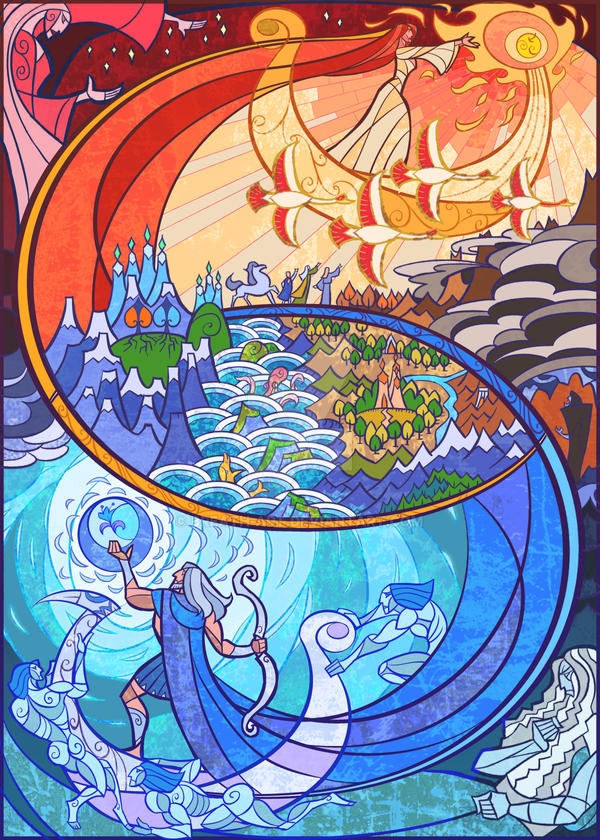
Though the season of Firith is now upon us, there are still days that are bright and warm; and basking in the midday sunshine upon the grass-grown riverbank, I wondered how it was ere the rising of the Sun at the dawn of the First Age. Thus I tried to bring to mind a life without day or night, but ever in eternal twilight beneath the wheeling stars of Elbereth. When the Sun is set and the Moon is darkened I can know the abiding twilight that our forebears ever endured, but I cannot guess their mood; for in my mind I know the Sun will yet rise on the morrow and I cannot gainsay it to imagine otherwise! To behold the heavens in the glory of starlight alone is indeed a wondrous thing, but all my short life I have known the lights of the Moon and Sun.

Now Echeleb Túbeng, my father's father, was begat ere the Moon and Sun first arose in the West[1] (but this the Rodyn changed and we watch ever for their rising in the East), and Teithoron Tegilbor in his tale of years told that he was wed in Doriath under the light of the new-risen Sun; and they both tell that her first dawn was like a great fire upon the lands of Beleriand, and the clouds of Ennor were kindled, and there was heard the sound of many waterfalls.[2] But the Moon rose ere the Sun, and his light burnished the lands in shimmering silver and many things stirred and woke that had waited long in the sleep of Yavanna.[3] How wondrous it would be to have seen this with my own eyes! (And by the reckoning of Teithoron it is now seven thousand and forty-eight years of the Sun since her first rising... how very, very young I am!)
Teithoron told also the ancient tale that in the High Speech of the West is named Narsilion, the Song of the Sun and Moon; and in that tongue they are each named Isil, "the Sheen", and Anar, "the Fire-golden". This tale tells that after the ruin of the Two Trees by Morgoth Bauglir and Ungoliant Delduthling, the Moon was wrought by the Rodyn from the last Flower of Silver that bloomed upon Galathilion the White Tree; and after he had traversed the heaven seven times, the Sun arose, and she was fashioned from the last fruit borne by Melthinorn the Gold. From the Maiar two were chosen to guide these lamps of heaven: Tirion, a hunter of Araw, for the Moon; and Arien, who tended the gardens of Vána sister of Ivon, for the Sun. And Teithoron says that the Sun was set as a sign for the awakening of Men and the waning of the Elves, but it is the Moon that shall preserve our memory. And indeed, though I cherish the bright sunlight, it is the silver light of Tilion that most delights my heart.
And now the stars have risen on the new day, and as I lay upon the greensward of my forest home and gazed upwards at the sparkling sky, I wondered at the marvel of our being: that we each by Eru's grace embody a divine spark of the Flame Imperishable, our fae. And I pondered if to Tilion or Arien looking down upon Ardhon from the heavens above and seeing through the Unseen the countless luminous souls scattered across the lands, it would look alike to them as the scattered stars across the firmament look to us.

[1] "Varda [...] set them to voyage upon appointed courses above the girdle of the Earth from the West unto the East and to return."
- The Silmarillion, "Quenta Silmarillion: Of the Sun and Moon and the Hiding of Valinor"
[2] The Silmarillion, Quenta Silmarillion, "Of the Sun and Moon and the Hiding of Valinor"
[3] Ibid
 |
10 |
 |