Tale of the Blood-Queen, on one page

Back to the chronicle “Tale of the Blood-Queen”

All the adventures of this chronicle, the oldest first. 59 in all

51. Fountain of Lessons

          Carcírion was not upset at Seregrían for sneaking out of the house and visiting Mistress Gwathnim.  In fact, when they spoke the next morning he was mildly pleased.

          “So you boldly went to corner the dragon in her den!  Little blood, let none say you lack courage when your ire is up.  At least you return unscorched from your visit.”

          “Perhaps not scorched, adarinya,” Seregrían replies, “but surely not unchallenged.  I am invited to return today for a private lesson – I’ve not heard of such being done, how am I to read this riddle?”

          “The same way, I guess, that you read her first riddle:  with all the powers of mind that you displayed, but simply double them.  Daughter-mine, I did none of this, arranged none.  This is all your doing and that, I think, is what impresses the Mistress of the Gelydh most.  Just keep doing what you are doing, and I deem you will surprise even yourself.”

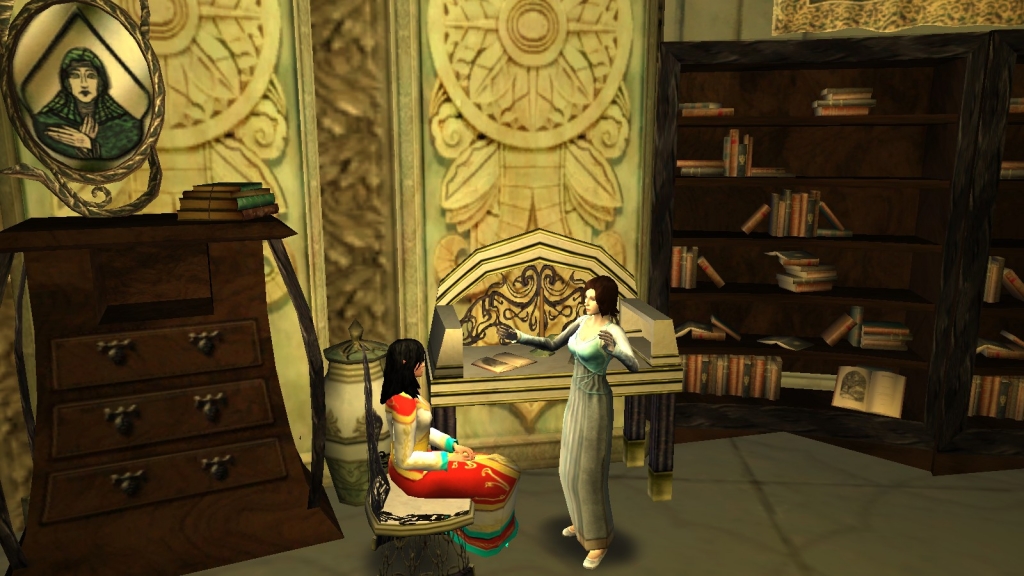
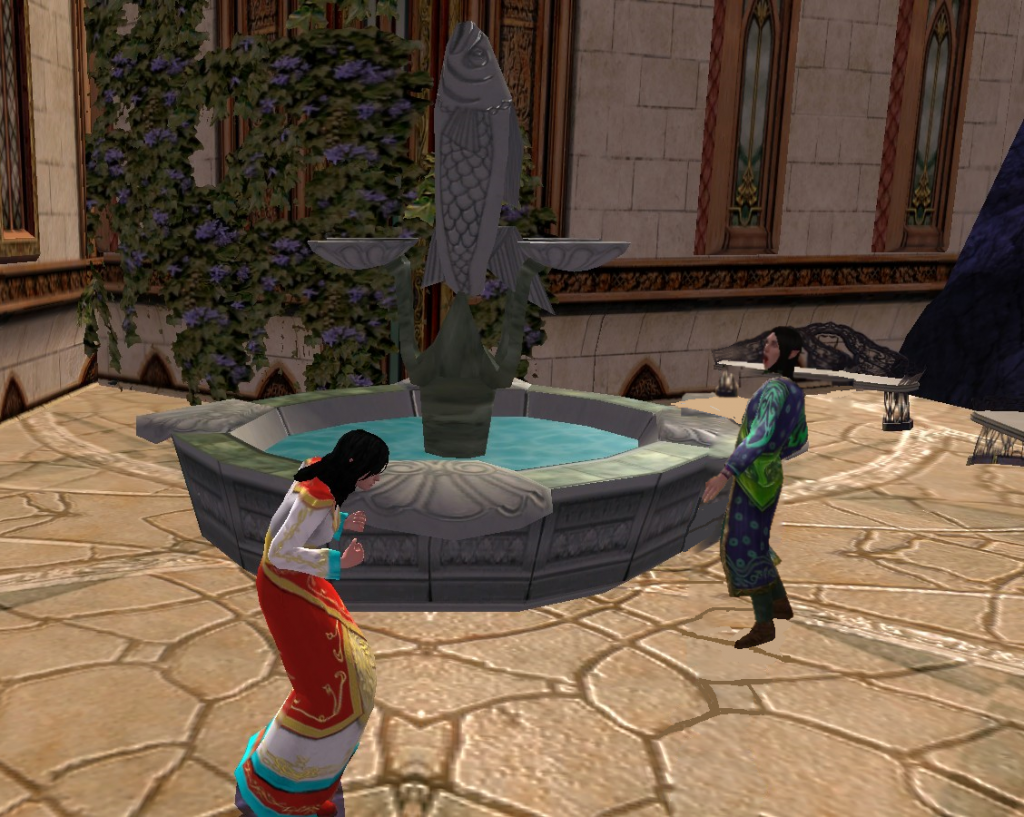
          The hour comes, and Seregrían appears at the house of the Lore-masters and is this time admitted openly, as she is expected.  The door ward bids her enter the house, but to proceed down the foyer to the garden.  She does so, and enters an open space with a terraced pavilion and a marble fountain.  There sits Mistress Gwathnim, watching the waters of the fountain play with quiet contemplation.  As before, she politely coughs to announce herself.

          Gwathnim speaks without turning from the fountain.  “Welcome once more, Seregrían of the House of Anorwë, punctual as you are curious.  This is the Fountain Terrace, one of our meeting places.  Can you deduce why I asked you here?”

          “Yesterday you said I might find another lesson to hold my interest.  That means my first visit was a lesson as well, and this is a continuation.  One might conclude that I have been accepted into the Gwaith-en-Gelydh, and this is but another step on my path.”

          “One with ambition might indeed make that conclusion.  Others might consider your first meeting less of a lesson, and more of an evaluation.  One that continues on to the next level.  I asked you here, young elleth, so that I might determine what gifts you already possess and what may need to be expanded upon.  So, let us begin.  Come and sit by me.  Clear your mind of all else and relax.”  Seregrían does as she is bid and sits on the bench next to Gwathnim.

          “Now, I bid you meditate upon the fountain, indeed the terrace as a whole.  I wish for you to elaborate on your surroundings, to whatever depth of detail you might observe.”
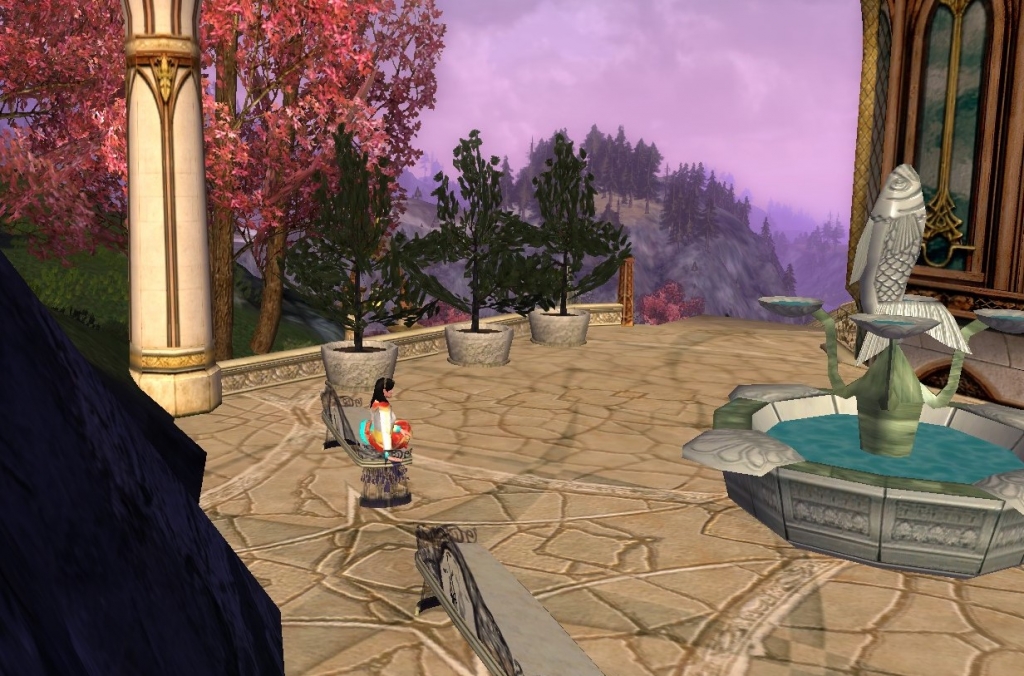
         

           Seregrían’s eyebrow raises slightly; her lesson was to observe a fountain!?  Well then, she thinks, I shall impress her immensely!  “I am seated in a classroom of sorts, with a fountain centerpiece.  The fountain is the focus of the place, as all the seats are arranged so as to face it.  The sculpture is of a large fish spewing water from its mouth, which falls into a basin then the pool; the waters’ action creates a pleasing sound.  The basin is clean, but the pool has water plants floating upon the surface.  The effect overall is to produce a space for tranquil thought and reflection.”

          “Is that all there is to observe, young elleth?”

          “Oh, there’s more!  The waters make a melodious sound; the flow from the sculpture’s mouth first strikes a metal plate, placed so as to produce a bell-like tone.  The terrace is also constructed so as to screen the view from the rear and somewhat from the sides; this is to further focus one’s attention upon the fountain.  There is a scent upon the air, smoke from a brazier that is perfumed by the type of wood being burned; I recognize it as pine resin. 

          “There! a bell just rang someplace close by, sounding the hour.  A chorus of voices are singing in low, repeated notes, more a vocalise than words.  There are now two sources of water sounds than can be discerned:  the fountain itself, and a spring and freshet somewhere close by.”

          “Rise and walk with me, young Seregrían,” Gwathnim says at last.  Seregrían does so and falls in at her side.  The two pace around the terrace, circling the fountain in a slow stroll.

          “What you have done just then was a simple thing,” Gwathnim explains, “but it is what too many others forget to do.  As a scholar and aspiring Lore-mistress, you pay attention to the things that surround you.  Your powers of observation tell you many things, much of which you use, but others you might not give a second glance.  But it is you who chooses which to use in your deductions.

           “As you made your observations and deductions, so I did to you.  Your reasoning and observations were sound, and quite so; but you neglected one detail, and that was you remained seated, unmoving, and absorbed what your senses told you from that point of view alone.  Had you risen and walked, as we are now, more information would have presented itself to you.  Did you not hear the birds, singing in the trees near this place?”

           “I had, Mistress,” Seregrían says, “but as you say, some pieces did not warrant mention; they had no bearing on the immediate observation.  My focus was the fountain, then the surrounding terrace where the fountain sits – as was your direction.”

           “Ah.  Indeed I did; and you fulfilled my wishes, to the limits I gave you.  Your pardon,” Gwathnim says with a smile.  “So, let us consider:  you demonstrated your powers of both observation and deductive reasoning – and your ability to follow instructions precisely, and to the letter of same.  Most intriguing, especially accounting for the fact you have only just come of age.”  The two Elves complete their circuit of the fountain before Gwathnim speaks again.

          “That will be all we shall discuss today, young elleth.  I bid you return tomorrow once again, at the same hour of the day.  This time, when you return, I wish for you to display this to the door ward.”  Gwathnim holds out a small brooch of simple work, which Seregrían takes in her hand.  “The wards will admit you without question upon seeing it.  I shall meet you here, at the fountain, at that time.  You have my leave.”

          Seregrían sees the dismissal for was it is and departs the house.  But when she arrives back home, she is greeted by the laughing smile of Carcírion and the delighted squeal of Gilalaith’s laughter upon seeing the brooch.

          “Daughter, do you realize what this means!?”  Gilalaith cries amid her laughter. “That is an acolyte’s brooch – only a member of the Gwaith-en-Gelydh wears them!”

          “You did it, little blood,” Carcírion says, “you are now part of the House of the Lore-masters, probably the youngest in memory.  Proud I am of you!”

          And Seregrían, staring at the brooch in her hand, allows herself a sigh, then a breath, then she laughs as well.

Next Chapter:  An Unexpected Trap
52. An Unexpected Trap

          Seregrían returns to the House of the Lore-masters next day at the same hour, this time wearing her new acolyte’s brooch prominently on the collar of her dress.  There is a spring to her step, and she hums tunelessly in her barely-contained joy.  She, the youngest member of the Gwaith-en-Gelydh!  Her parents are proud and happy for her, but as she approaches the House, she masters her glee and puts on a serious face as she enters the foyer, the door wards seeing the brooch and nodding in welcome.  She passes into the Fountain Terrace, only to find Mistress Gwathnim in the foyer chamber as if waiting for her arrival.

          “Good day to you, young Seregrían, punctual as ever,” Gwathnim says by way of greeting.  “Though I bade you come at this hour, I regret that other business shall take me away for a short time.  I would ask you to await me in the Fountain Terrace until I return.”  Gwathnim shows her the doorway to the garden, and Seregrían passes through, down the path and onto the terrace.  It looks much as it did the previous day, the waters of the fountain playing in the afternoon light – until she realized she was not alone.  Someone was seated at the same bench where she sat yesterday during Gwathnim’s testing of her, a young ellon with his back to the pathway, his face not to be seen.

          “Your pardon,” Seregrían says, “I do not mean to intrude, but Mistress Gwathnim bade me wait for her here.”  The young elf-lad rises and turns to face her – and she freezes in utter shock and revulsion at the face and voice she knows.

          “Well, well, Seregrían, the Bloody Elf, here inside these walls!”  Maribar sneers.  “So that means one of two things has happened:  either the Gwaith-en-Gelydh has lowered its entrance standards to allow you here, or you lied to be acceptable among polite company.  Truly, I know not which is the worse folly.”  Seregrían begins to tremble with barely-checked rage, her fingers bending into claws at her sides, her feet planting wide apart as if to spring, her nostrils flaring. 

          “…You…” she snarls, “and what shall we say of you, faint-heart?  Jests and mockery are hardly admissible in halls where wisdom and lore are prized – unless perhaps your high-born parentage is your coin at the door!”

          “At least my coin and value are acceptable, as yours are hardly worth mention – keep back, you, or I shall call the wardens!”

          “There are no chairs to hide behind today, spawn of kinslayers – there’s no one here to tear me off of you this time – but you needn’t fear, not today.  Do you honestly think I am going to begin a brawl, here in these halls?  I will not allow you to spoil this day, nor any day after this!”

          “So you really think you’re part of the Gelydh!?  What a laughable idea!  My kin are the only ones worthy of acceptance, even as the House was founded by them, and for them!  As if they’d accept a street-brawling Sindar, the very thought is repellent!”

          “Ah yes, as opposed to a fop whose only virtue – if it’s called that – is his parents’ patronage to the House!  I know all about that, everyone does, because you bragged about it yourself!  As if you think you can purchase a seat in the Lore-chambers, you simpering fool!”

          “Says the fool who thinks she is worthy of the wisdoms out of the Uttermost West, written by my folk in the light when your folk were still stumbling about in the dark beneath the trees!  Go back to the forest, bloody-brains, and use your hair for your garments!  The Gwaith-en-Gelydh is not for the likes of you!”

          “Ahhh, now I see!  Oh, clever people, the Gelydh!  This is another test – they brought you here to get me enraged enough to see my reactions.  Oh, this makes perfect logic!  Yes, they would know of our mutual hate and put you here to see how I master my passions.  I’ve reasoned it out, all of you listening,” Seregrían shouts at the air, turning in a circle, “you should have realized I would see through this – there is no way Maribar could be an acolyte, that was the clue!”

          “I don’t think you realize what you’re doing,” Maribar says, his voice dripping with scorn.  “I am most definitely an acolyte, the youngest in memory, so I’ve been told.”  He points at the collar of his tunic, where the acolyte’s brooch rests.

          “And a nice decoration it is, too,” Seregrían replies, “a part of the costume to make it believable.  But it is not,” she shouts at the air again, “I see through it!”

          “Your stupidity shines brighter than your anger, you foundling fool, and will be your ruin!”

          “And your contempt for anyone not of your precious bloodline will be yours.  You and yours, hiding on this island, feeling safe enough to scorn the rest of us – where on the mainland, your tongue is unheard and unspoken.  You think to be the arbiter of all lore and light, whose only authority is an accident of birth!?”

          “I have heard enough for one hour, let alone the day,” comes Gwathnim’s voice from the path.  The elf-woman walks slowly into the terrace, both Seregrían and Maribar bowing their heads in respect.  Gwathnim’s voice is low, even and steady, and more dreadful than any scream could be.

          “I have heard both of you, now you shall hear me.  The two youngest acolytes I have entertained in more than five-score summers are ready to do battle, literally and figuratively, in my halls.  I shall not permit it.

          “It appears that both of you have laid out the case for the others’ dismissal and left if for me to judge.  Maribar, the matter of your slanderous words about Seregrían and her parents was a tale I was not prepared to believe until now.  And I also see the truth about your boasting that your family’s patronage would assure you a place here.  I see the truth, and it repels me.” 

          As she speaks the word repel, her fingers reach to tighten on Maribar’s brooch as she rips it from his collar.  Maribar’s eyes widen in shock and realization.  “And what of her, shall I not see her be punished as well?”

          “You have my leave,” Gwathnim says frostily.  Maribar departs without a word or a backward glance.  Once he is out of sight, she slowly turns toward Seregrían, her face impassive, her voice still cold, but a different note can be heard – one of uncomfortable shame.

          “I suppose thanks are due you, young one.  You uncovered a bitter truth I needed to face.  Your argument about patronage is all too meaningful.  I must confess to you now, that Maribar’s admission to the Gelydh was indeed due to family connection, but more than simply patronage.  Maribar… is my brother’s son.”

          Seregrían is well and truly shocked by this.  “My lady, this is the first time I regret being right about my deductions; because this time, my being right has clearly caused you pain.  And now, knowing I saw through the test you laid out gives me no pleasure, because I was not able to master my anger at Maribar.”

          “What are you talking about, child?  There was no test.”

          “Wha – but it was – and he was – this wasn’t a test!?”

          “Not in the least.  I bade you both be here at the same hour, because I was intending to introduce you both to the High Table, my counselors.  I truly did get called away, and bade you join Maribar here to await my return.  I realized my error too late and came back – only to hear all of your shouts.  Walk with me again, Seregrían,” and the two elves began to repeat the slow stroll around the fountain, as they had done before on Seregrían’s last visit.

          “I had heard rumor of the animosity between you two; that was in great part why I spoke with you privately over the last few days.   I wished to see you for myself, with my own eyes, and not rely on gossip to decide.  And I see a young elleth with exemplary studies, a deductive mind, and a thirst and need to learn new things, always testing and trying them for herself.

          “What has just happened was not a test, but rather it was chance, if chance we can call it.  Maribar unwittingly stepped in a trap of his own making, for he sought to anger you enough to ruin your acceptance.  Instead, he confirmed all that has been related to me regarding his contempt of any Elf not of pure Noldorin blood.”

          “Then what he said – that the Lore-masters would only accept those of Noldorin blood – it’s true?”

          “Nonsense.  Two of my five at High Table are of the Sindar – one of them of the Falathrim, a survivor of Eglarest same as you, I think.  Seregrían, understand this,” Gwathnim said as she paused and faced the elf-maid.  “I am personally ashamed for the revelations I have heard this day.  Maribar’s actions are shameful, and diminish himself and his House – and that, you know, includes me.  And I crave your pardon.  I, too, am one of those who ‘hide on this island’, and ‘feel safe enough to scorn’.  But I am Mistress of the Gelydh, I am charged with the preservation of the lore of our kin – and that includes the Noldor, the Sindar, the Nandor, and all those who call themselves Elves.  And that includes you, child with the wayward heritage. 

          “You shall keep your acolyte’s brooch, Seregrían.  Few of greater age and none of younger are more deserving.  You unknowingly uncovered a grave error, and I thank you.”

          “But My Lady, why do I feel no joy now in this brooch?  Despite my anger, despite my own scorn for your kin in my turn – I feel as sullied as anyone.”

          “The difference lies in places that you and I shall discover, young Seregrían.  We shall explore the reasons together, I think.  Wisdom is a room with a door:  open it and enter the room, and you will find three more doors.  The next door is yours to choose.”

          Seregrían takes her leave of Gwathnim and walks home, promising to return in two day’s time; until then, she is to reflect upon the unintended lessons of this day.  On the walk home, she runs her fingers across the acolyte’s brooch, hers to keep for another day.  And today, she resolves that every day, she shall earn it again.

Next Chapter:  Blood-queen and Bright-hope

53. Blood-queen and Bright-hope

Twenty-eight years have passed since young Seregrían joined the Gwaith-en-Gelydh as an acolyte to the Lore-masters, and she has swiftly proven her worth in their company.  Her aptitude for rote-learning and memorization has earned her a reputation as “the library with legs”, who could be called upon to exactly recall almost any lore she has read.  Her gifts at research make her a sought-out commodity for the senior lore-masters.  The precision in which she can copy and restore even the most decayed documents has set a new standard for the other acolytes to emulate. 

And all the while, Mistress Gwathnim has watched and smiled inwardly, pleased with her decision to admit this young mercurial elleth into her service.  For as Seregrían has grown greater under the labors of the House, she has also benefited from private tutelage with Gwathnim in mastering her passions and her anger.  The young elf is more focused and cerebral, and less prone to outbursts of temper as the years pass.  Long years later, Seregrían would look back upon these years as one of the happiest of times.


Life has gone on for all the Elves of the Isle of Balar, the years passing in stable refuge but with the clouds of dreadful doom just on the horizon.  Rumor of war and death, defeat after defeat, reach the remnant of the Falathrim and the Elves who fled the mainland.  One by one, the Elven strongholds have fallen and been sacked; first to fall is Nargothrond to dragon-fire, its people scattered or enslaved.  The survivors of Doriath reach the Havens of Sirion, and the mariners of Círdan are often at sea, ferrying back and forth between the island and the Havens bearing supplies and refugees.

It is the news of the fall of Doriath and the second Kinslaying, Sindar slain at the hands of the Noldor, that rocks the Elves of Balar to their core.  Those of the Noldor are looked upon by the Sindar with suspicion and contempt, ofttimes harsh words exchanged, even fights breaking out in the streets.  For Seregrían and Gilalaith, this time is especially difficult, for Carcírion is often at sea and absent, unable to defend his family from the torment of others.  Gilalaith retreats to her garden and avoids leaving the house unless need drives her.  Seregrían continues her work with the Gelydh, enduring the taunts of others with a cool aloofness born of her learning with Gwathnim – but in her heart, she is seething over the evils that the High Kindred perpetrates without fear of reprisal.  And this anger begins to spill out at terrible times, even against Gilalaith.

“Twice it has happened,” Seregrían says bitterly one day, “twice that these arrogant orc-cousins put their own kin to the sword!  And who can stop them?  Who dares try?  Even their own lords egg them on, driving them like mad beasts in a stampede!”

“You and I both know that Elves are not all of a piece,” Gilalaith says sadly.  “The House of Fëanor has wrought much, if not all of the ills the Noldor have endured.  But they are not all the Noldor, for the children of Fingolfin and Finarfin are far more noble and wise.  And they dealt fairly with Doriath before its fall –“

“And look what that fairness has wrought,” Seregrían retorts with rising anger.  “Death and greed and blood – and now, who remains to stand against the Shadow in the North?”

“There remains one,” Gilalaith says, “and of that one it is not permitted to speak, at least not openly.  If you would learn more, then you must find it yourself, for I shall not say.  Go to the Archives when you return to the Lore-masters, and seek out a name:  Turgon…”


And only a few years later, the tidings come flying from the Havens to Balar:  the hidden city of Gondolin has fallen, along with the High King Turgon.  Deeds of valor and everlasting renown allow the remnant of the once-proud Noldorin realm to flee southward.  The young prince Gil-galad has sorrowfully taken up the mantle of leadership, and bids all who can be brought to Balar.

Seregrían and Gilalaith are standing on the quays gazing over the sea, for Carcirion’s ship is part of a flotilla bearing some of the remnant of Gondolin.  Gilalaith is looking upon the scene of refugees disembarking and is moved to the point of tears; something Seregrían has never seen on her mother’s face.

“They… they were my people,” she choked through tears.  “I am of Gondolin – was of Gondolin.”  And in reply to Seregrían’s shocked face, she explained, “I came to Balar with the company of mariners out of Gondolin, at Turgon’s bidding.  We began the building of ships – all to naught!  And now, Gondolin is gone.  Look at these lost ones, see their eyes!”  And Seregrían looks on as elves continue to leave the ship, the broken stares, the masks of horror hiding the memories of what they beheld.  And very nearly, she beings to feel her throat tighten as well.

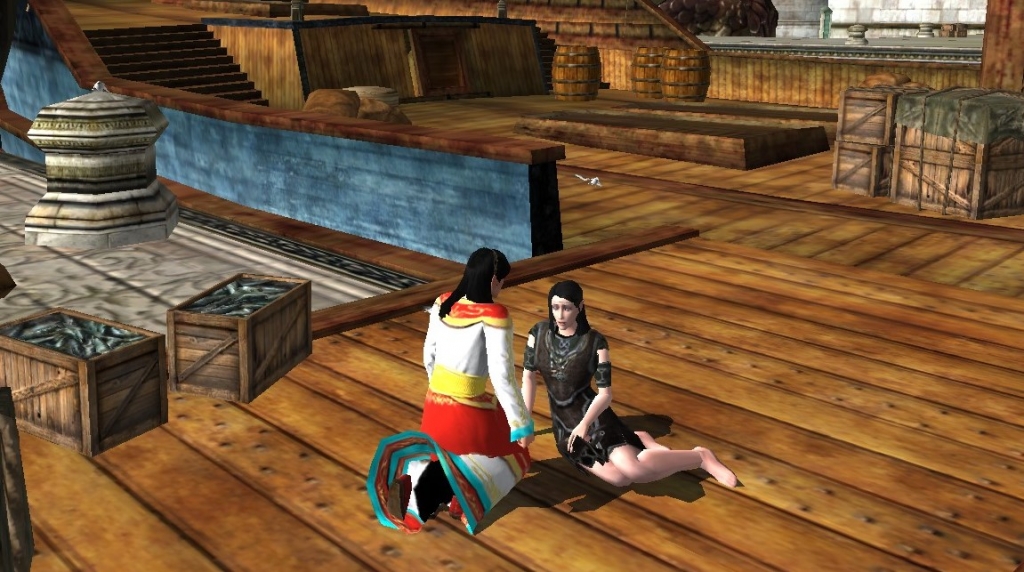
One voice rises above the murmur of the crowd, a plaintive call like a kitten seeking its mother.  Seregrían looks to see an Elf-maid, straining to see over the heads of those around her, her voice desperate and breaking, calling names over and over:  “Thelyndis?  Thenidros? Oh, sister, where are you!”  The girl abruptly sinks to her knees, almost collapsing under the weight of her despair.  Moved by a sudden feeling, Seregrían makes her way to where the Elf-girl has sat down on the gangway, her face a study of sadness and grief.  She kneels to comfort the lost elleth.

“Please,” she says, “please, I would help you.  You seek your sister, let us find her.  You aren’t alone anymore.”  The girl looks up with an expression of grief beyond tears; the same look that Seregrían saw on her own mother’s face on that day on the cliff by the Sea, and it smites her heart.

“I… who, who are you?” the girl asks.  “How can I find Thelyndis?  We got lost on the boats, and the storm arose…”

“She is not wrong,” came a tired voice from behind, and Seregrían turns to see Carcírion walking over to her, he and Gilalaith holding hands.  “We were very nearly swamped by the waves, with all the extra weight of people and stores; it was a near thing.”

“Adar!” Seregrían cries as she stands to embrace her father.  “Welcome home, adarinya.  But, what of all these poor people, what shall become of them?”

“They shall be welcomed, one and all,” Gilalaith says.  “Let none now speak ill of the Noldor, for this is tragedy beyond quarrels.  But who is this, my daughter?”

Seregrían turns back to the lost girl and kneels once again, reaching for her hand and looking at her more closely.  The girl is plainly a Noldo, tall and fair of skin and face, her hair black as jet.  Her limbs are thin and spare from the ordeals she has had to endure.  Her clothing is threadbare, though clearly it once was elaborate and beautiful, black and embroidered with silver.  Her legs and feet are bare, the exposed skin scratched and bruised.  And Seregrían feels herself drawn to this forlorn girl, not only out of pity but out of a depth of compassion she has rarely felt.  Holding her hand, she turns to her parents.

“Naneth, Adar, can she come live with us?  Behold, she has nothing; can we not share ours with her?  She can have my chamber with me, I shall make room, and you have given me clothing to spare.”

“What is this I hear, daughter-mine?” Gilalaith asks.  “Compassion for a Kinslayer?”

“No,” Seregrían replies, “compassion for her.  I… I know her pain.”  And she looks at the girl and asks, “Call me Seregrían, and these are my family.  What are you called?”  The girl looks around at Carcírion and Gilalaith, who are both smiling and nodding, then looks back into Seregrían’s eyes, taking both hands in hers.

“I am Hartagil, once of Gondolin.  And I deem I am alone in all the world.”

“Not any longer, Hartagil.  Welcome to the House of Anorwë,” Seregrían says, smiling gently and helping her to her feet.  As she stands, Hartagil towers over Seregrían, and is matched in height only by Gilalaith.  Seregrían wraps an arm around Hartagil’s waist as Hartagil drapes one arm across her shoulders.  Carcírion and Gilalaith are arm in arm, smiling at the scene.

“Come along, girls,” Gilalaith says, “let us go home.”

Next Chapter:  "Red Maid, Black Blade"

54. Red Maid, Black Blade

          On that very first night the House of Anorwë embraced Hartagil as one of their own, Seregrían welcomed Hartagil into the house and shared her chamber, her clothes and her bed to sleep in; but all the two Elf-maids did was sit up through the night, talking and whispering, and continued for seven nights after.  The two girls talked without ceasing, barely eating or drinking unless Gilalaith called them with firm words to meals.

          Seregrían spoke of Balar, and Eglarest, and the house of the Gwaith-en-Gelydh.  Hartagil spoke of Gondolin, of Tumladen, and the glistening Court of the Fountain before the tower of Turgon.  Seregrían told of her acceptance and rising to become an acolyte, then a trusted scribe and archivist, and her gift of memory and instant recall.  Hartagil told of how she chose not the arts of healing and making but of the blade and bow, and the way of the maethoriel, the warrior-maid.  She became known not for the strength of her arm, but for her incredible speed and agility, both uncanny even in the measure among the Noldor.  Just as Seregrían was named the Library With Legs, Hartagil was named the Black Blade of Tumladen.

          Time has passed swiftly and slowly on Balar, as is the way of the Elves. Twenty-six years have passed since the fall of Gondolin, and the year Hartagil came into Seregrían’s home and heart.  The two girls have become nearly inseparable, seen all about the towns and the docks, frequenting the markets and stalls, laughing gaily in each other’s company, and all who watch them pass smile in their turn.  They keep watch at the quays for Carcírion’s ship to come to haven and greet their foster-father in delight.  While Seregrían attends the Loremasters, Hartagil shares long speech with Gilalaith, who longs for stories of Gondolin after her departure so long ago. 

          As the years pass, Gilalaith’s laughter is heard less, her spirit seemingly darkened by the longing for the past and the foreboding of the wars.  For the news that Carcírion brings home following each passage grows ever darker and void of hope.   King Gil-galad maintains the havens of Sirion on the mainland, the last refuge of the Eldar in Beleriand, where Eärendil the Half-elven holds rule.  But the specter of the Second Kinslaying hangs like a cloud of chill rain above all hearts, and the rift between the Noldor and the Grey-elves cannot be wholly bridged.

          In this atmosphere of distrust, the House of Anorwë endures each season with stoic patience.  Gilalaith has promised Hartagil that they shall seek out and find word of her true siblings, missing since the disaster of Gondolin.  Seregrían continues her work with the Loremasters, aiding the family’s effort by searching all the archives she can gain access to, seeking any word or news of Thelyndis or Thenidros.  And throughout all this time Carcírion sails on, shuttling between Balar and Sirion, asking for tidings at each landfall.

          And then it happens:  the news comes to Balar of the Third Kinslaying, havoc wreaked upon the Elves by their own once more.  The remnant of the House of Fëanor descends upon the Havens, slaying all in their path, hunting Eärendil and Elwing to wrest their claimed prize.  But this time the brothers have gone too far, and their own servants rise up against them, refusing to strike down their own kin, and are slain in their turn; such is the twisting of hearts and minds in this time of chaos.

          The Havens have fallen; and once again, flotillas of Elven-ships bring refugees and survivors to Balar.  Once again, despair and heartbreak settle upon the Elves like a sodden cloak of heavy cloth.  And once more, tempers flare and heated passions rise to the point of swords.  The Sindar of the island are filled with a rage that will not be stayed.  Noldorin families are dragged into the streets and made to watch their homes put to the torch, then tormented by the mob; but none are slain, for the Sindar for all their fury will not spill the blood of their kin, thus staining themselves as well.

          One such angry mob approaches the House of Anorwë, seeking to deliver their wrath to the household.  As the first rank marches up the path, they are met by Carcírion and three of his shipmates, all Sindar themselves, blocking their way to the house.  Behind them stands Gilalaith, who has locked the door behind her, her eyes betraying real fear but anger rising behind them.

          “Stand aside, blood-traitor!” shouts the mob, “Thus shall it be to all Kinslayers, who leave the Grey-elves to wander the shores – they shall know no comfort, no refuge, same as we!”

          “Then shall your homes burn, too?”  Gilalaith replies.  “You, who laugh and rejoice at the suffering of the guiltless, are laughing with the very voice of Morgoth!  Go unto him, faithless ones, and claim your reward by the Great Mound!”

          “Go!” Carcírion shouts, he and his mariners brandishing wooden truncheons.  “Take your madness away from here, or by Össe, none of you shall remain unbeaten!!”  The mob presses forward; staves and cudgels are raised; battle is about to be joined – when a loud shrill scream is heard from the street, and all eyes turn to the source of the sound.

          There in the street stand two Elf-maids, Seregrían in scarlet, Hartagil in black.  Seregrían bears a broom handle, broken at the haft in a makeshift quarter-staff, anger on her face but fear in her eyes.  Hartagil wields two cudgels windmilling in her hands, wrested from two of the mob she has just beaten senseless, her feet planted wide in a warrior’s stance, her lovely eggshell face a mask of rage.

          “You were warned,” Carcírion shouts, “and yet you stayed.  You thought to assault women and children – now see what happens when they fight back!”  Three of the mob break ranks and spring upon the girls, their first and only mistake; for Hartagil launches forward, braining each of them with strokes faster than even an Elven eye can follow.  Standing over the unconscious elves, she fills her lungs and shouts mightily, “Öndolinde!!” and wades into the mob, smashing heads and limbs, no blow coming close to touching her, such is her speed and skill.

          Seregrían can only follow in her sister’s wake, brandishing her staff in her own defense; Hartagil has taught her the ways of staff-fighting, and she can defend herself easily, though mounting an attack of her own is beyond her simple skill.  But attacks are not needed, for Hartagil carves a path to Carcírion’s side, the mob giving way more out of terror at her coming.  The two girls stand at their father’s side, awaiting the next move.

          It is that exact moment that a harsh horn-call rises from behind the mob, and cries of retreat and fear fill the air.  The City Guard, bearing the livery of the High King, marches up to the scene, lances leveled at the rapidly vanishing throng.  With the mob dispersed, the guardsmen secure the house and street, their leader with two guards flanking him approaching the house.

          “I thank you indeed,” Carcírion says, “for your timely arrival.  I fear that my mariners, and my daughters, could not have held them off for long.”

          “Knowing your daughters as I do, I deem they would have carried the day,” the leader says, removing his helmet and revealing himself as –

          “Maribar!?”  Seregrían cries.  “You- you are our rescuer??”

          “You carry tales, little sister,” Hartagil sneers.  “You told me this Maribar was a craven and a fool, and here we find him leading the guard! Though late in coming, I admit – but rather late than not at all.”

           “Think you that you’re the only family assaulted this night?” Maribar replies.  “My patrol has dealt with this same mob twice now.  We scattered them once, but then they reformed and came for you.  They shall not find us lenient when next we meet, I assure you.

          “My orders are to prevent any further blood spilled by our kin, by any means save lethal blows on our part.  But I see you are more than capable of such skill; indeed, I beheld your charge as we rounded the corner there. That you are maethoriel there is no doubt, daughter of the Noldor that I see you to be.”

          “And is that the only reason for your ‘timely arrival’,” Seregrían snorts, “that the mob tried to burn a Noldorin house?  Would you have let a Sinda’s home burn, knowing you as I do?”

          “Seregrían, hold your tongue!” Gilalaith says hotly.  “Maribar does his duty to the King, as you shall do your duty to me!  You shall not be ungrateful to the one who stopped an attack!”  Seregrían is cowed by her mother’s angry tone.

          “Mistress, if I may,” Maribar says, “Seregrían has every right to say such.  For once upon a time, I would have done as she says; and for that, I would know shame and scorn.”  He turns to Seregrían, who stares at him in disbelief.

           “Seregrían, much has changed since you knew me from lessons, and from our day in the judgement of Gwathnim.  Most seriously are these two terrible Kinslayings, at the hands of the High Elves.  Never would I have thought such things would transpire once, but twice again.  As a Noldo, I am filled with shame – and I would ask your pardon, yours and your family’s also.”  And Maribar sinks to one knee before them all, his head bowed in deep remorse.

          Carcírion steps forward and offers his hand to Maribar.  “Rise, young ellon, and receive my pardon and the pardon of my House.  Our thanks be to you for your intervention.  I shall make it known to others of your deeds – and I daresay my daughter will bear news of this night to Mistress Gwathnim, shall she?”  He stares firmly at Seregrían, who nods wordlessly.  With that, Maribar takes his leave with a nod and rejoins his patrol, who quickly march away.  The family watches their leaving, and Hartagil leans closer to Seregrían.

          “So that was Maribar, eh, sister-mine?  He wears the armor well, and with a good leg – or hadn’t you noticed?  And contrite to you as well.  I taught you lessons of the staff, perhaps lessons in boys should follow?”  Seregrían’s only reply is a punch that Hartagil effortlessly blocks, followed by their laughter.    

Next Chapter: Speech in the Night

55. Speech in the Night

          Not long after the Kinslaying and the angry mob comes a time of restless nights for the House of Anorwë.  Carcírion does not depart for the mainland; with the Havens of Sirion destroyed and the refugees secure on the Isle of Balar, there is no further need for flotillas, and ships travel singly or in pairs to patrol the coasts.  This means the Red Mariner spends more time ashore with his family, and this brings a little joy to his heart.  One such night as Gilalaith sleeps fitfully, he rises from their bed and paces the halls, passing the chamber his daughters share.

          Carcírion smiles as he looks at the chamber door, hearing muted voices from within.  Seregrían and Hartagil often chat long into the late watches of the night, sometimes in the giddiness of youth, other times with heartfelt words; but not this night.  As he listens, it is plain the girls are arguing.

          “Do not fret so, Seregrían nethig nin.  You defended yourself well enough, you took to staff-fighting and used the lessons well –“

          “That’s just the point, belegnith – I shouldn’t have had to fight!  That mob would never have come here if it weren’t for the Kinslayers, curse them all –“

          “All?  Even me?  Even you?  Like or not, this family is looked on as Noldor – and Carcírion is even called ‘blood traitor’ by his own.  You look like one of us, and you are assumed as such - oh, do not roll your eyes at me!”

          “And what’s this ‘little sister’ you always say?  I’m older than you, Hartagil, and the ‘big sister’ title is mine, not just yours because of size!”

          “What a thing to be upset about!  What about something real?  If I were as pretty as you, maybe I could have boys in armor marching up the path to my door –“

          “Don’t you dare bring up Maribar again, you – and what about you, making eyes at him when we saw him afterward!  I didn’t accept that theatrical apology that night, but you certainly fell for it.  I’ve known him far longer than you, and I know what he is, and isn’t.”

          “You and your schoolgirl rivalries; you hate the word nethig, but you act like a child still!”

          “Schoolgirl, is it?  Says the one who looks all doe-eyed when that fool appears, like you’re seeking a courtship – wait until he finds out you snore!”

          A laugh, then “Why, Seregrían, now it is plain to see - you are jealous!  All this time, it is you who has vied for Maribar’s eye!  For all that leviathan intellect of yours, has it not occurred to you he has been interested in you since the start!?"

          “Dung!  Dung twice!!  And dung upon you too, if you think that - that creature has any amorous designs upon any other than you!  You say I’m pretty, but who’s the one they all call morbanath – as if I can compete with the Black Beauty, my own sister!”

          “Oh, of course, and the Valar forbid that my name should share the same breath as the Blood-queen – or maybe the Ice-queen, perhaps?  You freeze out all the boys who even dare speak to you!  Just because I welcome a boy’s advances does not mean you have to cause a blizzard every time your favorite one shows up – ow!!  You dare!?”

          Carcírion chooses that moment to throw open the chamber door, to see the two girls writhing on the bed, each with a handful of the others’ hair, Seregrían struggling in Hartagil’s grip.  Seizing a pitcher of water from the nightstand, he douses the two with it, their outrage turning to gasps of shock as he stands over them.

          “Cease this at once!” Carcírion shouts, a tone he reserves for disciplining his mariners.  “Have we not had enough of combat these past few weeks?  Seregrían, I cannot believe this – brawling, as if you’re still not come of age yet!  Hartagil, baiting your sister like this!  By Uinen’s robes, I am so cross with the two of you, I know not what to do – but when I do know, both of you shall regret this night!  Now march, both of you!”  He storms out to the main salon, the girls following, cowed into silence.  In the middle of the room, he grabs two chairs and sets them back-to-back, and points; the two girls sit without a word.

          “Sit there, both of you,” Carcírion growls.  “Do not speak, do not move, until I bid you may – I shall hear if you do.  The first to break the ban shall earn every cleaning chore for a month – including every chamber pot in the house!!”  Both Seregrían and Hartagil look straight forward, their jaws tightly clenched, hands folded in their laps as their father stalks out of the room.  Upon turning down the corridor, he is met by Gilalaith, standing in her nightgown, her arms crossed, but with an amused smile playing on her upturned face.

          “A moment before the mast, for both of them?” she says.

          “Just trying to be as clever as you, my love,” he replies.  “Let the silence eat at them.  They love each other, and their own consciences will punish them far worse than anything I can contrive.”

          “Wisely done, my husband.  And I need no explanation as to why; I could hear every word, they weren’t holding back.”  A sigh, then, “They each are jealous of the other, and yet each would fight for the other.”

          “My wife, I think it’s well past time they should recite the gwethnoss and be formal sisters, do you agree?”

          “Not yet, dear one.  Everyone sees them as sisters except themselves.  They say the words, true, but their hearts don’t mean it yet.  Maybe this will finally turn the page for them both.  Seregrían and Hartagil are destined for many years together, but they have to move past the rivalry they have yet to admit.”

          “For that, they need time; and I don’t believe that there is enough time left to the Elves for that…”

Next Chapter:  The Shape of the World

56. The Shape of the World

          In the span of seven short years, everything changes for the Elves of Balar.  Much of what transpires is written elsewhere, but the great events of the end of the First Age are observed and recorded by the dutiful chroniclers of Balar.

          After the Third Kinslaying and the fall of the Havens, the remnant of the Elves of Beleriand flee to the safety of the island.  Of their lords, only Gil-galad and Círdan remain; for Eärendil was at sea when the Havens fell.  Refugees of the Green-elves also arrive at Balar, bringing tidings from the mainland.  Well-nigh all Beleriand is overrun by the forces of the Enemy, and the Iron Crown of the North reigns supreme.

          It is in that hour, unlooked for and unforeseen, that a mighty armada appears on the western shore.  The Host of the Valar has arrived, bringing tidings of hope and vast strength of arms.  For the Noldor, there are many reunions with their long-sundered kin out of the West; and the splendor of the host of the Vanyar fills all with wonder.  But all are struck with dread and awe at the Valar themselves, arrayed in forms of power and might for a great war to come.

          And come it does.  From the first battle at the ruins of Eglarest, across Arvernien and to the shoulders of Sirion the battles rage for years, shaking the very ground.  Swift ships dash back and forth between Balar and the mainland, bearing wounded and tidings of the campaign.  And the House of Anorwë rises to the calls for aid.  Carcírion now commands a squadron of ships, ferrying passengers and stores across the sea.  Gilalaith opens her house to the wounded, filling almost every room with the sick and injured; for the healers among the Elves cannot manage the sheer numbers.  Seregrían and Hartagil serve Gilalaith as aid and helpers, handling the many chores needed to care for the injured.

          Upon one evening, the family gathers for a shared meal as Carcírion is home once more.  For a time, the four eat in silence, when Gilalaith makes an effort to lighten the mood.

          “There have been many little joys in these times, have you seen?” she says.  “With the coming of the Host out of the West, I have seen many reunions of friends.”

          “Some right here in this house,” Hartagil agrees.  “Just today, I watched two brothers reunite:  one came to these shores while the other remained behind – and to hear them laugh and weep made all the years melt away for them.”

          “Old friends are met, and new ones made,” Carcírion says.  “On my last voyage, I beheld a company of soldiers join an Elven-host headed north – a company of Men!  Arrayed in the armor of the Elves, they were – and bore it proudly and with valor - “

          “Mortals, playing at being Elves,” Seregrían mutters.

          “And why not, sister?”  Hartagil says, “They have as much cause to fight as we do – “

          Seregrían slams her hands on the table.  “On whose side!  Mortals are marching under the Enemy’s banners, in far greater numbers than these precious ‘Elf-friends’, and that is their true cause!  The same ones that fought under the banners of the Kinslayers – “

          “Silence!” Gilalaith nearly shouts.  “You know I forbade that word in my hearing, daughter, and I expect my wishes to be obeyed!”  Seregrían clenches her jaw, and falls silent, but glowering.  Hartagil finds her plate suddenly fascinating, staying out of the exchange.

          “I too, have heard such news,” Carcírion says, “that hosts of Mortals are fighting against us.  But not all of them, for the remnant of the Edain stand with us.  Their hearts are true; and you would see this is so, if you ever have the fortune to meet them.”

          “I hardly count Mortals among my desired meetings,” Seregrían growls, “now or in future.  If they are destined to die, by sword or by time, then let them – the stars will shine the brighter for it!”

          It was now Gilalaith who slams the table with a fist.  “I will endure no more of your hate!  Be silent or go to your chamber!”  And with a glare, Seregrían stands and leaves the room, a far-off slam of a door her reply.  Hartagil looks at her foster parents.

          “Leave me to speak with her, after she cools down,” she says.  “She has been boiling like this in recent days and talking to me seems to help.  Please?”  Carcírion and Gilalaith nod, and the three continue eating.


            The War of Wrath, as it is being called, drags on for decades.  The tide of war ebbs and flows, and news comes to Balar not only from ships and messengers, but in the earth itself.  Tremors can be felt at whiles, and harsh flashes of light can be seen in the night skies by the farsighted.  It comes on a time where for weeks no news comes, and even Carcírion has not returned with tidings. 

          On one evening, Hartagil cannot find Seregrían, and Gilalaith bids her search for her.  She looks in all the places the sisters are wont to haunt, to no avail.  After looking through the night and into the hours before dawn, Hartagil finds Seregrían standing alone atop a promontory looking across the sea to the north; the girls would stand there, keeping lookout for their father’s sails. 

          “Seregrían?”  Hartagil calls as she approaches.  “What are you doing here, we were worried about you.  What is it?”  Seregrian speaks without looking, here eyes fixed on the northern skies.

          “Can’t you feel it?” she replies.  “The air is changed, charged with something.  The sky to the north is utterly black with no starlight, but see, there are flashes like lightning in a storm, only greater – and more terrible.  Something dreadful is happening.”  Then, just before the sun breaks over the horizon, there is one tremendous flash in the north, followed by a tremor greater than any they had felt before.  And as the sun rose, both girls feel such a sudden flood of joy in their hearts that they begin to sing; and from the houses below can be heard singing also.

           The news comes from the mainland of the great victory of the West over the North; Thangorodrim is broken, and the Iron Crown is no more, and the war has been won.  And along with the word of victory comes the dreadful news of how the lands have been broken and blasted, mountains laid low and cataracts drown the land – and the Elves must now prepare themselves for what is to come.

          For the shape of the world has changed – and for Seregrían and Hartagil, so much will not be the same.


Next Chapter:  A Hidden Labor of Hate

57. Hearts Beneath the Gloom

          It took not the eyes of an Elf to behold the oncoming gloom, groping fingers of brown clouds reaching up over the edge of the world.

          The last three days for the city of Edoras have been that of frantic patience.  Frantic for preparations for war and the people emptying the city, making for the refuge of Dunharrow; and then patience, as all held ready and breathless for the arrival of Théoden King and the victorious host of Rohan.

          The Riders Four, their duty discharged, now seek to join with the host of the Rohirrim in whatever capacity they may.  But Seregrían’s next course is uncertain after the encounter of dreams with Gwathwethil, and she seeks counsel with Hutha, who kept watch with her that night.  They sit apart from the others as they camped in Harrowdale with the gathering host, many already there and more streaming in.

          “You are troubled, that is plain,” Hutha says as he passes a mug of hot soup to her by the fire.  “Does the memory of that dream-walk of yours plague you still?”

          “Not plagues,” Seregrían replies, “but puzzles.  All roads and paths now run to the East, though which twists and turns they take, who can say?  My road plainly runs east to the Black Land; but the road of the Riders runs east, then turns to Minas Tirith.  Shall I follow your track, for as long as needed?  Or shall I strike out on my own, and find a way alone where a host might not go?”

          “If my word carries any weight with you, Elf-lass – and this is speaking as one whom they used to call ‘elfling’ as a boy – I would see you ride with the Rohirrim.  You should see plainly that any road leading east is fraught with peril, and one who rides alone in this hour plays toss-stones with doom.”

          “’Elfling,’ you say!  And of course, it would be said in mockery by your kin.  But in that spirit, Hutha, your counsel is sound.  I shall ride in the swath made by the host, not part of you but following hard by.  But what of you and the others?  Have you decided what path is yours?”

          “Torn minds and hearts, same as yours, I deem.  All of us wish to ride to the war, and whatever doom awaits us:  Ulf looks for blood, Léofdag for his lost honor; and Burnoth, well, looks for fodder for his horse and for his next tale.

          “I do mark where Burnoth sought out the Lord Éomer, seeking to make report and learn his will.  Where he goes, we follow, such is the way of it – ah, look!  Here is Burnoth now, perhaps he has news?”  Both Hutha and Seregrían rise and greet Burnoth, Léofdag and Ulf walking with him, and the five friends gather round the fire, their faces bathed in the deepening night.

          “New tidings have come, brothers – and lass,” Burnoth says with a nod and a grin to Seregrían, “and the word is that we ride on the morrow.  News has come of an errand-rider from Gondor, and he speaks this night with Théoden King.  And I have had words with the Lord Éomer:  we shall rejoin his éored and ride in his company.  But be ready for even this to change, for the Rohirrim shall have need of scouts, ranging far and wide to bring report on the march.”

          “I call these tidings good,” Ulf says, “we have rested well enough, and I prefer a long ride to cooling my heels in Edoras.”

          “As do we all,” Léofdag says, then turns to Seregrían, “at least, all of us?” 

          “Surely, you ride with us, Blodcwyn?”  Burnoth says.  “For where might you go, or stay, for I had hoped our paths would run together a while longer.”

          “You had best not be thinking of riding alone, child…” Ulf says darkly.

          “There you are once again with your tender speech, Reaver,” Seregrían teases, and all there smile.  “In truth, Hutha here has made up my mind.  I shall ride in the wake of the host, with you but not part of you.  Well that we have fought as a company, I have no place among your host, nor armor or gear of war to ride with you.”

          “Folly, I say!” Léofdag cries.  “You, who have cut a path through our foes with light and fire, will not ride with us?”

          “Blodcwyn speaks wisely,” Burnoth says.  “In such a battle as what awaits us, could she be of use or hindrance to an eored’s charge?  Unarmored as she is, she risks the crush and press of close battle.”

          “And do you forget what she has already done?”  Ulf counters.  “Blasting a path through our foes at Hytbold?  Standing against the Winged Terror on the Wold?  I am of a mind with Léofdag, she would do well to ride in the host to battle.”

          “Fools, why can she not do both?” Hutha offers, and all eyes turn to him.  “All jests aside, she can do both.  Let the four of us ride in the rearguard with her!  Even if we are tasked to scout the flank of the march, the five of us will ride as always, do you not see?”  Silence, then nods around the fire as Hutha’s word take hold, and Seregrían grins in approval.

          “I think this a marvelous idea,” she says.  “Let it be so, then; the Elf and the Riders Four go forth!”  Hutha holds his hand out over the fire, and one by one the men lay their hands on his; and Seregrían lays her hand upon them all, smiling, and feeling more of a bond with these men than ever before.


          The men retire to what rest or sleep they can take, with Seregrían sitting by the fire, watching the flames.  Presently she hears her name called; not in the tongue of Rohan but in Elvish, and she looks up to see Elfidis approaching.

          “Hail, Seregrían, I thought to find you here in the company of the Riders,” she says.  “The news has been passed through the host, that the weapontake and the marshalling is set for dawn tomorrow.  I am to remain here, with the last garrison of Harrowdale, for such is my charge.  What of you, have you decided your course as yet?”

          “Yes, I have,” Seregrían says, “I shall ride with the Riders Four, to whatever fortune shall meet them.  Whether as part of the trailing guard, or the scouts on the flank, remains to be seen.  But I see you,” she says looking hard at Elfidis’ expression, “and I deem you are not pleased?  You wished for me to ride out with the host, and not remain?”

          “That is so; but I fear for the children of the House of Éomund.  For Éomer, I have no fear; but the lady Éowyn is even now distraught.  She endured a bitter parting not a few nights past, and it seems to have sapped her will.  And now, she is nowhere to be found; that is why I am here, I was seeking her among the host, but saw you first; and hoped you had news of her.”

          “Of that, I have none.  But now that I have found you once more, Elfidis, I wished to have words with you.  I would leave you a gift in memory of your courtesy and kindness to me.”

          “A gift!  But what have I done to earn such of the Elves, other than show the courtesy due a guest of renown?”

          “Your gift of fair speech with me, your gracious words, and reminding me of what I still need to learn:  that among Mortals, there are those of good and kind spirit.  And it is also a kindness to me as well.  Stay a moment.”  And Seregrían lets out a short, shrill whistle and stands still for a moment, when out of the gloom come shouts of surprise and dismay.  For the wolf Warfrost now pads quietly up to the fire, looking earnestly at Seregrían.  The elf kneels to the wolf, running her hand through his fur and speaking softly in the Elven-tongue, looking to Elfidis, then back to him; the wolf’s eyes also follow to her and he walks slowly to the woman, sitting and looking intently.  Elfidis can only stand still, looking at the wolf in wonder.

          “I cannot take Warfrost on the roads I must travel,” Seregrían explains.  “To ask such a thing of him would be beyond cruel.  Dagorlach shall bear me swiftly and sure, but Warfost I commend to you.  I have named you, and he shall know you and come at your call.  May you and he remain friends for as long as you may run together.”  Elfidis sinks to her knees and holds out a hand to Warfrost, and the wolf nudges it with his muzzle; she strokes his fur, and he moves closer.  Elfidis can only look up at Seregrían, her face a picture of delight and wonder.  She stands and begins to move off, the wolf following in her steps as Seregrían nods a farewell.

          The two women would never meet again, but the wolf would remain long in Elfidis’ company.  Long years after, when the great events of these years were but a memory, the men of Rohan would speak of the lady known as Elfidis Ulfswoster:  Elf-woman the Wolf-sister.

58. A Hidden Labor of Hate

            It becomes plain to the remnant of the Elves that the world has indeed changed.  Just one year after the fall of Thangorodrim, the full extent of the devastation of Beleriand is revealed.  Lands have sunk, seas have risen, and the coastlines have rolled away; but by some miracle, the Isle of Balar remains. 

            But then come the words of the Lords of the West themselves:  the Isle of Balar is doomed, and all that was built and labored for will be drowned beneath the waves.  The tumults of the war have overthrown the foundations of the world, and all of Beleriand shall be cast down; but by the grace of the Valar, the island stands a little while longer, buying the Elves time to depart.  Mistress Gwathnim bears these tidings to her councilors of the Gwaith-en-Gelydh.

            “How much time we have left to us, none can say,” Gwathnim says, “for who can gainsay the will of the Lords of the West?  But preparations for our leaving have already begun.  King Gil-galad has already taken ship for the mainland and is preparing a haven for those leaving Balar.  Lord Círdan among others shall remain here, directing the evacuation.”

            Nóremmatur, the master mapmaker and Gwathnim’s right-hand, speaks up.  “Mistress, this is woeful news!  We must prepare to rescue as much of the archives as we may.  But will we be allowed even one ship to transport it all?”

          ”Indeed, we shall have four ships at our call, by the word of Círdan,” Gwathnim says.  “The flotilla commanded by Carcírion has been placed at our disposal.  I am told that the King himself willed it so, for he would recover all that can be saved of our people, and our lore and histories.  Now, here is my mind regarding the task before us.

          “One ship shall be tasked with bearing our members, their families, and their goods and personal heirlooms.  The second ship shall bear away artifacts, works of art and craft, and such material things as the Loremasters have preserved.  The remaining two ships shall bear every book, scroll, tome and map possessed in the Archives.  In this task our two brightest stars, Seregrían and Parfiolossë, shall be of greatest service; for their gifts and skills shall be essential in reassembling the Archives once we arrive - at whatever new home the Gelydh shall make.”

          “Now go, I bid you!” Gwathnim says with a rising voice.  “Gather your staff, each of you, and report to me how quickly you can have ready all that can be made!”


          Carcírion’s ships sail forth the next day, bound for the shattered coast of Beleriand with all the craftsmen, masons and carpenters available, to establish a new harbor. All along the shores of Balar ships are being drawn up on the beaches, some being loaded in panicked haste with others in carefully planned resolve.  The Gwaith-en-Gelydh is one of those working in a measured pace to make ready to depart.  Their ships are due to return within seven days; this gives the Loremasters time to prepare their departure. 

            All throughout the House of the Gelydh, archivists and their acolytes pack and assemble crate after crate with precious books and artifacts.  Gwathnim and Nóremmatur seem to be everywhere at once, directing the storage and staging of the containers and bringing order to chaos.  But it falls to Seregrían and Parfiolossë to catalog and inventory the treasures and trove of lore that is being salvaged from this disaster.  Twice Gwathnim has to restrain the angry frustration of the Elves who would simply cram everything into barrels and crates and get the cargo to the shore.  The two young archivists press on with their careful cataloging and sorting – but not without issues of their own.

          “How many times must we do this!”  Parfiolossë says exasperated.  “Does it matter how the books get in the crate, so long as they come out unspoiled at our destination?”

          “I have no intention of sorting things twice,” Seregrían growls as she looks up from her catalog work.  “If we pack the tomes in reverse order, we pull them back out at our new archives in their proper order.  And if you separate them with the packing material – like I showed you – then each category is not only separate but protected.  And each box must have a list of the items within, equally protected.”

          “At the rate you’re moving, Seregrían, we’ll not be needing boxes, we’ll need fishing nets and draglines – because everything will be at the bottom of the Sea!  Look here, the boxes are large enough that one bookcase can fill it easily.  Why not just empty the bookcase, seal it, label it and move on to the next?  Master Nóremmatur has been by twice already and is growling more fiercely than you!”

          Seregrían looks up from her cataloging, irritated in her turn.  “Very well, then, we’ll do it your way – but I will enjoy the looks and rolling eyes when it takes thrice as long to restore the library once we’ve arrived.”  The packing goes swifter, if not smoother, when Parfiolossë begins rifling a chest of drawers filled with loose notes.

          “What are we supposed to do with this?” she cries.  “These have never been organized at all!”

          “They are organized, for they’re my own notes!”  Seregrían says.  “Each stack is a subject, each divided according to – stop that, Parfiolossë, you’ll spoil my work!!  Parfiolossë is not listening as she simply tips the drawer into an open crate.

          “What work might this be, then?  These are all notes on Mortals!?  Since when did you pay any mind to the children of Men?  And when did you keep such haphazard filing – this isn’t a sanctioned work, you’re doing this on your own?”

          Seregrían concentrates on the open book in her hand, not looking at her friend.  “No one has ever consolidated the collected lore regarding the Second-Comers.  These pages are a stew of many sources, and I have had little time to complete the work; I merely stored them against a future time – but now, there is no time.”

          Parfiolossë leafs through several parchments.  “These are accounts from refugees, from rumors – some from Doriath, some from Arvernien – even this one, from Gondolin!?  How did you even get these!”

          “It is as you say, accounts from refugees and from eye-witnesses.  You see the labor of full sixty summers, of interviews and rumor.”

           “But I still do not understand the why.  If you haven’t told anyone else, and only I have seen these, then explain to me, if no one else hears.  Why are you studying Mortals, when you claim so loudly you hate them?”

            “It is because I hate them, that I study them, you dolt!  You think they’ll change their allegiances, their loyalties, just because the Shadow is gone?  They carry the Shadow in their hearts even now!  They will recover their numbers in due time, they breed almost as fast as the orcs do; and what will they do with those numbers, once they also recover their wits?  The Elves will have to fight them once more, as we did in the Nirnaeth when they betrayed us – and this time, by my hand shall their weaknesses be revealed!!”  Parfiolossë sits silent while Seregrían rages, then speaks with a voice tinged with sadness.

            “You’re too young to hold such anger, dear friend, and so much lies before us yet to see and learn.  But what you say does make sense.  Perhaps there will come a time when such lore will be needful for some commander in years to come; but that is not today’s problem.  Here, this box shall hold your works, and I shall speak to no one about them.  But please, let us continue our labor here, and with greater haste?  As Mistress Gwathnim said, we know not how much time we have to depart.  Agreed, Blood-queen?”

          “Agreed, Book-flower.”  And the two friends returned to their packing in silence.

Next Chapter:  "The Bond of Family"

59. The Bond of Family

          Full seventy years have passed since the breaking of the world and the beginning of the new age, the Second Age as the chroniclers name it.  The Elves of Beleriand have established their new realm of Lindon in what remains of Ossiriand west of the Blue Mountains.  The King Gil-galad has taken his seat in the port city of Mithlond, and his people have begun to explore the new lands and coasts.  The Elves look upon these new and changed lands with wonder, and many scouts and explorers rise to the call of adventure.

          For the House of Anorwë, these years bring changes and adventures as well.  Carcírion is now a respected Captain of Ships and commands his flotilla, now grown to seven ships, on voyages of discovery and mapping the new coasts.  Gilalaith, now a member of the Gwaith-en-Gelydh in her own right, serves as the Steward of the Hall, providing support and provender for the Lore-masters in their new hall in the town of Celondim-on-Lhûn. 

          Seregrían has risen in both rank and status, now being hailed as the lead archivist who reports directly to Master Nóremmatur and Mistress Gwathnim herself.  Her friend Parfiolossë serves at her right hand, and the pair have spent the years not only rebuilding the archives but reorganizing and expanding them; for as each expedition returns with a new trove of lore and maps, the two archivists labor to grow the body of knowledge the Elves are building.

          The only clouds on the horizon come from Hartagil and affect Seregrían sorely.  The rebuilding of the Elven army requires anyone able to bear arms to do a term in service, and Hartagil’s martial prowess is sought in both training and deployment.  The sisters are separated for many a day at their tasks and see each other rarely.  But on one dismal and overcast day, the two sisters meet in Celondim and share their worries and toils.

          “Are you enjoying your new rank, and your new wardrobe?” Seregrían asks as she tosses pebbles from the overlook into the river below.

          “The same as you are, I would imagine,” Hartagil replies, “and I am surprised you emerged from your dungeons to see me.”  Seregrían shoots a look at Hartagil, clad in the black and gold livery of the newly formed Twilight Guard.

          “I’m as surprised as you are, considering you even agreed to meet today.  I would’ve thought you were consumed by your time with your comrades – especially Maribar…”

          “Oh, will you ever let that rest!?  I have said it already, Maribar is a lieutenant of the Guard, and I am a chief scout – and as such, I am bound to orders – “

          “Orders, she says!  More like you’d run at his call with your eyes aglow!”

          Hartagil falls silent, staring off beyond the river and when she speaks again, her voice is bitter.  “I should have guessed you would be in this mood.  It actually makes our parting that much easier, that I will no longer have to endure your petty jibes…”

          “Wait, you – what?  You’re leaving!?  But you only just returned from that journey beyond the rivers, what’s happening?”

          “Why do you think the Twilight Guard has formed?  A new region is being explored; beyond the eastern hills lies a lake they call Nenuial, the Twilight Waters – and the Guard shall station there permanently.  But since you are so eager to see me off…”

          “You can’t, you mustn’t… I was hoping you’d be staying.  Adar’s gone again on another voyage, and Naneth is so busy with her work at the Hall – oh, Hartagil, I was looking forward to time with you, truly I was!”

          “And did you not think I wished the same?  Strolling the markets, like the old days of Balar?  Talking for days and nights on end?  And it was fun, dressing in formal garb and attending the sunset balls, I miss that so!

          “Now think on this, nethig nin – if the Lore-masters gave you tasks that took you away from Celondim, would you not obey out of respect and duty?  And you think it strange, or cruel, that I might do the same?  Would you have me diminish my honor, to accommodate you?”

          “Yes!  Yes, I would – because if it came down to it, I would do the same for you!  Give up my own duty for the time spent with you – the sister I love!”

          Both stand in stunned silence, broken by Hartagil’s tight-throated whisper.  “I do believe that is the first time you said the words – Seregrían, you love me?  My sister, truly?”

           “Of course I do, you big, stomping, snoring idiot!  I know we’ve never stopped looking for Thenidros and Thelyndis, but I would’ve hoped that just once, you would accept me as the sister I hoped I was for you.  Hartagil, you love me?  My sister, truly?”

           For what seems an hour, neither girl speaks nor moves, just staring into each other’s faces while fighting back tears.  Then in unison, they join hands and whisper with strained voices the Gwethnoss, the Bond of Family, ending with the bonding words:

“Now hearken all, and do take heed.

No blood is shared, for none we need. 

Sisters in all but blood are we,

and sisters we shall ever be.”

Pages