Tale of the Blood-Queen, on one page

Back to the chronicle “Tale of the Blood-Queen”

All the adventures of this chronicle, the oldest first. 59 in all

1. Long Live the Queen...

            The word has come from the North of the last terrible battle of the War of the Jewels, which those who still live are already calling the Battle of Unnumbered Tears. The news is devastating; for not a single one of the armies of King Fingon shall ever return, nor his allies among Men. Wild rumors fly, telling of slaughter beyond the count of tears, and of the treachery of Men, and thus were the armies of the Elves destroyed. The forces of the Shadow now pour into the lands from the North, ravaging and destroying all in their path. All hope appears lost.

            To one household these tidings bring deep despair. The Elf-woman Thandwen and her daughter Nauthira are reeling with the realization that their husband and father will never return. As Nauthira weeps, Thandwen’s face becomes a mask of nothingness, her eyes as vacant as her heart. She and her husband had planned on raising Nauthira in peace among their own kin, but now the wars had ended all their hopes.

            Thandwen rises wordlessly and walks out of their home, toward the bluff overlooking the Sea. As the sun settles onto the bosom of the waters in the West, and the clouds gather in the East heralding a storm, Thandwen comes to realize that the only way she and her love might be reunited is in the Halls of Mandos in the West.

            Thandwen turns to a shout from behind her, as Nauthira comes flying up the greensward before the precipice. “Mother! You told me we must never walk this close to the bluffs. Come away from there!”

            “All will be well, my love,” Thandwen calls back over the rising wind. “The Elves have failed. It is time for all those to depart who shall, for if not now then soon.”

            “Mother, what are you saying? What are you doing? Come back, come back with me!”

            Thandwen steps closer to the edge, her feet balanced on the precipice; beneath her is a plunge of many fathoms onto the rocks and surf below. Framed against the setting sun, she turns to Nauthira once more.

            “Your father has gone before us, my child. I go now to join him and prepare the way for you to come when you will. This is not goodbye; this is simply a parting until we all meet again, a family forever.”

            “Mother, no, you cannot mean this! Do not leave me alone here, please! Come back to me! Do you not love me? Is not my love enough for you to stay? Mother, no!”

            Thandwen, with a look on her face of blank nothingness, steps out over the edge of the bluff and vanishes from sight, plummeting down to the waters below. Nauthira cannot move to follow; she sinks to her knees, wailing at the horror she has just witnessed, calling her mother’s name over and again. As if in answer, the winds rise fiercer, buffeting the Elf-maid in her despair. She rises to her feet and turns from the cliff’s edge, shutting her eyes away from the scene, running back to the house as fast as the winds will allow. Gaining the door, she shuts the storm outside, the winds beginning to shake the lattices and eaves. Gasping, she staggers into the parlor and braces herself against a table, letting her mind race in every direction, her voice hiccupping through rising sobs.

            “My father dies. My mother abandons me. I am alone in all the world. Unloved, and unlovable – how else could it be for them to abandon me? I am unloved, and betrayed by those who lied to me, making me think I could be loved by anyone!”

            Nauthira slams her hands onto the table, the sound sharp and echoing, loud even amidst the rising winds outside. The force of the blow felt strangely good; she strikes the table once more, then again, repeatedly smashing her hands, then her balled fists, onto the table top. Her blows match the rhythm of her beating heart and her gasping breath, in time with the gusts outside, a wordless symphony of anger, of bitterness and rising hate.

          After a time, the blows slow, then cease. Nauthira stands silent, gazing at the table, now decorated by two bloody streaks which mark the blows from her hands. Silently she looks at her hands, her fists unclenched, knuckles cracked and bleeding,  streaked with bright blood. She looks at her gown, pristine white and pure, now speckled with blood sprayed from her raining blows. She is fascinated by the contrast:  the pure innocent white, now stained with blood, her own. The crimson and scarlet flows against her pale skin and the clean cloth, and she finds the color change shockingly beautiful, and meaningful. And a new resolve begins to rise from a depth she never knew she possessed, filling her mind, and pushing out all thoughts of despair.

          “My world bleeds. All the world is fire and blood now. The Shadow took Father, and Mother, but it will not take me, let it try. I shall take it before it takes me. I shall learn how to defeat it if it takes all the years left to me. Let the Mortals tremble at my coming, let the minions of the Shadow fear even the mention of my name!

            “My name? My name…  I shall forge a name that shall make all quake in fear, Elves and mortals alike! At the merest mention of me, they shall know I come with fire and blood. Blood it shall be, the banner by which they know me shall be dyed in their own blood. By their blood shall I be their conqueror, their master - their queen! Yes, yes, they shall all know me as the queen of blood!”  And she raises her encarmined hands to the sky, her eyes flashing like the lightning of the storm.
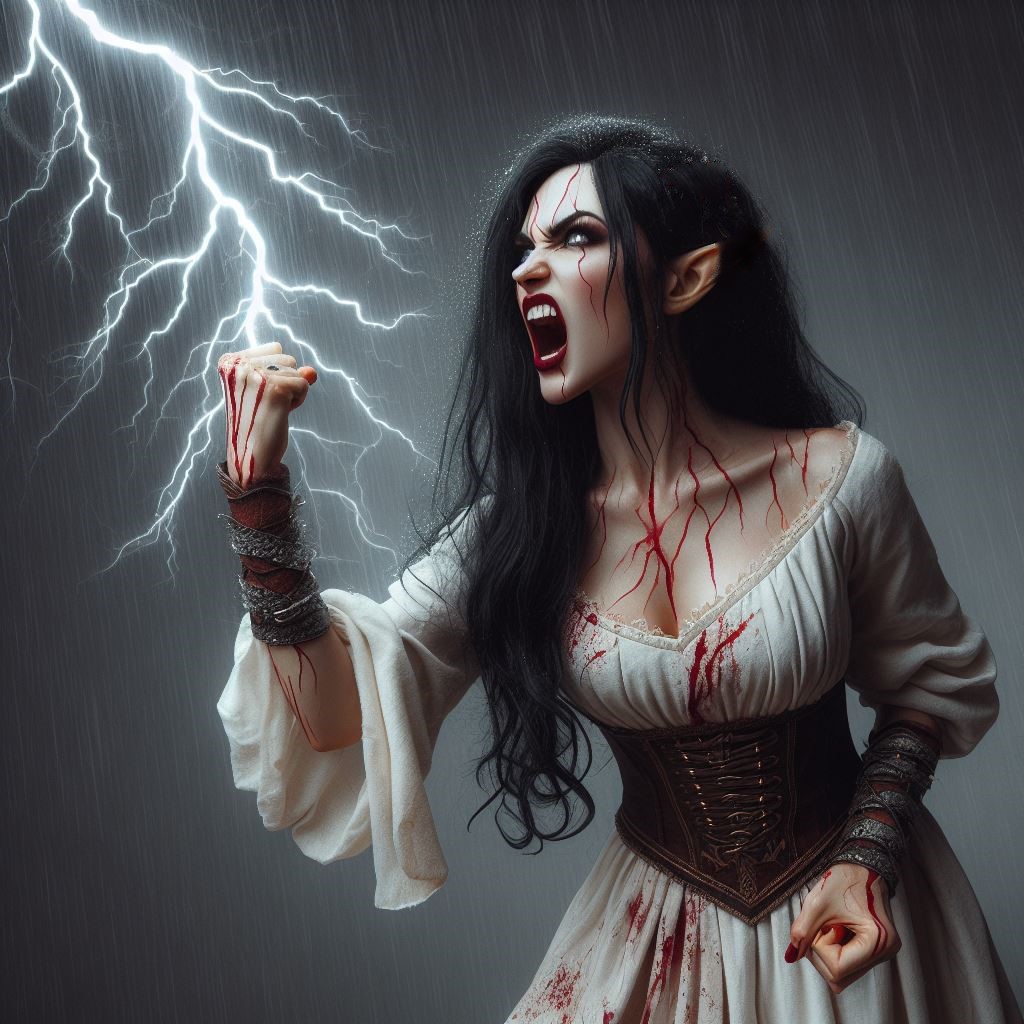
            “Nauthira is dead! Behold, this night is born the Blood-queen!"

            “I – AM – SEREGRÍAN!!”    

Next Chapter:  "The Red Beacon"

2. Secrets from the Past

The Dwarves of the Iron Garrison wait anxiously for the return of Seregrían, the Elf-scholar who they now regard as one of their own. Three days have passed since she followed the merrevail in a red rage to the peaks above Khazad-dûm. Bori and Svanr bravely tried to follow but halted at the gate of Zirak-zigil and kept watch, not daring to go further.

But on that third day, Seregrían reappears, and the Dwarves see a terrible change: covered in wounds, the Blood-queen's face is ashen and, incredibly, tear-stained. "Take me to Brogur" are the only words she says. They do so, and her words to the Dwarf-chief are terse and deadpanned.

"I must take my leave and depart without delay. I shall send word back to you and greet you again upon my return." And with bows and parting words, Seregrían leaves Moria by the West-gate, and passes swiftly north through Eregion, bound for the only place she knows where answers to questions might be found: The Last Homely House.

Her passage is swift, driving her lathered mount to the edge of endurance and heedless of dangers from all sides. At last, the lights of Imladris appear in the gloaming, and after a wash and travelers' fare and donning appropriate attire, Seregrían is shown into the library of Master Elrond.


There, the Elf-scholar makes her report to Elrond, and begins to pour out her tale of heartbreak. He questions her about the news of the Iron Garrison and their progress, Seregrían's newly-acquired powers and weapons, every word Bogrian spoke and, finally and in a choked voice, she speaks of Gwathwethil and her claim.

"Master Elrond, my wisdom falters, and I am unsure of my course. For three days I stayed at her side, using my lore to make her strong enough to travel. And in the days and nights we spoke. She told me things only my mother could know! Help me to understand, am I listening to the whispers of lies? Or have I indeed seen my mother restored to me? Even so, how is it possible? I watched her die! And how could she transform into the creature I fought in the Mines?"

Elrond falls silent and turns away, staring into the distance. Seregrían knows he is not ignoring her pleas; he is remembering, walking in his memory. She waits patiently for him to complete his meditation on the news she bore out of Moria. He paces the library, touching a book here, whispering to himself there, walking in his memories and recalling near-forgotten lore. At length, he turns to her and unveils his mind.

“Alas, the hardest question you put last and in chief. Mark this well, Seregrían my pupil: the purveyors of lies and deceit know well that each lie must be salted with a grain of truth, to make the deception believable. I bid you not to dismiss it all, but rather ponder the words of the merrevail, both Bogrian and Gwathwethil, and find that kernel of truth.

“You know full well of the origins of the minions of the Dark. The Dark Powers cannot create new things, they can only twist and corrupt those things which other hands have made. Even the Orcs, as you recall the most ancient of tales still preserved, were once like us, until the Darkness took them and ruined them, and bred that wretched race. And consider the other creatures of the Dark: the Trolls, made in mockery of the Onodrim; the Wargs, terrible forms of the wolves of the wild; and I have little doubt, Seregrían, that the merrevail are even so among that host of corruption.

“But this creature Gwathwethil, who claims to be the Elf-woman Thandwen? Examine her words with care. Consider her claim, that she truly is what she tells you. Your hardest lesson with me was to clear your mind of rage. I now bid you clear your mind of fear – fear of the truth, whatever form it takes.”

Seregrían struggles with Elrond’s words, and fights down her rising fears. “Bogrian said I live in denial of the truth. Gwathwethil tells me, and offers proofs, that she is somehow my mother. She exactly described the last time I saw my mother alive, and there was no one else there! How else might she know?”

Elrond takes her hands in his and presses her with a hard gaze. “Now, Seregrían, tell me this: did you actually see your mother die? Did you see her dead?”

Seregrían can vividly see the hour of death in her mind: Thandwen standing on a precipice over the Sea, in despair so deep she was beyond tears; Seregrían as a child, pleading with her to come back from the cliff; the look on Thandwen’s face of nothingness, no feeling or sorrow or joy; the moment she threw herself into the waters, and Seregrían sinking to her knees, wailing in horror –

– and never seeing her die.

“I never saw her die! I ran from that place, and never looked back. My mother might still live – as a Morroval!!”

3. One in Light, One in Darkness, Both in Twilight…

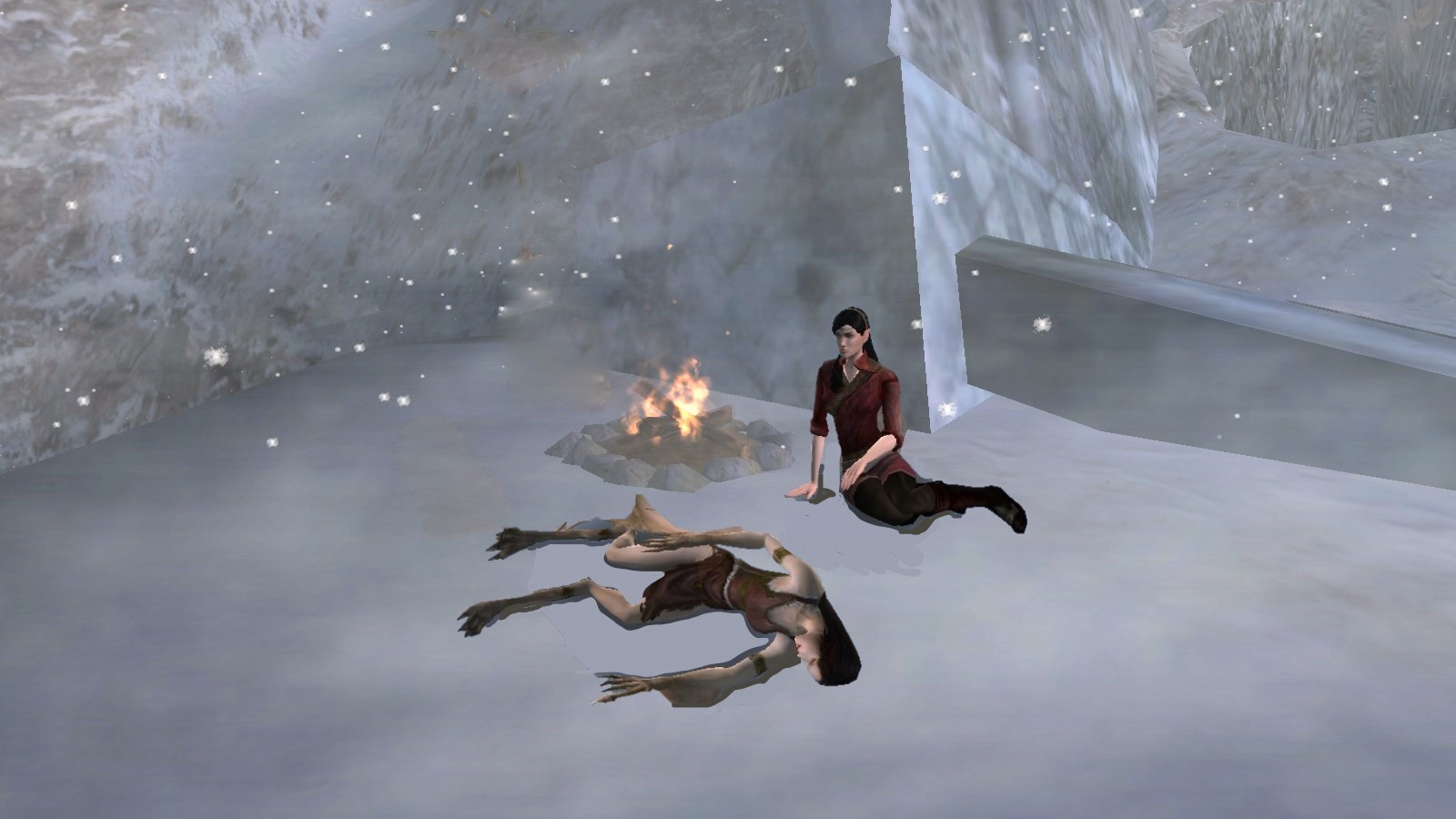
           Seregrían recalls that for three days and nights, she huddled near a fire fed only by scant wood and her staff’s power, watching over Gwathwethil as the wounded morroval healed herself from within. The she-bat slept a great deal, waking only to sate her hunger with the raw flesh of wolf and ice-drake that Seregrían provided. During those times, they shared words, and the Elf-scholar shrewdly used the morroval’s weakened state to question her about herself, and in this way she learned much of the nature of the merrevail – and finally, the events that spawned the creature lying in the snow beside her.

           The Merrevail are indeed creatures of the Dark, the ancient evils that roamed the world before the Count of Time began. The first of them all were spirits, summoned by the Dark Power and taking the half-bat form they still wear to this day. As the Dark Powers cannot create new things or imbue with life, the ranks of the merrevail would never increase; thus the means were devised to seize hapless victims and corrupt them through vile arts and torment until they slowly transformed into merrevail, but now able to multiply after the fashion of other races.

            But unlike the orcs, who could swiftly increase in massive numbers beyond count, the merrevail increased far too slowly to support the schemes of the Dark Powers. Therefore, they were confined as indirect servants and not used in the forefront of the wars, such was their value that they would not be squandered in fighting. Despite this, at the War of Wrath and the battle when Thangorodrim was broken, the ranks of the merrevail were thinned almost beyond recovery; but a handful of the ancient evil escaped the fall, chief among them Lhaereth the Stained, rumored to be active in Mordor in the service of Sauron.

            And that is how, after Morgoth was victorious over the combined hosts of Elves, Dwarves and Men, that the unthinkable happened.  Thandwen threw herself into the Sea in despair and madness, as Seregrían watched. But by a cruel twist of fate she did not impact on the rocks below, but was washed onto the sands, broken in body and spirit, and near death. It was thus that she was found by a pair of merrevail who, roaming the lands on the hunt, lurked close by and marked where Thandwen fell. Taking her up, they bore her to the lair of their chieftess, Bogrian; and she knew the arts that would change and morph the dying Elf into one of their own. For her part Thandwen, weakened and broken and now fearing death, clung to the only life offered her, and thus by evil choice became the morroval who took a new name: Gwathwethil.


            Seregrían can recall every word, having taken all the tale in silence, as much in shocked horror as careful notice. But there is no further doubt to her mind: for she watched the eyes of the morroval, amber and shot through with blood, fade into the clear grey of the Elves and not return. The limbs and frame may be corrupted, with misshapen pinions, fangs and talons – but the face and eyes, and even the voice, are free of the will of the merrevail and their queen, free of the Dark.


But, what is she: Thandwen the Elf-woman, or the morroval called Gwathwethil?

And can the Elf find redemption?

4. A Plea for Hope

            As Seregrían toils in her torment, a message arrives for her at Torech Besruth from someone she did not expect to hear from – for Arwen Undomiel bids her to return in haste to Rivendell and find her there. Swiftly the Elf-scholar departs and makes her way to the Hidden Valley once more. Upon her arrival, she learns that Arwen has retreated to Imdolen, on the heights above Rivendell. She joins Arwen in her solitude, and the two speak together of many things, coming to a subject which touches them both.

            “You are among those aware of the Company who departed Imladris on its daring and secret errand”, Arwen says. “Tidings have come from Lothlorien, as well as the word you brought out of Moria: the Company is in perilous straits. Mithrandir has fallen into shadow, and now we learn Aragorn leads them south on their journey.”

            “My Lady, there is less than nothing I can do to aid their endeavor”, Seregrían says. “Even were I to set out this night, I have little hope of overtaking them, to say nothing of finding them in the Wild. Even were I able to, what could I accomplish? If your father did not include a lord like Glorfindel, who with all his power could not blaze the trail into the Black Land, what hope can I offer for the Company?”

            “I speak to hope, for the Company and for their errand, but not the way you are thinking. You can provide hope to them, indirectly. You know the Grey Company of the Dunedain is mustering here, prior to their ride south. I would ask that you accompany them, Seregrían. I know your mind and heart are set upon the path to find your mother’s hope - and yours – but should the Company’s errand fail, then your hope will wither, as will all the world’s hopes.”

            “You are asking me to forsake my own kin? To ride with Men to some doom of arms, and forego taking the fight to the East? You advised me to seek your kin in Lothlorien, and now your counsel changes because of – your concern for a Mortal? For that is what this is about, isn’t it?”

            A dark look. “You forget to whom you speak. My doom is tied to the fortunes of the Company, as are yours. You seek to save your mother; I seek to aid my beloved. These two threads are woven into the same cloth – a banner, if you will, a standard which will be carried to victory, if the Powers allow. My betrothed has taken the Sword Reforged to war, and he shall also bear this!”

            Seregrían notices for the first time that Arwen stands before a tall staff, wrapped in black cloth. Arwen grasps it and holds it forth. “The days grow swiftly short. For all our hopes will come true, or all our hope will end. This then is my counsel, my bidding – my plea to you, Seregrían. Take this which I have wrought, and present it to Halbarad, the leader of the Grey Company, and kinsman to he who holds my hope. I would bid you ride with them, if not for all their journey then as long as you are able. Though you might not burn a path to Mordor, your light can show them the path to their destiny. Help them, speed their passage to victory. At some point along the way, you may turn aside to Lothlorien and return to your own errand: but not before this, I beg you. Will you do this?”

            Seregrían is, in a rare moment, humbled into silence by Arwen’s words. It is clear her contempt of mortal kind is not shared by all, especially the Evenstar of her people. Her heart and doom are twined with this Man, this Aragorn – and he must surely be of high doom for her heart to cleave to him thus. Hesitantly, she takes the staff and looks again at Arwen.

            “Thank you, Seregrían. Now find Halbarad and give him my word. But before you depart, seek out my father. He has not left his library, but others have done his bidding, and I am told he awaits you there.” Seregrían can do nothing but nod her respect and departs swiftly for the stables where the Grey Company gathers.

5. Wielder of the Flame

            The Grey Company prepares to depart on its desperate errand, for in two nights they shall leave the Hidden Valley and strike south, following in the footsteps of the Nine Walkers. With the company of the Dunedain ride the sons of Elrond, who are desirous to go to the war. As the Company prepares, Seregrían also readies herself to accompany them at the behest of Arwen and Elrond her father, with whom the Elf-scholar now holds a heated council in the sanctum of his library.

            “Many lives of Men have passed by, like falling leaves in the wood, and still your tongue masters your mind”, Elrond says to his one-time protégé. “Think not that you alone are burdened with cares beyond your strength – for I know your strength, and it is great, greater than you imagine. You must master your passions, Seregrían, for just as the forge’s fire melts and tempers the metal into steel, so also does the slag pool and be purged away – that must be your anger’s end.”

            “You speak of lofty things, Elrond, for so have I called you”, Seregrían snaps, “especially when I deem you wrong! You have put your trust and hope, indeed the hope of all the Free Peoples, in the hands of these short-lived usurpers. Dwarves, halflings, and yes, Men – irrespective of the one who leads them now, the blood of Numenor all but spent, standing like vinegar when set next to the wine of the Eldar!”

            “Even if that blood is my own kin, separated by threescore lives of Men? And you wonder at why I never took you into my confidence until now, your own voice diminishes you in my eyes, your wisdom shriveled like the grapes of that same wine of which you claim heritage.” Seregrían finds herself cowed into silence; a whisper from Elrond is more final than anyone else’s scream.

            “Almost, you make me regret my decision to allow Arwen to persuade you to join the Grey Company, and my own sons, on this errand. But events are in motion that cannot be slowed or stopped. Even more so with the fall of Mithrandir, wisest of counselors and more noble than many. There are powers that may stand against the East, here in Imladris, and in Lothlorien – but that power is needed elsewhere and must be free to walk abroad. Mithrandir was to be that one, but he is lost; but there remains one other.” His pregnant pause now has Seregrían riveted.

            “Then one of the others of the White Council must – but there isn’t – master, no, you cannot mean –“

            “Yes, you, for there are no others. Examine these truths: you have forged friendship anew with the Dwarves. You have faced down the minions of the Dark Lord, despite the ugly truth you have learned of your mother’s fate. You have brought out of the darkness beneath the mountains lore and powers beyond the reach of others more learned than yourself. And you are fearless, Seregrían – your rage becomes a potent tool when you use it with intent. And that tool needs one thing more. Do you not recall I bade you surrender your staff upon your arrival?”

            “Yes, and what has become of it? Shall I not have it for when I ride with the Grey Company, and your sons?”

            “No, and yes. You recall that the last of the Jewel-smiths, the Gwaith-i-Mirdain, dwell in this valley. They looked upon your staff as a marvel, a mighty though inelegant tool in your hands. And just as they reforged Narsil into Anduril, so they took your staff and made it a thing of glamorous might, thus!”

            And Elrond shows forth Seregrían’s staff, but it has been transformed by Elven craftsmen: a shaft of oak inlaid with holly, cunningly blended, bound with fine leather and topped with a head wrought of ithildin, in the shape of a lunar moth. The gemstones which Seregrían had carefully set in the old staff were now cut, polished and set in new and intricate patterns, channeling might in new ways beyond her thought.

            “Take this now, Seregrían, and know this: the bearer of this staff shall be recognized by both friend and foe alike, as a wielder of the Flame of Anor. This staff marks you as a servant of the Secret Fire. You already know how to use its power; may you quickly learn its wisdom, as well. Take this staff, though not of the Istari but in their service, which bears this name: Dondangol!”

            The Deep Magic’s Fist, Seregrían thinks. Holding the new staff, she can feel its thrum of might even more keenly than before, the staff ablaze with inner fire. She thrusts it skyward, reveling in the wash of power.

            “Dondangol. Will you walk with me into the fire? Will you dance with me in the storm? We shall be a guiding star to our friends, and a burning brand to our foes!”

6. Dances with Dwarves

         In the vast halls of Moria, time passes differently from the world of sunlight. The great louvres and mirrors which allow light and air to enter the Mines can show the change between night and day, but the days and even the hours themselves are a puzzle – that is, until Dwarvish thought is applied. And to mark the passage of time, the folk of Durin devised mechanical time markers that clink away the hours with the sounds of hammer on anvil.

          It is upon the striking of one of these “time-hammers” that an evening feast begins for the Iron Garrison in the Twenty-First Hall.  Brogur declared it done in an effort to raise the flagging spirits of the Dwarves; for the fortunes of the Garrison were not just stalled but being reversed, and this is all the talk at the feast tables. One by one, the outposts and watch-camps throughout the lower halls are being overrun. Rumors grow of orc and goblin regiments boiling out of the deep rocks and throwing themselves against the Dwarves’ defenses, heedless of losses. Precarious outposts still hang on in places like the Flaming Deeps but cannot hold for long.

          At one table apart from others sit several friends who commiserate on their efforts. The scholars Brodi and Thalfi, the adventurous Svanr, and even Bosi joins them when he overhears their words.

          “When did the change of our fortunes begin? I’ll tell you when,” Thalfi was saying. “The Elf-scholar. It began when she left us, and with barely a word. Right after the fight in Durin’s Way, recall that? When we cleaned out the merrevails’ lair, and she chased them all the way up Zirak-zigil? And after three days she returned, and did you mark her face – like she had seen something worse than death.”

          “Aye, I think you found it,” says Brodi. “She changed after that. I don’t mind telling you all, I got quite comfortable knowing she was somewhere nearby, even though she was as stubborn as any Dwarf!”

          “And as clever, mind you,” Svanr says. “Look at all she did to help us recover the old wisdoms. The Halls of Knowledge, the libraries, the Heart of Fire – why, half our gains would not have been, were it not for her. And she truly loves Khazad-dûm as we do, I know, for I saw it in her eyes and heard it in her voice. She is as much of a friend of Dwarves as any Elf could ever be!”

          “I agree with you all,” Bosi joins in, “and I Bosi, son of Bifur, say this: Seregrían is indeed a friend of the Iron Garrison, and her name is written in the journals as much as it is written in our hearts. Drink with me, lads: to Seregrían, Khazush-Khazad: Sister of the Dwarves!” And all the company raises their tankards as one: Seregrían, Khazush-Khazad!

          The Dwarves fall silent after the toast, their sullen thoughts interrupted by a harsh krang! of metal on metal, the rapid peals of alarm. Cries ring out from across the hall. “Goblins! Coming through the South Arch from the deeps! Baruk, Durinul!” All there reach for weapons and join the rush to the south arch. Harsh cries and the ring of steel echo through the hall, but it is soon clear the Dwarves are being forced back by the tide of goblins more than six times their number, hurling themselves into the fight. The Dwarves gradually give ground until they stand at the crossroads in the center of the hall, goblins now on their south and west paths pressing forward. The four friends form the anchor of a shield wall across the way, their faces grim, their hopes choking in a rising fear.

          Screams and curses now rise from the goblin ranks to the west, but the screams are of terror. Flashing lights and sharp bangs are heard, and smoke from many fires begins filling the air. And above the din of the goblins can be heard a single voice, screaming high words before each blast: Naur dan i glamhoth! Bo-mad deleth nin! DOSTACH AEN! Thalfi and Svanr turn and look at each other, smiles of wonder on their faces as they charge forward. And as the goblins scatter before them, the Dwarves are greeted by the sight of an old friend, Seregrían advancing towards them, clad in red and black, sword and staff in hand, and a satisfied lopsided grin on her fair face – but her eyes were gleaming with a light that was not reflecting of the fires.

“Suilaid, negethig mellyn nin. Pelian na siniath, Besruth in tolad!”

(Greetings, my dwarfling friends. Spread the news, the Bitch is back!)

          A mighty cheer echoes through the Twenty-first Hall as the Dwarves of the Iron Garrison are reunited with their friend. The feast tables are quickly reset, and the gathering now changes tone, from a lament to a celebration. Seregrían finds herself seated at the head table at Brogur’s right hand, Bosi gladly giving up his seat for her. After letting her eat (for she is mortally hungry), with Svanr and Thalfi arguing over which one was going to have the honor of serving their guest, the Dwarves press her with questions and listen to the tale of her journeys, hanging on her every word.

          Once she parted ways with the Grey Company, Seregrían galloped north like a tempest, passing swiftly through Dunland and Enedwaith with only a brief stop at Lhanuch to swap horses and a brief bit of news. Her thunderous ride then took her to Eregion, passing up the valley of the Sirannon and stopping again at Echad Dunann, not even waiting for a change of mounts, heading on foot to the Doors of Durin.

          Once within the threshold, the greeting Seregrían received would be repeated by every Dwarf she met; Tulk dancing merrily at her coming, Dalwin and Limar refused to stop talking to her, and old Narfi kept shouting, “I knew you were coming back to us!”

          And now, it is Bosi who repeats his toast for the company to let Seregrían know she is now Khazush-Khazad, the Sister of the Dwarves – and the entire assembly stands, raises their cups and sings her praise in the Dwarvish tongue. She covers her mouth with her hands, but the two streaks of wetness beneath her eyes betray her.

          “Oh friends!” Seregrían speaks through her tears, her voice catching. “Never would I have thought such a title would be mine to hold. True friends have been hard to find, but here in these halls, here you are!”

          The talk now progresses to Seregrían’s weapons. Her sword is of Dwarf-make, a gift from her previous time in the Mines, but shows the scarring and pitting of the powers that she wields. But it is Dondangol that captures their attention. Wafi and Rink Stronghammer appraise the work of the Mirdain smiths of Rivendell.

          “Much as I am not a woodwright, “ Wafi says, “this is masterful craft here. And the head of the staff – almost pure ithildin? A marvel of craftsmanship!”

          “And the gems, besides,” Rink says in awe. “Wrested from the arms of Khazad-dûm herself. And the cuttings! Dwarf-tools can do an equal job, mind you, but the shape and settings are what lends this staff its might. Displace even one stone, and the whole thing would be useless. If we Dwarves could ever create such art, those secrets are lost to us.”

          “She needs a newer and better blade, that’s certain,” Wafi says. “One crafted by ourselves, in the Heart of Fire she helped to find. Can you imagine, the forges fanned to new heights of power by what she can do – Seregrían’s Kiss, is it? It would forge a weapon worthy of the name. What say you, Khazush? I want your kiss in exchange for a weapon!” Wafi blushes as soon as he says it, and all the Dwarves laugh long and loud. And most unexpectedly of all, Seregrían smiles, then laughs – a true, real laugh from her heart. Hearing it, the Dwarves look at her and laugh along with her, their laughter filling the hall with a merry sound not heard since the days of old. 


“Come now,” Brogur cries, “let the laughter continue. Narfi, Holgir! Bows and flutes and drums! Let there be music and dance!” And in a twinkling, music fills the air and voices lift in song, and Dwarves begin a spirited dance in celebration of victory and friendships – and Seregrían, her laughter bubbling even more, kicks off her boots, casts away her cares along with her gear and joins the Dwarves – her new brothers – dancing with them long into the evening.

7. Kiss of the Blood-queen

          The Grey Company rides on, passing through the largely deserted Eregion and entering Enedwaith, the lands between the ancient kingdoms of the Dunedain, now long gone to grass and rubble. Though the kingdoms are no more, the lands are not without those who call these home. These are the Algraig, the Middle-men, wary of strangers to the point of the spear, and they confront the Dunedain with their disdain and distrust.

          With no small amount of cunning, Halbarad uses his three Elven riders as his envoys to the Algraig; the shock and wonder of meeting the Elves is more than enough for the Algraig and their curiosity. The Company aids them by laboring to lighten their burdens and safeguard their borders, and a tentative bond begins to form, and one day passage is granted for the longer trek south.

          It is during these days with the Algraig that Seregrían has her chance to put Dondangal through its paces; the staff's virtues exceed even her anticipated joy. She exults in the staff's power, the crystalline energies bringing her own fury forth in a blaze of might, burning a path through her foes - an echo of the words she spoke in Rivendell, for now it is she who will burn a trail to the East...

          One evening as the Company takes their ease in their camp outside the Algraig town, Seregrían reclines on the ground near a small fire of her making, her boots cast aside, her bare legs stretched out in the firelight. She is musing on her journeys, present and future, when she sees a Ranger, a young man whose name she does not recall. He approaches her small fire, which marvelously burns without wood, and stands respectfully, holding a small wineskin.

          "Greetings, scholar", he says brightly, "I hope I do not intrude on your thoughts. I brought you this, a skin of wine the Algraig share with us; it's not unpleasant. I had hoped I might share this with you?"

          Seregrían turns her now-silver eyes towards the man. "Good Evening. You are unlike your kin; they keep to themselves and disturb me not. But company is sometimes welcome. Sit, and we shall share this local drink." The Ranger moves to sit, but she interrupts, "But first, tell me your name..."

          "Faeron is my name", he says as he flops down on the grass next to Seregrían. She stirs at the name, not unlike Farohir, wherever he might be... "Tell me, O Faeron, would you have overheard what the others say, their mutterings in the gloom? I have heard my name several times."

          "They speak in admiration, and in awe", Faeron answers as he passes the wineskin to Seregrían. "The powers you wield to aid us and bring our foes to naught; such might is a great thing to have at one's side. One feat especially makes voices rise in praise. In our last encounter, not only did you hurl a ball of flame at your advancing foes, but your breath seemed to fan the flames even hotter, though you were many paces off. It appeared to many men that you blew your foes a kiss, and that's what they call it: 'Seregrían's Kiss' - though none, I daresay would want to receive such a thing..."

          "Oh indeed", Seregrían answers archly, one eyebrow climbing into her scalp, the silver light of her eyes now blazing in the firelight. "As if you children would know what to do with the gift of a kiss, if the sight of a woman would not send you reeling in fear. And harken, you are called by Candaith, he sounds in earnest", for she had indeed heard the older Ranger call out. Faeron rises and nods and leaves without a word.

          "'Seregrían's Kiss', is it?" she muses as she stretches her legs once more, a bitter smirk forming on her mouth. "They should know better; the Blood-Queen's kiss can bring only pain..."

8. Dark is the Water...

All is now ready for Seregrían to accompany Bosi on their errand to Lothlorien, seeking the aid of the Galadhrim in this desperate hour. But to reach this point took two days’ preparation, and it could not be avoided or sped up.

At the insistence of the Dwarves, Seregrían accompanies Wafi and Rink Stronghammer back to Nar-Khelab, the Heart of Fire. And there, by way of Dwarven craftsmanship and skill, her sword is recast and remade into a thing of wonder. The minute tailings of mithril gleaned from the Silvertine Lodes are blended with the ancient Dwarf-iron blade and forged anew, with the added touch of “Seregrían’s Kiss”, which fans the forge’s heat to an intensity that unshielded eyes are dazzled, and even Rink’s boast of endurance shrinks before the furnace’s fires.

But the labors have ended, and Wafi and Rink have crafted a sparkling new sword, with pristine blade and keen edge, gemstones set in the pommel, and runes of cunning work winding round the hilt guard meant to ward the wielder from harm. The Dwarves make a formal ritual out of presenting the newly forged weapon to Seregrían and inform her it answers to the name of Az-gazukh, ‘Lady-steel’. She says nothing, not daring to let her voice break and betray her…


Before the time-hammers strike the dawn hour, the party mounts their goat-coursers and sets out for the East-gate; Bosi and Seregrían in front, with an escort of four strong Dwarves in tow. Down the corridors and through the dim halls they gallop until the last outpost at the First Hall is behind them. It takes nearly a whole day to arrive at the Gates of Azanulbizar from the Twenty-first Hall, and the Dimrill Dale lies in shadow before them.

“Bosi, how far will we travel tonight?” Seregrían asks.

“There is a camp ahead, Mekhem-bizru, by the shores of Kheled-zaram,” he replies. “We were not idle in your absence, Khazush. A scouting party was sent out and discovered a caravan of Elves of the Wood, beset by goblins; we routed them, and the wagoneers set up camp at that spot. We have exchanged pleasantries, and goods, with them, but the threat from the Orcs has not lessened. Perhaps, you could set staff and sword to the task?” he said with a sly grin. “When we reach camp, we can gain news of the road ahead. There it is, just there!” The light of a watch fire flickers in the gloaming, guiding the party to its first camp.

News is shared, both from within Moria and from down the valley of the Silverlode into the Golden Wood. For while Seregrían and Bosi were preparing, Brogur dispatched messengers to Mekhem-bizru and from there to Caras Galadhon, with word of the embassy from the Iron Garrison and their purpose in coming. Within an hour of their arrival, messengers returned from Lothlorien bearing news: the party from Khazad-dûm was expected and would be granted passage over Nimrodel and Celebrant for audience with the Lord and Lady of the Galadhrim.


Seregrían takes a stroll to the edge of the waters and takes in the wonder of Nanduhirion. She has seen this valley and these waters centuries past, during her last sojourn to Lothlorien, and she notices the change: not in the land or the water or the sky above, but in the feel of the air, the ever-present dread of the East like a thin, sour smoke tasted on the wind. But then she casts her eyes on the surface of the lake and beholds the night sky, a vast rotunda of lights reflected in the still waters. A voice behind her breaks the silence.

“Dark are the waters of Kheled-zaram, and chill are the springs of Kibil-nala,” Bosi says almost chanting. “You are leaving Khazad-dûm, and the Dwarves. Now you approach the woods of Lothlorien, and the Elves. Do you regret your choice, Khazush-men, my sister? Do you rejoice to return to your people?”

“In leaving Khazad-dûm, it means I shall return one day, and that will be time for another celebration,” Seregrían replies. “But this day, the leaving and the arriving are for a mighty purpose, which I only gave you hints and secrets. In Lothlorien, I search for solutions to grave concerns, both for all free peoples, and for my own self.”

“Like, what you found on Zirak-zigil? The thing that left you haunted, and put even you to flight?”

“Yes, and I am still learning what it might be that I found on the heights.”

“The merrevail got inside your head, did they not? Or at least they tried. That is the way of the treacherous: plant the seeds of doubt, and let the hapless victim tend the crop and reap the harvest. You haven’t told us, and that I understand; but it is enough to know that what was said rocked you to your core. And you hope to find answers with the Lord and Lady of the Wood, that is plain.”

“There is wisdom in the Wood that spans the deeps of time, like the bridges that span the deeps in the mansions of your fathers. Just as you delve for riches, brother, so I delve for lore, and in that lore lies the truth. And there is no more ancient lode of knowledge than those who dwell in the Wood.”

“Your words move me, Seregrían of the Elves. Your heart truly does walk in the halls of Khazad-dûm. Bring your wisdom and your words with you when we stand before the Lord and Lady tomorrow. I bid you take your ease, while I take my rest. But know this: I also name you Thief, for you have stolen the hearts of the Iron Garrison – and mine.” And Bosi takes her hand and kisses it. “We stand together, you and I, come what tomorrow brings. Goodnight to you, Khazush.” And he leaves her standing by the edge of the water, the lapping of the lake against the shore louder than the night breeze, as Seregrían turns to once more watch the stars in Mirrormere.

9. Tension in Caras Galadhon

The embassy to the Galadhrim has not long to rest at Mekhem-bizru before setting out once more before dawn, headed down the course of the Silverlode to Lothlorien. As before, Seregrían and Bosi ride together in front of their escort, hoping the display of Elf and Dwarf riding in league may speed their passage into the Golden Wood. It is not long before the party reaches the banks of the Nimrodel and crosses the sweet-sounding waters to enter the frontier of Lothlorien.

No sooner do they gain the other bank then they are confronted by Elves, who seem to appear out of the very trees around them, bows drawn and stern of face. One archer stands in the path, blocking their way and calls out, “Daro, u-haer! Man eneth lin?”(Hold, no farther! What are you called?)

The reply comes, “Estannen Seregrían, istriel i Imladris. U-daur lend nin, i-geli gruith nin!” (Call me Blood-queen, scholar of Rivendell. Stay my passing and feel my fury!)

The archer looks quizzically, “Indeed, we are tasked to meet you and your companions, Seregrían of Rivendell, and speed your passage through Lothlorien. But from this point onward, you and yours must consent to our law, and have your eyes bound so as not to mark the paths through the wood.”

“We do not consent,” Bosi growls, “for our errand lies with your Lord and Lady, and not to be led around like a comic troupe bumping into trees!”

“As I said, you will not stall our passage,” Seregrían joins. “Would you deny the Lord and Lady our errand, whom they themselves would judge in crisis?” Bows are raised, Bosi’s hand drops to his axe, and Seregrían stares down the archer who, though daunted by her blazing silver eyes, holds fast his ground. Things are about to turn ill, when a voice enters her ears and her thought:

[Let the scholar and her friend pass unhindered, for we desire to meet with them with all speed!]

Seregrían shakes her head as if to clear her ears. She has felt osanwe, the Elvish gift of speaking with thoughts, though it has been untold years since any Elf, even Master Elrond, has spoken thus to her. And as she looks at the archer, it is clear he heard the exact same thing.

“It would seem,” the archer says, “that new tidings have come, and the Lady would bring you to her in haste. Very well, follow our lead, but only you and the Dwarf Bosi – the others must turn back, that is the wish of the Lord and Lady.” Seregrían nods to Bosi who, reluctantly, dismisses the escort. Once they are alone, the Elven patrol leads them on. Soon, the towering trees and walls of Caras Galadhon loom before them and they pass through the gates. Seregrían has returned to Lothlorien.


The Elven escort leads the two on the winding paths beneath the mallorn boughs, sunlight filtered into a green and golden glow about them. Seregrían is moved in thought; as comfortable as she has become with the darkness of Moria, the cool lights of the trees are truly the “heart of Elvendom on Earth”; and a new contentment begins to grow in her mind. Bosi, on the other hand, looks around with mixed wonder and disdain, clearly not comfortable beneath the trees.

Eventually the pair reach Talan Celeborn, the seat of the Lord of the Wood. As they ascend the winding path to the heights above, Seregrían can see Bosi’s growing discomfort. On impulse, she does something she never would have considered doing even a short year ago: she reaches out and takes Bosi by the hand.

“Lift your heart along with your spirits, Bosi my friend,” she says. “I felt as you do now, the day I first entered the Mines. But now you must steel your resolve, for the fate of Dwarves, Elves, and others we have yet to meet, may rest on our deeds here. I stand with you, as I said so.”

Bosi replies, looking down at their joined hands, “You are right, of course. Your heart is Dwarvish, Khazush, despite your Elvish nose. But your eyes are no longer yours, I fear; you are becoming something new, and that may be a boon – or a bane…”

The vast talan opens before them, and they stand at last in the presence of Celeborn and Galadriel, the Lord and Lady of Lothlorien. Pleasantries and salutations are extended on both sides, both bow their respect to the noble Elves – and while Bosi and Celeborn confer, once more in Seregrían’s mind comes that voice, and her fists and jaw clench as she responds in kind:

[Welcome once more to Lothlorien, Nauthira.]

[I fear you misspeak, My Lady, for that name belongs to none here.]

[Nonsense. It is thy mother-name, that thou dost choose to bury along with thy hopes – until just recently…]

[Is there nothing, and no one, to whom I can confide any longer!?]

[I know much of what has come to pass, young one, without word from any other. We shall speak plainly, and in private, when this embassy concludes successfully. Yea, we shall render all aid we can to the Iron Garrison – and to thee.]

10. The Long Lore of Lothlorien (Part One)

The negotiations between the Galadhrim and the Iron Garrison are in progress and are almost immediately agreed upon. Celeborn has readily pledged a contingent of Elven archers to return to the Mines of Moria with Bosi, along with stock and provision for a prolonged siege. Bosi in turn provides the Elves with tidings of the progress in the Mines, and every priceless piece of news regarding the foes within. While these discussions continue, Galadriel takes Seregrían aside, and the two Elf-women discuss matters higher than, and far beyond the scope of Moria. For the Lady of the Wood, like Elrond, has planned a long campaign against the Shadow, and she means full well that Seregrían shall be a player in this high-stakes game.

“I have indeed had words and thought with Master Elrond,” Galadriel explains. “He reached out to me first, such is his concern for you; you have always been high in his thoughts and his esteem, doubt it though you might. And I have means and gifts that allow me sight beyond sight, and I have seen much concerning you.

“The Shadow is moving, this you know. The fingers of the Dark Lord’s hand stretch out towards many lands and peoples, seeking to cover all in a second Darkness. You have done great deeds and balked the Shadow in many ways and at many turns; but there are challenges ahead, and foes you have yet to face.

“Into all of these cares comes the greatest care of all, for you: the slightest chance that Thandwen lives, albeit in a cursed form. Her departure from you was the defining moment of your life, and changed you from Nauthira to Seregrían, in more than just name. Even now the change works upon you, and others have seen it: the Flame of Anor is as perilous to possess as it is to wield. Have a care always that the Flame does not consume you as well, that you do not immolate yourself in its glory.”

“You counsel me to hold back my own gifts,” Seregrían counters, “while expounding on yours, and the coming storm where all gifts great and small shall be needed to fight back the Shadow?”

“Not so much as that,” Galadriel says. “Only to be mindful that fire is both servant and nemesis and can devour its wielder along with its foe. Just as your fires have blazed a path to victory for you and your friends, even so fire forged the Rings of Power, to the doom of all.

“Now we must turn our thoughts to your new path. Up until now, you have aided Durin’s Folk in their endeavors, and done well by any measure. Have you given thought to where your labors may take you next?”

“I have had counsel from many voices,” Seregrían says. “Elrond bade me aid the Dwarves, before turning his thought to the Dunedain. The Dwarves beseech me to stay with them and carry on the fight. But Arwen bade me seek you out for knowledge regarding my mother, and what might be the truth – for I am still in doubt of all I have heard and seen. My own wisdom is still uncertain, though my heart draws me to find out the truth and forsake all other paths. But this I know, that I cannot abandon all else to find out if my mother may yet be returned to me.”

Galadriel smiles, “Then your wisdom has not become uncertain – merely conflicted, as any would when presented with such a dilemma. But together we shall solve it. Arwen, my daughter’s daughter, was wise to send you to me, for here in Lothlorien resides the lore of the Elder Days, preserved not in manuscript but in memory. Now let us examine what is at hand. Tell me everything that has come to pass, this revelation of Thandwen you carry as a burden.”

Seregrían embarks on a recounting of her adventures, her embassies to the Dwarves, her joining the campaign in the halls beneath the stone, and the final confrontation with the merrevail where the terrible secret unfolded. Each passage of words and arms is examined and questioned, either accepted as lore or put to flight as false. Eventually Seregrían falls silent as her tale winds down to the present, and Galadriel picks up the threads.

“Every solution to every problem has an origin, a source,” she says, “and for this we must cast our thought back through the Wars of the Jewels, even unto the Noontide, and beyond. The denizens of the Dark are mighty, and beyond count, but not beyond knowledge. As you are aware, the Shadow can only twist and corrupt, it has never and has not the power to create new things of its own design. I have seen and learned as much of the lore of these creatures, even the merrevail, as any have ought to learn, and I say to you this: once a living thing is touched by the Shadow, the corruption runs deep, and is unlikely to be uprooted save through death.

“Do not despair at this, young one! I said unlikely, not impossible. I speak of the origin of the dilemma, not yet the solution. For now, our wisdom must consider events where the corruption was indeed expunged and turned to redemption. Do you recall the name of… Narmeleth?”

(To Be Continued…)

11. The Long Lore of Lothlorien (Part Two)

“Narmeleth! Well indeed do I remember her,” Seregrían says. “I knew her during the time I dwelt in Eregion before its fall. She was the Forge-maid, one of the Mirdain, but she fell into shadow herself and became Amarthiel!”

“Indeed so,” Galadriel says gravely. “But tidings have reached us here of great deeds in the North. Think you, Seregrían, that you were the only one that Elrond dispatched to fight the Shadow? Others took up labors against the Enemy, not just with wisdoms and powers of mind and hand, but with strong arm and bright steel, and by these was Angmar overthrown once more. The two lords of Angmar, Mordirith the False King, and Amarthiel his champion, have both been brought to ruin – but their fall sheds light upon our counsels.

“Mordirith, who was in life Earnur the last King of Gondor, was taken and corrupted by the Witch-King and made into a lesser wraith under his will. When he was thrown down, Mordirith’s spirit passed into the Void, and is no more; death released him at last.

“But Amarthiel! She and Mordirith betrayed and fought each other for control of Angmar, and especially a lesser Ring that Narmeleth herself crafted. In the course of that betrayal, Amarthiel was purged, and Narmeleth restored – though at a grave cost. For she recalled all the deeds of Amarthiel done by her hand, and the weight of remorse was almost too great for her to endure. But her knowledge helped bring Mordirith to ruin, though it cost her all she had left to give. Now, scholar, how would that news give light to your wisdom?”

“Narmeleth was corrupted and became Amarthiel,” Seregrían says slowly, deep in thought. “She was expunged and Narmeleth restored, and she retained all those memories. But how, by what means was Amarthiel purged and Narmeleth redeemed? And what else did she retain beside her thought?”

“Narmeleth returned by way of deep, traumatic agony, piled one after the other,” Galadriel replies. “Defeated by the power she sought to possess; the sight of her father slain at the hand of Mordirith; her hand that bore the Ring severed. All these wounds, of the body and the spirit, shook her to her core and brought about the redemption of Narmeleth from the Shadow.”

“Pain unto death created her, and pain unto death brought her back,” Seregrían says lowly. “You mean that the same must befall my mother? That she may only be redeemed in death?”

“Do not leap ahead of yourself, young one,” Galadriel say gently, “for we have only answered one question: that it is possible to return from beneath the Shadow’s wing. Now we must consider the crucial question: is this creature of the Dark in truth Thandwen, alive but turned? Have you not considered this is naught but a deception, a device of the Enemy to cause you doubt and send you on a chase for a phantom hope, away from the real danger?”

“I begin to concede that Thandwen the Elf was taken and spawned into the creature Gwathwethil,” Seregrían says flatly. “The proofs are there, the evidence plain. But the words of Bogrian bear you out. The Shadow fears what I have become and seeks to distract me from fighting it head on –“

“- and you are being distracted in fact and deed, for have you not wished to forsake the greater conflict and rescue your mother from the Dark?”

“But why must I forego one for the other? Why can I not achieve both? Would not the downfall of the Shadow release my mother from its clutch? Would not taking the battle to the enemy result in finding more means to redeem her? Surely the Dark itself might reveal –“

“Do you even hear your own words? Would the Enemy, the fountain of lies, reveal its secrets to such as you? Your anger at the world, and desperate hunger could be turned against you, brought to bear and corrupt you, and you would become even as they – a new Amarthiel, or something darker with all the hate you bear!”

“My hate is reserved for the Shadow, and all who would stand in my way! My power grows with each passage of arms, and I shall be the torch that both cleanses the lands and lights the way for my mother’s return!”

Galadriel glowers, her eyes darkening and her voice lowering, deep and threatening. “You who were once Nauthira presume too much. The idea that you possess power to combat the Enemy by yourself both offends and amuses me. I have watched the wisest and mightiest of our people fall before the Shadow, and your simple skills are laughable when set beside the hands and minds of the House of Finwë!”


Seregrían realizes she has stepped too far, and quickly sinks to her knees. “Lady Galadriel, I crave your pardon, and beg your forgiveness. Indeed, I forgot to whom I speak just now. Can you not now see the depth of my dilemma, how the thought of my mother consumes me? I come to you not just for your memory and lore, but for your counsel and your wisdom, for mine falters.”

Galadriel smiles softly, her ire passing like rain down the wind. She takes Seregrían’s hands and raises her to her feet. “You have my pardon, young one, as you always will. I know full well what desire is truly highest in your heart: to be relied upon and trusted by others. Be it Elrond’s counsels, the Dwarves’ friendship, your mother’s hope – it is all the same, your wish to be relied upon. And in the coming struggle, I shall rely upon you. I, and all the Free Peoples as well.

“Now, let us take thought as to what must come to pass…”

(And now, the conclusion…)

12. The Council of Lothlorien (The Conclusion)

“We have tried to answer two questions, Scholar,” Galadriel says. “and now on to the third. If those who have been turned to the Shadow can be redeemed, and if you are convinced that Thandwen the Elf is now Gwathwethil the Morroval, then the third question is, what must be done?

“I say to you, your desire for your mother’s redemption must not be allowed to be first before all else. The conflict which looms on the horizon shall be an all-or-nothing gamble, and the loser loses all, which is why both we and the Enemy are wagering everything on one throw. This is why I would advise you to –“ and Galadriel pauses, her eyes suddenly vacant, her head tilting to the side as if listening.

“Come, Seregrían,” she says at last. “News is on the wind, and counsel is changing.” And she moves off, Seregrían following her to the high talan where they are met by Celeborn and Bosi. Galadriel joins her lord, as they look silently at each other. Seregrían stands beside Bosi and mutters, “What news, brother?”

“Messages and reports have arrived while you two were off alone,” Bosi explains. “Word has come from Moria, and from the Mountain. And report is had from across the River. It would seem that the Lord and Lady are very well-informed about the world outside, even as they fence themselves in.”

Celeborn and Galadriel conclude their osanwë, of which Seregrían can discern nothing, only that they speak mind to mind and she is shut out. They turn to face their guests and include them in their discussion.


“News has come, and counsel and course must change,” Celeborn begins. “We have dispatched an expedition, the Malledhrim, to cross over Anduin and press home an assault on the Enemy’s former lair of Dol Guldur. As part of the larger gamble, we must do our part to keep the Eye roving this way and that, fixed on some movements and blind to others.

“This is in part the reason for sending a company to aid the Iron Garrison,” he says. “The Dwarves of Khazad-dûm shall do their part in this strategy as well as the Folk of the Mountain – who are also being invested closely by the East. Friend Bosi, is it your intention still to hold the Mines of Moria for as long as strength lasts?”

“We have never thought otherwise,” Bosi says. “Durin’s Folk have reclaimed Khazad-dûm, and the halls of our fathers. That which is ours is ours again and shall not fall while this world lasts. Especially not with the help of our allies, the folk of Lothlorien, and the Sister of the Dwarves at our side!”

“You may not have all you desire,” Galadriel says. “Our counsel indeed would have bade Seregrían rejoin you in Moria, to labor in your cause. But news and policies have changed, and this is now our counsel: that Seregrían go forth from Caras Galadhon, not in company with either Dwarf westward or Elf eastward, but alone and south – to the lands of Men.”

Seregrían is momentarily shocked by this, and she gives in to her anger. “You would have me travel with and hold congress with, with Them? Faithless, honorless, caring only for death and songs of war? Their former pride wasted, their memories tarnished by countless tides and seasons –“

“All the more reason for you to be among them, scholar,” Galadriel says. “Clearly, for all your lore cultivated in Rivendell, your wisdom is a blighted harvest. I deem that your company with them would benefit you, as well as they; for your presence among them would show they are not without allies among the Free Peoples, and that the counsels of the Wise still support them. And consider also, that travel to the southern lands would stand you into close quarters with the Black Land, where lies the true Enemy – and other goals, besides…” she leaves that last fruit hanging for Seregrían to pick. She does.

“If I am resolved to take the fight to the Enemy, then it is true that a southern road would serve better,” she says after a beat. “I shall go south, if the Council wills it.”

“It is decided, then,” Celeborn says. “We would bid you partake of our hospitality for a time, but events are moving swifter than the River. We invite you, Bosi, and you, Seregrían, to dine with us in leisure before your labors begin. The company bound for Moria shall be ready on the morrow. Tonight, take your rest here as our guests, and we shall talk more of lighter things.” But while Celeborn is speaking, Seregrían’s thoughts are broken by a strong osanwë:

[Moria lies behind thee, Nauthira, as does now Lothlorien. That which thou doth seek lurks behind the walls of Mordor. The answers lie with the creature, Bogrian. Find her, and thou hast found thy answers – the ones thou seekest, and the ones thou wouldst shun. Beware them both, young one…]

13. Partings and Gifts

That evening, as Celeborn and Galadriel feast with their guests, they discuss with Seregrían and Bosi as to what needs to be done prior to their departure. It is plain that Bosi is not pleased at the prospect of returning to Moria alone, for Seregrían is to travel south and away to some far doom.

“Heavy will hearts be,” he says, “when word reaches the Iron Garrison that Khazush-Khazad shall not return to us. I fear this parting shall be long indeed, with all of us under the growing Shadow.”

“Let not your heart be troubled,” Galadriel says, “for the end of these journeys is not plain, nor is the Shadow’s victory certain; nor shall it be, so long as all labor to their utmost.”

“Both of you,” Celeborn now speaks, “shall have counsel given for each concern. For Bosi and the Dwarves, the company of Galadhrim that accompanies you shall answer to you, but also bear report back to us, and in this way we shall share tidings between Lorien and Moria. Further aid shall be available to you, but not perhaps further strength of arms; for the might of Dol Guldur is about to press upon our own borders, and we shall be sharp-set to hold the line of the River.

“For Seregrían, we suggest you make your paths through Thinglad, our southern gate, and proceed along the line of the River until you find the northernmost dwelling of the Men of Rohan, that town called Stangard. Their welcome will not be warm; for the Men of that land are distrustful of outlanders, even more so from Lothlorien whose name they speak in dread almost equal to Mordor. Proceed with caution and courtesy, but remember that the Rohirrim respect strength, both of arms and of will.”

“One thing I note missing, my Lord Celeborn,” Seregrían says, “is how I should respect them. If there is no welcome among Men, then where shall I continue, and how swiftly?”

“You give yourself little credit, where your arts of persuasion are concerned,” Celeborn replies. “Have you not already fashioned alliance and good will among Elves and Dwarves? Your latent diplomacy will, I doubt not, shine once more among Men.”

“And have you not also been counseled of the need for all peoples to unite under one banner,” Galadriel joins, “by advice from old friends and new?” Seregrían stirs at this but says nothing.

“I agree with the Lord and Lady, Khazush,” Bosi says. “It took you and your clear thought to forge anew the ties between Dwarves and Elves. And you said yourself, we must find allies, and we have but to ask, remember?”

“I appear to be overruled,” Seregrían says with a tilted grin at Bosi. “Very well, when ought I start this new ‘embassy’ of mine?”

“Bosi shall depart with the Galadhrim company on the morrow,” Celeborn says. “You, Seregrían, shall depart the next day after and before first light; that will place you at the gates of Stangard at dawn after two days’ easy ride.”

“The delay is necessary,” Galadriel says, “for we bid you bear tokens with you to the land of the Horse-lords which, while not speeding your passage, will make smooth your path and aid you in ways not apparent. For tonight, both of you, take your ease and rest, for tomorrow begins your labors anew.” And the Lord and Lady rise, Bosi and Seregrían rising in courtesy, and the feast ends.


Later that evening, Seregrían sits alone on a high talan, thinking on where these new roads may take her, and what she might find at the end. She does not relish in the least any traffic with Men, regardless of lineage or heritage; all too well does she remember how many have sided with the Shadow down through the ages. She does, however, consider well the wisdom of the Lord and Lady – especially the Lady’s forbearance of Seregrían's hubris.

Dawn the next day brings partings at the gate of Caras Galadhon, as Bosi departs with the Elves who will escort him and join the fight in the Mines. Many of the Galadhrim are there to wish them well and see them off. At the last moment, Bosi spurs his mount next to Seregrían and looks on her steadily.

“I still do not approve of this leave-taking, Scholar,” he says in a vain attempt to be formal, “but I do trust in the sense of things. Therefore this parting is understood, though I regret it mightily. But I will not have it said that Bosi son of Bifur is ungrateful, nor are the Iron Garrison who, well, who have called you sister and more. Take this small thing,” and he holds out a small parcel and presses it into her hands, “and should – should our paths never cross once more, m-may this token give you memories of the times among your brothers.” And Bosi stops his stammering and kisses Seregrían’s hand once more, the Elves all murmuring with astonishment. “Dayamu Khuzan ai-menu, may the blessings of our ancestors be upon you, Khazush- Khazad!”

And Seregrían replies, “None shall ever say in my hearing that Dwarves have no honor or are unlovely, Bosi son of Bifur – Khâzash-men, my brother!” And to the Elves’ further shock, she draws his bowed head close and kisses his forehead. Bosi blushes redder than his beard and mutters something inaudible as he turns and rides off with the Galadhrim for Moria, glancing back over his shoulder several times before rounding the bends, lost from sight.

Seregrían stands still, watching the caravan until it fades from view, the Elves returning through the gates and muttering about what they just witnessed. Standing alone, she looks at the parcel in her hands, and opens it – and laughs loud and merrily amid sudden tears. For inside the parcel is a pouch containing four small dark seeds, and a parchment written by Svanr and Thalfi: instructions on how to plant, raise and prepare coffee.

14. In the Lair of the Blood-queen

When not on errantry from Master Elrond, or scouring the lands in search of lost lore, the Elf-scholar Seregrían will repair to her own private retreat, hidden near the banks of the River Lhun.

Few have ever visited Seregrían in her lair, a place of silence and study and contemplation by fire and lamp light. But fewer still are even welcomed by the pensive Elf-woman who shuns the company of those she will not hold congress with.

Even the twin children of her adopted family, Farohir and Eldariel, have rarely seen inside the walls of her private world. And the twins, with their penchant for mischief and pranks, have even given a name to the dwelling of their pensive, humorless aunt:  Torech Besruth, "The Bitch's Lair".

Now, contrary to belief, a life of adventure is not solely combat or passage of arms, but also quiet and thought, and this is also true in the case of Seregrían.  When she is not slashing and burning a path through the forbidding wastes, she can be found in the parlors of her own secluded retreat in the mountains.

In her vast library and word-hoard, the enigmatic elf-woman pores over ancient maps and texts of near-forgotten tongues, searching for the morsels of lore that will spirit her onto her next sojourn across the lands.  But there are times when, despite her ages-long intellect and iron resolve, the answers she seeks elude her - and the Blood-queen will vent her fury with clenched fist and grinding jaw, slamming her hands upon the table with blistering oaths. 

15. Sharper than Swords are Tongues

           Seregrían stands alone at the gates of Caras Galadhon for a time, gazing along the trail where Bosi and the Galadhrim company departed for Moria.  She remains alone in her thoughts until a sudden breeze moves the boughs of the trees and shines golden upon the forest floor.  She stirs, sighs once, and walks back through the gates into the city.  The soft light and music of the city of the Elves is a wan comfort to her as she walks beneath the trees, musing on how her path shall unfold in the coming days.

            The voices of the Elves lift in song, some sad, some tuneful but sonorous, none are gay or mirthful.  Seregrían’s mood deepens further as she walks until, beneath a tall mallorn where minstrels are wont to sit and perform, a different voice rises above all others:  deeper than the Elves, not unlovely but still not the same lilting sound, accompanied by a deep-sounding stringed instrument.  The song was also different, happier and upbeat, but in a tongue she had never heard before, rich and vibrant.  Taken in by curiosity, she approaches the pavillion and sees one singer standing among a small group of Elves who listen politely and in rapt attention.  The minstrel is strumming what appears to be a theoboro of large proportions, and he smiles as he sings, his song drawing to a close, the Elves smiling and applauding generously.  The minstrel turns to meet her gaze, and Seregrían is shocked to see that the singer is not an Elf, but a Man!


           The man bows to his audience and walks out of the circle as another minstrel steps up to share.  He walks toward Seregrían with a smile on his face, and she marks his appearance as he approaches.  Clad in black from head to foot, his hair is dark with touches of grey, and eyes of grey that reveal him as one of the Dunedain.  She is for a moment surprised when he speaks to her in clear, but roughly accented Elvish.

            “We meet at last, Seregrían, so far from Imladris,” he says.  “I am glad to see you safely here, kinswoman.”

            “And just how do you claim to be of my kin,” Seregrían frowns, “especially since you obviously are not of Elvish blood?  Surely you are not so presumptuous as to claim descent from the Half-Elven?”

            A chuckle, then “Never would I do such, for noble lineage is not within me.  But you yourself have claimed kinship with me, or have you forgotten?”

            “I know not of which you speak; for you are clearly of the Firimar, the Mortals, and I claim no kinship with such.”

            A laugh.  “Oh, but you have already, lovely fool!  For you have claimed as your sister the Elf Lonannuniel – she of the white skin, and eyes of bottle-green – she who is my bride, which makes us kin, you and I!”

            Shocked silence.  “You!  Halrohir?  My foster sister’s husband?  The Dunadan Ranger of whom she sings, and pines for in your absence?  I know of you, seizing upon her and begetting children, then riding off who knows where for who knows how long –“

            “Says the woman who claims kinship, then fades into her libraries, like a spider in a web, waiting for the flies to come unawares.  When were you ever going to emerge, Blood-queen, and see what you were missing?”

            “I miss nothing, ‘kinsman’ –“

            “Oh yes, you do.  The twins, for one thing, rather they miss you.  The family you adopted has adopted you in turn.  Eldariel delights in sharing the crafts she learns with you, offering up her trinkets to you for approval.  Farohir speaks of you with longing, wanting to hear your tales of ages gone.  These things they confide to us, wishing you would invite them into your world –“

            “Oh, the same world they name, ‘The Bitch’s Lair’?  They have no idea how fitting that name truly is…”

             A small laugh.  “You wise fool, do you not see?  Were you not family, they would not feel free enough to speak with laughter.  They jest with you, because they accept you into their hearts – because they love you!  Just as I have, friend and beloved sister – whether I call you sister, mellon – or perhaps, Khazush?”

            Dead silence, then a cold reply from gritted teeth.  “I earned that name, and the right to utter it.  And I’ll thank you not to, for you are not worthy of the meaning behind it, the kindred souls, the shared perils and dreams –“

            “And you and my beloved are no longer ‘kindred souls’, as two lonely Elves declared all those years ago?  Yes, you too, forlorn scholar who locks herself in prisons of her own making, shutting out all who fail to meet her measure?”

            “My scales are fashioned of wisdom gained through the ages, and not from the likes of such as you, as brief as a breeze through my hair, or a Dwarf’s hearty belch…” and she smiles despite her anger at her own jest.

            Merry laughter, “So your mask can crack after all!”  Halrohir says after his laughter subsides.  “Elf that you are, your heart is supposed to be merry and light, and this mask of anger you wear does not serve.  Ah, Seregrían,” he says as he reaches and takes one hand in his, “we are kin for good or ill.  Shall we not also be friends, you and I?”

            Seregrían looks down at their joined hands then meets his expectant smile, her mouth a tight-lipped line.  “I can accept your claim to kinship, man of the West.  But as to friendship?  That remains to be seen.  The winds of the world are changing, and you and I are about to be drawn into a growing tempest.  But that is for tomorrow.  For now, I wonder; since you are here in Lothlorien, of all places, I am told that Lonannuniel journeyed with you.  Is that true, is she here?”

            Halrohir smiles, “Why don’t we find out, together?”  And still holding her hand, he leads Seregrían on paths beneath the trees in search of his beloved bride.


16. Sisters in All but Blood

            Halrohir and Seregrían walk together beneath the trees, the sunlight building toward noon and bathing the Elven-city in golden light.  Their path takes them to Egladil, where Nimrodel joins her waters with Anduin's flow.  As they arrive, Halrohir cannot contain his delight as he spies a familiar white horse, and a lithe figure clad in white next to him.

            Lonannuniel spies her husband from afar, a presence she can sense whenever he is near, and her heart lightens. "Rana," she says smiling, turning to face him - though taken aback at the perplexing sight of Seregrían near him… and walking with him... a strange combination.

            "Suilaid, melima nin,” Halrohir calls gladly.  “See who I have found at last! Your far-off sister has been returned to you." He means for his words to be for both Elf-women and not just one, inwardly smiling at the sight of the two reuniting, realizing they've bonded for longer than he has been alive.

            The sight of Lonannuniel changes Seregrían's mask of discomfort, dissolving into a genuine smile, one she has not felt since Moria.. "Mara Aure, gwathel nin, hirant na vedui!" (Good morning, my sister, found at last!)

            Lonannuniel greets Halrohir with a warm embrace, clinging before letting go; she has learned over the years that he could leave at any moment, and any hug could be their last for a while. Then turning she says, "Seregrían,” and smiling she embraces her in turn, though not as long.  Lonannuniel looks long at Seregrían, taking in the sight of her.  She is clad in crimson from head to foot, her hair dark against skin that paled from so long under the mountains; but she notices the eyes, once grey, are now silver-bright and make even the slightest smile seem sinister.  She chooses not to make mention of it, yet.  "To see you two in each other’s company brings my heart joy."

            "As it does mine, my wife,” Halrohir says. “Come you two, I imagine you would wish to have a "sister chat" - so Astaldo and I shall see what has become of Morindal, and how much of the stable he has devoured.”  And with a short bow, he takes Astaldo’s reins and leaves them by the banks of the River, a plaintive look on Lonannuniel’s fair face.  Hardly has he moved out of hearing when Seregrían whispers softly, too soft for Halrohir to hear.

            “I thought he'd never leave us alone. He hangs upon you, as much as you upon him, and it is unbecoming.  Lonannuniel, what possible reason did you have for traveling with him?  Imladris would have been a far better place where to await tidings.”

            “Seregrían, do not fret over my choices,” Lonannuniel replies, smiling as she gazes out over the waters, looking east.  "Where my husband wanders, I would go, and gladly.  But what news of you?  What brings you to Lothlorien?" She couldn't help but look at her eyes over and over again.

            “A path that runs twisted, like vines in a trellis of fate,” she answers.  “Errantry at the bidding of Master Elrond has taken me from the Blue Mountains through Eregion, into Khazad-dûm, then south through Dunland and back into Khazad-dûm, and finally here.  And now the Lord and Lady tell me that my path runs further south – to the lands of Men.  It is a bitter bite to swallow.”

            “Say not so!  For all of your scholarship, you have not in my memory ever visited these lands, save for Lothlorien long ago.  For you to walk abroad, leaving your studies behind, means that you too are being swept into the great events of our time, as are the rest of our family.  Tidings come to me here, even swifter than they would in Imladris.  I am aware of Farohir and Eldariel and their travels, and of course my Halrohir – but you?  Some cloak of silence has descended between us, and I would have it lifted.”

            “Then you are alone in that silence, for everywhere I turn it seems others have had knowledge of my dealings before I ever arrive!  The irony!  I can trust no one in confidence, yet she who is closest to me is blind to my troubles.  But even if I told you all that has happened, there is little or less you can affect.”

             “Sister of mine, I can affect more than you admit.  I was held in thrall in Mordor, do you forget?  I walked these lands not long past in my flight from the Black Land, journeyed many leagues through many lands to finally arrive here, in this very wood.  I sense that your own journey may take you that way, or am I mistaken?”

            A pause.  “You are not.  I must pass through the realms of Men to reach my goal, which lies behind the walls of Mordor.  There is a difference between us, white Elf:  you have run from your past, though you can look back on it safely, for it shall not pursue you.  I seek out my past, and I can hear its footsteps closing behind me; it stalks me, no matter which way I turn.”

            “And it works a change in you, even as you walk.  Seregrían, can you not, or do you not see what has become of you?  You are stronger, healthier than last we met; but darker as well, and not just your hair.  And your eyes!  What is happening to you?  There is an unholy light shining from you, some unclean spirit gazing at me through those eyes, and it frightens me!”

            Silence, then,  “You are not the first to say thus.  But I say to you, if such power is now mine, then let it shine forth.  Where I shall go, I will use all the powers I command to see my purpose and work my will, and woe unto those who stand against me!”

            “Then I insist you make me to understand what is happening, what is changing you!  Lift the cloak of silence and tell me everything; what is this power, how did it come to you, and what is this past you flee from – or to?  If you trust none other, trust me!”

            And Seregrían is overcome by Lonannuniel’s words.  She embarks on the entire tale, and the names pour forth like venom from a wound:  Dondangol, Az-gazukh, and Khazush-Khazad;  Brogur, Bosi, Svanr and Thalfi; and finally, the names Bogrian,  Gwathwethil, and Thandwen.  And Lonannuniel listens in rapt, horrified silence. 

17. The Next Stage Begins

Seregrían and Lonannuniel talk and counsel through the day, and into the late afternoon, in Egladil by the banks of Anduin.  They stand in Imlad Lalaith, the Valley of Laughter, where the feasts and revels of Lothlorien are usually held.  As the day draws on and the gloaming settles about them, still the sisters talk on; and as other Elves gather to prepare for the evening’s feast, they are torn as to whether to interrupt the two.  A group of Elves argues this very idea.  Galhíril speaks to Maliriel, the Mistress of the Feasts, as to how to interrupt.


“At the risk of rudeness, Milady, how shall I approach them?”  Galhíril asks.  “Those two have talked for hours, not resting, eating or drinking!  And see how they talk?  The crimson lady speaks the most, telling what must be a horrid tale; for the argent lady reacts with dread at each pause!”

“Know you not whom they are?”  says Gelirora, a lore-mistress known for keeping her ears open for rumors of every kind.  “The white lady is Lonannuniel, recently returned to our wood from her sad life elsewhere, so they say.  But the crimson one?  That would be Seregrían, come from Moria and her sojourn across the lands on errantry from the White Council, it is rumored.”

“They are both walking weapons, if the tales are true,” Braiglinn says.  “Lonannuniel escaped from the Black Land, where she was made to fight in the arenas for sport; she can still wield blade with deadly skill, for I have seen her spar with others.  I met Seregrían when she abided in the Wood, long ago.  She had no gift or skill as anything but a lore-mistress, but now she returns to us in possession of might that would stand good stead with the Malledhrim, should she join us.”

“All the same, they are delaying our preparations for the revels,” Galhíril says, “and I can only work around them for so much.  Lady Maliriel, how shall I proceed?”

“Fret no more, Galhíril,” Maliriel says, “I shall do what is needful.  See to your work for now”  And she walks to approach the sisters, who do not notice her as they are still deeply in talk, the white now speaking to the red:


“So many have offered their thoughts to you, sister, and I know your confusion; but if you heed my words, there is only one path, clear as moonlight.  Your mother must find redemption at all costs, and that can only come by your hand.  The clues to her lie beyond the Ephel Dúath, her whereabouts and her cure.  But to get there, you must travel through the lands of Men – do not give me that look!  You now have friends among Dwarves and Elves and if you can do that, you can make friends of Men as well.

“You must cast aside your scorn for Men, for her sake and your own.  I do not say this simply because of my lord husband; I speak of their own goodness and virtues, which I have learned and if you travel among them you will learn as well.  Your lore spans ages in the past – but now it must look forward for answers.”

And the red replies, “You speak plain wisdom, my sister, that the Wise cannot seem to do.  I confess that I would be willing to cast aside all other labors for this one thing.  But as you said, the great battle of our time is upon us and will or no, we are being drawn in by its tide.   I shall aid them as I pass through their lands, but I will not allow myself to be pulled aside by their petty concerns for long.”

“And that is all anyone has a right to ask,” the white says.  “But Seregrían, this dreadful power that begins to consume you must be held in check, and that is all I insist you try to do.  Have a care to what the Wise tell you; I do not understand all that you have told me, but it is enough to know you bear a weapon that might be beyond your strength to hold.  Use it wisely, and only when needed!”

After a breath, the red answers, “For your sake, I shall hearken to your warning.  When I return, I shall bring my mother to you and declare our kinship to her.  And I just feel that she will take you into her restored heart, the way you have restored mine.”  And the two embrace, the white tenderly, the red fiercely.  And after staying silent for a short time, Maliriel chooses this moment to discreetly cough and announce her presence.

“My good ladies, you must forgive me my intrusion.  You stand here in the place where the evening feast of the Galadhrim shall shortly begin.  You of course are both invited to revel with us, should you be so inclined.”

“Our thanks to you, Lady Maliriel,” Lonannuniel says with a polite nod, “so long as Seregrían may accompany us?”

“I too shall come,” Seregrían adds.  And the three women move off to join the beginning feasts.


At dawn the next morning, Seregrían stands alone in the gazebo of Imlad Lalaith, where the revels have only just ended.  She had taken her leave of Lonannuniel, who had departed to return to her husband’s side – only to see her return with a gift of new clothing, garments more in keeping with the lands she is about to enter, more suited for riding across vast country beneath the skies.

Standing alone clad as a crimson rider, Seregrían brandishes her twin weapons, Az-gazukh gleaming in her left hand; in her right, Dondangol glistens with concealed fire.  As she looks southward on the next leg of her journeys, she is aware of a whisper of thought, rising unbidden:

Naur a-galad na-gûd i mellon.  Garthoss, Seregrían tolnev.

(Fire and light to foe and friend.  Beware, the Blood-queen comes…)

18. Sorrow by the River

Seregrían departs later in the morning than first planned, due to receiving late word from the Lady of Lorien. As she was readying to ride south, a messenger arrives from Caras Galadhon bearing a parcel, with a message attached:

“As promised, these tokens are for your journey into the lands of the Horse-lords. While these may not speed your passage, they will bring good will from your hosts, and aid you in other ways not so openly. Use them wisely. Farewell!”

As the day grew warmer, Seregrían rides south along a little-used trail that threads its way along the banks of the Anduin, but still beneath the eaves of the forest. The trees begin to thin out and spread apart as she proceeds along the road, lighting the path with a soft, green glow. According to the maps she memorized prior to leaving Lorien, the lands of Thinglad end where the forest abruptly ends and the lands open up into the field of Celebrant, a vast open land between the River and the foothills of the mountains. There, just south of the wood, rises the town of Stangard and the frontier of Rohan; her first waystop.

Just before the trees thin away, Seregrían reins up and listens; a sound meets her ears and causes her to look for its source. A song, a lament in the Elven-tongue, can be heard to the right and off beneath the trees. Dismounting, she leads her horse deeper into the wood and, atop a small hill, sees an Elf-woman seated against a tree, clad in the wood-cloak of the Galadhrim scouts, singing a tune of regret. The Elf-maid stops singing and looks up at Seregrían, her face care-worn and sad.

“Greetings, neighbor,” Seregrían says, “I heard your song in passing, and wished to learn the reason for its sorrow. Who are you, and who is this one of whom you sing?”

The Elf looks up at her. “Well met, traveler. Noriel is my name. You find me in mourning, for the passing of someone whom I should have allowed myself to love.”

Curious, Seregrían approaches and looks on the scene. Noriel sits against the bole of a tall tree, and close by is a plain stone marker amid the grass; it is fresh and recently placed, meaning the loss Noriel speaks of was recent as well.

“I greive with you, for your loss,” Seregrían says. “You say you did not allow yourself to love this one. Why?”

“Because I was selfish,” Noriel says. “In the face of all counsel and sense, I still began to care for him, and he the same, despite all reason. He declared his love, and I scorned it. I deemed the differences between us to be beyond solving. But my heart knew otherwise. All because the one who loved me was a man of Rohan…” and she falls silent, her eyes downcast.

“This one you mourn was a mortal?” Seregrían says in surprise. “What is this tale? Share it if you can.” And Noriel, with a glance at the nearby marker, tells the story of Wynmar, the hunter of Rohan, her cold disregard for his suit, and their bitter parting even as she confessed her feelings to herself, a moment too late. As the tale unfolds, Seregrían sits beside her in rapt attention.

“As much as I will mourn Wynmar’s passing, “Noriel says sadly, “I mourn something even more. For I regret not listening to the voice of my heart while there was still time. His heart was as valiant as it was forward and frank. And even in death, dear Wynmar teaches us something, do you know?”

“What lesson have you learned from this sadness?” Seregrían says.

“I have learned something of the nature of Men,” Noriel says. “Their lives are brief, too brief; and yet they would willingly spend it in exchange for the joy of the hour, or its glory. They must live for the moments, for those moments are all they have, when measured against the lives of the Elves. They will not hide their hearts behind cold and cool words and eyes. I shall take his lesson to heart. I shall not hide my heart should something like this happen again, for missed joy is even more grievious.”

Seregrían thinks for a minute, then, “You are not the first, nor the only Elf whose heart was won by Men. All know the tale of Tinuviel, of course; but there have been others of the two kindreds whose hearts cleaved to one another. One of them close at hand, for the lady Lonannuniel now dwells here in Lothlorien, and her husband is the Ranger Halrohir.”

“Halrohir! Well do I know the name,” Noriel says, “for he is known in Lothlorien as an Elf-friend. We parted company close to this spot, some days ago. He was riding north out of Rohan, and I saw his face aglow and his eyes dancing; for he was to reunite with his beloved. That is all the more painful to me, for I shall never see that light in Wynmar’s eyes again…,” her voice droppping to a whisper.

Seregrían considers softly, “He too, lives for the day. And Lonannuniel cannot bear to be parted from him, for she too would spend the days in bliss. I see that now, as well. Your Wynmar has a lesson for us all. I myself am bound for Rohan, and I shall see with my own eyes if the men of that land are as frank-hearted and fair-spoken as he.” And she stands, and calls to her mount. “I must take my leave, Noriel of the Wood, and leave you to your vigil. I can offer no comfort, save the hope that your memory of this Wynmar stays long with you. Farewell!”

“Farewell to you, traveler,” Noriel says, “and thank you for your kind words. I shall remain here, but I bid you look on the men of Rohan with my new eyes. Their hearts are not concealed, so look not for hidden meanings. Their honesty may do them ill, but it’s a chance they willingly take. May Elbereth watch you on your way!”

Seregrían mounts and rides south, leaving Noriel to her mournful watch. After a swift ride, she passes from beneath the eaves of Thinglad, and the rolling lands of Rohan open before her. At the edge of sight can be spied the curling smoke of the hearth-fires of Stangard. She thinks on Noriel’s plight, and considers her words. It is plain, and becoming even plainer, that the scholar has so much more to learn in her dealings with Men.

19. Westu Blodcwyn Hal!

The sun has already dipped behind the Misty Mountains and the lands are settling into shadows as Seregrían approaches the gated entry to Stangard, the northernmost town of the Men of Rohan. She is hailed by the watchmen, who bid her stand and approach no closer. A man approaches with a lantern and calls to her in the tongue of Rohan which she cannot understand more than a few words, such as “Dwimordene”, the name of Lothlorien to these people.

Thinking on how to approach the problem, Seregrían reaches for the parcel of Lorien, and produces an object which flashes in the lamplight, a fist-sized piece of etched silver shaped in the likeness of a horse running free: the symbol of Eorl the Young, the first King of Rohan. The man’s eyes widen at the sight, and he looks closer at her, finally speaking the Common Tongue in a heavy accent.

“You bear a token of Eorl the Young, a time-honored sign of friendship. I see you now, maiden, and know that you are an Elf as well! Such a thing has not happened within memory, that a visitor from Dwimordene should seek to approach us. Sabert is my name, and I bid you welcome to Stangard. Our laws of hospitality are less than of old, for I can offer you neither sup nor bed; but speak as you may with the keeper of the keys to find better greeting. Cynrec is his name, and he stands within.”

Seregrían notes his manner of speech and replies in kind. “I thank you, Sabert of Stangard, and I accept your hospitality. Seregrían is my name, and I indeed come lately from the Golden Wood to pass into your lands. Point me to where I might find Cynrec of the Keys, and I shall be your guest.”

Following Sabert’s directions, Seregrían finds herself at the great lock-house south of the gates, where she introduces herself to Cynrec; he stares in amazement at her, as does each person she meets along the path to the great Mead Hall, the largest and most important building of the town. There she is introduced to the two chief men of Stangard, Stanric and Sithric. Sithric is an envoy of the King of Rohan, from the capital of Edoras far to the south. Stanric is Captain of the Garrison and by right the leader of Stangard. The men are loyal and bound by honor to the King, but under their breath and in whispered tones the men of Stangard are troubled.

“Sithric came recently and naught but trouble has been our lot since his arrival,” the whispers tell. “Food is low, and spirits are lower. The animals suffer hunger and want as we do. Fell beasts encroach on the gates, and none may even go forth to hunt or gather from the fields – fertile lands we have, but there must be crops before there can be food, and we shall soon have neither.”

Seregrían is appalled at the conditions the folk endure. “If the hands of Men are bound,” she declares, “then the hands of an Elf shall serve.” And for the next two days, she secretly sets about labors to aid the struggling Stangardings, from the littlest things such as finding fodder for the animals and sowing seed for crops, to scouting the lands from the towers or riding across the moors. The men and women of the town look on in growing respect, and her name is praised in the paths and even the tavern – until the men loyal to Sithric begin to dog her footsteps.

Then comes the abrupt news: Stanric is dead! Rumors and accusations fly like banners in a stiff wind, and tongues wag against Seregrían, saying the Elf somehow caused his death – and any she helped along the wayare equally guilty. Sithric’s rule descends from arrogance to tyranny, and many loyal to Stanric flee the town. Seregrían seeks out Gadda, Stanric’s loyal guard, as well as Sabert and Cynrec, the two Men she met first, and begins asking questions of the townsfolk.

The intrigue rapidly unravels under Seregrían’s shrewd questioning. Cynrec reveals the plot in defiance of Sithric; Stanric was imprisoned in secret so that Sithric could usurp the town to his corrupt efforts. Sabert has kept up a pretense of loyalty, to pass news along to Gadda who has organized resistance outside. Seregrían has learned enough. After first sending news to Gadda, she accompanies Cynrec to the lock-house, and frees Stanric. After rallying the men who are still loyal, both Stanric and Seregrían force Sithric’s hand at the Mead Hall with what remains of his following.

“Why have you weakened our town, Sithric?” Stanric demands of the usurper. “You took delight in corrupting and starving us out – I would know why!”

“You defy the will of Theoden King, Stanric,” Sithric replies, “and as bad as that is, you also allow this Elvish outlander free reign to interfere. Depart from us, maid, and meddle not in the affairs of your elders and betters!”

Too late, does Sithric realize his peril.  All the men back away as Seregrían holds Dondangol before her, her eyes suddenly glowing white, the air in the hall becoming heavy as an approaching thunderstorm, her voice dropping dangerously low.

“Mortal fool, you are most definitely not my elder. As to my better: it is you who corrupt the lives of Men, with your lies and your treachery. You are revealed to be the vermin, the candle which shall be put out, you and all who follow you!”

“You threaten me in my hall? I will not tolerate this!” Sithric shouts to his men. “Take her, take them all! Kill them if you must!” Sithric’s men move forward – but not before Seregrían screams:

“Naurmenel dan i guid nin!!” (Lightning be to mine enemies!)

And the hall erupts in light and noise, smashing bolts coming from out of the air in a blinding flash of power, each of Sithric’s men wreathed in blue fire seeming to come from both Seregrían’s staff and eyes. Only Sithric now stands, quaking in terror as Seregrían stalks slowly towards him, her eyes aglow with white fury, her voice almost sultry behind a vulpine grin.

“Know this, baseborn. I am Seregrían, the Blood-queen. Is it your will to feel my fury, to slake my thirst? Then provoke me. Please.” And Sithric, his face a mask of horror, falls to his knees in surrender.

“It is over, my friend,” Stanric says firmly, laying his hand on Seregrían’s shoulder but dreading the sight of power uncloaked. “Stangard is free, and the folk owe this victory to you, Seregrían. You shall be welcome here with open arms, for as long as you wish. And should you depart from us, the gates of Stangard will always stand open for you.”

Seregrían slowly commands herself and lets out a deep shuddering breath, her eyes slowly fading from gleaming white back to silver, then grey. “Thank you, Stanric. I am glad to have freed the folk of your town from this man’s will. But I would learn and know you better, free and prosperous as you shall be once more. By your leave, I shall guest with you for a little while yet.”

“And the more pleased we all shall be,” Cynrec joins in. “Stanric, let us open the stores and give a feast to honor our Elvish deliverer. We shall drink your name, Blood-queen – westu Blodcwyn hal!” And the Stangardings echo the glad shout, westu Blodcwyn hal!

20. Lay of the Land

The next evening, the men of Stangard hold a feast to welcome Seregrían better and show their gratitude for her aid. The feast, though spare due to the deprivations of Sithric, still makes the mead hall ring with laughter and song, glad sounds that have been missed of late.

No gladder sound is raised than the toast of praise led by Stanric and Cynrec, hailing Seregrían and boasting her deeds on behalf of the town. Many know the tale, but it is wholly new to a few there, most of all a man named Caeorwulf, a errand-rider from the south who arrived that night from Harwick, the chief town of the region of the Wold. Stanric bids Caeorwulf sit with him and hears his tidings from the south; he then, with a grim face, bids Cynrec and Seregrían join him in a quiet corner for a hasty council.

“Caeorwulf bears tidings from Harwick and their Thane Harding, the Reeve of the Wold,” Stanric says by way of introduction, “and the news he brings to us is alarming. Blodcywn, I would have suggested your next journey would be to the stronghold of Langhold, where Thane Utdred and the Lady Cillan hold rule. But now we learn that Langhold was besieged and put to the torch. Utdred fell, along with many good men, defending the town from the combined numbers of brigands and Easterlings who swarmed against the walls. But it was not by numbers that they fell; a power of terror descended upon Langhold. The survivors speak of a black horror astride a great flying beast, and all men fled before it.

“Lady Cillan led the survivors to Harwick, but the city is already overcrowded. The Langholdings are now in tents and shelters outside the city walls, and they lack for even the most basic things. There is no help I can send for provision or men, for we shall be laboring to rebuild Stangard’s lot. But perhaps there is something you might do, Blodcywn?”

“I shall go and see for myself what has happened,”, Seregrían says, “and I shall help as I may. I do not know what comfort or aid I can provide, until I see what their greatest needs are.”

“Your greatest task will be to bend the stiff neck of the Reeve,” Caeorwulf says. “Harding’s distrust of anyone outside his walls is well known in these lands. He will not welcome you unless he sees proof of your friendship, and only deeds are proof to his eyes. While it is fair to say his distrust has kept his people safe, it has not made many friends.”

“And Harding, does he choose his counsel with equal care?” Seregrían asks. “I note that Sithric came here at the word of your king in Edoras, and that is simply the way of it. But I also noted a name he mentioned, and often: Grima? Who is this, and does Harding also know this name?”

Stanric and Cynrec share a dark look, then Cynrec explains, “Grima son of Gamlod is the chief and closest counselor to Theoden King. But to all who meet him, he is known as Wormtongue – and not for little reason. His words, many say, have bent the king and lessened him before his time – and those who would curry his favor are of like mind. You saw that with Sithric. They weaken the strong to being their fall.”

“I know not if someone of Grima’s ilk has also entered Harding’s counsels,” Stanric says. “We get little news as it is from Harwick and the rest of the Wold, let alone the schemes from within the mead halls.”

“This I will say, that Harding is his own man for good or ill,” Caeorwulf says firmly. “No counselor cut from Grima’s cloth is close to the Reeve, or anyone else in Harwick, that I avow. The Hardingas are true men, in spite of their coldness to newcomers. That is simply a mark of these days, though it was not always.”

“All this taken into account makes me see my next stop is Harwick,” Seregrían says. “I shall go and render what help I may. This I say to you, Stanric: war is marching on your frontier, and I am glad that you have not seen its’ fires yet. It seems that the first strikes have fallen upon Harwick, and there is where I shall go next.”

“Then I bid you a safe and strong journey, Blodcywn, in the hopes you guest with us once more in better times,” Stanric says. “Come, I drink your name, friend of the Eorlingas!” And Seregrían shares a toast with Stanric before departing.

The next day, Seregrían takes her leave and rides south through the lands between the rivers, Celebrant to the north, Anduin to the east, and Limlight to the south. Upon crossing the Limlight she enters the Wold, and the marks of strife already rise to meet her. She arrives at the site of what once was Langhold, now a burnt husk atop a scorched hill; the smell of ash and death fills the air. But beneath the smoke and stench she feels something more, a sense of dreadful fright that lingers long after the terror has passed; not even standing against the merrevail had she felt this undertow of fear. For the first time, she knows the presence of the Enemy’s most terrible servants: one of the Nine has surely been here.

“I only know what I have read of the Nine,” Seregrían thinks out loud, “but all my lore could not have warned me of this! The scent I knew in Dimrill Dale was like a faint smoke – but here, this is a reek, and stronger as I move south. The Elves can barely muster those who stand against them. What can Men do to defy such fear?”

And the answer comes to her mind, from somewhere else. “A guiding star to thy friends, and a burning brand to thy foes – were those not thine exact words?”

“Then that is what I shall be, if that is what these men of Rohan need most,” she says firmly. With a dig of her heels, she turns her horse and rides down the hill, the nearby walls of Harwick to the south.

21. Harwick on the Wold

Harwick is the largest town of the Wold, the northern region of the Eastemnet of Rohan. It is here that Seregrían arrives in the late afternoon, riding south from the ruins of Langhold and up to the gates - and once more must work her skill at diplomacy. The wardens at the gates deny her entry with cross words of warning, but the display of the emblems of Eorl once again fills all eyes with wonder. And to smooth things over even more, while in Stangard she learned a few phrases in the tongue of Rohan to greet the wardens with courtesy.

“Westu hál, Eorlingas! Seregrían is my name, come from Dwimordene to the north. I bring tidings from your kinsmen of Stangard and would have words with the Reeve of Harwick. Let me enter in, I bid you.”

“Dwimordene, say you?” asks the elder warden. ”None have dared to venture beneath the eaves of the Wood save in recent times, it is said. I see you, and you are an Elf? Even more that none of your kin have come this far to us.”

“All the same, I am here, and I would have words with your Reeve, the lord Harding,” Seregrían replies. “Will you allow me to pass, or at least send word to him? Time is no longer our friend, as the news I bear shall reveal!”

“Word shall be sent, Elf-maid,” the warden says as he signs to another guard to bear the news. The guard returns not long after, his face grim as he speaks in a low voice and in their own tongue to the warden, who turns back to Seregrían.

“The Aldor Harding is not here, nor is he expected to return until the morrow. With that in mind, I am asked to find you bed and sup for the night – though where in this crowded town is anyone’s guess. This I will offer you, that if shelter for the night within the walls cannot be found, then the camp of the Langholders must serve. The poor survivors of that place are camped outside the south gate, and they follow the House of Utdred still; the Lady Cillan, Utdred’s widow, leads them even now.”

“I shall spare you the trouble of searching, good warden,” Seregrían says, “and I shall prevail upon the Lady Cillan, for I bring her news as well. I thank you indeed for your welcome.” And she passes through the gate and through the paths of Harwick, her eyes taking in every sight to right and left.


Harwick, for all its being the chief town of the Wold, is a crowded and noisy place. Hovels of various sizes and states crowd around a small pond within the circle of the long palisade wall that protects the town. Smells and odors assault Seregrían’s nose and eyes, the stench of horse and human and the smokes from dozens of open fires. And everywhere around her are the stares and startled faces of folk who have never in their lives seen an Elf, but now one walks through their home. As fearful and hesitant the men and women are, the children look upon her with delighted awe, and soon a swarm of young girls and boys follows in her wake, chattering and talking, trying to catch her eye. Seregrían can’t help but be amused, and even looks over her shoulder with a sly grin as she moves through the south gate and toward the refugee camp.

The Langholders are clustered in a small encampment outside the Harwick walls, the tents patchwork, the fires few, the goods they have fewer still. Seregrían walks to where the Lady Cillan is camped with her son and daughter, Utmund and Hebruga. Cillan speaks with Seregrían while the children look on her with undisguised curiosity.

“I would never have thought in all my days that these things would come to pass,” Cillan says. “My home in ruin, my husband slain, my people in want – and yet in all this here is a wonder, that one of the Fair Folk should seek me out and I have words with her! You tell me that Stangard has been restored to wise rule and will prosper in time? That is good tidings, as far as they are. But I still stand in the place of the Thane of Langhold, for as long as my people need me, but what else can I do?”

“Surely there must be a way to improve the lot of your charges,” Seregrían muses out loud. “As I rode through the town, it seemed to me that several homes stand empty. Could not some of your folk find shelter therein? And what of provisions, cannot more be rendered by the folk of Harwick?”

“The enemies of Rohan are cunning, Elf-maid. They do not attack our Riders themselves, but rather the lands and crops and herds, driving us like cattle ourselves. Our stores are depleted by so many extra mouths. It is a grim device, to starve us out rather than throw themselves into battle. And with hunger comes despair, as you can plainly tell.”

“The same that I saw at Stangard. Well, the task that takes longest is the one that is never begun. So let us begin now. I shall cast around this town and see what the houses and their owners might reveal. After that, we shall solve the problems of stores for your folk. Help has arrived, Cillan, just not what you might expect!” And Seregrían arises and enters the town once more, and the same story repeats itself many times - she would approach the townsfolk, asking about the nature of a seemingly empty home; and the folk of Harwick, after their surprise of meeting an Elf for the first time, refuse any aid to the Langholders, some politely, some rudely.

After several encounters, Seregrían has had enough. Approaching a throng of people near a small market stand, she stands among the vendors, her upturned smile hiding an unspoken menace.

“Why, O people of Harwick, do you shut out your kinsmen in need?” she calls out in a strong voice. “Langhold is in ashes this day, but not as much as the ashes of your barren hearts, so it seems! The Elves would never turn aside those in want – not as it seems the sons of Men are often wont to do!”

“Then let the Elves provide for those in need, if they can spare from their magical largesse!” shouts a man from the path nearby.

“And so I shall,” Seregrían turns to face the man, her eyes now sparkling silver. “But first, show yourselves worthy of my aid – and worthy of the name, Eorlingas! A strong arm to shelter and save, a generous hand of bounty gave – or did I hear those words wrong?”

A great hush falls over the crowd. An old grandfather stands forth, looking long at Seregrían. “She knows, she quotes the Song of Eorl. Are our hearts as blighted as the lands outside? The magic of the Elves is in wisdom as well as strength – but what help can you give us, Elf-lass, that we have not already done?”

“Hearken to her, Hardingas! For I know her tale from Stangard!” All heads turn to see Caeorwulf, the errand-rider, just returned and leading his lathered mount. “Hail, Blodcwyn, savior of Stangard, mistress of lightning and bane of blackguards! I am bid to tell you that Aldor Harding has just now returned and has learned of your deeds on behalf of the men of Rohan. He desires greatly to meet you, if you will come.”

“And so I shall, good man Caeorwulf,” Seregrían replies. As she follows him toward the great mead hall at the top of the rise, she inwardly smiles amused at the broad and proud manner of speech the Rohirrim use, needing many words to say simple things.

She walks alongside Caeorwulf and can feel the eyes of everyone she passes on her, meeting a few for a second or two before they turn aside – but it seems that the older the eyes, the longer they hold her gaze. And now, on to Harding and what may befall…

22. The Reeve Fences with the Blood-queen

            The town of Harwick, like many of the major settlements in Rohan, has as its center a great mead hall where the lords sit at court, and councils and feasts are held.  It is here, atop the highest hill in the town, where Seregrían is shown audience with Aldor Harding, the lord of the Wold and the northern marches of Rohan.  Having seen and heard how the Rohirrim conduct themselves and the roles people observe, she decides to use this knowledge to cunning effect.

            “Caeorwulf, might I ask something of you?” Seregrían says with a disarming smile.  “Before we meet with Lord Harding, might I fetch some things from my baggage?  I should wish to make myself presentable before I receive the honor of meeting the Aldor.  Is there somewhere I could refresh?  I shall not be but a few moments.” 

            “I can understand how you might wish to do so,” Caeorwulf says.  “I should only say not to take time overmuch, as the Aldor is not a patient man, as you shall see.”  Seregrían agrees, and swiftly finds her seemingly meager pack of gear, and disappears inside a room just to the interior doors of the hall.  Caeorwulf waits courteously and talks with two of the guards when all talk stops dead; Seregrían emerges, having cast off her travel garb and now clad in a scarlet gown, her pale skin white against black hair, her eyes grey and piercing bright.

           “Is this more appropriate for meeting your lord?”  Seregrían asks the men, who all seem stricken dumb until Caeorwulf stammers, “Lady Blodcwyn, not only is it appropriate, but I think it will command the talk this night. Let us go on,” and he extends an arm to her, which she lays her hand upon and allows him to lead her down the length of the hall, all eyes watching as she moves.  She listens with barely concealed amusement to the whispered words from men and women around the hall, they not realizing she can hear every word:

“Who is this who comes with Caeorwulf?  I’ve never seen the like…”

“Who IS she?  She’s beautiful!”

”Look at her, she’s an Elf, or I’m a mule!”

“I can’t take my eyes away; it must be some spell…”

“What was her name, did Caeorwulf call her Blodcwyn?”

“How can such comely youth sound like old death?”

“An Elvish wight from out of the North – it can only mean ill for us all…”

            Lord Harding, sitting at the high table with several counselors, looks up and sees Seregrían and Caeorwulf come near.  He, too, is astonished at the sight of the Elf-woman who approaches.  He rises and walks down to the floor to greet the newcomers, as Caeorwulf speaks, choosing his words with care.

            “Hail, Lord Harding!  I have only just returned from Stangard with tidings, and here I find that the tidings have raced here before me.  I bring to you a visitor, an Elf from the Dwimordene.  Here is Seregrían, Blodcwyn in our tongue, who has released Stangard from dearth and foiled the plots of Sithric, the voice of Grima from Edoras!”

            “Westu Harding hál,” Seregrían says with a perfect curtsey, lowering her eyes then raising up to meet Harding’s gaze.  “I greet you in the name of the Golden Wood, and in the name of all Free Peoples and friends of the Riddermark.  I come to you on the wings of a coming storm, soon to cover all lands with dread; but also I bring news and counsel of hope, and of cheer.”

            Harding returns Seregrían’s greeting with a hard, cool gaze, but not without his eyes roaming over her from head to floor.  “I greet you, Elf of Dwimordene,” he says, “but look not for welcome just yet.  I have had report of you even as you arrived at my gate.  You have met the lady Cillan and wandered through the town looking for shelter – and stood in the marketplace scorning the folk of Harwick with unjust words.  You arrive on the edge of the storm, you say – as would the crows that fly before the thunder to pick clean the crofts and barns.”

            “The wise one is he who hearkens not to the crows, but the distant thunder and the rising breeze,” Seregrían counters.  “For then there is time to prepare for when the storm breaks.  That is my message, and my counsel.  You have guarded your folk and your walls well, O Harding, and I offer aid for those tasks you have yet to face.”

           "Even so?  You!?  Elf though you may be, you seem to our eyes no more than a maid of not twenty summers!  Of what use could I make of you, besides the sculleries and kitchens, or tending the fires in the hall - ” and Harding stops short as he sees Seregrían’s eyes glow with silver fury.

            “Fire, say you?”  Seregrían says icily.  “Fire, be it from the hearth or the skies, is mine to command, and thus did I deliver Stangard.  If my face and frame can confound your eyes so, what does that speak for your wits?”

            “Have a care, my lord,” Caeorwulf warns as he steps next to Seregrían.  “The men of Stangard have reported what power the lady Blodcwyn wields.  She not only faced down the servants of Sithric, but the fell beasts of the plains.  She it was who cleared the lands for our crofters to sow and work once more.  She it was who, alone, routed the Easterlings who crossed the marshes, driving them back from the walls.  The fire in her eyes is matched by the high spirit of her heart, and she is hailed as a friend of the Mark!”

            Harding looks once more upon Seregrían, taking these tidings into his thought.  Neither of their gazes waver, their eyes locked like two crossed blades.  After a heavy silence, Harding asks, “All these feats you have done at Stangard, can you do the same for Harwick?  Can you beat back the tide from the East and buy us back the breathing room we need?  Food and fodder run low, and those who flock here for safety risk hunger as well as fear.  If I were to listen to the counsel of Blodcwyn, where would we begin our labors?”

           “The Langholders must be sheltered,” Seregrían says without a pause.  “Let them be brought within the gates.  There are houses which stand empty; let them be filled with life and warmth once more.  While this is being done, let those who can draw steel work to clear the land of the Enemy.  Once done, crops can be sown, herds can be moved, and the lot of the folk will change.  Let word be sent across Rohan of the tidings of war; for that is what stalks your lands, Harding.  You have yet to see its full force, but it is coming, and the hammer will fall first and hard upon Harwick.  Be ready to withstand that stroke when it falls.”

           Harding again falls silent, his mind working, his jaw grinding in thought.  When he speaks, his voice has more force, a decision made.  “All you say is sense, Elf-maid.  But I will risk none of the folk of Harwick outside the walls, not until I know the foes arrayed against us.  So this is my thought:  let the folk of Cillan come within, room shall be found at my word.  As to the Enemy, let scouts be sent forth to find and learn of them – and that, my lady Blodcwyn, is where you shall go.  Scour the lands with the scouts, learn of the lands as well as the foes, and bring this dwimorcraft of yours to bear as you like.  For the rest of this night, take your ease and rest, for you shall ride with the dawn.”

           “If it pleases, lord,” Caeorwulf says, “let me ride with Blodcwyn, for she will need a guide that first day, and it shall be my honor to do so!”

          “You would be most welcome in my company, Caeorwulf,” Seregrían says.

           “So be it!  You ride at first light,” Harding says.  “Go to what rest you may.”  Both Seregrían and Caeorwulf thank Harding and leave the hall.  Once outside the doors, Caeorwulf turns to Seregrían, all smiles.

          “Blodcwyn, you did it!  You have accomplished what all Harding’s counselors could not, you changed his mind!  So might one move a mountain with a blade of sawgrass!  And now to sleep, and to rise before the dawn to our labor.  But first, I shall take you to the tavern, where there might still be a pallet and a plate for you.  Down to the stables near the gate, come!”

          “But good friend,” Seregrían says with a wry smirk, “what need have I for rest, a maid of but twenty summers?  Are there no fires to tend?”  And laughing, Caeorwulf leads her back down the hill.

23. Whispers on the Breeze

            Caeorwulf and Seregrían arrive at the Harwick tavern and enter the large common room.  Several people there hail Caeorwulf and bid him join them, though the conversation around the room softens when Seregrían approaches.  She still wears the crimson dress she wore at her encounter with Harding, and all eyes are now on her.

            “Everyone!”  Caeorwulf calls out.  “Here is the Lady Blodcwyn, come from Dwimordene to bring aid to Rohan.  She rides out with the dawn mount to help our cause.”

            Seregrían looks around at the faces of the people in the hall and says simply, “Good Evening to you all.”  She is not as comfortable here as she was in the mead hall; there, she could focus just on Harding and be forcefully diplomatic.  In this place, she is reminded of the one time she entered the Prancing Pony, the great inn at Bree:  noise, smells, people sitting almost on top of each other, more a rustic camp than a place of fellowship.  She is aware of Caeorwulf’s companions pressing in upon her, their curiosity and wonder to the fore.

            A man comes from around the bar with a goblet in hand, not a mug.  “Welcome, lady Elf, to my tavern.  Garfrith is my name.  They say Elves prefer wine, in tales at least; accept this, I have not much, but it’s the best I have in the house.”

            Seregrían accepts the goblet with a smile, “I thank you for your welcome, good man Garfrith.”  She sips, finding the wine weak but flavorful.  “And I thank you all, for your welcome as well, though perhaps my coming is not under the best of chance.”

            A young woman approaches, “Mistress Elf, is it true what we are hearing?  The Langholders will be offered shelter within the walls?  I am from Langhold, and the word has gone through the camp like fire.”

            “It is indeed true,” Seregrían says.  “Caeorwulf and I have only just come from meeting Aldor Harding, and he has given word that all the people shall be brought within Harwick by tomorrow.  Things will be arranged as best as can be, I am certain.”

            “It will be difficult for some,” another man joins in.  “There are houses standing empty, true, but families will have to double and treble up for space.  Most of the Langholders are women and children.  Few men survived the attack, and they have been pressed into the ranks of the Harwick garrison.”

           “We are Eorlingas, and we shall do what we have always done,” Caeorwulf says, “outwit and outlast our foes, and live on.  And now we have Blodcywn to aid us, and that encourages me, and should for you, too.”

            “But what help can we expect from the Elves?  Arms and warriors are our need, and here we have only one, and a young maid at that.”

            “And such a maid you have never seen,” Caeorwulf says before Seregrían’s temper rises.  “She has traveled far, from out of the lands of the North, even through Dwimordene to come to our aid.  She alone brought relief to Stangard, which is now going to be a prospering village once more.  Do not let your eyes cheat you.  She is a terrible foe, who brings spells of power to punish the wicked.  I have spoken with those who have seen her in battle – and this day I shall draw sword at her side, if needs must.”

            “The skill of Elves is with the bow, they say,” says a man seated near the bar.  “That interests me greatly.  I would pit my skill against an Elf in sport, rather than battle, if the tales be true.  You say you ride out on the dawn mount, Caeorwulf?  So shall I, and my companions, for we would wish to see for ourselves.”

            “It is also said, “Seregrían says slyly, “that the Rohirrim have skills with the bow from the saddle – and that is something I should wish to see.  If you ride with me tomorrow, we shall both learn, shall we?”


            Just as the light grows in the East, the riders depart the gates.  Seregrían and Caeorwulf ride with a company of ten spearmen, some with bows – one of them the man from the bar the previous night.  The ride-captain, Heruding by name, leads them out the gate and they turn south-east towards the town of Floodwend, several leagues away.  Along the road they meet several riders, messengers from Floodwend:  the town is shutting its gates to outsiders and bolstering its defenses, leaving the countryside to the enemy.

            And they hear other news:  tidings of a great band of Orcs that were seen coming down from the East Wall and passing over the Wold in a great rush headed west.  They held together in a strong pack, heedless of towns and crofts, not stopping to pillage or attack.  All has been quiet since that passing.

           Heruding elects to press on until they arrive at Floodwend, even if they arrive in the night.  They ride on with only a few pauses until the sun sets, and the stars are alight.  The riders are less than a league out from Floodwend, when Heruding calls a halt.

            “Did anyone else just see that?”  he says.  “Look, there in the sky against the stars:  something flew past the Moon, or I’m blind.”

            “I saw it as well,” another says, “it seemed large, for it to be seen that plainly.”

            “Are there more fell beasts in these lands than we heard of?” Caeorwulf asks.

            “There are reports of creatures like drakes in the highlands near Eaworth on the upper Entwash,” Heruding replies, “but nothing the like this far east –“ and he is interrupted by a sound, a shrill keening shriek on the wind, seeming to come from above.  And now, plainly visible against the waxing Moon, a winged shape flies above them.  The sound chills hearts, and a few men cry aloud.


            “What devilry is that?  Something out of the Black Land?”

            “Of that, there can be no doubt,” Seregrían replies.  “It is wise to ride on, how far is Floodwend now?”

            “You can see the watch-fires there,” Heruding says, “we ride hard, Eorlingas!”  And the company leaps ahead, soon reaching the guarded walls of Floodwend, the gate-guards admitting them and closing the gates behind; all are relieved…

            …especially Seregrían, who knows something more than her companions could.  For high in the airs, her eyes clearly saw the winged shape:  thin pinioned wings bearing aloft a slight figure.  And in that shrill keening which frightened the riders, Seregrían heard a voice, plain to her ears:

            “Heart-Sisterrrrr…”

24. Deep Thoughts and Shallow Magic

            The riders from Harwick enter the town of Floodwend after a long trek across the Wold and are grateful that the gates open for them; after the tidings on the road that Floodwend might be barred to them, the welcome sight of the opening gates fills all hearts with relief.  The dozen riders reined up at the stables and dismounted, stable-hands taking their mounts and farriers seeing to their state and care.  And as is now commonplace, the new wonder of never having beheld an Elf before puts all eyes upon Seregrían.  At first she was both amused and uncomfortable by the attention; but now, she has learned is can be a cunning and disarming weapon when dealing with these Men.

            The Harwick troop is quickly seen to, as the riders are shown a barracks and billeting; but the captain of the watch bids Heruding and Caeorwulf to a hasty council to report on the ride.  Heruding bids Seregrían to follow, and she listens more than speaks.

            “The lands appeared to be empty,” Heruding reports, “save for rumors and tidings on the trail.  No sight or sound of any enemy riding was to be found; that is, until we encountered the flying dread just outside your walls.”

            “Ah, you heard and saw that, too?”  the captain says.  “Many thought it the cry of some mournful beast in the wild; but this had a tone in its cry that struck men with dread, as if something wicked was watching for far off.”

            “We saw it much closer,” Caeorwulf adds.  “The fear that cry caused made men cringe, men I had known to be battle-ready.  Our companion, the lady Blodcywn, deems it to be from the Black Land, and I would agree with her.”

            The captain turns to look at Seregrían, and his reaction to her is the same as many others.  “Strange times we are seeing.  Fell creatures cross the River and menace us far afield, and now an Elfling steps out of legends to ride with the Rohirrim.  What else might you know of this thing we all saw, lady?  Elves have long knowledge of the Enemy’s devices, so the soothsayers tell us.”

            “I know what it is that harries you from the high airs,“ Seregrían says, “and indeed it comes from Mordor.  But as to its errand or purpose, who can say?  A scout, or a harbinger of assault?  These things you cannot learn yet, not in the night, for that is its right home and not yours.  You must wait for the dawn before the hunt, for then you will have an even chance, if not the advantage.”

            “The dawn will not help us that much”, the captain says, “for among these intruders are these great orcs, some warriors among their kind who can move and fight by sun or moon.  And there is one who seems greater than the rest, a chieftain or captain:  he rides a giant wolf, one of these Wargs we have seen in growing numbers,  Perhaps if this one falls, the others might see the folly of assailing our walls.”

            “We stand ready to ride alongside you,” Heruding says, “as soon as men and mounts are rested.  Come, let us see to the company.”  And the council breaks, each going separate ways, with Heruding seeing to the comfort and quartering of his men, while Caeorwulf and Seregrían repair to the tavern to refresh themselves with food and talk.  The tavern of Floodwend is little more than a tented pavilion near the city wall, with an open firepit beneath the stars.

           The scene is as the norm, with the folk of Floodwend gawking in wonder as Seregrían approaches.  The pair also find that four of the riders from Harwick are here, commanding a table near the firepit, one of them she recognizes as the bold talker from Harwick, who sought to test her in archery.  Two of the men smile at them, and one beckons them over to join them.

            “Hail, Caeorwulf, and you too, Lady Blodcywn!  At last, we leave Harwick to bring tidings of war to the other towns and crofts.  We stayed overlong in Harwick and it is well that we ride with you.”

            “And who are you,” Caeorwulf says, “speaking as if merely sellswords seeking gain for yourselves?”

           “Nay, none such are we!  I and my companions are charged by the lord Eomer, to ride the Wold and lands afar, spreading the alarm and harassing the Enemy where we can.”  The man introduces his companions who nod one after another, “Leofdag, Hutha and Ulf, along with myself, are the Riders Four, who seek the strike a blow for Rohan as best we may!”

           The one named Hutha speaks, “We have yet to see if the challenge of the lady Blodcywn has teeth, have we not?  No swords have been drawn; no arrow loosed – yet.  Perhaps on the morrow we shall see the mettle of our Elvish spitfire, eh lads?”  The others smile and laugh - as does Seregrían, with a wicked tilt to her smile and a growing light to her eyes, which Caeorwulf sees and causes him to step back a pace.

            “Hmm, ‘spitfire’, is it now?” Seregrían smirks.  “You mean, like this?”  She leans towards the firepit, and blows a kiss to the burning logs, sending the flames leaping high in a sudden rush and roar.  Men cry aloud in alarm as they jump back in haste, and all eyes are now on Seregrían as she stands alone, slowly turning to face the startled men, framed against the bonfire that slowly settles back into the coals.

            “What care have I for your dares and boasts?” Seregrían says in a sultry voice.  “I, who can turn your arrows to ash as they leave your fingers?  Who can bathe your steel with lightning from the clouds?  These are the tools by which I shall forge death to whoever stands between me and that which I hunt.  For I am the Blood-queen - and let all beware my kiss!”

            All there look upon Seregrían in new dread, save Caeorwulf who had known of her fire though had yet to see it; and one of the Riders Four, the first who spoke.  “An Elf-witch is among us.  Glad I am that she rides at our side, and not against us.  Your pardon, Blodcywn, and forgive us the rash words.  Burnoth, son of Baldeg, is my name; and the Riders Four shall be pleased to ride in your company.”

            “And now that I have proven myself, O Burnoth son of Baldeg of the Riders Four”, Seregrían says haughtily, “it is up to you to prove yourselves to me.  The coming days shall show whether bravery and brag go together, and this is but part of my business among you: to judge whether Men are worthy of my aid.  Do not be found wanting – again…”

25. The First Strike of the Fist

            The invasion of Rohan from the East begins as small bands cross the River, testing the Rohirrim at many points.  These raiders harass and burn the outlying crofts and villages, driving the folk of the Wold like lambs into the pens of the towns, fear and hunger following hard behind.  Then follows the larger hosts with engines of war in their trains, hurling themselves against the sparse-defended walls of the towns.  Langhold was only the first, for now assaults begin mounting against every village and town from Stangard to Floodwend.  And everywhere comes the rumor of the terror of the black beast with its screaming rider, unmanning even the doughtiest warriors, despair flying before its coming.

            Into this conflict where all hope begins to fade, comes the riding of the company of Harwick, who among their number is the Riders Four, the brave ones who crisscross the lands bringing warning to friend, and now fire to their foes.  For now alongside them rides Seregrian who, in the midst of battle, at last reveals the full power of the lore and weapons she possesses.

            Their first test under fire is to stave off the siege of Floodwend.  On that field, Seregrian and Hutha the archer play a game of skill.  As the Riders approach the fenced camp of Orcs and their Easterling allies, it is clear the siege-engines must be stopped before they are brought to bear on the town.

            Seregrian speaks to Hutha, with whom she is standing outside of sight of the wall.  “So now it is time for you to prove your arrows are not just for picking your teeth – or is your mouth only large enough for your feet?”  Hutha turns to Seregrian with a dry, humorous smirk.

            “So you can turn arrows to ash as they fly, eh, Spitfire?  I would like to see that.  But do it in this wise:  cast your flames toward that stockade there,” Hutha says as he knocks and draws an arrow.  Seregrian, with a smirk in reply, casts a bolt of flame towards the wooden palisade.  Hutha lets fly, his arrow passing through Seregrian’s bolt, igniting and striking the wall.  “Again,” he cries, “and aim higher!” 

            Seregrian sees what his plan is and begins hurling balls of flame at many points along the palisade.  As the firebolts impact on the wooden walls, the flaming arrows pass over the palisade and land inside the camp.  Soon there are shouts and chaos behind the walls, and several of the siege-engines are already ablaze.  Into this confusion comes harsh shouts and battle-cries as Burnoth, Leofdag and Ulf storm the camp, axes and swords flashing and spinning, driving the Orcs wailing into the flames, or fleeing into the night.

            But the Easterlings are not as easy to panic as the Orcs, and they rally near the entrance, their numbers bolstering their courage, thinking they only stand against three.  As the Easterlings gather for their charge, a scream comes from their flank, “Naurmenel dan i guid nin!!” and lightning wreaths their weapons and armor, wrapping them in blankets of agony, falling to the ground.  Those who somehow remain on their feet are cut down by the whirling axes in Ulf’s enraged fists, ending the fight.

            The five stand in the smoldering ruins of the camp, Burnoth and Leofdag smiling and nodding their approval, Ulf cradling his dripping axes with a satisfied sigh.  Hutha and Seregrian stand side by side, watching a hut collapse into sparks as if watching a bonfire at a festival, not looking at each other.

            “A fine display, Spitfire…”

            “Nicely done, Toothpick…”


            More battles and ridings come to pass in the following days, as the five riders pass hither and thither across the Wold, striking wherever the invaders gather.  The war-chief menacing Floodwend is dispatched, sending the forces of Mordor reeling.  Tidings of these deeds spread across the lands, and tales begin to be sung of the Riders Four, and Blodcwyn, the Elf-Flame.  Hope begins to rise where none was before, and more of the Rohirrim rise up and stand and follow their valiant example.

            The Orcs and their Easterling cohorts are slowly being pushed back from the walls of the towns, then pursued across the plains, as Seregrian and the Riders Four hunt them over hill and through ravine.  At last, they are driven to a single fortified bastion, a town of the Wold that fell in the first onset.  To assault the town, a full éored of Riders gathers to reduce the town and the enemies within.  On the eve of battle, Seregrian is met by Caeorwulf, who shares glad news from across the Wold.

            “The news of your deeds has gone in every direction, like the fires from your eyes, Blodcwyn!  Your boldness and willingness to help my people has given you renown, and none shall ever question you again.  Every town from here to Snowbourn will open its gate at your name, you and any who ride with you.”

            “I call these great tidings!”  Burnoth says.  “No longer must we worry to ride with alarm before it’s too late.  Thanks to our elf-maid, the alarm has spread faster than we ever could have done ourselves. I am proud of you, lass!”

            The stronghold is stormed by the Rohirrim.  The battle goes all their way, and the Easterlings are herded before them into the last tower and walled fort.  Seregrian and Hutha merely smile at the walls, which are soon aflame from arrow and firebolt.

            But in the moment when victory seems at hand, men and horses begin screaming and wailing in terror.  A shadow descends upon the flaming battlefield, and a creature of darkness with vast pinioned wings and rending fangs and claws scatters the Rohirrim, some falling to the monster’s attack, other consumed by a blind horror that leaves them cringing and weeping in despair.  Atop the ruined frame of a building the creature perches, and astride the horror is a looming figure robed in black, wielding a terror greater than any steel:  a Nazgûl has come.


            Only two stand in defiance of this terrifying foe:  Seregrian the Elf, and Ulf the Reaver.  Ulf has summoned all his hate and rage to ward off the fear, his axes windmilling in his hands, glancing to the Elf to confirm he stands not alone.  Seregrian holds both sword and staff before her, the head of Dondangol glowing with a light that is matched by the silver fury in her eyes.  Her heart is filling with a gnawing clutching fear – but that fear pales in the glow of the power she gives herself over to. 

            The air suddenly fills with a voice that could only come from the deepest nightmare.  “At last we meet, the child who plays with toys.  Meddle not in the affairs of those beyond thy mind and station, lest the Eye cast its gaze upon thee.  Get thee home to thy cradle, where thy parents await thee – ah, but I misspeak, thou hast none.  Or perhaps, thou dost after all?”

             “You know nothing of me, Mortal who plays at power,” Seregrian growls, “for if you did, then you would know your very real peril.  Behold, I am a servant of the Secret Fire, against which you and your black Master cannot stand!”

              The Nazgûl lets loose with a hideous, piercing screech, a sound for which all near cower and hide.  Ulf shrinks to his knees, his axes falling from numb fingers, mindless with fear.  Seregrian quails at the sound, but in that same moment a rising fury blasts into her mind from some deep place; hurling Dondangol aloft, she slams the staff to the earth, screaming in her own turn:

“GALAD AN EDRAITH ANIM!!”

            And a globe of starlight envelops her, a capsule of radiance as pure and clear as the evening sky.  Within that globe, Seregrian feels utter peace and hope, a sensation where nothing is impossible, where failure cannot stand.  She rises to her full height and glares in defiance of the Nazgûl, her eyes sparking brighter than mithril in the sunlight.

            The Nazgûl falls silent, motionless upon his fell mount.  “So the tidings be true.  The child hast learned how to play a deadly game.  So be it!  Thou shalt learn thy lessons at the hand of a greater master, in fullness of time.  I go to seek other sport – in the company of a Shade-sister, perhaps…” 

            And the winged creature leaps to the air, the downdraft of its wings a putrid and evil reek and wings its way eastward.  Men begin to recover from their terror and stand hard by, gazing at the scene – Ulf has recovered and is looking upon Seregrian with real worry, for the Elf stands rooted to the spot, her power utterly shorn, her face a mask of revulsion, the light in her eyes dimmed, as she utters only a single word, one that none there understand:

           “Gwathwethil…”

Pages