Tale of the Blood-Queen, on one page

Back to the chronicle “Tale of the Blood-Queen”

All the adventures of this chronicle, the oldest first. 59 in all

26. Into the Mist

            Caeorwulf slowly opens his eyes and looks around at the place where he finds himself.  Nothing is around him; all is a grey-white mist, swirling round his feet and in every direction.  He is neither warm nor cold.  The sensation he has is of nothingness, no pain or fear or cares.  He has no reckoning, no memory of this place or how he came to be here; but as he stands in bewilderment, his thought begins to firm up and form into waking memory.

            Caeorwulf remembers the battle at the last stockade; the burning tower; the shouts of victory by his comrades; then the coming of the Terror.  He begins to feel the horror once more, shaking him to his heart; he shudders as the fear begins to rise.  But then the fear vanishes, like smoke in the mist that surrounds him here.  And a feeling of surprise and sudden gladness rises and takes its place as he hears a voice in the mist.

           “Caeorwulf.  Caeorwulf, see me now.  Look to my voice and find me.”

            Caeorwulf turns and looks around, seeking the voice, that soft sultry voice that he has come to know and as the mist parts, he sees -

           “Blodcwyn!  I see you!  What has happened, what is this place?  We were in battle, there was fire and death all around us, and then the fear…”

           “And all of that has passed behind you,” comes the voice of Seregrían, as she steps out of the mist, clad in the lovely scarlet gown Caeorwulf remembers, her eyes shining with that silver-bright gleam.

           “Blodcwyn, what has happened?  I have heard tales of such as this.  Am I… am I dead?”

            “You live, but only just.  I have done what I can to find you here, but the cost is great, and I cannot remain long.  And now it is time to choose.  Look around you now and tell me what you see.”

            “We are in fog, and mist.  And lo! we stand on a path, you and I together.  That path behind you, that runs to a soft light in the mist, what is that?”

             “That path leads you Back.”

            “And that path behind me, into the deep curling mist, where does that lead?”

            “That path leads you On.”

            “On to… where?”

            “I do not know.  No Elf has ever walked that path, save one; and no report has ever been brought back.  That path belongs to the kin of Men, and only you can walk its ways.  If you choose to go On, I cannot go with you; no one can.”

           “I am at peace here.  No sorrow or fear or pain.  This is a good place, a safe place, can I not stay?”

           “No.  This is a place that is not a place, it is nowhere, it is Between.  And you must leave it, but the path you take is yours to choose.  All that I know is, you came to this place not of your own will, your choice was taken from you.  I have come to give that choice back to you, and you can choose to take the path Back.”

            “If I go On, I go alone.  I fear that path.  But if I choose to go Back – the mist gathers, I cannot see the path any longer, what is happening?  I am afraid, Blodcwyn…”

           “The time of choosing is upon you, Caeorwulf.  If you choose to come Back, I am here to guide you.  Follow me, and we shall go Back together.  And when you arrive, I shall be there.”

           “I choose to walk the path with you.”

          “Take my hand, Caeorwulf.  Walk with me, and fear not.  I shall walk with you.”

          “I cannot see the path, the mist gathers – I cannot see you!  But I feel your hand, so warm…”

         “Walk with me, Caeorwulf.  I shall be with you.  We are almost there.”

          “You are so warm, so alive.  So beautiful.  My guide from this place.  Take me home!”

          “Come back, Caeorwulf, come back… come back!”

           Caeorwulf sits bolt upright, panting, his eyes unfocused but slowly coming to clear vision.  He is lying on a pallet, naked to the waist, his clothes and armor and boots cast to the side.  He lies in a tented pavilion and can hear the sounds of a busy camp around him; horses stamp and nicker, men move and speak in hurried voices, tools chopping wood and earth.

           Caeorwulf looks at his skin, his arms and chest covered in small cuts and bruises, the signs of wounds bravely gotten in battle.  His hand still clutches something, and he looks to see another hand in his, and his eyes look up to see Seregrían, holding his hand and kneeling at his side.  She is clad in her travel-stained clothes, her hat laid aside, her black hair cascading over her shoulders; her eyes are their normal bright grey, the light of silver fading swiftly. The look on her face is one he has never seen, one of weariness, of exhaustion.

           “Welcome back, Caeorwulf, my friend,” she says, her voice breathy and tired.

          Caeorwulf cries out, a wordless sob, and seizes Seregrían in his arms, clutching her close and clinging to her, weeping uncontrollably.  Seregrían holds him firmly and gently, stroking his hair with her hand as if soothing a frightened child.  The tears last for several minutes until Caeorwulf’s sobbing subsides and the embrace loosens.  He looks first upon Seregrían’s face, smiling with her lopsided grin he has come to know.  He looks around him, and sees Burnoth, Leofdag, Hutha and Ulf standing around him, the Riders Four smiling in greeting.

           “We all stood watch,” Burnoth says, “while she fought the battle and won.”

          “I know a little of the healing arts,” Leofdag says, “ but Blodcwyn worked such dwimorcraft as I have never seen.  The minstrels sing of the magic of the Elves, but all we ever saw was her fires – until now.”

           “Welcome back, Caeorwulf,” Seregrían breathes, “welcome… back…” as her eyes roll back, and she crumples.  Leofdag and Ulf catch her and carry her between them, crossing to a pallet nearby, laying her down and covering her in a light blanket.  Caeorwulf tries to rise, but Burnoth stays him with a hand and offers him a full skin of water.

           “She warned us aforetime what the effort might do to her,” he explains, “and we prepared for this.  She told us you would thirst upon your return, so drink.  She is spent, and she told us to let her sleep; she will be well in a few hours.  In that time, drink and eat, and rest as well.”  Caeorwulf takes one long pull from the waterskin, and gasps as he finishes. 

           “What… what happened to me?”  Caeorwulf asks.

           “The winged monster had come, and terror was upon us all,”  Burnoth says.  “Only Blodcwyn and Ulf stood against it.  It screamed, and Ulf collapsed; but by  Blodcwyn’s dwimorcraft it departed and flew off East.  Even she was shaken by the fight.  But we found you among the slain, your eyes wide open in terror.  You breathed not, and we would have taken you for dead; but we saw some faint sign you yet lived and bore you away.  Blodcwyn was already weary, but she hovered over you, one hand on your brow and the other on your heart; and she called to you, like she was walking in a forest calling someone who was lost.  And in your sleep, you replied.  I knew not that you could speak her tongue.”

           “What is this?”  Caeorwulf says.  “I know not the tongue of Elves!  What did I say?” 

            “Who knows?  Ask her when she awakens, maybe she will tell you.  But for now, rest.  And be grateful that we know such a one as Blodcwyn.”

27. Merry Meeting at Moria

Bragin son of Borin has ridden hard across the wastes of Eregion, following a trail that in places vanishes beneath the trees, or wanders lost in the rocks, until at last he reaches the forlorn Elven outpost of Echad Dunann, the West-gate Camp.  It is afternoon with a westering sun when, as he reins up atop a small rise, he looks up and gasps in wonder at the sight of Celebdil, Zirag-zigil the white, soaring up against the sky like a sharp signpost heralding the end of his journey; the Mountains of Moria are at last in sight.

Bragin is compelled to rest here for at least a day because his faithful goat, Chisel, has chipped a hoof against the stones.  The Elves of the camp hail him with welcome, and expertly see to Chisel’s care.  But their greeting is nothing compared to the glad shout from across the camp, and Bragin is overjoyed to see Farohir flying towards him with a glad grin and a loud welcome.

“Farohir, my lad!” Bragin exclaims after a hearty bear-hug.  “What a surprise!  I never expected you to beat me here, I thought you and your sister were still north in the Lone-lands?”

”Well met, little master,” Farohir says smiling wide, “in truth I expected to arrive first.  Last word I had, you were jogging around the High Pass and weren’t due to come down, let alone south; so I kept riding, and made it here two days ahead of you.”

“Why, I’ve been chasing you two scalawags halfway across the North,” Bragin answers, “and after leaving your sister in Bree, well, I was delayed, just as you say.  But no matter – for here we are, and look above us, lad!  Zirak-zigil, bright as silver and sharp as a spear!  And at his feet lay the Walls of Moria.  On the morrow, I shall enter Khazad-dûm at last – will you honor me by walking through the gates at my side?”

Farohir smiles even wider, “Nothing much could make me happier, old Dwarf.   But now come, there’s hot food and a fire there, let’s catch up where it’s warmer.”  The pair move off to find food and the comfort of a bonfire against the setting sun.  And their talk resumes, with Bragin hanging on the young half-elf’s every word.

“Eldariel and I shared your letters,” Farohir explains between mouthfuls of bread and wine.  “We were pulled aside for errantry as well.  Eldariel ascended the Pass before you and continued on into the Vales of Anduin.  I had one message before I departed Rivendell; she was in the land of the Beornings, hunting along the eaves of Mirkwood, where she says the hunting is good and the goblins are thick as leaves in the fall.

“As for me, I came south along the Bruinen, and fell in with the garrison north of here.  A large company of orcs of the White Hand took Barad Morlas, and it was all hands to dig them out, but finally we cleared the ruins and I was free to continue on.  But when I arrived, I learned one important bit of news.  Not a day before I arrived, up from the west up the dry valley came a single rider, all clad in red, riding as if the Wargs were right at her heels – who do you think that was?”

“Not your Aunt Seregrían!”  Bragin cried in wonder.  “But I thought she was still within Khazad-dûm , how is it she’s coming up here?”

“My very question,” Farohir says, “and the answer was, she was part of the company that rode from Rivendell and headed south to somehow cross into Rohan.  She broke with them and returned here.  Leaped off her horse and stalked off on her own, they say, and with hardly a word.”

“Then if we move quickly, we might catch up to her!  Although,” Bragin says, “now that I have found you both, brother and sister, it no longer holds meaning to find her.  But to stand here, at the gates of Khazad-dûm , is far more value than a failed pursuit.  Mahal’s Tongs!  Look at it!  So close, and only a march away.  And what deeds have been done by the Iron Garrison, the Dwarves of Khazad-dûm  rising once more!  It warms the blood and fires the spirit, does it not?”

“It does, indeed,” Farohir says, smiling more at Bragin’s infectious glee.  “So, let’s get some sleep, and a bit of news from the camp, and at first light we’ll press on!”

The night passes without incident and at dawn the next morning, Bragin and Farohir rise and mount up.  Chisel has been deemed strong enough to travel again, and Bragin heaves his bulk into the saddle.  Farohir also mounts a hill-goat, knowing that his horse Forosul, Northwind by name, cannot negotiate the Mines.  The pair make their way up the twisting trail round the edges of the mirky pool that lays before the Doors of Durin. 

As they approach, Farohir reins up and gives Bragin the moment to himself; the Dwarf-smith dismounts before the open gates, totally absorbed in the moment of standing at the threshold of the mansions of his fathers.  After a silent moment, with a shine in his eyes both of eagerness and tears of joy, Bragin nods to Farohir, he remounts and they ride forward, vanishing beneath the rock and stone and passing into Moria, and what lies beyond.

28. The Fame of the Sister

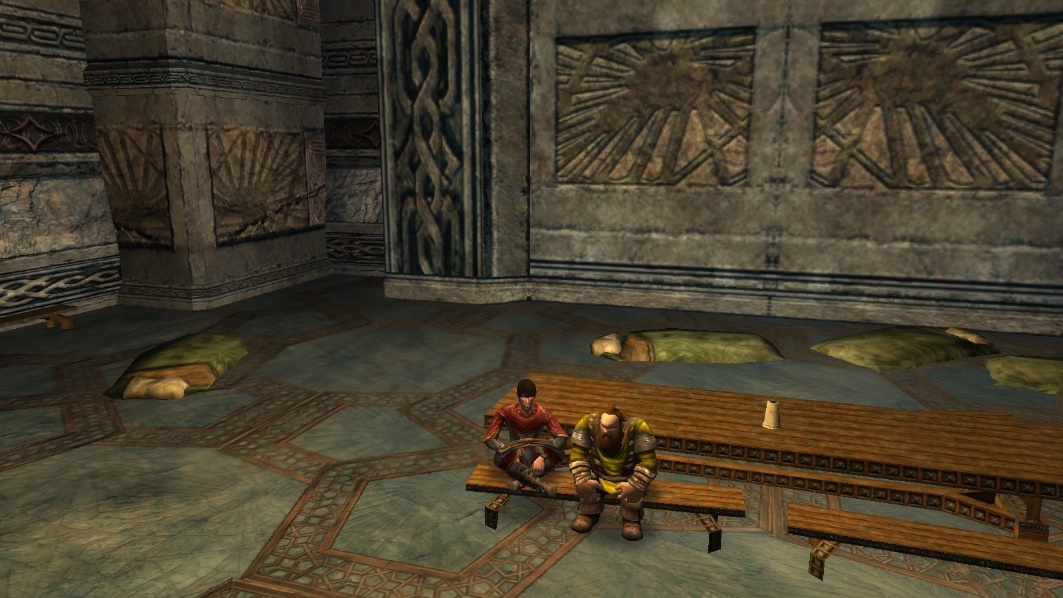
            Bragin and Farohir have at last entered the Mines of Moria.  Together they arrive at the first camp of the Iron Garrison, just at the western edge of the Great Delving.  Durin’s Threshold the Dwarves have named it, the last stop on the journey to the Mines and the starting point for the plunge into the deeps beneath the mountains.  Here the two travelers find stables for goats, an open camp which serves as a hostel, and they can clearly hear the sounds of hammer on anvil echoing down the grand staircase that climbs before them.

            Bragin is transported at the sight of the Threshold, but Farohir stares at his surroundings in utter disbelief.  “This, is this just the entry to Moria!?” he says in a hushed voice.  “What wonder lies beyond?  If this just a doorstep, then all of Thorin’s Gate is a parlor compared to this!”

            Bragin is also awed, but overjoyed, at the sight.  “Aye, lad, this is but a tease of the sights to come.  Khazad-dum is the mightiest of all the works of my people, and glad I am to have you see this, even if it is a work in progress.  And who have we here?” he says to a Dwarf who approaches the pair.

            “That is my question as well,” the Dwarf declares.  “You have arrived in Khazad-dum, and I welcome you to the halls of the Iron Garrison.  Ráthulf son of Rolf, at your service.  You are sellswords, I wager, come to seek your fortunes amid the plunder of Khazad-dum?  Then your hopes are in vain.  No gold will you find here, but you will find blood in plenty.”

            “Hail, Ráthulf son of Rolf,” Bragin says. “We are not sellswords, but volunteers, come to offer our services and our craft to the reclaiming of Khazad-dum!  Bragin son of Borin at yours and your family’s – and here is my apprentice and companion, Farohir son of Halrohir.  From Thorin’s Gate in the Blue Mountains we have traveled, and we crave the chance to be part of the saga of the Dwarves!”

            “What is this name I hear?” calls a Dwarf from across the hall, walking towards the group.  “Is that you, Bragin, you walking belly?  A long road from the Blue Mountains and no mistake!”

            “Althis!  Well met indeed, you old goblin-kisser!  Farohir, here we find Althis son of Altor, a master of the forge worthy of the craft!  So, Althis, you got a march on me and joined the Iron Garrison first.  We only just arrived, ourselves.”

            “Well, follow me you two, there is a sight for both of you that must be seen,” Althis says smiling broadly.  Bragin and Farohir, leaving their mounts with the stable-master, walk with him up the grand stairs and turn left into the northern wing where they are greeting with the sights and sounds of an active foundry.  Three great forges blaze with light and noise, and Dwarves circle each one with anvil and tools, shaping and crafting with iron and copper and metals of every kind.  Bragin’s face shows pure delight, while Farohir stands in amazement at the size of the hall.


          “Welcome, lads, to the North-Forge,” Althis says beaming.  “These are the first furnaces we restored upon our arrival.  Once I got these up and running, we began making repairs and reforging tools and weapons and other gear for the Garrison’s use.  As more and more traffic started coming into Hollin Gate, we kept mighty busy.  Word got out that we started our labors, and sellswords from across the lands began arriving.”

          “That explains the greeting we got,” Farohir says.  “You’re seeing that many fortune-seekers arriving?”

           “Aye, true,” Althis says.  “Not that it’s a bad thing, mind you; we need all the swords and axes we can muster.  The Orcs of the Misty Mountains have gained their numbers back since the rise of Erebor, and they are getting help from outside the Mines.  So we will never turn away anyone who comes, for whatever their reasons – as long as they can wield a weapon, we send them on their way.”

           “Weapons are fine, but what about crafters once the Mines are cleared?”  Bragin asks.  “Surely the roads and bridges need repair?  The halls and chambers restored?  You’ve done good work here, Althis, but what about the greater forges in the deep halls?  Have they been recovered yet?”

           “Have they!  Yes, and then some,” Althis declares.  “We found Katub-Zahar, the grand libraries with all the records of the craftsmen of old; and incredibly, we found Nar-Khelab, the Heart of Fire itself!  Well, I say we did, but it was Khazush who really found it…”

            “Who is this?  A Dwarf-dame, here?” Bragin says, “Khazush means ‘sister’, Farohir, and as you know, Dwarf-women do not travel except in great need.”

            “I didn’t say it was a Dwarf, Bragin,” Althis says.  “But a woman has claimed – no, she earned that title:  Khazush-Khazad, Sister of the Dwarves!  Deeds of incredible valor and power!  Half of our gains are to her credit, they say, and her name is sung in every hall throughout Khazad-dum.  Imagine, an Elf-scholar hailed as Khazush!”

            “What!?  An Elf?” Farohir gasps, “a woman and a scholar?  Her name, would her name be – Seregrían?”

             “None other, lad,” Althis says, his eyes and face taking on a dreamy quality.  “A tall, slender Elf-lass, all in red, pale skin and hair as black as the abyss.  She came among us, fought at our side, but then left as swift as she came – but then she returned, even mightier than before!  She has won the hearts of all the Garrison and we honor her as Khazush!”

            Farohir is utterly confused.  “Aunt Seregrían, popular?  Among Dwarves!?  It can’t be her, you must be mistaken –“

           “Hold on, Aunt Seregrían, you say?” Althis cries.  “You say you’re a kinsman of the Khazush!?  You are Elvish, that is plain by the ears – but your eyes are nothing like to hers.  Yours are green, whereas the eyes of the Khazush are fiery white, like the lightning from her staff, brighter than mithril beneath the Moon!”

           “You’re talking about MY aunt??” Farohir shakes his head in total disbelief.  “It makes no sense at all!  I have to see and hear it for myself, where can we find her? Is she somewhere within Moria?”

           “The last word I have is, she resides in the Twenty-First Hall, the new capital of Khazad-dum,” Althis says.  “Have a word to Fith, the stable-keeper.  He can get you a guide through the Great Delving, and on to Twenty-One with no delays.”

           “Then that, my boy, is the next stage of our journey,” Bragin says.  “Our thanks to you, Althis old friend.  Glad I am to see your labors paying such good dividend.  Come, Farohir, the halls of Durin await us – and perhaps, a reunion as well!”  And they return to the stables where Farohir upon his goat, Bragin astride his beloved Chisel, and a dozen Dwarves depart in a convoy headed east up the stairs, and boldly into the long dark of Moria.

29. Names and Oaths

            Bragin and Farohir have ample time to watch as their caravan slowly traverses the corridors and high-roads of Moria.  Farohir’s head swishes to and fro as he tries to catch every sight he can, overwhelmed by the vastness of the halls of Durin.  Bragin, however, is beside himself – he is desperately resisting the urge to stop at every intersection and crossroads, and simply bask in the sight of the archways and the galleries that open before them at every turn.

            After a trek of many hours, the caravan arrives at the Chamber of the Crossroads, where they dismount and regroup.  The Chamber is quite large and boasts a small area for stabling goats, room for a hostel and such; but the room’s center is dominated by a well that drops to unguessed depths below, fenced off to prevent accidents.  The caravan is greeted by a portly Dwarf at the stabling.

            “Hail, travelers!  Likmund, at your service.  Will you be staying with us, or traveling on to Twenty-One?  I can offer you some food and ale, if you care to join us by the fire.”  Bragin answers with a bow.

            “Well met, Likmund!  Bragin, son of Borin, at your service.  We are heading onward to ‘Twenty-One’, as you call it, but the thought of some ale is quite appealing.  What say you, Farohir lad?”

            “As long as we can drink without having to sit on a goat any longer,” Farohir says with a smile.  Likmund laughs and shows them to the hostel where a large keg is set up for some hospitality for travelers.  After pulling mugs and saluting each other, Bragin asks Likmund about the state of things with the Garrison.

            “Things went well at the start,” he says, “and news passed in and out of Khazad-dum about our works.  As word spread, many travelers by ones and pairs began arriving, and that wasn’t all bad.  Eager swords and bows are welcomed, especially now; I suppose you are much the same sort, seeking fortune and fame in the Mines?”

            “Not remotely, good Likmund,” Bragin replies grandly.  “As the Artificer of Thorin’s Gate, and servant of Master Tamar of Erebor, I have come with my apprentice here to offer our skills for rebuilding Khazad-dum!  We are told that ‘Twenty-One’ is the new capital and center of all decision, and that is naturally where we would start our labors.”

            “Well, Bragin son of Borin, I would say to you, sharpen your blade before breaking out your tools,” growls a Dwarf ascending the steps from the stables.  “By the word of Brogur son of Bofur, all but essential projects are on hold until the halls are made secure once more.”

            Bragin turns to meet the newcomer.  “Ah, I knew Brogur while working in Erebor.  If he wants to direct all work to defense, then his reasons are sound; I never knew him to just change his mind without rock-solid reasons to do so.”

            “Is the situation really that bad?” Farohir asks.  “We have heard that the Mines were opened up to many wonders, especially by the hand of some of the new arrivals – moreover by one called ‘Khazush?’”

            The Dwarf smiles at the name.  “Aye, you’ve heard of her, eh?  Not surprised, by how much she’s done for Khazad-dum.  I see the look on your face, for your features show your Elvishness – is it so hard for you to think of another Elf befriending Dwarves, and earning our esteem?”

            “Say rather, that I can’t imagine an Elf the likes of Seregrían to become respected by anyone, let alone Dwarves,” Farohir says.

            “Mind your tongue, guest or no,” another Dwarf joins in angrily, “for you know not of whom you speak.  The Khazush has proven her worth and wisdom, where a wet-bottomed youth like you has yet to do!”  And growls of approval come from several others.

            “And you know not to whom you speak in turn, Lackbeard!” Bragin says, rising to his feet, the other Dwarf doing the same.  “We know this Khazush better than your wits can fathom.  For this is my apprentice, Farohir son of Halrohir, the sister-son of Seregrían herself!”

            More Dwarves begin listening to the heated debate at the mention of the name of Seregrían, and several approach to get a look at Farohir.  “Thalfi will answer this, where is he?  Thalfi!  Come here and judge!  You have been alongside the Khazush as much as anyone, what can you say about this?”  And into the hostel comes Thalfi, lately arrived from the forges.  Hearing the tale, he looks long and hard at both Farohir, then Bragin in turn.

            “No family resemblance that I can see, that’s plain off.  And you, Bragin, I know too well from Erebor.  If there’s a name to be dropped, your fingers are the last to let it fall.  You hadn’t even heard of Khazush before entering the gates, had you?”
            “Not the name ‘Khazush’, certainly,” Farohir says.  “But this is the simple truth:  my family fostered Seregrían and took her into our hearts.  She is my kin in all but blood.  She and my mother pledged the Gwethnoss, the Bond of Kinship.”

            Several Dwarves nodded in approval at that.  “He speaks of the Oath of Imun-Khiluz, the Forever Family,” Thalfi says.  “And fostering can be a bond as strong as blood.  And so, you seek your foster-aunt, then?  You wish to find her and join her on her journeys?  Then you come too late.  Both Bosi and the Khazush are due to depart the Mines tomorrow, headed for Lothlorien to ask for aid from the Elves.”

             “Then she’s still here?”  Farohir cries.  “But leaving tomorrow?  Bragin, she’s less than a day ahead of us, we could get there if we leave now!  Thalfi, when can we leave, may we ride out now?”

            “Steady on, Elfling,” Likmund says.  “We send out caravans at intervals, never the same time twice; the orcs will be watching and laying traps if we keep a rhythm.  I was sending the next riding for Twenty-One in a few hours, you can go with them if you wish.”


            So Farohir and Bragin wait the hours until the caravan sets out, and they pass the time with the Dwarves sharing stories.  The Iron Garrison Dwarves are eager to hear Farohir’s tales of life outside the Mines with his aunt, and Farohir obliges.  It is clear that Farohir has inherited his father’s gift of storytelling, and soon the Dwarves are on the edges of their seats riveted by the anecdotes Farohir shares. 

            As the time for departure draws near, and the caravan prepares to set out, Bragin motions to Farohir and leads him aside with a grin and an odd look in his eye.

            “Young Elf, I listened to your tales like the others, and because I know you far better than they do, there’s something you’re not saying, but hiding behind those stories.  You speak of your parents with pride, and your sister fondly, despite your merciless pranks.  But your aunt, there’s a different sound to your voice, a light to your eye; and when you mention her name, you don’t speak it, you sing it.


            “Farohir, is there something you’re not telling me?”

30. The Coming of Warfrost

            Seregrían has recovered from her recent encounter with the Nazgul, and her healing of Caeorwulf.  The Riders Four, who now count her warmly in their company, have urged her to accompany them on their continued trek across the lands of Rohan, raising the alarm and striking wherever their enemies gather.  The party of six depart Floodwend and ride north to return to Harwick, and the glad shout from the gates heralds their arrival.  No sooner have they dismounted in the gate then they are met by Agelmund, captain of the Harwick Guard.

            “Welcome back, riders!  The tidings of your deeds across the Wold have lit the fires of hope for many.  Hail, Burnoth, there is news that bears upon your errand, if you shall follow me – Caeorwulf, you are wanted as well.  The rest of you, we shall see to your comfort as honored guests – especially you, Blodcwyn.  The Lady Cillan desires to see you, she has asked that upon your return you speak to her.  She has new lodgings near the south gate.”

            Seregrían finds Cillan in a comfortable house, her children and a maidservant living with her.  Cillan welcomes her gladly and bids she guests with her in her new home. 

            “Our fortunes have changed, and we have you to thank,” Cillan says as she and Seregrían sit beside the warm hearth.  “Harding is as good as his word.  All of the folk of Langhold are safe and more, they are useful and helping to make Harwick their new home, and better than they found it.

            “I wish to show my gratitude, on behalf of my former people, and my family.  As you know, I am still in mourning over the loss of my dear Utdred but seeing the hope in peoples’ eyes cheers me.  I wish to give you a gift, and no, I look for nothing in return; for this is in return for your valor and your strength of will.  Utdred’s steed stands without a rider or master.  There is no need I have for such a mount, so proud he bore my beloved.  I bid you, take him as your own.  Utdred named him long ago in our tongue, Güthbrond, Heat of Battle.”

            “’Heat of Battle’, you say?”  Seregrían says.  “I thank you, dear lady Cillan, for this gift.  And to honor Thane Utdred, I shall keep his mount’s name, but in the Elven-tongue, his name shall be Dagorlach.”


            Seregrían spends the evening in Cillan’s company, and in the morning after a meager meal a messenger arrives, bidding Seregrían come to the tavern near the city stables.  She makes her way there and the greetings now are as different as can be from her first coming to Harwick.  She is followed by a small crowd of townsfolk who wish to see her and praise her deeds.  She arrives at the tavern, and is greeted warmly by the Riders Four, Agelmund, and Caeorwulf, who has only just returned from another errand-ride.

         “The news I bear is for us all,” Caeorwulf says, “and it is not good.  Lord Harding bade me ride to the towns of Wildermore to bring back tidings of those lands, but I got no farther than where Langhold once stood.  Fugitives from the town of Scylfig came flying down from the mountains and spoke of terrible cold and more terrible foes that have overrun the lands.  Harding has dispatched parties of sellswords who arrived after we rode the Wold, but he spoke directly about us – that is to say, Lady Blodcwyn and the Riders Four.

          “Harding would have bade you ride north to Wildermore and aid the folk there, but he judged two points:  that there is enough strength of arms bound north to deal with the threat, and that there is far more pressing need across the Eastemnet for you.  It is Harding’s wish that you ride west to the Norcrofts and the town of Cliving, where Reeve Athelward has his seat.  The news out of Cliving is that many of the farms and crofts there have been overrun by the raiders of the White Hand, and the town is now crowded to bursting.  If there is any aid to be rendered, he bids you do so, as much as you are able.”

           “Caeorwulf, I notice that you say ‘you’, and not ‘we’,” Hutha says.  “Are you not including yourself in this errand?”

           “No, I am not,” Caeorwulf says, his jaw set.  “I am bid to ride north to Scylfig and join the effort in Wildermore.”

           “That decision must be stayed, for now!”  Agelmund says, after another messenger whispered news to him.  “Riders, to your steeds, we must ride without delay, I shall explain on the way!” 

           All there rise and hurry to the stables, finding their mounts – and for Seregrían, the stable-hands bring her the war-steed Güthbrond, who she approaches and whispers to the horse a single word, “Dagorlach”:  the horse nods his head vigorously as if in answer, and she springs lightly upon him.  All marvel at how the horse allows a brand-new rider without complaint, except for the Riders Four, who smile unsurprised.  Seven riders now thunder out from the gates of Harwick and turn westward, Agelmund speaking as they ride.

           “Wolves have been spotted on the road towards Cliving, great wolves and Wargs lead them, their howling spreading fear at their coming.  We are bid to deal with the threat, or the road west will be closed to us.  Eyes forward and to the sides, for ambush may await us!”

           They do not have long to ride before howls break upon them from the north.  They pass through a gap in the hills, rugged rocks to their right, from which a pack of large wolves begin their terrible song.  Horses shy and stamp, swords and axes flash out, Hutha’s bow at the ready – but none of it is needed.  A piercing cry is followed by a wall of flame which erupts between the horses and the wolves, putting the beasts to flight as two great wolves are caught in the flames.  As the smoke and fire disappear, one wolf remains behind watching, a great shaggy beast that eyes the riders in silence.

           “These wolves are used to the ice and snow,” Agelmund says, “and look as Blodcwyn’s fires drive them off – but see this last one, that stands without fear.”

         “What is she doing!?” Hutha says, “Lass, get back on your mount, that thing will run you down, come back!”  For Seregrían has alighted and walks purposefully toward the wolf, her hands outstretched, and speaking to the wolf who watches her unmoving, its ears erect.

          “She’s speaking to it,” Burnoth says, “in what I guess is the Elven-tongue.  You sounded like that, Caeorwulf, when you swooned, and she healed you.  Can you hear any of it?”

          “As I said, I know not her speech,” Caeorwulf says, “but it seems the wolf does, for look!”  And all watch as Seregrían approaches the wolf, speaking all the while, the wolf’s ears twitching, its head turning to and fro.  She then lays one hand upon its head, and walks with the wolf back to the party, a strange expression on their faces of mixed confidence and wonder.

         “He shall run with us, now,” Seregrían announces.  “His pack has deserted him in the ice of the mountains, and he is alone.  He shall harm none whom I name, and I have named all of you to him.  And you may know him by the name I have given him:  Warfrost.”  And to the wonder of all, the great wolf falls in line beside Seregrían as she mounts, and Dagorlach shies only once at the wolf’s closeness after she whispers to the horse once more.

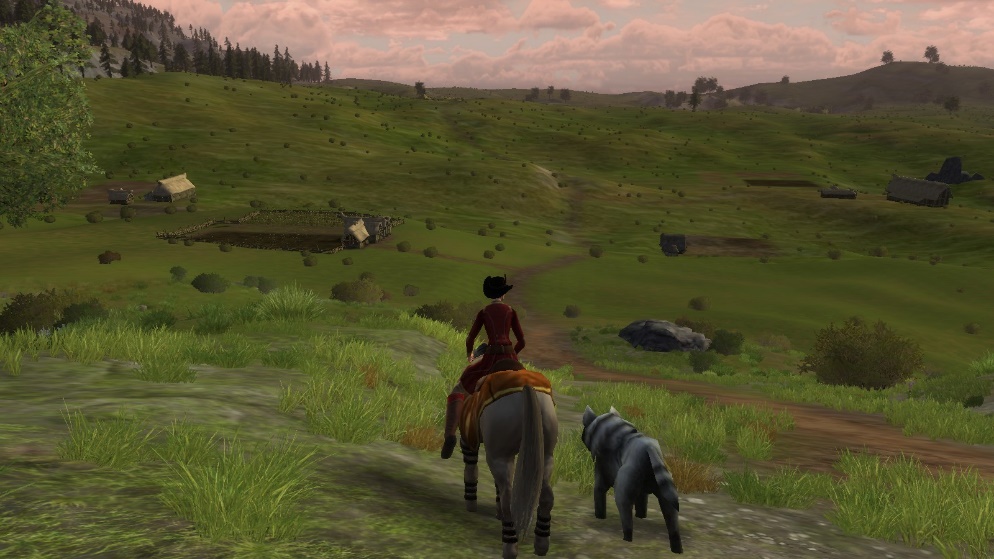
         Hours later, the guards at the gate of Harwick announces the return of the riding, and the gates stand open – and words of wonder follow silent stares as the seven riders enter the gates, Agelmund and Caeorwulf in front, followed by the Riders Four – and lastly comes the Blood-queen astride Dagorlach, and at her side stalks Warfrost the mountain-wolf, her newest companion on her quest in the lands of Men.

31. Words in the Waters

            Seregrían and the Riders Four have passed out of the moors of the Wold and entered the region of Rohan known as the Eastfold, a vast plain of rolling hills dotted by settlements and farms known as crofts.  The lands are sparsely settled, with the folk of Rohan living in a few towns protected by wooden palisade walls.  The land divides into the Norcrofts and the town of Cliving, and the Sutcrofts where stands the city of Snowbourn.

          It is for Cliving that the party rides through the day, pausing only when night falls and the horses tire.  The pace is slower than Burnoth would like due to the presence of the wolf, Warfrost; but not as slow as he feared, because the mountain-wolf shows greater endurance than expected.  All the same, Seregrían insists on an occasional halt for rest, knowing the wolf cannot keep pace with the horses of the Rohirrim for very long.

            The riders mount up before first light and continue westward, as to their right the land begins to rise in rocky heights covered with trees, and the sunlight glints off waterfalls from a distance.  Atop a spur from the hills stands a palisade wall, green banners upon towers flying in the breeze.

            “Yonder lies Cliving, the seat of Thane Athelward,” Burnoth explains to Seregrían as they pause on a ridge overlooking the lands.   “Far to the south lies Snowbourn, another two days’ ride.”

           “What do we know of Cliving, and this Athelward?”  Seregrían asks.  “Is he of the same temper as Harding, or even Sithric?”

            “His mood is different from both, they say,” Burnoth says.  “Athelward is in mourning over the loss of his wife, and has no son to carry on, but dotes upon his daughters.  The crofters, as we have heard, have been driven from the lands and inside the walls of any town that will harbor them,  Athelward seems to do nothing to hold the lands under his charge, but is content to stay within his walls.  As you can see even from this distance, Cliving is a fortress of strength, and many flock to its protection; too many, perhaps.”

            “Much the same as we saw in the Wold,” Seregrían says.  “Driving the people like a herd into one pen, easier for the harvest.  How soon shall we arrive, would you guess?”

           “We are not far off now,” Hutha says, “you can see the road to the main gate there, less than a half a league off.  We could walk the horses and be there in an hour.”

           “And what is that I see here,” Seregrían asks, “this mere with falling waters from the heights?”

          “These waters come from Cliving itself.  A stream feeds the fountains near the mead hall, and then falls over the rocks to the lake below.  Always the voice of the waterfall is heard.  Another advantage for Cliving, they never lack for water even in dry summers.”

           “Let us halt there, at the waters’ edge,” Seregrían asks, “so that we might be rested before entering the city and meeting this Athelward.”  All agree, and the five riders dismount on a stony shelf sloping down to the water.  The sound of falling water is loud, but not overpowering.  The riders let their mounts stray for grass, and Warfrost pokes around the scrub for game.

           Seregrían, however, is fairly intoxicated by the sound of the falling waters.  She leaves the Riders at their hasty camp and walks to where the cascade falls onto smooth rocks with a mantle of spray.  On impulse, she strips off her boots and laves her feet in the water; it is cold to the touch,  She dips her hands into the torrent and drinks; cold, but an odd taste to the water, of earth and mould, rich and grounding.  Moved by some feeling she cannot put into word, she strips off her leggings, then her tunic, and wades into the current.  Stepping onto the stony shelf, she stands beneath the waterfall, her arms outstretched, letting the falling waters wash over her.

                Seregrían feels an instant sensation as the water soaks her thin clothing, her skin, and her hair.  She leans back, letting the water strike her face and arms.  At once she is in touch with the richness of the land, its fertile soil carried along by the waters, the life and virtue of the lands of the Horse-lords in a way no word or song could convey.  She perceives the land is as rich as its people, these children of Men who, down through the march of years, have made this land so much their own that they cannot be parted from it.  And she realizes they belong here, as much as Elves belong in Lothlorien or Dwarves in Khazad-dum.

                Seregrían steps out of the water, shaking herself dry but still soaking.  She moves to stand in the sun to dry off, when she pulls up short; for Ulf is sitting on a rock just above her, slowly whetting one of his axes.  “You watch, and you stare?” she asks scornfully.

                 “I watch over you, and mark where you stand,” Ulf replies.  “The others are dozing in the shade of their horses, and that wolf of yours is nosing around for coneys.”  He hops down from the rock and stands near Seregrían.  “Even as close as we are to Cliving’s gate, I do not trust these lands to be safe.  None of us should go off alone, and a bathing maid such as yourself might become an easy mark.  Your tools you left with your mount, and if you insist on leaving yourself defenseless, then it is upon me to defend you.”

                 “Why you, especially?  Are there not four strong men who would rescue a helpless maid such as I appear to be?”

                 “You are anything but helpless, Blodcwyn, and we know it.  You were the only one, other than I, to stand against the Winged Terror.  I was unmanned in that hour, and even the red fog did not ward me from the horror of that beast; but your light gave me new strength to rise to my feet once more.”

                “And what is this ‘red fog’ you speak of?  Have you some gift of your own?”

                 “One day, you might learn.  And that day is not now.  But you, Elf-witch, have the habit of putting yourself into peril.  Standing against the Terror; healing Caeorwulf of his swoon; a dozen times I have watched you charge into battle, daring your foes, taunting them with your innocent youthful guise, only to draw them into your trap.  Well named you are, Blodcwyn, your thirst rivals my own.”

                “And how might you know of my thirst, as if to compare to yourself?  Your anger is swift, swift as your axe-strokes or your years, while mine has had ages in which to grow.”

                Ulf realizes he is truly staring now at Seregrían as she stands  in the sunlight, damp clothes clinging to her lithe and well-knit frame, arms akimbo and her eyes even with his, just beginning to glow with that deadly silver.  He thinks to himself:  can it be, can the white fury match the red fog?  Do her eyes see more clearly than mine?  And what would she see?

                “You may have ages behind you,” he says quickly, “but we do not have but an hour before us.  Here, use my cloak to dry yourself before you don your garb once more.  And if I may be so bold, find your scarlet clothes, the ones you wore that first night in the tavern.  If nothing else uncovers Athelward’s mind, that will.”  And Ulf moves off towards the camp to rouse the others.

                Seregrían watches Ulf walk away as she dries herself and finds her clothes.  And she looks toward him with an expression of… puzzlement.

32. A Mask of Smiles

             Cliving is a well-fortified town seated on bluffs overlooking the rolling plains of the Eastfold, and is the seat of Athelward, the Reeve of the Norcrofts, a man who by all accounts is reeling from his recent widowing.  Other accounts speak not only of the despondent Reeve, but the surge of villagers seeking the safety of the walls, flying from the bands of orcs and wolves crossing the plains unhindered.

             It is to the gates of Cliving that Seregrían and the Riders Four now approach, as the sun approaches noon.  The gate guards admit the company and watch in wonder as they pass into the town, the four Riders tall and proud as befitting the Rohirrim; but all eyes are riveted on Seregrían as she reins up by the fountain courtyard, the Elf-maid astride a war-horse with a great wolf stalking at her heel.

             Just before their arrival, Burnoth and Seregrían plotted out their best chance for finding out news and learning the true situation of Cliving.  The Riders Four would move among the townsfolk, especially the marketplace and the taverns; Seregrían, in the meantime, would seek audience with the Reeve himself, and use both her skills with words and the shock value of her Elvish presence to persuade the court to confide to her what others might not learn.  Later that evening, they would meet and compare their accounts and decide their next move.


            Word arrives from the mead hall that Athelward will receive the newcomers at once.  Seregrían elects to stay in her travel garb, presenting a bold and forward posture to Athelward and his court.  As she enters and walks down the length of the hall, she can once more hear the comments and awestruck remarks from the townsfolk over the sight of an Elf in their midst.  She then meets the Reeve, Athelward seated in his chair, a look of vacant eyes which turn slowly to wonder as he rises in greeting.

            “And who is this,” he says, “who comes to my hall on the wings of the storm, so they say?  Truly this is a marvel, that one of the Fair Folk should come unto the halls of Men.  I, Athelward of Cliving, bid thee welcome!”

            “Westu Athelward hál,” Seregrían replies with a courteous nod.  “Seregrían is my name, in your tongue called Blodcwyn.  From the Dwimordene my paths have led, and I have ridden with the men of the Mark from Stangard to Harwick to your gates with tidings of war, and of hope.  War marches on your borders, indeed the lands outside your walls are now the stage for a terrible drama of fire and foes.  I and my friends have arrived to offer both swords and counsels for your aid.”

            “And just whom are these friends of yours in your company?  Are there more Elves in your train, skilled at arms as we have heard in long tales past?  If the situation is as dire as you say, that would be the greatest aid we might look for in this hour.”

            “The friends I speak of are the Riders Four, servants of your lord Éomer charged with raising the alarm throughout the land and striking any and every blow they can.  I have ridden far these last days in their company, brave and faithful Men, and they have been both true to their word and their errand.

            “Now we come to Cliving, Reeve Athelward, with these tidings:  open war has come to Rohan from both east and west.  From across the River, the forces of Mordor moved towards the men of the Wold, but the Black Hand has been forced back for the present.  From the west, the White Hand moves as well, and we must turn our eyes to meet that threat in turn.”

            “From the West, say you?  The White Hand – you speak of Isengard, and the wise Saruman, ever the friend and ally of the Eorlingas?  Nay, Elf-child, I would discount any tidings of hostile intent from that quarter; though I confess there have been reports of rogue bands of orcs causing great harm to the crofters, and they are being dealt with as we speak.  For many sellswords have crossed our lands in recent days, and I have accepted their labors willingly, since by their efforts the folk of Cliving are safe within my walls and need venture not abroad.”

           “Ignore the warnings at your peril, yours and your folk. For even as we arrived in your lands, the rumors of the White Hand are everywhere.  Crops burned, homes leveled, and your people lie dead beneath the skies, prey for the carrion or even the orcs themselves!”

            “Trouble me not with your tidings of doom, Elfling.  Let us turn to other matters.  Your companions are from Lord Éomer, you say?  Then they should be brought here, to be feasted as befitting their station.  Go, find them, and return with them so they may know my hospitality properly!”  Seregrían sees this for the dismissal that it is, nods in parting and leaves the hall, her mind racing ahead at what she has learned.


           As night falls, the Riders Four gather with some of the Cliving Watch at a fellowship fire outside the mead hall.  There, they talk and debate the news they have found during the day.

            “Such a tangled and twisted web of tales we hear, brothers,” Burnoth says.  “And I am not certain whether what we learn is truth or falsehood.  The Reeve mourns his dead lady, to be sure; as do all the townsfolk.  But these rumors of his duel with the son of the Reeve of Elthengels?  A bizarre turn of events, that.”

            “This Reeve is unlike any of the others we have met in our ride,” Leofdag says.  “Harwick, Floodwend, and others, all the Reeves rise to the call once the threat is made plain.  But Athelward makes no move to defend or seek the enemy abroad – as if he is simply waiting for them to breach the gates.”
            “Or awaits a signal from elsewhere,” comes Seregrían’s voice as she approaches the fire.  Leofdag and Hutha make room for her as she joins the council.  “I watched his eyes and heard his voice today – and I also heard and watched all others in the hall as we spoke.  Nothing is as it seems here.  News I have from those who have ridden far speak of orcs of the White Hand prowling the lands from here to Eaworth westward, and as far south as Hytbold, though I do not know the names.

            “They speak of the Orcs mocking and bragging their foes – but sellswords I spoke with revealed strange tidings that the Orcs themselves are ordered not to assail Cliving – why is that?  Why would the orcs stay their bloody claws from this place alone among all the towns?”

            Hutha says, “Perhaps it is Cliving’s fortifications that stall them –“

            “Did that stop them at Floodwend?”  Ulf joins in.  “You and Blodcwyn burned their siege engines, you saw what they can do.  Though they were the foes from the East, you think the White Hand is less cunning?  I know, I have seen what they can do first-hand – or have you forgotten, Hutha?”

            “It is the Reeve who disturbs me the most,” Leofdag says.  “I think Blodcwyn speaks truly; he seems to wait for some signal – and that the orcs are waiting for that same signal bodes ill.  He waits, and stalls – his words remind me of Wormtongue!”

            “Wormtongue - there, you have it!”  Seregrían cries.  “Just the same as Stangard, we see it here:  minions or like-minds with the White Hand, weakening and delaying, holding true hearts in check while the enemy moves freely.  Do you not see, my friends?  I know it sounds wild and reckless, but it all makes sense.  The venom of this Wormtongue pours into many ears, and not all Men might stand proof against its wiles.  My folk know the White Wizard and his powers, chief among them his command of words and voices; and if his servant Wormtongue is any student of the master, then his words are just as deadly as his master’s spellcraft.

            “It is clear we can do no good here, and our labors would fall to no purpose,” Burnoth declares.  “Riders, we must leave this town and move on to the next task.  This is what I propose:  we ride south to Hytbold and determine what can be done there.  Blodcwyn, will you ride with us once more?”

            “Of course I shall,” Seregrían answers, “but not just yet, hear me out.  I can remain here for one day longer, keeping the Reeve off-balance as to your purpose.  That will give me the chance to find out more of these hidden plots, if there is anything to be uncovered.  I can then rejoin you all at Hytbold in a day.”

            “You would ride alone, across the Eastfold, without us?”  Ulf asks,  “I like that not, lass; with the growing peril of Isengard, none of us should be abroad without the company.  You forget what we spoke of at the waters?”

            Seregrían replies with her quirked grin, “I do not forget your gentle words to me, Reaver.  And remember, I shall have Warfrost and Dagorlach with me; I shall ride fast, and not alone.  Burnoth, your counsel is sound, and I would have you all agree with him.”

            So it settles that before dawn, the Riders Four shall depart and ride south for Hytbold.  As the men move along to find food and a corner to sleep, Hutha thumps Ulf’s shoulder.  “So, ‘gentle words’?  What brought that on, Ulf?”  To which Ulf responds with a solid punch to Hutha’s head before stalking off…

33. The Twisted Heart

            Farohir has been called out by Bragin as they wait for the caravan departing the Crossroads headed for the Twenty-First Hall of Moria.  The young half-elf squirms under Bragin’s eye, who is now appraising him as he would a rough-cut gem.

            “Farohir my lad, there’s something you’ve been hiding from me, maybe even from yourself, if that’s the lay of it.  Talk to me and listen to your own voice.”

             “Bragin, in the years you’ve known me, when have I not told you something that matters?  Yes, this journey of ours has been long and yes, I miss my family - who would not?  I even miss Eldariel and her sass.  Adar and Naneth are the two people in all the world I never worry about; their deeds are sung by many voices.”

            “And your aunt isn’t included in that roster of valor?”

             A pause.  “She’s not the adventurous type, she’s not a wanderer, certainly not a warrior by any stretch of imagination.  She’s a scholar, a lore-mistress!  The biggest battle she fights is boredom in her library!”

           “And you know this how?  Have you not spoken to the others of the Garrison, as I have?  By her deeds, your aunt is positively a heroine among my people.  No one has been hailed as Khazush-Khazad in ages; certainly not an Elf, that hasn’t happened since before the coming of Durin’s Bane.”

            “But what could she possibly have done to earn that title?  Many have remarked about Seregrían’s hate of anything and anyone non-Elvish – and hate is not strong enough a word!  Her anger has had two whole ages in which to boil, and I’m shocked she didn’t burn the Dwarves to cinders at first sight.”

            “Something has changed, what could it be?  Now lad, let’s look at this another way.  When was the last time you saw her, spoke to her?  How long ago was that, think now.”

            Another pause, then “It was before all this wild errantry began, back in the summer of last year.  It was the last time the whole family was together.  We met in Rivendell, and it was our parting feast.  Adar and Naneth, Eldariel and me, and Aunt Seregrían.  She did not talk to anyone except Naneth, she made a point of ignoring Adar – he’s a Mortal, after all.  She barely spoke to anyone, and just stood alone on the balcony watching the waterfalls.

            “I joined her there, and we talked a little by ourselves.  I got the impression that she was lonely but didn’t want to admit it to anyone.  And I don’t know what made me say it, but I took her hand and said, ‘There’s a difference between being alone, and being lonely – you don’t have to be either, as long as I’m here.’  And she gave me a look I have not seen before, her whole face softened, and she squeezed my hand.  We just stood there for a while, watching the waters and holding hands.”

            Bragin lets that hang silent in the air for a moment before answering.  “Farohir lad, I think I know now.  You are thinking of her not as your aunt, but as a woman.  And I tell you this:  it can only lead to being hurt.  Your aunt may not be your aunt by blood, and you might think there lies hope; but there is more to it than that.  You’re bad blood in her eyes, you are half Mortal – and if I know Elves as I do, to many of that kin we’re not worth a second thought. 

            “Now lad, the caravan for Twenty-One is due in a little while, and it is still quite a journey, so you’ll have time on your hands to think.  What is it you are riding to, or riding from?  Will you stay with me, in Khazad-dum, as I plan on doing?  Or will you take up the chase and ride on, in the hope of finding your aunt?  And even if you catch up to her, what will you do?  These are things you must decide – and honestly, boy, I will honor whatever decision you make, whatever the cost to your heart.”

            A call from the goat-stable brings both their heads around to see Thalfi waving to them.  “C’mon, you two, the caravan is forming.  If you’re riding with us, get over here!”

            Bragin looks to Farohir and, in a fatherly gesture, gives his shoulder a hearty thump.  Farohir rubs his shoulder and smiles wanly, and they both cross to the stable and mount up.  The caravan drovers whistle, and the column moves out smartly into the corridor that leads to the main road headed east and higher up, the Twenty-First Hall a few hours away.

            As the caravan trots along, Farohir looks around at the vast delving and galleries of the Dwarves, overwhelmed by the scale of Moria ever since entering the Mines.  He wonders if Seregrían felt the same thing when she first entered these halls, and what happened that the Dwarves were so impressed by her.  And he ponders Bragin’s words:  what is it that is driving him along, across leagues and leagues, in an effort to overtake and reunite with his family – and especially Seregrían?

34. The Race is On

            The Riders Four make ready to depart Cliving just before dawn the next morning, bound for Hytbold to the south.  Seregrían stands at the stables to bid them farewell, assuring each of her friends she would find them there within a day.

            “Though we have no word or bond to hold you save friendship,” Burnoth says to her, “I bid you in that name, ride fast and without delay!  I shall hold you to your word, Blodcwyn, for though we be the Riders Four, the fifth is part of our story now.”

            “True words!” Hutha cries.  “Tidings of the Lady and the Riders flies before us in each croft and town.  You bring hope with your flames, Spitfire.  Stray not long from our side.”

            “You bring honor to yourself and to others,” Leofdag joins in, “along with hope for good folk across the Mark.  We look for your coming when you can.”

            “And no word from you, Reaver, gentle or otherwise?”  Seregrían says with gentle chiding to Ulf, who looks at her sullen and silent.

            “I like not this parting, as I said,” he finally says to her.  “It is the part of a comrade to rebuke a friend’s foolishness, and this is what I call it.  It is folly unbecoming you, Elf-lass.  You yourself said there is uncertain treachery afoot, and surely we can do no good here; and the rest of the Mark must be fought for.”

             “And that is where you go, Ulf; to continue the fight,” Seregrían replies.  “But my part here remains, to ferret out that treachery and bring it to light.”  She lays her right hand upon Ulf’s shoulder, a gesture more of kin than comrade.  “This pact I make with you.  When next we meet and raise a glass, you give me one answer to one question:  you shall tell me the secret of the ‘red fog’ you spoke of.  And I shall in turn answer one question of yours.”

            Ulf lays his hand upon Seregrían’s shoulder in reply.  “And you shall tell me, in your turn:  what is the white fury that burns within you?  This I shall learn, as you say, when next we drink.”

            A cough from Hutha, “When you two are finished with your tender farewells…”, and the others chortle; they had mounted their horses unnoticed while the two talked.  Even Seregrían smiles at the jest, though Ulf glowers as he mounts.

            The company now rides through the gate of Cliving, the Riders Four and Seregrían with Warfrost next to her.  At the crossroad outside the gates, Seregrían reins up and watches as the Four continue south toward Hytbold, hands raised in token of farewell.  She watches the Riders as they fade into the distance and are soon lost to sight.  Warfrost raises a shivering howl in the gathering dawn, giving her a feeling of both farewell and foreboding.  Riding back into Cliving, she takes stock of what she and her friends have uncovered in the recent days, and she sets out to learn more.  Nothing is as it first seems to the eye, and intrigue opens with each passing hour. 

            Reeve Athelward was indeed involved in the deadly duel with Pendulf, son of Pendrad of Elthengels.  Tongues wag over Athelward bringing Pendrad’s daughter, Siflád, to Cliving as a ward; and how the Reeve presses his suit upon Mildrith, the widowed thane of Elthengels.

            The Reeve forsakes the defense of the open lands and the folk of the Norcrofts, and the enemies of Men ride unchecked across the plains.  Everywhere they strike with fire and death, save Cliving; for it is told that among the Uruks are orders to avoid the town.  And over the course of the day, another rumor stirs: for the Reeve has departed Cliving, and rides himself with his daughter, Ides!

            “There are tidings of great events afoot, Blodcwyn,” Siflád confides to Seregrían as they speak in private.  “Aldor Harding has called for the Witan, the gathering of the thanes and reeves, a great council.  I overheard Athelward speak of it:  all the leaders of all the towns of the Eastfold shall meet tomorrow, to debate and decide if they shall defend their lands in defiance of the word from Edoras!”

            “All the leaders in one place,” Seregrían mutters, “and treachery on the wind.  Siflád, where is this Witan to take place?”

            “Why, that is the strange thing.  By right, Harding should be calling it to Harwick; but Athelward persuaded him to hold it in Hytbold.”

            And Seregrían has a sudden flash of insight, and her mind races to and fro.  Of course!  It all falls together!  But would he be so bold – no, he’d strike from a position of strength – but he has one, Cliving is his – and all the thanes in one place, like the townsfolk, herded into one pen – and the orcs spare Cliving, why? – a stronghold from which to – Burnoth!  Leofdag!  Hutha!  Ulf!  They ride into a trap!!

            Seregrían turns without a word and rushes for the stables.  She finds Dagorlach, saddling and mounting with a speed unmatched by the Rohirrim.  She pounds down the paved lanes of town, exploding through the gate and nearly bowling over the guards.  A high piercing whistle brings Warfrost flying to her side, and they now thunder across the plains, headed south along the road. 

            Seregrían does not know the way she is to ride, but reasons that the next town visible should provide her direction and tidings of the unfolding trap.  She reins up near the gate of Faldham and demands to speak to the thane.  The guards, amazed at the sight of the Blood-queen and her wolf, explain that their thane Elfhelm is abroad in service to Edoras; his son Elfmar, who stands in his stead, was summoned away to Hytbold.  She demands to know which way she must ride; the guards point the way along the south road.  Without a word she digs her heels and Dagorlach springs away, Warfrost following hard behind. 

            The race is on.

35. The Heart of the Hunter

            Farohir, the half-Elven twin brother to Eldariel, now stands just outside the great gates of Moria at the opening expanse into Dimrill Dale.  This is the first time in his life that he has ever beheld this land, though he has heard tell of it from many voices:  the forbidding white peaks of the Misty Mountains soaring above him to unguessed heights; the crumbling but majestic edifice of the East-gate of Khazad-dûm; and the expanse of Kheled-zaram, the Mirrormere stretching beyond sight towards the valley of the Silverlode.  He stands for a few moments just breathing in the air, a chill tang from the mountains above, fresh and cool and moving after the still warm airs of the Mines of Moria.  It is late in the day, and the shadows of the peaks are long in the valley, the stars just beginning to appear in the darkening skies.

            As he contemplates the vistas before him, Farohir hears on the wind a bird calling, or so others might think so – but he knows it for what it is, a four-note call that only one other in all the world knows:  Eldariel is somewhere near.  He raises a cupped hand to his lips and calls the same notes in answer.  In just a few minutes, through the undergrowth and the trees’ shadows comes Eldariel, garbed in black and grey with a massive bow slung across her back.

            The twins have not seen one another since their parting from Rivendell weeks ago, and both have ridden far and wide through many leagues and dangers.  They greet each other with a fierce hug, then turn to gaze down the length of Mirrormere, holding hands in silence for a long moment before Farohir breaks the silence.

            “I am glad you came, Rosgalen.  I am also glad I see this place with you, first.”

            “I set out to find you, Faron, as soon as the falcon brought your message.”

            “You must have been very close, to come here so swiftly.”

            “I was beneath the eaves of Mirkwood, across the River.  Coming down to the landings near Echad Sirion was easy – but I had to wait until cover of darkness to cross back.  Finding my way up the Silverlode took longest, as the Galadhrim wanted to forbid my coming.”

            “Still, you made good time.  I’ve not had long to wait here.”

            “You were easy to find – all I had to do was follow my nose.”

            “Why, because I bathe more often than you?”

            “Precisely – that perfumery you insist on could lead an entire orc patrol to your doorstep!”  Several playful jabs follow, then Eldariel frowns.


           “You are not dressed for a hunt; you’re wearing red, like Aunt Seregrían, why is that?”

           “Yes, well,... you see, erm, well... it's involved, because...”

           “’It?’  And what is ‘it’ that you’re sporting a new look, dandy that you are?”

           “Look, I'm worried about her, is that alright with you?”

            “So you wear red... wait, why are you worried about her?”

           “I mean, you haven't heard about her in Moria, and what the Dwarves are saying!”

           “How could I, I have been north in the Vales!  I set out as soon as I got word and didn’t stop for idle chat.  Faron, what is going on?”

           “The Dwarves told me stories of Seregrían.  How she fought dark creatures in the Mines, and she left all of a sudden; then after a few weeks she returned – changed.  She was more powerful than ever we've heard!  Almost as if she's become a Wizard or something.  They say she can command fire and lightning like you use arrows!”

            “And what’s wrong with being a Wizard? I’ve heard great tales of them, especially Mithrandir and Radagast; tales both in Rivendell and the Vales, same as you.”

           “But Rosgalen, that’s just the point:  Seregrían is not a Wizard, and never will be!  Somehow, she’s mixed up with powers no one, not Elf or Man, has any business dabbling in!  We have to find her, to save her!”

           “Faron, don’t you even hear yourself? Is this why you asked me to come here? Farohir, what is going on with you - not her, you!  Why this sudden concern for her?”

          “She’s like family, isn’t she?  I mean, Naneth and she swore the Sister-pact before we were born.  But even so, she’s not kin, but she’s more than friend.  So much more.  I mean, when we all last were together in Rivendell, and she looked so sad and alone, and we talked, and watched the waterfall, and she smiled – don’t look at me like that, I mean, she really smiled!  And we just held hands and talked, and watched…”

            “You can’t be serious.  Farohir, you’re getting – you’re feeling something for Seregrían!?  I don’t believe this!  That she’s family is bad enough – but she’s ages older than you!  And she’s always angry, you know how bad her temper is!  You think one tender moment means she – oh, I can’t say it!  You know her, she can’t love!  She hates Adar, she hates anything that’s not up to her Elvish standards!”

           “Then why is she a hero to the Dwarves?  Do you know what they call her?  ‘Sister of the Dwarves’!  She even parties and dances with them, they told me!  With Dwarves!  Does that sound like the Seregrían we grew up with?  She’s softening, she’s loosening up.  Her heart is melting, or something.  And if it finally thaws, I want to be there for her.  She’s lived for so long without love, that maybe that’s all she needs, someone to love her, and someone she can love in return.  And I… I guess I want to be that for her.  Maybe someone to love will save her from whatever power is taking hold of her.”

            Eldariel is stunned to silence, her mouth opening and closing wordlessly.  Seeing Farohir’s face and eyes tell her the truth:  he means every word, and he’s trusting her with a secret he has held close for who knows how long.  He is the only other person in the world who she could trust that deeply, how can she not believe him?

            “I don’t have words for this.  You’ve never talked like this, Faron, not ever.  But you’re not thinking, you’re not making sense at all.  If you won’t believe me, then we have to talk to the only ones you might listen to.  I know where Naneth and Adar are staying, in Caras Galadhon.  We’ll leave now and walk through the night – I want answers for this, and they are the only ones who can help make sense; or at least slap some sense into you!”

36. The Last Leg

            All roads now lead to Hytbold as many forces converge upon the walled town of the Eorlingas for a meeting of doom.  The Riders Four have ridden far to warn the people of the Eastemnet of the approaching menace from both east and west, the Black Hand and the White, and now ride hard for the town to bring the tidings they have gathered.  At the same time, the Thanes and Reeves of the East are gathering here for the Witan, to decide on defiance of their king or staying their hands and blades from assailing their foes.  And also to this fateful crossroads rides Seregrían in a race to warn the men of Rohan of treachery and deceit from among their own.

            Seregrían rides Dagorlach to the edge of endurance and beyond, the faithful horse flagging but still pounding away the leagues, feeling his rider’s anxious fear and growing rage.  Almost at even pace with the horse runs Warfrost, the mountain-wolf showing the strains of the wild ride as well.  Glancing every so often at her voiceless companions, she tries to gauge how much strength is left to them.  She has halted several times to allow the two beasts rest before running once more; but now she is reluctant to halt again, as if some desperate call can be heard on the wind.

            The sun has westered, and the sky to the east darkens with approaching night.  Seeing that there must be one more halt, Seregrian reins up on a rise that overlooks the plains of the Sutcrofts, the lush green moors and pastoral expanse that is the south of these lands.  She jumps lightly from the saddle and alights on the rocks, Dagorlach heaving and lathered but still willing to bear the Elf-woman further into peril.  Warfrost has flopped onto the cooling stones, tongue lolling out and sides heaving in exhaustion.  She also feels the strain of the ride but is also driven on by the urgency of what may be happening ahead.

            Seregrian wonders at this thought, as she looks out over the vast rolling plains before her.  Why is she so driven to ride to the aid of the mortals, these Men whom but a year ago would have earned nothing save her loathing?  Her task is to fight the Shadow and bring the battle to the Enemy; her task is also to move among the Free Peoples and show them they do not stand alone.  Dwarves, and now Men, have harkened to her words, heeded her voice, and fought at her side.  But is this what she actually should be doing?  For an ever-present thought pervades her mind like smoke on the breeze: what of her mother?

            Not since Floodwend has Seregrian entertained thoughts of her own situation, not since the night of her arrival when the morroval shadowed her path, or when she confronted the Nazgul with the power of her staff, and swooned, and dreamt of the last time she saw Thandwen, alive or otherwise.  She swore that this errand would not stay her or interfere with the ultimate goal of redeeming her mother – but as she considers it, that is precisely what is happening with these troubles among Men, riding and running across the lands.  But a high yip from Warfrost brings her reverie to a halt.  The wolf has risen to his feet, sides heaving and nose working, testing the wind. 

            Seregrian squats besides Warfrost, running a gloved hand through his shaggy coat.  “Man nostich, Naisauth, mellon nin?” (What do you smell, Warfrost, my friend?)  After a few moments, she smells it too:  smoke, mixed with a pungent reek.  Looking skyward, she notes the winds blow from the east, where stand the rocky heights that form the East Wall of Rohan and, nestled in a hollow among the rocks and shielded by the pines, also stands Hytbold, not a league off by now.  The warning on the breeze is all too plain: war has come ahead of her, and it may already be too late!

            Giving Warfrost a pat on the shoulder, Seregrian crosses to Dagorlach, who appears still fatigued despite the halt, but his eyes are bright and strong.  “We are losing the hour, you two.  I must ask you for one last burst of speed, or the race will be lost.  Will you run for me once more?”  Dagorlach nickers and paws the stones, and Warfrost, panting still, looks at her with a seeming expectant gaze.  She smiles grimly, and springs onto Dagorlach who immediately starts down a stony narrow path leading to the grassy carpet that stretches out from the heights.  Warfrost follows in the horse’s track.  When they reach the grass at the bottom, they explode into a quick run and a near gallop, pushing against time and the setting sun, the last leg of the race about to start.

            The road leading to Hytbold runs through lands dotted with small homes and farmsteads, most of these abandoned or destroyed.  One of these just atop a rise has just been put to the torch, the all-too familiar figures of orcs darting through smashed doors and holes in the fences, bent on slaying any living thing they find, whether for rage or for food.  They turn about at the sound of approaching hoofbeats, followed by a high shivering howl, and laugh at the sight of a single rider seemingly being chased by a wolf. 

            All laughter ceases at the sound of a woman’s voice, screaming in the hated tongue of the Elves:  “Nor na lim i dagor!  Yrch!  DOSTACH AEN!”  And the orcs scream in their turn, lightning and blasting fires erupting from the very ground they stand upon, and those few who do not burn flee shrieking in fear toward the town. 

            Atop the rise, framed by smoke obscuring the setting sun, Seregrian raises Dondangol on high, reveling in the power coursing through her, and screams out: 

Naur an gyth nin!  Seregrian Tolnev! 

37. Into the Mines of Moria

           News has reached Rivendell of the exploits of a new colony of Dwarves, styling themselves the Iron Garrison, seeking to reoccupy the Mines of Moria. Following hard on the success of her embassy to Durin’s Folk in the Blue Mountains, Seregrían is now tasked to approach the Dwarf leaders and join their company, and provide what assistance she can.

           After a swift ride south through the empty lands of Eregion, Seregrían overtakes the Dwarven caravan and holds council with the leaders of the expedition. She is introduced to Brogur, the son of Bofur who was a companion of Thorin Oakenshield, and Bosi, son of Bifur who was also a member of the Quest for Erebor. They accept her offer of aid reluctantly, but time proves it a wise choice, for little did they realize the perils they had to face at the Doors of Durin.

            As the expedition succeeds in excavating the ruined West-gate of Moria, the vanguard of the Garrison is suddenly attacked by the terrifying Watcher in the Water. The Dwarves are driven back with loss, with Broin son of Brogur being seized by the monster and dragged beneath the waters. Seregrían lends what aid she can, and when a cache of ancient weapons is discovered, her knowledge of Eregion lore reveals a quarter-staff’s potential to help defeat the Watcher. Armed with the ancient weapons, the company confronts the monster once more, driving it back into the depths of the lake and gaining the passage into the Mines.

            Emboldened by their initial successes, the Iron Garrison establishes their first temporary camps within the Mines and begin probing deeper into the vast mansions of their forefathers, seeking to recover the lost secrets of the craftsmen of old. In this effort Seregrían plays a key role, for her knowledge and skill as a Lore-mistress aids the Dwarves in recovering and deciphering the Dwarven texts.

            In truth, Seregrían doesn’t expect much of the Dwarves; her distrust has not been totally expelled despite her recent time among them. But when she discovers the ancient Chambers of Wisdom and Knowledge hidden within the Great Delving, she cannot believe her eyes; here is a treasure-house of lore and knowledge, handed down through the ages, waiting for the right hands and eyes to reveal their secrets!

38. Discoveries in the Dark

The Mines of Moria reveal their secrets slowly, and not without a sore trial, so Seregrían learns…

The Elf-scholar has accompanied a Dwarvish expedition deeper into the Mines than ever they fared before, in search of more of the lost libraries and book hoards in the lower mansions. Thus they come upon Katûb-Zahar, the ancient Word-Hoard of Durin’s Folk. Overrun as it is by creatures of the deep rocks, Seregrían and her cohorts battle through the halls until, exhausted but elated, they enter the main repository only to discover an even darker horror: the Merrevail have entered the Mines.

Having beaten back the intruders and put the creatures to flight, Seregrían takes a moment to survey the vastness of the vault of knowledge – large enough that the whole of the Last Homely House could have fit snugly inside! – and in her awestruck mind, she ponders what ancient lore she might bring again into the light.

Now the Dwarves take stock in their gains, for the fight in the halls of Katûb-Zahar yields an immense profit for all. Two Dwarf-scholars, Bori and Thalfi, sing her praises loudly for the wealth of lore she has brought out of the vaults. Thalfi the scribe has updated and corrected the maps the Iron Garrison use to navigate the Mines. Bori has used those same maps to speed the search for any trace of a mithril lode in the Silvertine Deeps.

But Seregrían herself has found something far greater, and to her profit alone. For hidden and forgotten among the scattered leaves of parchment is found an obscure piece of Dwarvish trivia that is the final link in her own research: a method for harnessing lightning and directing it along a path of one’s choosing.

Armed with this new lore, Seregrían adds a crystal touch to her already formidable staff and wanders into the passages to test it – and the first hapless orc to encounter her feels the Blood-Queen’s new fury!

39. Down into the Deeps

           Each passage leads to – one more passage…

           Seregrían has found lodgings for the present, courtesy of her Dwarvish hosts, with the Iron Garrison in the relative comfort of the Twenty-first Hall of Moria. Because of her bold forays into the Mines in their company, as well as finding clue after precious clue to advance the Garrison’s mission, the Dwarves see that the Elf-scholar wants for nothing.

           As the days pass in the outside world, the timeless dark of Moria is pierced by the light of both lamp and fire, as the Dwarves establish footholds in key areas of the Mines, extending their control of the ancient halls. The expedition’s leader, Brogur son of Bofur, bids Seregrían accompany members of the Garrison into the Deeps below, not only to search for the mining lodes but also to spy out the deep halls and learn of the threat posed by the Orcs.

            As the company plunges deeper into the long dark of Moria, Seregrían is at once awed and angered at the places they discover, each one larger and more forbidding than the last. Awed, for the scale and vastness of Khazad-dûm towers over even the greatest tales of the Elven strongholds of a bygone age; angered, because nothing of Elven-lore even approaches the size and grandeur of the mansions of Durin’s Folk, now lost in ruin and darkness. And in that hour, the Blood-Queen resolves to do something about it.

            The days have rolled into weeks for Seregrían’s sojourn beneath the mountains and deep into the Mines of Moria. And with this perilous but profiting journey, changes have wrought themselves upon her a new image, and a new insight.

            The change from stolid scholar haunting the libraries, to an avenging adventurer roaming the lands, have added muscle and sinew to a formerly frail frame. Spindly limbs have given way to toned and supple arms and legs. New strength and endurance flows through a healthier and active form. Those she encounters in her forays in the Mines now cast covetous looks her way, which she dismisses with her usual glaring gruffness.

             But the greatest change is in Seregrían’s attitude towards the people of Durin’s Folk. She learns of their thirst for knowledge and craft, surpassing their supposed greed; not greed, she learns, but rather the love of beauty wrought by hand and wrested from the bosom of the earth. With each hall and deep she enters, each more splendid than the last, she appreciates the skill and patience of the craftsmen of old. And she even considers a few of the Dwarves as something like friends – and so taking a Dwarvish hill-goat as a steed, she gives it a name, one of the first words in Khuzdul she learned: Khûzsh, which is “Friend”.

            One evening comes when, in the company of a kindred spirit named Svanr, Seregrían explores further than ever, even to the great Eastern Gate of Khazad-dûm itself, and for the first time in weeks stands beneath the starlight of Dimrill Dale and beholds the majesty of the Gates of Moria. Not in two hundred winters had she set foot east of the Misty Mountains until this night – and she finds herself longing to re-enter the Mines to complete her quest for wisdom.

            And Seregrían learns, what’s better than one power? Two powers. For upon her return from the libraries of Katub-Zahar, her search for lore among the vast Dwarf-hoards yielded a means to master and call forth lightning.

            But on her recent journey into the gloom with the Dwarf Bosi son of Bifur, they find the revered Nar-Khelab, the Heart of Fire, the greatest forge of Dwarvish legend. While Bosi completes his quest, Seregrían completes hers: to find a further piece of lore to allow her to expand her already formidable power. And find it she does – a way to combine the powers of fire and lightning into a fearsome weapon. And on her next foray into the darkness, she resolves to test it.

           So it is that, descending into the Flaming Deeps beneath Caradhras, Seregrían tests this terrible power against her massed foes, as the Blood-Queen screams a Word of Command:

“DOSTACH AEN!!” 

(You will burn!)


40. Beneath the Black Wings

           As Seregrían becomes more accustomed to the company of the Dwarves of Durin’s Folk, and enamored of their hoarded lore and knowledge, the Dwarves in turn share a growing respect for the enigmatic Elf-scholar who wields arcane weapons at their side in battle. Hall by hall, deep by deep, the Iron Garrison plunges into the dark of the mansions of Durin, with the Blood-queen in the vanguard blazing their trail.

           Scouts have reported back that the hideous creatures of darkness called the Merrevail have claimed part of the upper halls as their lair, a springboard from which to conquer the rest of Khazad-dûm. Brogur and Bosi will not allow the merrevail to befoul the halls any longer, so they dispatch a scout party, with Seregrían in their company, to find out all they can and look for a way to reduce the lair by storm. The Dwarves do their work well, and locate the entries to the lair, and Seregrían goes forth to confront the beasts. But imagine her surprise when upon seeing a morroval scout, she is not attacked, but hailed!

           “Greetings, Heart-sister, for such we call you,” comes the husky, sultry voice of the dark she-bat. “We have heard your name, Blood-queen, and see a kindred heart in you. Come, I am told you’re granted audience with She Who Must Be Obeyed.”

           So now, Seregrían fearlessly walks in the company of a servant of the Dark, to parley with the merrevail and learn more of their plans, her fires banked – for now.  They walk side by side, both looking ahead and not at each other.

           “You know me,” Seregrían says, “but if we are as you say, heart-sisters, by what name shall I call you?” She looks sidelong at her guide and can see a smile more like a leer.

            “Call me Gwathwethil, if you wish,” is the reply.

            Shade-sister, how fitting, Seregrían thinks.  “And tell me, O Gwathwethil, how is it that She Who Must Be Obeyed sees fit to grant me audience, rather than assail me on sight?”

           A short silence, then, “Had you been of the Stunted People, we would. Since you traffic with them, we should. Your elegant displays of power and anger stay Her hand, until She decides what course to offer you.”

           “And tell me, ‘sister’, what course would the merrevail offer that I might entertain?”

            “Why, what better course than to serve and obey Her! Not only to prolong your own life, but the chance to learn even greater power for your anger’s release. Is that not what you truly desire? She can provide delectable delights for you if you only obey.”

            Seregrían halts in her tracks. “I already possess delights of my own making, far from these halls and beneath the stars. She cannot provide what I already own, so spare me your words, sister. Have you nothing else to offer?”

            Gwathwethil rounds on her, her face now a contorted mask. “Only this, that you give Her one service – as sport! Hers is the audience, so make your death pleasing to Her!” And the morroval lunges at her – an instant too late. For Seregrían was not unprepared, weapons flashing into her hands and dodging the first strike – the fight is on!

            The vast cavern of Tith-maudhûl becomes an arena for the Merrevail, as the winged horrors gather to watch an epic contest unfold on the cavern floor. Seregrían squares off against the morroval who calls herself Gwathwethil. But the wary elf is not easy prey, as she brandishes her twin weapons – making no sudden or complex moves, hiding her skills and true power until her opponent makes her first mistake.

            Backwards and forwards the two wheel and lunge, a circling dance around an ever-moving center. Gwathwethil strikes; Seregrían deftly counters. Seregrían feints; Gwathwethil lashes out with razor-sharp pinions. Their faces tell the tale of battle: the morroval is all snarling rage, the elf is icy contempt; but the eyes of both are the same, pent-up fury screaming to be let out. Seregrían’s gambit is paying off as Gwathwethil’s frustration rises with each pass, falling a little out of balance each time. The she-bat makes a desperate play, taunting her opponent once again.

            “Your blood boils within you, heart-sister. Shall I chill it for you?” And the air is rent with the dreaded scream of the merrevail, which freezes the will and limbs and opens the victim to slaughter. Seregrían counters with a Word of Command: Hebo Le Deleth Nin!  The sound of Gwathwethil’s voice impacts the air over Seregrían’s heart – and freezes in its turn, leaving the elf untouched.

            “And that proves we are not sisters, dark-wing,” Seregrían replies in a voice as icy as the air. “You cannot touch my heart, there are few who can – and you are not they!”

            Gwathwethil steps back, her face twisted with anger but her eyes betraying doubt; such power, to defy the merrevail, not possible! “Then perhaps we shall find others who can. Sisters! The sport is open!” At her shout, three more merrevail descend to the cavern floor and advance on Seregrían, while she retreats out of reach. “Find her heart, sisters, and take it!” The three alight on the cavern floor and begin spreading apart, presenting no easy target for the Elf-scholar’s wrath.

            They’re toying with me, they’re making sport of me, Seregrían thinks. She brandishes her weapons with daring circles, her sword twirling slowly in her left hand, her bejeweled staff cold and stiff in her right. She knows by intuition that her power will flash forth by the humming vibration in the wood, but the last Word of Command depleted its energy; it will take moments longer to build back the power she needs. And for these opponents, only one power will serve…

            These merrevail are clever. They watched as the elf rendered their screams useless, thus they confine their assaults to the slashing of their talons and claws, and press home their assault with claws and words.

            “This one doesn’t like us very much, eh sisters?” one hisses.

            “Not in the least, such gratitude for Her hospitality,” the second says, licking her lips in anticipation. “Does she not realize the honor that She will bestow upon her?”

            “She Who Must Be Obeyed is most displeased with the she-elf,” says the third, a silver-haired creature who might have been called beautiful were she other than merrevail. “This sport ends now. So, heart-sister, even though you spurn the honor – have you any last words to share before Her will becomes your end?”

            Seregrían meets their eyes each in turn, and the merrevail see a face with a smile that might be mistaken for one of their own, twisted with building fury. For just at the right moment, the familiar humming in her staff has returned. And she replies in a voice dripping with malice:

           “Why yes, ‘sisters’, I have just one word for each of you – DOSTACH AEN!!”

           And the merrevail scream, this time in agony, for Seregrian’s staff and sword bring down blazing fire and smashing lightning, turning the very stones they stand on to molten slag, splashing up and covering them in withering tongues of power. And in an instant, the fight is over, as the merrevail char and die by the Blood Queen’s hand!

41. The Lie that is the Truth

           The battle in the caverns of Tith-Maudhûl has been fought and won. Seregrían and the Iron Garrison rout the merrevail, bolts of energy flying from the tip of her staff, nipping at their retreating heels, pursuing them through the halls, the Elf-scholar fast outrunning her allies.

           The passages wind higher and higher until the chase opens on the heights of the Misty Mountains, a dizzying arena beneath the ice-rimed peak of Silvertine. Here the merrevail turn at bay, laughing at the solitary Elf-woman who has pursued them – unaware of their approaching doom.

           Seregrían wields her staff and sword, screaming Words of Command with her cracking voice, fire and lightning raining down upon her foes, scattering them like the snows that swirl around them. At last, only two remain: Seregrían, exhausted and covered in gashes from the talons of the she-bats, and the Queen Herself, She Who Must Be Obeyed. And her voice is venom dipped in honey…

           “I give thee audience at last, Heart-sister. Thou hast proven thyself, with the defeat of my guard. Canst thou not see the irony, thy name betrays the truth of our kinship: Seregrían, the Blood-Queen – and I, Bogrian, the Tyrant-Queen!”

           “Names are but words,” Seregrían rasps in answer, “and behold, my words have proven mightier than yours. What words could you possibly offer that would change this day’s end, and yours?”

           “Why, the words thou hast longed to hear: the why. Why art thou consumed with anger, equally to thy thirst for lore?  Thou dost thirst for blood, as all Elves crave it!  Thy kind are kinslayers ever, thrice putting thine own kin to the sword. And the wretched Orcs, thine ancient cousins, molded by the Dark into the conquerors they are destined to be – even thine own mother, whom thou didst leave to die – thy history is dripping, gushing with blood, and thine own name damns thee to my service!”

           Seregrían knows her strength is ebbing, but still stands in defiance of Bogrian. The queen of the merrevail, enjoying the sport but wearied by her own wounds, chooses to end the game.

            “Thou hast the victory for a day. But a Power rises in the East that thy child’s tools cannot hope to fight. Therefore I leave thee, Blood-Queen, in thy denial – but the greatest denial shalt come from the snows behind thee. Stand against the truth, if thou wouldst dare!” And with a coughing laugh Bogrian leaves, walking and weakly flying, a trail of wounds in the ice. Seregrían watches, summoning the will to pursue and finish off the wounded morroval, when a voice stops her.

          “Seregrían… Stay your hand, for not by yours shall She fall…” And Seregrían turns to see Gwathwethil, lying in the snow, charred but still alive, beckoning her to her side. As the Elf-scholar stands over her, the look on the morroval’s face is not of hate or anger, but compassion.

            “I am free of Her will for a moment, and I must speak. You were right, we are assuredly not sisters, though we are so much more. I have waited for this day, since our last parting at the cliff by the Sea in the lands that are now under the waves…”

           “Your wounds have addled you,” Seregrían says, “for we have never met before this day. You speak with the eyes of death, and the Dark awaits you; and all your lies cannot halt its approach.”

           “Nay, I do not lie, and this is my token of truth: you were not born the Blood-Queen, for that is not your name, the name your mother gave you: you are Nauthira, the Heart’s Desire, for she loved you beyond her end.”

           A moment of stricken silence then, “You lie. You LIE! That name has no meaning, you are guessing in the Dark that is reaching out to take you!”

           The morroval’s face softens further, and Seregrían sees the eyes of Elven-kind staring back at her. “Just as your name is not as you once were, neither am I. For on that day when we parted, I was Thandwen. Ai Nauthira, im Thandwen, naneth lin, a meleth pan-orthron (Yes, Heart’s Desire, I am True-maiden, your mother, and love shall conquer all).

           And for the first time in more than six thousand years, bitter tears flow from pitiless eyes and soften the snow…

42. Meeting of the Minds

           Seregrían and the Riders Four have returned to Harwick, and rest one more day before departing for Cliving and their ongoing errantry.  As they gather for a shared meal at the Harwick tavern, they are joined by Caeorwulf, who has bitter news to relate.  At the will of Lord Harding, he shall rejoin the errand-riders and ride north to Wildermore as planned.      

           “I know my duty, both to Harding and to Harwick itself,” Caeorwulf tells his five comrades.  “But I also would do my duty to my friends in arms.  There seems to be so much more of labor to perform, so much more to achieve.  But I go where my lord bids me, and that is the way of the Rohirrim.”

           “You are a true man, Caeorwulf, and we will not forget it,” Burnoth says proudly, “and we shall carry your comradeship to every corner of the Mark, this I swear.”  The others all voice their agreement, and the six friends feast into the night, though retiring early to make ready for the morning’s first light.

           All that is, except Caeorwulf, who bids Seregrían walk with him a while.  They find themselves atop one of the watchtowers overlooking the Wold, a carpet of stars alight in the sky.  As Seregrían gazes at the stars, Caeorwulf unfolds his mind.

           “Blodcwyn, I recall your first night in Harwick, and the meeting with Harding.  He mocked you by saying you looked no more than a maid of twenty summers – and he was not wrong.  To my eyes and others, you are indeed a slip of a girl; but when your true nature comes to the fore, all are amazed, and your legend only grows.  But tell me, if you may, just how old are you?  I know that the Elves are long-lived, but can you really be that much older than I – than we?”

             “Do you see them,” Seregrían replies, “the stars above?  Each star would be each summer I have seen.”         

             “But… but there must be thousands!”

           “There are, indeed.”

            Silence, then, “Your people are long-lived, and possess lore and dwimorcraft far beyond my understanding.  You are so high above us – why are you even here, Blodcwyn?  What possible interest could you have in the lives of Men?”

            “The interests of all free peoples.  A great Enemy threatens all, and I have a task given to me by greater minds than mine:  to go out across the lands and render what help I may, and to remind you all that you are not alone in this fight.  All shall unite in defiance of the Shadow, in whatever ways and means can be.”

           “And your ways are frightening, Elf-maid.  You wield power that in our songs belongs in the hands of Wizards, or witches in far-off lands and farther-off tales.  But not just death; you bring life as well.  I have never known death, up close, until Floodwend and when you found me in that place.  And in truth, it leaves me with many questions, and few answers.”

          A chuckle.  “That is the way of the lore-masters, to open one door reveals three more rooms beyond.  Even for those with the ever-mounting count of years.”  And she gazes to the stars once more.  “I, too, have more questions than answers, except for this:  even for the scholar, the learning never stops.” She laughs lightly and smiles at Caeorwulf.  “If only my master would have heard me say that now!”

              Caeorwulf smiles as well, then continues, “When the student learns, the master laughs, and begins the next lesson.  I know that from my training with the sword.  Blodcwyn,” he says as he reaches for her hand, “you have taught me a lesson as well.  I once never gave a moment’s thought to what lies beyond things, beyond the night, beyond even life itself.  But you have let me walk right to the edge of the life Men know, and brought me back to speak of it.  I no longer fear it, because thanks to you I know for truth there is something awaiting us beyond this life.  I merely have yet to walk that path – but when the time arrives that I must, I shall not face it in fear.”

              Seregrían looks at their joined hands, Elf and Mortal – no, she makes herself think, Elf and Man.  She turns her eyes to Caeorwulf’s.  “It is part of the long lore of the Elves, that the dark was made to be fearful by the Shadow long ago.  We Elves love the night for its beauty and peace; but that joy has been denied Men for time out of count.  As I told you, no Elf save one has ever walked that path you saw.  It is a gift to you, we deem, one in which we cannot share.

            “But this, we can share, you and I.  Yes, we have walked that path and both returned to speak of it.  It is not the most fitting gift I would leave you with, but I see in your eyes it gives you hope – and that pleases me, that you will take that gift all your days.” 

             “And I shall always cherish that gift, Blod- no, no, let me try:  S- Ser-  Sair-ruh-GREE-yon.”

              And amid laughter, Seregrían and Caeorwulf embrace, this time not out of fear or near-death dreams, but out of something else.  Seregrían had found another friend.

              The next morning sees the Riders Four ready to depart Harwick and bound for Cliving at last.  In their company rides Seregrían astride Dagorlach, and the wolf Warfrost running at her stirrup.  Absent from their company is Caeorwulf, who stands among the small crowd at the gate to see the Riders off.  Lady Cillan, who stands in the place of Lord Harding, lifts what she calls the “stirrup-cup” to bid the riders farewell.

             “Ferthu Eorlingas hal!” she says.  “Glad was the hour when the Riders Four came to our aid.  Receive this cup and drink to happy hour, and health be to all at our parting!”  And as each drink from the cup, she turns to Seregrían.  “Glad as well is the coming of the Lady Blodcwyn, whose name races across the Mark swifter than the fire she wields.  Ride to renown and a safe return!”  Cillan hands the cup to Seregrían, smiling as she drinks in salute. 

           Leofdag lifts a horn and blows a blast.  The Riders Four spur their mounts, Seregrían calls aloud to Dagorlach, and a shivering howl rises from Warfrost.  The company explodes into a canter, and they ride out to the cheers of the folk of Harwick to their next adventure.

43. Red Fog, White Fury

Hytbold is now the site of the Witan, the gathering of the Thanes and Reeves of the Eastemnet of Rohan that will decide the course of the battle for the Riddermark.  The gathering is anything but civil, as words both heated and hateful fill the hall.  Voices call for action, and restraint; accusations fly of ambitions and suspicion; loyalties are declared and questioned.  The Witan is divided down the center with one faction calling for blood and battle, the other for obedience and inaction.

Aldor Harding, who called the Witan to meet, leads the faction which calls for waging war in defiance of Edoras.  But it is Reeve Athelward who argues smoothly for staying the hands of the Eorlingas and doing nothing to disobey the King.  During the debate, as voices swirl and spin in ever-mounting rage, Athelward makes his excuse to leave the hall, just as the call rings out that the town is under attack!

Harding calls the thanes to arms and leads them to the gates of the town, to see Athelward gloating, exulting at the treachery revealed:  war has come to Rohan and his hand helped to bring it about, with the reward of lordship over the surviving lands as its king.  With a cohort of uruks at his call, he at last makes the lies of Saruman plain for all to see.

“Burn it all!”  he shouts to the onrushing orcs.  “Tear Hytbold stone from beam!  Spare only my daughter but slay all who stand!”

Battle is joined harsh and sharp as the orcs throw themselves at the town, the thanes wielding blade and axe to meet the invaders head on.  From inside the gate of Hytbold comes the ringing shout, “Forth Eorlingas!” as the Riders Four join the fray; Burnoth and Leofdag with swords swinging, Hutha’s bow striking a deadly tune with each arrow, and Ulf the Reaver with whirling axes threshing a deadly harvest.

But the battle bodes ill for the thanes of Rohan.  Béortnoth is the first to fall, striking in vain to avenge the fallen of Thornhope.  Brave young Radwig is slain, screaming curses at Athelward as he is overborn.  Old Gisil gives his last measure as the pikes fasten him to the ground.  Burnoth and the others charge to the center of the line, hoping to stem the assault before it begins anew.

“Things go ill for us, brothers,” he gasps, his sword almost touching the ground in weariness but still at the ready.  Hutha stands at his side, his arrows spent, his sword notched.  Leofdag and Ulf are somewhere close but not to be seen.  The orcs are massing for another charge, when Hutha suddenly laughs.

“Hearken!  Hear that?  Bema’s beard, that’s more welcome than any war-horn!”  For high above the din of battle can be heard the piercing howl of a wolf’s cry, followed by an equally high scream from a familiar voice:  Man aníra gurdh minui!! (Who wants to die first!)

“Run, you curs,” shouts Leofdag, “Blodcwyn has come upon you!”  Cutting into the press of arms comes Leofdag and Ulf, and Seregrían with Warfrost close beside her, sparking fires flying from her staff, her sword glittering in the lights.  With a whooshing sweep of her staff, all the orcs close at hand are struck by lightnings and howl in terror and pain, their attack shattered, breaking in every direction to run from the wrath of the she-Elf who shrieks wordlessly in pursuit.

“Now is our time!  Victory is at hand!”  Burnoth shouts.  “Forth the Lady and the Riders!”  The Riders Four throw themselves into the breach that Seregrían has made, and charge forward to the open land before the gate, only to pull up short.  For stalking towards them comes a mountain-troll, and all give way at its coming save for Ides, Athelward’s daughter; her heart is broken at her father’s betrayal, but still she stands for Rohan, proud and defiant in the face of terror.

“Father, help me!  Please!” she cries out to Athelward.

“Hold, beast,” Athelward calls out to the troll, who halts before them.  “She is my child, I told you she was to be spared!  That was the White Wizard’s word!”

The troll laughs in answer.  “You fool.  The White Hand says ALL shall die.  And your child shall be for the pot, that is my word!”  The troll reaches a clutching claw to Ides but is met by Athelward’s desperate sword thrust.  The troll howls in anger, and bats Athelward flying like a stinging fly; he crashes onto the stones, falls and does not rise again.

Ides valiantly raises her sword for one last effort.  The troll bears down on her, only to freeze in agony with arms stretched out as lights and fire envelop it head to foot, accompanied by a shriek in Elvish:  Torog, bo mad deleth nin!!  For Seregrían has thrust Dondangol like a spear, blazing fires leaping.  Her fair face is a twisted mask of hate, her hat lost in the fight, her black hair disheveled and flying free.  The troll topples backwards, crashing to the ground and not moving.

“Blodcwyn, help us!”  Seregrían turns as Hutha calls to her, a note of panic in his voice.  “The enemy is routed, but Ulf fights on – he is in a battle-rage and is striking friend and foe alike!  We can’t stay his axes, please come!”  She follows quickly and there is Ulf, his axes whirling at anything that moves, even others of the Rohirrim who seek only to parry his blows.

Seregrían rushes towards Ulf, who sees her approach and turns his axes to meet her as well.  She does not wish to hurt him but closes without thought and steps into his oncoming blow, blocking his axe-swing with the arm that holds her staff.  There the two stand, locked together; close enough to look in each other’s eyes; and what is seen holds them both fast.  Seregrían’s eyes are white with the fury of the power of Dondangol; but Ulf’s eyes are red, unblinking, and devoid of mercy.  For a long moment, the two are locked in a silent struggle.  Hutha, Leofdag and Burnoth can only watch as the two are held in a violent embrace until, slowly, their faces change, falling from rage through shock to bewilderment.  And each speaks to the other, in hushed and astonished voices, each only one word:

“Wigelm!?”

“Nauthira!?”

44. Pledges Honored

Pledges Honored

           The latest battle for the town of Hytbold, and indeed for Rohan, has been fought and won, and in a bleak dawn mantled by heavy clouds the thanes of the Eastemnet are counting the cost.  Three thanes and one of the reeves are dead.  What also died that night was the trust and belief that the White Wizard was a friend and ally of Rohan; and that there was ever any choice but to ride to war.

           The Witan is due to convene again that day, with different faces standing among them:  young Ides stands for Cliving in the shadow of Athelward’s treason, but all look upon her with pride as a Shield-Maiden proven in battle; Thornhope has ceased to exist, both as a town and in the person of its thane; Harding himself stands for Floodwend and fallen young Radwig; Gisling stands in his father’s stead.  And standing there as well is Burnoth of the Riders Four, who has pledged to ride to Edoras with tidings of the last few days, and the word that the Eastemnet stands with Theoden in arms.

           Around the town, work begins as first light to clear away the wreck and flotsam of war.  The forces of Isengard were not able to breach the city, such was the valor of arms of the defenders; but the gate and approaches have been ruined and blocked both by wreckage of the gates and the bodies of the slain.  But for all the activity and labor, a group of three weary figures cluster around a fire that gives wan warmth in the dawn.  Leofdag and Hutha sit hunched over bread and mugs of ale, and just apart from them sits Ulf, staring unblinking into the fire.  

            The three sit silently, unspoken words in weariness, when they are joined by a fourth; Seregrían makes her way over to them, and sits heavily down beside Ulf, looking as weary as the men.  Not content with ale, she has somehow found a bottle of wine, and wordlessly offers the first drink to Ulf.  With barely a glance, he takes the bottle and drinks, and hands it back to Seregrían, who drinks in turn. 

             As the group stares at the sparks and smoke rising from the fire, both Seregrían and Ulf ask at the same time, “Who are you?”  This brings a round of snuffling chuckles, and even Ulf shows a wry grin.  They both then say, as if on cue, “You first…” which brings actual laughter.  As the laughter wanes, Seregrían says, “Come, Reaver, our pledges at Cliving still hold.  Tell me of the red fog; I have seen it in your eyes, now tell me with your words.”

            And Ulf, haltingly at first but then warming as he goes on, tells of how he was born Wigelm, son of Widere.  He speaks of his family in Gapholt; his young wife, Atta, and their three sons.  He tells of how he returned from battle, one of the few survivors of an Orcish ambush, only to find his whole family slaughtered and Dunlendings sacking his home.  The next thing he remembered was holding the severed heads of those who had murdered his family.  On that day, Wigelm died and Ulf the Reaver was born.  And the red fog descends upon him in battle, leaving him no clear memory of his deeds, knowing only what others tell him after the fog lifts and his mind is his once more, seeking only to feed his hunger for vengeance and slaughter.

            Ulf falls silent and takes the bottle that Seregrían offers him.  After one long pull, he looks sidelong at her, and she knows what he is thinking:  it’s her turn now.  And she begins, even more reluctantly than Ulf, to speak of Nauthira, daughter of Thandwen, and how her mother cast herself into the waters after the news of her father’s death in battle; the hour of dreadful despair that left her blood-stained and broken in spirit; and how in that hour the Heart’s Desire faded and the Blood-queen arose.  And she speaks in guarded words of the white fury, the power that flows through her in the hour of battle and lingers afterward, and how she brings her burning anger and hate to any who stand before her.  All there stare in shock and amaze as Seregrían’s tale draws to a close.  Ulf simply offers the bottle back to Seregrían, who in her turn takes a long pull of wine.

            “Elf and Man, young and old, both know life – and death,” Ulf says after a long pause.  “You would be my children’s age, had they lived – but I know you to be elsewise, for your eyes alone are both ancient and not of this world of Men.  How like, and unlike we are.  But truly I say to you, Heart’s Desire:  I shall never find mine, but I wish from my heart that you find yours once more.”

            And Seregrían replies in a strained whisper, “ Yes, we have both known death, you and I; we both bring our hate to our foes.  Yes, how alike we are; I am shown each day that perhaps Elves and Men are not so utterly different.  We dream, we long, we love, we hate – we grieve.  I cannot wish better for you than that you find the peace that eludes you, the bliss that was taken from you – that for both of us, the fog lifts and the fires burn out.  But until that day…” and she takes his hand, “neither of us is alone.  The pledge has been honored, Reaver.”

           Ulf squeezes Seregrían’s hand, “Yes, our pledge is honored, Blodcwyn.”


            Later that day, the Witan convenes once more as planned, but with a larger circle, for Seregrían and the Riders Four are also present at Harding’s bidding.  It is decided that all the thanes and reeves shall ride, with Harding at their head, to Edoras and present themselves to the court at Meduseld, to reaffirm their oaths to Theoden and to Rohan.  Riders would bring the tidings to the towns of the Eastemnet, and faithful stewards would be charged with the safety of the folk.  It is decided that Ides shall stand as Reeve of the Norcrofts; Mildreth is asked, and accepts, to stand as Reeve of the Sutcrofts in Fastred’s absence; and word is sent that Lady Cillan shall stand as Aldor of the Wold until Harding’s return.

            And Harding bids that the Riders Four, with the Lady Blodcwyn in their company, ride ahead to Edoras while the Witan makes ready, to bear the news of Hytbold and the treason in their midst.  Into the westering sun ride the five, arriving at Snowbourn in the twilight, setting out once more at first light, bound for Edoras and uncertain war.

45. Words of the White Wizard

           Night descends upon Edoras as the sun dips beneath the edge of the world, watchfires and lamps beginning to shine in the gathering gloam.  From the main gate of the city, a road runs straight between two rows of mounds, seven upon the left hand, nine upon the right:  the Barrow Field, where sleep the kings of the Riddermark. 

           The watchmen on the walls and the towers can see approaching up this road a small troop of riders, and the word passes to the gate-wardens to mind their approach.  The wardens stare in wonder at the coming of five riders, four clad in the green of the Mark and the fifth in scarlet, and a wolf stalking at the stirrup of the five.  A horn blasts with a high, heroic note; a baying howl trills in reply; and a sudden flash of light illumines the company as they pass beneath the archway. 

           Thus comes Seregrían and the Riders Four to the courts of Meduseld at nightfall on the fifth day of March.


           Burnoth and Seregrían speak with the captain of the watch and the door-wards of Meduseld, and they in turn learn of the great events of the past few days; for not only has Theoden King awoke from his dotage and led his Riders westward to meet the threat of Isengard – but it happened by the hand of Mithrandir, who had arrived mere days ago.

            Seregrían is confused at this, for the word she had before setting out from Rivendell was that Gandalf had met his doom in Moria weeks before – no, months now.  She listens to all that can be said of his coming, and especially his being clad now in white and showing forth great power.  Though Burnoth and the others retire for rest, she remains awake and speaking with anyone who would talk to her.

            Thus it was that, just before dawn begins to lighten the eastern sky, Seregrían sees a great white horse approaching from the west, gleaming in the gathering light.  And there entering the gates rides the White Rider with a halfling in tow.  Swiftly he enters the city, bearing news of victory at the Hornburg, the downfall of Isengard and the humbling of Saruman, and the word of Theoden that a great weapontake shall commence without delay.  As he speaks, his eye lights upon Seregrían, and his demeanor changes to an appraising smile.

           “See to the King’s commands, all of you.  I must have a private council; I shall return shortly.  Walk with me, scholar of Rivendell, and we shall speak – in your tongue, perhaps?”  Seregrían follows Gandalf to an open space near the stables at the main gate, where she cannot contain her curious questions.

            “The report to be had in both Imladris and Lothlorien was of doom regarding you,” she says in Elvish, “but it of course has been premature?”

            “Whatever happened in the past, it is done,” Gandalf says, “and we shall not speak of it now.  More pressing matters are at hand, and time is a coin we cannot squander.  I, however, have had news of you, scholar.  In my absence, Elrond sent you abroad bearing a power that you are ill-suited for, though you have acquitted yourself valiantly in its use.  I have had counsel from both he and the Lady Galadriel, regarding both your tasks on behalf of the Wise – and that which pursues you from your past. 

             “Nay, do not argue how I know, just accept that I know!  First, let us speak of the Enemy.  The Nine have crossed the River once more, for you yourself have faced one of them in battle; and I was narrowly missed by another south of Isengard.  The part you were asked to play has paid off well, indeed.  The Enemy is in doubt, seeing power and defiance here and there across the lands, and thus is the Eye turning this way and that, looking at the fires blazing up but missing the tiny spark that creeps into his house even now.”

           “Then you have had some news of the ‘hopeful folly’, as I have heard it called?”

            A smile.  “Hopeful folly, is it?  Those words ring familiar, I think.  Yes, I have had news of the errand, but that is not for here.  For now, each of us must do what our gifts allow us to do, in support of that folly.  Your instinct and intuition have served you well, Elf-scholar.  Continue your path and use those gifts as need demands.  Now we come to a deep matter.  Show me this staff of yours, this ‘fist of deep magic’.”

            Seregrían walks to the stable where her gear is laid beside Dagorlach’s tack and harness and finds Dondangol.  Bringing her staff to Gandalf, she feels a sudden reluctance to let the wizard see it, reluctance or perhaps guilt.  The wizard holds the staff at eye level, a penetrating and appraising glare in his eyes, muttering under his breath. 

            “Found in Moria, and tested by your hand,” he says.  “Brought to Rivendell and recast into – what was the word – ‘glamorous might’, so Elrond told me.  The Flame of Anor is a power that no Elf – no, not even Glorfindel or Galadriel herself – was ever meant to wield; yet wield it you have and worked it well enough.  You have barely begun to feel its virtues, Seregrían; or its very real peril.”

            “Master Elrond said much the same,” Seregrían says.  “That the staff would reveal me to all who can see such things.  The words the Nazgul spoke to me are true, then?  ‘The child has learned to play a dangerous game?’”

             “And you have done well with little more than ‘beginner’s luck’, as it is called,” Gandalf says as he hands the staff back to her.  “Yes, both chance and cunning have served you well.  And our cause in turn is served – for now there is not one light and fire crossing the lands, but two.  And the Enemy cannot know which wielder is which, until they are found.  Therefore doubt gnaws him, and he must await tidings as to who he faces and where before he moves; and that gives us a great advantage and freedom of action.”

            “You spoke of that which ‘pursues me from my past’, and how it might affect our courses.  Who have you spoken to of this, and though I don’t deserve it, I ask for your counsel.”

            “And why should you not deserve it!  For indeed, I have been told much of what it is that haunts your mind, young Elf.  You were counseled not to let it interfere with the fight against the Shadow, but now that the fight is moving into the open, you will find yourself more free to act upon your past; and that is an opportunity to use, for it will keep doubt rising in the Enemy’s mind. 

            “But this counsel I shall offer you, and I bid you not forget it, not ever.  The power you wield through your staff is ancient, far more ancient that even the first Elves who ever awoke.  The Flame of Anor is a power of life, but not life itself.  Through it, you cannot create or bring forth new things; but you can preserve and restore life within your reach and strength.  You have already done so once, if tidings of you are true; and that is encouraging.  But remember that, for lives may depend upon it, including your own:  preserve and restore, and naught else.”

            At that exact moment, a horrid rending scream fills the air, coming as it seems from a hundred throats bursting in terror.  Looking up, a great black shape like a gigantic bird swoops from the East and passes over the gables of Meduseld, a terrible croaking followed by a piercing shrill shriek that causes men to cower and shrink with a blind horror.  Seregrían has heard that cry once before, at Floodwend, and knows how she fought it.  She thrusts Dondangol aloft, preparing to put forth power when she is stopped by Gandalf.

            “Stay your hand, do not reveal yourself yet!”  Neither does he raise his hand against the monster but watches as it passes swiftly westward, rising higher into the sky.  Gandalf begins swiftly moving among the Rohirrim, calling and giving orders and sending men running about to prepare to move.  And Seregrían rushes to find Burnoth and the others and take thought of their next labors.     

46. Elf-woman of Edoras

           Daylight strengthens in the skies over Edoras, although far-sighted eyes can see a darkening wall of gloom beginning to climb over the edge of the world from the East.  The people of the city are shaking off the dreadful passage of the Flying Terror that swooped over Meduseld, before winging its way west and north towards Isengard.  Once it passes out of sight, the Rohirrim set to their labors of bringing their folk out of the path of peril and into the safety of the mountain fastness of Dunharrow.

            It is to this labor that Seregrían and the Riders Four lend their aid, lending strength to a heavy load, encouraging word to the fearful, or bringing tidings of the Eastemnet to those who would plan the Rohirrim’s next move.  In these things their names and renown go before them, glad smiles and welcomes meet them with each hour; and none more than the wonder of seeing the Lady Blodcwyn, for speaking to one of the Elves in this desperate hour brings hope that they are not alone in the fight against the Shadow. 

            Seregrían moves about the streets and ways of Edoras, hailed by many, stared at in wonder by even more.  She is by now not only used to the attention and greetings paid to her but uses it wisely to raise hopes and encourage these people she has come to know.  As she discovered herself, the folk of Rohan are part of this land as much as the stones and waters and trees, and not only have they fought valiantly in its defense, but now they begin to rally their widely scattered people and muster a great host to confront the Shadow. 

           As Seregrían gazes into the gathering daylight and takes in the spectacular sight of the Golden Hall high above, she cannot help but feel admiration and a growing affection for these people – and realizes for the first time, she has not thought of them as Mortals.  She thinks of Cillan, and of the Riders Four, and her thoughts turn to Caeorwulf who is somewhere far to the north; and she wishes him well.

           Seregrían’s reverie is interrupted by another voice who calls to her – but in the most unexpected turn, she hears a woman’s voice:  Ai Seregrían, edennil i vellon Rohan! Na medui im suilann maedol i Edoras!  (Hail Blood-queen, friend of Men and of Rohan! At last I give you welcome to Edoras!)  She turns and stares in amazement at the woman who speaks to her in accented but familiar Sindarin.  She is tall, golden hair framing a fair face, clad in the green-hued hauberk and cloak of the Rohirrim, outfitted in gear of war, smiling broadly in greeting.

           Seregrían cannot believe her ears.  Pol sen na naed!? Pedil lam nin? Man eneth lin?  (Can this be true!?  You are speaking my tongue? What are you called?)

           She replies first in Elvish then in the common tongue, Im Elfidis i Edoras, lam lin Edheldess (Call me Elfidis of Edoras, in your tongue Elf-woman).  “I long ago learned the Elven-tongue as a matter of familiar use.”

           “Familiar, here in Rohan? How is that possible?  Of all this land I have seen, there has ever been distrust and doubt towards my kin.  And of all the wonders I have known, this stands high among them.  Tell me how this can be!”  Elfidis smiles and leads Seregrían to the center market where food and drink might be found, and over steaming mugs of hot barley soup, she begins her story.

            Elfidis is a lady of the court of Meduseld but was originally a handmaiden to the house of Eorl, first to the lady Theodwyn, the sister of Theoden King.  After Theodwyn and her husband Éomund perished within a year of each other, their children Éomer and Éowyn were taken in by their uncle; and Elfidis became handmaiden to their grandmother, the Queen Mother Morwen of Lossarnach.  The family had been raised in Gondor for a time, and both the Common Tongue and the Elven-tongue were taught and spoken in their household.  When they returned to Rohan with Thengel their father, their customs of speech were still in daily use, much to the displeasure of the court.

            All that changed in recent years, with the rise of Grima Wormtongue to the king’s council.  All who spoke any tongue save that of Rohan was declared a spy and banished from Edoras, if not the lands of Rohan as well.  Elfidis herself fell under that ban and fled to Aldburg, until Theoden was released by Gandalf the White; she had only returned to Edoras just two days before, to find Theoden and Eomer gone to war, and Éowyn as steward charged with leading the people to Dunharrow in the mountains.

             “It is well that you and the Riders did not arrive until after such events unfolded,” Elfidis explains.  “Had Grima still held sway over Theoden King, it is likely you would have been barred from entering the city – to say nothing of being taken as a spy and cast into prison or worse, such was Grima’s power over men.”

            “Events are moving as they should, perhaps,” Seregrían says thoughtfully.  “Or perhaps faster than they may.  I see you, Elfidis, armed and clad for war.  In my travels across your lands, I note that there are women who also take up arms for their people, they are – what was the word – Shield-maidens?  Are you even such?”

           “Only by need, not by choice.  As soon as she assumed the mantle of steward of Edoras, Éowyn bade all women with any skill with a blade should arm and be ready to stand in the last defense, should fortune turn against us.  And that includes me, among others.  There are perhaps three score shield-maidens who hold themselves in readiness at the lady Éowyn’s call.”

             “And I sense that you would not do such duty, had you the choice?”

            “I wondered if you might understand.  I am not maethoriel, a warrior like you –“

            “And I am?  Neither am I maethoriel, but istriel, a scholar and lore-mistress.  If I carry aught into battle, it is the lore of weapons that few might wield with wisdom.”

              “The tales that come ahead of you speak of dwimorcraft that none but a Wizard might wield.  Fires and light, and even the power to stand against the flying terrors.  Seregrían, others listen to you, they know what you can do.  Have they asked you to join the Rohirrim in battle?  Or is your path taking you abroad once more?  I would ask you to stay, if not here in Edoras, then ride to war with Theoden and the Eorlingas, I beg you!”

             “Truly, I cannot say where my next course will take me.  I and the Riders Four intended to come to Edoras to bring tidings of the eastern lands, for war has been marching over the Wold and the crofts for weeks.  Now those tidings are overcome by the swift tide of events.  All I can say to you, Elfidis of Rohan, is that my road lies to the east – and I believe that as I go, so does Rohan, and Gondor, and all free peoples.  You, I, and countless others are now part of a mighty history about to be written; but the moving finger that writes has not written all yet.”

            “Your words do not comfort, but that does not make them less true.  And what I say to you, Seregrían of the Elves, is whatever road you take, I deem that renown and peril will follow you hand in glove.  I am pleased that chance brought us together, even for an hour, for now I see and hear all that I knew of your kin is true, your beauty and your wisdom together.  If I remember this rightly – may Elbereth watch over you.”

            Seregrían smiles at Elfidis’ warmth and welcome, and at the words that show respect for her kin.  And if she learned these things from Gondor, then perhaps the lands of Men have not wholly forgotten the Elves – and unlikely as it may seem, there may yet be Elf-friends in the world.

47. The Fluttering of Dreams

           Seregrian awakens slowly, letting herself drift upwards from sleep to wakefulness.  She looks around at her surroundings in confusion, for this is not the place where she lay down to rest mere hours before.  She is standing in a high place, a platform within a vast open grotto.  As she turns slowly to take in the sight, she recognizes it:  Tith-maudhûl, the lair of Bogrian in Moria.

           This must be a dream, Seregrian thinks, but such a dream, it’s so real!  The feeling, the sensations, all of it is exactly as she recalls the vast Fanged Pit of Moria.  The slight movement of the air in the huge void brings the stench of blood and rotting flesh.  The gloom is pierced by shafts of light from unguessed portals in the cavern roof above.  And the sounds, the creaking of overburdened stone, the echoes of falling rocks; but also the monotone, single-note whisper coming from a dozen throats: the chorus-song of the merrevail.

            Seregrian recognizes the high timber platform, forming the royal roost of the she-bats.  She begins ascending the winding grade, a spiral path leading to the topmost tier of the pillared scaffolded tower.  At the center of the circular space stands an ancient Dwarvish mirror, which she remembers Bogrian claiming and using it as a vanity-glass, basking in her dark self-absorption.  There is a figure standing before the mirror, facing away from her, but she sees it is clearly not the Tyrant-queen of the merrevail.  She slowly crosses the platform and halts, as the figure speaks to her without turning.

           “I greet you, Heart-sister,” the she-bat says, “for such we still call you despite your spurning our overtures.  Are you still of the same mind, refusing our offers and denying yourself the delights which can be yours?”

            “If this is some sort of parley,” Seregrian replies, “then you already know my answer.  Your offers perished in the ice of Celebdil, along with all your kin.”

            “Not all, for She Who Must Be Obeyed parleyed with you that day.  She, and one other.”  And the figure turns to face Seregrian, who sees in the light –

            “Gwathwethil!  So, you still live, and now you walk in my dreams, hawk of Sauron, through some foul craft of the Shadow you serve?”

            “As one of the few of our sisters who departed Moria, I have risen to my queen’s side as Her body-servant, to attend Her will.  And in this hour, it is Her will that I speak thus with you.  Indeed, you have been made aware to Her; and others under the Great Eye are aware of you in their turn, for their own purposes.”

            “You appear different than last I saw you.  Are these trappings a badge of your new status among your kind?”

            “Indeed yes.  I wear the mark and raiment of those who serve not only Bogrian, but also the eldest and mightiest of our kind – and one day, it may be the greatest honor of your life to be granted audience with Her in Her abode, the greatest citadel of our kind.  You especially would be drawn to this place, for its appeal matches you well, in appearance as in its very name:  Seregost!”

            “The Blood Castle?  And I am supposed to cast my lot with you, simply over a rumor of a name!  I bested you in battle, so you tempt me with bargaining?  Take this message back to her, to Bogrian, or this mighty nameless elder of yours:  the Blood-queen does not treat with those she would burn!  Behold, I come with fire, both from the earth and sky, and I shall find you all and bring your end!”

           A smirk, then “And what end shall that be, Elf-child?  To find your precious mother?  Yes, in your vanity you have declared yourself and your purpose to those against whom you cannot stand.  For in your folly, the Nine now know your name – and thus the Great Eye has heard as well, and in that lies your doom.  Up until this hour, the Eye has given you the greatest gift: you have been beneath notice.  But now?  The Eye turns to you, and it will not forget you or your Elvish hubris.”

            Seregrian watches Gwathwethil intently during this exchange.  The morroval is indeed different than their last encounter, now clad in crimson and looking stronger and better fed.  But it is the eyes that speak the greatest difference; for not once during her speech did her eyes change from amber to grey, the sign that Thandwen was speaking.  And not once did her eyes lower from looking distantly, as if reciting what was taught her to say, or taking unspoken orders from a voice only she can hear.   

            Seregrian makes a daring gamble.  “You can hear me, O Bogrian, I deem, through Gwathwethil’s ears.  Let your body-slave carry this vow back to your new lair, which I will indeed find in time:  everything you hold dear to you shall perish in fire, and the last thing you hear before the Void shall be my laughter!”

            Gwathwethil smirks at her, “Not long now shall that meeting be delayed, arrogant Elf.  Each day brings you closer to us, and we await the reunion where you shall decide to join us or perish.”  She turns to look at Seregrian, and though the eyes are amber, the face is filled with regret, even fear.  And the next words, though meant to be heard by unseen ears, are meant for Seregrian as well:

           “We hear you, and we know your heart’s desire and we know it remains true, maiden.  Come to us when you can, we are waiting….”

           …and Seregrian sits up with a gasp, fully awake and aware.  She is lying in a bed in a warm lit room, the light coming from a tended fire and a guttering lamp.  Sitting in a chair by the fireside is Hutha of the Riders Four.  She is wearing a light shift, her clothes and boots folded and laid upon the floor, her other gear stacked neatly in the corner.

            “Did I sleep?  How long was I in dreams?”

            “For some time, Spitfire.  You did not move, you scarcely breathed, then your head began thrashing to and fro, and you awoke just now.  Here is mead, as you requested before you laid down.  You were expecting these dreams?”

            “All Elves walk thus in dreams, but what awaits us there is not always what one expects – and that was the case here.”  A smile.  “Thank you, Toothpick, for watching the hours with me.”

            “Thanks are not needed, you should know that by now.  May your dreadful dreams pass with the night, Elf friend,” Hutha raises a goblet in salute.

            “For the most part – Elf-friend,” Seregrian toasts in reply.  But as she drinks, her thoughts turn to the final moments of the dream-walk.  Did her mother give her a message?  The words linger on her mind - like the fluttering of a bat’s wing…

48. The Red Beacon

          It is the Year of Lamentation in the lore of the Elves, a time of deep sorrow and deeper despair.  None of the Elves who set out to battle have returned from the Unnumbered Tears, and only rumors flying down the wind reach the Elves of the Falas.  The tales speak of the armies of the Shadow pouring out of the North, ravaging all the lands from what was once Hithlum and Dor-Lómin south to Arvernien and the eaves of Nimbrethil.  For months after that terrible summer Círdan, lord of the Falathrim, dispatches swift ships that harry the Enemy with numerous landings and brief, sharp battles along the coasts.

          Later that next year, the forces of the Enemy bring their might to bear on the Falas, and both the cities of Brithombar and Eglarest are besieged.  Seeing that little help might arrive in time, Círdan begins sending the women and children aboard ships bound for the Isle of Balar, the refuge upon the ocean.  The Falathrim wait almost too long, for the last eight ships depart Eglarest just as the city is breached and put to the torch.

          Further disaster strikes, or perhaps Fate intervenes; for at the peak of their plans to depart, the Enemy attacks the harbor with great engines and stone-casts that batter the quays and the ships themselves.  The first three ships manage to get under way, but the other five are smashed to debris and sunk before they can escape the harbor.  Many perish in the waters or the wrecked ships; the surviving vessels turn about and rescue as many as can be saved.

          Aboard one vessel is an Elven mariner, who casts a line to a flailing maiden and hauls her to safety on the deck; sputtering and choking on sea-water, she cannot speak for some time.  The mariner is struck by not only the girl’s pitiable state, but by the odd look in her eye, one of blazing rage whenever she looks back at the now-fiery ruin of Eglarest.

          The mariner sincerely tries to help her.  “Here, young one, take my cloak and warm yourself.  What are you called?  Can you still not speak?  Do not try, you may injure yourself further.  I shall watch for you and we shall speak later.”  The girl’s only reply is a hoarse whisper, “Thank you…”

          After several days at sea the ship makes landfall at the Isle of Balar, and after debarking the mariner and the young Elf-maid begin to share words.  She learns that she is one of the few survivors of the ship she boarded, and that the family she was with perished in the water.  The mariner is shocked by her reaction, for she counts their deaths as no loss.

          “They were family in name only,” she says, “for they loved not and cared less; they were of the Kinslayers, and not of the Falathrim.”

          “Harsh words to use, even if they are called for,” the mariner replies.  “But lo, we are here in Balar, your new home, and my old one; and also the home of many of the Kinslayers, as you name them.  I have come to know that they are not all of a piece; you shall find good hearts among their number, as I have; for I am wed to one.”

          “I thought by law there were no weddings during time of war?”

          “That is true; and we did not wed in war, but long ago while the lands still knew peace for a time.  But now, maid, I wish to have you answer one thing for me:  in all this passage, you have yet to tell me your name.  May I learn it now?”

          “Call me Seregrían.”

          The mariner starts at the name.  “Call you ’Blood-queen’!  A harsh name for a harsh girl-child.  Your true parents must have had ominous portents regarding you.”

          “My parents are dead, both the birth and the foster.  Only I am master of my paths, and to the Darkness with any portents.  I shall chart my own course, just as you steer your ship for your next passage.”

          “Well, I say to you, Seregrían, lost girl that you are, I shall perhaps help you chart that new course; and let this be your beacon.”  The mariner unclasps a bright red gem that hangs from his collar and presents it to her.  “Take this now and make your way from the harbor to the houses there.  Ask for the House of Anorwë, it shall be easy to find.  There present yourself to the lady of the house and show her this pendant with these words:  Carcírion sends his love, and this maid, to your house. I shall take my leave and await further news of you.”   The mariner smiles impishly and bows in farewell as he moves off to tend to his ship.

          Seregrían does as she is bid, more out of curiosity than any else.  At the House of Anorwë, she is led to the lady of the house, a woman clearly of Noldorin heritage, but with russet hair instead of sable, and a smile that looked to burst out laughing at any moment.  At the sight of the pendant, and upon hearing Seregrían’s message, she does indeed laugh happily.

          “So my beloved is well and sends you to our house!  My husband Carcírion did not make jest with you.  He invites you to abide with us and be one with our family.  Be welcome, young Seregrían, and leave behind you any fear and despair.  I am Gilalaith, and I wish for you to consider this your new home!”

          “You would take in a orphan, clearly not of your kin?” Seregrían asks.

          ”I took into my heart one not of my kin,” Gilalaith smiles, “for my dear Carcírion is of the Sindar.  You are of Elven-kind, and that is all that matters.  And I do say to you,” she says as she looks long and deeply at Seregrían, “perhaps something is at work here:  the Blood-queen meets the Red Mariner, do you see?”

          So begins Seregrían’s life with the House of Anorwë, and within one year Carcírion and Gilalaith host a feast for their neighbors and recite the Gwethnoss, the Bond of Family, declaring Seregrían to be their ward and of their house.

          And for the first time in two years, Seregrían allows herself to smile. 

Next Chapter:  "Feast of the First Year"

49. Feast of the First Year

           Time passes for the Elves in different ways than it does for the Mortals.  These differences are apparent in how they each appear and grow as children.  By an Elf-child’s first year from birth, they can walk, talk, sing and dance with ease.  One might happen across a group of Elf-children happily playing and think them all just children of maybe seven years of age – not realizing that these Elves are all twenty years old or older.

           Elven youths might take between fifty and a hundred years before they attain their full stature and beauty, and in that visage would they remain for their lives.  To mark the occasion and to celebrate the youth’s coming of age, an Elven house might hold the Mereth Minuídhrinn, the “Feast of the First Year”, where the young Elf would be presented to the community as an adult of responsibility and a credit to their house.  The feast would be a time of joy and celebration, and it would also be an event where a young Elf might be introduced to or meet their first beau, now being of age and approachable for marriage.


           For the House of Anorwë, this is a very special occasion.  Ten years have passed since the fall of the Falas, and Carcírion and his beloved Gilalaith are planning the First Year for their adopted daughter, Seregrían.  The young Elf-maid has lived in their care and under their roof in relative comfort, if not always harmony.  Many times Gilalaith has had counsel from Seregrían’s instructors regarding her behavior among the other youths; Carcírion attends these sessions rarely, he being at sea on errantry, thus it falls to Gilalaith to listen to the comments and complaints regarding their mercurial ward.

           It is after one such meeting that Gilalaith calls Seregrían to her garden, her favorite area of their house and her personal retreat from cares.  Over the years Gilalaith has never once raised her voice at Seregrían, though she has spoken with firm and stern tone that Seregrían respects – and this is one of those times.

           “Young elleth,” Gilalaith is saying, “this is now the fourth time I have had to hear words from your masters at lessons, and I endure those as I may; but this time, you have stepped over the bounds of patience.  Rudeness to your lesson-masters I might abide; but brawling I shall not tolerate.  You might not think it matters, but your behavior shows badly upon Carcírion and myself, can you not see that?”

           “Even if that behavior rises to not my defense, but yours?” Seregrían replies angrily.  “They spoke against you, and that I shall not tolerate, can you not see that?”

           “Against me, you say?  What is this story?  What was this that made you so angry that you started throwing things?”

           “I wasn’t ‘throwing things’, I was merely pushing chairs and desks out of the way so that I could get close enough to Maribar to get my fingers in his eyes!”

           Gilalaith bites the inside of her cheek to stop the laugh, then “But what did Maribar say that doomed his eyes to your judgement?”

           Through clenched teeth Seregrían says, “That you were a traitor to your kin, that you sold your body to a Grey-elf for a roof over your head, the same as I did – and I replied, ‘Then let this Grey-elf show you how blind you are, son of kinslayers!’ And he began retreating, shoving chairs between us as he backed away – and those were the furniture I was ‘throwing about the room’.  Can I help it if others happened to be where I threw them?”

            Gilalaith is silent for a beat, her lips in a flat line, then speaks again.  “And this Maribar is a Noldo, I am guessing?  And also mistook you for one, by your appearance alone?”  Seregrían nods, her eyes downcast.  They sit for a silent moment, and when Gilalaith speaks again, her voice is gentler and patient.

            “You are my daughter in all but blood, ever since you appeared at our door bearing Carcírion’s pendant and promise.  Yes, you have the features and the bearing – and the hot temper – of the Noldor, that is plain to any who see you.  But for all that, yes, you are of the Sindar, as you told me the tale of your birth parents’ journey; but all those things are of the past, they simply are.   I want you to focus on what you shall be. 

            “You are plainly not happy with your lessons, Seregrían.  Others see it, and in their youth and folly they torment you for it.  But you, I am quite certain, are meant for higher things of thought and deed.  And I have taken thought as to what those things might be.  Now, you know that we are holding your First Year Feast soon, and the good news is twofold:  one, I have heard that Carcírion is about to return just in time.”

            “He is!?  Oh, that’s wonderful!”  Seregrían exclaims, her face transported to delight.

            “And second,” Gilalaith goes on, “I have received word that completes a surprise I held in store, one I was going to wait until the feast to give you.  One of the guests at the feast shall be the Mistress Gwathnim, one of the Gwaith-en-Gelydh, the House of the Lore-masters; and she has consented to interview you.”

           “Interview – as in, she’s going to accept me in to the Gelydh!?”

           “That entirely depends upon you, my young hothead.  But I have explained to Mistress Gwathnim at length regarding your studies, especially your aptitude for reading and rote-learning.  These are qualities she has expressed interest in, especially for a possible apprenticeship. 

           “But all that shall come in time.  First and utmost, Seregrían, this feast is to celebrate you and your coming of age.  Enjoy the day, for it is yours.  But I hope that, as you enter the endless summer of the life of the Eldar, you become the mistress of one thing:  your temper.  For I fear that will always be your greatest challenge, maybe even your undoing.”

Next Chapter:  "The Glass and the Window"

50. The Glass and the Window

          “She said what!?  About me?!?”  Seregrían cries.

          “As I told you already,” Gilalaith explains, “Mistress Gwathnim extended her regrets that she could not attend your First Year Feast, and she was as reasonable about it as you are not.  You are aware the demands on her time are formidable?”

           “And her reasons were perfectly sound, daughter,” Carcírion joins.  “That academically you are a fine fit for the Gwaith-en-Gelydh, so she tells us; but emotionally, you are not ready yet.”

          “And just what is that supposed to mean?”  Seregrían says.  “That I am to be treated like a child, even though I am now of age?”

          “Judging by your actions of the moment, I’d agree with that,” Carcírion says wryly.

          Seregrían paces back and forth, her fists balled and her jaw set grimly.  “And how is it supposed to be, would the Lore-masters admit one based on how giddy and happy they appear, instead of how studious and serious you are about your craft?  Have I not bested each and every one of my schoolmates, my assignments near perfection, my presentations the envy of my colleagues and the admiration of my lessons-masters?”

          “All those things are true,” Gilalaith says, “but is it not as I told you, your temper shall be your undoing?  Look at yourself, stomping about like a caged beast, and growling as one.  What are people to think?  How can you master your studies, when you cannot be master of yourself?”  Seregrían, with an effort, unclenches her fists and puffs out a shuddering breath.

          Carcírion holds out his hand, and Seregrían takes it.  “Go now to your chamber, little blood” he says, calling Seregrían by his pet name for her.  “Not as punishment, just as a moment to catch yourself.  We shall call you to supper, and we shall speak again.”  Seregrían bows her head and leaves.  After she is out of hearing, Carcírion puffs out a breath of his own. 

          “Just as I was, as a yearling mariner,” he says.  “I wanted it all at once, without the patience.  You have done so much and so well in my absence, my love, but I fear as you do:  our daughter’s anger may never truly abate.” 

          “I was hoping as she does, that she would be accepted into the Gelydh,” Gilalaith says sadly, “but I also hoped that she might learn to master that rage of hers.”


          Seregrían, however, does not go to her chamber as she was bid.  She instead slips out of the house and makes her way through the neighborhood to the house of the Lore-masters.  An elf stands as door ward, barring her way and asking her business.

          “My business is with Mistress Gwathnim, can you tell me if she is within?” she says.

          “The Mistress is on the grounds, indeed,” the door ward replies, “ but she is not receiving visitors at this hour.  I can relate word to her, or one of her assistants if need be.  Whom shall I say is calling?”

          “Tell her it is Seregrían of the House of Anorwë who comes to call – and craves audience with Mistress of the Gelydh.”  The door ward opens his mouth to speak, but for a moment his eyes glaze over as if listening to something distant.  He merely replies, “Enter and use the door to your right.”    

          Seregrían passes the threshold and enters an ornate foyer.  She finds the right-hand door leads to a circular chamber off the entrance, and she stands in what appears to be a gallery of artifacts, arranged around the walls of the room.  In the center of the room is a table strewn with books and scrolls.  Seated at the table is an Elf-woman, deeply engrossed in a page.  Seregrían manages a polite cough, and the woman looks up at her, fixing her with a stare of frosty examination.

          “Your pardon, my lady,” Seregrían says, “I was told by the door ward I might find Mistress Gwathnim within?”

          “She is within,” the woman replies with a voice as frosty as her gaze.  “Few are they who might disturb her without purpose, and I am one of those.  And who is it who asks of her?”

          “I am Seregrían of the House of Anorwë.  I wished to have words with her, concerning an interview that might not take place.  Since she cannot come to me, I must go to her.”

          “Sensible, as far as that goes.  The Mistress is elsewhere, but I might find her should the need be great.  I shall inquire, and I invite you to remain here and pass the time.”  The woman rises and exits the room, leaving Seregrían to examine the artifacts around the hall.  After a few minutes of glancing at the titles of the many books, she crosses to a large wooden plaque, seeing upon closer look that it is a mirror, turned toward the wall.  She is looking curiously at the piece when she hears the woman return.  

          “That piece holds your fascination, why?” she asks.

          “I do not understand why a mirror would be facing the wall,” Seregrían says.

          “It is a tool, a part of a lesson.  Can you venture a guess as to the purpose?”

          “If the mirror is turned away, one cannot use it as intended, therefore the purpose is other than its normal use.  It is on display in this room with other artifacts and not discarded, therefore its new purpose has intrinsic value.”  A pause, then, “If the mirror faces the wall, one cannot see their image, therefore a different mirror must be used.”

          “An adequate deduction, for one so young as I see you to be.  But what if the purpose is not to use a mirror at all?  How might one examine oneself?”

          A beat, then, “One might use their reflection in the window pane?”

          “True enough.  But what might one see in the window?  A view beyond, whether looking outside or gazing inward?”

          “That would distract from the goal of viewing oneself.”

          “Or enhance that view – or perhaps, seeing others through the window?  And would not others, gazing though the window at you in turn, see you as the glass might?  Look at the glass once more and think.”

          Seregrían does so, lost in thought for a longer moment then, “But the purpose is to examine one’s appearance, so the glass facing the wall is not meant to be used; one is forced to use the window, but that is not sensible, using things for other than they are intended.”

          “Then you fail to grasp the sense, child.  If you use the glass to view yourself, you see only yourself, through your own eyes, and only that perspective is available to you.  But looking through the window allows you to see what is beyond, and with a different perspective.  And if others see you through the window, they too have a different perspective of you, one that you do not.”

          “Then the purpose… wait, the purpose is to look outside – looking outside yourself, with new eyes?  Seeing yourself in the glass or seeing yourself in the window!”

          “You achieved the result of the lesson with some prompting, but the path of your reasoning was sound, and steady.  How promising.  I would bid you return tomorrow, at this same hour; and perhaps as you wait, another lesson might hold your interest further.  I bid you good evening, Seregrían of the House of Anorwë.”  As the woman crossed to the door, Seregrían saw for the first time she was truly a tall and regal elleth, her every movement a glide and a dance. 

          “Oh, my lady, stay a moment.  You know me, but by what name do I ask for you tomorrow?”  The regal elleth smiled slightly, lifting one eyebrow before closing the door behind her.

          “I am Gwathnim.”

Next Chapter:  "Fountain of Lessons"

Pages