Notice: With the Laurelin server shutting down, our website will soon reflect the Meriadoc name. You can still use the usual URL, or visit us at https://meriadocarchives.org/
Gaelhadhir
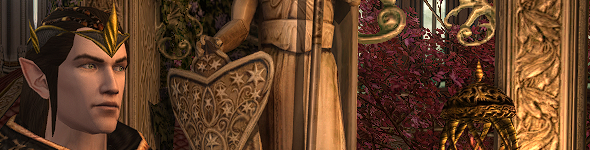
Gaelhadhîr
| Name | Gaelhadhir |
|---|---|
| Status | Active |
| Occupation | Way-Warden of Routes of Pilgrimage, Friend to the Wandering Companies. |
| Age | Old |
| Race | Elf |
|---|---|
| Residence | Wanderer, recently abiding in Imladris. |
| Kinship |
| Outward Appearance | - Hair the deep dark of a forest-pitch night, adorned in places with rings, threads, and beads of silver and gold. A single bead of blue therein, a flawless lapis-like enamel of a depth which resists all but the most plumbing attention.
Eyes a green-blown grey, as moss cloched in silver glass.
Arrayed either in the mantle of war or in the trappings of rest and ease; the elf you behold looks much as many of his kin do: so far as you yourself are accustomed to seeing them. -
As with many among the Quendi, a voice may be songlike even when not raised in song, and Gaelhadhir’s music is sonorous, soul-steeped, and searching. -
A weight of consideration hangs in the air about this elf just heavy enough that his brow shows the faintest, faintest few furrows. -
When he stands still, he stands exemplary. Either with enthused attention at an evening’s meet, or clad in battle-raiment and with spear and shield in hand: statuesque not in the sense only of being handsome per convention, well-built, and finely cut; but in embodying the essence of the way-guardian, the gate-warder: of that which keeps harm out of home, and away from those whom he earnestly attends. -
Without discord, his fragrances offer the barest deviation from the mute and innate: only so much as the crest of a river rock breaking through the gloss of water’s rush. Meddling in the flow such as this does not hinder or halt but instills play, creates beauty: new rivulets in the fabric of company assembled. -
- |
|---|
Background
Of the Father-Name Cánofarion, and Mother-Name Vórlenonwë: the High Elf known in the Third Age as Gaelhadhîr came into adulthood just as the first fell weapons were being forged between Y.T. 1410 and Y.T. 1490.
Through the latter days of his youth he was endowed of the name Carcarmo, and was appreciated as a gifted toolmaker: making particularly those tools which rendered other tools. As such, at the nascence of weapons made not-to-hunt, he was approached by those fellow Noldor within the House of Fingolfin who had drank of Melkor’s proliferated unrest and paranoia; and of the quiet panic wrought by Fëanor’s increasingly brash overtures.
The young Noldo fell heartily in with the new work of weapon-making, with his own fears playing alongside a fresh and emboldened fascination. He became taken also with the wearing of a great shield, as did others: marked with subtle devices identifying himself as one amongst a kindred of hidden craftsfolk; and of the Elves under Fingolfin who made themselves prepared to unknown end, whether their lord knew it or not.
Carcarmo’s natural and pervasive delight in novelty, newness, and innovation saw him take, by progression, to what would become ‘soldiering’ as an art-form itself.
Before this, he had felt it difficult to distinguish himself versus the many virtues of his brother: his elder, an excellent student of many arts, and much-celebrated at home and in wider court. All that Carcarmo would make, his brother would turn to better; and even his greatest works; his finest edges, his most precise bores - such tools as ought be beloved themselves - were overshadowed by what other works required them.
To his mind; at a time in which war was all but unknown, soldiering would become something which was his own. An enfolding of much new discipline, form, and theory, and a route to the greater esteem he sought from his people.
It was so, but with sobering cost. By then an adult, and being called Caramacaro, he was present at the First Kinslaying at Alqualondë, attached to the rearguard of Fingolfin’s host.
Coming late to the fray and near the instant the mistake was realised; beginning only then to ripple throughout those so direly assembled; Caramacaro was subsumed with a powerful and arresting grief, and for the only time in his long life: abandoned arms.
He surged forwards as best he could unprotected and, bellowing and crying, set about the work of separating those at-blows. But in the thick of those amassed before him, and the heedless yet further on: too many remained out-of-reach, and he bore this shame deeply. To this day he bears in his heart a secret name, born of this tragedy.
He swore off the use of swords thereafter, inwardly asserting that the protection of his people could be maintained by spear and by bow alone; such tools as the Elves were all but born to; and by shield, which was to him the most worthy of inventions in this endeavour.
His love for craft itself however was not dissuaded, and he loves yet all things well-made. More than this, he loves to read the nature of a tool in the path it has left in its work: a love which makes of itself a skill bearing many uses. He will not, though, make weaponry himself; instead preferring to lend his remaining skill to the armouring and outfitting of those least-protected.
Feeling that redemption would not be found nor earned within the bounds of Aman, Caramacaro endured the long crossing of the Helcaraxë alongside others of the Noldorin Exiles.
Throughout the Wars of Beleriand he held a position of watch in varied locales about Eastern Hithlum and in the rearguard of Fingolfin’s forces whilst they were united. Come the Dagor Bragollach, and Fingolfin’s fatal and heroic duel, Caramacaro (now of the roughly Sindarised form ‘Cadrammagor’) found his way to the service of Turgon in Gondolin.
His entrance to Gondolin was hard-won, and well paid-for. From the lives of the House of Hador dearly laid down to bolster the elven retreat, to the journey made amidst tides and knots of orcs made proud: Cadrammagor, leading some few survivors from battered Eithel Sirion, had espied the route of Thorondor travelling South by the cut of the Eagle-King’s wings and the weft of the airs as a wake about him; and, to his great grief: the glint of the silver-clad form that the eagle bore up.
Strange skill and strange chance were not alone at play in this eking from place to place. At once bane and balm of his heart and mind, and worn between the two, lay a brace of tokens given to him by a Telerin Elf-maid. Each bore a single tengwa made distillate from their words, from thought, and that thought from woven song: each bearing ever a truth of what is best in water and best in Elf and what of each calls to the other. The world-long thread tended by Ulmo and oft tugged-upon by Ossë: the whisper of water to elven ears itself, made as beads set within a torc, helped him there.
By merit of these jewels, his survivorship, soldiering pedigree, and further agreed-upon terms: in Gondolin itself he began the duty of his watch at the Gate of Wood under close eye of Elemmakil. Later he went on, with others, to represent the Outer Guard upon the high plains overlooking Tumladen. He did not march with the ten-thousand Gondolindrim to what became the Nirnaeth Arnoediad, as he stood his charge once more at the Dark Gate - vainly hopeful of their return. What fraction did come again to those gates bore a tale so alike his own first coming there, that he scorned himself for his absence on the field.
Forty-two years later, the eve preceding the Gates of Summer brought bold tidings to Cadrammagor. A chieftain from beyond the new Gate of Steel informed him with a glad embrace that he was to be recognised and uplifted. Uplifted not just in rank, but within the House of Fingolfin alike, for a simple coat of arms lay drafted for his use in one of the towers of the city. He was to receive this alongside others so-honoured after the ebb of the next day’s great song, when all throats made parched would be quenched in young wine and cool water. Despite some confliction, Cadrammagor accepted.
It was making himself ready for this honour which removed him, once again, to a place of grace. Set apart from the guard and apart from the hosts of Gondolin’s army, as one among many of newcoming privilege, he was placed close to Elves of surpassing dignity in the formation of the silent choir come midnight.
What came before the break of that day cast such a shadow as to render it in memory utterly dawnless. No song was raised, no endowment received, and blazonry unknown would remain unemblazoned and unclaimed. Taking immediately to guarding those nearest, hampered though minutely by unfamiliar ceremonial dress, his good fortune and virtue put him among some bestowed with the confidence of Idril’s secret way; the entrance of which he covertly defended until the coming of Tuor and Idril and their quick urging onward. A good thing amidst much ill that Cadrammagor adjoined himself to this company, for the dangers these new exiles faced on their way to Nan-tathren were unhalting. This laid upon him a familiar charge and for the sakes of the refugees he was glad of it, albeit grimly so.
Taking least respite at that migration’s end, he moved swiftly on from the Havens of Sirion to the Isle of Balar. There he made what report he could to those who asked it of him, and pledged himself to the command of the last High King of the Noldor in Middle-earth, Ereinion Gil-galad.
Too short a time after came the march of the last of the sons of Fëanor upon the refuge at the Mouths of Sirion, whereafter Cadrammagor sailed in upon the late-coming ships with a fury and anguish made fractal. This he sought to purge from himself in the work of setting survivors seawards to safety, until he was stooped with exhaustion and heedless of any thought whether it were good or ill. The marring shadow of this new kinslaying burned its mark in him as its forebear had, and the name pitted within his heart spoke itself inwardly once again. Hereafter he gazed a long while Westward, and wondered.
Through the decades of the War of Wrath Cadrammagor was made busy with a great span of duties. The defence of the Isle of Balar itself, and the Mouths of Sirion up through Nan-tathren proved vital for parts of the conflict, providing a waning route for the egress of refugees, as well as a second prong to the Host of the Valar’s landing held at Eglarest. From this naval foothold different fronts across the West of Beleriand and what could be reached from the warps of the River Sirion could be supported or retreated, even as the land began to pock and crack ever the worse. Cadrammagor held station on many of these ships, and at many of these landings and flights.
Come the end of that vengeful conflict, the end of the hated foe Morgoth, and the drowning of wondrous and tragic Beleriand, Cadrammagor took up with those gone to Lindon under Gil-galad. Having been weighed upon heavily since his first coming to Middle-earth, he was retained there through much of the War of the Elves and Sauron. Having foregone any manner of restful healing for far too long a time, there he would be attended insistently by healers, slowly drawing into better unity the parts of his self. To this he submitted due in no small part to a fear of returning to Valinor, even under pardon.
In the wards of Lindon he would exchange riddles and verse with wardmates fondly, which proved a healing all its own. While the slowly-wearing rigours upon his body were alike well-tended, for his heart, none better could be done than the straight steps that came in one gilded evening of one last seen as a child, and as a child himself. A piece of his thought-lost West had come to him.
It was in his flight from Gondolin that Cadrammagor had most nearly met his end. An orc-blow that sought to cleave him at the neck instead found the inner core of the torc he wore, and the orc was repelled and slain in a tide of others. The torc, though, was rent beyond use, and one of its lapis-like adornments shot far-off at the force of the strike weathered. The bruise and bone-crack had long since left him, but he felt it anew and the absence of the torc as a freshened pang: for here was the one who had bestowed it to him long ago.
As children of court, the boy Cánofarion and the girl Colmarilliel were on occasion called upon to act as pages to their families and houses. On one occasion of friendship between Noldor and Teleri, each was honoured with bearing adorned chests in an exchange of things beloved both natural and made: jewels for pearls, and craft for craft.
It was at this meeting that the two recognised one another in the way of those Elves who come to love do, and so the assembled did recognise them also. There and then, in grand gesture, the two kinships began to celebrate the fated betrothal of their issue. To this end, from each their borne chests, Cánofarion and Colmarilliel were instructed, invited, to outlift the finest jewel to their eye and make it a gift to the other. To Cánofarion, by Colmarilliel’s hand, was given the now-storied water-torc. To Colmarilliel, by Cánofarion’s hand, was given a great and subtle Noldorin lamp-mote; whose stories are told elsewhere.
Colmarilliel, later called Carethril, was there, now. Having left the shores of Aman early of the War of Wrath, she appeared to Lindon along with a good many who found for themselves a duty in Middle-earth, by the many arduous routes entangled there.
There was glad reunion between the two, and thanks and forgiveness: all worry became denied its hold, and there followed the reconciliation of much pain, and the dispellation of great woe. All fears were laid bare and wide, and burned off as dew in the dawning of their high relief. So followed a private though constrained peace; and, within it, their marriage.
As Cadrammagor became ever the more wholly hale, the bounds and blinkers of that peace waned. At the time of the Sack of Eregion he was not permitted to go-to: not even to the foundling Imladris in the wake of valiant relief repelled. Not until he could no longer be outspoken, or calmed with the press of a hand, nor the threat of reward, would he be given blessing to take the field once again. He did so with the Númenórean-reinforced press that staged their part at the Battle of the Gwathló; for seeing those Men come in and recalling their forebears, he could no longer remain in place.
Peace again of a greater form came passing wide through Eriador not long thereafter, and with it a life long-sought. Moved well beyond the youthful and vain clamour of the heights and hopes and dreads of the days of Beleriand, Cadrammagor was now known to the height of his measure among those that knew him at all. He had his beloved with him, now long-banished from fearful thought; and he, less pressed by centuries-weight guilt. His hands took to tools again, and his love of craft renewed. For his soldiership, in the latter years of the Second Age, he was honoured with a place of captaincy of guard at the White Towers of the Tower Hills. Much was gained to be lost again, though not all.
Throughout the War of the Last Alliance, Cadrammagor commanded a compart of a grand rearguard. Over the hard course of that conflict they warded much outgoing of the injured and slain, and much incoming reinforcement. Reinforcement dwindled and so, too, the bearing out of the slain - but not for glad cause. With each passing day the lines of the front and the lines of the back came nearer each to the other by men or by miles, and those that fell were kept hold of by the burgeoning Dead Marshes. The long progress to holding Barad-dûr under siege was costly, as was its eventual breaking, for all that was won by it.
Thereafter he was weighted with the consideration of the place of the Noldor in Middle-earth and his own amongst or without; with Gil-galad lost by violence now one among countless others Cadrammagor had known, both young and old, noble and not. He resolved to take a time abroad upon Middle-earth away from under the banners of others, and to learn a place disentangled of the ambition or legacy of others. Carethril would travel with him, and apart, at different times over the long years.
In whole and for a long while, he became a wanderer. But habit and fondness, over time, had him appear ever increasingly along the seen and unseen routes of his former watch at the Tower Hills. This and more he took to as a private charge, rather than as a matter of command or duty, and over time he became known to those whose steps he guarded as ‘Gaelhadhîr’. Although thought of by some as a benefic phantom only; as the autoexilic nature of Gaelhadhîr’s going-about waned, he came to associate with wandering companies, merchants and their guards, and other travellers. In time he became known anew for his hospitality at camp, and his enjoyment of poetry and riddles from the least adequate and up.
Whatever else may be, love for Middle-earth and the Free Folk has been maintained in the heart of this High Elf, and it is this love which turns Gaelhadhîr from his seatless watch to what fronts now appear versus the encroachment of the returning Enemy.
| Friends | |
|---|---|
| Relatives | Carethril, Wife. |
| Rivals/Enemies |
| Loves | The peace under stars, company either firm or fleeting, craft which serves many by its use or its beauty. To watch, to guard, and to make and keep safe that which affords the Free People what bliss there is to be had in Middle Earth. |
|---|---|
| Hates | The Enemy, the shortsighted, the weapon-minded, those who love and create not to love and create but to have and hold alone. |
| Motivation | After a long time cloistered in duty, holding himself selfishly apart; an increase in road-chatter speaking of the Shadow sets Gaelhadhir seeking his people, that he may lend his strength against what surely comes. |
| Quotes | Is it truly so, then: the state of the world? That it, once again, must be fought for? |
Gaelhadhir's Adventures
| A Winter Flitfrit: Elf-High in Emerald | 1 year 6 months ago |
| A Blight on the Banks of Mitheithel - First Entry | 1 year 10 months ago |
| A Riddle, and Run of Clues | 1 year 11 months ago |
| A Riddle, and Brace of Clues | 2 years 2 weeks ago |