"I wandered in Summer in the elm-woods of Ossiriand.
Ah! the light and the music in the Summer by the Seven Rivers of Ossir!
And I thought that was best."
- The Lord of the Rings, The Two Towers, "Treebeard"
.: The Coming of the Green-elves to Ossiriand :.
Ever have my kin dwelt within the greenwoods that skirt the mountains of Harlindon. For my forebears came to Ossiriand, the Land of Seven Rivers, in the Years of the Trees, long ago, ere the Great Sea rode in upon the land and Beleriand was forever lost. Indeed, before even the coming of the High Elves from the Uttermost West.
It is told that it was they who named our woodland home 'Lindon', Land of Music, in their tongue for the singing of the Nandor therein could be heard even across the swift waters of River Gelion1 -- although this is said chiefly by the Noldor themselves! But I deem this claim untrue, for our lore deems it was indeed my kin who gave Lindon its name, which was Lindânâ in our ancient tongue of the Elder Days.
And it was the Grey-elves who first called the people of Denethor 'Green-elves', that is Laegrim in their Sindarin tongue, but the Noldor named us in Quenya the Laiquendi; yet my kindred called themselves by their old clan-name Lindi in Nandorin,2 which we yet name ourselves in these latter days.
But the Sindar knew the Lindi as kinsfolk whose tongue was akin to their own; thus they took up the names Lindi and Lindon, yet gave to them the forms Lindil or Lindedhil, and Dor Lindon; Lindónë, the High Elves called it. Or so the esteemed lore-keepers of our clan tell it, and I cannot gainsay them.
Most elf-children first learn their reckoning lore by way of the tale of Cuivienyarna: the awakening of the Firstborn upon the starlit shores of Cuiviénen, Water of Awakening, which the Sindar name Nen Echui. One, two, three -- min, tata, enel -- the Elf-fathers arose from the sleep of Eru Ilúvatar and were named therefore Imin, Tata, and Enel; and with their spouses they chose their followers from the Unbegotten, the First Elves, and thus formed the Three Clans: the Minyar, Imin and Iminyë with their twelve companions; the Tatyar, Tata and Tatië with their four and fifty companions; and the Nelyar, Enel and Enelyë with their two and seventy companions.3
The Nelyar thus numbered four and seventy and was therefore the largest company and they became the forebears of the Teleri, but in those Elder Days they named themselves Lindar, that is "Singers". Therefore, a long age ago, they were also the forefathers and foremothers of Feveren son of Gladlin!
Long they dwelt and flourished in Cuiviénen and Oromë Tauron, Lord of Forests, was first among the Valar to find the Elves therein; and he learned to his dismay that the shadow of Melkor lay already upon them, and so after long debate the Powers of Arda came forth from Aman to assault the strongholds of the Great Enemy, whereafter they summoned the Elves to Aman to gather in the Light of the Two Trees forever.
But the Elves were at first unwilling to heed the summons, for they knew little of the Valar save for the rumour of their wrath in the War of the Powers and their hearts were filled with dread. Therefore three emissaries were chosen, one from each clan, and they were Ingwë from the Minyar, Finwë from the Tatyar, and Elwë from the Nelyar; and they journeyed thence to the Blessed Realm and beheld in awe the majesty of the Valar and the splendour of silver Telperion and golden Laurelin, but the tales tell not of the manner of their passage!
Yet depart they did, and erelong returned to Nen Echui whereupon a Debate was held, in which the ambassadors counselled the Elves to hearken to the summons. Thus spake Elwë:
"I will go with my friend, but I do not choose for anyone but myself. Let all my folk do likewise. We are a great company -- the most given to wandering afar. Let many of us at least go with the safe conduct of Lord Oromë and see what Endor is like, and the Sea! We need not pass the shores!"4
And with these words the Nelyar especially were deeply moved, and the most part of the Elven-folk, but not all, were thus swayed to depart. But I deem his words sad, for looking back at the Elder Days, far removed through years uncounted, and with hindsight and the knowledge that Elwë was indeed doomed to become Elu Thingol, King of Doriath and Lord of Beleriand someday, brings sorrow to my heart; for, alas, never more did he cross the Sea!
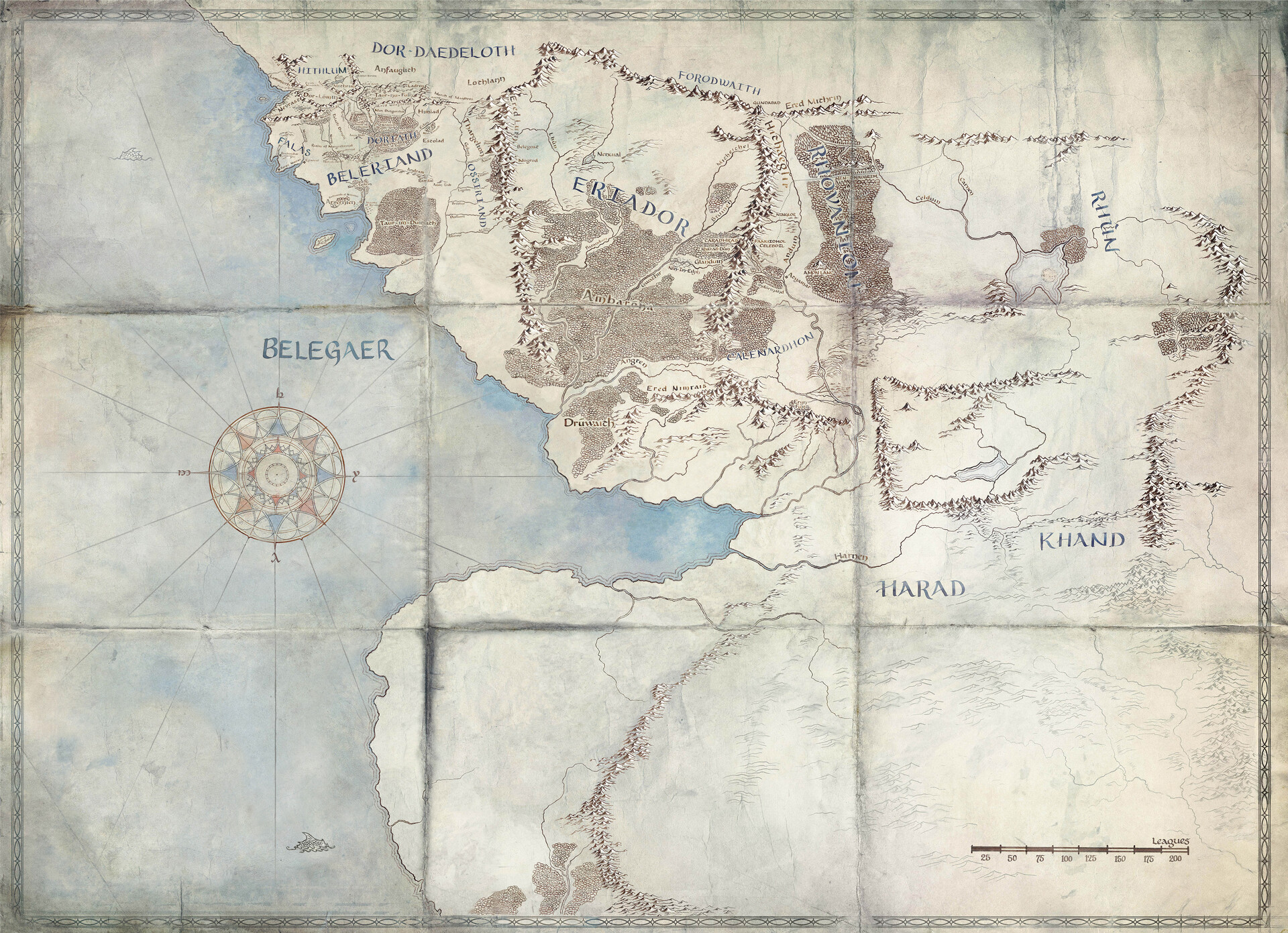
Thus were the Elves sundered into the Avari, the Unwilling, and the Eldar who followed the Great Rider, and they were doomed to meet never again until many ages were past. And the Eldar set forth in three hosts: first the Minyar or Vanyar, as they now named themselves, led by Ingwë; then came the Tatyar or Noldor, led by Finwë; and last the Nelyar or Lindar, ever the least eager to reach the shores of the Western Sea and forsake the lands of Middle-earth, and thus they were called Teleri, "the hindmost", by the High Elves. They were the greatest in number and therefore had two lords: Elwë and his brother Olwë.
Leagues upon leagues they marched, yet not in haste for they were filled with wonder at all that they saw; and passing northward about the Sea of Helcar, they turned towards the Sea of Rhûn. Here they tarried long before proceeding on, for it was a pleasant land and not a few elf-children were begotten there in the quiet of the world, and they were not yet able to travel until they were further grown.5
Removing thereafter past the Sea of Rhûn, the Eldar found wide grasslands of grain, and there they learned much from Oromë of the sowing and reaping thereof in the years that followed,5 ere they again took up the March. Then nigh the eaves of Greenwood the Great they again lingered, until Oromë returned from his labours to lead the Vanyar and Noldor through the Great Forest; the Lindar, coming hindmost as was their wont, came thither too late! But evil creatures of Melkor crept within the woods, and bereft of the aid of Oromë, they were compelled to skirt the southernmost reaches of the perilous woodland.5
And it came to pass that the Lindar at last overtook the elven-host alongside the Great River in the Vales of Anduin, where they dwelt at Atyamar, the "Second Home" of the Eldar; for that land between the greenwood and wide water was rich in fragrant flowers and wholesome food and they fared well, and in their delight they would fain make there a lasting abode (which ill pleased their chieftains, who were eager to return to Valinor and the Light that they had beheld!)
Many elf-children were begotten to the Vanyar and Noldor ere the Lindar came to Atyamar, and they were swift to do likewise. (It should here be said that the Elven-folk were more fruitful aforetimes, for they much desired to swiftly people the empty world!)5

Then came the onset of a bitter winter, and the chiefs bade that erelong an advance be made to cross the Anduin, whereat the Lindar made a great boat-building; but many of their number were against the crossing, for the wide and wild river was flooded with snow-melt from the Hithaeglir, the Mountains of Mist.5 And therefore from among the host of Olwë a large company of Lindar, led by Denweg, forsook the westward march to remain at Atyamar, and thus they were named the Nandor, "Those who go back" by the Eldar; yet thenceforth they called themselves Lindi, which grew from the name Lindē that means Lindar in their speech. (Also, Denweg was called Lenwë by the Eldar.)
Long the Lindi dwelt in contentment at Atyamar in the Vales of Anduin, and slowly they spread; some removed southwards down the Anduin, yet others passed between the Hithaeglir and Eryd Nimrais, the White Mountains, and into the wilds of Eriador. Alas, they were beset by fell beasts of the North, for while Melkor was taken by the Valar after the Great Battle, not all of his evil creatures perished and they multiplied in the darkness; and even ere the return of Morgoth were roaming the wild lands east of the Blue Mountains.
Now the Nandor were but lightly armed, for they were woodland folk and knew little of weapon-craft, and were afeared. Therefore Denethor son of Denweg thought to seek refuge in the realm of Elu Thingol, and he gathered together his scattered folk and led them over the Blue Mountains into starlit Ossiriand, the Land of Seven Rivers, filled with green woods wide and fair.6 There they were welcomed by Thingol, as kin long lost that return, and abode thereafter in the forests between the River Gelion and Eryd Luin, for it was a great country, and yet little peopled.7 Moreover, they dwelt in the protection of the Seven Streams, for after Sirion, Ulmo loved Gelion above all the waters of the western world.1
Meanwhile, the other Eldar, after many travails, for the most part reached the western shores of Beleriand and passed thence over the Sea, but this tale speaks of them no more.
And here in Eryn Milbar8 we yet dwell amidst the beech and oak and elm, beside swift Brilthor of old that aforetime lay southwards of Legolin, and still falls steeply down from Ered Lindon and thence flows into Belegaer, the Western Sea. Alas, the power of the Lord of Waters has long withdrawn from the flowing waters of Middle-earth; yet ever and anon I deem that I can hear sweet voices singing, mingled with the sound of the rushing mountain-streams. Or perhaps it is not the music of Ulmo, but another water-spirit? For it is told that there were many others besides Ossë and Uinen!9
* * *
Thus have I, Feveren son of Gladlin, set forth this tale that I learned in my childhood. Hopefully, I remember it aright as it was told of old, but, alas, I am no loremaster!

* * *
In Ossiriand dwelt the Green-elves, in the protection of their rivers; for after Sirion Ulmo loved Gelion above all the waters of the western world. The woodcraft of the Elves of Ossiriand was such that a stranger might pass through their land from end to end and see none of them. They were clad in green in spring and summer, and the sound of their singing could be heard even across the waters of Gelion; wherefore the Noldor named that country Lindon, the land of music, and the mountains beyond they named Ered Lindon, for they first saw them from Ossiriand.
- The Silmarillion, "Quenta Silmarillion: Of Beleriand and its Realms"
1. "... the sound of their singing could be heard even across the waters of Gelion; wherefore the Noldor named that country Lindon, the land of music [...]"
- The Silmarillion, "Quenta Silmarillion: Of Beleriand and its Realms"
2. "This name they at first applied to the Nandor that came into Eastern Beleriand [Ossiriand]; but this people still called themselves by the old clan-name *Lindai, which had at that time taken the form Lindi in their tongue."
- The War of the Jewels, "Part Four. Quendi and Eldar: C. The Clan-names [...]"
3. "According to the legend, preserved in almost identical form among both the Elves of Aman and the Sindar, the Three Clans were in the beginning derived from the three Elf-fathers: Imin, Tata, and Enel (se. One, Two, Three), and those whom each chose to join his following. So they had at first simply the names Minyar 'Firsts', Tatyar 'Seconds', and Nelyar 'Thirds'. These numbered, out of the original 144 Elves that first awoke, 14, 56, and 74; and these proportions were approximately maintained until the Separation."
- The War of the Jewels, "Part Four. Quendi and Eldar: Appendix: The legend of the Awaking of the Quendi (Cuivienyarna)"
4. The Nature of Middle-earth, "Part One. Time and Ageing: XIII. Key Dates"
5. The Nature of Middle-earth, "Part One. Time and Ageing: VII. The March of the Quendi"
6. "About the year of the Valar 2700, and nearly 300 years of the Valar ere the return of the [Noldor], while the world was still dark, the Green-elves, that were called in their own tongue Danas, the followers of Dan [Lenwë], came also into eastern Beleriand, and dwelt in that region which is called Ossiriand, the Land of Seven Rivers, beneath the western slopes of Ered Lindon."
- The Lost Road and Other Writings, "Part 2: Valinor and Middle-Earth Before the Lord of the Rings, VI. Quenta Silmarillion"
7. "Therefore Denethor, the son of Dan, hearing rumour of the might of Thingol and his majesty, and of the peace of his realm, gathered such host of his scattered folk as he could and led them over the mountains into Beleriand. There they were welcomed by Thingol, as kin long lost that return, and they dwelt in Ossiriand in the south of his kingdom. For it was a great country, and yet little peopled [...]"
- The War of the Jewels, "Part One. The Grey Annals"
8. Eryn Milbar = "Forest Home" or "Beloved Forest Dwelling"
eryn - S. forest, wood of trees.
milbar - S. dear home, beloved dwelling [place] (PE17, Sindarin Corpus)
9. "... and Ossë and Uinen also, to whom he gave the government of the waves and the movements of the Inner Seas, and many other spirits beside."
- The Silmarillion, "Quenta Silmarillion: Of the Beginning of Days"
Tengwar Cursive font by Harri Perälä
 |
i |
 |