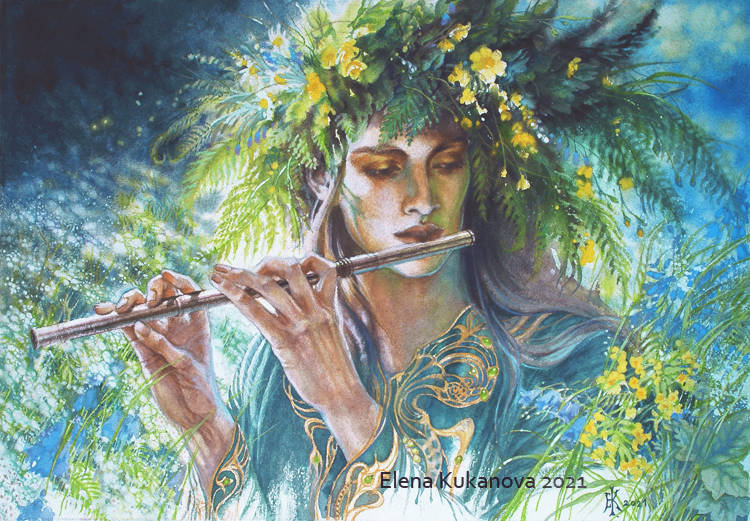
With a cry of wild joy Feveren ran naked along the wooden pier, the creaking planks thudding softly beneath his elven footfall; they felt rough beneath his feet, the hardwood dented and worn from uncounted years of traffic and labour. A cool autumn wind suddenly gusted down from the far mountains and swept along the vale of the Lhûn, bringing with it a cloud of pink and white petals that swirled around the young elf as he ran, catching in his long dark hair as it streamed out behind him, then dropping to gently float upon the rippling river.
Before him it lay, clean and inviting, and at the boardwalk's end he sprang; leaping aloft, he tumbled head over heels and splashed noisily into its depths. Then with slow easy strokes, he drew himself through the cool water, and he felt the stain of travel and all weariness wash from his limbs.
And in his heart he hoped ever to hear the voice of Ulmo, yet he well knew that the Lord of Waters was long withdrawn from the flowing waters of the world, and his music would never again be heard in Middle-earth by elven ears. For although he was an Elf of the Darkness who had never beheld the Light of the Two Trees and to whom the Powers of the World were but names in song; yet by those songs his kin knew well the names of Elbereth Star-kindler, and Ivann the Giver of Fruits, and Ulmo the Dweller of the Deep.
But it was not the Lords of the West themselves that the Green-elves held in reverence, but their great handiworks; and it was of these he sang as he swam: the green and glad, the mountains and waters, the Sun and Moon, and the kindled stars. And still he sang while he washed clean his travel-soiled tunic and breeches, and as he hung his wet clothes upon a bush to dry, pinned with thorns against the wind. There he lay down beside them and basked naked in the pale sunlight, humming softly; his eyelids were closed against the bright autumn sky, and with his keen woodland ears he hearkened to the grumbling of the fishermen standing upon the docks, bemoaning the splash that had frightened the fish, or laughing loftily at the rough, wild ways of rustics from the south.
Feveren grinned merrily at the scudding clouds.
The echo of the noon-bell's1 ring was fading when at last Feveren clad himself in his clean, but somewhat damp, clothing and settled his small pack onto his shoulders. He ran his fingers through his hair, dislodging a few pink petals and a tiny green-leaved twig, and lastly he tightened the bracelets on his wrists: these were thin thongs of leather threaded with small shining stones that glittered in the sun, and gleaming bangles of fine woven copper. Faethurin, his friend, had oft called him "magpie" in jest, for Feveren had treasured his "jewels" even as an elf-child; they told a story, he had said.
The sun had climbed above the clouds and was shining overhead, making the white stone walls gleam radiantly upon the western slopes above. Feveren flicked his staff up from the ground with his toes, and caught it deftly in his hand with a wide grin: the ancient elf-city of Celondim awaited him.
* * *
Feveren climbed again the stair where he had before met Mibrethil, but the High-elf was there no longer. Beneath his feet the paving stones felt warm and cheerful compared with the unfriendly coldness they had exuded at early light, and his eyes were dazzled when he looked up westwards at the crafting terrace whereof the High-elf had told; but he could hear clearly the varied sounds of toil that drifted down along the breeze: the tapping of hammers, the ringing of anvils, the sawing and hammering of wood, and the scraping of raw hides. And from ovens came wafting the rich smells of baking cakes and breads, and simmering soups and stews, and fresh river-fish grilling upon sizzling coals; and from Feveren's belly there came a loud hungry growl. From a pouch girt about his waist he withdrew the last of the sweet windfall apples he had gathered along his road, and he munched it as he stood in silent thought, watching the small elven figures strolling along the quays below.
In his mind Feveren thought that he was now accustomed to elven-cities, for he had visited the port of Harlond thrice before and had tarried for some days when he passed through great Mithlond on his road hither (but never had he slept within the stone-wrought city-walls, choosing instead to camp beneath the glittering stars in a nearby wood.) Yet in his heart he knew he was a newcomer in a world far different from his simple forest life. For though Celondim was fashioned by Elves and thus encompassed their inherent elven virtue, its pervading enchantment lacked the subtle potency that he always felt amid the singing groves of his home-forest. And in his mind he deemed the love of the Elves of Celondim held for their land seemed somewhat less, or perhaps that it was different somehow; but how precisely, Feveren knew not.
Perhaps it was that the green-shadowed woodlands were still wild and vigorous, while the elven-cities seemed too fixed and ordered for his liking. Here bells tolled out the daytime hours, carving up the stream of time to measure out each day; but to his kin time was reckoned by the ever turning seasons, and the passage of the Moon, and the Sun and the swirling stars. Or maybe that beneath the boughs of oak and elm, life was lived simply for the pure joy of being alive in Middle-earth, but the elves here seemed to live with purpose, or for purpose, rather.
For in his speech with city-elves, sparse though as it was, he oft found that they yearned for the simple life they said was natural to the Firstborn ere the Great Journey,2 saying, 'From this summons came many woes that afterwards befell,'3 and secretly they longed for his rustic life. But for all the pride this engendered in his heart, he marked also that they were otherwise content to count the passing days of Middle-earth, and await the hour that they would depart over the Sea; for in his youthful boldness, he could not fathom the weariness of spirit that the elder elves endured, after dwelling long, long years in the waking world.

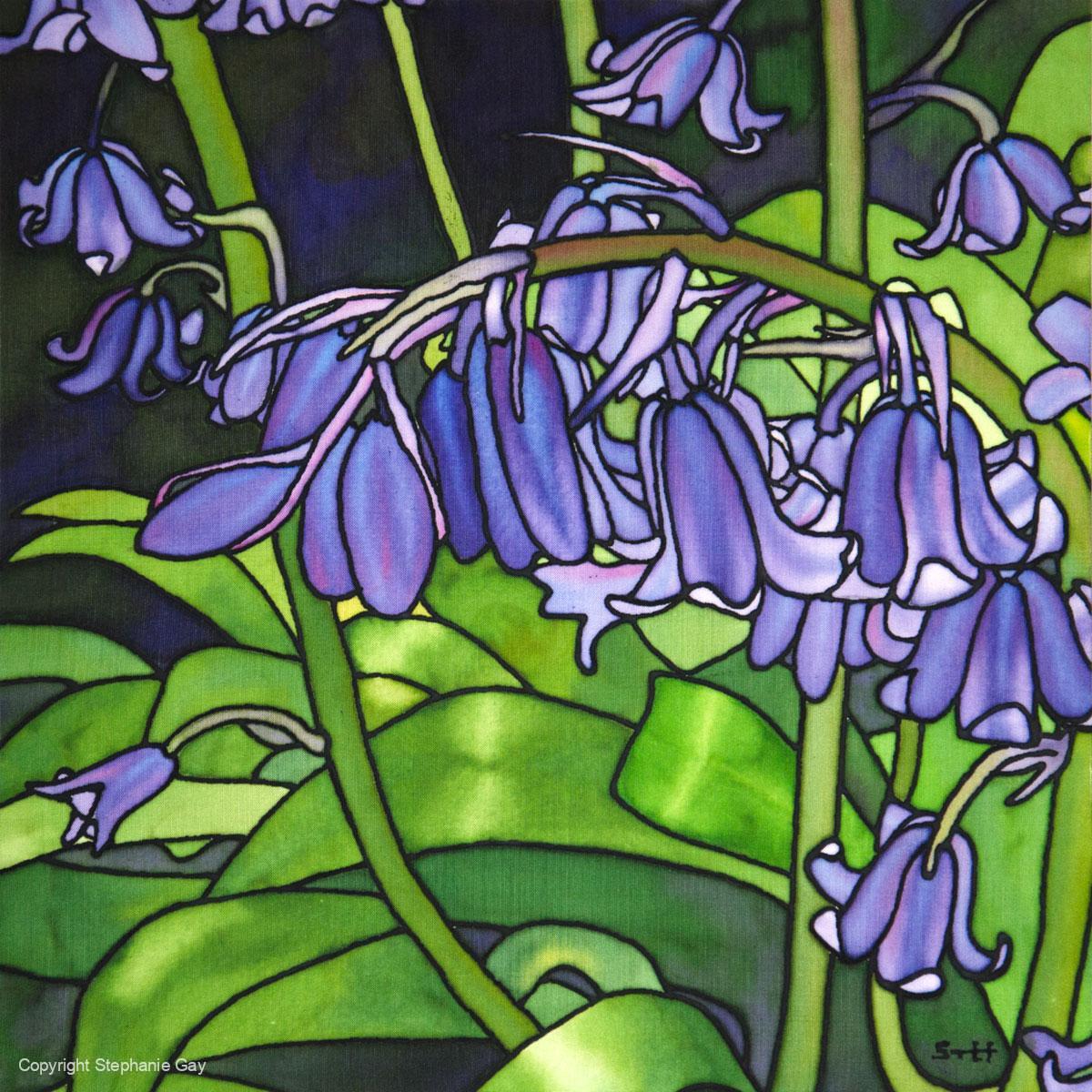
Another stair he climbed, up past a minstrel strumming on her lute, and atop it a path led southward to the crafting terrace; there he sought Gwaloth, the friend of Mibrethil. He found at last an elf-lady whose raiment brought to his mind fields of forest bluebells in the Spring; she said her name was Gwaloth and he told her of his purpose.
'Mibrethil sent you to me?' she asked. 'You must be interested in learning a crafting trade, then? Wonderful! Ered Luin will be better for your efforts, my friend!'
Now Feveren was unsure how his meager attempts to earn coin would avail the tall mountains, but he smiled and nodded all the same, yet in his face she read that he mistook her words.
'Ered Luin is indeed the name of the high mountains, but we give it also to the lands that lie within their eaves, between the peaks and the running river in the East,' she explained, yet in his mind he still knew not how his efforts would aid the land, but he did not speak aloud his thought, nor show it on his face this time.
'Is not that land even now part of the elven-realm called Lindon?' he asked instead.
'Indeed it is,' Gwaloth answered, and then she frowned. 'But I know not why we should name it otherwise, yet ever have we done so. How curious! Perhaps Ereinion Gil-galad, the High King of the Elves of the West, himself licenced that it should be so? I know not.'
And then she went on to list a number of people who would counsel him in his desire. There were nine by Feveren's count: novices of seven divers arts or crafts who were eager to share their skills and lore, and their Master who would offer wise guidance about his chosen trade, and last, a supplier of vital tools and instruments.
'Be not over-shy with your coinpurse!' Gwaloth said to him, and Feveren groaned. 'Indeed!' he thought, 'If I gather coins, I need someplace to hold the accursed things!' Gwaloth would no doubt tell him only whence he might buy one should he ask, so he guessed that he best make his own plan.
Of the novices listed by Gwaloth, five were elf-wrights who wrought with either the metals of the earth, or the wood of hewn trees, or with woven cloth and cured leather hides. Of the remainder, one tended the great ovens and cooking hearths that had teased his hunger; the other, to his wonder, was a scribe. That folk would pay for written words had never come into his mind, and this was a skill that he indeed knew well enough, for the Grey-elves who took refuge among the Lindil4 in Lindon had taught the runes and letters5 to those Green-elves who were willing and eager to learn. Feveren had himself been instructed in the art by Dimaethor, father of Faethurin,6 and together the two friends had taken boyish delight in scratching messages to one another in elf-runes upon stone or wood, and leaving them secretly in the forest to be discovered by the other.
Feveren sat with his legs crossed upon the terrace floor, and for a while he watched the hale elven-smiths as they crafted arms and armour in their fiery forges and furnaces, sweating from their labours in the sweltering heat. In his heart he knew that this was not the trade for him, for to his woodland ears the banging hammers and clanging anvils were a violent and painful discord; and besides, the work looked far too toilsome to his mind.
He could cook on a campfire well enough (and he was the friend of birds and beasts, and had no desire to eat them), and he could repair his own gear if need be, therefore those trades held no allure; but when he spied the enchanting work of the jewel-wright it brought joy to his heart. His name, he said, was Haldan, but he downplayed the delicate finery that he had spun from silver and woven in gold, and set with stones like twinkling stars.
'Many of our finest smiths and traders have departed to the west,' he said in sorrow, 'I am but that which is left.'
The magpie eyes of Feveren were enrapt by the sparkle of the stones set within, and the soft gleam of burnished rings, and circlets, and necklaces, and bracelets! O, what bracelets! Each was a song of love in filigree, and the young elf looked wistfully at his own entwined wrists for a moment but then he smiled, for his homespun braids sang their own tale of love too.
'I deem your handiwork is equal to the cunning hands of the Gwaith-i-Mírdain,7' he told the elf-wright in earnest, for into his mind had come the name of Celebrimbor and the tales of his folk long ago, and Haldan smiled at this praise.
'Alas for the ruin of Ost-in-Edhil8 and the defilement of Telperinquar.9 There may yet dwell some of those selfsame Elven-smiths within the House of Elrond,' Haldan said, 'But, alas, I know not for sure.'
Mindful of the counsel of Gwaloth, Feveren wandered along the paved pathway to where stood Golphedinir, the Master of Apprentices. There he hoped to receive the Master's guidance regarding the work of both the jewel-smith and the scribe.
'I am here to help you through the very first stages of learning a craft,' Golphedinir said as the elf-lad came near. 'If you have any questions, feel free to ask me.'
'I give thanks to you,' said Feveren with a bow, 'for it would ease my heart to learn a craft here in Celondim,' and he told the Master of his choosing.
'I love to wear rings and bangles,' the elder elf chortled in reply. 'Perhaps when you are more experienced, you can make me some finery!' But a frown creased the brow of the young Green-elf. 'What manner of guidance is this?' he wondered. Golphedinir went on, unheeding of the Feveren's growing glower. 'The study of the past is a pursuit that provides us with insight into our elders and the ways that they chose.' And to the mind of Feveren came the childhood memory of lessons of Dimaethor; for once he had learned the skills of reading and writing he loved them with all his heart, but to his mind the learning thereof had been somewhat irksome.
'But I desire only to scribe, not to ponder lore!' he objected.
'Scholars study the ancient past to divine the secrets that were kept there,' argued the old Master, 'They...'
But Feveren held up his thin hand to end the debate. 'It is not my wish to be a loremaster,' he said, adding, 'Nor a 'scholar'! I thought only to earn some easy coin to help me on my way, not to confine myself to the gloom of dusty book-hoards until the world ends!' This picture had formed within his mind while he visited in Mithlond, for the lore-keepers of his clan were Elders who hoarded no books, but kept the songs and stories alive in waking memory.
Golphedinir gave a haughty laugh, 'And whence, think you, come the books and scrolls of those dim hoards? Why, scholars unearth them in the deep dark places in the world, and reveal them to the light of wisdom. So if you crave not learning but adventure, then perhaps the path of treasure-hunter or tomb-robber would better suit your mood, for I deem you have an air of mischief that the learned would not well abide in their solemn halls!'
'I said not that I desired adventure,' Feveren replied hotly, 'But you deem me a thief, and the thought now takes shape in my mischievous mind that perhaps honest toil is but folly, if misdeeds can better fulfill my need!'
'Spare me your callow wrath, child, and heed my words: first, do not gainsay your elders, whose worldliness and wisdom far exceed your own; second, trouble not the scholar with your ill humour, for she is of the Elder Days and ancient beyond years. Thavroniel brooks no affront, least of all from backwoods beggar-boys!' declaimed the Master.
'I do not beg,' the woodland youth retorted in dismay, 'nor do I steal. We backwoods-elves live by far nobler virtues than you imagine in your refined thought!'
'I met a Mornedhel10 once in Taur-i-Melegyrn, long ago in the quiet of the world. You bring the memory of him to my mind,' the elf replied.
* * *
Feveren's heart was still hot when he came to the pavilion of the scribe, and his mood was not cooled by the cold look she cast him. A strange urge to bow came over him, but his mind sharply dismissed the thought, and he held his hands aloft instead; his bracelets glittered in the afternoon sun, and his heart was emboldened.
'Elen síla lúmenn’ omentielvo!'11 he said earnestly, for he was eager to flaunt what little he knew of the High-elven tongue; but the High-elf gave him a thin smile of disdain.
'Man meril, Avar?'12 she scoffed.
Feveren ignored the affront, and spoke with formal courtesy. 'I am told you are Thavroniel. Feveren Tarwardil is my name, and I seek your wise counsel in following your esteemed trade, if you would deign to share it.'
She gave no heed, but kept her piercing gaze upon him. 'Nay,' she said with a shake of her head, 'Of the Laiquendi, to be sure: a Guest-elf of Eglamar.13'
'We name ourselves Lindi,' he said, irked by the elf-woman's manner, 'of Lindon!' It was a point of pride that the realm of Ereinion Gil-galad bore the ancient name of his kindred.
'Yet still no better than the Avari, nonetheless.'
'And we don't call them that!' he said, and a hot wrath blazed up in his heart.
'What then? Do you name them morbin in common Elvish, or perhaps abari in your ancient Telerin tongue? They are the same.'
'Nay,' he frowned, 'we call them kin!'
Thavroniel's eyes narrowed, glittering behind her dark lashes. 'And you wish to learn to scribe?' she asked, and doubt was in her voice. 'It comes to me as a surprise that our rustic kin can either read or write. Can you, really?'
'My teacher was of the Iathrim!'
'O! Indeed? My teacher was of the Iathrim, also. Daeron was his name; you have perhaps heard of him? It was he who first wrought the Certhas Daeron which gave to us the Angerthas Daeron. In Doriath was oft my abode, for the House of Finrod was ever welcome in Menegroth.'
She bent and studied the young elf's uncertain face, 'You know not what I am saying, do you, boy?'
Utterly bewildered, Feveren shook his head. 'No, I do not know that name, but I do know both the letters and the runes,' he managed to say.
The High-elf sighed. 'Show me then your skill with pen and ink,' she commanded, pointing her long finger at a writing desk which held the implements of her art. 'Write for me your name.'
And when he had done so, in his most careful hand, Thavroniel said, ''May I see the scroll you penned?'' and he proudly proffered her the parchment, which she snatched sharply from his grasp.

She took a moment to 'admire' his handiwork, and then she shook her head. 'Your script is inelegant and unpleasing to the eye, and there is ink dripped upon the scroll. It is no good whatsoever!'
The High-elf pointed an accusing finger at his handiwork.
'And what is this atop the page?'
'That is my name written in the Common Tongue'
'I am almost impressed,' she said. 'And how much of the common tongue is known to you?'
'Just how to fashion my name,' said Feveren, abashed.
'Of course,' she smiled with her teeth, and the glint in her eye was unfriendly. 'Yet your runes are passable, so there is that.' Feveren smiled gratefully. 'Alas,' she added,' that they are now little used and mostly forgotten save for loremasters!'14
Taking up the discarded pen she swiftly wrote along the bottom of the page:

'That is your name written in tengwar penmanship, worthy of the art,' she smirked. 'Now begone, young imp, for I have much to do! Practice makes perfect, it is said.'
With a hot cloud growing in his heart, Feveren thought to return to the cool comfort of the flowing waters of the river. But passing again the strumming minstrel, he espied an elf-woman who had not been there before. Curiously, she was clad in bluebell coloured raiment akin to Gwaloth, and she had an air about her that he knew too well, for it was much alike his mother's: a glimmer of the powerful spirit that dwelt within her slender form. She had hands of healing, he did not doubt, and she smiled warmly as he came up to where she sat upon the floor, listening idly to the music of the lute. She beckoned him to sit beside her, and together they shared the shade of a silver birch and spoke softly for a while; and in his heart she marked he had some skill, passed down from his mother, and in his mind she found some little teaching in the art. And for his part he felt a comfort in her presence, so akin was it to Gledhril his mother; but in his mind he did not grasp that this was also from the his heart's loneliness reaching out for the familiar and the beloved.
She was Maegamel, he learned, and was lingering in Celondim ere crossing forever over the Great Sea; but now, she said, her heart told her that one last errand remained. And of the elf-lad's plight, she remarked, 'But you are of the race of Nandor! The knowledge your kindred has of living things is greater than all other Elves in Middle-earth.15 And it is especially of your tree- and herb-lore that I am mindful, for here in Celondim is a teacher who is a master of potions. A good salve is worth its weight in gold!'
This seemed more to Feveren's liking. 'Who is this teacher?' he asked hopefully. But all hope failed in his heart when she replied with a sad smile, 'Alas, it is Thavroniel!'
The night was old, and the thin crescent moon was rising over the hills, when Feveren took his leave and slumped disheartened down to the riverside. This was not the mirthful road he had hoped for in his heart, and a cloud of doubt was growing in his mind; not for the first time he wished Faethurin was there beside him to share his burdens and lighten his heart with his merry laughter. Desperately, he bent his mind on Tol Eressëa, sending his thought over the Sundering Sea; but alas, to no avail. The friendly mind he sought made no answer; nor would it ever, he well knew, while he yet dwelt in Middle-earth.
He stripped bare and waded soundlessly into the lapping waves, and then sank slowly into their wet embrace. And he sang as he swam.
* * *

1. Bells and Bell-ringing in Middle-earth by Martin Hardgrave
2. "They [...] came from Doriath after its ruin and had no desire to leave Middle Earth, nor to be merged with the other Sindar of Beleriand, dominated by the Noldorin exiles for whom the folk of Doriath had no great love. They wished indeed to become Silvan folk and return, as they said, to the simple life natural to the elves before the invitation of the Valar had disturbed it."
- Unfinished Tales, "The History of Galadriel and Celeborn", "Appendix B: The Sindarin Princes of the Silvan Elves"
3. The Silmarillion, "Of the Coming of the Elves and the Captivity of Melkor|
4. Lindil - (S.) the Green-elves; (Nan.) Lindi
5. "The alphabets were of two main, and in origin independent, kinds: the Tengwar or Tîw, here translated as ‘letters’; and the Certar or Cirth, translated as ‘runes’. The Tengwar were devised for writing with brush or pen [...] The Certar were devised and mostly used only for scratched or incised inscriptions."
- The Lord of the Rings, "Appendix E: Writing"
6. "But the neri [elf-men] are more skilled as smiths and wrights, as carvers of wood and stone, and as jewellers. It is they for the most part who compose musics and make the instruments, or devise new ones; *they are the chief poets and students of languages and inventors of words.*
- Morgoth's Ring, "The Laws and Customs Among the Eldar"
7. Gwaith-i-Mírdain means "People of the Jewel Smiths"
8. "The building of the chief city of Eregion, Ost-in-Edhil, was begun in about the year 750 of the Second Age [...] News of these things came to the ears of Sauron, and increased the fears that he felt concerning the coming of the Númenóreans to Lindon and the coasts further south, and their friendship with Gil-galad..."
- Unfinished Tales, "Concerning Galadriel and Celeborn"
9. Quenya name of Celebrimbor, from which his Sindarin name is derived.
10. "If in Sindarin an Avar, as distinct from other kinds of Morben, was intended, he was called Mornedhel."
- The War of the Jewels, "Part Four. Quendi and Eldar: B. Meanings and use of the various terms applied to the Elves and their varieties in Quenya, Telerin, and Sindarin"
11. "A star shines on the hour of our meeting." - The Fellowship of the Ring, "Three is Company"
12. "What do you want, Dark Elf? "
Calling another elf one of the Avari is considered an insult:
Name Calling: Group Identity and the Other among First Age Elves
13. "Of those Nandor who took refuge in Doriath after the fall of Denethor it is said: 'In the event they did not mingle happily with the Teleri of Doriath, and so dwelt mostly in the small land Eglamar, Arthorien under their own chief. Some of them were "darkhearted", though this did not necessarily appear, except under strain or provocation.' 'The chief of the "Guest-elves", as they were called, was given a permanent place in Thingol's council'..."
- The War of the Jewels, "Part One. The Grey Annals"
14. The Longbeard Dwarves therefore adopted the Runes [...] and they adhered to them even far into the Third Age, when they were forgotten by others except the loremasters of Elves and Men.
- The Peoples of Middle-earth, "Of Dwarves and Men"
15. "[The Nandor] became a people apart, unlike their kin, save that they loved water, and dwelt most beside falls and running streams. Greater knowledge they had of living things, tree and herb, bird and beast, than all other Elves."
- Quenta Silmarillion, "Of the Coming of the Elves and the Captivity of Melkor"
* * *
* Much of the NPC dialogue is taken verbatim from the game with some slight embellishment. *
 |
viii |
 |