A Journey of Knowledge in Ennor, on one page

Back to the chronicle “A Journey of Knowledge in Ennor”

All the adventures of this chronicle, the oldest first. 38 in all

1. Amarth faeg! (Evil fate!) {42 Iavas 3018}


Chronicled in Mithlond in the realm of Lindon,
On this the 42nd day of Iavas in the Year 3018 of the Third Age,
By Angollon son of Ioriston the Learned.


Alas! That this day on which I come of age should be one of bitter and grievous loss, not joyous celebration; for with the red dawn came ill tidings, and the shadow of Mordor reached into our home.

My father is dead.

O! To see these words set in ink upon parchment in my own hand, as though by being written here they make real this terrible truth that my heart would sooner not believe.

Adar, nínion an gurth lîn.

He had been visiting in the House of Elrond this past season, and was now journeying home from Imladris to rejoin Naneth and me in commemorating this one-and-fiftieth anniversary of their union in love and my begetting, when his company was waylaid by yrch near the ruins of Amon Sûl. None survived.

Yrch! The revulsion I once felt for these fell creatures of Morgoth, these vile servants of Sauron, is now full grown into hate; that the arm of the Shadow has grown so long as to reach my family in Mithlond, fills me with both bitter despair and a burning desire for vengeance.

As Oromë is my witness, though I am no warrior trained in the art of war, nor have I before committed any violent deed in my brief lifetime, I swear that henceforth I shall hunt down and slay every foul offspring of Morgoth Bauglir that crosses my path, for as long as I linger in Middle-earth. Gurth anin yrch!

This is my oath to your memory, Ioriston of Doriath, my father. Long may I live to fulfil it.

Nínion an gwannad lîn, Adar, savo hîdh nen gurth.

{Next entry}

2. A Wife's Grief {48 Iavas 3018}


Chronicled in Mithlond in the realm of Lindon,
On this the 48th day of Iavas in the Year 3018 of the Third Age.


Six days have passed since the news of the death of my father and his companions reached Mithlond, and today their bodies returned to the Grey Havens and have been interred in tombs of white marble with great ceremony. From this room in which I write I can hear the lament the Edhil sing for the dead, but I have not the heart to join them; for me the grief is still too near and much weighs heavily on my mind besides.

Naneth, in her anguish, has become ever more weary of the world, burdened by both its sorrows and her own, and speaks no words save, 'Penin estel!' in her weeping. I fear that she yearns for release from the labour of living and will waste away in grief, and so it is my thought to counsel her to take the Straight Road; to seek rest and solitude in Aman the Blessed Realm before she is consumed utterly in spirit and body by her torment.

I doubt not that she will agree, but on condition that I accompany her on the White Ship, and so I must prepare to forstall her arguments; for I have sworn my oath of vengeance before the Valar, and so sworn it may not be broken. Also, I am young still; my grief will one day diminish and I will yet find joy in the experience of Ennor. She may contend that it is her maternal duty to remain with me until I am full grown, but it is clear to me that she will not endure her melancholy for yet another fifty years.

Nay, she must leave now before, alas, it is too late. She is a Healer, she knows that hers is an affliction of the spirit and as such can not be healed in the mortal lands, for recorded in lore is the counsel of Manwë:

"Marriage of the Eldar is by and for the Living, and for the duration of life. Since Elves are by nature permanent in life within Arda, so also is their unmarred marriage. But if their life is interupted or ended, then their marriage must be likewise. Now marriage is chiefly of the body, but it is nonetheless not of the body but of the spirit and body together, for it begins and endures in the will of the fëa. Therefore when one of the partners of a marriage dies the marriage is not yet ended, but is in abeyance. For those that are joined are now sundered; but their union remains still a union of will."1

I shall feign to seek safety with a kinsman, perhaps of her choosing, which should allay her concern for my lingering in the Hither Lands while she departs. It grieves me that I do not intend to keep this pledge, but not as much as it would to see her waste away in grief.


1 "Laws and Customs Among the Eldar" - Morgoth's Ring

{Previous entry} {Next entry}

3. The Straight Road {51 Iavas 3018}


Chronicled in Mithlond in the realm of Lindon,
On this the 51st day of Iavas in the Year 3018 of the Third Age.


Te teliannen. My counsel was unneeded, for Naneth of her own choosing has taken ship; and with the setting of the Sun, she has forever departed the shores of Ennor to travel the Straight Road unto the Blessed Realm. Not for nothing is she named Ýridhremes, Wise Course, for she knew all my mind and intent, better perhaps than I myself, and indeed has foreseen that great good may yet come from my desire to linger in Ennor. I am much relieved, both for her well being and that I had no cause for deceit after all, but I am deeply saddened by our parting.

Cuio vae, Naneth. May Elbereth watch over you always.

As ever, when my happiness wanes I find great comfort in lore, and so now I turn my thought to her long journey and the course she follows. In that time which songs call Nurtalë Valinóreva, after the destruction of the Two Trees, the realm of Aman in the West came to be safeguarded by the chain of the Enchanted Isles and the bewilderment and darkness of the Shadowy Seas. I know not if this still holds true, for it is written by Elendil the Fair in Akallabêth, after the Downfall of Númenor, now called Atalantë, the World was made Bent and the the lands of the Uttermost West were removed from the Circles of the World.

Henceforth, mortals sailing into the West would but circle the World-globe and thus return to their place of starting; but by the grace of the Valar, an elven-ship sailing into the West leaves the Bent World and travels through the air 'as it were on a mighty bridge invisible'1 until it comes to Tol Eressëa and the Undying Lands. And this is called the Straight Road, for it follows the course of old across Belegaer from before the Flat World was made Round.

The truth will not be known to me until that day when I too board a White Ship for my final journey out of Ennor, but today is not that day. For now I must prepare for a very different journey, one that will take me into lands as yet unknown to me, but which I have long desired to see; and despite the great sorrow I feel for my father's death and my mother's parting, my heart is aflame with the prospect.


1 from Akallabêth, The Silmarillion

{Previous entry} {Next entry}

4. On the Eve of Departing {54 Iavas 3018}


Chronicled in Mithlond in the realm of Lindon,
On this the 54th day of Iavas in the Year 3018 of the Third Age.


And so tomorrow heralds my departure from Mithlond, and the start of my journey east along the ancient Great East Road.  Whither I go I know not, but I deem it is time to leave the city of my birth, for there is naught now that would keep me here since Adar perished and Naneth left on a white ship to Valinor. Besides, as the Time of the Elves wanes, I see ever more of my kin pass through Mithlond to leave these shores forever, and watch as the hallowed ships leave the harbour at sundown never to return. Never again in the life of the World will I have the chance to wander the lands of Ennor that I have yet not seen, and many there are that I have not.

It seems fitting to me that I set out to travel during the enderi, the between days that belong not to any season, for I too am between the autumn and fading of this season of my life, and on the morrow I will belong not to either the past or the future.

But today I can afford to dwell briefly in the past, for I cannot say that I am glad to leave the Grey Havens. As I write, the sound of the gulls and the Sea bring me comfort, as is their wont. Being born on its shores, I am fortunate to not bear the sea-longing of my inland kin, but I wonder how it shall be to leave behind the song of Great Belegaer. As I follow the Lhûn into Eriador will I yet hear the voice of Ulmo in the music of its waters, and what of the eastern lands far from sea and river?

O! My love of Mithlond is heightened all the more on the threshold of quitting her solace. Home of my childhood, my memories of you will ever grow fonder after our parting! Sweetest of all, the remembrance of Ioriston, my father, and my time spent learning lore at his knee: his joy while teaching me Fëanor's Tengwar and the Cirth, his mirth at my childish attempts at Rúmil's Sarati; the smell of books and parchment and ink in the Great Library he attended; my delight when sometimes the other children listened wide-eyed to my tales of yore, and when they laughed with me and named me 'Parvion' in jest. For never was I close with the hîn of Mithlond; while they danced and sang and played in the forests, I could instead be found curled in a corner of Adar's library (for as a child I thought of it as his own) lost in a copy of Ainulindalë or the Valaquenta, or reliving the adventures in the Quenta Silmarillion.

Savo hîdh nen gurth, Adar.

I recall also the soft voice of Ýridhremes, my mother the healer, as together we explored the forests in search of the plants and herbs of her art; the tenderness with which she would remove leaf, flower or stem, and her delicacy in their preparation as salves and tinctures; my awe when she showed the power of her fëa while treating ailments not of the body, but of the spirit. For she it was, in the hour of my birth, who with the strength of her will foresaw my destiny and named me Angollon, son of Deep Lore, and called me gollor-to-be. Long shall I endeavour to fulfil her vision.

Law firo i laiss e-guil gîn, Naneth.

But now I need return to the present, for Ithil rides high in the sky, and I must get what rest I can and gather my strength for the morrow. Books, map and provisions I have packed, and my staff and cloak stand waiting at the door.

Sevin chûr.

{Previous entry} {Next entry}

5. Arda Marred {1 Firith 3018}


Chronicled in Duillond of Ered Luin in Eriador,
On this the 1st day of Firith in the Year 3018 of the Third Age.


Thirty-three leagues have I travelled along the Great East Road these past days, and though I thought to meet Edhil moving West toward the Grey Havens, none did I see until I came to the settlement of Celondim in the foothills of Ered Luin. There I lingered briefly, then followed the river Lhûn northwards to the village of Duillond where now I rest in the soft silence of the ancient Scholar's Enclave, reading the many books collected here and pondering ancient lore. For walking the long and lonely road from Lindon into Eriador gave me much time for contemplation, and the beauty of the lands through which I travelled brought to my mind the words of Mandos:

"For even if we under Eru have the power to return to Middle-earth and cast out Morgoth from the Kingdom of Arda, we cannot destroy all the evil that he has sown, nor seek out all his servants—unless we ravaged the whole of the Kingdom and made an end of all life therein; and that we may not do." 1

For difficult it is, when surrounded by such abundant and sublime life, to recall Arda Hastaina, the corruption of the World long ago by that fallen Vala who was once called Melkor, "he who arises in might", first and most powerful of the Ainur created by Ilúvatar; he whom Fëanor cursed and named Morgoth Bauglir, the Black Foe of the World.

But the marring of the World began in the ancient past, for even amidst the Ainulindalë from which Eä was created, did Melkor sow discord into the great Theme of Eru Ilúvatar; not once but thrice did Melkor's thought oppose the Music of the Ainar, and each time did Eru unfold a new Theme amid the turmoil. And the Ainar made real the Vision of Eru shown unto them in the Void, despite the taint of evil brought into it by Melkor's rebellion, for he desired to bring into being creatures of his own with the Flame Imperishable, and so increase his dominion.

"When... Earth was yet young and full of flame Melkor coveted it, and he said to the other Valar: "This shall be my own kingdom; and I name it unto myself."... Then Melkor saw... that the Valar walked on Earth as powers visible, clad in the raiment of the World, and were lovely and glorious to see... His envy grew then... and he also took visible form, but because of his mood and the malice that burned in him that form was dark and terrible. And he descended upon Arda in power and majesty greater than any other of the Valar, as a mountain that wades in the sea and has its head above the clouds and is clad in ice and crowned with smoke and fire; and the light of the eyes of Melkor was like a flame that withers with heat and pierces with a deadly cold." 2

And so it was that in his malice Melkor did endeavour to undo all of the labours of the Valar in building Arda for the Children of Ilúvatar, filling the valleys and levelling the mountains of their creation. And in the Years of the Lamps he built his stronghold in the North: Udûn (called Utumno in the Quenya tongue), under Ered Engrin where the light of Illuin and Ormal was dim and cold (and also the fortress Angband beneath the three ash and slag towers of Thangorodrim, commanded by the fallen Maia, Sauron.) Here was home to hosts of demons - fallen Ainur - and monsters of corruption made in mockery of the creatures of Ennor, and from it an evil blight issued forth to poison many Olvar and Kelvar and created choking weeds and fens in which bred foul swarms of flies, and caused animals to prey cruelly upon one another. Thus ended the Spring of Arda.

From Udûn did Melkor assault the green Isle of Almaren, dwelling place of the Valar, and he cast down the Two Lamps that lighted the World, and the symmetry of Arda was forever unmade. Thereafter the Valar departed Ennor for the hallowed realm of Valinor in Aman, and there Yavanna sang into existence the Two Trees, silver Telperion and golden Laurelin, and Nienna watered them with her tears. So began the Years of the Trees.

But, alas, the withdrawal of the Valar to the Undying Lands brought about their neglect of Ennor, and thus allowed Melkor to reign unchecked in the new continent. Unaware of the true designs of Melkor, the Valar would not approach him for fear that to contest him would bring destruction equal to the casting down of the Two Lamps. But when Varda, Queen of the Valier, ended her labours in creating the Stars, the Quendi were awakened under starlight beside the bay of Cuiviénen, and Melkor did commit the most heinous of his evil deeds:

"For by after-knowledge the wise declare that Melkor, ever watchful, was first aware of the awakening of the Quendi, and sent shadows and evil spirits to spy upon them and waylay them. So it came to pass, some years ere the coming of Oromë, that if any of the Elves strayed far abroad, alone or few together, they would often vanish, and never return; and the Quendi said that the Hunter had caught them, and they were afraid. And indeed the most ancient songs of the Elves, of which echoes are remembered still in the West, tell of the shadow-shapes that walked in the hills above Cuiviénen, or would pass suddenly over the stars; and of the dark Rider upon his wild horse that pursued those that wandered to take them and devour them. Now Melkor greatly hated and feared the riding of Oromë, and either he sent indeed his dark servants as riders, or he set lying whispers abroad, for the purpose that the Quendi should shun Oromë, if ever they should meet.

"Thus it was that when Nahar neighed and Oromë indeed came among them, some of the Quendi hid themselves, and some fled and were lost.
[...]
"But of those unhappy ones who were ensnared by Melkor little is known of a certainty. For who of the living has descended into the pits of Utumno, or has explored the darkness of the counsels of Melkor? Yet this is held true by the wise of Eressëa, that all those of the Quendi who came into the hands of Melkor, ere Utumno was broken, were put there in prison, and by slow arts of cruelty were corrupted and enslaved; and thus did Melkor breed the hideous race of the Orcs in envy and mockery of the Elves, of whom they were afterwards the bitterest foes. For the Orcs had life and multiplied after the manner of the Children of Ilúvatar; and naught that had life of its own, nor the semblance of life, could ever Melkor make since his rebellion in the Ainulindalë before the Beginning: so say the wise. And deep in their dark hearts the Orcs loathed the Master whom they served in fear, the maker only of their misery. This it may be was the vilest deed of Melkor, and the most hateful to Ilúvatar."
3

*At this point the manuscript is stained with what are clearly tear-drops*

At the counsel of Ilúvatar, Manwë, King of the Valar, resolved that they should go to war against Melkor and deliver the Quendi from his tyranny. Long and grievous was the Battle of the Powers and the Siege of Utumno, but at last the Valar were triumphant and Melkor's ancient stronghold was laid in ruins. Melkor himself was defeated by Tulkas the Strong and bound by the great chain Angainor, and judgement was passed upon him. But never did Melkor forget that war had been made against him for the sake of the Elves and that they were the cause of his downfall, and thus Melkor desired above all things to corrupt them.

For three ages Melkor remained imprisoned in Valinor, plotting his vengeance, and when the time came he feigned repentance before the throne of Manwë, begging for pardon. Thus granted, he turned his influence upon the Eldar who had taken the Great Journey and dwelt then in Aman, in particular the Noldor. Long did he subvert their minds with his malice, spreading lies about the intentions of the Valar and tales of the coming of the Edain, and after a time a shadow fell upon the Noldor and they began to openly rebel against the Valar. Then, coveting the Silmarils, Melkor slew Finwë, father of Fëanor, and stole the jewels of the Noldor; and aided by the monstrous Ungoliant, destroyed the Two Trees and their hallowed light was forever lost. Fëanor cursed him, naming him Morgoth, and by that name he was known ever after to the Eldar. So began the Doom of the Noldor.

"So the great darkness fell upon Valinor. Of the deeds of that day much is told in the Aldudénië, that Elemmírë of the Vanyar made and is known to all the Eldar. Yet no song or tale could contain all the grief and terror that then befell. The Light failed; but the Darkness that followed was more than loss of light. In that hour was made a Darkness that seemed not lack but a thing with being of its own: for it was indeed made by malice out of Light, and it had power to pierce the eye, and to enter heart and mind, and strangle the very will." 4

And so Morgoth returned to Angband, and thereafter followed the Wars of Beleriand for many long years, and after The War of Wrath he was recaptured by the Valar and banished forever into the Void. But though he had been vanquished, Arda was forever marred, and there was one who escaped to carry on his evil legacy: his greatest servant, the fallen Maia Sauron. For in their haste, the Valar did not discover all the vaults hidden with cunning far under the fortresses of Angband and Utumno, and many evil things still lingered there.

"But Morgoth himself the Valar thrust through the Door of Night beyond the Walls of the World, into the Timeless Void; and a guard is set for ever on those walls, and Eärendil keeps watch upon the ramparts of the sky. Yet the lies that Melkor, the mighty and accursed, Morgoth Bauglir, the Power of Terror and of Hate, sowed in the hearts of Elves and Men are a seed that does not die and cannot be destroyed; and ever and anon it sprouts anew, and will bear dark fruit even unto the latest days." 5

And so it is even now. Whereas it was the purpose of the Valar to form the World according to an ideal, and to create an abode for the Children of Ilúvatar without flaw, Arda's very structure is tainted with Morgoth's evil fëa, making it instead a place of decay and misfortune. Thus ever shall his will affect the hearts of those who dwell in Arda, even since his removal, for it is from this tainted world that are formed the hröar of all living things, and no creature that depends on the world of nature for its survival could escape this corruption of Morgoth; it affected their perception of the World and their subsequent actions. Thus, it was the Marring of Arda that allowed the Shadow to fall upon the Children of Ilúvatar, causing misunderstandings and conflicts among them.

Arda Hastaina broke also the design of edhellen immortality, for now our hröa slowly fades, until at last we are naught but wraiths. Only in Valinor is this delayed, which is why all Edhil have no choice but to leave the lands we love and sail to the Blessed Realm in the end.

And lest we in the Third Age forget,

“Among those of his servants that have names the greatest was that spirit whom the Eldar called Sauron, or Gorthaur the Cruel. In his beginning he was of the Maiar of Aulë, and he remained mighty in the lore of that people. In all the deeds of Melkor the Morgoth upon Arda, in his vast works and in the deceits of his cunning, Sauron had a part, and was only less evil than his master in that for long he served another and not himself. But in after years he rose like a shadow of Morgoth and a ghost of his malice, and walked behind him on the same ruinous path down into the Void.” 6

Alas, the recounting of this history has indeed been grievous for me, and recalls to me my oath made before Oromë to hunt down and slay every foul offspring of Morgoth Bauglir that I discover. To this I would append that now, in these the Fading Years of the Edhil while the Edain inherit the mastery of the Hither Lands, I also swear that I shall, as best I can, work towards Arda Envinyanta. For I lament the spiritual and physical corruption of Arda, and hope that one day this damage will be undone and the World purged of all ill. And yet I pity it also.

For as it is written of the Aratar Nienna:

"She is acquainted with grief, and mourns for every wound that Arda has suffered in the marring of Melkor [...]  But she does not weep for herself; and those who hearken to her learn pity, and endurance in hope." 7

At work in the Scholar's Enclave

{Previous entry} {Next entry}

1 The Peoples of Middle-earth
2 The Silmarillion, Ainulindale
3 The Silmarillion, Quenta Silmarillion, "Of The Coming of the Elves and the Captivity of Melkor"
4 Ibid, "Of The Darkening of Valinor"
5 Ibid, "Of the Voyage of Eärendil and the War of Wrath"
6 The Silmarillion, Valaquenta
7 Ibid

6. Se i mâr nîn (This is my home) {13 Firith 3018}


Chronicled in Falathlorn of Ered Luin in Eriador,
On this the 13th day of Firith in the Year 3018 of the Third Age.


Twelve days have I lingered here in the hamlet of Duillond, the 'River Haven', and a haven from my recent trials it has truly been. The tranquility of the river Lhûn has brought me much comfort; the music of its waters is unlike the strong resounding song of Belegaer, the Western Sea beside which I spent my childhood, but the voice of Ulmo can yet be heard within it. And still do I find delight in the solitude of the Scholar's Enclave, that ancient vault of Eldar lore where each day I discover some new tome or manuscript that adds all the more to my learning. Indeed, Duillond has become very dear to my heart since my arrival.

And so I have sought, and found, a place of abode nearby. Amongst the noble trees of Falathlorn shall I abide, beside a sweetly singing stream. 'Estel' I will name my home, for amidst Arda Hastaina this shall be the heart of my hope and labours for Arda Envinyanta.

Perchance one day eyes that are not edhellen will read these chronicles, and so I shall here endeavour to describe the essence of 'estel' as understood by my kin, for it is a  deep belief that is fundamental to Elvish thought. Thus are written the spoken words of the Elven-king Finrod Felagund in the Athrabeth:

"That is one thing that Men call "hope" [...] Amdir we call it, "looking up". But there is another which is founded deeper. Estel we call it, that is "trust." It is not defeated by the ways of the world, for it does not come from experience, but from our nature and first being. If we are indeed the Eruhín, the Children of the One, then He will not suffer Himself to be deprived of His own, not by any Enemy, not even by ourselves. This is the last foundation of Estel, which we keep even when we contemplate the End: of all His designs the issue must be for His Children's joy." 1

Thus amdir describes a concept akin to 'optimism' in the Westron tongue, while estel is best described perhaps as 'faith' and the hope that comes thereof. Similar they may be, but while amdir is based on reason, estel is more deeply based in the heart. For it refers to the belief that Eru Ilúvatar, the Creator of Eä, is virtuous and therefore his designs for his creation will be virtuous also, despite its marring by Morgoth Bauglir. Knowledge of what is to happen to us, the Edhil, beyond Arda's end has been thus far withheld by the Valar, so in estel we must surely trust.

Estel is also connected to the hope found in the Edhil that keeps us from being overcome by the anguish of Arda Hastaina. The Valar call this the ability to appreciate "the Unmarred that [we] discern in the Marred"; that is, we can see what is good about Arda in its present state, despite its corruption by Morgoth. It is estel that gives us this ability.

Now estel is one of two requirements that Eru bids his Children (the first being belief in his very existence), and it's lack is beheld as a fault in a person's fëa and can have dire consequences. This is witnessed most clearly in none other than that of Morgoth himself, whose denial of the majesty of Eru led to his malice and thus Arda Hastaina. Ultimately, most poor choices of Elves and Men come from a failing in estel.

And so here in Ennor I have chosen to remain, for I have faith that the Shadow will one day be overthrown and the healing of Arda from the taint of Morgorth will begin. And while Ennor is my home, so shall my abode be here in Falathorn in my House of Hope.

Se i mâr nîn. Dhe nathlof hi.


1 Morgoth's Ring, Athrabeth Finrod ah Andreth (The Debate of Finrod and Andreth)

{Previous entry} {Next entry}

7. Menin na Bree (I am going to Bree) {33 Firith 3018}


Chronicled in Duillond of Ered Luin in Eriador,
On this the 33rd day of Firith in the Year 3018 of the Third Age.


Word has reached me that south-east of Duillond, in the town of Bree, there is a great Scholar's Hall that holds unnumbered written works of lore within its walls. By the account told to me, it may rival even the library in Mithlond where my father was an attendant, and where I spent many contented hours during my childhood. And so I deem it necessary that I visit this hall in order to further my studies, for I have nigh exhausted the resources of the Scholar's Enclave of Duillond these past weeks.

Scholars must be much revered in Bree, for many are the landmarks named for them: I am told that there is a 'Scholar's Stair' that leads up to the 'Scholar's Walk' which then follows along to the 'Scholar's Stair Archives', where learned Edain study lore, ancient ruins, and runes. Thus Bree must surely be a place of much culture and sophistication, although the visitor to Duillond who shared these tidings seemed curiously reluctant to elaborate upon its nature.

And little is recorded concerning Bree in the elven annals here in the Scholar's Enclave, save that it is reputed to have been founded long ago in the Second Age by Men from Dunland, when the traffic on the roads was far greater. For Bree stands at an old meeting of ways in the heartland of what once was the kingdom of Arnor; where the ancient North Road crosses the Great East Road, and in former days Men and other folk travelled much upon it. But the Northern Lands have long been desolate, and the Númenórean North Road from Arnor to Gondor is now seldom used; it is grass-grown, and the Bree-folk now call it 'the Greenway'.  

It is described as the chief village of the Bree-land. Besides Bree itself, there is Staddle on the other side of Bree-hill, Combe in a deep valley a little further eastward, and Archet on the edge of the Chetwood. Lying round Bree-hill and the villages is a small country of fields and tamed woodland only a few miles broad. Also, Bree is the only place in Ennor where Men and Periannath dwell together in peace.

My map shows that it lies some one hundred leagues from Duillond, a journey of two enquier on foot, and so I deem it would be wise to hire a horse from the local stable. Long have I desired to travel through lands yet unseen by my eyes, and the prospect fills my heart with great eagerness. I shall leave on the morrow.

{Previous entry} {Next entry}

8. Skirting Emyn Beraid {37 Firith 3018}


Chronicled in the wilds of Arthedain-that-was in Eriador,
On this the 37th day of Firith in the Year 3018 of the Third Age.


Three eraid travel from Ered Luin has brought me into the lands that lie betwixt Emyn Uial in the north, and Emyn Beraid to the south. Alas that I had not the will to divert my course and pass by the White Towers that give their name to the Tower Hills, but I resolved to take the more direct course south-east and join the Great East Road in i Drann.

Long has it been since I have laid eyes upon Elostirion, tallest and westernmost of the three towers; for in my childhood I attended my father on the ten league pilgrimage from Mithlond, so as to behold Valinor through the Palantír housed in its summit. For the White Towers were built by Gil-galad, High King of the Elves of the West, during the Second Age, as a gift for Elendil, first King of Arnor and Gondor; and Elostirion is abode to the Palantír that is called the Elendil Stone, the last of the Palantíri of the North. Never did this Stone call to the others (even ere some were lost), but looks only westwards across the Sundering Seas to the haven of Avallónë on Tol Eressëa.

For in the Tower of Avallónë abides the Master-stone, the chief of all the Palantíri, both in Aman and Ennor; and the Elendil Stone is used to look back along the Straight Road and glimpse the white-shining city with its great harbour's lamplit quays. In elder times only Elendil the Fair could look west across the Sea and see the Undying Lands, but those lawfully authorised by Círdan, who is now its guardian, and who possess great strength of will and of mind might now direct their gaze thither.

Thus it is that Elostirion is oft the goal of pilgrimage by Edhil in Eriador, who desire a glance of easternmost Aman, even such as I and Adar in my twelfth idhrinn. Alas, I lacked then the needed power of will, and saw naught within the Stone but small lights that shone briefly like distant stars ere they were extinguished.

Perchance it should have been nostalgic to revisit Elostirion along this journey, even without Círdan's sanction to look into the Stone, but that my sorrowful memory of Adar's death and Naneth's departure for the Undying Lands is still too near.

'These stones were gifts of the Eldar to Amandil, father of Elendil, for the comfort of the Faithful of Númenor in their dark days, when the Elves might come no longer to that land under the shadow of Sauron.'
- The Silmarillion, "Of the Rings of Power and the Third Age."

{Previous entry} {Next entry}

9. Threading the Needle {40 Firith 3018}


Chronicled in Needlehole of i Drann in Eriador,
On this the 40th day of Firith in the Year 3018 of the Third Age.


It has been an enquië of uneventful travel from Duillond, and so my course has brought me over the White Downs, the chalk hills bordering the 'Westfarthing' region of i Drann, and through the Rushock Gate ere nightfall. As evening fell, I crossed two sturdy stone bridges, which in the twilight revealed themselves to be dwarf-built; for upon inspection they each beheld tokens of the Gonnhirrim (whom we name Nogothrim or Hadhodrim in the Sindarin tongue) etched upon their surface.

In the nearby village of Needlehole I thought to spend tonight, for the road descends southwards into Rushock Bog, and I care not for travelling through a foul swamp during the darkness of night, elven eyes or no. And here I found a small community of Hadhodrim who bear no enmity toward the Edhil, and with whom I fell to speaking. Proud they were to confirm that the Great East Road was indeed dwarf-built of old, and after I had shared what tidings I could of Ered Luin, were glad to instruct me in its ancient history:

It was during the First Age that the road was laid by the Khazâd (as the Hadhodrim name themselves); from the Iron Hills, through Rhovanion, to Khazad-dûm it reached in the days of old, then across Eriador to Ered Luin, and on into the Kingdom of Doriath in Beleriand. This western segment was built to ease the passage of companies of Dwarf craftsmen across east Beleriand long ere the Battle of the Thousand Caves by the dwarves of Nogrod ended trade with Menegroth.

And then, they told me, it came to pass that after the deluge of Beleriand and the ruin of Nogrod and Belegost in the War of Wrath, Durin's Folk (the dwarven house of the Longbeards who abode in Khazad-Dûm in the east) grew mighty in power and craft. Such was their reknown that the Men-i-Naugrim which led from the Iron Hills and traversed Taur-nu-Fuin to the gates of Khazad-Dûm, became widely known and well travelled. And to the west, the dwarven road of old still passed over Hithaeglir through the Pass of Imladris and extended across Eriador to Ered Luin, and this became known as the Great East Road in later days.

Then when the Númenórean realm of Arnor was founded by Elendil at the end of the Second Age, the Dúnedain assumed its care, and raised diverse fortresses along its course and i Varanduiniant over Baranduin and enhanced the Last Bridge across Mitheithel. But after the division of Arnor in the year 861 of the Third Age, the Great East Road traversed then the realm of Arthedain but formed the boundary betwixt its scion states of Cardolan and Rhudaur, and yet its care befell to Edain. Then in the year 1601 i Drann was founded, and the Periannath who abode therein were tasked with maintaining the mid-west section of the Great East Road. And thus for many long years were the Hadhodrim no longer the caretakers of this route, and all memory of their labour was lost, save for ancient landmarks such as the bridges I had examined.

Much aggrieved were these doughty Dwarves regarding this neglect of the industry of their ancestors, and little hope do they have that my humble chronicles might restore the glory of their race in the history of Ennor. Alas that this is doubtless true, but my assurance to share their tale henceforth with whomever cares to listen has briefly assuaged their displeasure.

And so now in these latter days of the Third Age, this broad and ancient western road is yet well-travelled by Dwarves who journey hither and thither the mines of Ered Luin, and Elves passing on to Mithlond and the ships of Círdan. And myself.

Now the night is late gone and the day long with travel, and the courtesy of dwarves insists on supping much ale during the sharing of news and tales of history!

Ni uhunc ylf ú-nedui! Boe annin postad.

{Previous entry} {Next entry}

10. Smoking Weed in i Drann {41 Firith 3018}


Chronicled in Michel Delving of i Drann in Eriador,
On this the 41st day of Firith in the Year 3018 of the Third Age.


While at the Scholar's Enclave in Duillond I studied what little is written there regarding i Drann, the land between the White Downs and Baranduin, and the Periannath that abide therein, but this scant prepared me for my first encounter with those of their kindred.

None did I meet in Needlehole, for I departed with the rising of the Sun to walk down into the thinning mists of Rushock Bog, and follow the sodden rush-lined path to Michel Delving, the capital settlement of the Shire. But when I came to Waymeet (which on my aged map is named 'Waymoot') ere dusk so as to converge with the Great East Road to Bree, great was my astonishment.

Foremost, I must remark that in my short life never have I met a Perian, or 'Hobbit' as they name themselves (and this name I shall use henceforth out of respect for the dignity of these Eruhín), for none have ever ventured westwards into Lindon.

At fifty idhrinn of age, I am not yet an ellon full grown, but still I stand almost twice the height of a Hobbit; for they are a little people, smaller even than Dwarves. They are much like men in frame, but stout in belly and short of leg; with broad good-natured faces, long nimble fingers, and slightly edhellen ears. But their most uncommon feature is their feet: unshod and clad from ankle to toe with thick curling hair. (And great was their amusement that I too walk barefoot!)

The Hobbits of Waymeet were not unfriendly towards me, but nor were they overly welcoming of an outsider to their lands (for wandering companies of Elves making for Lindon are wont to skirt their settlements, keeping instead to the the hills and woodlands); yet when they beheld that I was a scholar, they cheerfully directed me to the 'Mathom-house', a museum in Michel Delving.

Here I was warmly received by Mistress Rue Goodbody, a merry scholar of Hobbit-lore, and she generously invited me to prolong my visit to the township, and offered me lodging and a "small" supper; a repast the like of which I have not eaten since I was a hên in Mithlond. Simple fare, but plentiful and delicious. She says that on the morrow much has she and her husband, Maneser, to share concerning her kindred and their history.

Now Hobbits are much interested in genealogy, or family history, and long was the discourse of Mistress Goodbody this eventide in this regard; I briefly record some of it here out of respect for her hospitality:

The Goodbody Family is one of the many prominent families that abide in the Shire. They are kin to the Baggins Family through Mr Bilbo Baggins's great aunt Lily, who married one Togo Goodbody over a century ago. Now this Bilbo Baggins is a Hobbit of great renown in the Shire, for he it was that accompanied Thorin Oakenshield, son of Thráin and King-in-Exile of Durin's Folk, on his quest to regain his kingdom under Erebor in the realm of Rhovanion, in the year 2941 of this Age.

Thus proud is any Hobbit family that can claim kinship with the Bagginses of Hobbiton (albeit that adventurous endeavour is considered indiscreet in Hobbit society), particularly those of whom were invited guests at Bilbo Baggins's 'Grand Eleventy-first Birthday Party' seventeen years ago, during which he mysteriously and famously disappeared forever.

Diverse are the descendants of Togo and Lily Goodbody, and many are there that abide here today in the Shire:

Maneser Goodbody Rue Goodbody Adalgrim Goodbody
Basil Goodbody Bodo Goodbody Erling Goodbody
Glad Goodbody Hasculf Goodbody Honesty Goodbody
Iris Goodbody Opal Goodbody Pearl Goodbody

Before withdrawing to their bedchamber, Mistress Goodbody (or Rue, as she insists I call her) and her husband invited me to partake in some 'pipe-weed' with them; alas I was bewildered by their offer. Thus they proceeded to demonstrate, filling the bowl of a long wooden pipe with dried leaves that Maneser produced from a small leather pouch. Then to my utter amazement, he set an ember from the fire to it and proceeded to suck upon it until smoke billowed from between his lips! Then long he drew upon it and puffed out a large ring of smoke, then leaned back in complete contentment. So too did Rue produce a pipe and echo her husband's actions with a large grin upon her broad face. I was intrigued, and eagerly did I accept her pipe when she offered it to me.

I admit that when my coughing and tears at last abated, I did feel much mellowed from inhaling herb-smoke! Upon examination of Maneser's pouch, I found the leaf to be that of galenas, called alanessë in the Quenya tongue, which is usually appreciated only for its sweetly fragrant flowers. Rue told me that the smoking thereof is considered an art among Hobbits, and is much enjoyed by Dwarves and Men also. So great was her delight when I said that I too deemed it enjoyable, that she gifted me with a pipe for my very own! Elo!

Ant gîn vîr vin faer nîn.

{Previous entry} {Next entry}

11. Perilous Knowledge {42 Firith 3018}


Chronicled in Michel Delving of i Drann in Eriador,
On this the 42nd day of
Firith in the Year 3018 of the Third Age.


This morn, at Mistress Goodbody's sumptuous 'first breakfast', I asked if I might respectfully forgo her promise yestereve of a day of learning Hobbit-lore, and instead spend today exploring Michel Delving. To this she reluctantly agreed (alas, I expect she looked forward to instructing a new-found student!)

However, I am forever grateful to her for this opportunity to tarry here in Michel Delving whilst on my journey to Bree. For though I have not forgotten my quest to visit the Scholar's Hall, this sojourn in the serene beauty of the Westfarthing has provided me with some much needed time for reflection. For this is the first time that I have roamed far beyond the borders of the elven havens, and I have now come to realise what a sheltered existence I have led ere now. For too long have I had only the company of my kin, the Edhil, living far removed from the diverse world that Ennor is proving to be. Lingering here amongst the merry, laughing Shire-folk has reminded me that, not very long ago, I too lived a life of careless joy; an everyday happiness of pure existence: the life of a hên.

It is oft said that the time of the Elves is ending, but my time has only just begun! I yearn not for the timeless refuge of Valinor surrounded by my kin, for I am yet unaged. Not for naught did the Elves in Duillond give me the epesse 'i Nethon', the Young One, for I am yet blessed with the exultation of fëa and the mischievous inquisitiveness of youth... or so I was in Mithlond ere Adar was slain.

I have lost my bliss.

For in reading my chronicles in retrospect, the words that I have scribed upon these pages oft seem as dry as the parchment upon which they are written; nothing more than the scribblings of a naive child writing only to earn the approval of his teacher. And thus I ask myself for whom, in truth, do I compose this account of my journey in knowledge, for these chronicles will not live on timeless in lore as do the writings of loremasters like Pengolodh or Ælfwine of old. Perhaps it is only for myself that I write these words after all, for this was meant to be a private record of my path, but it would be gratifying to know that my words shall linger on for posterity, even after the fading of my kin.

But now here in the tranquil shelter of the Shire, as I wander through the lamplit gardens of Michel Delving beneath the radiant stars, oft it is difficult to recall the ever-growing Shadow in the south that draws Ennon closer into war each day that passes; even the anguish of Adar's death, Naneth's grief thereof and her subsequent departure to Aman no longer cuts deep into my heart and is healing slowly into memory. Ever does my departing the Grey Havens and passing into Duillond seem but a fading dream.

However, I have great concern regarding my pursuit of knowledge, for this it is that drives me ever onwards; and the cause of my unease is the bond between knowledge and corruption. For it is well-known that in Valinor, in their desire for knowledge, the Noldor were deceived by Melkor, which led to their doom; and it is also known to scholars of ancient lore, that the Dark Lord Sauron (in his guise of Annatar) befriended Celebrimbor and the Gwaith-i-Mirdain and ensnared them through their eagerness for knowledge. It seems, therefore, that seeking knowledge is fraught with peril, which I must surely guard against, if I can.

{Previous entry} {Next entry}

12. Concerning Periain {43 Firith 3018}


Chronicled in Michel Delving of i Drann in Eriador,
On this the 43rd day of
Firith in the Year 3018 of the Third Age.


Much thought have I given to my maudlin mood of yesterday, and so sought the opinion of the Goodbodys this morning. Both Master Maneser and Mistress Rue prescribed a second breakfast and Old Toby (a variety of galenas), which indeed improved my outlook! It is their view that I yet suffer greatly from my wounded heart and mind, and my feelings of healing and recovery are but the denial of my grief, tempered with the peacefulness of the Shire; and my distress of Arda Marred, together with my dread of seeing its consequences first-hand after my cosseted childhood in Mithlond, did lead to my despair. Pessas nin! For my new friends may be small in stature, but great they are in wisdom and mighty in fëa!

Regarding my chronicles, they bid me continue recounting my journey, for they believe that composing my thoughts might aid in purging the shadow in my heart.Thus encouraged, I therefore resume my record of Ennor:

Of the history of Hobbits and the Shire, I have learned much from the Goodbodys and the inhabitants of Michel Delving. Although their origins ere the year 1050 of this Age are long lost, it is earliest recorded that Hobbits once dwelled below the northern Vales of Anduin in Rhovanion, between Taur-nu-Fuin and Hithaeglir.

A map of Wilderland from the Mathom House collection

Nigh the Éothéod they dwelled and there was good will between the two kindreds; thus of old the Hobbits spoke the languages of Men, in their own fashion, and therefore many words and names in the Hobbit's tongue are derived from Rohirric. Now Bree-land scholars are in agreement that Men are closest in kin to Hobbits; far more closely than Men are to either Elves or Dwarves. The ancestral details of how Hobbits are kin to the 'Big Folk' (as they call Men) are also long lost, but it is commonly understood that Hobbits too were of the Secondborn, or Younger Children of Ilúvatar, in the time of beginning, and were therefore also created within Ainulindalë.

Now in those days in Wilderland, there lived three branches of Hobbit-kind:

~ The Fallohides were bold hunters and intrepid adventurers. They loved trees and woodland, and were friendly with the Elves and thus skilled in both speech and song. More tall and less stout than their kin they were, and also fairer of skin and also of hair. The Fallohides were the least numerous of Hobbit-kind, and dwelled at first on the northern reaches of the River Anduin. The Fallohidish line is yet seen in the families of the Tooks, the Bolgers and the Brandybucks.

~ The Harfoots were settlers and burrowers of 'smials', and they preferred highlands and hillsides. Smaller and shorter were they, and browner of skin; their hands and feet were neat and nimble. They were friendly with Dwarves who travelled through Cirith Forn en Andrath on the Great Road. The most common of Hobbit-kind, the Harfoots dwelled at first in the lower foothills of the Misty Mountains in the Vales of Anduin.

~ The Stoors were fishermen and boatsmen, and liked flat lands and riversides. Broad and heavy they were, with large hands and feet; of all Hobbit-kind they most resembled Men and were less shy of them.They dwelled southward of their kin in the Vales of Anduin. Stoorish characteristics remain among the Hobbits of the Eastfarthing, Buckland (such as the Brandybucks) and the Bree-hobbits. The Stoors also had their own dialect of Hobbitish, fort they spent some time in Dunland (Nîn-in-Eilph near Tharbad).

With the rising evil power in Dol Guldur in Mirkwood at the turn of the second millennium of this Third Age, they traversed the Misty Mountains and began thus their 'Wandering Days'; for this is the name given by Hobbits to their centuries of migration into the west. The Harfoots wandered westbound in III 1050, and the Fallohides followed them nigh a century later. The Stoors lingered long in the vale of Anduin, but between III 1150 and III 1300 they too removed westwards. Diverse though the courses of the three clans were, they came at last to the land between the River Baranduin (which they renamed Brandywine) and the Weather Hills. Here they founded many settlements, and the divisions between the Hobbit-kindred diminished over time.

Elsewhere have I briefly described my first impression of the Shire-folk and told that they are a little people; but they are diverse in stature, standing between two and four feet in height, though it is said that they have dwindled since ancient days; but most commonly they reach three and a half feet tall, though the taller amongst them can attain well-nigh four feet. The tallest recorded in Hobbit-lore is one Bandobras Took, known as the 'Bullroarer'; he was distinguished by his considerable height of four foot five, and he won great renown during the Battle of Greenfields against invading goblins in the year III 2747.

However, their small size is not to be mistaken for weakness, for Hobbits are stout of both heart and limb. It was through their exceeding courage and profound pity for one another that they survived the Long Winter of III 2758 and the Days of Dearth that followed; for famine is profoundly harder on a folk who delight in eating six meals a day. And there came in III 2911 the cold Fell Winter when again food became in short supply, and when White Wolves traversed the frozen Baranduin they were repelled by the indomitable boldness of the Hobbits.

But in days of peace and prosperity they are a merry folk. Even now, while the Shadow of Mordor lengthens across Ennor, little do the Shire-folk heed the cares of the outside world; for they love peace and quiet and good tilled earth, and laughing, eating, and drinking, often and heartily. Much I have grown to love the Little Folk during my stopover in Michel Delving, but I must ere long don my travelling robe and shoulder my pack once more, and resume my journey onwards to Bree.

{Previous entry} {Next entry}

13. Tarrying in Tuckborough {44 Firith 3018}


Chronicled in Tuckborough of i Drann in Eriador,
On this the 44th day of Firith in the Year 3018 of the Third Age.


This morning I bade farewell to the Goodbodys and the Mathom-house, and took the Great Road east from Michel Delving towards Buckland. By my reckoning, this is a journey of well-nigh twenty-eight leagues, but I have chosen to walk on foot for I would prolong my pleasure of the Shire and mingle with those Hobbits I meet along my journey.

In Michel Delving I took my leave of its mayor, Mr Will Whitfoot, who is considered also the Condir i-Drann. Alas, this poor Hobbit is famously the fattest of all the Westfarthing, and is unkindly called "Old Flourdumpling" by his folk, for nigh five years ago the Town Hole collapsed upon him and he came forth from the ruins covered in white chalk dust. But though he is oft seen as a comical figure by the Shire-folk, I wager that he would be as bold as his fellows when roused!

Nonetheless, his is a position of considerable prestige among the Hobbits of the Shire and he is the only official in the Shire to be elected, unlike the hereditary title of the Thain. For every seven years the Mayor is chosen at the Free Fair on the White Downs at Lithe (or Forelithe on the Shire Calendar). His primary role is to preside over banquets during Shire-holidays and other various events, though he is also the Postmaster and First Shirriff.


Of the founding of the Shire, I learned from Mistress Rue Goodbody that in the year III 1601 (Year 1 in Shire Reckoning, the calendar of the Shire), it came to pass that the Fallohide brothers Marcho and Blanco crossed the Baranduin and founded on its west bank a new land, which they named the Shire. Thereupon the Dúnedain King Argeleb II of Arthedain gifted it to them and their followers, and many were the Hobbits that settled in the Shire thereafter and who thus considered themselves to be nominal subjects of the King. But after nigh four hundred years, the last realm of Arnor fell to the Witch-king of Angmar in III 1974, and King Arvedui perished in the Icebay of Forochel the year after, but the Shire endured as a sovereign province of the Kingdom of Gondor and established the office of Thain (which signifies "Chief" in the Hobbit tongue) to represent the Crown.

The present Thain is Paladin Took II, and having gotten directions from a friendly Hobbit matron in Waymeet, I followed a well-travelled path through fallow farm fields to Tuckborough so to pay my respects. Though it was long after nightfall when I came at last to the ancestral home of the Thains, the Great Smials, in Tookland, the Thain bade me welcome with customary Shire hospitality. And after a late supper (his second, he cheerfully admitted) he told me much of his important position in Hobbit society, and I learned that it is in origin a military office and thus he is master of the Shire-moot, and captain of the Shire-muster and Hobbitry-in-arms. However, he conceded that it is mostly an honorary title, for there has been no call to arms in the Shire since the Battle of Greenfields in the year 1147 by Shire-reckoning or when White Wolves entered the Shire during the Fell Winter in S.R. 1311.

Over time, the Thainship became a hereditary position, and passes strictly through the male line. For twelve generations it was held by the family Oldbuck of the Marish, until Gorhendad Oldbuck removed from the Shire and crossed the Baranduin to found Buckland. Thus the Thainship passed to a new line, the powerful Took clan, and thenceforth the Thain is oft called simply 'the Took', for always is he the head of the Took family also. Now Master Paladin was born the fourth child, but only son, of Adalgrim Took, and he was a farmer in the lands around Whitwell when the thirtieth Thain died three years ago. Never did he think to become Thain, as the title had passed to the descendants of the Old Took's second son, Isumbras. But his grandson died without an heir, and thus the Thainship passed to Paladin, his nearest male-line relative, who was the grandson of the Old Took's third son.

Now during my sojourn in Michel Delving and along my journey to Tuckborough, oft did I see burly Hobbits patrolling road and field, and had wondered much about their incongruence with the carefree quietude of the Shire. Quoth the Thain, they are the Watch, who are charged with maintaining the peace; and they answer not to the Thain, but to the Mayor of the Shire. The Watch consists of twelve 'Shirriffs' (three in each Farthing) and a larger group of 'Bounders': the former keep order within the Shire, while the latter guard its borders (which is called "beating the bounds"), mostly from trespassing Outsiders. In times of threat more Bounders are deputised at need as "Special Constabulary".

Law in the Shire is based wholly on common sense and ancient tradition, and thus rarely is it broken, for it is intrinsic to a Hobbit's nature. It is deemed an honour to serve in the Watch, and all members are volunteers; they wear no uniform save a feathered cap, and bear no arms save in extreme peril. However, of late there have been frequent reports of ruffians skulking about the Shire's outskirts, and thus the company of Bounders has swelled in number and has prudently been armed with weapons of Dwarf-make from Ered Luin and whatever else that remains in the Shire as trophies hanging on walls of Hobbit homes, or on display in the Mathom-house at Michel Delving.

Thain Paladin has most generously offered me lodging and the opportunity to examine the Year-book of Tuckborough (also called 'Yellowskin') which is held within the library of the Great Smials. This, says he, being the ancient annals of the Took family that contains details of births, deaths, marriages and historical events dating back to nigh five hundred years after the foundation of the Shire. It is therefore the most important historical resource in the Shire, and I am of a mind to tarry here tomorrow in the Green Hill Country.

{Previous entry} {Next entry}

14. Last Days in i Drann {47 Firith 3018}


Chronicled in Stock of i Drann in Eriador,
On this the 47th day of Firith in the Year 3018 of the Third Age.


Mistress Goodbody gifted me with a handsome copy of a map of the Shire from the Mathom-house.

A full arad did I spend in the library of the Great Smials perusing the aged Year-book of Tuckborough, which is called also the 'Great Writ of Tuckborough', and it was time well-spent indeed. For not only does it record legal details and divers important events in the Shire, but also an archaic form of the Hobbitish tongue, from which the Hobbit names for the the days of the week have been preserved unto the present day:

Modern name: Archaic form: Dedicated to:
Sterday Sterrendei The Stars
Sunday Sunnendei The Sun
Monday Monendei The Moon
Trewsday Trewesdei Nimloth (the White Tree of Númenor)
Hevensday (or Hensday) Hevenesdei The Heavens
Mersday Meresdei The Sea
Highday Hihdei The Valar

And so yesterday morning I departed the Tookland in a light wintery rain and moved on along the East Road into the Eastfarthing. Now the Shire is quartered into 'farthings': Northfarthing, Southfarthing, Eastfarthing and Westfarthing; and there is a point where the borders of the Eastfarthing, Westfarthing and Southfarthing come together, which is marked by the 'Three-Farthing Stone' by the side of the East Road. The Northfarthing meets not with the other farthings at this landmark, but instead its borders abut upon those of the Westfarthing and Eastfarthing about ten miles north of the Stone. Quoth a local Hobbit from nearby Bywater, "If you stand on a bench and squint, you can almost see the Northfarthing from here, too!"

Within the Farthings there are smaller, informal divisions of family lands; for instance, nearly all the Tooks live in or nigh Tuckborough, and outside the Farthings, Buckland was named for the Oldbucks (who were later called the Brandybucks.)

Now the Shire was once the hunting grounds of the King of Arnor, but it became deserted during the waning days of the Kingdom when it was known as the realm of Arthedain; but of the foundation of the Shire I told in my last chronicle, and yet have I to describe its countryside. For the Shire is a beautiful and fruitful land of green rolling hills and bountiful farmland; and though it is somewhat densely populated in parts, with many villages and several larger towns, still is it sufficiently open as to brook wide woodlands, meadows and marshes. It is needless to say that it is much beloved by its Hobbit inhabitants.

The Shire is largely given over to agriculture, and its fertile soil is well-suited for farming fields of cereals, orchards of fruits, and forests of timber. But chief of its products is galenas, or "Halflings' Leaf", which is called Pipe-weed by the Shire-folk, and is grown mostly in the Southfarthing's warmer regions. Now I have told of my first experience with pipe-weed and the smoking thereof, and discussion with local farmers at Bywater's renowned tavern, the Green Dragon, revealed that it was first introduced into the Shire by Tobold Hornblower in Longbottom sometime nigh the year 1070 in the Reckoning of the Shire. Popular varieties include Longbottom Leaf, Old Toby (named after the aforementioned Tobold), Southern Star, and Southlinch, which is Bree-grown.

The Shire is but a small land: from the west to the east, it measures forty leagues from the Far Downs to the Brandywine Bridge; from the north to the south, it measures fifty leagues from the northern moors to the marshes in the south. Nevertheless, I gratefully accepted the kind offer of Farmer Cotton to ride aboard a pony-cart of produce he was sending hence to Stock in the care of his son, Wilcome. Jolly, as he is known, was merry company and he told that he too had but just come of age last year, for Hobbits are acknowledged as adults at the age of thirty-three; long and loudly he laughed when I told him that it would be yet another fifty years afore I will be an ellon full-grown, for one hundred years is the average span of a Hobbit's lifetime!

We passed last night at the the Floating Log Inn in Frogmorton, and Jolly delighted in sampling the diverse and delicious Shire-brewed ales and beers with me. Today he cut across southwards from the Great East Road onto the Stock Road which follows eastwards from the Tookland; and coming this evening into the village of Stock, he brought me to the Golden Perch Inn which is famed among Hobbits for its beer, and thus we spent another merry supper before bidding one another farewell.

And so tomorrow shall mark my leaving the Shire, for nigh three leagues northwards lies the Brandywine Bridge, across which lies Buckland and, eastwards, my destination of Bree beckons ever nearer.


Scaled map of the Shire from the Encyclopedia of Arda.

{Previous entry} {Next entry}

15. An Heir Astray {48 Firith 3018}


Chronicled in Buckland in Eriador,
On this the 48th day of Firith in the Year 3018 of the Third Age.


Late this morning did I set out from the Golden Perch Inn, and nigh midday I crossed the Brandywine Bridge over the golden waters of the Baranduin into Buckland and the threshold of Bree-land. Here it was, I later learned, that Gorhendad Oldbuck had also crossed over from the Eastfarthing more than six and a half centuries before, and entered into this land hitherto unpopulated by Hobbits; and in the year 740 by Shire Reckoning he began the building of Brandy Hall in Buck Hill. This is yet the abode of the Master of Buckland, named Saradoc "Scattergold" Brandybuck, and thus I set off for the town of Bucklebury forthwith to offer my respects to this most important of Hobbits in the Eastfarthing.

I found him enjoying the afternoon sunshine on the steps outside his Hall ("sunning his toes," quoth he), and he courteously bade me welcome and enquired politely of my journey through the Shire. He listened with interest to my tale, but seemed somewhat distracted throughout, and at length admitted that he had a troubled mind; for his only child and heir, Merriadoc, had departed some two months before on a journey also, but whither he could not say. Nonetheless, he encouraged me to visit, for he said it would be a welcome distraction from his cares.

And so he told me how it came to pass that he inherited his title after his father's demise a decade before, and that as head of the Brandybuck family he is also called the Master of the Hall. Though he has but nominal authority, it extends across the Baranduin into the Eastfarthing - that is between the villages of Stock and Rushey - for much trade is done between Buckland and the Marish; however, Buckland is not officially part of the Shire, but the Shire-hobbits regard it as its frontier.

Now there is a common opinion in the Shire that "there's queer folk in Buckland", and proud is Master Saradoc of this sentiment, for it pleases the Brandybucks to have Fallohidish blood and most Bucklanders claim Stoorish ancestry; hence their bold natures and love of rivers and boating , which is frowned upon by Shire-hobbits. Indeed, some can even swim, and it is not uncommon for Bucklanders to wear boots for their riverside endeavours. Also, abiding nigh the Old Forest as they do, the Bucklanders are hardier and more suspicious than their kin in the Shire, and are well organised to deal with danger through the famous 'Horn-call of Buckland', and they keep their doors locked at night, which is foreign to Shire-folk.

Of his appellation 'Scattergold' I was most curious, and so Master Saradoc explained that it has long been a tradition -  since Gormadoc 'Deepdelver' Brandybuck, six generations past - for the Masters of the Hall of Buckland to be given such bynames; and that his describes both his wealth and his generosity.

But yet his thoughts turned towards his adventuring son, for he is clearly anxious about the well-being of Meriadoc (who is by most called Merry), and his tale is mysterious indeed. For it came to pass that in the year S.R. 1380 Master Saradoc's aunt Primula Brandybuck and her husband, Drogo Baggins, were drowned in a boating accident and so their twelve-year-old son, Frodo, came to live at Brandy Hall. He befriended Meriadoc, and being something of a rascal, the two cousins - along with with their friend, Peregrin Took - were prone to cause trouble wherever they went.

To the relief of the Master of the Hall, nigh thirty years ago Frodo was taken in by his cousin, Bilbo Baggins (of whom I briefly mentioned in these chronicles) and removed to Bag End in Hobbiton. There he abode until he bought a house in nearby Crickhollow this past summer, and Meriadoc went there to receive him one day in late Halimath and did not return. But in a note left for his father, he told that he and Peregrin were to accompany their friend Frodo on an unspecified journey eastwards for an undetermined length of time, and Master Saradoc has heard no word from him since. Indeed, he had much hoped that I, as a traveller, had mayhap encountered their small party before he learned that I had journeyed from the west.

Great is his distress, for in the early hours soon after their departure, three 'Black Riders' came to the house in Crickhollow. But the Hobbit left to attend it, Fredegar Bolger, escaped and ran to the nearest house whereupon he raised the Horn-call of Buckland so to spread news of the invasion, which traveled swiftly to Brandy Hall and resulted in the rousing of the Hobbits of Buckland.

Now who - or what - these fell Black Riders could be I cannot say, but I reckon it bodes ill for the company of Meriadoc.

Tonight I camp beneath the eaves of the Old Forest, which has a dangerous reputation with the Bucklanders; but here under the boughs of the diffused ancient trees upon its edge, I feel naught but a lingering yearning within them for the days of old when this land was yet primeval and untamed. But when I walked in a furlong deeper, where the trees grow ever closer and the undergrowth thickens, there can be felt a distant malice emanating from the forest's heart, and I fear that not even Elves would be welcome there.

{Previous entry} {Next entry}

16. A Mellon in Bree {50 Firith 3018}


Chronicled in the Scholar's Stair Archives of Bree in Eriador,
On this the 50th day of Firith in the Year 3018 of the Third Age.


It was, perchance, a mistake to make camp close to the Old Forest, for I awoke with bewildered mind and thoughts astray, lost in a mist of whispers. By good fortune, a passing adan set me back on my course to Bree, for I had forgotten even my road amidst my confusion; though at first I thought him to be a waking dream, for tall he was, black-bearded and clad in furs that brought to my mind the likeness of a bear. But then he spake and the illusion melted and the fog that clouded my wits cleared away; Folthorn, he is named, and he assured me that I was indeed on the East Road. For he himself had travelled from Bree, and I marvelled when he told that he had been in the Scholar's Archive to learn what more he could of 'wargs', which he described as fell beasts like unto giant wolves, that he was preparing to hunt. Never had I heard of monsters such as these, and they must surely be the spawn of Morgoth's corruption of the kelvar of Yavanna's realm.

Still unsettled by my ordeal I proceeded onwards, and again fortune graced me, for soon a cart of the Quick Post driving in haste towards Bree halted its rush along the East Road at the sight of a solitary elf wandering unsuspecting along its path. The driver, a Hobbit unknown to me, insisted that I board his cart for fear of brigands and outlaws who would be certain to waylay me were I on foot, and then carried me swiftly along the uneven road. Stopping briefly only once to exchange his frothing horses for fresh ones at a halfway station, we rode on through the night while I rested in reasonable comfort amidst the sacks of letters bound for Bree that he carried.

And so today I finally came into Bree, and it is not what I had thought to behold; for it is utterly unlike the havens and settlements of the Elves, nor does it resemble the tidy Hobbit villages and towns of the Shire. Perhaps it is because I spent my childhood breathing the clean salted air of Belegaer, but what first impressed itself upon my senses was its overwhelming stench. For the sky is filled with the smoke of ten hundred fires, and along its cobbled and muddy streets flows the effluences of a hundred hundred inhabitants and livestock, and always it reeks of... well, it smells awful.

However the Bree-folk must be much accustomed to their surroundings, for the streets throng with Men and Hobbits, and even Dwarves and occasional Elf. Which are inhabitants and which are travellers passing through, I cannot tell, for Bree stands at the crossroads of the Great East Road and  Royal Road of old between northern Arnor and Gondor in the south; and many are they for whom Bree is but a temporary halt along their journey, or are visitors and traders from the nearby settlements of Archet, Staddle or Combe.

Nor is it the bastion of learning and lore that I had conceived within my mind ere my journey hither, for after narrowly avoiding being run down in the streets by several galloping horses, I obtained directions to the Scholar's Stair and fled there forthwith. And within the Scholar's Stair Archives I found aught but a single loremaster; a master of runes; a scholar learned in lore and the history of the Barrow- downs; and an adan who sought naught but to teach me to fish! However, there was one source of consolation...

Never did I expect to befriend one of the Edain, but here in Scholar's Stair Archives I met with a young Scholar's Assistant named Joesph Cardin, who is known to all as Joe, and whom I would call mellon; for though he might be the first among the race of Men that I have spoken with, much we have in common.

For he too is a student of lore, newly begun on his journey of knowledge. And at sixteen summers, he is to his fellow Men as I am to my edhellen kin: that is, not yet full-grown to adulthood, and therefore ofttimes underestimated; but I deem that he is noble in spirit, and I can sense the greatness of his fëa, though perhaps he does not yet know it within himself.

Alas that we should also share the misfortune of losing a much-loved kin to fell Yrch: I, my father; he, his mother. Though his loss is much the more grievous, for while my father perished far from our home in Mithlond, Joesph was with his mother when she was brutally slain nigh the settlement of Trestlebridge in the North Downs. And while Adar was but an unfortunate traveller on the road from Imladris, she and her son were on a mission of mercy to gather herbs so as to bring healing for the unhappy inhabitants of Trestlebridge. Ae, nínion an gurth lîn, Mother of Joesph!

Ci vellon nîn n'uir, and may the stars shine upon your road.

{Previous entry} {Next entry}

17. The Hearth of Friendship Kindled.

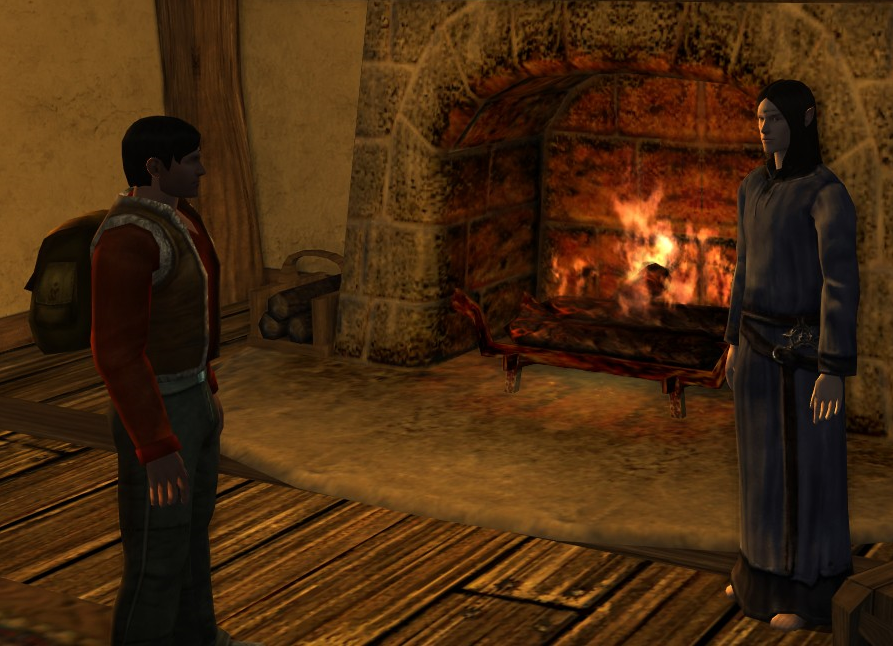
The winter night was drawing late - the Sun had long set beneath the azure horizon, and the Moon had risen high and bright into the dark and cloudless sky - but within the Scholar's Stair Archive in Bree, time beyond its walls went utterly unheeded by the unlikely pair that spoke earnestly together beside the blazing hearth, each completely engrossed with the other's company. Not often had an adan boy from Bree met with an edhel boy from Mithlond, but they found as much in common with each other as their particular races were diverse.

The Bree-boy, at sixteen summers of age, was yet young enough to feel nothing but unprejudiced curiosity towards his new companion; the elf-child, though some three decades his elder, felt wholly likewise. For both were, in the eyes of their respective kin, not full-grown and thus often unworthy of serious consideration; still mere children yet awaiting their stark initiation into adulthood. Thus, though drawing the occasional side-long glance from the resident scholars, they were left completely uninterrupted by those grey-beards; envious though they might be, perhaps, to have been denied such an opportunity in their own distant youth, but grateful indeed to bear witness upon such a meeting of young souls in these latter days of the Third Age.

Wine was forbidden in those archives of lore, and yet there was an air of quiet but inebriated celebration around the fireside, rising and falling with the bright sparks and fervent flames within; an exhilaration that caught the old men up in its youthful intoxication, but which they, for all their ancient wisdom, could not recognise as the unadulterated exuberance of the springtide of life in both elf and man; of joy and hope, and the assured confidence of youth untainted by the bleak despondency of age, nor by the dark Shadow that over-clouded Middle-earth more and more each passing day.

Though for all their innocence in age, the pair spoke long of Arda Marred and the taint of Morgoth upon the essence of the world; and in the blissful optimism of youth they pledged themselves to Arda Healed and to friendship eternal. Now these hot words struck deep into the warm hearts of the listening elder scholars as sure as any blade of cold steel, for they alone recognised the hollowness of such an oath between immortal elf and mortal man.

18. What's in a Name? {51 Firith 3018}

Chronicled in the Scholar's Stair Archives of Bree in Eriador,
On this the 51st day of Firith in the Year 3018 of the Third Age.


Long into the chilled late watches of the night did I and my new-found friend converse, but no cold did we feel by the warmth of the hearth and in the glowing of spirit that friendship nourishes. And of the many things that we spoke, one most curious to me was the matter of our naming, for edhellen traditions are intricate and our names have deep meaning; but the customs of the edain of Bree are much unlike ours.

Now the given name of my friend is Joesph Cardin. However he knows not the meaning of his name, 'Joesph', but it was bestowed him by his parents and thus it will always remain (although he chooses to be called 'Joe'.) And 'Cardin' is a family name; but is the name of the family of his father, and that of his mother changed to his father's when they were wed. Although this name has a meaning, "one who combs wool", it is indeed meaningless for none in the family of Cardin have aught to do with sheep. Joesph merrily suggested that perhaps in days of yore, his ancestor must have been a wool-comber of high esteem and great renown to be honoured with this appellation!

But Elves have not family names, nor any name shared in wedlock; rather our names oft describe our lineage or qualities. My father's name, Ioriston, signifies "Ancient Scholar" for indeed he was a scholar of Eldar lore; and upon my birth he gave me the ataressë (Father-name) Ioristion (that is "son of Ioriston") and thus was I presented at my Essecarmë or 'Name-making ceremony'. However my mother, Ýridhremes ("Wise Course Wife") seeing my fate in a vision at the hour of my birth, did bestow the amilessë (Mother-name) of Angollon upon me; though more correctly we call it the amilesse apacenyë, or Name of Foresight, and it is an uncommon and valuable gift. My name signifies "Magician", and contains within it both 'angol' ("Deep Lore") and '-ron' ("doer"), for I am both a scholar and a practitioner ('gollor') of angol, that edhellen Art the mortal races oft call "magic".

Now these names are all public names, but there is yet a name which is called a cilmessë, which is utterly private and may be used only by close kin and closest friends; for it is intimate and an insult if used by any other to address an Edhel. This is the Chosen-name which a hên chooses for themselves when they are adepts of lámatyávë, which translates into common speech as "sound-taste" and signifies that personal pleasure is found in the sound and form of words; that is, the hên is eloquent in the tongue of their people and knows therefore the making of words and names of beauty; also that their own nature is known to the hên and they can thus name themselves. Commonly this is when hîn are between seven and ten years of age; for myself, ten summers had I seen when I chose the cilmessë 'Amarion Tirnel', which is "Son-of-earth Star-gazer", and which can be written herein without harm for none shall read these chronicles ere I have removed to Aman or await my fate in the Halls of Mandos. Now to reach self-awareness is of great import in the life of a hên, and is celebrated with the ceremony of Essecilmë.

The final name is the epessë or After-name, which is also an anessi or Given-name, and may be given by any. It can be a title of honour for a great deed or feat, or descriptive of the nature or qualities of its bearer; just as my father was called 'the Learned' and my mother 'the Wise'. Myself, I bear the epithet 'i Nethon', "the Young One" which was bestowed upon me by the Edhil of Duillond where I now abide. However, the most common epessi - and most flattering - are those given between lovers!

And thus is my name in full:

Ioristion Angollon Amarion Tirnel i Nethon

Now the mindful reader of this chronicle will note that the terms I have written are Quenya, though I am of Sindar blood. For the lore of naming arose in Aman with the Amanyar who dwelled with the Valar; and it came to pass that through trade and travel did the Úmanyar who abode in Beleriad commune with the Blessed Realm, and thus did the customs of Valinor cross Belegaer to the Sindar in Doriath. And when Doriath fell into ruin the Iathrim, my parents among them, fled deeper into Ennor, and together with the Sindarin tongue they brought with them those customs to Telerin lands.

So too did the Noldorin Exiles, though Quenya speech was forbidden in the realm of Eru Thingol while the king yet lived, bring their customs and words to Lindon after the deluge of Beleriad in the War of Wrath; and in Mithlond where I was born and nurtured, though Sindarin is the tongue of the Havens, Quenya yet abounds in the lore that I learned from my father.

There are but two more customs of the edain that I needs must record: firstly, the name Joesph is not unique to my friend, for anyone else may also be named thus, but the Edhil will not knowlingly use a name that belongs to another; and secondly, edhellen names change over the course of one's lifetime, and even a cilmessë may change to reflect the nature of whom it belongs (though this is uncommon). Alas, Joe will remain Joesph Cardin until the day he dies and his fëa departs the confines of Arda for that destination unknown even to the Valar.

{Previous entry} {Next Entry}

19. Song of Angollon

An Elven-son in Mithlond born,
With starlight in his eyes;
His robe of woad with travel worn,
He sought to be a gollor wise.

A stone was bound upon his brow,
A sapphire blue and clear
As sky within the twilight hour,
Above deep Belegaer.

And far he roamed, with feet unclad,
Upon the dusty road
Of Eriador, the Lonely Land,
As his mother did forbode.

A home he found, in Falathlorn
Upon the river Lhûn,
And yet an oath he had forsworn
Beneath the rising Moon.

For vengeance he would have:
By Orcs his father slain,
His word to Oromë he gave
To hunt his father's bane.

So under stars and shining Moon
And burning Sun by day,
Does this hên, by lore and rune,
The spawn of Morgoth seek to slay.

Long is his road, and hot his heart,
But cool remains his mind.
And hard he learns his elven Art,
Yet peace he yearns to find.

{With apologies to the Song of Nimrodel by J.R.R. Tolkien }

20. Boe annin mened (I must go) {10 Rhîw 3018}

Chronicled in the Scholar's Stair Archives of Bree in Eriador,
On this the 10th day of Rhîw in the Year 3018 of the Third Age.


Overlong have I lingered now in Bree, and I deem it high time to return to my home in Falathlorn. For I yearn to forsake this foul smelling city and abide once more beside the clear cool waters of the Lhûn, and breathe the clean air that blows fresh and sweet from the ice-capped peaks and green valleys of Ered Luin.

Much have I learned here regarding the Edain which I shall record within these chronicles in due time, when I have assembled my many notes and scattered thoughts.
For the world of Men is one of many contrasts: where there is cruelty there is also compassion; great wealth abides beside abject poverty; sublime beauty is marred by profane unseemliness; and the forlorn yet live in hope. It is both heart-warming and heart-rendering, and my own heart is torn asunder.

But now I must remove in haste, for word has reached me that Isferon, a pengolodh of great renown, tarries even now in in Duillond and I much desire to speak with him about my experiences thus far of Arda Hastaina.

And so I have bade farewell to my new-found friend, Joesph, and the learned men of the Scholar's Stair Archives, and at first light tomorrow shall I set forth unto Ered Luin.

{Previous entry} {Next entry}

21. Tôl auth! (War comes!) {16 Rhîw 3018}

Chronicled in Laerodhris of Falathlorn in Eriador,
On this the 16th day of Rhîw in the Year 3018 of the Third Age.


Now Bree lies nigh one hundred leagues from the elven haven of Duillond, a journey of two enquier on foot. And so to hasten my return to Ered Luin, I hired an amiable horse from the Bree stables who carried me swiftly from Bree to Hobbiton, and then on to Needlehole in the Shire. There did I meet again with my Hadhod friends whom I befriended on my first visit to that settlement.

Alas, travel through the lands that were once the proud Dúnedain realm of Arthedain has now become perilous, and so it was agreed that I should join a company of Hadhodrim who were returning home to the great halls of Thorin's Gate. And so did we set out on a day that was cold but without snow, and not three days hence were we accosted by foul servants of the Dark Lord.

Brief but fierce was the fight, and my companions with fury and merciless affray did slay our assailants and left none alive. However, I - who heretofore has never been in an instance of violence let alone bloody battle - was of little aid to those doughty dwarves. For angol is not a martial art, but one of healing and balance; and though it may be deadly, it is neither swift as blade nor arrow. And although I am skilled with my staff of wood, little did it avail against the cold iron weapons of our enemy.

And so did Gróin, leader of our company of travellers, describe to me the need for weapons well-forged and sharp of blade to stem the black tide of hate that issues forth against the Free People of Ennor. And so it is that I, who has held naught but peace in my heart for all my youth in Mithlond, now turn my thought to weaponry and death: a glaive perhaps, like the famed Aeglos of Ereinion Gil-galad, for much like a staff it seems to me.
      'Nay,' said Gróin, 'it is not so, but to the mind of a child untrained in war.'
And he spake of those who wield a staff one-handed in battle, but who carry a blade in the other: long and light and keen-edged. A sword is what I need, he says, but one forged by no hand other than my own! For, says he, within a sword dwells the heart of he who makes it, and thus it will not love the hand it serves, but only its maker.

Now in Mithlond oft had my father sent me to spend time with the smiths of the Haven, and I have learned the foundations of that craft, but I know not the Deep Lore of metal-work and weapon-craft so as to forge my own sword. For my comfort, Gróin spoke also of a smith in Celondim who was before of the Gwaith-i-Mírdain ere Eregion was laid waste by the malice of Sauron. Curubrannon he is named, and he feigns to be but the Master of the Crafting Guilds, but ever does he linger nigh the forge of Celondim.

[Source]

Then, as a sign that comes from Menel, on the third day after our assault did a star fall blazing from the heavens and struck the earth with flaming splendour and great thunder and clouds of smoke nigh our wakeful camp. And lo! Within the smouldering hollow lay a red-glowing stone of hot iron, and when it was cooled by the winter air, Gróin bade me recover it and carry it hence to Celondim for the Master's pleasure. For from its smelting, he forbode, shall I forge my blade and yet will there remain shards enough to please Curubrannon.

And so I recall my oath sworn before Oromë that I should avenge my father's murder at the fell hands of the Yrch upon the road from Imladris, and my heart is hardened. So shall I learn the art of war at the knee of Curubrannon as I learned the art of peace at that of my father.

Nínion an gwannad lîn, Adar, savo hîdh nen gurth.

{Previous entry} {Next Entry}

22. The Forge of Celondim {40 Rhîw 3018 }

Chronicled in Celondim in Ered Luin of Eriador,
On this the 40th day of Rhîw in the Year 3018 of the Third Age.*


And so it is nigh three enquier since my return to Falathlorn, and it came to pass that I met with Master Curubrannon in Celondim, and the tales of Gróin the Hadhod were proven true. For Curubrannon was indeed among the Gwaith-i-Mírdain during that time when Sauron in his malice descended upon Eregion and laid waste to that Elven realm.

Now the Gwaith-i-Mírdain was a brotherhood of Elven master craftsmen of the Second Age, founded by Celebrimbor son of Curufin son of Fëanor together with those Noldor of Lindon who removed to Eregion nigh the West Gate of the mines of Durin's Folk at Khazad-dûm; this they did because they learned that mithril had been discovered in Hadhodrond, for the Noldor were great craftsmen and thus had much love for the making of arms and jewels, and were less unfriendly to the Dwarves than the Sindar; and the friendship that grew up between the people of Durin and the Elven-smiths of Eregion was the closest that there has ever been between the two kindreds. For it was in Moria (as it was named by the Gwaith-i-Mírdain) that the Nogothrim, delved deep into the earth for mithril, that most precious of metals, which when forged was light and yet harder than tempered steel, and the polished beauty of which did not tarnish or grow dim with age. And the Golodhrim of Eregion learned to craft an alloy thereof that they named ithildin, which is visible only by starlight or moonlight and oft adorned hidden gateways and portals; and thus the followers of Celebrimbor became famous for their works of art and craft.

And Curubrannon was there when the fell host of Sauron descended upon Ost-in-Edhil, chief city of Eregion, during the War of Sauron and the Elves. It was there that the House of the Mírdain stood for nigh a thousand years and during the strife that city was utterly destroyed by Sauron's dark forces, but its ruins yet survive into the present  Age. Those few who survived found refuge in either Lindon or Lothlórien, while others led by Elrond Peredhel founded Imladris nigh the Ford of Bruinen, but well hidden in the moorlands and foothills of the Hithaeglir.

This bitter history Master Curubrannon told to me while I toiled in the red heat of the forge of Celondim, as I learned from him the ancient mystery of his art. But the lore of edhel weaponcraft is yet held secret by its masters, and so I shall commit naught of his teachings in ink upon these pages.

{Previous entry} {Next Entry}

* ((By pure coincidence, according to the Encyclopedia of Arda Interactive Calendar, this is also the date that the Company of the Ring entered the land of Hollin in T.A. 3019 -- call it serendipity, if you will, but sometimes Eru blows my mind!))

23. Guren meren! (My spirit is joyous!) {42 Rhîw 3018}

Chronicled in Duillond in Ered Luin of Eriador,
On this the 42nd day of Rhîw in the Year 3018 of the Third Age.


Glad am I to be back home in Duillond, upon the tranquil shore of the Lhûn whose slow course passes here through Falathlorn, and thence past Celondim to Mithlond and the Great Sea. And while during the hours of daylight I am to be found with Master Curubrannon at the forge in Celondim, ever broadening my knowledge of smith-lore ere I am ready to smelt my precious piece of star-iron, at the setting of Anor I return to Duillond to converse with the pengolodh Isferon, or retire into the Scholar's Enclave to continue my research of ancient and esoteric lore within the muted silence that it affords for study undisturbed; and here I scribe manuscripts in solitude for my developing library at my home in Laerodhris, or such work written at the behest of others.

However, at minuial today my seclusion was disrupted by the arrival of a Hadhod who introduced himself as Lothinn Longbeard, a novice scholar from the nearby Dwarven hold of Gondamon; and he brought a request from Ráthorm, an Edhel loremaster who abides there, for certain scrolls of lore known to be held within the Enclave. However he was hastening on to Celondim with a similar request for Thavroniel, the scholar there, and thus bade me to kindly bear my package to Ráthorm forthwith.

And so it was that sunrise this morn found me riding swiftly upon a horse from Colchyl's stable towards a destination that hitherto never had I been, and I was not without great curiosity to see the dwelling-place of the Nogothrim. It is not a long ride and I arrived ere midday and soon found she whom I sought. By good fortune, or so it came to pass, with her I found a Hadhod with a well-kempt beard deep in conversation. Todsi son of Bodsi he is named, and when I had delivered my package we fell to talking.

He is not of Gondamon, but far-off Erebor in Rhovanion, of which I know little but some history of the Battle of Five Armies nigh eight decades past, and is engaged as a guard for a caravan of traders to Ered Luin. To my delight, he is also a blacksmith, and in exchange for a compiled history of Thorin's Halls in the north, he agreed to share with me some Dwarven smith-lore to complement my studies with Master Curubrannon! This is indeed a boon, for Dwarves were taught unique skills by their maker, the Vala Aulë (whom they themselves call Mahal), and thus they are unrivaled in some arts even by the Elves.

Now I am not ungrateful for the opportunity to learn from Master Curubrannon, and it is indeed fascinating, but my progress has hitherto been as slow as that of the Lhûn; for the foundation of this craft is the smelting and refining of ore and infusing the molten metal with the fëa of the maker, and thus have I spent many long hours. But soon shall I begin true forging, for Curubrannon deems me ready for what he calls "essays in the craft", that is the making of various small daggers to hone my skill in preparation for sword-craft.

Todsi seeks also a history of Erebor and knowledge about dragons, neither of which is contained in the library of the Enclave. However, the course of his return journey along the Great East Road takes him to Cirith Forn en Andrath over the Hithaeglir, and thus passes nigh Imladris hidden in the foothills below the pass; and it came to my mind that the Library of Elrond should surely hold such lore, and that perhaps I might accompany Todsi's caravan of merchants and travel with it as far as the House of Elrond. My new friend readily agreed to this, although he knows not when the journey shall commence.

Now long have I desired to see the Last Homely House East of the Sea, but it lies nigh six hundred leagues distant from Duillond which is a journey of four enquier on foot. Therefore on the morrow shall I call upon Colchyl the Stable-master and together we can find me an agreeable mount, for I assume the Dwarven traders will not be walking home to Erebor!

But now night is drawing nigh and I must prepare my parchment on the history of Thorin's Halls.

{Previous entry} {Next entry}

24. A Brief History of Thorin's Halls in Ered Luin

A Brief History of

~ Thorin's Halls ~

in Ered Luin of Eriador

Now it came to pass that after the Sack of Erebor by the dragon Smaug in the year 2770 of the Third Age that Thrór son of Dáin, the exiled King of Durin's folk, led his kin into long and homeless wandering. But when twenty years had passed, Thrór, poor and desperate, left his people and went north with but a single companion for he wished to see the fabled city of his ancestors, Khazad-dûm; and there he was slain by Azog, an Orc-chieftain of Moria.


And Thráin son of Thrór sat for seven days without eating or sleeping, until he stood and said "This cannot be borne!"1, and he declared a war of vengeance against the Orcs of the Misty Mountains, and mustered all the Seven Houses of the Dwarves. And at the Battle of Azanulbizar in the year 2799 Thrór was avenged when Dáin Ironfoot removed the head of Azog and impaled it upon a spike.


Then Thráin with his son Thorin Oakenshield and the remains of his people returned to the hills of Dunland, and soon afterwards they removed and wandered in Eriador, until at last they made a home in exile in the east of the Ered Luin and there they established their Halls in the year 2802 of the Third Age. (Upon, it is said by some, the foundations of the ancient Dwarf city of Tumunzahar, which was ruined during in the War of Wrath in the First Age.)

There they prospered to some extent, but they worked mainly with iron and had little gold. Then after forty years Thráin, consumed with the lost riches of Erebor, travelled east with a small company of his kin and was lost under the eaves of Mirkwood, and Thorin was made ruler of Durin's folk. And under his leadership his people prospered; their trade increased as well as their numbers, for wandering Longbeards heard of Thorin's realm and came to him.

Thorin ruled in Ered Luin for nigh one hundred years, until he set out in the year 2941 to take back Erebor from Smaug the Great Worm, and reclaim his rightful place as King under the Mountain. But in the Battle of Five Armies, he was mortally wounded and his cousin Dáin Ironfoot of the Iron Hills became king of Durin's folk; and when tidings reached Durin's folk in the Ered Luin that Erebor was retaken, many of them removed to the Lonely Mountain, yet Thorin's Halls remained an important hub of trade in the region.

((N.B. The following is Lord of the Rings Online "lore" ONLY))

However, the rule of Thorin's Halls fell to the Dourhands clan, for Gormr Doursmith was appointed Steward by Thorin Oakenshield when he left for Erebor. Now the Dourhand dwarves hoped to restore their long-dead leader, Skorgrím, to life and therefore allied themselves with evil fell spirits of Old, just as Skorgrím himself did long ago; however in the year 3016 of the Third Age, King Dain sent a company of Longbeards to learn why the Master of Thorin’s Hall had ceased sending tribute to Erebor. And they, with the aid of the Sons of Elrond, uncovered the heinous plot to resurrect Skorgrim Dourhand, and together they fought to thwart that foul plan and reclaim Thorin's Halls. Following their victory, the Dourhands were expelled from the Halls, and Dwalin son of Fundin became the ruler there and so remains to this day.

           
            This account was compiled by Angollon son of Ioriston
            In the Scholar's Enclave of Duillond in Eriador
            On the 42nd day of Rhîw T.A. 3018
            At the behest of Todsi son of Bodsi of Erebor


1 J.R.R. Tolkien, The Lord of the Rings, Appendix A, "Durin's Folk"

A copy of this document may be found in the Istari Nalmë Archive of Lore within the Scholar's Enclave in Duillond.

25. Menin n' Imladris (I am going to Rivendell) {43 Rhîw 3018}

Chronicled in Duillond in Ered Luin of Eriador,
On this the 43rd day of Rhîw in the Year 3018 of the Third Age.


At sunrise today I rode again for Gondamon to deliver to Todsi the history of Thorin's Halls that he bade me scribe, and in return he gave to me some notes he himself had prepared. These told much of the Dwarven methods of assaying metal ores and the extraction thereof - which is ideal for I am yet studying the smelting of ore - and also various techniques for the shaping of blades during forging. The latter are much like those of the Edhil, but with some subtle differences that will certainly enhance my own crafting; and when I later showed these notes to Master Curubrannon he nodded gravely in approval (which for him is indeed high praise!)

I told him also of the opportunity I had been given to travel with Todsi's caravan to Imladris, and of this journey he also approved, for quoth he: "This is well, for much there is that may be learned in the House of Elrond from my friend Snár, who is there the Forge-master of the Forges of Rivendell, and who is by chance also a Hadhod; and in the sanctuary of Imlad Gelair can be found Crisdúr who is an expert in weaponcraft, and also Ruineth, a metalsmith of great renown among the Edhil of Imladris."

And he deems that should I be departing soon, then I must begin my "essays in the craft" yet sooner, and thus he set about teaching me the forging of divers simple daggers; and after my labours sent me hence to consult with Fanhir in Duillond, for as he said, no new-forged blade will avail me without training in its use, and he told me that she can assist me with that. This I did, and she agreed to begin my sword-training on the morrow when I have finished my day at the forge, and so little respite will I have for evenings in the library for some time to come.

Thus I visited also with Isferon while I yet have hours to spare, and I told him too of my forthcoming journey. Now ordinarily we speak of lore or Arda Hastaina and our hope for Arda Envinyanta, but my discourse tonight with Isferon was unusually cryptic: for he spoke of his former friendship with my parents in Menegroth ere the Second Kinslaying and the fall of Doriath in days of yore. Now I knew naught of this and naught thereof had he spoken ere this day, and much is my wonder at these tidings. But no more would he speak on this matter, save that it is his wish that I when I travel thither I should there present a letter from him to Forgamthan, an edhel scholar of Elrond's Library. Of him I have knowledge, for he it was whom my father would visit each idhrinn for the season of Iavas, ere returning to Mithlond in time to honour the anniversary of his union in love with my mother and my begetting thereof; and it was upon one such journey that he grievously perished.

And now as I write this entry in the sanctuary of my home, ever does my mind bend to this mystery and what of my parent's long history remains untold and thus is yet unknown to me.

{Previous entry} {Next entry}

Pages