Feveren leaned back against the cool stonework of the Eastway, feasting on a dripping honeycomb with great delight, and though the carven columns under which he sat brought back to his mind the daunting mansions of Thorin's Hall, he did not let the memory mar his enjoyment of the tasty treat.
The great Dwarf-wrought gateway marked the border of Falathlorn, and before its lofty stonework grew the last fair woods of the Elven-realm, deep-shadowed in the moonless night. On his way hither from Duillond he had left the road to bid farewell to the elven-trees, and in the gloom beneath their boughs he had chanced upon a hive of sleeping bees; and though it was in the dark of night and they had retired after their labours of the day, the young Green-elf had softly hummed a soothing song, and the becalmed insects did not swarm in defence of their sweet treasure, as was their wont with trespassers.
From his tan fingers he licked the last golden drops, then washed the sticky syrup from his lips with a sip of the sweet elven mead with which the butler of Dorongúr, Master of Duillond, had refilled his empty wineskin. In his heart Feveren gave thanks to the honeybees for his nectarous repast, and he sang a soft song of praise for them though they were a mile away.
* * *
Earlier in Duillond the elf-lad had supped at eventide with Dorongúr, and together they had spoken of many things until late into the crisp Spring night. Then Feveren had bade farewell to the Elf-haven, and as he crossed the long windswept bridge that spanned the River Lhûn, he had looked back at its bright lanterns twinkling gaily in the darkness; its pale overhanging terraces and graceful arches shone pearl-white in the starlight.
And while he hearkened to the song of the gleaming waterfall that leapt joyfully from the high crag whereon Duillond stood, to fall singing in a foaming cascade to join the waters of the wide blue river, he had watched as the silver sliver of the waxing moon slowly sank behind the purple-shadowed Ered Luin.
Long he stood gazing at the wondrous sight, while the crown of seven shining stars, Valacirca,1 wheeled above his head, for he had wished to behold the elven-hamlet one last time, ere his feet led him into the unknown country that lay eastwards of the elven-lands.
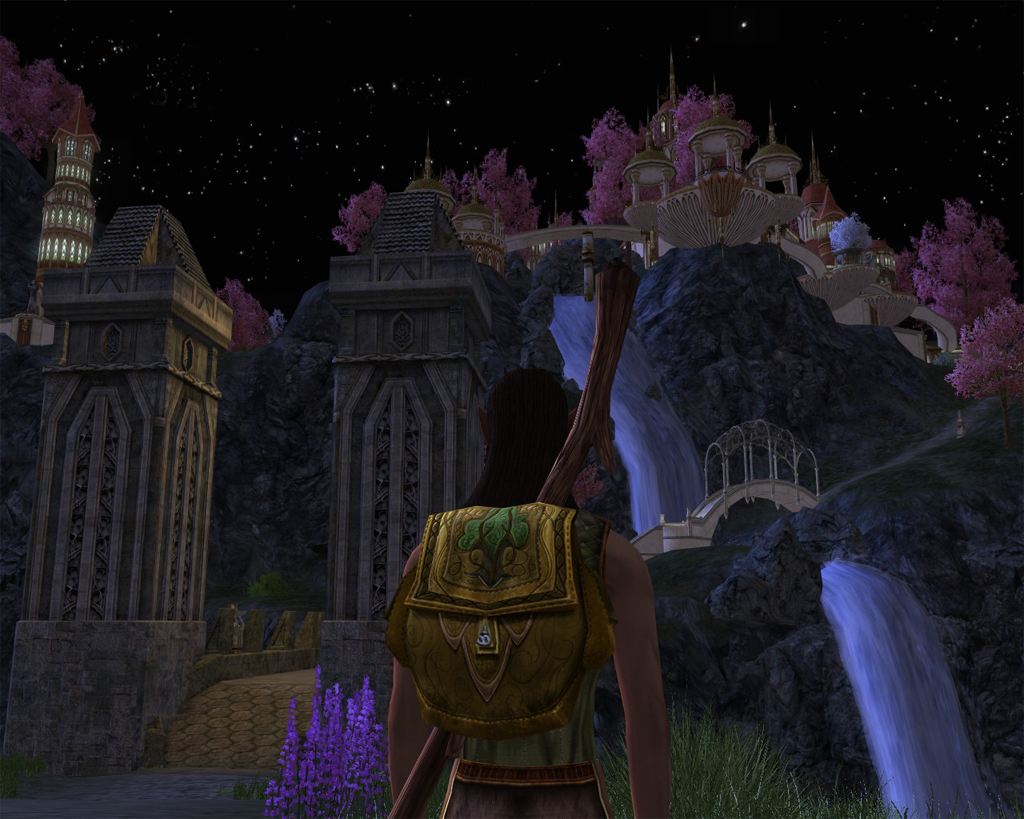
Then for two more leagues he had followed the paved road on foot, with Gwedal pacing at his side. Glavror rode singing gaily upon the grunting boar's back, for both were glad to moving again in the company of their elven friend, who was merrily singing, too.
Feveren's feet led him past the entrance to the elf-homesteads, wherein dwelled those who wished to forsake Middle-earth, and yet awaited the hallowed ships of Mithlond that would bear them hence. Beyond it grew the woodland abode of the friendly honeybees, then rounding a bend he had at last beheld the great Eastway whereof Dorongúr had told.
The twin towers he had yesterday descried from the terraces of Duillond loomed over the Dwarven gate. Each stood alone on either side atop a high ridge of rock, but the sheer sides of the scarp were unscalable, even for an agile young elf well used to clambering among the tall boles and woven boughs of his greenwood home. Neither window nor light could be seen in their steep shadowed walls.
* * *
Now it was well past midnight, and Feveren sat in the eastern lee of the stone-wrought gate and awaited the rising of the sun, for he desired to look upon these new lands in the bright clear light of day. The night breeze from the east brought with it a sharp and bitter smell from the unseen muddy marshlands beyond, wafting away the sweet scent of the wildflowers that grew in the shadow of the gate.
Glavror had taken Gwedal to scout the way ahead, for Dorongúr had warned that the inhabitants of the Yondershire, the Pheriannath or Halflings, were unused to Elves. The elf-lad thought therefore to travel through their land in secrecy, which was far more to his liking than his encounter with the Longbeards underground where his woodcraft could not avail him. Besides, it was the wont of his people to move soundless and unseen amidst the woods of Eryn Milbar, and he knew also that this was the manner in which the Wandering Companies of the High Kindred passed through the Shire at need.
Reaching into his pack he withdrew his journal; then from a side-pocket he took a freshly cut reed-pen and the small crystal vial that held his precious ink. He felt for a moment a pang of shame in his heart, for he had had a mind to forsake his chronicle as folly; but Dorongúr had reminded him that he was bound by his promise to Faethurin, despite the unthinkable span of the Straight Road that sundered the two friends.
Feveren crossed his legs and laid the book across his lap, then biting his lower lip in thought, he began to write. In the moonless starlight the dark ink seemed to gleam upon the pale page before his elven-eyes.
I tarried this time in Duillond only briefly, for the mood in the Scholar's Enclave has grown unfriendly. For while Dorongúr Whitethorn, the Master of Duillond, has a kindly heart, a prideful High-elf lore-master called Isferon has returned to reclaim the seat therein that he deems I usurped while he was away travelling. Alas that he does not share the generous spirit of the beech-tree for which he is named,2 but I did learn from him that the lands about Lake Evendim are perilous, for they are overrun with many evil foes: orcs, wargs and wights. Of Orcs there are many tales and I have met their lesser kin, the goblins; wights I guessed are the fell shades of Men; but never have I heard tell of wargs.
But in speech with with Master Dorongúr yestereve, I learnt that wights are in truth evil spirits that stir the bones of the dead, though whether they are the spirits of Orcs or Men or even Elves is unknown even unto the Wise. Nevertheless, they are undead and fell, dwelling in barrows -- burial mounds -- and graves of mortal Men; the handiwork of the Witch-king of Angmar, so it is said.
Wargs, however, are a race of evil wolves: larger, stronger and more cunning than the common woodland wolves I know and esteem, and Master Dorongúr deems they too are host to fell spirits of shadow, and were begotten byBelegurthMorgoth Belegûr3 long ago in the Elder Days.
Feveren paused in thought with his reed-pen poised above the page, and smiled wrily when -- as so often seemed to happen when he wrote -- a drop of black ink dripped from its tip and splashed wetly upon the page.
He thought wistfully of his early lessons together with Faethurin, when they were but elflings being taught by his friend's father, Dimaethor, sitting cross-legged on the grass beneath the spreading boughs of the greenwood. There they had toiled with wooden boards held flat upon their laps, which served the two elf-boys as writing-desks; and more often than not, they both got more ink on their hands and knees than upon the scraps of hand-pressed paper whereon they were scribing!
He then noticed that, sure enough, he had also left an inky thumbprint on the page! With a shake of his tousled head, he laughed and bent again to his task, taking care to scribe his rows of runes around both blot and blemish, just as he had done as an elven-child.
Therefore, while I had a mind to follow the ancient footsteps of Lord Celeborn and Lady Galadriel to the shores of the Lake of Twilight4 beyond the Emyn Uial, I have instead resolved to follow a new course: one that will take me across the fair woodlands and green fields of the Halflings. The Shire, it is named, and here beyond the Eastway gate lies a region called the Yondershire. Master Dorongúr says this is a wet land of moor, thicket, and fen; but little can I descry from my perch beside the Eastway, a great stone-wrought gateway, fashioned by the Dwarven-folk a long
age ago.
He tells also that in days of yore, this was the safeguarded woodland hunting ground of Ereinion Gil-galad, but in later times kings of Men razed the hapless trees5 to
Again he halted, for the memory of the elf-lord's words again smote his heart. Yestereve a hot wrath had blazed up within it, for Dorongúr had told of the wanton ruin of the merry greenwood by the Secondborn, merely to free land for their crop-growing. Fresh in his mind had been the words that Isferon had spoken earlier: the Dominion of Men. Feveren had railed against their purpose, saying it was not dominion, but domination that mortal Men desired, to the bane of all that was green and glad; but Dorongúr had quenched his flaming heart with soft words and chill wine. But now, in the coolness of the night, the young elf's heart was no longer afire, but heavy with loss and sorrow.6
He stifled a sudden yawn. No rest had he taken since departing Thorin's Gate at the rising of the sun, and the swift pounding ride for fifteen leagues on Gwedal's broad back had not been restful; the elf-lad's uneasy encounter with Isferon the Lore-master had been tiresome, too. (Also, the wine-cellar of Duillond was well-stocked with choice vintage from Limael's Vineyard, and Dorongúr was a generous host!)
Even youthful Elves cannot forever stave off weariness, and so Feveren thought to rest his mind till dawn while he waited for his companions to return with tidings of the road. Leaving his journal unfinished, he wiped his reed-pen with a fallen leaf, and carefully repacked his things. Then he lay down on the soft grass amidst the fragrant wildflowers, his fair hands folded upon his breast and his eyes unclosed, blending living night and deep dream, as is the way with Elves.7
The flowering stars glittered above him in the dark field of the sky, and in his mind he hearkened to their sparkling silver music.
* * *
The morning dawned bright and fair, and Feveren stirred as a shadow crossed his face. Lifting his head, he was surprised to see a small bending figure outlined against the shining light of the rising sun, with an arm outstretched towards his foot.
'Gi suilon!' he said in Elvish. The figure nimbly leapt back in alarm and clasped its hands to its breast. 'Oh my!' it exclaimed in the Common Tongue.
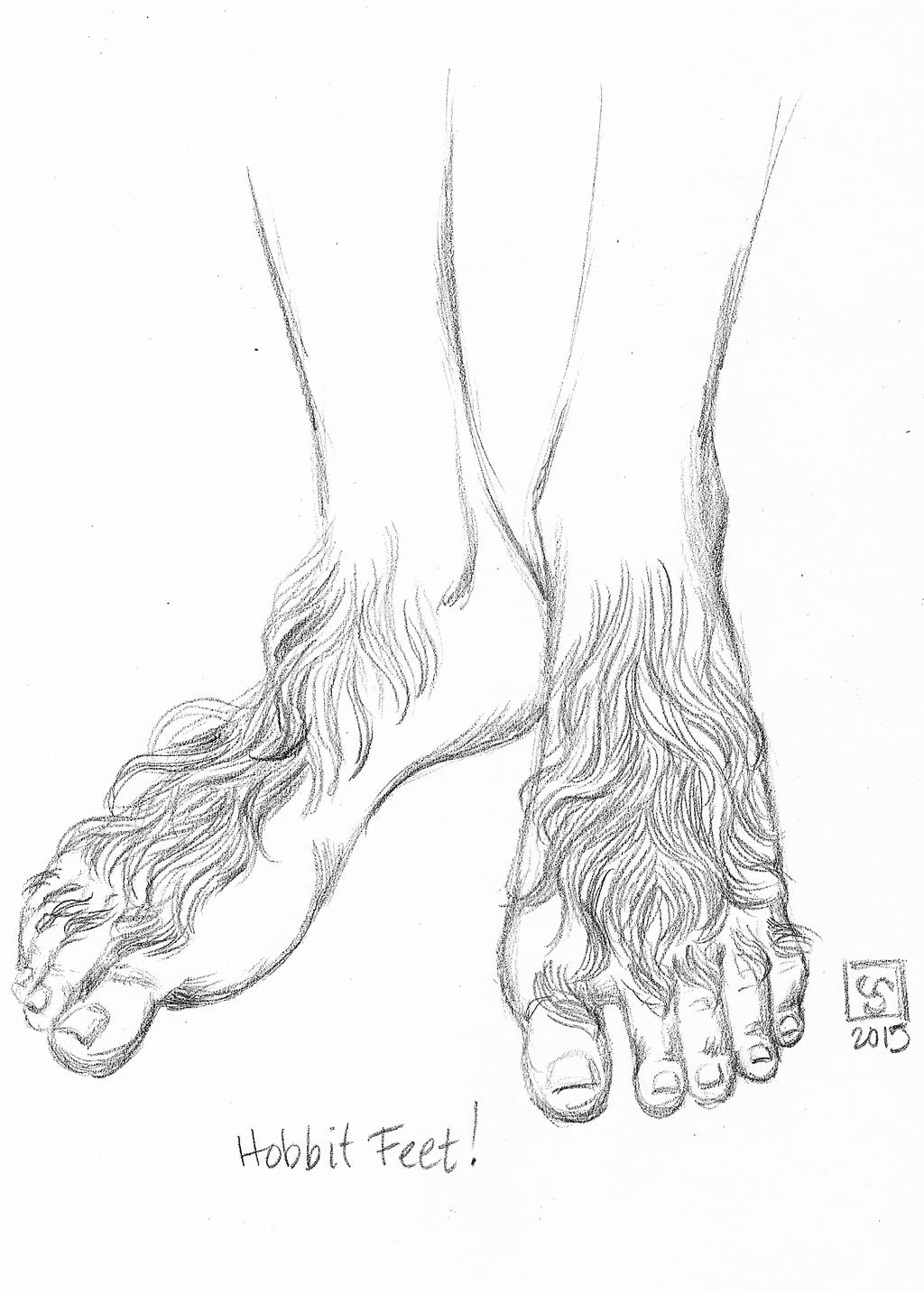
'Greetings!' repeated the young elf in the same tongue. In the growing light he could see that it was a little person of no more than four feet in height, garbed in a blazoned corslet of leather. But he was no Dwarf, for his good-natured face bore no beard and he was less broad and strong in the arm than any of Durin's Folk; and he was unshod, but his feet were clad in thick curling hair, much like the hair of his head!
For the span of half a dozen heartbeats each gazed at the other: the young Green-elf in wonder, the other with his bright eyes wide in alarm, and with guilt etched across his features. Feveren rose quickly to his feet and bowed. The other took a hasty step back and waved his hands nervously. 'I wasn't...' he stammered, 'I mean, I didn't...'
Feveren laughed and clapped his hands. 'You must be a Halfling!' he exclaimed with joy.
'A Hobbit, if you please!' the other retorted, his unease seemingly forgotten.
'Forgive me, Master Hobbit' said the elf-lad, running his slender fingers through his long unkempt hair. 'Never before have I beheld one of your kindred. I am Feveren, son of Gladlin, of Eryn Milbar in Harlindon.' He bowed again.
'My name is Hildifons,' replied the hobbit, bobbing a timid bow in return. 'Of the Shire... Yondershire, I mean! And marchwarden of the Eastway, mark you.' He continued to eye Feveren nervously, and the elf-lad noticed that the hobbit kept glancing furtively at his feet.
'Be not afeared, Hildifons,' he said kindly. 'I mean you no harm. I am but a wanderer in these parts.'
'Oho!' said the marchwarden, with his hands upon his hips. 'I ain't afraid. You ain't the first Elf to pass by the Eastway gate! But...' he stared at Feveren's bare feet. 'But beggin' your pardon,' he said awkwardly, 'you are the first Elf I've ever seen without his shoes! Most unusual, and no mistake; but I said to myself, when opportunity knocks, it only knocks once.'
'What were you doing when I awoke?' the elf-lad asked curiously. To his surprise the hobbit blushed, his rosy cheeks turning an even deeper shade.
'Erm,' he said, 'Actually, I... you know...' He looked down in embarrassment. 'Well, if you must know... I wondered what they felt like to the touch, if you take my meanin'!'
'My feet?' laughed Feveren in astonishment.
'Um... well, yes!' the hobbit confessed. 'Just to see if they're at all like a hobbit's, you understand.'
'As you see, they are not fur-clad,' the elf-lad said with a bemused grin, 'but as you wish!' He sat down again on the turf and lifted a foot across his knee.
Hildifons crept forward cautiously, his wide eyes now level with the young elf's. Feveren merrily waggled his toes at him, and the hobbit reached out both small hands and took hold of the elf-lad's somewhat dusty foot. With long deft fingers he first rubbed its smooth hairless top, then gently stroked its sole and heel beneath.
'Why, it feels nowt like a hobbit-foot!' he exclaimed. 'How very odd.'
'No?' asked Feveren with a wide smile on his lips.
'Not at all,' replied Hildifons in amazement. 'See here!' To the young elf's surprise he thrust his furry foot into Feveren's face. 'My soles are tough as leather, you see, but yours are more like lambskin gloves.'
Feveren took the hobbit's ankle in one hand and tickled under the obtruding foot with the other. It felt indeed like the travel-worn leather of his pack.
'Hoi!' cried Hildifons and snatched his foot away. Then he smiled sheepishly. 'I reckon I deserved that!' he said and laughed. Feveren joined in his laughter.
'This is a merry meeting!' the elf-lad said. 'Alas, I know not your ways. Is it common to greet people by the foot in your land?'
'Oh, not at all!' said Hildifons, the colour rising in his cheeks yet again. 'In fact, I would be most obliged if you said nowt of this to the Shirriffs. Or nobody else, really.'
'I shall say no word,' promised Feveren, 'but you are a strange being to my mind.'
'And you seem a queer Elf to mine, if you pardon my sayin'.'
'Indeed,' Feveren nodded in agreement, to the wonder of the hobbit. 'And uncommon among the Elven-kindred also. For my people dwell deep within the greenwood, and to be shod would be a hindrance whilst climbing amidst root and bough, or running over deep drifts of fallen leaves, and springing through the singing streams.'
Hildifons nodded thoughtfully. 'And I must say, of all the elves I've seen passin' through this here Gate, I've not seen one that's nearly as brown as a Harfoot,' the hobbit declared. He squinted at the young elf's face. 'Mind you, now I look more clearly in the mornin' sun, I reckon you ain't brown, really; more golden-like.' He nodded to himself. 'Like honey, to be sure!'
'Alas, I know naught of Harfoots,' Feveren replied, masking his amusement. 'Nor, indeed, anything of your land or its folk. But from your words and thought, I guess that Hobbits can be of divers clans, and so it is with Elven-kind. My forebears were of the Lindi of fair Ossiriand a long, long age ago, and thus even in these latter days our clan of Green-elves, are unalike to the High-elves of the Wandering Companies that I deem you have beheld. Nor are we altogether alike in looks and manner to the Elves of Beleriand of old that were named Grey-elves, Sindar in the elvish tongue, though we are closer kin to them than to those of the High Kindred.'
'Well I never!' said Hildifons in astonishment. 'Who'd ever have guessed there are diff'rent coloured Elves! But you ain't green, exceptin' for your shirt.'
Feveren laughed merrily. 'Nay, these are but names of old that were given by the High-elves, who call themselves Noldor, the Wise, in their own ancient tongue, for they have great knowledge of lore and much skill in the elven-arts. We, they named Green for our raiment was ever the colour of leaves; I am garbed thus for comfort while wandering, but in my pack is stored my armour, such as it is, which is indeed leaf-green! Our Telerin kin they called Grey for their silver-haired lord was named Elu Thingol, King Greymantle.'
The hobbit pursed his lips. 'These wise-elves don't seem so clever to me in the handin' out of names!' he said with a shrug of his shoulders, and Feveren laughed with glee, for the selfsame thought had long before come into the childish minds of Faethurin and himself in the elm-woods of Eryn Milbar. But of this he said naught, for he had no desire to explain Faethurin's unhappy departure to Tol Eressëa.
'We each have our own names for our peoples,'8 he said only. 'Elven-lore is as tangled and knotted as the bridges of living roots that cunning-voiced elves like my father sing into being, and much has been lost and forgotten in downfall and ruin through years uncounted; yet I and my kin delight in calling ourselves Green-elves in fun!'
Hildifons looked at Feveren in disbelief. 'You mean to say your father makes bridges out of tree-roots by singin'?' he asked incredulously. The elf-lad nodded and tucked a wayward strand of his long hair behind his ear. 'Indeed, he is a master of the artful craft,' he replied, his eyes shining with pride. 'Thus is he named Gladlin, tree-song,9 in our woodland tongue.'
'Good heavens!' the hobbit cried in excitement. 'Elf-magic, and no mistake! I've heard tell of marvellous magic toys, but they were of dwarf-make.10 I'd love to see elf-magic!'
'Say rather enchantment,' said Feveren laying his hand on Hildifons' arm. He glanced at the charm encircling his wrist, and wondered what the hobbit would say if only he knew that what he deemed elf-magic lay right before his eyes! 'For it is the soft Art of making with love and delight of the green earth,' the elf-lad said, 'not by dominating the will of the trees by force with hard Power!'11
Hildifons nodded, his face thoughtful. 'Elf-lore seems to be more than just history, to be sure,' he said. 'Now Hobbits love all livin' things, but we can't do magic... enchantment, I mean, more's the pity.' He heaved a great sigh, and gazed wistfully at the clouds sailing across the bright morning sky. 'Everyone's diff'rent, I s'pose.'
He gazed back at the young elf and Feveren saw a yearning in his eyes.
'But we are who we are,' the hobbit said gloomily, then he shook his head to clear his mood, and continued cheerily. 'Anyways, like I was sayin', you guessed rightly about diff'rent kinds of Hobbits, though lots of our history is also muddied and muddled, by all accounts!' He proudly patted his breast. 'I myself am of Fallohide stock, mostly, a breed apart from Stoors and Harfoots, 'cos we're fair-skinned and taller than others of our kindred, and much bolder, too... and fonder of woodlands than highlands or riverbanks.'
He scratched his curly head in thought. 'Most likely that's why my forebears were more friendly with Elves than the rest, afore they all crossed over the Misty Mountains long ago, or so I've heard tell.'12
'Fate smiles on me again!' Feveren laughed at his good fortune. 'That the first Hobbit I should chance to meet is of elf-friendly kin!'
Hildifons smiled too. 'Luck is surely on your side, I reckon, 'cos Harfoots are the most commonest of Hobbits, and there are far fewer like me with chiefly Fallohidish blood. Mind you, it's said in the Old Days that Harfoots were more friendly with Dwarf-folk, and the Stoors got on best with Big Men. P'raps 'cos they don't dig comfy hobbit-holes down in the Marish like regular folk, but built mannish farmhouses and barns.' He barked a harsh laugh. 'Hah! You'd think maybe they'd choose to be friends with Dwarves, rather, 'cos some've got small little beards on their chins, and they've broad bodies atop their thick legs, and they clad their big feet in dwarf-boots!'
'Big feet?' chuckled the elf-lad, casting his eye at Hildifons' own. While not overlarge, beneath their furry coat they were somewhat broad with splayed toes.
'My feet mightn't be comely as elf-feet,' the hobbit snorted, 'but they're neat and nimble compared with a Stoor's!'
'I have yet to meet folk of the Secondborn, the kindred of Men' said Feveren, 'but from tales I have heard told, these Stoors seem akin!'
'Mayhap they are, and mayhap they ain't,' said Hildifons, 'but that's somethin' to think about anyhow, to be sure.'13

'Still,' the hobbit went on, 'you could've done worse than fall in with me, like maybe come across a Puddifoot or Smallburrow instead! Not that I'm sayin' they're not worthy hobbits, mind you, but the Puddifoots are Eastfarthin' house-dwellers, and the Smallburrows are hardly what you might call a respectable family, if you know what I mean.' He looked Feveren in the eye. 'Now take me. I'm a Took!' he said proudly. 'Hildifons Took the Second!'
'Tûk?'14 Feveren repeated awkwardly. The Hobbitish word was strange to his tongue, but not unlovely to his ear. 'That is the name of your kin?' he asked.
'Indeed it is!' the hobbit replied loftily. 'An old and noble family, to be sure. The Fallohide brothers, Marcho and Blanco, might've founded the Shire (though their folk were mostly Harfoots, mind you!), but ever since Isumbras Took the First became the thirteenth Thain of the Shire in the year seven hundred and forty in the Shire-reckonin', a Took has always been Thain.'
'Thain?' asked the young elf warily. While he delighted in growing the store of knowledge he held in his mind, he was starting to find the many strange ways of Halflings bewildering; and while his new-found friend was a font of hobbit-lore, Hildifons babbled like a leaping brook after the first Spring thaw in the snow-capped mountains of his home!
'Oh yes,' Hildifons said happily. 'The Thain is master of the Shire-moot, and captain of the Shire-muster and Hobbitry-in-arms, don't you know.' Feveren thought it best not to ask what these might be. 'As a matter of fact,' the hobbit continued, 'the Thain is also chief of the Took clan, and is just called The Took. Today Paladin Took the Second bears that title, and so he's head of the Great Smials, the old family mansion.' He pointed his hand to the south-east. 'That's in Tuckborough in Tookland, by the way, in the Westfarthin'... where I came from afore,' he added somewhat glumly.
'And you also are the Second?' asked Feveren, wondering at this change in mood, but he deemed it better not to pry.
'I'm the second so named, indeed,' boasted the hobbit, suddenly cheerful again. 'For I'm named for Hildifons Took, you see. He was the son of Gerontius the twenty-sixth Thain, who's commonly called The Old Took, 'cos he reached the great age of a hundred and thirty -- the oldest ever Hobbit -- before he died in thirteen hundred and twenty. Very impressive!'
The young elf did his best to look impressed, though his mind was spinning like a dry leaf in the wind from this bewildering lesson in Hobbit-lore!
'Hildifons the First was the sixth-born of the Old Took's twelve children, but he went off a journey Outside of the Shire and never returned home to the Great Smials,' Hildifons the Second went on.
'A merry wanderer!' smiled Feveren. 'Know you his fate?'
'No, alas,' said the hobbit, also with a smile. 'But I'm sure he went on adventurin' right till his end. Still, he'd be one hundred and seventy-four if he were yet among the livin', so he won't never be comin' back home! Hildifons means battle-ready,15 don't you know.' He drew a small wooden cudgel from his belt and waved it menacingly above his head. 'Anyway, I reckon I'm as bold as he was... look at me: here I am guardin' the furtherest Western March, twenty miles from the bounds of the Westfarthin'!' He looked sidelong at Feveren. 'And at the gateway to the Land of the Elves, no less... beggin' your pardon, but most Hobbits are afeared of you Elves, and they distrust sensible folk like me that have dealin's with your kind.' Hildifons face fell. 'Even if it's not as often as I'd like, and then only to watch them pass by with nary a word.' He shrugged. 'Still, half a loaf is better than none, if you take my meanin'!'
'Are there other such sensible folk guarding the Eastway with you?' Feveren wondered if Glavror and Gwedal had chanced upon any hobbit-wardens themselves, and how they fared on their errand. The small sparrow could move secretly from tree to tree, but the great boar was highly noticeable.
'Oh no,' replied the hobbit, 'It's only me by day and a prentice after dark. They -- the Shirrifs -- told me this westernmost post is far too important for nobody but the most boldest of Bounders.'
'Yet none stood here when I came hither in the late watches of the night,' Feveren remarked.
'Oh bother!' frowned Hildifons. 'Now I'll have to make a report! I was so taken aback when I saw you sleepin' there, it didn't cross my mind that young Dinodas was gone! Well, that's a Boffin, for you!'
'But what indeed are Bounders?' the elf-lad asked curiously, yet it seemed at odds to him that an apprentice would be entrusted with such an important post in the perils of the night.
'Why, we aid the Shirrifs (there are only twelve of them, mind you; three in each Farthin') and it's our job to beat the bounds and make sure the Big Folk don't make a nuisance of themselves.'
'The Big Folk? Such as I?' Feveren laughed.
'No, no... Men-folk, don't you know. Strange Outsiders that prowl about the borders of the Shire. We don't want their kind causin' mischief now, do we?'
'But there are no Men in the lands beyond the Lhûn,' said Feveren. 'It is the abode of only Elves and Dwarves.'
'There ain't?' The hobbit seemed crestfallen by this news, but he soon rallied. 'Dwarves pass by aplenty, and they're a grim bunch by all accounts. Why, they talk almost as little as the stern Elf-folk.' He glanced at the young elf. 'Apart from present company, that is!'
Feveren felt strangely flattered by the compliment, such as it was. 'My thanks,' he said. 'Perhaps it would please you to learn that there is indeed a House of evil Dwarves named Dourhand, which assails both Durin's Folk and the Elves of Ered Luin. Tribes of fell goblins plague the dark places in the mountains and defile ancient elven-ruins, and I've heard tell of giant spiders that infest many fair woods!'
'My, my, that is news to me!' He smacked his club against the palm of his hand. 'If any of these Dourhands or goblins and suchlike try to cross into the Shire... Yondershire, I mean ... they’ll have Hildifons Took to reckon with!'
In his heart Feveren hoped this brave but foolish halfling would never meet such foes, but he did not voice his fear.
'I'll tell you somethin' else,' said Hildifons, 'I've not never met an elf as chatty as you.'
'Chatty?' the bewildered elf-lad asked. 'Alas, I am unused to your tongue.'
'You know, talkative,' Hildifons answered. 'When I asked for news, your High Elves laughed and called me dull, and like I said, and would speak nary another word to me, save that they're leavin' Middle-earth and have no care for its troubles! And to be sure, I don't never see them pass by back along the eastern road. The Dwarf caravans won't stop awhile to hobnob, neither... far too busy, they say.' He shook his head sadly. 'Though there are more and more of them nowadays. But sometimes they seem as troubled as the Elves, and mutter 'bout an Enemy, and some faraway place called Mordor! Still, 'cos they say so little, I don't ask for no more.' The hobbit looked at the young elf gloomily.
Feveren's heart was filled with pity for this lonely halfling, and he wondered what words or deed he might offer to cheer his forlorn mood. Then a glad thought came into his mind: he leapt lithely to his feet and from his pack he withdrew the old notched short-sword that Laenin had gifted to him in Celondim.
'This elven-sword was given to me by a Glade Watcher, a guardian of the greenwoods in Ered Luin.' He held it laid out across his palms. 'I deem Hildifons the Battle-ready could find good use for an elf-warden's blade.'
The hobbit was rendered speechless with delight, but only for a moment. 'Good heavens! An Elf Sword of my very own?' he gushed. 'Oh my word!' He did a little dance of joy upon the grass. Then he took it reverently from Feveren, and with difficulty he hefted it with both hands clasped around its hilt; its sharp point wavered precariously near the elf-lad's groin before Hildifons dropped the sword to the ground with a thud.
'O! I meant no insult' Feveren apologised. 'It is but a shortsword, and thus it was my thought that it would suit your stature, for you told that your kin were taller than most. A dagger would be better, I guess, but alas! I bear no such blade, only a small silver knife for harvesting herbs.'
'Never mind, never mind!' Hidifons cried happily as he bent to pick up the sword from the grass. He stood up and beamed at Feveren. 'It'll look splendid above my hearth, anyways! Just wait till my cousin Frothard sees my present! Thank you! Thank you very much!' Then a frown suddenly creased his brow. 'Half a minute,' he said, 'if you don't have no dagger, shan't you need your sword on your Adventure, seein' as you've only got a little knife?'
'Nay,' Feveren grinned, 'In days of old my people were light-armed and bore no weapons of iron or steel, and still in these latter days it is my will to keep with our age-old custom, hence I bear my stout staff of elm-wood gifted to me by a tree of my forest-home. Besides, my heart is glad to see you in bliss and I would not part you from your gift!'
Then his elf-eyes suddenly shone with delight, for he had thought of yet another boon he could bestow; one that the songs told that Elves sometimes made of old.
'And it is my hope that maybe you have now met an Elf you can indeed call your friend,' he said, and Hildifons raised his hands to his cheeks, his mouth agape. 'For there is but one other within the Circles of the World who has ever tickled my feet,' Feveren went on with a wide grin, 'and he is the dearest friend of my heart and my sworn brother! Hildifons Took the Second, I name you Elf-friend! No gelin idh raid lîn, a no adel len i chwest!' he said a blessing of his people in his own tongue. 'May your paths be green and the breeze behind you!'
This was all too much for the excited hobbit. With a sudden cry, his eyes rolled back, and to the young Green-elf's dismay, Hildifons swooned and fell to the ground as stiffly as a hewn tree.
Feveren knelt anxiously beside the prone hobbit. He placed his palm on the small brow and sent forth his thought; within the hobbit's breast he sensed Hildifons' heart beating strongly, but quickly, and the young elf breathed a sigh of relief. For one terrible moment he had feared that the excitement might have stopped the hobbit's mortal heart! Searching deeper he found what he sought: the hobbit's fe16, while less predominant and radiant than that of an Elf, burned with a small steady flame. Feveren carefully breathed his will gently into it, soft as the whisper of a butterfly's wings, and felt the spark of life enliven in the dark, then steadily brighten.
Hildifons' eyes fluttered open, and he stared up into Feveren's face with astonished joy. 'Am I dreamin'?' he asked weakly. 'Was it all a dream?' The elf-lad sat back with a smile.
'Nay, Hildifons,' he said. 'I am here, and so too is your elven-blade.' He put the hilt into the hobbit's hand. Still lying on his back the hobbit murmured, 'It wasn't a dream! It wasn't a dream!' Then he sat up, and to Feveren's surprise, a glistening tear ran down his rosy cheek.
''Let not your heart be sad,' the young elf said. 'All is well. No veren! Be glad!'
Hilidifons shook his head sadly. 'Beggin' your pardon, but I feel so ashamed!' he sniffed, wiping his eyes with his hand.
'Be not sorrowful,' said Feveren gently. 'There is no shame in being overwhelmed with joy.'
'But it ain't that,' the hobbit replied. 'Oh, my wretched heart!'
'What grieves you then?' Feveren asked uncertainly. 'What is amiss?'
The hobbit did not meet the young elf's eye, but stared at the sword hilt he held in his lap. 'You've been so kind,' he gulped, 'the kindest anybody's been in a long time... but I must confess... well, it's like this...' He glanced fretfully at Feveren's face. 'You see, I've clean forgotten your name! I've talked and talked, and I know I talk too much -- everybody says so -- but I talk and I forget to listen! You told me your name, but I didn't hold it in my brain!'
Feveren laughed, high and clear like an elf-child. Hildifons looked at Feveren in astonishment. 'You're not angry, then?' he asked hesitantly. 'Most folk get mightily affronted when I forget to listen and don't remember what they said. And with you bein' an Elf and all... well, I thought maybe you'd get extra riled!'
Feveren stood and held out his hand. Hildifons took it gingerly and the young elf pulled him to his feet. 'Come, my friend,' he said, and still holding the hobbit's trembling hand (with the treasured shortsword dragging along the ground from the other), Feveren led him to where he had left his pack. From it he retrieved his mead-filled wineskin and offered it to Hildifons, who was shaking his head and whispering to himself in awe, 'Friend... he called me my friend!'
'Here, drink of this,' Feveren said kindly. The hobbit took a hefty swig, then another; the colour returned to his pale lips. He smacked them together appreciatively.
'Good heavens! That's better than Old Winyards even!'
'It is elven-mead, made from the sweet honey of fragrant wildflowers that grow in the green meadows nigh Duillond. It is a potent cordial, and even dwarves do not quaff it!'
'Well, it goes down a treat for throat and tongue, and works a treat for a foggy head, if you take my meanin'!' the hobbit laughed. 'Come now, my good elf... I can't drink to your health if I don't remember what you're called!'
'My name is Feveren,' said the elf-lad, sipping himself from the skin.
'That was it!' exclaimed Hildifons smacking his brow with such force that he sat down hard on the grass with a hiccough. He looked up dazedly at the elf. 'Feveren! But what does it mean?'
'It is not as mighty as battle-ready,' smiled Feveren sitting cross-legged beside the hobbit. 'It means joyous spirit in the woodland tongue of my people.'
'Oh,' said the hobbit, his eyes wide. 'That's quite beautiful, that is.'
'It gladdens my heart to hear you say so.' Feveren plucked a stalk of green grass and chewed it as he watched the little halfling recovering his wits, and the thought came to him that Hobbits seemed a hardy folk despite their small size. Hildifons took Feveren's hand in both his own, and looked at the young elf imploringly.
'Please, Feveren' he said, savouring the elvish name, 'if there's anythin' I can do for you... anythin' at all...'
'I am in dire need of counsel,' the elf-lad told the hobbit. 'The lands beyond the Eastway are strange to me, therefore I would be grateful for any tidings you might share.'
'Counsel?' Hildifons repeated increduously. 'You want aid from me?' Feveren nodded. 'Well I never!' the hobbit squealed, agog at his good fortune. He tightened his hold on the young elf's hand. 'Will wonders never cease?' he said in awe.
Feveren gently detached the hobbit's clutching hands. 'Let us hope not,' he grinned. 'Now say on, if you will.'
'Well,' Hildifons said, 'This here is just beyond the bounds of the Shire. If you're lookin' for the Shire proper, you have to travel a bit further east. I would recommend a stop in the Yondershire to rest your dainty elf-feet before you continue on. The best of the Bounders all patrol there! (Besides me, mind you!) Talk to Salga Greengrass in the village of Nobottle and Frothard Took in the hamlet of Tighfield. They'll surely welcome you.'17
'Another Took?' Feveren remarked.
'Oh yes,' nodded Hildifons. 'My cousin, once removed. He's a Bounder, too.'
'And what of Salga Greengrass?'
'Well, she's another Bounder. There's a lot more of us nowadays 'cos of all the complaints of Outsiders, but she's no relative of mine.'
'Yet her name gladdens my heart,' Feveren smiled. 'But the Elven-lord of Duillond warned that Hobbit-folk are unused to Elves, and you yourself said they mostly fear and mistrust my kindred; I deem it would be unwise for me to wander your lands openly. There is but one hobbit that I seek, and the Dwarf-lord Dwalin said he could be found here in the Shire.'
'Elf-lords and Dwarf-lords?' the hobbit squeaked excitedly. 'You keep high and mighty friends! Are you an elf-prince, then?'
The elf-lad laughed. 'Nay, I am no prince! Indeed, never will you find an elf born with less noble blood than I! But I seek a hobbit named Bilbo Baggins; know you this name?'
'Bilbo Baggins!' cried Hildifons. 'Do I know Mr. Bilbo Baggins? Why, he's Hildifons the First's nephew, to be sure! Belladonna Took was the Old Took's ninth child and the eldest of his three daughters. She wedded Bungo Baggins, who built Bag End in Hobbiton for her (and partly with her money!) Mr. Bilbo, he's her only child, he was born there and lives there still as a gentlehobbit with means.' He creased his brow. 'The Bagginses are well-to-do and very respectable, but old Mr. Bilbo was always been a bit queer, if you take my meanin'.'
'This is good fortune indeed!' Feveren cried eagerly. 'I shall go hence to Hobbiton and seek this Bag End. How should I wend my way, or could you lead me thither?'
'Mercy me!' said Hildifons. 'I'd love to show you the way, but I'm afraid I couldn't leave my post until I'm relieved at dinnertime; and besides, it's well over a hundred miles to Hobbiton and I'd never be back in time for breakfast!' Suddenly he gasped and slapped his hand to his brow yet again. 'But I was forgettin'!' he cried. 'Mr. Bilbo's gone!'
'Gone?' asked Feveren in dismay. 'Whither?'
'Why, nobody knows!' the hobbit answered, alarmed that he might have disappointed his new-found friend with his forgetfulness. 'He completely disappeared, they say.'
Feveren sighed. 'Alas! When did this ill doom come to pass?'
'It was just after his big Birthday Party, when he turned eleventy-one. There's them as say it was at the party itself, and he vanished with a bang and a flash! There was quite a hullabaloo, I can tell you, and even talk about plots to steal his treasure that he brought back from foreign parts when he went off adventurin'; but there's nowt so queer as folk, I always say.' Hildifons glanced fearfully at the young elf. 'I'm sorry, Feveren. Like I said, I talk too much and then I clean forget!'
'Fear not, Hildifons,' Feveren said kindly. 'Tell me all you do remember.'
'Well, let me see... it was around a year after I came from Tuckborough to live here in Gamwich, but the less said about that the better!' the hobbit said with a wince. 'But the fishin' is awfully fine.18 Anyways, that would've been in fourteen hundred and one -- the Party, I mean -- and I was mightily put out that I missed it all, for it was magnificent, or so they say, with vittles aplenty and fireworks even!'
'The reckoning of the Hobbit-folk is unknown to me,' said the elf-lad, though he wondered also what vittles or fireworks might be.
'Oh, that would be seventeen years ago come September,' Hildifons nodded, 'and nowt's been heard of old Mr. Bilbo ever since! But it's said Mr. Frodo Baggins, his nephew, lives at Bag End nowadays.'
'Then it is to this Mr. Frodo Baggins that I must speak,' Feveren reasoned. Then he paused and gave thought to the hobbit's words. 'But what is September? Whence does it come? From Hobbiton?'
'What? The month of September?' Hildifons said with a laugh 'No, of course not! It comes after August!' The young Green-elf shook his head in bewilderment. 'Why, it's a month of the year in the Shire-reckonin',' the hobbit explained. 'We call it Halimath.19 Like this very month is April, and today's the twenty-third of April fourteen hundred and eighteen, to be precise... Oh dear, you did say before that you didn't know the Shire-reckonin', didn't you?'
'The word year in your tongue, I remember,' replied Feveren with relief. 'We Elves call it a loa, which means time of growth, or a coranar, sun-round, in the High Elvish fashion of old,19 for my people have no such word in our woodland tongue. But it comes back to my mind that in Celondim I learned of the rending of the year into seasons, and it is my guess that it is thus with Hobbits also.'
'Well,' said Hildifons, 'It seems we both have much to learn from each other, and no mistake!'
'Indeed,' said Feveren. He gave the hobbit a broad grin. 'Yet there is one thing I learn more each day, that in my heart I ever knew: I love the simple ways of my folk in our rustic woodland home! But onwards I needs must go, so let us speak more of seeking Hobbiton.'
From his pack Feveren took his precious map and laid it out upon the turf. Hildifons gave a low whistle. 'Hallo! That's a rare and pretty thing, to be sure!' he remarked. 'Though I know nowt of maps save that they're very dear.' The hobbit watched in wonder as the young elf traced a slender finger from the banks of the Lhûn to where Hobbiton was marked, his beaded wristlet glinting merrily in the morning sun.
'One hundred and fifty miles, as the eagle flies,' he said, proudly displaying his grasp of the teaching of Camaen Teithor on the working of the scale. 'Alas that my map shows neither roads thither, nor any Hobbit-dwellings along the way. Oft it is so with such a map that renders a great span of the countryside.' He looked up at Hildifons' enrapt face. 'A map of the Shire alone would be a boon,' he said. 'Where might I find such a thing? Your Shirriffs, mayhap?'
'Well, the Mayor of Michel Delvin' is First Shirriff and head of the Watch,' Hildifons said doubtfully, 'but I doubt that fat Old Flourdumplin' -- Mayor Will Whitfoot -- I mean, can read a map neither. He's better with banquets than with brains, if you take my meanin'! P'raps the Second Shirriff -- Bodo Bunce is his name, a fine respected hobbit -- well, p'raps he would know. But if you're headin' down to Michel Delvin', you might best try Brombard Foxtail, the Keeper at the Mathom House, instead. Maps are rare things, and you can't go wrong with the Keeper for treasures.'
'O!' Feveren looked closely at the parchment, then exclaimed in delight, 'Michel Delving is indeed marked hereon! Too often have I found that my feet have led me to places unmarked and unknown, but look here!'
'Oh dear,' said Hildifons. 'I've never learned my letters! Not properly, I mean to say. I can sign my name and make out signposts in the Shire, right enough, but that's about all.' His brow creased in thought. 'Mind you, I do love the learnin' of new things, but that's uncommon among Hobbits mostly... I s'pose it's a Tookish trait. Still, I learn with my ears, not from readin'.' He laughed. 'When I remember to listen, of course!'
The young Green-elf gave him a kindly smile. 'The Elders of our clan deemed it proof that we are not rude and rustic, and urged us thus to learn it as well as we were able.20 The art has served me well.' Feveren pointed to its place on the parchment. 'Here it says Michel Delving on the White Downs.'
'Good heavens!' blurted the hobbit. 'It is indeed on the White Downs; how astonishin'!' He peered at the drawn picture. 'What are these little wrigglin' lines, then?' he asked.
'Those mark roads,' replied the elf-lad, 'though as I said, there are none to be seen to the north. But no matter, fate and fortune shall guide my footsteps, as ever!'
'Fate and fortune, is it?' remarked Hildifons wrily. 'There ain't no call to go talkin' of luck, when I know the way! I can't show you on your map, but to be sure, I can tell you how to go.' He stood and walked onto the roadway where he stamped his foot lightly on the pavestones.
'This here is the road to Tighfield. If you follow it some twenty miles along, then you'll be past the Far Downs that mark the westernmost march of the Shire, and be in the Westfarthin' proper. You'll know 'cos there's a long stone wall that stretches right along the march.'
He returned to sit with Feveren among the wildflowers on the grassy verge. The elf-lad wondered at a marchwarden holding his post twenty miles beyond the march itself. But he did not speak aloud his thought; perhaps the Hobbits esteemed the ancient gate and thus deemed it worthy of guardianship, for to his mind the unreachable towers of guard that looked down on the notch in the rocky ridge seemed utterly useless.
'That's usually Bounder Tuftlow's post, she'll be standin' at the archway where the road passes through the wall; you can always tell a Bounder by the feather in their cap.'21 Feveren looked sidelong at Hildifons' bare head. Clearing his throat, the hobbit rolled his eyes.
'Yes, I know,' he said with a sigh, 'but my hat went missin' while I was takin' a nap at the Shirriff Hole that stands beside the road, just inside the wall. Another Bounder must've taken it by mistake, to be sure. And you might remind them while you're there to please send somebody with luncheon as soon as they can, 'cos I aint eaten nothin' since I left the Hole afore dawn!' He looked up at the rising sun. 'And I reckon it must be almost time for elevenses, as it is, but a Bounder is duty-bound to make pers'nal sacrifices,' he added ruefully.
'Elevenses?' the elf-lad asked before he could stop himself.
'Why, it's the mid-mornin' meal, of course!' the hobbit exclaimed. 'After second breakfast and before luncheon.'
'Alas,' said Feveren, 'as you know, I hope to travel in secrecy. I doubt I shall have the chance to offer your message.'
'Oh! I'm sorry, I forgot!' said Hildifons. 'But it's a mighty high wall -- you can only pass through it at the archway.'
'High for a hobbit, perhaps,' the elf-lad said with wink and a mischievous grin, 'but I am a lithe and agile Elf!' Yet in his secret thought he wondered what he might do about Gwedal and the hobbit-wall.
'So anyways,' with flushed cheeks the hobbit went on, 'like I was sayin', from the march-wall the road keeps goin' till it forks just before Tighfield, and you'll be wantin' to take the southeastern way that leads round the village. After that the path's as easy as pie!' He licked his lips. 'At every fork in the road, just take the way that heads southwards.
'On Foxden Heath it follows the river east past a small pony stable, but there's nowt else to watch out for till you reach Little Delvin'. From there it's only about thirty miles to Michel Delvin' as the crow flies across the White Downs, and maybe twice as far by road.'
'You lighten my heart, friend Fildifons,' said Feveren, 'and ease my journey, for you have spared me from going astray and wandering needlessly over heath and fen.'
'I hope so,' said the hobbit. 'I've told you the quickest way I know. Leastways as I remember it, but it's many a year since I've been home... that is, to the Hithershire, I mean.'
'You have my thanks, Hildifins, but if you hunger,' said Feveren, reading the hobbit's face and thought, 'I have in my pack some travelling fare, which I would be glad to share.'
'Oh, I'm not hungry, as such,' said Hildifons,' and I thank you kindly for your offer. But talkin' of mealtimes has made me peckish. I've a snack here I save for emergencies, pr'aps you'd like some of mine?' From under his leather breastplate he drew a brown paper package tied with string. 'It's a little bit squashed, I'm afraid, but still good eatin'; pork pies are my one of my fav'rite things!'
'Pork is unknown to me,' said the young Green-elf, as the hobbit again licked his lips and began unknotting the binding.
'It's meat from a pig, don't you know! Like pork sausages or rashers of bacon.'
'Alas,' said Feveren, 'my people are friends to bird and beast, therefore we do not eat their flesh.' Secretly he thought, 'And my swift hairy friend is a wild pig! Try eating him, if you dare!' and his heart swelled with silent mirth.
'Oh, steady on,' pouted Hildifons, 'flesh is a bit of a nasty word for such a tasty treat!'
'Forgive my word-choice, my hobbit-friend' said the elf-lad, 'for I do not mean to chide. Ever has it been thus in the ways of my folk, but all other elves hunt to eat. Truly, some of my clan were Iathrim of old, Elves of Doriath that I told you are also called Grey Elves, who mingled with us in long ages past; indeed, my dearest friend is such a one, and he learned to hunt from his father.'
'Beggin' your pardon, Feveren,' said the hobbit. 'I wasn't chidin' neither. Hobbits kill nothin' that lives for sport, only for the pot. And my Fallohide forebears were no farmers of the soil, for of old they preferred huntin' to tillin'. Mind you, for myself I don't like to hunt, but I am rather fond of fishin'.'
'Then there is no quarrel between us,' grinned the young elf. From his pack he withdrew a fresh red apple, and he munched as Hildifons chewed.
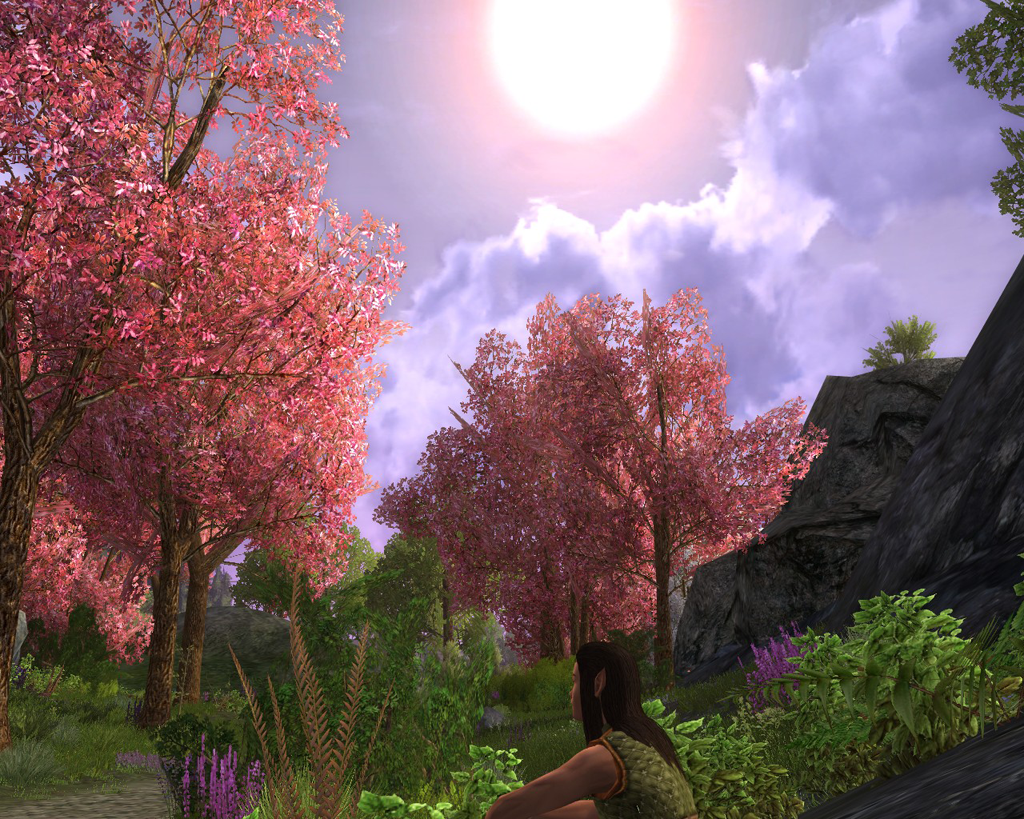
The wind had changed, bringing banks of billowing clouds down from the North, but the sun had risen above them and now shone over the treetops, bathing the world in morning light. But little of the land beyond could the elf-lad see through the trees that crowded the slopes along the road. He hoped in his heart that this roundabout journey would indeed reward him with a good map of the Shire.
Hildifons saw in the doubt his new friend's elven eyes, and the hobbit stroked his chin in thought. 'Unless you're wantin' to go to Hobbiton, after all?' he asked shrewdly.
'Nay,' said Feveren, 'I shall keep to the western marches as far as I am able. I deem it will be peopled less than the inner lands of the Shire, and I do not wish to chance upon folk unfriendly to Elves.'
'It's a shame that most Hobbits ain't as friendly as me,' Hildifons nodded sagely, 'but there are some in Tookland who like to say that Wanderin' Elves pass by the Great Smials on their way through the Green Hill Country. Hobbit-children mainly, but oft from the mouths of babes comes wisdom, if you take my meanin'.' He gave the elf-lad a wink. 'And I swear I saw Elves through the birch-trees near Woodhall once when I was in my tweens!' He noticed the puzzled look that crossed Feveren's face. 'Ah, that's our name for the years between bein' a lad or lass, and comin' of age at thirty-three.22 Be-tween, you see? I'm fifty-two now, mind you, and those years have long passed me by!'
'O!' Feveren cried in amazement. 'By uncanny chance I have also lived for two and fifty years!' Hildifons joined in the young elf's mirth, laughing in astonishment.
'Well I never!' the hobbit exclaimed. 'Who would have thought... well, well, well...' He looked quizzically at the young Green-elf's face and shook his head. 'I know nowt of Elves, to be sure, but by your manner I might've deemed that you were just out of your tweens yourself!'
'Indeed I am, by Elven reckoning!' replied Feveren. 'For among my people I am deemed but lately full-grown!' And in his mind flashed the thought of himself wellnigh a score of years before. At that time, Faethurin had been gone but a dozen years, and Feveren's riven heart was yet heavy with sorrow and loneliness. Indeed, in his grief he became aloof from the clan that loved him, forsaking their mirth to oft wander alone and forlorn in the woods, mourning the merry company of his lost love-brother. Glad he was that his downcast mood had soon after been overcome, and joy had returned to his heart.
The turning breeze rustled the leafy boughs and stirred the miry smell that lingered in the air, which was filled again with the sweet scent of wildflowers. Feveren breathed deeply of the heartening perfume.
'Still, if I might be askin',' the hobbit said, breaking through the young elf's thoughts, 'why are you wantin' to find old Mr. Bilbo? Not be meddlesome, you understand, but seems strange that one of the Fair Folk would be seekin' one of the Little Folk at all.'
'Fair Folk?' Feveren repeated. 'This is a Hobbit name for my kindred?'
'That's what you are called in our tales,' Hildifons replied shyly. 'I always loved the tales of Elves that the storyteller told in The Green Dragon when I was a lad.' His eyes shone with happy memory. '... and the handsome prince saw the Elf-woman standin' alone in the clearin',' he recited fondly.
The young elf laughed and clapped his hands. 'Indeed it is a tale that has brought me to your land, for Dwalin of Durin's Folk told me that Bilbo Baggins was afore his companion on a quest to Erebor. This tale he would not tell, for he said that I would best hear it firsthand from the hobbit of that name.'
'You're goin' all that way to Hobbiton just to hear a story?' exclaimed Hildifons in surprise, shaking his head in wonder. 'When I was a lad, old Mr. Bilbo would sometimes hint at his mysterious journey, when he disappeared (the first time!) and unexpectedly returned, but not nobody ever believed him. Mad Baggins they called him 'cos they reckoned he was cracked.'
'The dwarf-lord says it is truth, and in my heart I trust his words,' said Feveren.
'Then I guess it's also true, what I've heard tell,' the hobbit said, ' that tales and songs are like bread and butter to the Elves!23 Well, I never!'
The young Green-elf grinned merrily and shrugged his slim shoulders.
'It’s been a queer day, and no mistake!' said Hildifons, shaking his head once more.
* * *
Suddenly Feveren looked up as if he hearkened to a silent voice that called his name, and indeed he had in his mind heard the piping call of Glavror nearby. He thought it would be best that Hildifons be kept unaware of his travelling companions, for he had no mind to explain their friendship to the hobbit.
'Alas,' he said, 'I have tarried overlong. The day is growing old while we sit here on the grass, and the fresh morning dew that I love to feel upon my feet, now dries beneath the sun. Adventure calls, and alas! I needs must be on my way.'
'Oh!' the hobbit said sadly. 'That really is a shame, but I know very well what you mean about the call of Adventure. It's why I joined the Bounders, after all.'
The elf-lad wondered at that, and at what might have brought this hobbit hither from the land of his forebears. But he deemed if Hildifons had wished to share his tale, the talkative hobbit would have surely done so by now! His secret was his to keep, and besides, Feveren had not revealed his full purpose either: the tale of why he had forsaken his forest home in fair Harlindon.
'But for now, be glad in your heart, friend Hildifons!' he said merrily. 'For I have learned much from you that shall aid me greatly upon my journey. I give you my thanks.' He thought then of the words of Dwalin: Take such friends as are trusty and willing, but in his heart Feveren knew that the eager hobbit would never forsake his safe life in the Yondershire for an uncertain, and possibly perilous, Adventure beyond the confines of the Halfling lands. Not least if such boldness might imperil the promise of breakfast!
Instead the elf-lad rose to his feet and bowed. 'Always will I remember our meeting with great fondness, my friend. And here, this also is for you as a token of friendship.' He handed the hobbit a pale-green stone from the small store of jewels Dorongúr had gifted him for trade along his road. 'It is a beryl, an elf-stone.24 Should any passing High-elf prove too haughty, show him this! May the stars shine ever upon you, Hildifons Took the Second, Elf-friend and brave Marchwarden of the Eastway! May we one day meet again!''
The hobbit stood and hugged his Elf-stone to his breast, a tear glistened wetly in his eye. 'Oh, Feveren!' he said, 'I promise I'll always remember you... and be sure that I shan't never forget your feet!'
* * *
1. Valacirca - Q. "Sickle of the Valar", name of the constellation of the Great Bear (Ursa Major).
- The Silmarillion, "Quenta Silmarillion: Of the Coming of the Elves and the Captivity of Melkor"
2. "Isferon (Sindarin for Beech Lore)"
- Lotro-Wiki: Isferon
3. "Melkor they called Morgoth 'the Black Enemy', refusing to use the Sindarin form of Melkor: Belegûr 'he that arises in might', save (but rarely) in a deliberately altered form Belegurth, 'Great Death'."
- The Peoples of Middle-earth, "The Shibboleth of Fëanor"
((Feveren's kin delighted in this wordplay, and the jest became tradition.))
4. Nenuial, which is named Lake Evendim in the tongue of Men
5. "The Yondershire is traditionally considered the 'wild' part of the Shire. The last part to be occupied by the Hobbits centuries after the original settlement of the rest of the region. Originally covered in woods that served as hunting grounds for Gil-Galad and, later, Elendil, it became part of the province of Arthedain when Arnor was settled but preserved as wilderness by writ of the King. Later kings, however, razed the old forests for farmland: some woods later grew back but much of it remains open country, heather-covered moors and fields of rich tilth that support such crops as barley, hemp and cotton."
- Lotro-Wiki: The Yondershire, lore
6. "The Elves find their supersession by Men a mystery, and a cause of grief; for they say that Men, at least so largely governed as they are by the evil of Melkor, have less and less love for Arda in itself, and are largely busy in destroying it in the attempt to dominate it."
- Morgoth's Ring, "Athrabeth Finrod ah Andreth", Note 7
7. Cribbed from The Two Towers, "The Riders of Rohan"
8. "edhel 1b, pl1. edhil, pl2. edhellim {ð}[-] n. Elf. A name used by the Sindar for themselves, characterizing other varieties by an adjective or prefix. [PE17:139] => Aredhel, Thinnedhel"
- Parma Eldalamberon 17, Sindarin Corpus By David Giraudeau
Nan. Lindi - "Nandor"
S. Lindel - "Nando", lin ("singer") + el ("elf") Q. Linda, T. [i]Linda - “Teler”
9. Gladlin - Nan. galad (“tree”) + S. lind ( “song, chant, singer")
- Courtesy of u/Elaran at r/sindarin
10. "There were toys the like of which they had never seen before, all beautiful and some obviously magical. Many of them had indeed been ordered a year before, and had come all the way from the Mountain and from Dale, and were of real dwarf-make."
- The Fellowship of the Ring, "The Long Expected Party"
11. "[The Elves'] 'magic' is Art, delivered from many of its human limitations: more effortless, more quick, more complete (product, and vision in unflawed correspondence). And its object is Art not Power, sub-creation not domination and tyrannous re-forming of Creation."
- The Letters of J.R.R. Tolkien, "#131, To Milton Waldman" (~1951)
12. "The Harfoots were browner of skin, smaller, and shorter, and they were beardless and bootless; their hands and feet were neat and nimble; and they preferred highlands and hillsides. The Stoors were broader, heavier in build; their feet and hands were larger; and they preferred flat lands and riversides. The Fallohides were fairer of skin and also of hair, and they were taller and slimmer than the others; they were lovers of trees and of woodlands."
"The Fallohides, the least numerous, were a northerly branch. They were more friendly with Elves than the other Hobbits were [...] "
- The Lord of the Rings, "Prologue", "Concerning Hobbits"
13. "The Hobbits are, of course, really meant to be a branch of the specifically human race (not Elves or Dwarves) hence the two kinds can dwell together (as at Bree), and are called just the Big Folk and Little Folk. They are entirely without non-human powers, but are represented as being more in touch with 'nature' (the soil and other living things, plants and animals), and abnormally, for humans, free from ambition or greed of wealth. They are made small (little more than half human stature, but dwindling as the years pass) partly to exhibit the pettiness of man, plain unimaginative parochial man – though not with either the smallness or the savageness of Swift, and mostly to show up, in creatures of very small physical power, the amazing and unexpected heroism of ordinary men 'at a pinch'."
- The Letters of J.R.R. Tolkien, "#131, To Milton Waldman" (~1951)
14. "Long vowels are usually marked with the 'acute accent', as in some varieties of Fëanorian script. In Sindarin long vowels in stressed monosyllables are marked with the circumflex, since they tended in such cases to be specially prolonged; so in dûn compared with Dúnadan."
- The Lord of the Rings, Appendix E "Writing and Spelling", "Pronunciation of Words and Names", Vowels
"Translation of these presented little difficulty; but there remained one or two older names of forgotten meaning, and these I have been content to anglicize in spelling: as Took for Tûk, or Boffin for Bophîn."
- The Lord of the Rings, Appendix F "The Languages and Peoples of the Third Age", "On Translation"
"And in those days also they forgot whatever languages they had used before, and spoke ever after the Common Speech [...] Yet they kept a few words of their own, as well as their own names of months and days, and a great store of personal names out of the past."
- The Lord of the Rings, "Prologue", "Note on the Shire Records"
15. "High-sounding names taken mostly from legends of the past concerning both Hobbits and Men, e.g. Bandobras, Peregrin, Tredegar, Menegilda. Their use is peculiar to a few old artistocratic families, such as the Tooks and the Bolgers."
Hildifons, hild 'battle' + fons 'ready'.
- An Introduction to Elvish, "Giving of Names, Hobbit Names", Jim Allan (1978)
16. Nandorin rendering of Q. fëa, S. fae - "incarnate spirit, soul"
17. From the quest To Yondershire with some slight embellishment.
18. "... the hobbits of Gamwich are more familiar with a fishing pole or bow than those in other villages."
- Lotro-Wiki: Gamwich
19. The Lord of the Rings, Appendix D, "The Calendars"
20. "... little is now known of the Silvan Elvish. The Silvan Elves had invented no forms of writing, and those who learned this art from the Sindar wrote in Sindarin as well as they could."
- Unfinished Tales of Numenor and Middle-earth, "Appendix A, The Silvan Elves and Their Speech"
21. "The Shirriffs was the name that the Hobbits gave to their police, or the nearest equivalent that they possessed. They had, of course, no uniforms (such things being quite unknown), only a feather in their caps..."
- The Lord of the Rings, "Prologue, Of the Ordering of the Shire"
* However LotRO has taken the liberty of giving feathers to Bounders:
"Bounders have feathers in their hats as recognition of their duty, the more higher ranking bounders have 2 or 3 feathers."
- Lotro-Wiki: Bounder
22. The Fellowship of the Ring, "The Long Expected Party"
23. "Not that hobbits would ever acquire quite the Elvish appetite for music and poetry and tales. They seem to like them as much as food, or more."
- Bilbo Baggins, The Fellowship of the Ring, "Many Meetings"
24. The Fellowship of the Ring, "Flight to the Ford"
* All additional Hobbit-lore is from The Lord of the Rings, Prologue: Concerning Hobbits *
 |
xxvi |
 |