An Unlikely Champion, Part 4, on one page

Back to the chronicle “An Unlikely Champion, Part 4”

All the adventures of this chronicle, the oldest first. 20 in all

1. An Unlikely Champion, Part 4, Chapter 1

The Fairy Ring

'Beannaithe were now eighteen years of age. Two years had passed since she dreamt of Áine, her Sióg Mhaith ("Fairy Godmother"). In all this time Áine had not returned, yet, Beannaithe recalls hearin' Áine's voice sayin',

"I will watch over you always, and guide you where I may, but I cannot intervene in your battles. Choose them wisely, daughter of Aengus!"

"Aengus!" thought Beannaithe. "That's me father's name, but who is he?"'

'The farmer's daughter thought the man in her dreams may have been one of the Fair Folk,' I said. I looked around to see if me daughters were nearby before proceedin'...

'Aengus were not the Fairy King at all, as Beannaithe had thought. Rather, as she would later learn, he were the son of the Dagda, chief of the Tuatha Dé Danann, and the river goddess Boann.'

'Meanin' that Beannaithe were a demigod?' asked Darowva.

I looked at Darowva. She often surprises me, but never more so than on this occasion.

'So it appears,' I answered before addin' under me breath, 'but looks may be deceivin'.'

'This would account for her extraordinary abilities, would it not?' asked Darowva.

'Aye, it would indeed,' I replied. I suppose that were my intention when I first began this tale. All this time I had thought I were makin' it up as I went along, but perhaps not.

'Don't be forgettin' that she had learnt much from Fikta,' I reminded Darowva. 'Much of Beannaithe's skill and ability had come from his teachin'.'

'Aye, but even he were amazed by her precociousness,' Darowva reminded me.

'Aye, you're right, lass,' I admitted.

'Did Áine make another visit to Beannaithe?' asked Daibhidh.

'Well, let me continue the story so that we may discover it together,' I says.

'Beannaithe were anxious that Áine had not returned to impart wisdom and guidance to her, so she decided to force the matter.

She'd recently observed a Fairy Ring in her granda's garden. The farmer had warned her, "Don't go steppin' into the Fairy Ring. It will bring bad luck or worse!"

Beannaithe decided to take a chance. Late that night she quietly climbed out of her bead, slowly opened the door to the garden, then crept out of the house. She made certain that the door closed as quietly as she had opened it.

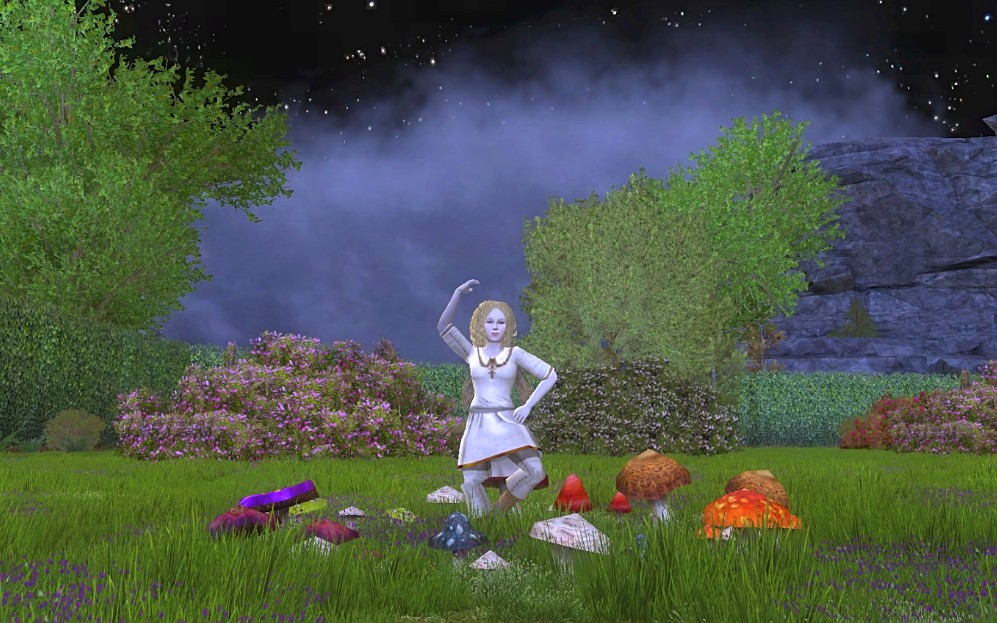
She searched the garden for the Fairy Ring. "There it is!" she thought when she found it. She looked around to make certain no one was watchin', then stepped inside it and began to dance.'
'All right,' I heard me daughter Ériu say, 'it's bedtime for this lot.'

I never heard me grandkids groan so loudly.

'Can't we stay up a wee bit later?' asked Darowva.

'No, lass,' me daughter answered, 'it's much too late to hear any more of Daidí Beag's fanciful stories about fairies, demigods, and the Tuatha Dé.'

Oy! Seems me eldest daughter had been listenin' without me knowin'. I had best check more carefully next time.

Fódla, Banba, and Ériu gathered their wee ones and escorted them to bed.

'Oíche mhaith, leanaí clainne!' I said after them.

'Good night, Granda!' I heard their voices answer.

'Oíche mhaith, iníonacha!' I said to me daughters.

They did not answer.
2. An Unlikely Champion, Part 4, Chapter 2

Hall of the Huntsman


'When last we saw Beannaithe she were dancin' in a Fairy Ring,' I reminded me grandkids.

'What happened next?' Darowva excitedly asked.

'Did she die?' wondered Daibhidh.

'She should've set out some báirín breac for the fairies,' suggested Dooli.

'Or mince pie!' added Diolun.

'May I continue me story?' I asked the lot.

'Aye, sorry, Granda,' said Dooli. 

'Sorry,' said the others.

'One moment Beannaithe were dancin' in the Fairy Ring,' I said, 'and the next she found herself standing in a circle of tall standin' stones amidst a forest of dead and dyin' beech trees.'

As I looked at their shinin' faces I could see questions arisin' in their minds, but they had the good sense to hold their questions.

'Havin' no idea where she were, Beannaithe thought she'd better find a high place where she could survey the landscape. To the west of where Beannaithe stood the land climbed steadily upward. She decided to walk in that direction to find a better vantage point. She walked slowly yet steadily toward the top of the steep hill. There she found yet another stone circle.

Knackered from her hike, Beannaithe sat upon the stone table that lie within the stone circle. When she had sat she immediately heard a strange hum behind her. When she turned to see its source she discovered an open portal through a dolmen. She stood then walked through the portal.

On the other side of the portal Beannaithe found herself in a grassy hall bound by tall stone walls on three sides. Amidst the hall were two wee ponds amidst some willow trees, one to her left and another to her right. 

Three very tall and beautiful women, river-maidens they were, were standin' near the pools. Two of the women were so occupied with what that they were doin' that they didn't seem to notice Beannaithe enterin' the hall. The third stood and faced Beannaithe but said nothin'. At the far end of the courtyard were a stone dais. As Beannaithe drew near it she saw that at its base and to the left stood a fourth river-maiden.

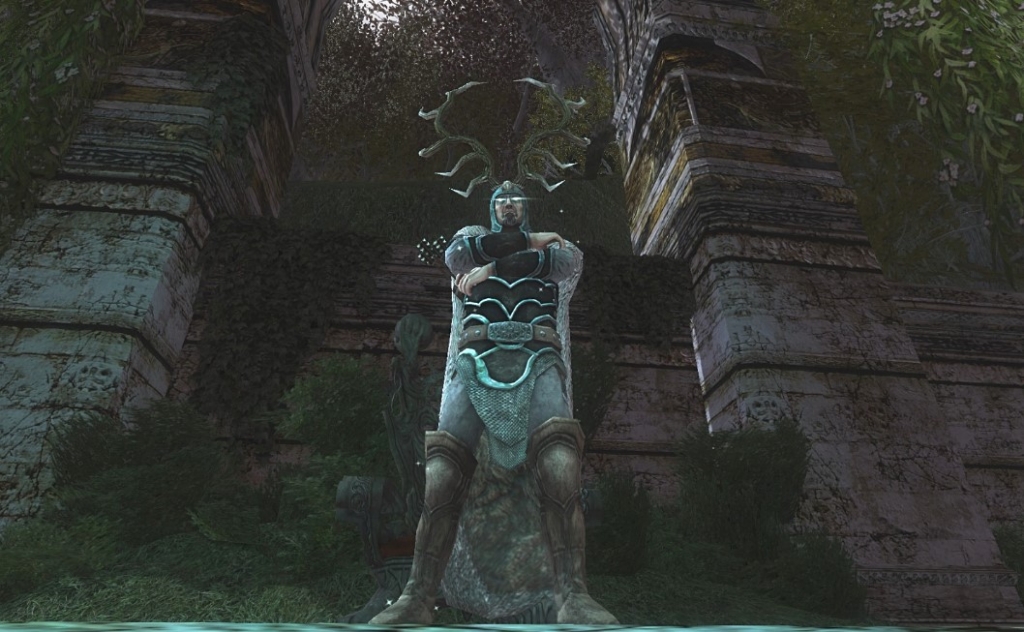
At the top center of the dais were a man of giant proportions. He were two or three times the height of the tall river-maidens, and many times taller than Beannaithe.

Strange he were and grim. Protruding from the top of his head were the antlers of a stag, although he may have been wearin' a cap to which the antlers were attached. He were too tall for Beannaithe to see the top of his head. 

His body sparkled as if he were covered with a thousand stars. His piercin' gaze flickered with a peculiar glow. It seemed to Beannaithe that he were the source of the strange hummin' sound she'd heard near the stone table outside the portal.

The river-maiden at the foot of the dais spoke as Beannaithe approached. "This is the Hall of the Huntsman. Remember your courtesy!"

The voice startled Beannaithe so much that she, who were afeared of practically nothin', cowered and quavered in fear. When Beannaithe realised that no harm would befall her, she stood upright and curtsied politely to the antlered giant.'

Again I could see more questions arise in me grandkids' faces, but still they held their tongues.

'The Huntsman began to speak, slowly and in a deep rumblin' voice...

"Beannaithe, daughter of Aengus, you have been called for a special purpose: to aid the Tuatha Dé Danann in their conflict with the Fomhóraigh."

Beannaithe's mind began to race with questions and doubt.

"More will be revealed when you visit Bean an Tí na Locha ('The Lady of the Lake'). Seek her for the answers to your questions."'

'Lady of the Lake, is it?' asked me daughter Fódla. 'I don't know about these silly tales.'

'They're not silly!' said Darowva.

'Don't sass your aunty, lass!' said her mother Ériu.

'Sorry, aunty,' said Darowva apologetically.

'That's all right, love, I know you're mighty fond of your granda's stories,' Fódla replied. 'That's why we have allowed them to continue. Just know that they're just that, stories, no more and no less.'

'Yes, aunty,' said me grandkids in unison. 

Fódla's own daughter Beacha could not reply because she were, as usual, already sleepin'.

'Off to bed with ye!' I said.

'Good night, Granda,' they quietly replied.

After the wee ones were put to bed I thanked me daughters for allowin' me to tell me stories in me own way.

'It's we who should be thankin' ye, Daidí,' said Banba. 'The kids greatly enjoy your stories.'

'We can be a protective lot, overprotective some might say, but it's our wee lads and lasses we're lookin' after,' Ériu explained. 'They mean the world to us.'

'Aye, daughter, and they mean the world to me as well,' I said.

We four hugged and kissed before partin' for our own beds.

'Oíche mhaith, iníonacha!' I said.

3. An Unlikely Champion, Part 4, Chapter 3

The Lady of the Lake

I continued me story where I had left off the night before...

'Once again the next evenin' Beannaithe went into her grandfather's garden with the thought of dancin' in the Fairy Ring. The sky were cloudy, no moonlight could be seen, and Beannaithe could not find the Fairy Ring. Disappointed, she returned to her bed.

In a dream, however, she heard Áine's voice say, "To the Lake of Twilight you must go. There you will find the Lady of the Lake."

"But where is it?" Beannaithe thought. "And how shall I get there?"

No answer were forthcomin'.

Over the next few days the weather became severe in the mountain vale. There were winds and rain. The thunder were so loud that it shook the ground. Great bolts of lightnin' filled the sky. The villagers were greatly afeared. "The end of the world is upon us'!" some thought, but it were not so. It were just a storm, a strong one perhaps, but a storm nonetheless.

When the storm cleared the moon could again be seen high in the sky at night. The Fairy Ring reappeared. When Beannaithe danced in it she found herself transported to an ancient land with many ruins scattered throughout.

In the center of this ancient land were a vast lake. On the shore Beannaithe found a small boat. When Beannaithe sat in the boat it began to move, takin' her to the far end of the lake. There she spied the openin' to a cave. 

"This must be where I'm to go," she thought. She climbed out of the boat, waded though a shallow pool then entered the cave. 

This were no mere cave: it were a grotto. It were green and teemin' with life. So deep were the grotto that Beannaithe walked several minutes before she finally found its end. 

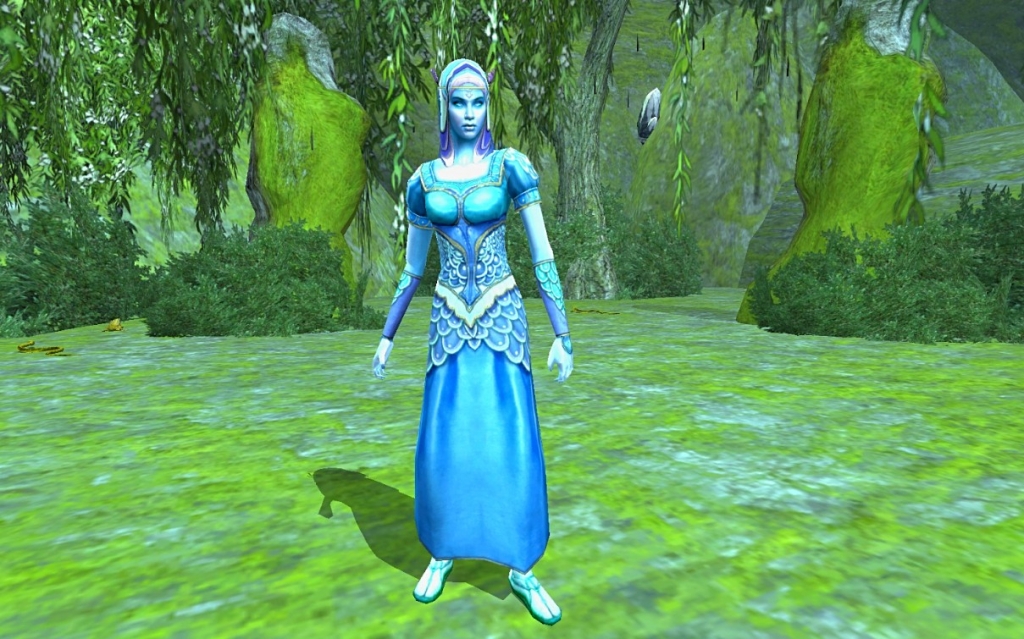
There Beannaithe found a strange woman. Blue she were, and stern of countenance. Her dress seemed as it were covered in fishes' scales. It were beautiful, Beannaithe thought, though quite peculiar. The strange woman said nothin'. Beannaithe felt very uneasy in her presence. Then she recalled hearin' the tall river-maiden in the Hall of the Huntsman say, "Remember your courtesy". Beannaithe politely curtsied to the strange woman in the cave. It seemed to be the thing to do.

"I am known by many names," the strange woman said, "but to the Little Folk of the Mountain Vale I am known as Bean an Tí na Locha ('The Lady of the Lake'). Who sent you to me?"

Beannaithe merely stared at the strange woman, not knowing how to answer her.

"You cannot speak, this I understand. Merely think of what it is you wish to say and I will hear you."

"The Huntsman sent me to you," Beannaithe answered in thought.

"The Huntsman? Is that what he calls himself now? He, too, is known by many names. Your folk may know him as Fer Benn, the Horned Man," explained the strange woman. "Were not his antlers magnificent?"

Beannaithe nodded.

Seemin' from nowhere the woman drew forth a long sword. It shone with a light that nearly blinded wee Beannaithe. "This blade I hold is called Claíomh Solais, the Sword of Light. It was the sword of Nuada Airgetlám, Nuada of the Silver Hand. Do you know of him?"

Beannaithe shook her head.

"That is a pity," the strange woman answered. "His story is an interesting one, but very long. We have not the time for me to tell it to you now, but perhaps one day you shall learn of him from another."

The woman looked Beannaithe over, slowly noddin' her head as if answerin' her own question.

"Claíomh Solais was Nuada's longsword, but to one of your stature it shall be as a great sword. It will require you to use both hands to wield it. Will you be able to do that?"

Beannaithe nodded her head. She had seen Dwarves wield great axes with two hands. "How much different could it be with a sword?" she thought to herself.

"This sword I now place into your hands. When you have fulfilled your destiny, you must return it to the waters of the Lake of Twilight. I shall receive it.

Do you understand?"

Confused though she were, Beannaithe agreed to do as the strange woman instructed. Beannaithe received the sword with both hands. The sword gleamed with a great light as she gripped its hilt. It were surprisin'ly lightweight for its size.

Suddenly Beannaithe found herself back in her room in Lyndelby. "I must douse this light!" she thought. Quickly and quietly Beannaithe found a spare blanket to wrap the sword in, then placed it under her bed hopin' that none would find it.'

Beannaithe yawned, then climbed into her bed. She were quite content now that the mystery surroundin' her were comin' into focus. She slept 'til the sun were high in the sky.'

'The poor thing must've been knackered somethin' fierce to sleep so long!' observed Darowva.

'I've never been allowed to sleep so late,' said a frownin' Dooli.

'And you never shall!' said his mother Ériu with a laugh.

'Aw!' he replied.

'Off to bed with ye!' I said to me grandkids.

Like sheep, with the guidance of their mothers as shepherdesses, me grandkids silently meandered off to their beds.

4. An Unlikely Champion, Part 4, Interlude 1

A Caution from Áine

"Give heed, daughter of Aengus! Claíomh Solais is very powerful, and must be used with great care. Failure to do so may lead to your own destruction," cautioned Áine. "Do not take life without need. Succumbing to blood lust will only lead one down the path of darkness and evil."

"Do you understand?" asked Beannaithe's sióg mhaith.

The lass nodded gravely.

5. An Unlikely Champion, Part 4, Interlude 2

The Snail's Home
--Maya Anthony

His house upon his back he totes,
A spiraling, snug retreat.
It’s not a place with moat,
But still a home that’s neat.

A mobile home, yet sturdy still,
Defending from life’s plight.
Within, he finds a tranquil fill,
A space that’s just so right.

For in each curl, a story lies,
Of slow but certain roam.
In comfort’s spiral, we realize,
Wherever you go, there’s home.

6. An Unlikely Champion, Part 4, Chapter 4

Inspiration from the Garden


The next evenin' I continued me story about the lass what were raised by Fikta the Dwarf:

'It were a usual day, nothin' out of the ordinary were happenin'. Beannaithe were helpin' her grandfather the farmer with his garden when inspiration struck her. Beannaithe saw a snail. It were an ordinary garden variety snail. Rather than immediately chuckin' the snail in a bucket as she'd always done before, Beannaithe paused to consider the beauty of the snail's shell, its swirlin' shapes, and how it protected the slimy creature within.'

Beannaithe thought that if she were to go into battle on behalf of the Tuatha Dé Danaan she would need armour to go along with her sword. She were stumped, however, on how to begin makin' it. "I'll go to the blacksmith, surely he will help me," she thought.

The blacksmith were elated to see Beannaithe, but were quickly disappointed that she had not returned to work for him. The lass did her best to convey her notion of makin' armour for herself.

The farmer laughed to think that Beannaithe thought he knew anythin' 'bout makin' armour. He agreed to allow her to use his forge and to help her obtain the materials she needed, but she were on her own when it came to makin' it. Fortunately, that's all Beannaithe truly needed.

Beannaithe recalled watchin' with great interest the Dwarf-smiths hammer armour for the defenders of the Lonely Mountain. She thought she'd attempt to duplicate their work with perhaps a few added elements of her own.

The lass sought the aid of the village seamstress as well, for not all of the armour would be made of metal. There would be leather bits, straps and what have you, that would require needlework. The blacksmith served as the interpreter of Beannaithe's hums and gestures while conversin' with the seamstress.

"Leather is what ye'll be wantin', lass. I have precious little of that," said the seamstress. "However, the cobbler should have enough to see you through. Tell him I sent ye. We're good friends he and I.'

Beannaithe and the blacksmith thanked her heartily.

The cobbler said he'd be happy to provide Beannaithe with all the leather she wanted, but wanted to know her purpose.

"What's she need it for?" asked the cobbler.

"If I understand her aright," answered Blacksmith, "she's makin' some armour."

For a moment the cobbler stared at them both as if they were mad. Then he laughed. "All right, ye don't have to tell me if you don't want to," he said. "I were merely curious is all."

"That's truly the reason, I assure ye," said the blacksmith. "If ye provide the leather she'll be happy to show you the finished work when she's accomplished it. Won't ye, lass?"

Beannaithe shrugged and nodded. She didn't know what all the fuss were about.

"I'll be good for the price," Blacksmith told the cobbler.

"Don't ye worry about that," Cobbler answered. "It'll be worth the price just to see what the lass does with it," he said with a laugh.

It took a few weeks for Beannaithe to complete the armour, even with the aid the blacksmith, the seamstress, and the cobbler. Her mother and grandfather did not know precisely what the lass were up to. They thought she were helpin' the blacksmith as she had a few years before. Unbeknownst to them, quite the opposite were true. It were the blacksmith that were helpin' the lass.

As promised, once the armour were finished Beannaithe showed the cobbler what she'd made from the leather that he'd provided.

"In all me years that's the most outlandish thing I've seen" said Cobbler with a laugh. "I don't know why the lass needs armour, but I reckon that'll get the job done whatever it may be. I particularly like the helm. Very snail-like it is."

Beannaithe smiled broadly despite the cobbler's laughter. She thought the armour were very fittin' for a warrior of the Fair Folk.'

'I'm a wee bit confused,' said Diolun. 'Is the armour made of snails or is Beannaithe dressed as one? If the latter, will she be crawlin' on her belly?'

Dooli and Daibhidh laughed.

'Weren't ye listenin'?' interjected Darowva. 'Why would Beannaithe need leather if the armour were made of snails?'

'Be kind, lass,' I whispered to Darowva. 'Ye know the lads are not as clever as ye.'

'That much is true,' Darowva said triumphantly. 

'Diolun, lad, I'll explain it to ye in the mornin',' I said to him. 'In fact, I'll take all ye lads fishin'. We can talk about it then.'

'Don't ye think ye should clear it with their mothers first?' said Ériu. 'Aye,' agreed Banba and Fódla.

'Aye, of course, dear daughters,' I replied. 'I hope ye won't mind.'

'I suppose not,' said Ériu. 'All we ask is that you gain our approval before makin' any promises.' Her sisters nodded in agreement.

'We can make ye a fine lunch to take with ye,' said Banba.

'And plan for a fish fry in the evenin',' added Fódla.

'That'll be grand,' I said. 'Thank ye, ladies of the house,' I added with a bow.

'Time for bed now, ye rascals!' Ériu said playfully.

Me grandchildren laughed and ran off to their beds. Exceptin' Beacha, of course,  whom I carried as she were already sleepin'.

7. An Unlikely Champion, Part 4, Chapter 5

The Bear-folk

Me grandsons and their old granda enjoyed a fine fishin' expedition filled with many questions asked and few answers given. The fish weren't bitin' particularly well, but we caught enough for a supper supplemented with lots o' vegetables from me garden. After supper it were time for a story by the hearth.

'Each year when Fikta and Beannaithe would return to the Lonely Mountain for the Durin's Day celebration the Dwarf would tell his young ward the story of how Thorin Oakenshield and his company of adventurers reclaimed their ancestral home from the dreaded Smaug the Golden. Within this story were the tale of Beorn the Skin-changer, a huge man who at night would become a bear and roam about the countryside lookin' for wargs and goblins to slay.

Beannaithe had long wished she could visit Beorn and his animal friends. Doin' so would mean travellin' a long distance and include fordin' the Abhainn Mhór ("Great River"). The lass were certain that her grandfather and mother would not allow it, so she secretly gathered provisions in advance of the journey. She placed them with her armour and sword, which she'd stored in the barn under a pile of old farm equipment.

In preparation for her journey Beannaithe had rummaged through some of Fikta's old things. She recalled that he had kept maps to help him from getting lost. This became particularly important as he grew older and more forgetful. Since Fikta had himself never visited Beorn's house he did not have a map leadin' to the place, but Beannaithe recalled hat he would point to a spot on his map when tellin' the tale.

Now equipped with weapon, armour, provisions, and map Beannaithe went forth to fulfill her destiny as declared by The Huntsman. When the time came to leave, since she had no pony, the lass set out on foot. She would've left a note if she could write, but she could not. Instead, she put some pillows under the blankets on her bed and clothed others in one of her old dresses, so at least her family would understand that she'd left of her own will.

It took a few days to find it, but at last Beannaithe found the path leadin' to the home of the Bear-people. The house itself were not as large as the lass had imagined. She supposed the Bear-people were few in number.

Beorn, the Bear-man in Fikta's stories, had grown old and died since the time of the tale. His son himself had grown old, Grimbeorn the Old he were called. He came out at once when he'd received news of a visitor from one of his animal friends.

"Oh, ho!" laughed the Bear-man. "What have we here? A young cub dressed in fancy armour. But where is she going I wonder?" Grimbeorn were as big and imposin' a mortal man that Beannaithe had ever seen. Only the immortal Huntsman were taller.

Beannaithe gestured indicatin' that she were without speech.

"Mute, eh? That is a pity. Let us find you something to slake your thirst. Perhaps that will loosen your tongue."

Just then a wee pony gamboled over with a flagon of mead and two tankards perched on its back. The Bear-man poured the contents of the flagon into the tankards.

"What shall we toast then?" he asked.

Beannaithe smiled bashfully and shrugged

"Down with goblins!" the large man bellowed.

Beannaithe took the tankard in both hands and, thinkin' it were water, took a long draught of mead, for mead it were. Beannaithe, feelin' a bit light-headed, stumbled a little and nearly fell until Grimbeorn reached out his large hand to steady her.

"Slow down, little lady! I see that you care no more for goblins than I," the Bear-man said with a great laugh. "Let us go inside where we may recline while we eat." 

Grimbeorn told a version of the tale of Thorin and Company's visit that he'd heard from his father. "They weren't all Dwarves," the great man said, "with them were an excitable little fellow. Bilbo Baggins was his name. Is he any relation of yours?"

Beannaithe shook her head.

"Still can't talk? Well, if the mead can't help I suppose nothing can," Grimbeorn said thoughtfully.

"You're welcome to stay the night. After a hearty breakfast I'll see you off in the morning."'

'I suppose I've rambled on long enough,' I said to me grandkids.

'I'd like to hear more, please,' Darowva politely said.

'We can stay awake a little longer,' pleaded Diolun.

'We can!' said one or two of the others who had not yet fallen asleep.

'No, ye can't,' said Ériu, Diolun's mother. She was supported by her two sisters, Banba and Fódla.

'All right,' me grandkids said disappointedly.

'Good night, me wee darlin's!' I said as they were being led away.

8. An Unlikely Champion, Part 4, Interlude 3

Imbolc

Imbolc ("in the belly") marks he beginning of the lambing season. Brigid, daughter of the Dagda, who provides special protection for domesticated animals, is honoured on this day.

9. An Unlikely Champion, Part 4, Chapter 6

An Unlikely Steed


I continued me storytellin' to the grandkids...

'The next mornin' after breakfast Beannaithe packed up her things in anticipation of her departure.

Grimbeorn came to her sayin', "I might lend you a pony, but you would only be permitted to ride to forest's edge. Instead I will persuade another of my friends to carry you to visit the Elves of the Greenwood."

This caught Beannaithe's attention as few things would.

The Bear-man escorted Beannaithe beyond the gate of his compound and strode some distance into the meadow beyond. He reached into the pouch that hung on his belt and pulled out a handful of somethin'. What it was Beannaithe could not see.

The great man put his finger to his lips signalin' Beannaithe to be silent. He then sat on the turf with his long legs folded in front of him. He motioned for Beannaithe to do the same. When the lass had done so Grimbeorn rested his thick hairy arms across his legs, and opened the palm of his right hand facin' upwards. Beannaithe could see that in his hand he held some grain.

Within a few minutes a hart, a hind, and two fawns came over the hill. The hart sniffed the air then, supposin' it were safe, strode towards the Bear-man. Grimbeorn smiled then winked at Beannaithe. He spread the grain across the turf. The hind and fawns began eatin' the grain while the hart kept watch.

Grimbeorn reached into his pocket for more grain, and held his hand out to the hart. The hart hesitated a moment before approachin' the great man. Then, after sniffin' the air, the hart ate the grain from the man's hand. Grimbeorn gently reached out with his left hand to stroke the hart's proud neck.

Then Grimbeorn did somethin' even more surprisin' to Beannaithe. While the hart continued to nibble the grain the Bear-man slipped a leash around the hart's neck. Speakin' softly and calmly, Grimbeorn said to the lass, "Slowly stand and take this leash." She did as the man asked. "Now climb onto his back as you would a pony." The lass looked doubtful, but after a brief moment did as the man asked. To her great surprise the hart did not bolt.

"There you are, lass," he said. "Treat him gently and with great care, and he will carry you as far as you like. I will care for the hind and fawns until the hart returns from the forest."

Beannaithe smiled and gave silent thanks to Grimbeorn. Then with a wave of her right hand, the one not holdin' the leash, she waved and was off.'

'A lovely story, Granda!' gushed Darowva.

'Aye, 'twas grand, Granda,' said Dooli. Daibhidh and Diolun agreed.

'Good night!' I said to them. I lifted wee Beacha and carried her to her bed.

'Thank ye, Da,' said me daughter Fódla.

'Oíche mhaith, me darlin' daughters!' I said to the three.

10. An Unlikely Champion, Part 4, Chapter 7

Into the Greenwood


As were me usual custom, I began me tellin' me grandkids' bedtime story in the spot where'd I'd ended the evenin' before...

'The hart carried Beannaithe in an easterly direction towards the forest of the Greenwood. The lass assumed the hart knew its way through the woods, and she were right. 

The hart happily gamboled along the old Elf-path. The path turned and twisted to avoid the great beech trees and other obstacles along the way, but it steadily if not directly led deeper and deeper into the dense, dark forest.

They had travelled quite some way when the hart began slowin' its pace before comin' to a stop. It twitched its ears this way and that as it sniffed the air.

"Daro!" said a commandin' voice. Two strange men leapt from the foliage and took control of the hart that Beannaithe rode. They spoke to each other in a language that Beannaithe did not understand.

One said to another in a bemused voice, "A halfling on a beast of the forest? Have you ever seen so strange a thing?"

"Nay," said the second, "and neither have you! This little one has unwittingly provided our evening meal."

The strange men laughed. They were not Men, of course. They were Wood-elves.

Although Beannaithe could not comprehend their words, she sensed that they were talking about her and her new friend. She'd seen that sort of gleam in their eyes before when Fikta beheld a New Year's feast in the Hall Under the Mountain.

Beannaithe threw herself between the Elves and her forest friend, spreadin' her arms to shield it. "HOO!" she shouted or something to that effect. She shook her head "no" to tell the Elves that they could not take her friend.

The Elves spoke again to each other in their strange tongue. 

The first Elf said to his comrade, "Do you think this little one understands our words?"

The second Elf answered, "Nay, I do not think so, but she clearly perceives the tone in which we speak."

The first Elf spoke to Beannaithe in the Common Tongue, "Do not fear, little one, we merely jest among ourselves. No harm will come to you or your 'steed'."

So difficult was the notion of an elk-steed that it was all the Elf could do from burstin' into laughter. 

"At the same time," said the second Elf, "we cannot allow you to roam freely through the Greenwood without receiving judgement from our king."

Beannaithe was at first confused by their actions, but slowly she began to understand. She held out her arms, hands palm up, in a gesture of surrender.

The two Elves looked at each other, then smiled at Beannaithe. "We do not wish to take you prisoner, little one. You will remain unfettered as long as you do not try to escape."

Beannaithe remembered the tales that Fikta had told her of Thorin and Company's misadventure with the Wood-elves of Mirkwood. She did not wish to be imprisoned nor be shot full of arrows tryin' to escape. Elves are highly skilled bowman and are unlikely to miss even such a small target amidst so many trees.

Beannaithe nodded to demonstrate that she understood the Elves' purpose.'

I stopped me story at this point as I could see me grandkids gradually growin' sleepy despite their best efforts to remain awake. I motioned to me daughters to claim their wee ones.

'Oíche mhaith,' I quietly said to me daughters.

'Good night, Da,' they answered in return.

11. An Unlikely Champion, Part 4, Interlude 4

An raiḃ tú ag an gCarraig?
--Dominic Ó Mongain

An raiḃ tú ag an gCarraig, nó ḃ-faca tú féin mo ġraḋ,
Nó a ḃ-faca tú gile, finne, agus sgéiṁ na mná
Nó a ḃ-faca tú an t-uḃal ba cúbarṫa is ba ṁillse bláṫ
Nó a ḃ-faca tú mo valantíne no a ḃfuil sí da claoiḋ mar taím?

Do ḃíosa ag an gCarraig, is do ċonairc me féin do ġraḋ,
Do ċonairc mé gile, finne, agus sgéiṁ na mná,
Do ċonairc mé an t-uḃal ba cúbarṫa is ba ṁillse bláṫ
Do ċonairc mé do valantín agus níl sí da claoiḋ mar táir!

Is fiú cúig ġuinea gaċ riḃe da gruaig mar ór,
Is fiú oiread eile a crideaċta úair raiḃ ló;
A cúilín trom tripiliċ a tuitim léi síos go feóir
'Sa ċuaiċín na finne, ar ṁiste do sleinte d'ól

'N úair ḃím-se am ċoḋla bían osnaḋ gan ḃríg am ċlíaḃ,
Is mé am lúíḋ eadar cnocaiḃ go d-tigiḋ an dúaċ aníar;
A rúin ḋil s'a ċogair ní'l fortaċt mo ċúis aċt Dia,
Is go n-dearnaḋ loċ fola do solus mo súl ad diaiḋ!

Is go d-tigiḋ an ċáirg air lár an ḟoġṁair ḃuiḋe,
Is lá ḟéil Pátruig lá nó ḋó na ḋiaiġ,
Go ḃ-fása an bláṫ bán tre lár mo ċoṁra ċaol,
Paírt da ġraḋ go braṫ ní ṫaḃarfad do ṁnaoi!

Siúd í síos an Ríoġ-ḃean áluin óg,
A ḃfuil a grúaig léi sgaoilte síos go béal a bróg,
S i an eala í mar an lítir do síolraiġ ón t-sár ḟuil ṁór,
Ċaraid ġeal mo ċroiḋe, céad míle fáilte roṁat!


Have you been at Carrick?*
--Edward Walsh, translator

Have you been at Carrick, and seen my true-love there?
And saw you her features, all beautiful, bright, and fair?
Saw you the most fragrant, flowering, sweet apple-tree?
Oh! saw you my loved one, and pines she in grief like me?

I have been at Carrick, and saw thy own true-love there;
And saw, too, her features, all beautiful, bright and fair;
And saw the most fragrant, flowering, sweet apple-tree—
I saw thy loved one--she pines not in grief, like thee!

Five guineas would price every tress of her golden hair—
Then think what a treasure her pillow at night to share,
These tresses thick-clustering and curling around her brow—
Oh, Ringlet of Fairness! I’ll drink to thy beauty now!

When seeking to slumber, my bosom is rent with sighs—
I toss on my pillow till morning’s blest beams arise;
No aid, bright Beloved! can reach me save God above,
For a blood-lake is formed of the light of my eyes with love!

Until yellow Autumn shall usher the Paschal day,
And Patrick’s gay festival come in its train alway—
Although through my coffin the blossoming boughs shall grow,
My love on another I’ll never in life bestow!

Lo! yonder the maiden illustrious, queen-like, high,
With long-flowing tresses adown to her sandal-tie—
Swan, fair as the lily, descended of high degree,
A myriad of welcomes, dear maid of my heart, to thee!


*Also translated as "Were you at the rock?"

12. An Unlikely Champion, Part 4, Chapter 8

The King of the Woodland Realm


An unusually cold wind blew across the snow-covered mountains and into the valley where the village of Lyndelby resides. There I were workin' in the garden when I became chilled to me very bone. Unfortunately, I were far too late in heedin' me daughters' pleas to come indoors. As a result, Daidí Beag, that's meself, took ill for several days.

Me daughters Ériu, Banba, and Fódla did their best to nurse me back to somethin' resemblin' me previous health and vigour. I passed the time sittin' in me rockin' chair by the fire wrapped in warm woolen blankets whilst I sipped cups of hot nettle tea. It weren't like me to sit still for more than a few minutes let alone a few days, but on this occasion I had no say in the matter.

'You're sittin' there 'til you're well, and that's all there is to it!' scolded Ériu. 'Aye, and we'll keep a close eye on ye to see that you do!' added Banba. "Hmm!" Fódla added for emphasis. As I said, I had no say in the matter.

By the time I'd regained most of me health me grandkids Dooli, Daibhidh, Darowva, Diolun, and Beacha were more than anxious for me to resume me bedime storytellin'.

'The Wood-elf scouts escorted Beannaithe to stand before the King,' I says. 'He were tall and fair with bright golden hair. On his brow he wore a crown of green leaves.

"I am King of the Woodland Realm," he said to the lass. "Although I am an Elf of the Twilight, my folk are Silvan Elves, that is, Elves of the Woods. Those not of my folk often find my name difficult to pronounce so I will say to you that in the Common Tongue my name means 'Vigourous Spring'."

Beannaithe gave no response. The King's countenance darkened.

"Who are you and why have you come into my realm?" he asked somewhat sternly.

Beannaithe did her best through expressions, gestures, and her own peculiar sounds to answer the Woodland King's questions; she were unsuccessful. Unlike a few others found in this tale, the Wood-elf king could not read her thoughts.

The King stared at the lass in wonder. Finally he commanded his chamberlain, "Bring this Halfling a glass of wine. Can you not see that she thirsts?" His command were immediately obeyed.

While his servant were fetchin' the wine the king noticed the marvelous sword that Beannaithe had strapped upon her back.

After his guest had a few sips of wine the king said to her, "What a fine sword you have, little one. It shines so brightly! Wherever did you get it?"

Beannaithe pantomimed a woman and swimmin' then spread her arms wide and made a circular motion. 

"The sea?" the King guesseed.

Beannaithe made a fist, extendin' only her thumb and forefinger. Then she narrowed the distance between thumb and finger indicatin' somethin' smaller. 

"A lake?" the king guessed again. 

Beannaithe nodded her head to confirm his guess. 

"A woman in a lake then?" 

Beannaithe nodded again. 

The King smiled and chuckled to himself, not believin' a bit of her fanciful story.

"Stole it from some forgotten dragon hoard I warrant, or perhaps from one of those miserable Dwarves. Serves them right, the wretches!" the King thought to himself before sayin', "You had best take care of it then. It is obviously of great worth." 

Beannaithe smiled and vigorously nodded her head.

The King then remarked on her strange snail-inspired armour, "Did this Lake Lady also provide your armour?" 

Beannaithe seemed surprised and a little confused by the King's question. She shook her head indicatin' that she had not. 

"Never the matter," replied the King. "You should be properly attired while you remain in my realm. I would be greatly saddened if one of my scouts pierced your beautiful armour because they thought you were a goblin."

Beannaithe were not pleased at all that the Woodland King thought she resembled a goblin, but she did not express her displeasure to him.

The King called for his armourer to make Beannaithe some suitable woodland gear durin' her visit. Later, when the King saw how fine Beannaithe looked in the armour of his people, he also granted her a slender woodland bow from his weapon hoard.

"I have one final thing to show you, little one," the King said proudly. He escorted her through the gate and across the bridge to where one of his folk stood holdin' the leash to Beannaihe's elk friend. 

"Behold!" said the King.

To Beannaithe's surprise and delight it had been equipped with the saddle and gear of a proper mount.

"Do you like what you see?" said the Elf-king.

Beannaithe vigourously nodded her head once again.

"I have given you not one, and not two, but three gifts, young Halfing!" boasted the King. "Have you anything you'd like to give me in return?" he asked, glancin' at the sword strapped across Beannaithe's back.

The lass felt uneasy, but did her best not to show it. Instead, she innocently reached into her pack and drew forth a small object wrapped in beech leaves. Beannaithe then placed it into the King's hand.

He opened the packaged and slowly peeled back the leaves. "What is this?" he asked, disappointedly.

Beannaithe motioned that he should eat it.

The Elf-king gingerly took a small bite. Although he would not admit it, it was delicious. Again he asked, "What is this?"

The elf holdin' the elk steed's leash bent at the waist to examine the object.

"Lord, it appears to be a honey-cake," the Elf answered. "It is said that it is very rare indeed that the Beornings give these to strangers. To receive one is a great honour."

The Elf-king, forcin' a smile, thanked Beannaithe for the cake. Clearly he had his eyes on a larger prize. "I will have that sword!" he said to himself but for now he'd bide his time until another opportunity presented itself.

Beannaithe, movin' quickly before the Elf-king could snatch her sword, mounted the elk, waved good-bye, then rode away.'

'That were some story!' said a delighted Darowva.

'Aye, quite strange but entertainin' nonetheless,' said Daibhidh with a chuckle.

Dooli and Diolun looked at each other and shrugged.

From the corner of me eye I could see me daughters comin' to claim their sons and daughters.

'Oíche mhaith, me wee darlin's!' I said to me grandkids as their mothers led them away to their beds.

13. An Unlikely Champion, Part 4, Chapter 9

Land of the Fair Folk


After supper the grandkids and meself gathered near the warm fire for another evenin' of storytellin' whilst their mams chattered amongst themselves in the kitchen...

'Beannaithe were anxious to discover what she were to do next. She lay in her bed until all had gone to sleep then silently crept into her grandfather's garden. Finding the Fairy Circle, she began to dance. She vanished at once.'

'A moment, please,' said Darowva. 'How did Beannaithe return to her home in Lyndelby followin' her adventure in the Greenwood?'

'Did I not say?' I asked.

'No!' me grandkids shouted.

'Well, your old Granda is gettin' forgetful in his dotage,' I said with a chuckle. 'Let me think...'

A moment passed before I got it sorted.

'Ah, well then, the entire journey visitin' the Bear-folk and the Elf-king were a dream.'

'Did Beannaithe still have the Elf-bow?' asked Dooli. He is particularly keen on archery.

'Uh, why, yes, she did,' I answered.

'Yet it were a dream?' asked Daibhidh.

'Well, then, no, it weren't a dream,' I said. A seanduine ("old person") such as meself is permitted to change his mind on occasion, isn't he?

'Your old Granda was just testin' ye to see if ye were payin' attention,' I fibbed. 'This is what really happened...

The lass felt badly about takin' so many grand gifts from the King of the Wood-elves while givin' him only a honey-cake in return, so she returned to the gate of the Wood-elf city where she persuaded them to return her snail armour to her. In exchange she gave them the Wood-elf armour, the Elf-bow, as well as the saddle and such that they'd placed on the hart. Truth be told, the hart didn't fancy wearnin' the gear anyway.' 

'Didn't you say the lass kept the bow?' asked Dooli.

'Aye, lad, I did,' I said. 'Let me finish.'

'The Wood-elves said she could keep the bow as a remembrance of her visit to their hall, but they kept the rest. They bid her farewell and wished her good fortune on her travels.'

'Is that all?' asked Daibhidh.

'Not quite,' I said. 'The lass road the hart back to the home of the bear-folk where he were reunited with the hind and her fawns. Beannaithe spent another night with Grimbeorn and his kin, and in the mornin' found the path leadin' back across the Abhainn Mhór ("Great River") and, eventually, to Lyndelby.'

'And now?' asked Daibhidh.

I thought a moment before sayin', 'Aye, that's the short version of it.'

Me grandkids looked at one another and agreed that they were fine with me explanation. 

'All right,' they said.

Continuing where I'd left off earlier...

'After dancin' in the Fairy Circle the lass were surprised to find herself in a new place. Not amid a stone circle in a haunted forest nor along the shore of a vast lake. No, she weren't in a stone circle but in a circle she were. It were a circle of livin' pillars within an immense forest of tall trees shrouded in mist.

She heard a squawk and looked up. Atop one of the pillars were a raven as black as coal. It gazed at her intently.

"Beannaithe," it said in a croaky voice.  The lass were greatly surprised that she understood Raven Speech. "Beannaithe, daughter of Aengus, war is coming."

Beannaithe's knees began to shake, but only a wee bit. "It must be the cold damp mist that I'm feelin'," she thought to herself.

"Best prepare yourself!" the raven cried before takin' to wing. It quickly disappeared into the mist.

"That's just what I'm doin'!" Beannaithe thought, but the raven had gone. If the raven could read her thoughts as others had--Áine, The Huntsman, and the Lady of the Lake--it were not there to do so. 

Beannaithe began to walk through the forest. "I must find the Fair Folk that live in this land," she thought. 

The trees in this forest were unlike any found in Misthallow, or anywhere else that she'd travelled with Fikta the Dwarf. The trees rose to great heights, farther than the eye could see. Their bark was smooth and white, and their great roots protruded from the ground. 

"The roots must run very deep indeed to support such tall trees," thought Beannaithe.

She walked the whole day without seein' another livin' soul. There were birds and deer and squirrels, but no people at all. Night fell, and still Beannaithe walked on. Finally she came to a path lined with strange lampposts, and a high hedge wall. She could hear music comin' from the other side of the wall. She rushed to see who made such beautiful sounds.

In the clearin' on the other side of the wall Beaanaithe observed what she thought must be a host of fairies dancin' merrily. Held in a reverie, she watched them for the longest time. They were tall and very beautiful.

"I wish I were tall and beautiful as they so that I may join in their dance," thought Beannaithe. "Me clumsy steps would surely spoil the gaiety of their revels."

Beannaithe observed that none of the other fairies were dressed as she. "Is that because I am only a half-fairy?" No, she decided. She is dressed for battle, while these other faeries wore festive clothing.

She would change her mind when she observed the guards of the Tree City when she saw how different their armour were from her own. But we'll save that discussion for another evenin'.'

'Don't stop now. The story were just gettin' interestin'!' complained Daibhidh.

'I'd like to think that all of it were interestin', but I'll let ye decide that for yourselves,' I answered. 'Now off to bed with ye!'

"Good night, Granda," they said as they were led off to bed by their mothers.

14. An Unlikely Champion, Part 4, Interlude 5

An Céilí Mór

The Wee Folk of Lyndelby celebrate the grand comin' together event of An Céilí Mór ("The Great Dance") with food, drink, music, dancin', and the wearin' of the green.

15. An Unlikely Champion, Part 4, Chapter 10

The Lady of Light


Come the next storytime me grandkids were very excited to learn of Beannaithe's fate in the Land of Faerie...

'Finally one of the revelers noticed the stranger in their midst. They motioned to the guards to approach the Halfling lass dressed in strange armour.

"Greetings, little one. Who are you and how came you into the realm of Dreamflower?" one of the guards asked in the Common Tongue.

"Is this the land of Faerie?" Beannaithe asked in her thoughts.

Sensing that the guards were unable to read her thoughts Beannaithe gestured in an effort to convey her story to them. Still they could not understand, so they decided to take the lass to their lord and lady.

The guard gently guided Beannaithe through the gates of the City of the Trees, then to the court of the Lord and Lady who ruled the land. Beannaithe curtsied to them as she had been taught by Fikta.

"Greetings, little one from a distant land. What has brought you to this realm?' asked the Lady.

"Is this the land of Faerie?" Beannaithe asked again in her thoughts.

The Lady smiled and said aloud, "This is the land of the Dreamflower. It is but a glimpse of Eldamar, the home of the Eldar in the Blessed Realm."

"Are ye not the Fairy Queen?" asks Beannaithe.

"I am the Lady of Light, and my lord is called the Silver Tree. Although we rule this land, we are no King and Queen. We are, for awhile, the stewards of this land and its people."

"Then he is not the Faery King?" asks Beannaithe.

"No, child," the Lady lightly laughed, "he is not."

"But you are fairies, are ye not?" Beannaithe asked in thought.

"Our people are called many things. Some refer to us as the Fair Folk. Perhaps that is origin of the term 'fairy'?" It is not a name we use for ourselves. In our Ancient Tongue are called Quendi meaning 'Those that speak with voices'."

"I'm certainly no Quendi," the mute Beannatihe sadly thought.

"We are also called 'Eldar'," the Lady continued. "It means 'People of the Stars', for we came into being before the creation of the Sun and the Moon when only stars lit the sky."

Beannaithe found it difficult to imagine the world without the sun and the moon.

"In the Common Tongue we are called 'Elves', perhaps mistakenly so, but this a name to which we have grown accustomed," the Lady explained.

"Do you know my father, and does he dwell in this land?" Beannaithe asked in thought.

"No, little one, your father in unknown to us," answered the Lady. "It is almost certain that he does not live with us here in Dreamflower."

"Then I came here for no reason at all?" asked Beannaithe.

The Lady were surprised by this question.

"It may not be immediately apparent, but surely there was a reason for your visit," the Lady said with a smile. "To make certain of this..."

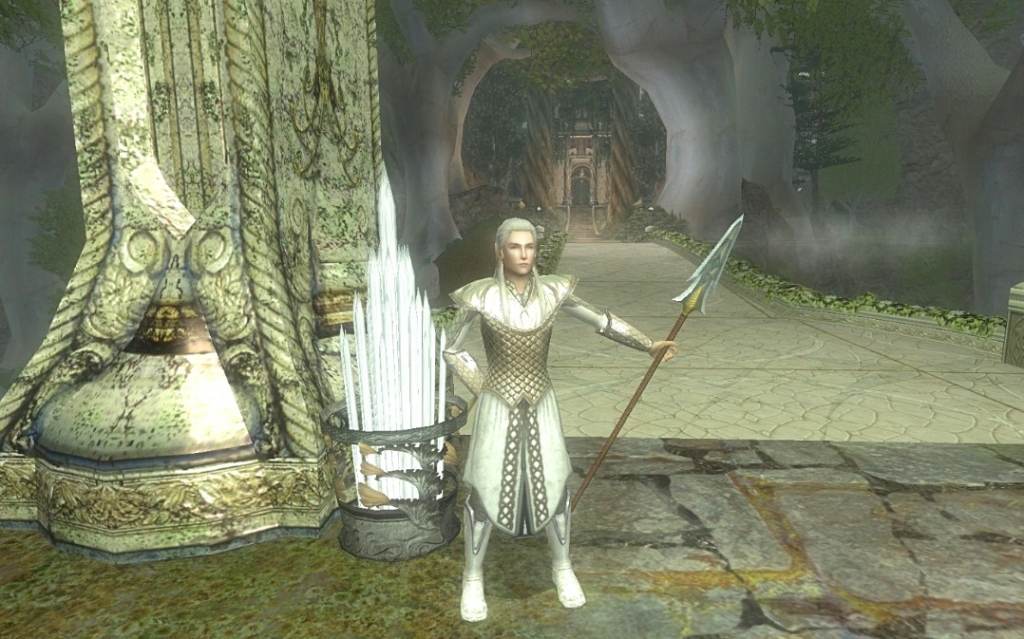
Two tall Elves clad in white armour walked into the presence of the Lord and Lady, bowed, and placed in the Lord's hands a long slender object wrapped in cloth.

"...we have a gift for thee."

"Beannaithe of the Little People," said Lord Silvertree, "please accept this gift. May it aid and preserve you in the days ahead."

He stretched out his arms to place the object into Beannaithe's trembling hands.

"What is it?" Beannaithe asked.

"Open it and see!" said the Lady.

Beannaithe removed the wrappings to reveal a scabbard. It were a perfect fit for Claíomh Solais! The lass gasped at the sight of it, for its beauty took away her breath. The throat and chape of the scabbard were made of hardened steel. The leather body of the scabbard were embossed with flowers of silver and gold.  

Beannaithe's eyes welled up with tears. "Thank you," she said in thought.'

'How wonderful!' Darowva remarked.

'It were a kindly gift,' added Dooli.

Me daughters Ériu, Banba, and Fódla motioned to their children who, for a change, obeyed without complaint.

'Good night, me wee darlin's!' I said.

'Good night,' they mumbled in return.

Had I given me grandkids too much to consider, or were they merely knackered from their daily chores? Perhaps I'll discover the answer to these questions tomorrow.

16. An Unlikely Champion, Part 4, Chapter 11

An Enigma


I began straight away tellin' the next chapter in Beannaithe's saga durin' me grandkids' evenin' storytime...

'When Beannaithe awoke early the next mornin' she crawled out from under the covers and peaked beneath her bed. She unwrapped the blanket that lay there to see whether her gift from the Lord and Lady of Dreamflower were there along with Claíomh Solais, the Sword of Light. Much to her delight and amazement it were!'

'A moment, if you please,' interjected Daibhidh. 'Didn't ye say that Beannaithe could only have had the Bow of the Wood-elves if she'd travelled there in truth and not in dream only?'

'Aye, I did,' I answered.

'Then it follows that if she'd travelled to Dreamflower in dream only,' Daibhidh mused, 'she would not have had the scabbard the Lord and Lady gave her.'

'You're forgettin' somethin', lad,' I told me grandson.

'Aye, what's that?' Daibhidh asked.

'This is a fairy-story in which many strange and wonderful things may occur,' I said. 'This particular occurrence is somethin' we call an enigma.'

'E-nig-ma?' he hesitantly asked.

'Aye,' I replied.

'What is that?' he asked.

I turned to me granddaughter Darowva. 'Lass, would you care to explain it to him?'

'I'd be delighted!' Darowva exclaimed. 'An enigma is a person, thing or situation that is mysterious and difficult to understand.'(1)

'And clearly,' Daibhidh said with a frown, 'a way of explainin' away any inconsistencies in storytellin'.' He indignantly crossed his arms in front of his chest to emphasise his point.

Sometimes me grandkids were too clever for their own good. I decided it best to ignore me grandson's comment and crack on with me story.

'Beannaithe's day went the way that most of her days in Lyndelby did. She enjoyed a hearty breakfast...'

'With rashers?' asked Diolun.

'Aye,' said I. 'May I please continue me story without further interruption?'

'Aye, sorry, Granda,' Diolun replied.

'...weedin' in the farmer's garden, a dinner of roast chicken, spuds, and carrots; more gardenin', wash-up, then finally supper.

Beannaithe were not as fortunate as ye all are, as her granda were not much of a storyteller. However, they did enjoy singin' a few favorite songs by the hearth before takin' to their beds.'

Despite great temptation, I could see it in their bright faces, me grandkids made no comment.

'While she were sleepin' Beannaithe heard the voice of Áine say, 

"Little one, to accomplish the tasks that lie ahead you will need a steed of great speed and strength. Travel to White Horse Hill in the Vale of the Long River. It is there that you will find a steed of great worth. Be wary, for the way is fraught with peril. Many enemies prowl those lands. Keep Claíomh Solais at the ready. Farewell!"

Beannaithe had many questions that she wanted to ask of Áine but, to her great disappointment, she had not the opportunity.'

'It seems to me that Áine is one of them enigmas you were talkin' about, Granda,' observed Daibhidh.

'She is indeed,' I said. The lad were beginnin' to understand.


(1) Source: Oxford English Dictionary

17. An Unlikely Champion, Part 4, Interlude 7

Lá na gCuach 
(Cuckoo Day)


One mornin' just as I was about to take me tea me grandkids came rushin' to me in all a panic.

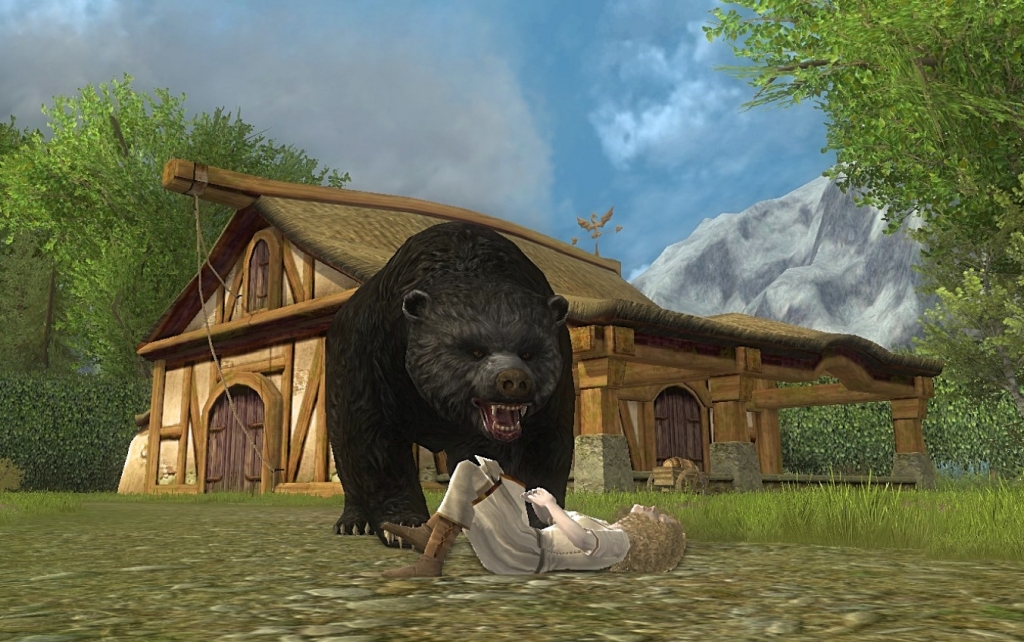
'Granda, wee Beacha is bein' eaten by a bear!' shouted Darowva.

'Not just any bear', said Dooli, 'it's the biggest bear I've ever seen!'

'Aye, it's nearly as big as the barn!' shouted Diolun.

'It's in the garden!' cried Daibidh.

Quick as a flash I grabbed me cowbell from where it hung on the wall.

'I threw open the front door and ran towards the bear as quick as me spindly legs could carry me, bangin' on the cowbell all the while and shoutin', 'Hoo! Away with ye bear!'

Just then I saw Beacha tumble to the turf.

'No!' I cried. Me eyes began wellin' up with tears, and soon commenced to sobbin'. That is when I heard the wee lass gigglin' like a mad bean sí ("banshee"). I'd been had. Beacha wasn't writhin' on the ground with pain. She were laughin'!

I heard laughter behind me as well. There stood me three daughters with their children. They were all in this together. 'Happy Cuckoo Day!' they shouted. 'Cuckoo! Cuckoo!' they cried with a giggle and a laugh.

Thinkin' of how clever they'd been I couldn't help but smile. But what of the bear?

Before me very eyes the bear transformed into a giant of a man with long black hair and beard.

'Good mornin' to ye, Man-bear,' I says to him. 'Were ye a willin' participant in these shenanigans?'

'Ġēa,' he answered with a toothy grin, 'but it were the lad Dooli who were the chief instigator of this mischief.'

Dooli! I ought to have known. After this prank ye may be certain that I'll be keepin' an even closer eye on the lad.

18. An Unlikely Champion, Part 4, Chapter 12

Beannaithe Makes a New Friend


This evenin' I began me storytellin' straight away after supper...

'The next mornin' began as usual for Beannaithe. After a fine breakfast she spent some time gardenin' with her granda. When he weren't lookin' the lass slipped away. She went to the barn, retrieved a large sack containin' her snail-inspried armour, placed it on a small cart, then wheeled it into the village pretendin' to be on an errand. While in the village she gathered provisions for her journey as it would take a few days to reach her destination.

The villagers were always friendly to Beannaithe. Over the years they'd grown accustomed to the strange lass who were unable to speak. They knew just what things her grandfather the farmer needed from them. They placed the items in her cart. Beannaithe smiled and waved her thanks then went on her way.

One particularly curious merchant noticed the large sack in her cart. He could not help askin', "What's in the sack?"

Pretendin' not to know, Beannaithe shrugged. 

"Sorry, lass, I keep forgettin' that ye cannot speak. May I have a peak?"

Beannaithe's eyes widened. She extended her hands and arms, fingers up and palms forward, and shook her head. "Hoo!" she said.

"Oh, all right, it's somethin' secret is it?" the merchant teasingly said to her.

Beannaithe smiled and giggled.

"Good day to ye, lass!" the merchant said with a wave.

Beannaithe breathed a big sigh of relief after she'd put some distance between her and the nosey merchant.

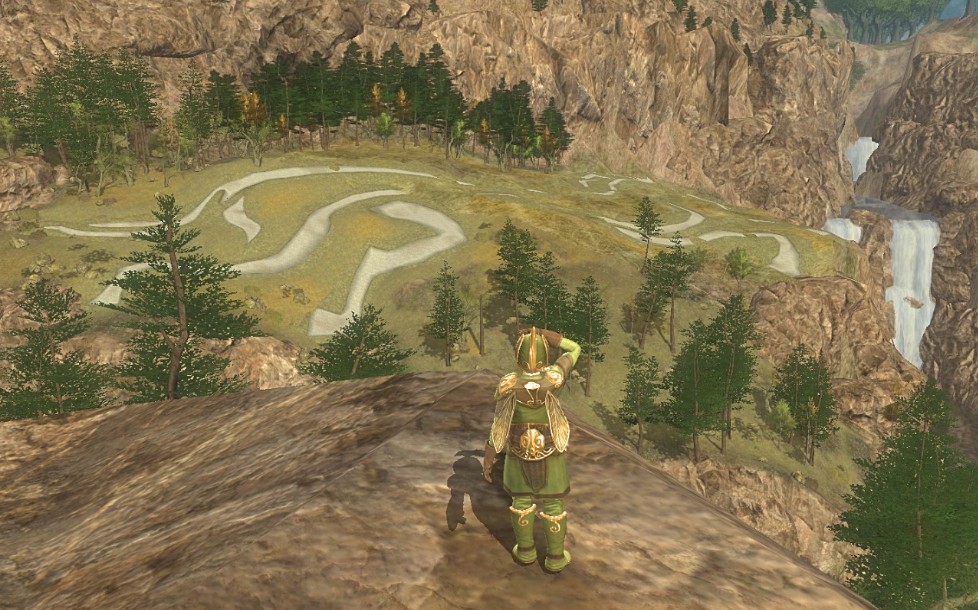
When she reached the edge of the village she hid behind some bushes, donned her armour, then strolled down the path that led in the direction of the Long River. She crossed the ford when she came to it then, makin' sure there were no dangerous beasts about, examined the maps that Fikta had left her. Although she could not read the captions, she could see the silhouette of a horse drawn on the northeastern side of the vale.

It were an arduous journey to White Horse Hill. The path were steep enough, but eventually she'd need to leave the path to reach her destination. It were rocky, and in some places the footin' could be treacherous. She climbed to a high point to gain a vantage point of the hill.

She saw that she would need to cross a rushin' stream that lay between her and the white horse depicted on the hillside. She carefully made her way down to the stream, then tossed a rope with a grapplin' hook that anchored itself onto a small tree. With a firm grasp on the rope she crossed the stream. Without the rope the rushin' water would likely have washed her down the hill with disastrous results. 

She crept up the hill on the other side of the stream to where at last she could see the white horse design. She gasped when she saw what, or should I say who, she found lurkin' about.

"What were goblins doin' here?" she thought with alarm. "Aiee, they'll kill the steed of great worth what Áine spoke of!" 

She reached for Claíomh Solais only to find that, despite Áine's warning, she'd forgotten it.

"What shall I do now?" she wondered. It were all she could do not to cry in frustration.

Knowin' that without her sword she hadn't a chance against so many goblins, Beannaithe sadly crossed back over the stream, gathered the rope and hook, packed it in her bag, then begin to make her way back to Lyndelby to retrieve Claíomh Solais.

Suddenly Beannaithe heard a neigh and saw a flash of white out of the corner of her eye. "The goblins haven't slain the steed of great worth!" she gleefully thought.

She started walkin' in the direction that the steed had gone, but it had vanished from sight. Beannaithe examined the ground where she found hoof prints in the sod. Quickenin' her pace she followed the tracks where they ended without further sign of the steed.

Disappointed, frustrated, and more than a wee bit peckish, Beannaithe found a shady tree to sit beneath while she ate some of the provisions she had brought. There were cold meats, bread with butter, and a ripe red apple. She hungrily took a bite of the crisp apple. It crunched as her teeth sunk into it. Just then she heard a whinny. It were the steed of great worth!

Beannaithe stood then extended her arm with the apple restin' in the palm of her hand. She nodded to the steed as if to say, "Go ahead, take it." The steed accepted her invitation. Beannaithe stroked the steed's flank while it crunched the apple. Not able to speak, Beannaithe made cooin' sounds to calm the beast. It nuzzled her hand. Beannaithe had made a friend.'

It were then that me daughters appeared to take their wee ones to bed. There were complaints, of course, particularly from Darowva who like most lasses adored horses and ponies.

'Tis late, Darowva,' her mother Ériu said. 'You'll be cranky all day tomorrow if ye don't get your proper sleep.'

'All right,' Darowva relented.

'Oíche mhaith!' I said after me grandkids as their mothers led them to their beds.

'Good night, Granda,' they wearily mumbled.

19. An Unlikely Champion, Part 4, Chapter 13

Naming the Pony


After supper as we gathered around the hearth I continued me story about Beannaithe and her pony...

'Beannaithe had made a friend of the steed of great worth, but now she had to learn whether the beast would allow her to mount and ride it. Before she attempted that, however, Beannaithe thought she ought to name the pony first. Beannaithe thought about the tales she'd heard her grandfather the farmer tell about the heroes of old and their horses. 

One great hero that came to mind was Nuada Airgetlám of the Tuatha Dé Danann whose sword, if Bean an Tí na Locha spoke truly, Beannaithe now possessed. "What were his horse called?" Beanaithe thought to herself. "It had something to do with hair." She thought and thought but the name did not come to her recollection. 

"Hmm," she thought, "perhaps it would be better to ride the pony first after all." Then suddenly the name of Nuada's horse came to her: "Énbarr of the Flowing Mane!"

She looked at the pony and thought, "I do not know whether you are able to pass over both land and sea as Énbarr could, hopefully we shall not have to put that to the test, but I shall call you Mac Énbarr, for you, like his foal, are a smaller version of him."

Beannaithe took a deep breath then slowly blew out the air. Feelin' a wee bit calmer now, the lass grasped the pony's mane in her left hand and laid her right hand on its back. With a hop she mounted the pony. It did not bolt.

"This is good," she thought, "but will the pony allow me ride?" 

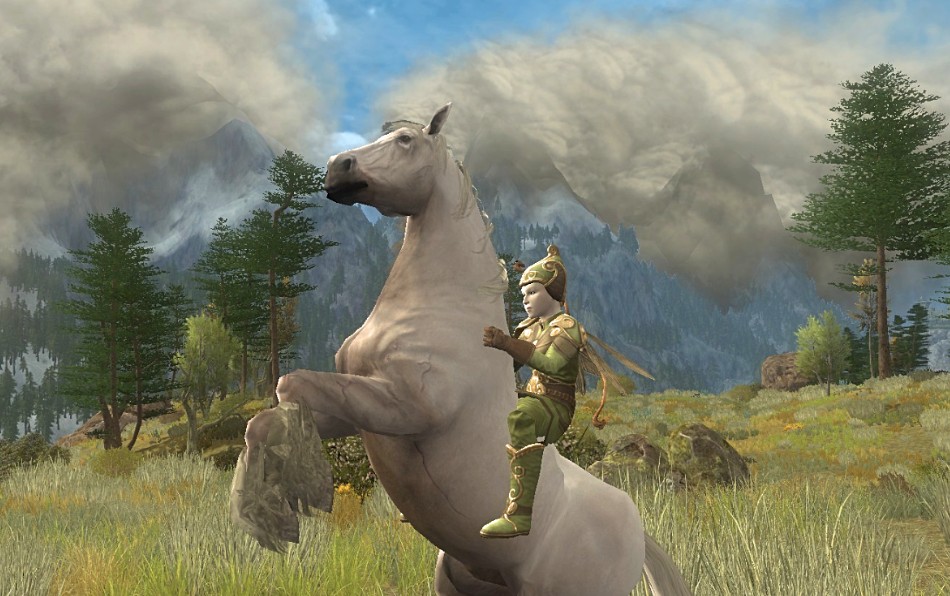
Beannaithe nudged the pony's flanks with the heels of both her feet. The beast loosed a great neigh then reared up on its back legs. Beannaithe held on tightly to avoid slipping off. 

Coming back down onto all four hooves, the pony then raced down the slope of the hill in the direction of An Abhainn Mhór ("The Great River").

"Whee!" Beannaithe cried. She did not know that it was possible to travel so quickly, nor to feel such exhilaration.'

'Exhili-what?' asked Diolun.

'Sorry, lad, it means a thrill of great joy and excitement,' I explained.

'Oh, that's a grand word!' he marvelled.

'So it is,' I said, 'and so is the feelin',' I said with a smile.

Me grandkids giggled.

'That's a grand story,' me daughter Ériu interjected, 'but the hour is late.'

'Aye, daughter, it is,' I agreed. 'Tis time for bed, me wee darlin's'

'Aww!' they moaned before dutifully followin' their mothers to their sleepin' chambers.

'Oíche mhaith!' I said after them.

'Oíche mhaith, Granda!' they said in reply.

20. An Unlikely Champion, Part 4, Chapter 14

Beannaithe Returns to Lyndelby


I began me evenin' storytellin' with Beannaithe's return to Lyndelby...

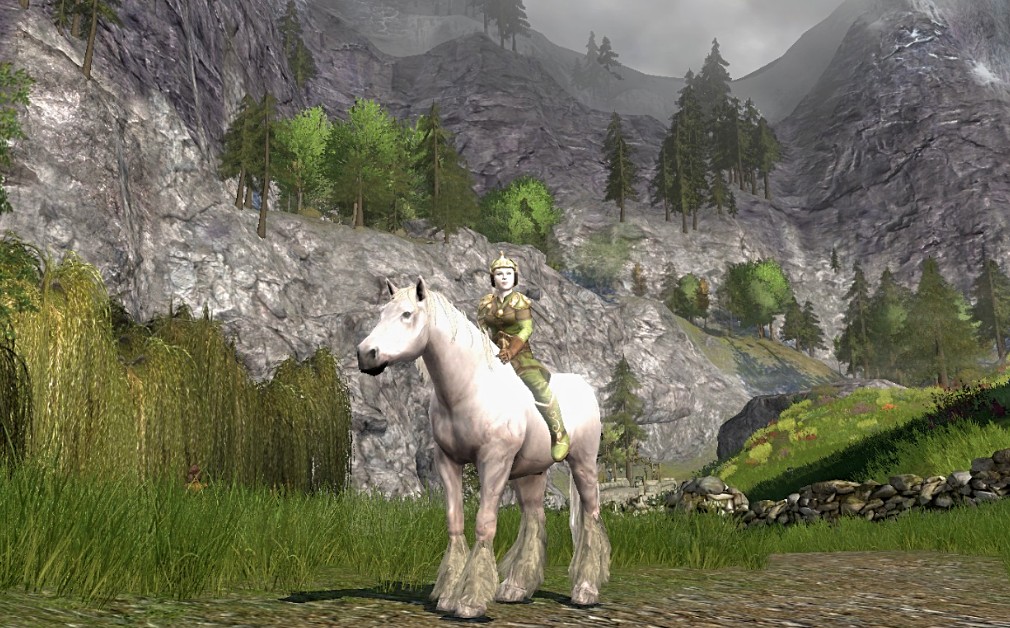
'"This is your new home, Mac," Beannaithe said in thought to her new pony friend, "but don't become too comfortable as we'll be leavin' soon to fulfill our purpose. Before we leave, however, we'll say a proper good-bye to me family."

The villagers stopped and stared when they saw the lass ridin' bareback on her pale pony.

"Who's that?" they asked each other, "What's she wearin'? and "Where'd she find that pony?"

The children of the village marvelled at the beautiful white pony, and thought that Beannaithe looked grand sittin' upon it.

"Hooray for Beannaithe!" they cried.

Beannaithe blushed when she heard the lads and lasses cheerin'. "Are they makin' this fuss over me? Nay, it must be on your account, Mac." She stroked the pony's fine neck to reassure him that everythin' was all right."

"What a beautiful pony!" cried the lasses of the village. "Wherever did you find him?"

Beannaithe merely smiled and blushed.

"Would ye look at that armour!" said one lad to another. "Where'd ye suppose she got it?" asked another. "Do you suppose the Fairies gave it to her?' asked a third.

Beannaithe waved and smiled while gently proddin' the pony to move along. The lass were much relieved when her grandfather's farm finally came into view.

Her mother and aunties rushed out to meet the lass. Her grandfather set down the hoe he were holdin' to mop the perspiration from his brow. He smiled to see the lass, but were goin' to leave the fuss makin' to his daughters.

"Where have ye been, lass?" asked her mother. "We've been worried sick that ye might've become lost--or worse!"

Beannaithe hugged her mother warmly, and smiled reassurin'ly to let her know that she were all right.

The farmer led the pony to the stable, and saw to it that it were fed and watered before joinin' his family inside for a cup of tea.'

'That's all for this evenin', me wee darlin's,' I said to me grandkids. 'Your mams will take ye to your beds.'

'Good night, Granda!' they all said.

'I wish I had a pony like that!' Darowva said to her brothers and cousins as she was bein' led away.

'Oíche mhaith,' I replied.


This is the end of Part 4.