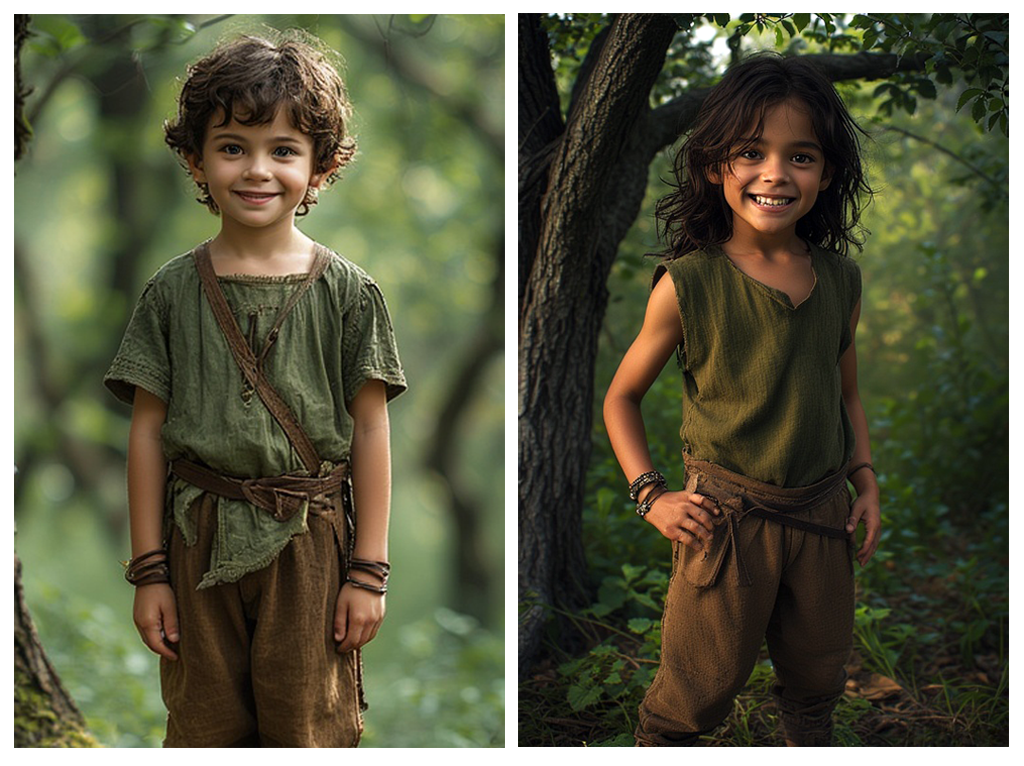
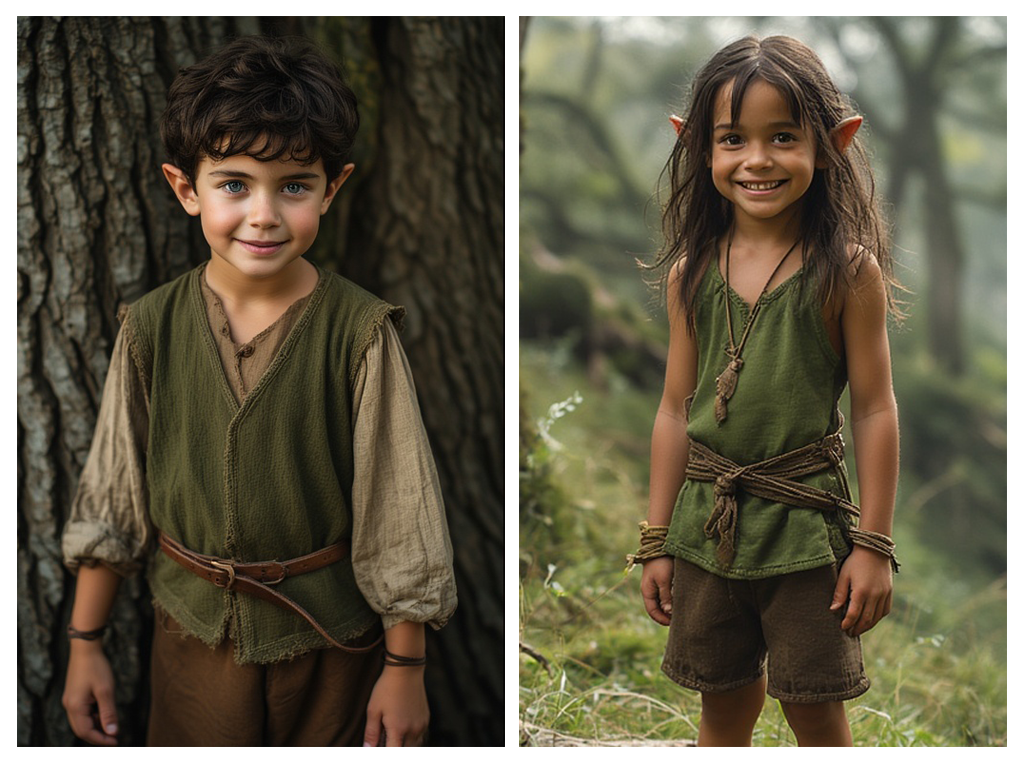
Autumn had come again to fair Harlindon, and in the forest of Eryn Milbar the leaves shimmered red and gold in the light of the afternoon sun; above the treetops the distant white-tipped peaks of Ered Lindon1 blushed in the hazy air. In a glade within the elven wood, Feveren and Faethurin stood side by side upon the leaf-strewn sward, facing the Elder Council, the leaders of their clan. These esteemed luminaries were all seated upon the dark trunk of a long-fallen elm, shaded by the spreading boughs of a towering beech that grew on the edge of the dell. All, that is, save Selcheneb the Lore-keeper, eldest and wisest, who was looming over the pair of small elf-children.
On her head was an autumn crown of berries and red leaves, below which her dark tresses, interwoven with green and white gems, hung in a long sparkling braid down her back; shining silver anklets gleamed from underneath the hem of her leaf-green robe, and delicate rings adorned her sun-bronzed toes.
This was not the first time the two elf-boys had faced the Council, nor would it be the last, but today Selcheneb was not doling out a scolding for some mischief the pair had made. Indeed, the whole clan had amassed for a feastday given especially in their honour; an extraordinary event, to say the least! The smells of woodsmoke and the cooking feast2 mingled with the earthy autumn scents of the woodland, filling the air with festive excitement.
In the clearing behind them the bulk of the clan sat under the open sky: a wide half-circle of shining eyes and bright smiles. Their heads were crowned with woven wreaths of ivy and berries, and they had autumn wildflowers entwined in their dark hair. Their garments were adorned with gleaming jewels, and some held elven-harps, or reed-flutes, or silver bells in their fair hands. And though the feast proper had not yet begun, bowls of fragrant wine were passing from elf to elf. All were merry, passing the time gaily talking and laughing, or singing and making music; their elven-eyes glanced now and then at the still figure of the Lore-keeper, awaiting her sign.
Some of the clan-folk were apart from the assembled host, tending the blazing cookfires beneath the boughs, or calming the herd of rhovan3 who had just now been alarmed by an enormous passing bear. These were their forest friends, the great red deer , who lightened the load when the Green-elves removed each year to the lowlands to lend aid to the elven-farmers at harvestime. For never had stonewrights dwelt in Ossiriand of old, and thus no paved roads had been laid in that wild green land; wheeled wagons could not travel with ease upon the narrow woodland paths that wound closely between the crowded trees.
Feveren glanced sidelong and caught his friend's bright eye, and they shared a merry grin. Seeing their look, the Lore-keeper smiled wryly down at them, yet her heart was filled with mirth. Both boys' hair was damp from bathing in the rippling waters of Brilthor, their faces scrubbed and their garb fresh and unstained; they had even washed clean their feet. To her relief, no trace remained of the pungent bear-droppings in which they had trodden while chasing off the ursine interloper, a foul mischance which had thereafter led to a gleeful dungfight!
Selcheneb gave a small sigh. The Elders had thought to linger in the glade but overnight ere the clan hastened onwards to the harvest, therefore they had not deemed it needful to set spells of warding around their makeshift camp, so near the fence of their wild wood. It was mere mischance that had brought the hapless beast into their midst, and of course it would be Feveren and Faethurin who first came upon it and then given merry chase, when a grown elf would have used their thought to sway its mind and gently change its path. 'A lesson learned', she upbraided herself, 'but late in its coming!' She shook her head in silent mirth; for despite her long, long years of worldliness, in her haste she had forgotten the mayhem she knew the pair could bring about from even the most simple tasks!
* * *
The day was growing old, and the waning autumn sun cast long shadows across the waiting throng; a wind began to blow chill from the mountains to the east. Selcheneb considered the assembled elves, looking out over the boys' tousled heads; despite the merry mood and sounds of mirth that filled the glade, her thought fell to silent musing.
Few were the Green-elves in these latter days, compared with the years of bliss in Ossiriand a long age ago which she yet held in her long memory. Then she had been as young and carefree as Feveren and Faethurin today, but then came the Exiles over the Sea, and with them came strife and war and death. The long years of peace were ended, and the singing of the Lindi was stilled. The fair land of Beleriand was brought to ruin and the walls of Ered Lindon were broken; the Land of Seven Streams was sundered, and great Gelion, beloved of Ulmo,4 was no more.
But her Lindi kin had endured, and despite their inborn distrust of strangers they had welcomed survivors of the deluge, Sindar and Abari5 alike. Selcheneb's eyes drifted over the lighthearted throng, and she saw scattered among the tan faces of her Nandor kin, others that were pale or brown; and it brought gladness to her heart to see that they all had one thing in common: each face shone with joy and delight! Regardless of their roots, they all deemed themselves Laegrim,6 and ever their rustic raiment was in varied shades of green,7 even the festive finery they wore on this day of mirth.
The Lore-keeper smiled. Though they bore no common token that marked them as many parts of a whole people, there was yet one other aspect they all shared in their garb: each and every elf was unshod, so as to run swiftly and silently amidst their wild woodland home; and with their bare feet thus unhindered, ever was their spirit and vigour enlivened and renewed by the virtue of the living earth.
But in her heart lay a shadow of sorrow, for in the end the intermingling had not availed the clan overmuch: at the dawning of the Second Age of the world many that endured the Great War took ship unto the Uttermost West; and of those that yet remained, many more passed beyond the Mountains of Lindon into the inner lands, refusing the lordship of the High-elves in the realm of Lindon.8
'Lindon!' Selcheneb thought wryly. Ereinion Gil-galad had claimed not only the green lands west of Ered Lindon for his realm, but taken also its Nandorin name!9 'Nay,' she chided herself, 'of old it was used by the High Kindred, and the Grey-elves too.10 The same folk who first named us in their tongues Laiquendi and Laegrim!'11
She glanced down to see Feveren whispering in his friend's ear, and Faethurin snickered at his words behind his hand. 'The past is past,', she thought, 'and I cannot hold back Time. But there is yet much hope in their young hearts, which brings hope back to mine own!'
Now, for the most part, the elves of the clan were young, as the Elves reckoned time: many had been born in the quiet years ere the first war with Sauron, or in the Watchful Peace. Few there were whom had dwelt in Ossiriand of old and seen its splendour and its ruin. And she gave thought to the Elves that dwelled yet in the heartlands of Middle-earth, and how they fared. Wellnigh five thousand years had passed since the Days of Flight,12 the black years when many Elves fled Middle-earth and countless were destroyed. And ever the grey ships of Mithlond had set sail since that time, and in her mind Selcheneb pondered how many of the Elf-kindred yet remained in the vast lands beyond Ered Lindon. She had heard rumour of a growing shadow in the East, whispers of a nameless fear,13 and strife in the lands of Men. But though her heart misgave her, she knew naught for sure.
For tidings from outside came seldom to their secluded forest. Indeed, all she knew came chiefly from the elven-farmers she met when the clan lent their aid with the harvest on the lowlands, save for the few emissaries the Council sometimes sent to the Grey Havens. Even now the clan drew near the eaves of Eryn Milbar on the westward journey thither, and but tarried briefly as they had done a dozen years before when the two elf-boys were born.
Each autumn, through years uncounted, the clan left behind their abode beside the mere they named Nen Echui in jest, and followed the glittering Brilthor down to the farmlands on the plains. There, by light of day and under the bright Harvest Moon, they toiled in the ripened grain fields and orchards, ere the woodland folk celebrated the Middle-days together with the elven-farmers with feasting and great merriment.
The vineyards were harvested soon after, and from this bounty of the vine came the clan's share of mellowed wine from yesteryear; yet after the clan had returned home from their nearby winter camp, more casks were oft brought to the forest eaves in trade or as gifts throughout the spring and summer: trade in the form of cured hides and venison furnished by the tribe's small group of Sindar and Abari hunters; and gifts of gratefulness (for the elves of the lowlands had in ages past given thought to the chance of their cunning woodcrafty -- and wild -- neighbours turning to banditry in desperate need! And even now in these latter days, when the Green-elves had proven to be worthy friends, the custom yet endured.)
Selcheneb recalled how she had been affronted when first she heard this tale, and long before in Ossiriand she was dismayed when she heard tell that the Elves of Doriath ever deemed the Nandor to be rustic and less wise; but the hearts of Feveren and Faethurin had been filled with delight to learn that the -- to their minds -- dull farming folk once thought of the tribe as wild and perilous! Back into the Elder's mind came the memory of the pair of six-year-olds armed with sharpened sticks, running through the trees of Eryn Milbar naked and besmeared with mud, with feathers in their hair. 'Wild, wild woodland-elves are we!' they had howled up at the sky!
* * *
Selcheneb gave no sign of what was passing in her mind as she stood coolly gazing out into the glade, but suddenly the high clear voice of Faethurin broke into her wandering thoughts.
'A, theilin i chedhyd teiliar!'
The chill wind had blown Feveren's long hair across Faethurin's face, and the young Grey-elf had reached out his hand and tucked the wayward locks behind his friend's ear; Feveren had thanked him for his kindness by pinching his backside! The Elder bit back a laugh. Ever did Faethurin like to remind Feveren that although the Laegel was soonest born, the Sinda was yet the taller of the two! And it lightened her heart to hear the woodland tongue on the young Grey-elf's lips, with nary a trace of a Doriathrin accent (unlike Dimaethor, his father!) Yet the Elders had long urged the tribe to speak always the common elvish tongue, Sindarin, for they had felt a change in the tides of the world, and thus deemed their kin should be better skilled therein.
Silently she thanked Faethurin in her heart, for Selcheneb knew that her grave thoughts had no place in such a day of joy and mirth, and she banished them from her mind. Again the east wind gusted, whipping Feveren's hair once more; Faethurin puffed out a strand from between his grinning lips.
The Lore-keeper breathed deeply and raised her slender arms above her head, gazing up at the westering sun in the washed autumn sky. The wind died down, and in the glade the air was still; the elves fell silent at this sign, for they knew that the ceremony was about to begin at last! Lowering her eyes she looked over the gathered host, marking again the gladness in every face and sensing in their hearts their mirthful mood.
'Here before us stand Feveren son of Gladlin, and Faethurin son of Dimaethor,' the Lore-keeper declaimed; her clear voice was musical and mild. 'Twelve times have the red leaves fallen in Eryn Milbar, our home, since these two elf-children were born -- but a single day apart --into our elven-clan. We are gathered here together in the greenwood ere the Feast of the Middle-days begins in earnest...' The gathered Green-elves erupted in singing and laughter, and Selcheneb, smiling broadly, waited for the merriment to subside. 'Indeed, mirth and merrymaking await! But that festival begins not today, but six days hence, and only after a week14 of toil amongst our farmland friends that is yet to come! And ere it does we have a solemn duty to perform.' An eager hush fell over the elven-folk; a few dry leaves came rustling down. Away in the trees an unseen robin trilled its merry melody.
'Now when the High Kindred came unto the Country of Balar, Finrod son of Finarfin came even into Ossiriand, the Land of Seven Streams, and won the friendship of our kindred.15 The golden-haired Elf-king brought with him much lore that had been learnt of old in the Blessed Realm, and also the law and customs of his people, which he and Galadriel his sister shared with the Elves of Doriath, and which thence passed on to our woodland folk.'
A thought passed between the elf-boys, and Feveren and Faethurin both grinned up at Selcheneb, for they knew that as the clan's steward of lore she never missed a chance to teach; and she winked at them in return, for she read their thought in their sparkling eyes.
Gesturing to them, the Lore-keeper said, 'For elf-children, it is the way of the High-elves to remember their day of begetting year by year,16 but that is not our way!' This was met with acclaim by the assembled throng, and Selcheneb raised her hand for silence. 'Peace, my kin!' she chided, and the elves fell quiet. 'Nay,' she continued, 'we mark the birthing day of our children beneath the boughs of Eryn Milbar.' She halted for a moment, and the Elders rose from their seat on the dead tree and Fechith brought to her a wooden bowl of wine. With it she saluted the elf-children, then drank it down and smacked her lips appreciatively. A mirthful murmur rose from the assembled elves.
'But for long years no elf-child was begotten and born unto our clan, even in days of peace,'17 Selcheneb continued. 'For we deemed that to bring a new life into the world ere we depart into the Uttermost West would be an unkindness. For a child, the world is new and wonderous, a place of awe and mystery; they would love Middle-earth with their whole heart, and in the spring of childhood would ever remain unwearied by the toil of living their long lives within its fences. Thus it was our thought that they would be unwilling to take ship across the sea, until -- too late! -- the last had sailed, and no longer would there be a ship to bear them hence to the Blessed Realm.' Selcheneb reached forward to place a hand on each of the boys' slim shoulders and gently squeezed. Feveren looked down at his toes and chewed his lip, while Faethurin gazed up guilelessly into the rustling beechen boughs above their heads; for oft had this selfsame thought come into their minds, and sometimes in their hearts they begrudged their Abari kin who were unwilling to forsake their merry lives within the circles of the world.
'Yet despite our fears, two of our own but lately welcomed motherhood!' Selcheneb beamed. 'Come to my arms, Gledhril and Aeweneth, proud mothers of Feveren and Faethurin,' the Lore-keeper held wide her arms, and the two smiling elf-women -- pale Aeweneth and golden-hued Gledhril -- came forward to receive her embrace, while the woman-folk among the gathered elves lifted their voices in tender song. When the last soft notes faded into the shadowed trees, Selcheneb went on:
'Nor could they conceive this wonderful blessing without the aid of their deft husbands!' Selcheneb said to much laughter and hooting from the men-folk. 'Come forth, Gladlin father of Feveren, and Dimaethor father of Faethurin.' Beaming, the two elf-men moved to stand beside their spouses before the line of Elders, and together the four elves bowed low: first to the six Elders standing three on either side of the Lore-keeper, then turning, they bowed to the smiling throng.
From the ranks of the Council four Elders stepped forward, Agaren and Seleth, Echadron and Torogarch, all bedecked in festive finery, each with a bowl of deep red wine clasped between their hands. These they gave to the proud parents, who drank a long draught from their cups, then poured the remainder upon the leaves in libation to their woodland home. The two elf-boys nudged one another and licked their lips, as their parents joined the line of councillors upon the elm-log. Gledhril gave the pair a merry wink.
Selcheneb spoke on. 'It is told that even as Elbereth ended her long labours, kindling new stars to light the world for the awakening for the First Elves, Menelvagor strode up the sky and the blue fire of Helluin flickered in the mists above the borders of the world; in that hour the Children of the Earth awoke, the Firstborn of Eru Ilúvatar.18
'At Nen Echui in the far east, where upon a time stood Illuin, North Lamp of the Valar, the first awakened. These were the three Elf-fathers named in the ancient tales Imin, Tata, and Enel. The glittering stars they first saw, then they beheld their spouses lying in slumber on the green sward beside them; in their minds they fashioned the first words of speech and song, and woke their three wives, Iminyë, and Tatië, and Enelyë.
'Now after a time the six Unbegotten came upon six more pairs of awakened elves, and Imin took them for his companions; and lo! nine more pairs they next discovered, and Tata claimed those eighteen elves for his followers; then in grove of silver birches nigh a stream they afterwards found twelve pairs of elves, and Enel took the four and twenty for his own. And so on it went, six and thirty, then eight and forty, until the full count of Awakened Elves was one hundred and forty-four, and the tale of the First Elves was complete. And so it was that we of the Elven-kindred ever after reckoned in twelves, and that twelve dozen was of old our highest number.'19
The Lore-keeper turned the pair of young elves to face the clan-folk at last. Here and there amongst the throng a hand waved, and many of the elves threw flowers plucked from their hair. Smiling, Selcheneb again placed a hand on the shoulder of each boy. 'With the coming of these two sons of our clan, we too came to number twelve dozen!' She swept her arm over the assembled Green-elves. 'Chance, some might say, and others Providence.' She gave a mischievous grin. 'Still others may deem it but ill fate, that these two imps were set loose in our midst!' The elves howled with mirth and the faces of the elf-boys flushed. Raising her hands to their small heads, Selcheneb ruffled their unkempt hair. More flowers flew through the air, showering Feveren and Faethurin with a colourful and fragrant rain of petals.
'Yet in our hearts we love them and treasure them, and today we give praise to them,' she cried. 'For the number twelve is dear to us, and in the wearing of of the swift years of Middle-earth, a dozen have now passed since that glad Autumn wherein both these boys were birthed beneath oak and beech and elm. And though this is but a wink of time in our long lives, in this short span they have brought to us much merriment... and much mischief!'
Merry laughter rang like ringing bells through the dell, then the host of elven voices were raised in joyful song as the Green-elves rose to their feet. As one, unthinking, each elf-boy reached out and clasped the other's hand, eyes wide and gleaming with awe and astonished delight. Each could feel the glee in the other's mind, and knew this moment would ever be graven in their memories.

The sun was slowly sinking behind the trees, the last light of day slicing through the trunks in soft gilded beams of autumn light.
'Behold the Sun!' cried Selcheneb, 'She20 sets at the turning of the day21 that marks the birthing-day of Feveren Tawardil, son of Gladlin and Gledhril!' Joyous was the song of the clan of Green-elves in the glade, and Feveren stood with his face aglow, his honeyed skin gleaming in the golden sunlight beneath the autumn trees. To the east, the burnished snow-capped peaks of faroff Ered Lindon looked down from their lofty heights, while purple shadows spread up along the mountain-sides.
Long the elven song rang through the trees, until evening was closing in; twilight deepened in the glade until the sun was gone. The evenstar rode above the mountaintops in the fading western sky, and high above the stars began to flower.
'Rejoice in the hour of Aduial!'22 Selcheneb now cried. 'The Sun has set and the stars now rise to bring forth the birthing-day of Faethurin Amdirchir, son of Dimaethor and Aeweneth!' A new song sounded through the woods, and Feveren turned to face his friend; Faethurin's pale face was flushed with delight, rosy in the dusk. The two young elves embraced.
'A dozen years we have lived and loved, my brother Fethurin!'
'Ever shall we share our hearts and minds until the end of days, my brother Faemheren!'
Long had it been their friendly jest to name one another in the tongue of each of their own people: the Nandorin of the Laegrim, or the Sindarin of the Iathrim.
A wood-fire sprang up, casting a rosy glow across the singing, dancing elves; and the boles of the encircling trees were girt with bright burning torches. Selcheneb raised her arms above her head, and waited until all again stood still and silent. Somewhere in the shadowed wood a nightingale whistled and trilled.
'My people, heed my words!' she called. 'One thing yet remains before we broach the casks and the merry Feast of Birthing-day begins! Feveren, Faethurin, you both bear a name that your fathers each bestowed on the day you sprouted from their seed: Tawardil and Amdirchir. This ceremony the High Elven kindred call Essecarmë, 'Name-making', but we call it simply Galdol in our woodland tongue. And while you were growing like two young saplings amidst the singing grove that is our clan, your mothers bestowed the names of foresight that you commonly bear,23 your apacenyë.' She turned both boys to face her once more and bent to speak to them face-to-face, but clearly enough that her words carried across the glade and all might hear. 'But now you are twelve-year-old elf-children, no longer elflings, and it is the time of your Essecilmë: your Name-choosing!'
Selcheneb spoke proudly the words of the ancient tongue of the High Kindred, yet with a woodland accent; but Quenya was unknown to the woodland-elves, save for Seleth the Wise, and ever were they impressed by her mastery thereof! Both Elder elf-women had learned it a long age ago -- despite the law of Elu Thingol that forbade it24 -- from the sons of Fëanor who fled the Battle of Unnumbered Tears to shelter in the greenwoods of Ossiriand.25 For it was their thought to take the language of Noldorin lore as some small redress for the loss of Denethor son of Denweg, their Green-elven lord who was slain in the Exile's wars.26
Faethurin looked at Feveren with raised brows. 'Ess-e-keel-meeh?' he tried. 'Meh!' gibed his friend with a careless shrug.
The Lore-keeper disregarded the muted muttering below, and addressed the watching host: 'My kin, rest your feet as these sons of the tribe declare the deep names they have chosen!'
The clan-folk sat once more upon the leaf-strewn turf. Naught could be heard save the crackling bonfire and the rustling leaves. 'In the naming of our children we are chiefly in accord with the ways of the High-elves, save that the Chosen Name of a woodland elf-child is not kept secret.27 Ever have our people lived in wariness and secrecy, but only from the wars against Belegurth28 that the Exiles brought to Beleriand, or from those strangers who trespass in Eryn Milbar; but never from one another. Trust in each and every one is the watchword of our tribe!'
Selcheneb drew the two elf boys to her side. Their small heads barely reached up to the tall elf-woman's silver belt, and she rested her hands on the napes of their slender necks.
'When last the Moon was full you were told to give thought to your Choice,' the Elder said. 'He has since faded to darkness and grown again to full light, marking the end of your allotted time. Now the Harvest Moon rises behind the mountains. Behold!'
Beyond Ered Lindon the moon, now waxed round, filled the eastern sky with a pale cold sheen. His bright face could be seen gleaming through the darkened leaves. Feveren and Faethurin looked up at the Lore-keeper's face glimmering in the firelight; the burning logs settled with a crunch, sending a shower of glittering fiery sparks into the darkness above.
'Now is the time to make your Choice,' she told them. But the Lore-keeper had been their erstwhile teacher when they were yet elflings, and she knew them all too well. With a playful twinkle in her eye, she gestured to her fellow Elders and said, 'We await with bated breath to learn what merry jest you two imps are going make of this solemn moment!' The two friends shared a mischievous glance and grinned.
'Nay, O Selcheneb!' said Feveren in earnest. 'An oath we each swore to our dear mothers that we would not mock this grave and formal ceremony.'
Faethurin nodded his head. 'Aye,' he said, 'an oath made with fondness and love!'
Selcheneb laughed. 'Indeed, just as you both honour your mothers so greatly that, in jest, you render your worthy mother-names of foresight in one another's tongue!' The elf-boys grinned and shared a shrug, for to their minds it did not matter. 'And,' the Lore-keeper added, 'to my mind mock and jest are not the same, and it is your thought to bypass your solemn oath with slight of tongue!' The Elders chuckled knowingly at her words, and as one, Feveren and Faethurin with widened eyes stuck out their small pink tongues.
The Harvest Moon rose in the night sky, and put to flight all the lesser stars. The shadows of the wood deepened, and all was dimly lit in the red glow of the wood-fire. More dead wood was piled on and it blazed forth brightly.
Feveren stood so his clear young voice could be heard by both Elders and clanmates. He smiled broadly. 'You told that for long years no elf-child was begotten and born into our clan, for reasons you have made plain. Yet here I stand, fruit of the loins of my Green-elven parents; but in a dozen years no other such fruit has ripened upon the branches of our tribe. Thus the thought comes to my mind that I shall indeed be the last Green-elf to ever be birthed beneath the woven boughs of Eryn Milbar. Therefore I choose for myself the name Methlegel, the Last Green-elf!' He gave a brash bow.
Selcheneb clapped her hands. 'Nobly done!' she exclaimed, and she reached down to embrace the young elf-boy and kiss his brow. Each of the Elders then took their turn to enfold him in their arms. 'And now you, Faethurin?' the Lore-keeper said. The young Grey-elf stood beside his friend and cleared his throat.
'My kin were afore of the Iathrim,' he replied, 'but after the ruin of Beleriand this merry tribe gave them welcome, and here for many years they have made their glad abode in Eryn Milbar, mingling with the clan-folk and taking the woodland ways for their own.' He smiled at his mother and father, sitting alongside the Elders, and they bowed their heads in agreement.
'Here I was birthed and so have I done also,' he said. Nodding their heads, the elves all murmured their accord: they had known him all his short life, and indeed, he was clad always in raiment the colour of leaves, and ran through the trees barefoot like all of them. No trace of Grey-elven accent could be heard when he spoke the woodland tongue. Even to the Lindel Elders, his pale hue and sea-grey eyes, and his somewhat taller, robust stature counted for naught; and in the minds of the tribe he was the brother of the Lindedhel, Feveren, which made an end to any debate.
'Indeed,' Faethurin went on, 'to keen eyes my bodily form is not as slight and slender as the Lindi forebears of Faemheren... Feveren, I mean! But my spirit is, I deem, fully Green-elven. Thus I choose the name Felegel, Spirit of a Green-elf, for my own!' He too made a brazen bow.
The watching elves began to sing their cheerful acclaim, but were suddenly cut short by an outburst from the Elders' seat: Torogarch, his brow creased in a frown, called out, 'But we are friends to birds and beasts, yet you are a hunter like your father! I deem you are our unfriends!'29
Feveren stifled a laugh, for he well knew that Faethurin and Torogarch had set up this frolic for the merriment of the tribe, and all of it was feigned!
'Indeed, Master Troll-fang,' Faethurin answered with a smirk, 'and like my father I hunt but beasts that are infirm, or near death, or perilous to our tribe! The flesh we feed to our neighbours, the glad wolves and bears and elf-farmers, and the hides are cured for the use of our clan or for trade. Mayhap one day I will hunt great fell beasts, too, and also wear the long tooth of a troll girt round my neck upon a thong of leather; and with just as much pride!'
The clan-folk had hearkened closely to this debate, and now they erupted with mirth. Laughter rang through the glade, and Torogarch was pelted with flowers.
'This too is nobly done!' laughed Selcheneb. 'Yet it seems to my mind that Methlegel and Felegel sound so much alike that this is indeed a jest, after all!'
'Indeed,' agreed Agaren, 'my heart tells me that mischief is afoot, though indeed no mockery was made. I know both your minds, and your thoughts are filled with mirth! I deem they are laughing at us, Selcheneb!' Then her own laughter burst forth, and she took the two boys -- one in each arm -- and pressed them tightly to her breast.
'I deem you are right, sister Agaren!' laughed the Lore-keeper. 'But I cannot fault their reasoning behind these chosen names, and I deem their oaths fulfilled. They shall not suffer the wrath of the heavens!' She bent to embrace Faethurin and kiss his brow. Once more the Elders followed in kind. The mothers and fathers all hugged each other together at once, and then each of the Elders, one by one. The boys embraced one another again and Feveren stood up on his toe-tips to kiss his friend upon the brow; Faethurin bent his neck to return the gesture.
Now the Name-choosing was over, and the Lore-keeper called aloud, 'The deed is done! Feveren Methlegel and Faethurin Felegel are parched! Broach the casks and pour the wine! The Names have been Chosen by our young clanmates, and the now feast begins!'
All the Green-elves leapt lithely to their feet and their voices were raised in joyous song; harps and flutes and bells were singing in mirth. A brimming wooden bowl of rich red wine was put into each of the elf-boys' hands by Fechith, and they drank gratefully (without any libation!) Then they joined in the song, dancing merrily in amongst their Green-elf kin around the blazing bonfire.
Above their heads all the sky was filled with the light of white stars, and there leaned up, as he climbed over the rim of the world, the Swordsman of the Sky, Menelvagor with his shining belt.30

Etymology:
Feveren: Nan. fe ("soul" Q. fëa, S. fae) + meren ("festive/gay/joyous")
Faethurin: fae ("soul") + thurin ("secret/hidden")
Tawardil: S. tawar ("forest") + ndîl ("friend")
Amdirchir: S. amdir ("hope") + cîr ("renewed")
Methlegel: S. methen ("end/final") + Nan. Legel (S. Laegel, "Green-elf")
Felegel: Nan. fe (Q. fëa, S. fae; "incarnate spirit, soul") + Nan. Legel
1. " ... wherefore the Noldor named that country Lindon, the land of music, and the mountains beyond they named Ered Lindon, for they first saw them from Ossiriand."
- The Silmarillion, "Of Beleriand and It's Realms"
2. But there was no smell of roasting meat, for the Green-elves are friends to birds and beasts, and do not eat their flesh. (see note #29)
3. S. rhovan, “a large beast, especially applied later to the great red deer of the Vales of Anduin and western Mirkwood” (and now in Harlindon, too!)
- Parma Eldalamberon #23
4. "In Ossiriand dwelt the Green-elves, in the protection of their rivers; for after Sirion Ulmo loved Gelion above all the waters of the western world."
- The Silmarillion, "Of Beleriand and its Realms"
5. "*Abari: This name, evidently made by the Eldar at the time of the Separation, is found in histories in the Quenya form Avari, and the Telerin form Abari [...] The plural Evair was known to Sindarin loremasters, but was no longer in use."
- The War of the Jewels, "Quendi and Eldar: Meanings and use of the various terms applied to the Elves..."
6. "[Green-elves] This name, S Laegel, pl. Laegil, class-plural Laegrim or Laegel(d)- rim, was given [to the Nandor] both because of the greenness of the land of Lindon, and because the Laegrim clothed themselves in green as an aid to secrecy. This term the Noldor translated into Quenya Laiquendi; but it was not much used."
- The War of the Jewels, "Quendi and Eldar: The Clan-names [...]"
7. "In that region [Ossiriand] the forests in after days were tall and green, and the people of Denethor there dwelt warily and seldom seen, because of their raiment of the colour of leaves; and they were called therefore the Green-elves"
- The War of the Jewels, "The Grey Annals, 1350 The Coming of Denethor"
8. "Others of the Eldar there were who crossed the mountains of Ered Luin in that age and passed into the inner lands. Many of these were Teleri, survivors of Doriath and Ossiriand; and they established realms among the Silvan Elves in woods and mountains far from the sea, for which nonetheless they ever yearned in their hearts."
- The Silmarillion, "Of the Rings of Power and the Third Age"
9. "The country in which most of [the Nandor that came into Eastern Beleriand] eventually settled, as a small independent folk, they called Lindon (< [/i]*Lindana[/i])"
- The War of the Jewels, "Quendi and Eldar, Nandor"
10. "The Sindar quickly recognized the Lindi as kinsfolk [...] and they adopted the names [...] Lindon or Dor Lindon. In Exilic Quenya the forms used (derived from the Sindar or direct from the Nandor) were [...] Lindon (or Lindóne)."
- The War of the Jewels, "Quendi and Eldar, Nandor"
11. "This name, S Laegel, pl. Laegil, class-plural Laegrim or Laegel(d)- rim, was given [to the Nandor] both because of the greenness of the land of Lindon, and because the Laegrim clothed themselves in green as an aid to secrecy. This term the Noldor translated into Quenya Laiquendi; but it was not much used."
- The War of the Jewels, "Quendi and Eldar: The Clan-names [...]"
12. "Thus the Black Years began, which the Elves call the Days of Flight. In that time many of the Elves of Middle-earth fled to Lindon and thence over the seas never to return; and many were destroyed by Sauron and his servants."
- The Silmarillion, "Of the Rings of Power and the Third Age"
13. Cribbed from Galadriel’s opening monologue in New Line Cinema's The Fellowship of the Ring (2001)
14. "For ritual rather than practical purposes the Eldar observed a week or enquië of six days..."
- The Lord of theRings, Appendix D, "The Calendars"
15. "Of these Finrod Felagund came most often, for he had great love of wandering, and he came even into Ossiriand, and won the friendship of the Green-elves."
- The Silmarillion, "Quenta Silmarillion: Of Beleriand and its Realms"
16. "As for the begetting and bearing of children: a year passes between the begetting and the birth of an elf-child, so that the days of both are the same or nearly so, and it is the day of begetting that is remembered year by year. For the most part these days come in the Spring."
- Morgoth's Ring, 'The Laws and Customs Among the Eldar'
17. Yet it would seem to any of the Eldar a grievous thing if a wedded pair were sundered during the bearing of a child, or while the first years of its childhood lasted. For which reason the Eldar would beget children only in days of happiness and peace if they could.
- Morgoth's Ring, "The Laws and Customs Among the Eldar,
18. Cribbed from The Silmarillion, "Quenta Silmarillion: Of the Coming of the Elves and the Captivity of Melkor"
19. "And so it was that the Quendi ever after reckoned in twelves, and that 144 was for long their highest number, so that in none of their later tongues was there any common name for a greater number."
- The War of the Jewels, "Quendi and Eldar, Appendix: The legend of the Awaking of the Quendi (Cuivienyarna)"
20. "Elves (and Hobbits) always refer to the Sun as She."
- The Fellowship of the Ring, "At the Sign of the Prancing Pony" (footnote)
21. A ‘day’ of the sun [the Eldar] called ré and reckoned from sunset to sunset.
-The Lord of theRings, Appendix D, "The Calendars"
22. The Eldar paid special attention to the ‘twilight’ (in the northerly regions), chiefly as the times of star-fading and star-opening. They had many names for these periods, of which the most usual were tindómë and undómë; the former most often referred to the time near dawn, and undóme¨ to the evening. The Sindarin name was uial, which could be defined as minuial and [i]aduial. These were often called in the Shire [i]morrowdim and [i]evendim. Cf. Lake Evendim as a translation of Nenuial.
- [i]The Lord of the Rings, Appendix D: "The Calendars"
23. "Mothers often gave to their children special names of their own choosing. The most notable of these were the 'names of insight'... or of 'foresight' [...] In the hour of birth, or on some other occasion of moment, the mother might give a name to her child, indicating some dominant feature of its nature as perceived by her, or some foresight of its special fate."
- Morgoth's Ring, "The Laws and Customs Among the Eldar, Of Naming"
24. "'But hear my words! Never again in my ears shall be heard the tongue of those who slew my kin in Alqualondë! Nor in all my realm shall it be openly spoken, while my power endures. All the Sindar shall hear my command that they shall neither speak with the tongue of the Noldor nor answer to it. And all such as use it shall be held slayers of kin and betrayers of kin unrepentant.' [...] And it came to pass even as Thingol had spoken; for the Sindar heard his word, and thereafter throughout Beleriand they refused the tongue of the Noldor, and shunned those that spoke it aloud; but the Exiles took the Sindarin tongue in all their daily uses, and the High Speech of the West was spoken only by the lords of the Noldor among themselves. Yet that speech lived ever as a language of lore, wherever any of that people dwelt."
- The Silmarillion, "Quenta Silmarillion: Of the Noldor in Beleriand"
25. "The realm of Fingon was no more; and the sons of Fëanor wandered as leaves before the wind. Their arms were scattered, and their league broken; and they took to a wild and woodland life beneath the feet of Ered Lindon, mingling with the Green-elves of Ossiriand, bereft of their power and glory of old."
- The Silmarillion, "Quenta Silmarillion: Of the Fifth Battle: Nirnaeth Arnoediad"
26. "But the victory of the Elves was dear-bought. For those of Ossiriand were light-armed, and no match for the Orcs, who were shod with iron and iron-shielded and bore great spears with broad blades; and Denethor was cut off and surrounded upon the hill of Amon Ereb. There he fell and all his nearest kin about him, before the host of Thingol could come to his aid. [...] his people lamented him ever after and took no king again. After the battle some returned to Ossiriand, and their tidings filled the remnant of their people with great fear, so that thereafter they came never forth in open war, but kept themselves by wariness and secrecy; and they were called the Laiquendi, the Green-elves, because of their raiment of the colour of leaves."
- The Silmarillion, "Quenta Silmarillion: Of the Sindar"
27. "Now both these names, the father-name and the chosen name, were 'true names', not nicknames; but the father-name was public, and the chosen name was private, especially when used alone. Private, not secret. The chosen names [...] they could lend, or share with kindred and friends, but which could not be taken without leave. The use of the chosen name, except by members of the same house (parents, sisters, and brothers), was a token of closest intimacy and love, when permitted. It was, therefore, presumptuous or insulting to use it without permission"
- Morgoth's Ring, "The Laws and Customs Among the Eldar, Of Naming"
(This pertains to the Noldor only)
28. "Melkor they called Morgoth 'the Black Enemy', refusing to use the Sindarin form of Melkor: Belegûr 'he that arises in might', save (but rarely) in a deliberately altered form Belegurth 'Great Death'."
- The Peoples of Middle-earth, "The Shibboleth of Fëanor"
(Feveren's kin delighted in this wordplay, and the jest became tradition.)
29. "For we desire no strangers in this land to break the peace in which we live. And these folk are hewers of trees and hunters of beasts; therefore we are their unfriends..."
- The War of the Jewels, "The Later Quenta Silmarillion: Of the Coming of Men into the West"
30. Cribbed from The Lord of the Rings, "Three is Company"
 |
xxvii |
 |